Proceedings of NAACL-HLT 2019, pages 3103–3114 3103
On Evaluation of Adversarial Perturbations
for Sequence-to-Sequence Models
Paul Michel1, Xian Li2, Graham Neubig1, Juan Miguel Pino2
1Language Technologies Institute, Carnegie Mellon University 2Facebook AI
{pmichel1,gneubig}@cs.cmu.edu, {xianl,juancarabina}@fb.com
Abstract
Adversarial examples — perturbations to the input of a model that elicit large changes in the output — have been shown to be an effective way of assessing the robustness of sequence-to-sequence (seq2seq)models. However, these perturbations only indicate weaknesses in the model if they do not change the input so sig-nificantly that it legitimately results in changes in the expected output. This fact has largely been ignored in the evaluations of the growing body of related literature. Using the example of untargeted attacks on machine translation (MT), we propose a new evaluation framework for adversarial attacks onseq2seqmodels that takes the semantic equivalence of the pre- and post-perturbation input into account. Using this framework, we demonstrate that existing methods may not preserve meaning in general, breaking the aforementioned assumption that source side perturbations should not result in changes in the expected output. We further use this framework to demonstrate that adding ditional constraints on attacks allows for ad-versarial perturbations that are more meaning-preserving, but nonetheless largely change the output sequence. Finally, we show that per-forming untargeted adversarial training with meaning-preserving attacks is beneficial to the model in terms of adversarial robustness, with-out hurting test performance.1
1 Introduction
Attacking a machine learning model with ad-versarial perturbations is the process of making changes to its input to maximize an adversarial goal, such as mis-classification (Szegedy et al., 2013) or mis-translation (Zhao et al.,2018). These attacks provide insight into the vulnerabilities of machine learning models and their brittleness to
1A toolkit implementing our evaluation framework is released at https://github.com/pmichel31415/ teapot-nlp.
samples outside the training distribution. Lack of robustness to these attacks poses security concerns to safety-critical applications, e.g. self-driving cars (Bojarski et al.,2016).
Adversarial attacks were first defined and in-vestigated for computer vision systems (Szegedy et al.(2013);Goodfellow et al.(2014); Moosavi-Dezfooli et al. (2016) inter alia), where the input space is continuous, making minuscule perturba-tions largely imperceptible to the human eye. In discrete spaces such as natural language sentences, the situation is more problematic; even a flip of a single word or character is generally perceptible by a human reader. Thus, most of the mathemati-cal framework in previous work is not directly ap-plicable to discrete text data. Moreover, there is no canonical distance metric for textual data like the `p norm in real-valued vector spaces such as images, and evaluating the level of semantic simi-larity between two sentences is a field of research of its own (Cer et al.,2017). This elicits a natural question:what does the term “adversarial pertur-bation” mean in the context of natural language processing (NLP)?
We propose a simple but natural criterion for adversarial examples in NLP, particularly untar-geted2 attacks on seq2seq models: adversarial examples should be meaning-preserving on the source side, but meaning-destroying on the target side. The focus on explicitly evaluating mean-ing preservation is in contrast to previous work on adversarial examples forseq2seqmodels ( Be-linkov and Bisk, 2018;Zhao et al., 2018; Cheng et al., 2018; Ebrahimi et al., 2018a). Nonethe-less, this feature is extremely important; given two sentences with equivalent meaning, we would ex-pect a good model to produce two outputs with
equivalent meaning. In other words, any meaning-preserving perturbation that results in the model output changing drastically highlights a fault of the model.
A first technical contribution of this paper is to lay out a method for formalizing this concept of meaning-preserving perturbations (§2). This makes it possible to evaluate the effectiveness of adversarial attacks or defenses either using gold-standard human evaluation, or approximations that can be calculated without human intervention. We further propose a simple method of imbu-ing gradient-based word substitution attacks (§3.1) with simple constraints aimed at increasing the chance that the meaning is preserved (§3.2).
Our experiments are designed to answer several questions about meaning preservation in seq2seq models. First, we evaluate our proposed “source-meaning-preserving, target-meaning-destroying” criterion for adversarial examples using both man-ual and automatic evaluation (§4.2) and find that a less widely used evaluation metric (chrF) provides significantly better correlation with human judg-ments than the more widely used BLEU and ME-TEOR metrics. We proceed to perform an evalua-tion of adversarial example generaevalua-tion techniques, finding that chrF does help to distinguish between perturbations that are more meaning-preserving across a variety of languages and models (§4.3). Finally, we apply existing methods for adversar-ial training to the adversaradversar-ial examples with these constraints and show that making adversarial in-puts more semantically similar to the source is beneficial for robustness to adversarial attacks and does not decrease test performance on the original data distribution (§5).
2 A Framework for Evaluating Adversarial Attacks
In this section, we present a simple procedure for evaluating adversarial attacks onseq2seqmodels. We will use the following notation: xandy refer to the source and target sentence respectively. We denotex’s translation by modelM asyM. Finally, ˆ
xandyˆM represent an adversarially perturbed ver-sion of x and its translation by M, respectively. The nature ofM and the procedure for obtaining ˆ
xfromxare irrelevant to the discussion below.
2.1 The Adversarial Trade-off
The goal of adversarial perturbations is to pro-duce failure cases for the model M. Hence, the evaluation must include some measure of the tar-get similarity between y andyM, which we will denotestgt(y,yˆM). However, if no distinction is being made between perturbations that preserve the meaning and those that don’t, a sentence like “he’s veryfriendly” is considered a valid adversar-ial perturbation of “he’s very adversarial”, even though its meaning is the opposite. Hence, it is crucial, when evaluating adversarial attacks on MTmodels, that the discrepancy between the orig-inal and adversarial input sentence be quantified in a way that is sensitive to meaning. Let us denote such asource similarityscoressrc(x,xˆ).
Based on these functions, we define the target relative score decreaseas:
dtgt(y, yM,yˆM) =
(
0if stgt(y,yˆM)≥stgt(y, yM)
stgt(y,yM)−stgt(y,ˆyM)
stgt(y,yM) otherwise (1) The choice to report therelativedecrease instgt
makes scores comparable across different models or languages3. For instance, for languages that are comparatively easy to translate (e.g. French-English),stgtwill be higher in general, and so will
the gap betweenstgt(y, yM)andstgt(y,yˆM). How-ever this does not necessarily mean that attacks on this language pair are more effective than attacks on a “difficult” language pair (e.g. Czech-English) wherestgtis usually smaller.
We recommend that both ssrc and dtgt be
re-ported when presenting adversarial attack results. However, in some cases where a single number is needed, we suggest reporting the attack’s suc-cessS := ssrc+ dtgt. The interpretation is simple:
S >1⇔dtgt>1−ssrc, which means that the
at-tack has destroyed the target meaning (dtgt) more
than it has destroyed the source meaning (1−ssrc).
Importantly, this framework can be extended beyond strictly meaning-preserving attacks. For example, for targeted keyword introduction at-tacks (Cheng et al.,2018;Ebrahimi et al.,2018a), the same evaluation framework can be used ifstgt
(resp.ssrc) is modified to account for the presence
(resp. absence) of the keyword (or its translation in the source). Similarly this can be extended to other
tasks by adapting stgt (e.g. for classification one
would use the zero-one loss, and adapt the success threshold).
2.2 Similarity Metrics
Throughout§2.1, we have not given an exact de-scription of the semantic similarity scoresssrcand
stgt. Indeed, automatically evaluating the semantic
similarity between two sentences is an open area of research and it makes sense to decouple the def-inition of adversarial examples from the specific method used to measure this similarity. In this sec-tion, we will discuss manual and automatic met-rics that may be used to calculate it.
2.2.1 Human Judgment
Judgment by speakers of the language of interest is thede factogold standard metric for semantic similarity. Specific criteria such as adequacy/flu-ency (Ma and Cieri, 2006), acceptability (Goto et al.,2013), and 6-level semantic similarity (Cer et al.,2017) have been used in evaluations ofMT and sentence embedding methods. In the context of adversarial attacks, we propose the following 6-level evaluation scheme, which is motivated by previous measures, but designed to be (1) symmet-ric, likeCer et al.(2017), (2) and largely considers meaning preservation but at the very low and high levels considers fluency of the output4, like Goto et al.(2013):
How would you rate the similarity between the meaning of these two sentences?
0. The meaning is completely different or one of the sentences is meaningless 1. The topic is the same but the meaning is
different
2. Some key information is different 3. The key information is the same but the
details differ
4. Meaning is essentially equal but some expressions are unnatural
5. Meaning is essentially equal and the two sentences are well-formed Englisha
aOr the language of interest.
4This is important to rule out nonsensical sentences and distinguish between clean and “noisy” paraphrases (e.g. ty-pos, non-native speech. . . ). We did not give annotators addi-tional instruction specific to typos.
2.2.2 Automatic Metrics
Unfortunately, human evaluation is expensive, slow and sometimes difficult to obtain, for exam-ple in the case of low-resource languages. This makes automatic metrics that do not require hu-man intervention appealing for experimental re-search. This section describes 3 evaluation metrics commonly used as alternatives to human evalua-tion, in particular to evaluate translation models.5
BLEU: (Papineni et al.,2002) is an automatic metric based on n-gram precision coupled with a penalty for shorter sentences. It relies on ex-act word-level matches and therefore cannot detect synonyms or morphological variations.
METEOR:(Denkowski and Lavie,2014) first estimates alignment between the two sentences and then computes unigram F-score (biased to-wards recall) weighted by a penalty for longer sen-tences. Importantly, METEOR uses stemming, synonymy and paraphrasing information to per-form alignments. On the downside, it requires lan-guage specific resources.
chrF: (Popovi´c, 2015) is based on the char-acter n-gram F-score. In particular we will use the chrF2 score (based on the F2-score — recall is given more importance), following the recom-mendations from Popovi´c (2016). By operating on a sub-word level, it can reflect the semantic similarity between different morphological inflec-tions of one word (for instance), without requir-ing language-specific knowledge which makes it a good one-size-fits-all alternative.
Because multiple possible alternatives exist, it is important to know which is the best stand-in for human evaluation. To elucidate this, we will com-pare these metrics to human judgment in terms of Pearson correlation coefficient on outputs result-ing from a variety of attacks in§4.2.
3 Gradient-Based Adversarial Attacks
In this section, we overview the adversarial attacks we will be considering in the rest of this paper.
3.1 Attack Paradigm
We perform gradient-based attacks that replace one word in the sentence so as to maximize an ad-versarial loss functionLadv, similar to the substitu-tion attacks proposed in (Ebrahimi et al.,2018b).
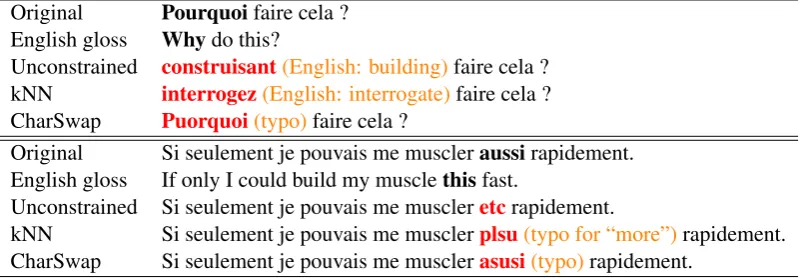
Original Pourquoifaire cela ? English gloss Whydo this?
Unconstrained construisant(English: building)faire cela ? kNN interrogez(English: interrogate)faire cela ? CharSwap Puorquoi(typo)faire cela ?
Original Si seulement je pouvais me muscleraussirapidement. English gloss If only I could build my musclethisfast.
Unconstrained Si seulement je pouvais me muscleretcrapidement.
[image:4.595.98.503.65.204.2]kNN Si seulement je pouvais me musclerplsu(typo for “more”)rapidement. CharSwap Si seulement je pouvais me musclerasusi(typo)rapidement.
Table 1: Examples of different adversarial inputs. The substituted word is highlighted.
3.1.1 General Approach
Precisely, for a word-based translation modelM6, and given an input sentencew1, . . . , wn, we find the positioni∗and wordw∗satisfying the follow-ing optimization problem:
arg max
1≤i≤n,wˆ∈V
Ladv(w0, . . . , wi−1,w, wˆ i+1, . . . , wn)
(2) whereLadvis a differentiable function which rep-resents our adversarial objective. Using the first order approximation of Ladv around the original word vectorsw1, . . . ,wn7, this can be derived to be equivalent to optimizing
arg max
1≤i≤n,wˆ∈V
[ ˆw−wi]|∇wiLadv (3)
The above optimization problem can be solved by brute-force in O(n|V|) space complexity, whereas the time complexity is bottlenecked by a |V| ×dtimesn×dmatrix multiplication, which is not more computationally expensive than comput-ing logits durcomput-ing the forward pass of the model. Overall, this naive approach is sufficiently fast to be conducive to adversarial training. We also found that the attacks benefited from normalizing the gradient by taking its sign.
Extending this approach to finding the optimal perturbations for more than 1 substitution would require exhaustively searching over all possible combinations. However, previous work (Ebrahimi
6Note that this formulation is also valid for character-based models (see Ebrahimi et al.(2018a)) and subword-based models. For subword-subword-based models, additional diffi-culty would be introduced due to changes to the input result-ing in different subword segmentations. This poses an inter-esting challenge that is beyond the scope of the current work. 7More generally we will use the bold w when talking about the embedding vector of wordw
et al.,2018a) suggests that greedy search is a good enough approximation.
3.1.2 The Adversarial LossLadv
We want to find an adversarial inputxˆsuch that, assuming that the model has produced the correct outputy1, . . . , yt−1up to stept−1during
decod-ing, the probability that the model makes an error at the next steptis maximized.
In the log-semiring, this translates into the fol-lowing loss function:
Ladv(ˆx, y) =
|y| X
t=1
log(1−p(yt|x, yˆ 1, . . . , yt−1))
(4)
3.2 Enforcing Semantically Similar Adversarial Inputs
In contrast to previous methods, which don’t con-sider meaning preservation, we propose simple modifications of the approach presented in§3.1to create adversarial perturbations at the word level that are more likely to preserve meaning. The ba-sic idea is to restrict the possible word substitu-tions to similar words. We compare two sets of constraints:
kNN:This constraint enforces that the word be replaced only with one of its 10 nearest neighbors in the source embedding space. This has two ef-fects: first, the replacement will be likely semanti-cally related to the original word (if words close in the embedding space are indeed semantically related, as hinted by Table1). Second, it ensures that the replacement’s word vector is close enough to the original word vector that the first order as-sumption is more likely to be satisfied.
characters. Word internal character swaps have been shown to not affect human readers greatly (McCusker et al.,1981), hence making them likely to be meaning-preserving. Moreover we add the additional constraint that the substitution must not be in the vocabulary, which will likely be partic-ularly meaning-destroying on the target side for the word-based models we test here. In such cases where word-internal character swaps are not pos-sible or can’t produce out-of-vocabulary (OOV) words, we resort to the naive strategy of repeat-ing the last character of the word. The exact pro-cedure used to produce this kind of perturbations is described in Appendix A.1. Note that for a word-based model, everyOOVwill look the same (a special <unk> token), however the choice of OOVwill still have an influence on the output of the model because we use unk-replacement.
In contrast, we refer the base attack without constraints as Unconstrainedhereforth. Table1 gives qualitative examples of the kind of perturba-tions generated under the different constraints.
For subword-based models, we apply the same procedures at the subword-level on the origi-nal segmentation. We then de-segment and re-segment the resulting sentence (because changes at the subword or character levels are likely to change the segmentation of the resulting sen-tence).
4 Experiments
Our experiments serve two purposes. First, we ex-amine our proposed framework of evaluating ad-versarial attacks (§2), and also elucidate which au-tomatic metrics correlate better with human judg-ment for the purpose of evaluating adversarial attacks (§4.2). Second, we use this evaluation framework to compare various adversarial attacks and demonstrate that adversarial attacks that are explicitly constrained to preserve meaning receive better assessment scores (§4.3).
4.1 Experimental setting
Data: Following previous work on adver-sarial examples for seq2seq models ( Be-linkov and Bisk, 2018; Ebrahimi et al., 2018a), we perform all experiments on the IWSLT2016 dataset (Cettolo et al., 2016) in the {French,German,Czech}→English directions (fr-en, de-en and cs-en). We compile all previous IWSLT test sets before 2015 as
validation data, and keep the 2015 and 2016 test sets as test data. The data is tokenized with the Moses tokenizer (Koehn et al., 2007). The exact data statistics can be found in AppendixA.2.
MT Models: We perform experiments with two common neural machine translation (NMT) models. The first is an LSTM based encoder-decoder architecture with attention (Luong et al., 2015). It uses 2-layer encoders and decoders, and dot-product attention. We set the word embedding dimension to 300 and all others to 500. The second model is a self-attentional Transformer (Vaswani et al., 2017), with 6 1024-dimensional encoder and decoder layers and 512 dimensional word embeddings. Both the models are trained with Adam (Kingma and Ba, 2014), dropout (Srivastava et al., 2014) of probability 0.3 and label smoothing (Szegedy et al.,2016) with value 0.1. We experiment with both word based models (vocabulary size fixed at 40k) and subword based models (BPE (Sennrich et al., 2016) with 30k operations). For word-based models, we perform <unk> replacement, replacing <unk>
tokens in the translated sentences with the source words with the highest attention value during inference. The full experimental setup and source code are available at https://github. com/pmichel31415/translate/tree/ paul/pytorch_translate/research/
adversarial/experiments.
Automatic Metric Implementations: To eval-uate both sentence and corpus level BLEU score, we first de-tokenize the output and use
sacreBLEU8(Post,2018) with its internalintl
tokenization, to keep BLEU scores agnostic to to-kenization. We compute METEOR using the of-ficial implementation9. ChrF is reported with the
sacreBLEUimplementation on detokenized text with default parameters. A toolkit implementing the evaluation framework described in §2.1 for these metrics is released athttps://github.
com/pmichel31415/teapot-nlp.
4.2 Correlation of Automatic Metrics with Human Judgment
We first examine which of the automatic metrics listed in §2.2 correlates most with human judg-ment for our adversarial attacks. For this exper-iment, we restrict the scope to the case of the
8
https://github.com/mjpost/sacreBLEU 9
LSTM Transformer
Language pair cs-en de-en fr-en cs-en de-en fr-en
Word-based
Target RDChrF Target RDChrF Original chrF 45.68 49.43 57.49 47.66 51.08 58.04 Unconstrained 25.38 25.54 25.59 25.24 25.00 24.68 CharSwap 24.11 24.94 23.60 21.59 23.23 21.75 kNN 15.00 15.59 15.22 20.74 19.97 18.59
Source chrF Source chrF Unconstrained 70.14 72.39 74.29 69.03 71.93 73.23 CharSwap 82.65 84.40 86.62 84.13 85.97 87.02 kNN 78.08 78.11 77.62 74.94 77.92 77.88
Subword-based
Target RDChrF Target RDChrF Original chrF 48.30 52.42 59.08 49.70 54.01 59.65 Unconstrained 25.79 26.03 26.96 23.97 25.07 25.28 CharSwap 18.65 19.15 19.75 16.98 18.38 17.85 kNN 15.00 16.26 17.12 19.02 18.58 18.63
[image:6.595.79.518.66.339.2]Source chrF Source chrF Unconstrained 69.32 72.12 73.57 68.66 71.51 72.65 CharSwap 85.84 87.46 87.98 85.79 87.07 87.99 kNN 76.17 77.74 78.03 73.05 75.91 76.54
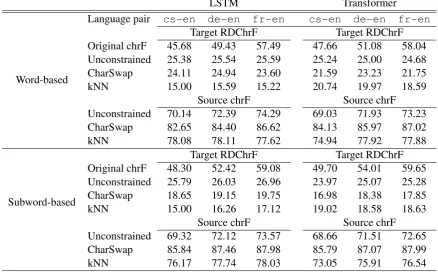
Table 2: Target RDchrF and source chrF scores for all the attacks on all our models (word- and subword-based LSTM and Transformer).
LSTM model onfr-en. For the French side, we randomly select 900 sentence pairs(x,xˆ)from the validation set, 300 for each of the Unconstrained, kNN and CharSwap constraints. To vary the level of perturbation, the 300 pairs contain an equal amount of perturbed input obtained by substituting 1, 2 and 3 words. On the English side, we select 900 pairs of reference translations and translations of adversarial input(y,yˆM)with the same distri-bution of attacks as the source side, as well as 300 (y, yM) pairs (to include translations from origi-nal inputs). This amounts to 1,200 sentence pairs in the target side.
These sentences are sent to English and French speaking annotators to be rated according to the guidelines described in §2.2.1. Each sample (a pair of sentences) is rated by two independent evaluators. If the two ratings differ, the sample is sent to a third rater (an auditor and subject matter expert) who makes the final decision.
Finally, we compare the human results to each automatic metric with Pearson’s correlation coeffi-cient. The correlations are reported in Table3. As evidenced by the results, chrF exhibits higher cor-relation with human judgment, followed by ME-TEOR and BLEU. This is true both on the source side (xvsxˆ) and in the target side (yvsyˆM). We
Language BLEU METEOR chrF French 0.415 0.440 0.586∗
English 0.357 0.478∗ 0.497
Table 3: Correlation of automatic metrics to human judgment of adversarial source and target sentences. “∗” indicates that the correlation is significantly better than the next-best one.
evaluate the statistical significance of this result using a paired bootstrap test for p < 0.01. No-tably we find that chrF is significantly better than METEOR in French but not in English. This is not too unexpected because METEOR has access to more language-dependent resources in English (specifically synonym information) and thereby can make more informed matches of these syn-onymous words and phrases. Moreover the French source side contains more “character-level” errors (from CharSwap attacks) which are not picked-up well by word-based metrics like BLEU and ME-TEOR. For a breakdown of the correlation coef-ficients according to number of perturbation and type of constraints, we refer to AppendixA.3.
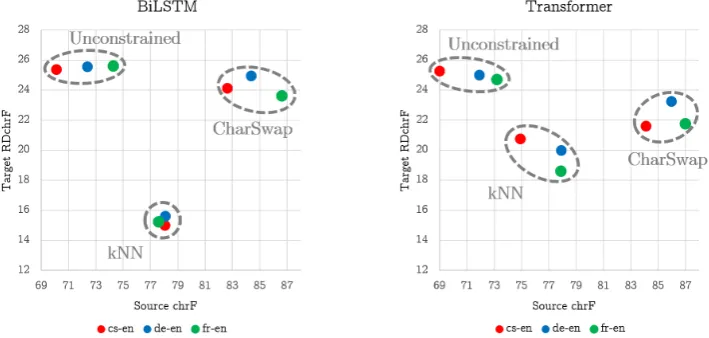
Figure 1: Graphical representation of the results in Table2for word-based models. High source chrF and target
RDchrF(upper-right corner) indicates a good attack.
4.3 Attack Results
We can now compare attacks under the three con-straints Unconstrained, kNN and CharSwap and draw conclusions on their capacity to preserve meaning in the source and destroy it in the tar-get. Attacks are conducted on the validation set using the approach described in§3.1 with 3 sub-stitutions (this means that each adversarial input is at edit distance at most 3 from the original input). Results (on a scale of 0 to 100 for readability) are reported in Table 2for both word- and subword-based LSTM and Transformer models. To give a better idea of how the different variables (language pair, model, attack) affect performance, we give a graphical representation of these same results in Figure1 for the word-based models. The rest of this section discusses the implication of these re-sults.
Source chrF Highlights the Effect of Adding Constraints: Comparing the kNN and CharSwap rows to Unconstrained in the “source” sections of Table2clearly shows that constrained attacks have a positive effect on meaning preservation. Beyond validating our assumptions from §3.2, this shows that source chrF is useful to carry out the compar-ison in the first place10. To give a point of refer-ence, results from the manual evaluation carried out in§4.2show that that90%of the French sen-tence pairs to which humans gave a score of 4 or 5 in semantic similarity have a chrF>78.
10
It can be argued that using chrF gives an advantage to CharSwap over kNN for source preservation (as opposed to METEOR for example). We find that this is the case for Czech and German (source METEOR is higher for kNN) but not French. Moreover we find (seeA.3) that chrF correlates better with human judgement even for kNN.
Successful attack
(source chrF= 80.89, targetRDchrF= 84.06) Original Ils le r´einvestissent directement en engageant
plus de proc`es.
Adv. src Ilssle r´einvestissentdierctementenengagaent plus de proc`es.
Ref. They plow it right back into filing more troll lawsuits.
Base output They direct it directly by engaging more cases. Adv. output .. de plus.
Unsuccessful attack
(source chrF= 54.46, targetRDchrF= 0.00) Original C’´etait en Juillet 1969.
Adv. src C’´etiatenJiullet1969. Ref. This is from July, 1969. Base output This was in July 1969. Adv. output This is. in 1969.
Table 4: Example of CharSwap attacks on thefr-en LSTM. The first example is a successful attack (high source chrF and targetRDchrF) whereas the second is not.
[image:7.595.306.526.284.461.2]Char-Swap constraint is the only one that consistently produces attacks with>1average success (as de-fined in Section2.1) according to Table2. Table4 contains two qualitative examples of this attack on the LSTM model infr-en.
5 Adversarial Training with Meaning-Preserving Attacks
5.1 Adversarial Training
Adversarial training (Goodfellow et al., 2014) augments the training data with adversarial exam-ples. Formally, in place of thenegative log likeli-hood (NLL)objective on a samplex, y,L(x, y) =
N LL(x, y), the loss function is replaced with an interpolation of the NLL of the original sample
x, yand an adversarial samplex, yˆ :
L0(x, y) = (1−α)N LL(x, y) +αN LL(ˆx, y) (5) Ebrahimi et al. (2018a) suggest that while ad-versarial training improves robustness to adversar-ial attacks, it can be detrimental to test perfor-mance on non-adversarial input. We investigate whether this is still the case when adversarial at-tacks are largely meaning-preserving.
In our experiments, we generate xˆby applying 3 perturbations on the fly at each training step. To maintain training speed we do not solve Equa-tion (2) iteratively but in one shot by replacing the argmax by top-3. Although this is less exact than iterating, this makes adversarial training time less than2×slower than normal training. We per-form adversarial training with perturbations with-out constraints (Unconstrained-adv) and with the CharSwap constraint (CharSwap-adv). All exper-iments are conducted with the word-based LSTM model.
5.2 Results
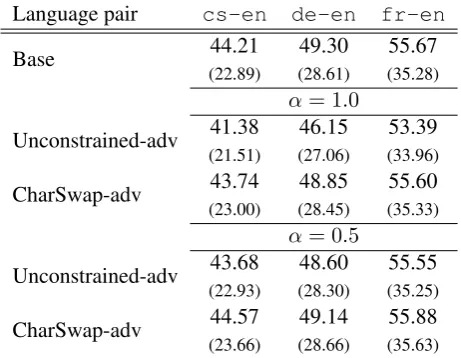
Test performance on non-adversarial input is re-ported in Table5. In keeping with the rest of the paper, we primarily report chrF results, but also show the standard BLEU as well.
We observe that whenα = 1.0,i.e.the model only sees the perturbed input during training11, the Unconstrained-adv model suffers a drop in test performance, whereas CharSwap-adv’s per-formance is on par with the original. This is likely
11This setting is reminiscent of word dropout (Iyyer et al.,
2015).
Language pair cs-en de-en fr-en
Base 44.21 49.30 55.67
(22.89) (28.61) (35.28)
α= 1.0
Unconstrained-adv 41.38 46.15 53.39
(21.51) (27.06) (33.96)
CharSwap-adv 43.74 48.85 55.60
(23.00) (28.45) (35.33)
α= 0.5
Unconstrained-adv 43.68 48.60 55.55
(22.93) (28.30) (35.25)
CharSwap-adv 44.57 49.14 55.88
[image:8.595.307.538.62.241.2](23.66) (28.66) (35.63)
Table 5: chrF (BLEU) scores on the original test set be-fore/after adversarial training of the word-based LSTM model.
Language pair cs-en de-en fr-en
Base 24.11 24.94 23.60
α= 1.0
Unconstrained-adv 25.99 26.24 25.67 CharSwap-adv 16.46 17.19 15.72
α= 0.5
Unconstrained-adv 26.52 27.26 24.92 CharSwap-adv 20.41 20.24 16.08
Table 6: Robustness to CharSwap attacks on the val-idation set with/without adversarial training (RDchrF). Lower is better.
attributable to the spurious training samples(ˆx, y) whereyis not an acceptable translation ofxˆ intro-duced by the lack of constraint. This effect disap-pears whenα = 0.5 because the model sees the original samples as well.
Not unexpectedly, Table 6 indicates that CharSwap-adv is more robust to CharSwap con-strained attacks for both values of α, with 1.0 giving the best results. On the other hand, Unconstrained-adv is similarly or more vulnera-ble to these attacks than the baseline. Hence, we can safely conclude that adversarial training with CharSwap attacks improves robustness while not impacting test performance as much as uncon-strained attacks.
6 Related work
Moosavi-Dezfooli et al., 2016) and defense (Ciss´e et al., 2017;Kolter and Wong, 2017) mechanisms have been proposed. Adversarial examples for NLP specifically have seen attacks on sentiment ( Pa-pernot et al., 2016; Samanta and Mehta, 2017; Ebrahimi et al., 2018b), malware (Grosse et al., 2016), gender (Reddy and Knight,2016) or toxi-city (Hosseini et al., 2017) classification to cite a few.
In MT, methods have been proposed to attack word-based (Zhao et al.,2018;Cheng et al.,2018) and character-based (Belinkov and Bisk, 2018; Ebrahimi et al., 2018a) models. However these works side-step the question of meaning preser-vation in the source: they mostly focus on tar-get side evaluation. Finally there is work centered around meaning-preserving adversarial attacks for NLPvia paraphrase generation (Iyyer et al.,2018) or rule-based approaches (Jia and Liang, 2017; Ribeiro et al., 2018; Naik et al., 2018; Alzantot et al., 2018). However the proposed attacks are highly engineered and focused on English.
7 Conclusion
This paper highlights the importance of perform-ing meaning-preserving adversarial perturbations for NLP models (with a focus on seq2seq). We proposed a general evaluation framework for ad-versarial perturbations and compared various au-tomatic metrics as proxies for human judgment to instantiate this framework. We then confirmed that, in the context ofMT, “naive” attacks do not preserve meaning in general, and proposed alter-natives to remedy this issue. Finally, we have shown the utility of adversarial training in this paradigm. We hope that this helps future work in this area of research to evaluate meaning conser-vation more consistently.
Acknowledgments
The authors would like to extend their thanks to members of the LATTE team at Facebook and Neulab at Carnegie Mellon University for valuable discussions, as well as the anonymous reviewers for their insightful feedback. This research was partially funded by Facebook.
References
Moustafa Alzantot, Yash Sharma, Ahmed Elgohary, Bo-Jhang Ho, Mani Srivastava, and Kai-Wei Chang.
2018. Generating natural language adversarial ex-amples. InProceedings of the 2018 Conference on Empirical Methods in Natural Language Process-ing, pages 2890–2896.
Yonatan Belinkov and Yonatan Bisk. 2018. Synthetic and natural noise both break neural machine transla-tion. InProceedings of the International Conference on Learning Representations (ICLR).
Mariusz Bojarski, Davide Del Testa, Daniel Dworakowski, Bernhard Firner, Beat Flepp, Prasoon Goyal, Lawrence D Jackel, Mathew Mon-fort, Urs Muller, Jiakai Zhang, et al. 2016. End to end learning for self-driving cars. arXiv preprint arXiv:1604.07316.
Daniel Cer, Mona Diab, Eneko Agirre, Inigo Lopez-Gazpio, and Lucia Specia. 2017. Semeval-2017 task 1: Semantic textual similarity multilingual and crosslingual focused evaluation. InProceedings of the 11th International Workshop on Semantic Eval-uation (SemEval-2017), pages 1–14.
Mauro Cettolo, Jan Niehues, Sebastian St¨uker, Luisa Bentivogli, Roldano Cattoni, and Marcello Federico. 2016. The iwslt 2016 evaluation campaign.
Minhao Cheng, Jinfeng Yi, Huan Zhang, Pin-Yu Chen, and Cho-Jui Hsieh. 2018. Seq2sick: Evaluat-ing the robustness of sequence-to-sequence mod-els with adversarial examples. arXiv preprint arXiv:1803.01128.
Moustapha Ciss´e, Piotr Bojanowski, Edouard Grave, Yann Dauphin, and Nicolas Usunier. 2017. Parse-val networks: Improving robustness to adversarial examples. InInternational Conference on Machine Learning.
Michael Denkowski and Alon Lavie. 2014. Meteor universal: Language specific translation evaluation for any target language. InProceedings of the EACL 2014 Workshop on Statistical Machine Translation.
Javid Ebrahimi, Daniel Lowd, and Dejing Dou. 2018a. On adversarial examples for character-level neural machine translation. InCOLING.
Javid Ebrahimi, Anyi Rao, Daniel Lowd, and Dejing Dou. 2018b. Hotflip: White-box adversarial exam-ples for text classification. In Proceedings of the 56th Annual Meeting of the Association for Compu-tational Linguistics (Volume 2: Short Papers), pages 31–36.
Ian J. Goodfellow, Jonathon Shlens, and Christian Szegedy. 2014. Explaining and harnessing adver-sarial examples. Proceedings of the International Conference on Learning Representations (ICLR).
Kathrin Grosse, Nicolas Papernot, Praveen Manoha-ran, Michael Backes, and Patrick McDaniel. 2016. Adversarial perturbations against deep neural net-works for malware classification. arXiv preprint arXiv:1606.04435.
Hossein Hosseini, Sreeram Kannan, Baosen Zhang, and Radha Poovendran. 2017. Deceiving google’s perspective api built for detecting toxic comments.
arXiv preprint arXiv:1702.08138.
Mohit Iyyer, Varun Manjunatha, Jordan Boyd-Graber, and Hal Daum´e III. 2015. Deep unordered compo-sition rivals syntactic methods for text classification. In Proceedings of the 53rd Annual Meeting of the Association for Computational Linguistics and the 7th International Joint Conference on Natural Lan-guage Processing (Volume 1: Long Papers), pages 1681–1691.
Mohit Iyyer, John Wieting, Kevin Gimpel, and Luke Zettlemoyer. 2018. Adversarial example generation with syntactically controlled paraphrase networks. InProceedings of the 2018 Conference of the North American Chapter of the Association for Computa-tional Linguistics: Human Language Technologies, Volume 1 (Long Papers), pages 1875–1885.
Robin Jia and Percy Liang. 2017. Adversarial exam-ples for evaluating reading comprehension systems. In Proceedings of the 2017 Conference on Empiri-cal Methods in Natural Language Processing, pages 2021–2031.
Diederik P. Kingma and Jimmy Ba. 2014. Adam: A method for stochastic optimization. InProceedings of the International Conference on Learning Repre-sentations (ICLR).
Philipp Koehn, Hieu Hoang, Alexandra Birch, Chris Callison-Burch, Marcello Federico, Nicola Bertoldi, Brooke Cowan, Wade Shen, Christine Moran, Richard Zens, Chris Dyer, Ondˇrej Bojar, Alexandra Constantin, and Evan Herbst. 2007. Moses: Open source toolkit for statistical machine translation. In
Proceedings of the 45th Annual Meeting of the ACL on Interactive Poster and Demonstration Sessions, ACL ’07, pages 177–180.
J. Zico Kolter and Eric Wong. 2017. Provable de-fenses against adversarial examples via the con-vex outer adversarial polytope. arXiv preprint arXiv:1711.00851.
Thang Luong, Hieu Pham, and Christopher D. Man-ning. 2015. Effective approaches to attention-based neural machine translation. In Proceedings of the 2015 Conference on Empirical Methods in Natural Language Processing, pages 1412–1421.
Xiaoyi Ma and Christopher Cieri. 2006. Corpus sup-port for machine translation at ldc. InLanguage Re-sources and Evaluation Conference.
Leo X McCusker, Philip B Gough, and Randolph G Bias. 1981. Word recognition inside out and out-side in. Journal of Experimental Psychology: Hu-man Perception and PerforHu-mance, 7(3):538.
Seyed-Mohsen Moosavi-Dezfooli, Alhussein Fawzi, and Pascal Frossard. 2016. Deepfool: A simple and accurate method to fool deep neural networks.2016 IEEE Conference on Computer Vision and Pattern Recognition (CVPR), pages 2574–2582.
Aakanksha Naik, Abhilasha Ravichander, Norman Sadeh, Carolyn Rose, and Graham Neubig. 2018. Stress test evaluation for natural language inference. InProceedings of the 27th International Conference on Computational Linguistics, pages 2340–2353.
Nicolas Papernot, Patrick McDaniel, Ananthram Swami, and Richard Harang. 2016. Crafting adver-sarial input sequences for recurrent neural networks. InMilitary Communications Conference, MILCOM 2016-2016 IEEE, pages 49–54. IEEE.
Kishore Papineni, Salim Roukos, Todd Ward, and Wei-Jing Zhu. 2002. Bleu: a method for automatic eval-uation of machine translation. In Proceedings of 40th Annual Meeting of the Association for Compu-tational Linguistics, pages 311–318.
Maja Popovi´c. 2015. chrf: character n-gram f-score for automatic mt evaluation. InProceedings of the Tenth Workshop on Statistical Machine Translation, pages 392–395.
Maja Popovi´c. 2016. chrf deconstructed: beta param-eters and n-gram weights. In Proceedings of the First Conference on Machine Translation: Volume 2, Shared Task Papers, pages 499–504.
Matt Post. 2018. A call for clarity in reporting bleu scores. arXiv preprint arXiv:1804.08771.
Sravana Reddy and Kevin Knight. 2016. Obfuscat-ing gender in social media writObfuscat-ing. InProceedings of the First Workshop on NLP and Computational Social Science. Association for Computational Lin-guistics.
Marco Tulio Ribeiro, Sameer Singh, and Carlos Guestrin. 2018. Semantically equivalent adversar-ial rules for debugging nlp models. In Proceed-ings of the 56th Annual Meeting of the Association for Computational Linguistics (Volume 1: Long Pa-pers), pages 856–865.
Suranjana Samanta and Sameep Mehta. 2017. Towards crafting text adversarial samples. arXiv preprint arXiv:1707.02812.
Nitish Srivastava, Geoffrey E Hinton, Alex Krizhevsky, Ilya Sutskever, and Ruslan Salakhutdinov. 2014. Dropout: a simple way to prevent neural networks from overfitting. Journal of Machine Learning Re-search (JMLR), 15(1):1929–1958.
Christian Szegedy, Vincent Vanhoucke, Sergey Ioffe, Jonathon Shlens, and Zbigniew Wojna. 2016. Re-thinking the inception architecture for computer vi-sion. 2016 IEEE Conference on Computer Vision and Pattern Recognition (CVPR), pages 2818–2826.
Christian Szegedy, Wojciech Zaremba, Ilya Sutskever, Joan Bruna, Dumitru Erhan, Ian J. Goodfellow, and Rob Fergus. 2013. Intriguing properties of neural networks. arXiv preprint arXiv:1312.6199.
Ashish Vaswani, Noam Shazeer, Niki Parmar, Jakob Uszkoreit, Llion Jones, Aidan N Gomez, Ł ukasz Kaiser, and Illia Polosukhin. 2017. Attention is all you need. InProceedings of the Annual Conference on Neural Information Processing Systems (NIPS), pages 5998–6008.
A Supplemental Material
A.1 GeneratingOOVReplacements with Internal Character Swaps
We use the following snippet to produce anOOV word from an existing word:
1 def make_oov(
2 word,
3 vocab,
4 max_scrambling, 5 ):
6 """Modify a word to make it OOV 7 (while keeping the meaning)"""
8 # If the word has >3 letters
9 # try scrambling them
10 L = len(word) 11 if L > 3:
12 # For a fixed number of steps
13 for _ in range(max_scrambling):
14 # Swap two adjacent letters
15 # in the middle of the word
16 pos = random.randint(1, L - 3)
17 word = word[:pos]
18 word += word[pos+1] + word[pos]
19 word += word[pos+2:]
20 # If we got an OOV already just
21 # return it
22 if word not in vocab:
23 return word
24 # If nothing worked, or the word is
25 # too short for scrambling, just
26 # repeat the last letter ad nauseam
27 char = word[-1] 28 while word in vocab:
29 word = word + char
30 return word
A.2 IWSLT2016 Dataset
See table 7 for statistics on the size of the IWSLT2016 corpus used in our experiments.
#train #valid #test
fr-en 220.4k 6,824 2,213
de-en 196.9k 11,825 2,213
cs-en 114.4k 5,716 2,213
Table 7: IWSLT2016 data statistics.
A.3 Breakdown of Correlation with Human Judgement
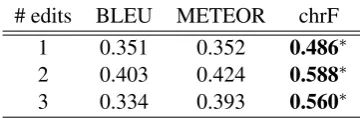
We provide a breakdown of the correlation co-efficients of automatic metrics with human judg-ment for source-side meaning-preservation, both in terms of number of perturbed words (Table 8) and constraint (Table9). While those coefficients are computed on a much smaller sample size, and their differences are not all statistically significant withp < 0.01, they exhibit the same trend as the results from Table3(BLEU<METEOR<chrF).
# edits BLEU METEOR chrF 1 0.351 0.352 0.486∗
2 0.403 0.424 0.588∗
[image:12.595.306.488.61.120.2]3 0.334 0.393 0.560∗
Table 8: Correlation of automatic metrics to human judgment of semantic similarity between original and adversarial source sentences, broken down by number of perturbed words. “∗” indicates that the correlation is significantly better than the next-best one.
Constraint BLEU METEOR chrF Unconstrained 0.274 0.572 0.599
CharSwap 0.274 0.319 0.383
kNN 0.534 0.584 0.606
Table 9: Correlation of automatic metrics to human judgment of semantic similarity between original and adversarial source sentences, broken down by type of constraint on the perturbation. “∗” indicates that the correlation is significantly better than the next-best one.
[image:12.595.67.291.145.447.2]