191
Question Answering Using Hierarchical Attention on Top of BERT
Features
Reham Osama, Nagwa El-Makky and Marwan Torki
Computer and Systems Engineering Department Alexandria University
Alexandria, Egypt
{eng-reham.osama, nagwamakky, mtorki}@alexu.edu.org
Abstract
Machine Comprehension (MC) tests the abil-ity of the machine to answer a question about a given passage. It requires modeling complex interactions between the passage and the ques-tion. Recently, attention mechanisms have been successfully extended to machine com-prehension. In this work, the question and pas-sage are encoded using BERT language em-beddings to better capture the respective repre-sentations at a semantic level. Then, attention and fusion are conducted horizontally and ver-tically across layers at different levels of gran-ularity between question and paragraph. Our experiments were performed on the datasets provided in MRQA shared task 20191
1 Introduction
The tasks of question answering (QA), especially machine comprehension have gained significant popularity over the past few years within the natu-ral language processing and computer vision com-munities. Systems trained end-to-end now achieve promising results on a variety of tasks in the text and image domains. The task of machine com-prehension is challenging as it requires a compre-hensive understanding of natural languages and the ability to do further inference and reasoning. Restricted by the limited volume of the annotated datasets, early studies mainly relied on a pipeline of NLP models to complete this task, such as se-mantic parsing and linguistic annotation. Bene-fiting from the availability of large datasets, e.g., SQuAD (Rajpurkar et al., 2016), rapid progress has been made recently.
There have been advancements in multiple vari-ations of the problem including visual question an-swering and video question anan-swering due to this fast improvement in QA models. Attention mech-anisms have a very significant role in increasing
1https://mrqa.github.io/shared
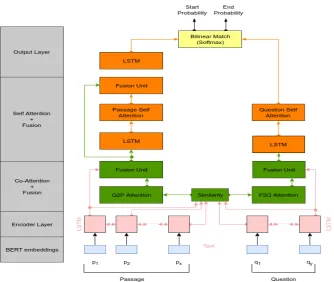
the performance of the models as they focus on the targeted area in the passage. In this paper we use BERT (Devlin et al.,2018) to obtain the rep-resentation of both the passage and question, then an encoder layer, which consists of recurrent neu-ral networks, is used to build representations for questions and passages, then a co-attention layer and fusion followed by a self-attention layer are used. Finally, an output layer is added to get the index of both the start and end of the answer.
The rapid progress that has been made recently was mainly due to the availability of SQuAD dataset benchmark. The work in (Wang and Jiang,
2016) was one of the first to investigate the dataset. The authors proposed an end-to-end architecture based on match-LSTM and pointer networks. (Seo et al., 2016) introduced the bi-directional atten-tion flow network which captures the quesatten-tion- question-document context at different levels of granular-ity. (Chen et al.,2017) introduced a bilinear match function and a few manual features. (Wang et al.,
2017) proposed a gated attention-based recurrent network where self-match attention mechanism is first incorporated. In (Liu et al.,2017) and (Shen et al.,2017) the multi-turn memory networks are designed to simulate multi-step reasoning in ma-chine reading comprehension.
trans-former as the goal is to generate a language model. BERT is considered a masked language model as the input to the BERT model is masked before entering the model. 15% of the words in each se-quence are replaced with a [MASK] token. The model then attempts to predict the original value of the masked words, based on the context provided by the other, non-masked, words in the sequence.
Due to the great effectiveness of the attention mechanism in the performance of the machine comprehension systems, we used two attention mechanisms in this work similar to (Wang et al.,
2018), where in addition to the co-attention mech-anism proposed in (Seo et al.,2016) we use a self attention for each of the paragraph and question. So, the output layer can use both of them while predicting the start and end index of the answer.
2 Architecture
The model used in this work was inspired by some of the components of (Devlin et al., 2018) and (Wang et al.,2018).
We chose the components from these 2 mod-els due to their effectiveness in solving the task of machine comprehension. So, we expected that merging the strong components from both models will achieve better results than each one of them individually.
The proposed architecture is explained in this section and is shown in Figure1.
2.1 Embedding Layer
For the input embeddings we used BERT pre-trained models (Devlin et al.,2018) which is based on word piece level tokenization. BERT has two models that have the same architecture with differ-ent sizes
1. BERT base: which consists of 12 transformer blocks, 12 attention heads, and 110 million parameters.
2. BERT large: which consists of 24 trans-former blocks, 16 attention heads and, 340 million parameters.
BERT can be used in two ways. The first way is to use it as a model and add a task-specific layer on top of it to produce the required output and train the model with the added layer. The second way is to use it as a pre-trained language model while either keeping the pre-trained weights as they are or training them with your model.
In this work we used a pre-trained BERT base model and we used the second way which is us-ing the pre-trained model with trainus-ing its weights along with the model. Using BERT large model is expected to yield better results when used. We didn’t use it in this work due to the limited re-sources we had, as the machine we had access to couldn’t run BERT large model in its memory.
2.2 Encoder layer
The goal of this layer of the model is to trans-form the discrete word tokens of question and pas-sage to a sequence of continuous vector represen-tations.
In this layer a Bi-LSTM network is used on top of the embeddings provided by the previous layer to model the temporal interactions between words.
2.3 Co-Attention Layer
This layer is similar to the co-attention layer used in (Seo et al.,2016). Given the question and pas-sage representation from the previous layer, a soft-alignment matrix is built to calculate the shallow semantic similarity between question and passage. We use this similarity matrix to compute the atten-tion between quesatten-tion and passage, which is fur-ther used to obtain the attended vectors in passage to question and question to passage direction, re-spectively.
The output here is a passage-aware question representation and a question-aware passage rep-resentation. The question-aware passage repre-sentation is calculated using the Passage to Ques-tion (P2Q) AttenQues-tion which signifies the quesQues-tion words that are most relevant to each passage word. The passage-aware question representation is cal-culated using Question to Passage (Q2P) Atten-tion which signifies the passage words that have the closest similarity to one of the question words and are hence critical for answering the question.
After calculating the aligned passage and ques-tion representaques-tion, a fusion unit is used to com-bine the original contextual representations and the corresponding attention vectors for question and passage.
Figure 1: Model Architecture
2.4 Self attention Layer
In this layer, we separately consider the represen-tations of question and passage, and further re-fine the obtained information from the co-attention layer. Since fusing information among context words allows contextual information to flow close to the correct answer, the self-attention layer is used to further align the question and passage rep-resentation against itself, so as to keep the global sequence information in memory.
The idea of benefiting from the advantage of self-alignment attention in addressing the long-distance dependence was taken from (Wang et al.,
2017). To allow for more freedom of the align-ing process, we used a bilinear self-alignment at-tention function on the passage representation, in-troduced in (Wang et al., 2018). We then fol-low this layer with another fusion unit that com-bines the question-aware passage representation with the passage self-aware representation. Then, a bidirectional LSTM is used to get the final con-textual passage representation.
As for question side we follow the question en-coding method used in (Chen et al., 2017) fol-lowed by linear transformation to encode the ques-tion representaques-tion to a single vector. First, an-other contextual bidirectional LSTM network is
applied on top of the fused question representa-tion Then we aggregate the resulting hidden units into one single question vector, with a linear self-alignment.
2.5 Output layer
Instead of predicting the start and end positions based only on the passage representation, a top-level bilinear match function is used to capture the semantic relation between question and passage representation from the previous layer in a match-ing style.
The top model layer uses a bilinear matching function to capture the interaction between outputs from previous layers and locate the right answer span.
The output layer is application-specific, in Ma-chine comprehension task, we use pointer net-works to predict the start and end position of the answer, since it requires the model to find a contin-uous span of the passage to answer the question.
3 Experiments
given datasets.
3.1 Datasets
In this work we used the datasets provided by the MRQA 2019 shared task. The training datasets in-cluded some benchmark datasets such as SQUAD and NewsQA. In-domain and out-of-domain de-velopment datasets are also included. Examples of the out-of-domain datasets are DROP and RACE. The datasets were adapted from several exist-ing datasets from their original formats and set-tings to conform to the unified extractive setting. The changes made to the datasets to conform to the new settings included:
1. Only a single, length-limited context is pro-vided.
2. There are no unanswerable or non-span an-swer questions.
3. All questions have at least one accepted an-swer that is found exactly in the context.
3.2 Evaluation metrics
Performance is measured via two metrics: Exact Match (EM) score and F1 score.
• Exact Match: is a binary measure (i.e.
true/false) of whether the system output matches the ground truth answer exactly. This is a considered a strict metric.
• F1: is a less strict metric. It is the harmonic mean of precision and recall.
A span is judged to be an exact match if it matches the answer string after performing normalization consistent with the SQuAD dataset. Specifically:
1. The text is uncased.
2. All punctuation is stripped.
3. All articles, e.g., a, an ,the, etc. are removed.
4. All consecutive whitespace markers are com-pressed to just a single normal space ’ ’.
3.3 Training details
We use the BertAdam optimizer, with a batch size of 6 and initial learning rate of 0.0003. A dropout rate of 0.2 is used for all LSTM layers. We take F1 score as reward with Cross Entropy Loss. We consider the BERT parameters trainable during the training process.
Dataset EM F1
BioASQ 43.02 59.09
DROP 24.38 34.78
DuoRC.ParaphraseRC 38.46 49.64
RACE 24.57 37.38
RelationExtraction 67.87 81.30
[image:4.595.326.508.61.161.2]TextbookQA 32.10 40.49
Table 1: Development Datasets Results.
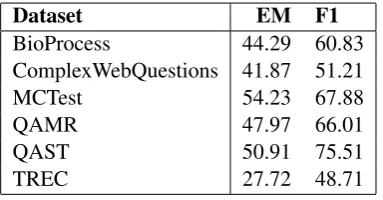
Dataset EM F1
BioProcess 44.29 60.83
ComplexWebQuestions 41.87 51.21
MCTest 54.23 67.88
QAMR 47.97 66.01
QAST 50.91 75.51
TREC 27.72 48.71
Table 2: Test Datasets Results.
The training process takes roughly 48 hours on a single Nvidia Tesla K80 GPU when training the whole provided training and validation datasets, and it takes roughly 12 hours when training a sam-ple size of 20000 instances from each of the train-ing datasets and a sample size of 2000 from each of the development datasets.
3.4 Results
The results of our model on all the development datasets are summarized in Table1and the results on all the test datasets are summarized in Table2. The proposed model achieved an average EM of 41.45 and an average F1 of 56.07 on all datasets (development and test sets combined).
The average F1 obtained for the development datasets is 50.45 and the average F1 obtained for the test datasets is 61.69
3.5 Other Experiments
Other experiments were performed either by changing the model parameters or by trying to add new componenets. But they didn’t achieve any in-crease in the performance of the model.
The following is a brief description of each of the tried experiments
[image:4.595.322.514.196.296.2]2. Adding CNN character level embeddings with different number of filters(64, 100). In this experiment, the input to the model was the concatenation of BERT embeddings and the character level embeddings. At first we used the settings in (Seo et al.,2016) but we couldn’t train the model due to the memory limitations.
When setting the BERT parameters to be trainable, we cannot add the character level embeddings. However, when we set the pa-rameters to be untrainable ,which causes a big decrease in the performance, the maxi-mum number of filters we could use was 100.
3. Adding L2 regularization.
We expected that adding the L2 regularizer will make the model achieve better results on the validation and not seen datasets but this didn’t happen.
4. Using Adamax optimizer instead of
BertAdam.
In this experiment, we used Adamax opti-mizer instead of the BertAdam optiopti-mizer but we didn’t achieve better performance.
4 Conclusion
In this work, we described our machine com-prehension system which was designed for the MRQA 2019 Shared Task. When supplied a ques-tion and a passage it makes use of the BERT embedding along with the hierarchical attention model which consists of 2 parts, the co-attention and the self-attention, to locate a continuous span of the passage that is the answer to the question.
The proposed model achieved an average EM of 41.45 and an average F1 of 56.07. After ana-lyzing our results, we have identified many ways for improving the system in the future. For in-stance, other features can be added to the passage and question representations such as adding char-acter embeddings with BERT embeddings. Part-Of-Speech (POS) and Named Entity Recognition (NER) features can also be added in the self-attention layer to better capture the information in the passage.
Another way that will probably increase the per-formance is using the proposed model with the BERT large model to produce the embeddings in-stead of BERT base in case there are more re-sources available.
References
Danqi Chen, Adam Fisch, Jason Weston, and An-toine Bordes. 2017. Reading wikipedia to an-swer open-domain questions. arXiv preprint arXiv:1704.00051.
Jacob Devlin, Ming-Wei Chang, Kenton Lee, and Kristina Toutanova. 2018. Bert: Pre-training of deep bidirectional transformers for language understand-ing.arXiv preprint arXiv:1810.04805.
Rui Liu, Wei Wei, Weiguang Mao, and Maria Chik-ina. 2017. Phase conductor on multi-layered atten-tions for machine comprehension. arXiv preprint arXiv:1710.10504.
Pranav Rajpurkar, Jian Zhang, Konstantin Lopyrev, and Percy Liang. 2016. Squad: 100,000+ questions for machine comprehension of text. arXiv preprint arXiv:1606.05250.
Minjoon Seo, Aniruddha Kembhavi, Ali Farhadi, and Hannaneh Hajishirzi. 2016. Bidirectional attention flow for machine comprehension. arXiv preprint arXiv:1611.01603.
Yelong Shen, Po-Sen Huang, Jianfeng Gao, and Weizhu Chen. 2017. Reasonet: Learning to stop reading in machine comprehension. InProceedings of the 23rd ACM SIGKDD International Conference on Knowledge Discovery and Data Mining, pages 1047–1055. ACM.
Ashish Vaswani, Noam Shazeer, Niki Parmar, Jakob Uszkoreit, Llion Jones, Aidan N Gomez, Łukasz Kaiser, and Illia Polosukhin. 2017. Attention is all you need. InAdvances in neural information pro-cessing systems, pages 5998–6008.
Shuohang Wang and Jing Jiang. 2016. Machine com-prehension using match-lstm and answer pointer.
arXiv preprint arXiv:1608.07905.
Wei Wang, Ming Yan, and Chen Wu. 2018. Multi-granularity hierarchical attention fusion networks for reading comprehension and question answering.
arXiv preprint arXiv:1811.11934.