Proceedings of the 2019 Conference on Empirical Methods in Natural Language Processing
5679
Aspect-Level Sentiment Analysis Via Convolution over Dependency Tree
Kai Sun BDBC and SKLSDE Beihang University,China
Richong Zhang∗ BDBC and SKLSDE Beihang University, China
Samuel Mensah BDBC and SKLSDE Beihang University, China
Yongyi Mao School of EECS University of Ottawa,Canada
Xudong Liu BDBC and SKLSDE
Beihang University, Beijing, China [email protected]
Abstract
We propose a method based on neural net-works to identify the sentiment polarity of opinion words expressed on a specific aspect of a sentence. Although a large majority of works typically focus on leveraging the ex-pressive power of neural networks in handling this task, we explore the possibility of inte-grating dependency trees with neural networks for representation learning. To this end, we present a convolution over a dependency tree (CDT) model which exploits a Bi-directional Long Short Term Memory (Bi-LSTM) to learn representations for features of a sentence, and further enhance the embeddings with a graph convolutional network (GCN) which operates directly on the dependency tree of the sen-tence. Our approach propagates both contex-tual and dependency information from opin-ion words to aspect words, offering discrimi-native properties for supervision. Experimen-tal results ranks our approach as the new state-of-the-art in aspect-based sentiment classifica-tion.
1 Introduction
The current explosion in digital technology in re-cent years has led to a vast amount of opinion-ated materials on the internet. In particular, in-dividuals have expressed opinions on several as-pects of products, services, blogs, and comments which are deemed to be influential, especially when making purchase decisions based on prod-uct reviews (Schouten and Frasincar,2015). How-ever, due to the voluminous amount of content on-line, sifting through reviews to learn knowledge of opinions expressed on specific aspects of a re-view is cumbersome. This fact has led to an in-crease in research in aspect-based sentiment anal-ysis (ABSA), which aims to find scalable solu-tions to address the problem automatically. More
∗
Corresponding author
specifically, ABSA involves two tasks: (1) to iden-tify aspects of a sentence, and (2) to determine the sentiment polarity (e.g. positive, negative, neutral) expressed on a specific aspect. In this paper, we focus on the second task: aspect-based sentiment classification.
We ordered the special grilled branzino , that was so infused with bone, it was difficult to eat.
TO NN
VBD DT JJ WDT VBD RBVBN IN NN PRPVBD JJ VB
PRP JJ TO
We ordered the specialgrilled branzino, that was so infused with bone, it wasdifficultto eat
Figure 1: An example of a dependency tree where an opinion word (blue) and the specific aspect expression (red) are connected with other word tokens based on their syntactic dependencies.
With the aim to address the classification task, several methods have been developed. Majority of recent works such as (Dong et al.,2014;Tang et al.,2015;Wang et al.,2016;Chen et al.,2017;
Cheng et al.,2017) have exploited neural networks due to its ability to model representations for sen-tences automatically. Even so, some recent meth-ods have integrated both lexical resources with neural networks to achieve state-of-the-art perfor-mance in ABSA (Wang et al.,2018;Ouyang and Su,2018).
trees have graph-like structures bringing to play the recent class of neural networks, namely, graph convolutional networks (GCN) (Kipf and Welling,
2016). The GCN has been successful in learning representations for nodes, capturing the local posi-tion of nodes in the graph. Several AI applicaposi-tions such as link prediction (Schlichtkrull et al.,2018;
Zitnik et al., 2018; Kong et al., 2019), semantic role labeling (Marcheggiani and Titov,2017), and relation extraction (Zhang et al.,2018) have suc-cessfully exploited GCNs to improve representa-tion learning.
These observations motivate us to develop a neural model which can operate on the depen-dency tree of a sentence, with the aim to make accurate sentiment predictions with respect to spe-cific aspects. Spespe-cifically, we propose a convolu-tion over a dependency tree (CDT) model which exploits a GCN to model the structure of a sen-tence through its dependency tree, where node (word) embeddings of the tree are initialized by means of a Bi-directional Long Short Term Mem-ory (Bi-LSTM) network. Motivated by the re-cent work of (Zhang et al., 2018) in a relation extraction task, we find that the architecture of CDT allows the Bi-LSTM account for contextual information between successive words, while the GCN enhances the embeddings by modeling the dependencies along the syntactic paths of the de-pendency tree. Such operations allow informa-tion to be transferred from opinion words to as-pect words, implying that the encoding for asas-pect words is sufficient for supervision in the classifi-cation task. Experimental results, including visu-alizations show the effectiveness of our proposed model.
2 Related Work
The performance bottleneck in the classification task of ABSA comes from modeling represen-tations which efficiently encode the relationship between a specific aspect and the opinion words of a sentence. Most recent methods have fo-cused on leveraging neural networks (Chen et al.,
2017;Gu et al.,2018;Majumder et al.,2018;Fan et al.,2018a;Xue and Li,2018;Huang and Carley,
2018;Zheng and Xia, 2018) which model repre-sentations automatically. Besides, in contrast to rule-based methods (Hu and Liu, 2004; Popescu and Etzioni,2005;Ding et al.,2008;Popescu and Etzioni,2005), neural networks are more capable
of dealing with situations where opinion words are found in more complicated contexts.
Among neural network methods, some model the sentence representation using RNN variants such as LSTM and gated recurrent units (GRU). (Chen et al., 2017) handles the encoding of re-views using BiLSTM and attention networks. (Gu et al., 2018) improves the performance by con-sidering the position of the aspect words. Simi-larly, (Zheng and Xia,2018) use LSTMs to learn embeddings for the left context, right context and target phrase of sentences while considering the interactions between targets and contexts. ( Ma-jumder et al., 2018) on the other hand models the sentence representations using GRU and at-tention mechanisms. However convenient, these neural network based methods neglect informative resources such as dependency trees which is capa-ble of shortening the distance between aspect and opinion words, enabling dependency information to be preserved effectively in lengthy sentences.
The state-of-the-art methods for representation learning have integrated dependency trees with neural networks. (Tai et al.,2015) proposed a tree-structured LSTM: a generalized class of LSTMs which enables the learning of dependency infor-mation between words and phrases. (Mou et al.,
2015) exploit the short paths of dependency trees to learn representations of sentences using con-volutional neural networks, while preserving de-pendency information. Motivated by such works, (Gu et al., 2018) proposed a position encoding convolutional neural network which takes into ac-count the relative position of words and entities of a dependency tree for relation classification. Given that dependency trees can be considered as a graph, (Marcheggiani and Titov,2017) intro-duced a variant of a GCN to model representations for dependency graphs in semantic role labeling tasks.
In a recent relation extraction task, (Zhang et al.,
vec-tors. We believe this is sufficient because the GCN componet can be interpreted as a messaging pass-ing network which propagates information along edges. Thus, successive GCN operations allow information to be propagated across the network, and hence aspect vectors are encoded with infor-mation from opinion words which should be suffi-cient for supervision.
3 Convolution over Dependency Tree Model
In this section, we describe the CDT model which takes as input a dependency tree of a sentence. Node embeddings of the dependency tree are ini-tially modeled by means of a BiLSTM, and the embeddings are further enhanced via a GCN. Fi-nally, an aggregator is applied over the enhanced aspect embeddings to distill a dense vector em-bedding for the classification task. In particular, we aim to extract embeddings which encode both contextual and dependency information between a specific aspect expression and opinion words, providing supervisory signals for the aspect-based classification task.
We briefly describe the BiLSTM model, which takes as input the sentenceswithnordered word embeddings. The BiLSTM integrates context in-formation in the word embeddings by keeping track of dependencies along the chain of words. Given an aspect-sentence pair (a, s), where a =
{a1, a2, . . . , al}is a sub-sequence of the sentence
s={w1, w2, . . . , wn}. The sentenceshas
corre-sponding word embeddingsx ={x1, x2, . . . xn}.
The LSTM learns hidden state representations
{−→h01,−→h02, . . .−h→0n} in the forward direction on the word embeddings inx. This allows contextual in-formation to be captured in a forward direction. In a similar fashion, a backward LSTM will learn representations{←h−01,←h−02, . . .←h−0n}onx. Finally, we can concatenate the corresponding parallel rep-resentations modeled by both forward and back-ward LSTMs into higher dimensional represen-tations{h01, h02, . . . , h0n}, which contains the sub-sequence{h0a1, h0a2, . . . , h0al}corresponding to the aspect expressiona. In doing so, we capture con-textual information between opinion words and as-pects. Besides, we integrate dependency infor-mation in the contextualized embeddings using a GCN which operates directly on the dependency tree of the sentence.
3.1 Graph Convolutional Network
The dependency tree can be interpreted as a graph
Gwithn nodes, where nodes represent words in the sentence and edges represent syntactic depen-dency paths between words in the graph. The nodes of the dependency tree are given by real-valued vectors modeled by BiLSTM as described above. This structure allows a GCN to operate di-rectly on the graph to model dependencies that ex-ist between words. To allow the GCN to model node embeddings efficiently, we allowGto have self-loops. The GCN approach ensures that the sentence structure represented by the dependency tree is encoded efficiently, whereby the represen-tations for nodes encode the local position of opin-ion words and the target words in the dependency tree.
The dependency tree G for any arbitrary sen-tence can be represented as an n×n adjacency matrix A, with entries Aij signaling if node iis
connected to nodejby a single dependency path in G. Specifically, Aij = 1 if node i is
con-nected to nodej, andAij = 0otherwise. Together
with node embeddings modeled by BiLSTMs, we can exploit a GCN capable of operating directly on graphs. The GCN makes efficient use of de-pendency paths to transform and propagate infor-mation across the paths, and update node embed-dings by aggregating the propagated information. In such an operation, the GCN only considers the first-order neighborhood of a node when model-ing its embeddmodel-ings. However,ksuccessive GCN operations result in the propagation of information across thek-th order neighborhood. A single node embedding update takes the form
h(k+1)i =φ
n
X
j=1
ciAij
W(k)h(k)j +b(k)
,
(1) whereh(k)j is the hidden state representation for nodejat thekth layer of the GCN,b(k) is a bias term,W(k) is a parameter matrix,ci is a normal-ization constant, which we choose asci = 1/di.
didenotes the degree of nodeiin the graph
calcu-lated asdi=Pnj=1Aij.φ(·)is a relu elementwise
non-linear activation function. Note that h0i rep-resent the initial embeddings modeled by a BiL-STM, andh(k+1)i is the final output for node iat layerk.
classifi-f
GCN
w1
w2
wa1
wa2
w5
Bi-LSTM Embedding Embedding
Word GCN
Embedding
Average Pool
Softmax
h0 1
h0 2
h0
a1
h0
a2
h0 5
hk1+1
hk2+1
hk+1
a1
hk+1
a2
hk+1 5
σ hk+1
a
[image:4.595.77.523.63.199.2]syntactic dependencies
Figure 2: Overview of the CDT model based on the sentences= [w1, w2, wa1, wa2, w5]
, where[wa1, wa2]is the specific aspect expression ins, andkis the number of GCN layers.
cation task, we exploit a simple aggregator. For our framework, we choose an average pool which aggregates information over the aspect vectors. We choose to aggregate only the aspect vectors because we believe that these vectors encode con-textual and dependency information owing to the BiLSTM and the GCN respectively. The BiLSTM and the GCN can be interpreted as message pass-ing networks. Specifically, the BiLSTM allow as-pect words of an arbitrary sentence to be contex-tualize, while the GCN finds the local position of aspect words in the syntactic dependency tree. The local position within the dependency tree encodes dependency information of a word with respect to its neighbors. As a result, the BiLSTM and the GCN allow embeddings for aspect words to have discriminative features, providing supervisory sig-nals for the classification task. Moreover, we per-form an average pool to retain most of the infor-mation in the aspect vectors. The pool operation over the aspect vectors takes the form of
h(k+1)a =f{hk+1a1 , hk+1a2 , . . . , hk+1al }, (2)
where f(·) is an average pool function applied over the enhanced aspect vectors. We present an overview of the model architecture in Figure 2
based on an example sentence input.
4 Model Training
The aspect-based representationh(k+1)a is passed
to a fully connected softmax layer σ whose out-put is a probability distribution over the different sentiment polarities. The model is trained end-to-end through a backpropagation, where the objec-tive function to be minimized is the cross entropy error defined as
J(θ1, θ2) =−
X
(a,s)∈D
X
c∈C
yc((a, s)) log ˆyc((a, s)),
(3) whereDis a collection of aspect-sentence pairs,
C is the collection of distinct sentiment classes,
yc((a, s)) is the ground truth for (a, s) which
takes the value of either 1 or 0. Besides, (a, s)
can belong to only one sentiment class. Hence
yc((a, s)) = 1indicates that the ground truth
sen-timent class for(a, s)isc.yˆc((a, s))is the model’s
prediction for(a, s). θ1, θ2 are trainable
parame-ters for the BiLSTM and GCN respectively.
5 Experiment
improves on a simple BiLSTM model.
5.1 Datasets
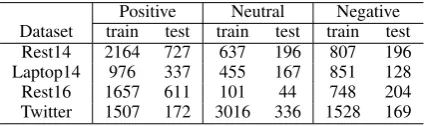
We evaluate the performance of our model on Se-mEval 2014 (Pontiki et al., 2014), which con-sists of restaurant reviews (Rest14) and laptop re-views (Laptop14). We also evaluate our model on SemEval 20161 containing restaurant reviews (Rest16). Experiments are also performed on a collection of tweets from Twitter provided in the works of (Dong et al.,2014). We summarize the statistics of the datasets in Table1.
Positive Neutral Negative Dataset train test train test train test
Rest14 2164 727 637 196 807 196
Laptop14 976 337 455 167 851 128
Rest16 1657 611 101 44 748 204
[image:5.595.75.288.232.295.2]Twitter 1507 172 3016 336 1528 169
Table 1: Distribution of samples by class labels on benchmark datasets
5.2 Implementation and parameter settings
For fairness in model comparation, we use similar parameters in compared models. Specifically, we exploit300-dimensional Glove vectors ( Penning-ton et al.,2014) for the word embeddings, as well as a 30-dimensional part-of-speech (POS) em-beddings, 30-dimensional position embeddings, which is used to identify the relative position of each word with respect to the aspect in the sen-tence. We concatenate both word, POS and posi-tion embeddings, and learn a50-dimensional BiL-STM embeddings for each word. The GCN op-erates on the dependency tree of the sentence to enhance the BiLSTM embeddings. All sentences are parsed by the Stanford parser.2 To encourage the GCN to model dependencies between words, we randomly dropout 10% of neurons per layer, and about0.7at the input layer. The GCN model is trained for100epochs with batch size32. We use the adam optimizer with learning rate0.01for all datasets. The code for our model is found on the Github page3.
5.3 Compared Prior Art
As a baseline, we include CNN and LSTM models, which learn representations from both
1
http://alt.qcri.org/semeval2016/ task5/
2
https://stanfordnlp.github.io/ CoreNLP/
3https://github.com/sunkaikai/CDT_ABSA
word embeddings and position embeddings. We denote these models as CNN+Position and LSTM+Position. We also include a CNN baseline method which exploits an attention mechanism to model the relation between aspect words and con-text words. We denote this model as CNN+ATT. These models extract a final embedding by ag-gregating all learned embeddings using an aver-age pool. In particular, we compare our proposed model with very recent models on the benchmark datasets. The models we consider include,
• TNet (Li et al., 2018a): In this work, BiLSTM embeddings are transformed into target-specific embeddings, and a CNN model is used to extract a final embedding.
• PRET+MULT (He et al., 2018b): A multi-task framework based on LSTMs is proposed to transfer knowledge from a document-level model task to an aspect-level model task.
• SA-LSTM-P (Wang and Lu, 2018): This work first learn embeddings using BiLSTM and model structural dependencies between words by means of a segmentation attention mechanism.
• LSTM+SynATT+TarRep (He et al., 2018a): This method models target representation as a weighted sum of aspect embeddings, and models the syntactic structure of the sentence using an attention mechanism.
• MGAN (Fan et al.,2018b): A BiLSTM is ex-ploited to capture contextual information in the sentence, while a multi-grained attention mechanism is proposed to extract an embed-ding which effectively captures the interac-tion between the aspect and the context.
• MGAN (Li et al., 2018b): This work inte-grates an alignment mechanism in a multi-task model comprising of an aspect-term multi-task and an aspect-category task to effectively ex-tract aspect-specific representations.
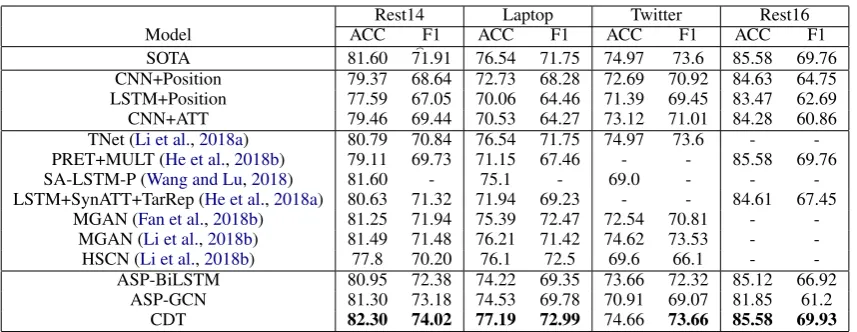
Rest14 Laptop Twitter Rest16
Model ACC F1 ACC F1 ACC F1 ACC F1
SOTA 81.60 71.91 76.54 71.75 74.97 73.6 85.58 69.76
CNN+Position 79.37 68.64 72.73 68.28 72.69 70.92 84.63 64.75
LSTM+Position 77.59 67.05 70.06 64.46 71.39 69.45 83.47 62.69
CNN+ATT 79.46 69.44 70.53 64.27 73.12 71.01 84.28 60.86
TNet (Li et al.,2018a) 80.79 70.84 76.54 71.75 74.97 73.6 - -PRET+MULT (He et al.,2018b) 79.11 69.73 71.15 67.46 - - 85.58 69.76
SA-LSTM-P (Wang and Lu,2018) 81.60 - 75.1 - 69.0 - -
-LSTM+SynATT+TarRep (He et al.,2018a) 80.63 71.32 71.94 69.23 - - 84.61 67.45 MGAN (Fan et al.,2018b) 81.25 71.94 75.39 72.47 72.54 70.81 -
-MGAN (Li et al.,2018b) 81.49 71.48 76.21 71.42 74.62 73.53 -
-HSCN (Li et al.,2018b) 77.8 70.20 76.1 72.5 69.6 66.1 -
-ASP-BiLSTM 80.95 72.38 74.22 69.35 73.66 72.32 85.12 66.92
ASP-GCN 81.30 73.18 74.53 69.78 70.91 69.07 81.85 61.2
[image:6.595.86.515.60.226.2]CDT 82.30 74.02 77.19 72.99 74.66 73.66 85.58 69.93
Table 2: Performance comparison on different models on the benchmark datasets. The best performance are bold-typed.
5.4 Performance Comparison
In this section, we compare model performance of recent methods with CDT, ASP-BiLSTM and ASP-GCN. We implement and report re-sults for the baseline methods CNN+Position, LSTM+Position and CNN+ATT, and report the re-sults in the original paper for the recent models under comparison. The classification results are shown in Table2.
From the table, we find that CDT generally ouperforms all models for the different datasets, while having a slight accuracy performance degra-dation of0.31on the twitter dataset for the TNet model. The difference between TNet and CDT is not really significant. Hence it is fair to conclude that both models are competitive on the Twitter dataset. Even with simple architectures, we find that ASP-BiLSTM and ASP-GCN have competi-tive performance with the recent models on bench-mark datasets. Particularly, ASP-GCN outper-forms the models on the Rest14 dataset.
ASP-BiLSTM, ASP-GCN and CDT extract fi-nal representations from only the aspect vectors. Based on the performance, it seems as a suffi-cient technique for the classification task. We be-lieve that the aspect vector is encoded with con-text and dependency information from the concon-text and structure of the sentence by means of the BiL-STM and the GCN. The BiLBiL-STM and GCN can be regarded as message passing networks, propa-gating information along a chain of sequence of words(BiLSTM) or along syntactic dependency path(GCN). Due to the fact that relevant informa-tion is passed to the aspect words, a simple average pool is all we need to retain information relevant
to the classification task. Note that the informa-tion propagated in the network is learned there-fore only weighed information is encoded within the aspect words.
5.5 GCN Performance
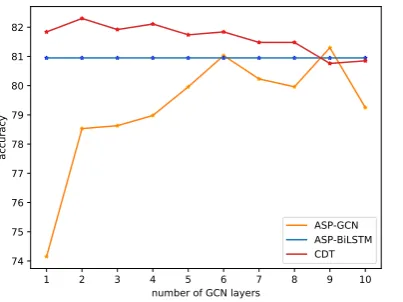
We conduct an experiment to demonstrate that the performance of our proposed models, namely CDT and ASP-GCN, depend on the number of layers of the GCN. We perform this experiment on the Rest14 dataset and present the result in Fig-ure4.
informa-(a) Case Example 1: aspect word is ‘Sangria’ (b) Case Example 2: aspect word is ‘LASAGNA’
Figure 3: Word relevance scores with respect to the final embedding of ASP-GCN. Number of layers for ASP-GCN is 1, 2, 3 for row 1, row 2, and row 3 respectively in both examples.
1 2 3 4 5 6 7 8 9 10
number of GCN layers 74
75 76 77 78 79 80 81 82
accuracy
ASP-GCN ASP-BiLSTM CDT
Figure 4: Accuracy curves for GCN, ASP-BiLSTM and CDT on the Rest14 dataset
tion in the contextualized embeddings to improve accuracy performance over just2layers, reducing the number of GCN layers needed.
5.6 Mask Experiment
Our primary assumption was that the aspect em-beddings learned by our GCN model contains suf-ficient information necessary for the classification task. Based on this assumption we aggregate only the aspect embeddings using a max pool with the aim to retain most of the information. To ver-ify this assumption, we trace from the input em-beddings to the final embedding. We propose a mask method designed to estimate the relevance of a word with respect to the final embedding, and perform mask experiments using ASP-GCN.
The mask method works as follows. First, we follow through the conventional procedure to ex-tract a final embeddinghsfor a given sentence s
using ASP-GCN. We perform a subsequent run of ASP-GCN on the same sentencesto extract a final embedding, but in this instance we conceal a spe-cific input wordw. We concealwby mapping it to the zero vector before applying ASP-GCN ons. As a result a final embeddingh(s\w) is generated
fors. Ifhs = h(s\w), the wordwhas no impact
on the representationhs. In other words,hsdoes
not capturew or no information flows fromw to
hs. To this end, we can define a score function to
estimate the relevance ofwonhs. We define the
score function forwas
γ(w, s) =m
d
X
i=1
|his−hi(s\w)| (4)
where d is the dimension of the final embed-ding distilled by ASP-GCN,mis a normalization constant which we choose as m = max
w∈s γ(w, s).
Generally, the final embedding should capture in-formation on opinion words with respect to the tar-get aspect. Hence, we expect to score high val-ues for opinion words. Consider the scores for words shown in Figure 3, we find that γ scores high values for opinion words as we increase the number of layers of ASP-GCN, while reducing scores on irrelevant words. Implying that the fi-nal embedding captures information from opin-ions. The results as seen in these case examples convinces us that the final embedding distilled by our model captures relevant information necessary for the classification task.
5.7 Case Study
In this section we study the behaviour of ASP-BiLSTM, TNet and CDT on case examples. To this end we present visualizations showing the at-tention these models place on words. For a good model, we expect the model to attend to words which influence the sentiment inferred on a spe-cific aspect.
[image:7.595.85.287.200.351.2]Figure 5: Attention visualization for ASP-BiLSTM (1st row), TNet(2nd row) and CDT (3rd row) for the aspect word ‘Sangria’
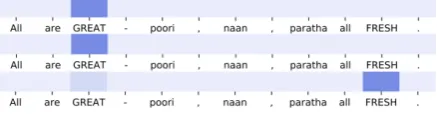
Figure 6: Attention visualization for ASP-BiLSTM (1st row), TNet (2nd row) and CDT (3rd row) for the aspect word ‘paratha’
in Figure5, ASP-BiLSTM was clever to know that the word ‘good’ is an opinion word with respect to the aspect ‘Sangria’. But ASP-BiLSTM failed to identify whether ‘good’ on the far left is asso-ciated to the ‘Sangria’ or ‘good’ on the far right is associated to ‘Sangria’. Interestingly, we find that the GCN could analyze this further through the dependencies between words to identify that it is the ‘good’ on the far right. TNet on the other hand measures the association between ‘Sangria’ and ‘good’ in both directions to identify the cor-rect ‘good’.
In Figure 6, even though the BiLSTM is able to identify the opinion word ‘GREAT’ which ex-presses an opinion on the aspect ‘parathra’, CDT is able to capture the opinion word ‘FRESH’ which directly expresses the sentiment towards the as-pect. However, from the visualization is eas-ily observed that CDT still attends to ‘GREAT’. This suggest that the GCN is able to model the importance of the words with respect to the as-pect, placing larger weights to words directly ex-pressing the opinion on the aspect. At the same time, TNet misses the opinion word ‘FRESH’ and places attention to the word ‘GREAT’ just like ASP-BiLSTM.
In the case example shown in Figure7, we find that ASP-BiLSTM places small attention on the opinion word ‘BEST’ which expresses the senti-ment on the aspect word ‘LASAGNA’, while fo-cusing its attention on ‘WAS PROBABLY’ which is not meaningful alone. Interestingly, CDT builds upon this little information and rely on the pendencies between the words through the
de-Figure 7: Attention visualization for ASP-BiLSTM (1st row), TNet (2nd row) and CDT (3rd row) for the aspect word ‘LASAGNA’
pendency tree to learn that ‘BEST’ is the correct word to attend to. Similar to ASP-BiLSTM, TNet misses the important word ‘BEST’ and places at-tention to ‘WAS PROBABLY’. This result suggest that TNet heavily depends on the representations modeled by its BiLSTM layer, while CDT con-siders other information such as the dependencies among words to accurately identify words which expresses opinions on specific aspects.
6 Conclusion
Modeling representations for aspect-based senti-ment classification generally require capturing formative words which express the sentiment in-ferred on the target aspect. Leveraging neural networks are highly desirable for representation learning. BiLSTM-based models have been suc-cessful to capture contextual information in prior works.
In this paper, we integrate a GCN with a simple BiLSTM model, with the aim to capture structural and contextual information of sentences. We have shown that the GCN successfully performs convo-lutions on the dependency tree to refine BiLSTM embeddings. Experimental results with visualiza-tions support our argument on the extraction of a final embedding based on only the aspect vectors. In fact, the model we propose is simple and out-performs more complex and recent models tack-ling the same problem.
Acknowledgment
[image:8.595.73.292.181.238.2]References
Peng Chen, Zhongqian Sun, Lidong Bing, and Wei Yang. 2017. Recurrent attention network on mem-ory for aspect sentiment analysis. InProceedings of the 2017 Conference on Empirical Methods in Nat-ural Language Processing, pages 452–461.
Jiajun Cheng, Shenglin Zhao, Jiani Zhang, Irwin King, Xin Zhang, and Hui Wang. 2017. Aspect-level sen-timent classification with heat (hierarchical atten-tion) network. In Proceedings of the 2017 ACM on Conference on Information and Knowledge Man-agement, pages 97–106.
Xiaowen Ding, Bing Liu, and Philip S. Yu. 2008. A holistic lexicon-based approach to opinion mining. InProceedings of the 2008 International Conference on Web Search and Data Mining, pages 231–240.
Li Dong, Furu Wei, Chuanqi Tan, Duyu Tang, Ming Zhou, and Ke Xu. 2014. Adaptive recursive neural network for target-dependent twitter sentiment clas-sification. InProceedings of the 52nd Annual Meet-ing of the Association for Computational LMeet-inguistics (Volume 2: Short Papers), volume 2, pages 49–54.
Feifan Fan, Yansong Feng, and Dongyan Zhao. 2018a. Multi-grained attention network for aspect-level sentiment classification. InProceedings of the 2018 Conference on Empirical Methods in Natural Lan-guage Processing, pages 3433–3442.
Feifan Fan, Yansong Feng, and Dongyan Zhao. 2018b. Multi-grained attention network for aspect-level sentiment classification. InProceedings of the 2018 Conference on Empirical Methods in Natural Language Processing, Brussels, Belgium, October 31 -November 4, 2018, pages 3433–3442.
Shuqin Gu, Lipeng Zhang, Yuexian Hou, and Yin Song. 2018. A position-aware bidirectional atten-tion network for aspect-level sentiment analysis. In Proceedings of the 27th International Conference on Computational Linguistics, pages 774–784.
Ruidan He, Wee Sun Lee, Hwee Tou Ng, and Daniel Dahlmeier. 2018a. Effective attention modeling for aspect-level sentiment classification. In Proceed-ings of the 27th International Conference on Com-putational Linguistics, COLING 2018, Santa Fe, New Mexico, USA, August 20-26, 2018, pages 1121– 1131.
Ruidan He, Wee Sun Lee, Hwee Tou Ng, and Daniel Dahlmeier. 2018b. Exploiting document knowledge for aspect-level sentiment classification. In Pro-ceedings of the 56th Annual Meeting of the Asso-ciation for Computational Linguistics, ACL 2018, Melbourne, Australia, July 15-20, 2018, Volume 2: Short Papers, pages 579–585.
Minqing Hu and Bing Liu. 2004. Mining and summa-rizing customer reviews. InProceedings of the tenth ACM SIGKDD international conference on Knowl-edge discovery and data mining, pages 168–177.
Binxuan Huang and Kathleen Carley. 2018. Parameter-ized convolutional neural networks for aspect level sentiment classification. InProceedings of the 2018 Conference on Empirical Methods in Natural Lan-guage Processing, pages 1091–1096.
Thomas N Kipf and Max Welling. 2016. Semi-supervised classification with graph convolutional networks. arXiv preprint arXiv:1609.02907.
Fanshuang Kong, Richong Zhang, Hongyu Guo, Samuel Mensah, Zhiyuan Hu, and Yongyi Mao. 2019. A neural bag-of-words modelling framework for link prediction in knowledge bases with sparse connectivity. InWWW 2019 : The Web Conference.
Zeyang Lei, Yujiu Yang, Min Yang, Wei Zhao, Jun Guo, and Yi Liu. 2019. A human-like semantic cog-nition network for aspect-level sentiment classifica-tion. AAAI.
Xin Li, Lidong Bing, Wai Lam, and Bei Shi. 2018a. Transformation networks for target-oriented senti-ment classification. InProceedings of the 56th An-nual Meeting of the Association for Computational Linguistics, ACL 2018, Melbourne, Australia, July 15-20, 2018, Volume 1: Long Papers, pages 946– 956.
Zheng Li, Ying Wei, Yu Zhang, Xiang Zhang, Xin Li, and Qiang Yang. 2018b. Exploiting coarse-to-fine task transfer for aspect-level sentiment classifi-cation. CoRR, abs/1811.10999.
Navonil Majumder, Soujanya Poria, Alexander Gel-bukh, Md Shad Akhtar, Erik Cambria, and Asif Ek-bal. 2018. Iarm: Inter-aspect relation modeling with memory networks in aspect-based sentiment analy-sis. InProceedings of the 2018 Conference on Em-pirical Methods in Natural Language Processing, pages 3402–3411.
Diego Marcheggiani and Ivan Titov. 2017. En-coding sentences with graph convolutional net-works for semantic role labeling. arXiv preprint arXiv:1703.04826.
Lili Mou, Hao Peng, Ge Li, Yan Xu, Lu Zhang, and Zhi Jin. 2015. Discriminative neural sentence mod-eling by tree-based convolution. arXiv preprint arXiv:1504.01106.
Zhifan Ouyang and Jindian Su. 2018. Dependency parsing and attention network for aspect-level sen-timent classification. InCCF International Confer-ence on Natural Language Processing and Chinese Computing, pages 391–403.
Maria Pontiki, Dimitris Galanis, John Pavlopoulos, Harris Papageorgiou, Ion Androutsopoulos, and Suresh Manandhar. 2014. Semeval-2014 task 4: As-pect based sentiment analysis. InProceedings of the 8th International Workshop on Semantic Evaluation (SemEval 2014), pages 27–35.
Ana Maria Popescu and Orena Etzioni. 2005. Extract-ing product features and opinions from reviews. In Proceedings of Human Language Technology Con-ference and ConCon-ference on Empirical Methods in Natural Language Processing, pages 339–346.
Michael Schlichtkrull, Thomas N Kipf, Peter Bloem, Rianne Van Den Berg, Ivan Titov, and Max Welling. 2018. Modeling relational data with graph convolu-tional networks. InEuropean Semantic Web Confer-ence, pages 593–607. Springer.
Kim Schouten and Flavius Frasincar. 2015. Survey on aspect-level sentiment analysis. IEEE Transactions on Knowledge and Data Engineering, 28(3):813– 830.
Kai Sheng Tai, Richard Socher, and Christopher D Manning. 2015. Improved semantic representations from tree-structured long short-term memory net-works. arXiv preprint arXiv:1503.00075.
Duyu Tang, Bing Qin, and Ting Liu. 2015. Document modeling with gated recurrent neural network for sentiment classification. InProceedings of the 2015 Conference on Empirical Methods in Natural Lan-guage Processing, pages 1422–1432.
Bailin Wang and Wei Lu. 2018. Learning latent opin-ions for aspect-level sentiment classification. In Proceedings of the Thirty-Second AAAI Conference on Artificial Intelligence, (AAAI-18), the 30th inno-vative Applications of Artificial Intelligence (IAAI-18), and the 8th AAAI Symposium on Educational Advances in Artificial Intelligence (EAAI-18), New Orleans, Louisiana, USA, February 2-7, 2018, pages 5537–5544.
Yanyan Wang, Qun Chen, Xin Liu, Murtadha H. M. Ahmed, Zhanhuai Li, Wei Pan, and Hailong Liu. 2018. Senhint: A joint framework for aspect-level sentiment analysis by deep neural networks and lin-guistic hints. InWWW ’18 Companion Proceedings of the The Web Conference 2018, pages 207–210.
Yequan Wang, Minlie Huang, xiaoyan zhu, and Li Zhao. 2016. Attention-based lstm for aspect-level sentiment classification. InProceedings of the 2016 Conference on Empirical Methods in Natural Lan-guage Processing, pages 606–615.
Wei Xue and Tao Li. 2018. Aspect based sentiment analysis with gated convolutional networks. arXiv preprint arXiv:1805.07043.
Yuhao Zhang, Peng Qi, and Christopher D. Manning. 2018. Graph convolution over pruned dependency trees improves relation extraction. empirical meth-ods in natural language processing, pages 2205– 2215.
Shiliang Zheng and Rui Xia. 2018. Left-center-right separated neural network for aspect-based sentiment analysis with rotatory attention. arXiv preprint arXiv:1802.00892.
![Figure 2: Overview of the CDT model based on the sentence s, where = [w1, w2, wa1, wa2, w5] [wa1, wa2] is the specific aspect expression in s, and k is the number of GCN layers.](https://thumb-us.123doks.com/thumbv2/123dok_us/1341649.665785/4.595.77.523.63.199/figure-overview-sentence-specic-aspect-expression-number-layers.webp)