University of Warwick institutional repository: http://go.warwick.ac.uk/wrap
A Thesis Submitted for the Degree of PhD at the University of Warwick
http://go.warwick.ac.uk/wrap/58689
This thesis is made available online and is protected by original copyright. Please scroll down to view the document itself.
A Case study of Team teaching and Team teachers
in Korean primary schools
Jaeyeon Heo
A thesis submitted in partial fulfilment of
the requirements for the degree of
Doctor of Philosophy in
English Language Teaching and Applied Linguistics
University of Warwick, Centre for Applied Linguistics
I
Table of Contents
TABLE OF CONTENTS I
LIST OF TABLES VI
LIST OF FIGURES VII
LIST OF PICTURES VII
ACKNOWLEDGEMENTS VIII
DECLARATION IX
ABSTRACT X
ABBREVIATIONS XI
CHAPTER ONE: INTRODUCTION 1
1.1 My motivation for the study 2
1.2 Research background and aim 4
1.3 Research focus and research questions 6
1.4 Brief outline of research context 8
1.5 Chapter overview 8
CHAPTER TWO: THE KOREAN CONTEXT 10
2.1 English education in Korea 10
2.2 Educational policy for the subject of English 12
2.3 Primary English education in Korea 14
2.4 The EPIK (English Programme in Korea) scheme 15 2.4.1 Introduction of EPIK 16
2.4.2 Current status 22
CHAPTER THREE: LITERATURE REVIEW 26
3.1 Teacher collaboration 26
3.1.1 Teacher learning 27
3.1.2 Collegiality 28
3.1.3 Teaming 30
3.2 Team teaching 30
II
3.2.2 Definition and rationale 33
3.2.3 Language education 34
3.2.4 English language team teaching in EFL contexts 37
3.3 The NET schemes in East Asia 40
3.3.1 JET in Japan 40
3.3.2 NET in Hong Kong 44
3.3.3 FETIT in Taiwan 47
3.3.4 EPIK in Korea 49
3.3.5 Comparison of the four schemes 51
3.4 Discussion of team teachers’ interaction and relationship 53
3.4.1 Research dilemmas 53
3.4.2 Team teaching in context 54
3.4.3 Interaction between team teachers 56
3.4.4 Relationship between team teachers 62
3.4.4.1 Power 63
3.4.4.2 Role and responsibility 64
3.4.4.3 Distance-closeness 65
3.4.4.4 Face sensitiveness 66
3.4.5 Interrelation between interaction and relationship 66 3.4.6 Team teaching as team learning in a social context 67
3.5 Summary 69
CHAPTER FOUR: RESEARCH METHODOLOGY 71
4.1 Qualitative case study 71
4.1.1 Paradigmatic stance 71
4.1.2 Definition and rationale 73
4.1.3 Main characteristics of case study 76
4.1.4 Type of case study 78
4.1.5 Validity and reliability 80
4.2 Research methods 82
4.2.1 Interviews 82
III
4.2.3 Document analysis 93
4.2.4 Research journal 94 4.2.5 Ethical issues 95
4.3 Research process and fieldwork 99
4.3.1 Fieldwork procedures 99 4.3.2 Preliminary work 100
4.3.3 Piloting 102
4.3.4 Sampling 106
4.4 Data analysis 108
4.4.1 Transcription and translation 108
4.4.2 Codification and categorisation 109
4.4.3 Narrative analysis 112
4.4.4 Classroom interaction 112
4.4.5 Critical incident 115
4.5 Summary 116
CHAPTER FIVE: FOUR NARRATIVES OF TEAM TEACHERS AND THEIR CONTEXTS 117 5.1 Case One 121
5.1.1 Jessica 122
5.1.2 Matthew 126
5.1.3 Contextual conditions and their team teaching 129
5.2 Case Two 137
5.2.1 Mary 138
5.2.2 James 142
5.2.3 Contextual conditionsand their team teaching 143
5.3 Case Three 152
5.3.1 Rona 153
5.3.2 Kevin 156
5.3.3 Contextual conditionsand their team teaching 158
5.4 Case Four 164
5.4.1 Kate 165
IV
5.4.3 Contextual conditionsand their team teaching 168
5.5 Summary 174
CHAPTER SIX: TEAM TEACHERS’ INTERACTIONAL RELATIONSHIP 175
6.1 Collaborative presentation: modeling and role-play 177
6.2 Division of labour: different skills and content roles 188
6.3 Language in the classroom: L1 and L2 198
6.4 Complementary support: classroom management and discipline 206
6.5 Flexibility: decision-making and intervention 217
6.6 Partnership: teacher-to-teacher talk 227
6.7 Conclusion 236
CHAPTER SEVEN: FACTORS UNDERLYING TEAM TEACHERS’ INTERACTIONAL RELATIONSHIP 238
7.1 Professional (personal) factors 239
7.1.1 Professional motivation 240
7.1.1.1 Willingness and part willingness 241
7.1.1.2 Imposition and semi-imposition 243
7.1.2 Professional readiness 246
7.1.2.1 Previous (team) teaching experience 246
7.1.2.2 Educational and professional background 249
7.1.2.3 Language proficiency: English and Korean 251
7.2 Pedagogic (team) factors 255
7.2.1 Perspectives on teaching English 255
7.2.2 Role sharing and differentiated skills 260
7.2.3 Team strategy 269
7.3 Interpersonal factors 273
7.3.1 Personality 274
7.3.2 Problem/conflict solving 278
7.3.2.1 Misunderstanding 278
7.3.2.2 Discrepancy 280
7.3.2.3 Disagreement 283
V
7.3.3.1 Professional power 286
7.3.3.2 Linguistic power 288
7.3.3.3 Contextual power 290
7.4 Conclusion 292
CHAPTER EIGHT: EVALUATION AND CONCLUSIONS 293
8.1 Summary of main findings 293
8.1.1 Diversity in team teaching implementation 294
8.1.2 Team teaching experiences 295
8.1.2.1 Positive experiences 295
8.1.2.2 Challenging experiences 296
8.1.3 The nature of interactional relationship 298
8.1.3.1 Collaborative relationship in contrived collegiality 298
8.1.3.2 Inequality and power 299
8.1.3.3 Complementarity and interdependence 301
8.1.4 Key factors underlying interactional relationship 302
8.2 Contributions 304
8.3 Practical implications 307
8.3.1 Implications for the EPIK scheme 307
8.3.1.1 Recruitment of NETs 307
8.3.1.2 Teacher training: On-site orientation and in-service 310
8.3.2 Implications for schools 312
8.3.2.1 Mentoring 312
8.3.2.2 Team and collaborative reflection 314
8.3.3 Implications for team teachers 315
8.3.3.1 Team strategy 315
8.3.3.2 Relationship management 316
8.4 Limitations 317
8.5 Recommendations for further research 318
8.6 Concluding remarks 319
BIBLIOGRAPHY 322
VI
APPENDIX 1: Sample of Interview questions 344
APPENDIX 2: Sample of field note (Case One) 345
APPENDIX 3: Sample of Research Journal 346
APPENDIX 4: Letter (participant teachers) 348
APPENDIX 5: Informed Consent form (participants) 349
APPENDIX 6: EPIK Orientation Programme (August, 2010) 350
APPENDIX 7: Schedules of research fieldwork 351
APPENDIX 8: Example of category generation (team teaching implementation) 352 APPENDIX 9: Initial comments and memos 354
APPENDIX 10: Sample of categorisation and codification (Interview) 355
APPENDIX 11: Sample diagram of themes and categorisation 357
APPENDIX 12: Grouping thematic scripts 358
APPENDIX 13: Transcription conventions and abbreviations 359
LIST OF TABLES
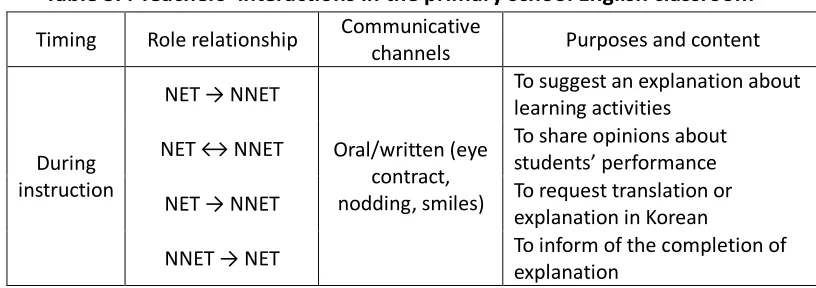
Table 3.1 The distinction between team teaching and co-teaching 32 Table 3.2 Comparing features of the four schemes 51 Table 3.3 Teachers’ interactions in and out of classes 59Table 3.4 Teachers’ interactions in the primary school English classroom 60 Table 4.1 Process of observation 90 Table 4.2 Summary of the procedures of research fieldwork 100
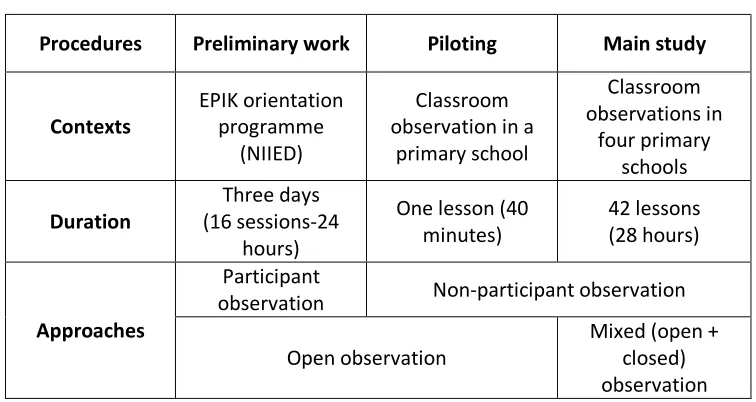
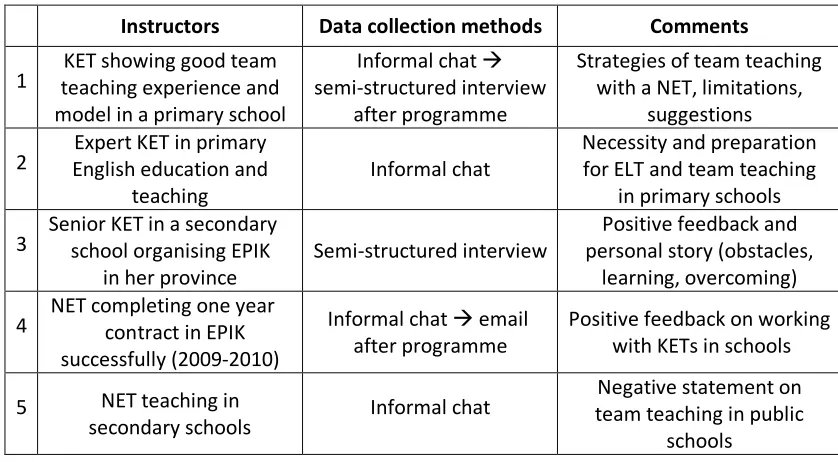
Table 4.3 Summary of data collection for preliminary work 101
Table 4.4 Summary of data collection in a piloting study 103
Table 4.5 Examples of codification and categorisation (interviews) 111
Table 4.6 Sample transcript of classroom interaction 112
Table 4.7 Examples of codification (classroom interaction) 114
Table 4.8 Themes and categories (interaction) 115
Table 5.1 Team Teachers in Four Cases 119
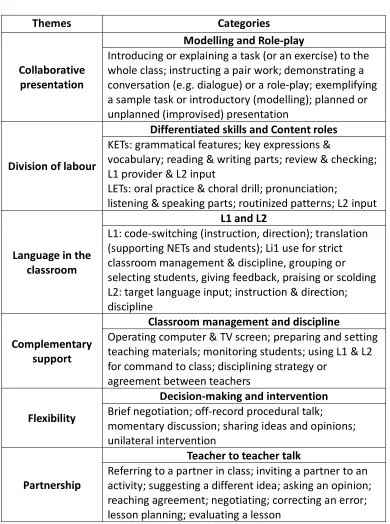
Table 6.1 Themes and categories 176
Table 7.1 Factors and Themes 239
VII
LIST OF FIGURES
Figure 2.1 Organisation (EPIK 2013) 17
Figure 2.2 Pay scale (EPIK 2013) 19
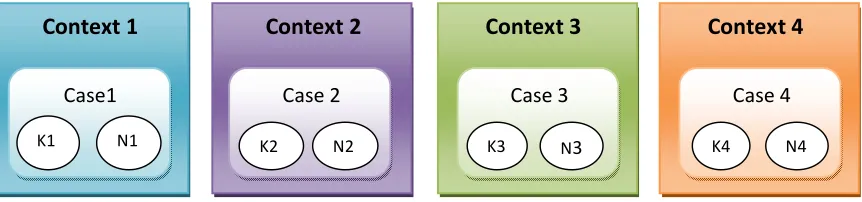
Figure 2.3 Provinces (NIIED 2013) 20 Figure 2.4 Sample of onsite orientation programme (NIIED 2013) 21 Figure 2.5 The number of schools where NETs were assigned (MEST 2010) 22 Figure 3.1 Strengths of team teaching between NETs and NNETs 39 Figure 4.1 Multiple embedded cases in the study 80 Figure 4.2 Interview stages in the study 84
LIST OF PICTURES
Picture 5.1 English Only Classroom (Case One) 130Picture 5.2 Subject Teachers’ Room 132
Picture 5.3 English Only Classroom (Case Two) 144
Picture 5.4 Arrangement of Mary and James’ desks 145
Picture 5.5 English Only Classroom (Case Three) 159
Picture 5.6 Arrangement of Rona and Kevin’s desks 160
Picture 5.7 Classroom (Case Four) 168
Picture 5.8 Subject teachers’ room 170
Picture 7.1 Team Instruction by Case One 261
Picture 7.2 Correction and Reward 262
Picture 7.3 Team Instruction by Case Two 264
Picture 7.4 Team Instruction by Case Three 265
Picture 7.5 Instruction by Case Four 268
Picture 7.6 Classroom management before a lesson 271
VIII
ACKNOWLEDGEMENTS
The LORD is my shepherd, I shall not be in want (Psalm 23:1).
From the bottom of my heart, indescribable thanks go to my sincere Lord who gives His countless grace and love to my life.
First and foremost, I should like to thank all teaching and administrative staff in the Centre for Applied Linguistics. Especially, I should like to express my deep gratitude to my supervisor, Dr. Steve Mann who has provided me with invaluable advice, guidance, support and encouragement throughout my PhD journey as a mentor, tutor and friend. I am also grateful to: Dr. Richard Smith, Dr. Keith Richards, Dr. Ema Ushioda, Dr. Annamaria Pinter, Prof. Helen Spencer-Oatey, Dr. Steve Walsh, Pat Chauhan, Maureen Tustin, and Elaine Roberts.
I would like to thank the authorities of the schools and National Institute of International Education and Development (NIIED) and Ministry of Education, Science and Technology (MEST). I owe my deepest gratitude to the participant teachers for their active participation and genuine commitment. This thesis would not have been possible without their invaluable help.
I am immensely grateful to my friends. Without their endless love and care, I would not have survived in times of trouble. My warm-hearted thanks go to all members of my small group in Jubilee Church and the bible study group and the colleagues in the CAL and friends in Korea, USA, Japan and Taiwan who have supported and prayed for me.
IX
DECLARATION
I declare that this thesis is entirely my own work and that it has not been submitted elsewhere for any other degree or professional qualification.
X
ABSTRACT
Team teaching has become widespread in Korean EFL classrooms through the nationwide implementation of the EPIK scheme, the government-sponsored ELT programme. Despite an ongoing process of policy changes in the EPIK scheme and English education, there has been little empirical research with a focus on team teachers and a lack of empirical data regarding classroom interaction where there is a ‘two teachers in one class’ model and this has not helped in the development of understanding or supporting team teaching.
This thesis reports on a case study in relation to the team teaching practised by four pairs of team teachers in four different South Korean primary schools. It provides a sophisticated data-led understanding of team teaching implementation and insights into its complexity through descriptive, narrative, reflective and discursive approaches to representation of the data. The full range of diverse interactions between team teachers makes it possible to explore the complex features of team teaching classrooms and to understand the multifaceted nature of the team-teaching relationships. In particular, the emphasis is put on the actual classroom discourse spoken by the team teachers, which fills gaps methodologically in terms of developing understanding of classroom interaction with a two-teachers-one-class model. The four pairs of team teachers have varying team teaching styles with different levels of collaboration and experiences in their contexts. The distinctive characteristics of their interactional relationships are documented through six themes: delivering collaborative presentation in team instruction; taking charge of different skills and content roles; using L1 and L2; providing complementary support; making decisions and intervention; and partnership talk. In addition, the interactional relationship between team teachers has multidimensional features in terms of power, equality, complementarity, interdependence, and collaboration in contrived collegiality. In addition, the key factors underlying their interactional relationships are identified as professional (personal), pedagogic (team), and interpersonal factors.
XI
LIST OF ABBREVIATIONS
ALT = Assistant Language Teacher (Japan) AET = Assistant English Teacher (Japan)
CLAIR = Council of Local Authorities for International Relations (Japan) CLT = Communicative Language Teaching
EFL = English as a Foreign Language ELT = English Language Teaching
EPIK = English Program in Korea (Korea)
FETIT = Foreign English Teachers in Taiwan project (Taiwan) GET = Guest English Teacher (Korea)
INSET = In-service Training
JET = Japan Exchange and Teaching Program (Japan)
JTE = Japanese Teacher of English (Japanese local English teacher) KET = Korean English Teacher
KNEC = Korean National Education Curriculum LET = Local English Teacher (Teachers in EFL contexts)
MEST = Ministry of Education, Science and Technology (Korea) NET = Native English Teacher
NET = Native-speaking English teachers scheme (Hong Kong)
NIIED = National Institute for International Education Development (Korea) NNET = Non-Native English Teacher
POE = Provincial (Metropolitan) Offices of Education SMOE =Seoul Metropolitan Office of Education (Korea) TETE = Teaching English Through English
1
CHAPTER ONE
Introduction
Along with rapid globalization and the emergence of English as an international
language, English language teaching in East Asian countries has gone through many
changes, challenges and paradigm shifts in terms of educational policy over the last
two decades (Jeon 2009; Jeon & Lee 2006; Nunan 2003). For instance, in several
East Asian countries such as Hong Kong, Japan, Korea and Taiwan, team teaching
practices have become widespread in EFL (English as a Foreign Language)
classrooms, where native and local English teachers work together. As a result,
great attention has been paid to the importation of foreign teachers from
English-speaking countries. Korea is not an exception in this trend, as it also has been
experiencing dynamic changes in English education such as the EPIK (English
Programme in Korea) scheme. Indeed, in Korean ELT, team teaching between a KET
(Korean English teacher) and a NET (native English speaking teacher) has been
implemented mainly through EPIK since 1995. In light of this trend for foreign
teachers of English in Korean schools and the use of team teaching on the EPIK
scheme, the present study aims at understanding the team teaching implemented
by KETs and NETs in Korean primary schools and at exploring team teachers’
interaction and relationship within this context.
In this chapter, I shall present my motivation for the study, the research
background and aims, the research focus and research questions, a brief outline of
2
1.1 My motivation for the study
My own interest in this study has come from my personal experiences of the
following: 1) being a team teacher in the academic institute where I previously
worked; 2) providing support for a new NET who was preparing for involvement in
the EPIK scheme; and 3) being a doctoral student in the Centre for Applied
Linguistics (CAL) at the University of Warwick. These experiences and their roles in
developing my interest in the study are detailed below.
While working in a private language institute in Korea in 1995, I was
involved in the recruitment of native English speaking teachers (henceforth NETs),
supporting them and team teaching with them for over two years. At that time, it
was a relatively rare, unfamiliar, and sometimes controversial approach in which
English was taught with a NET in the same classroom. Even though at that time
team teaching with NETs was considered an innovative and up-to-date method in a
Korean ELT context, there were manifold problems in co-working with NETs. As a
Korean team teacher, one of the most challenging issues I faced was that I did not
have any clear ideas about co-working or team teaching with someone who I had
never met before and, in particular, with someone who had to communicate in
English all the time. In addition, most of the NETs who I worked with at that time
were neither fully qualified nor skilful as English teachers. As a result, my institute
ceased recruiting NETs almost two and half years later and I found several institutes
had had similar difficulties or had experienced failures in recruiting, co-working, and
team teaching with NETs in their own contexts. Since then, I have not had any
opportunity to work with NETs in both public and private sectors. Even though I had
3
which weakened this negative impression occurred as a result of the following
experience. While doing my Master’s course in 2007 at the University of Bristol in
the UK, I met a British man who planned to get married with my close Korean friend,
and who was applying for a position as an English teacher on the EPIK scheme. As a
former Korean English teacher, I introduced him to basic information such as the
educational system, curriculum, cultural issues and current affairs (e.g. North-South
problems, presidential election, oil spill in the western sea) and taught survival
Korean language to him over seven months. In particular, I focused on some
challenges that NETs had commonly experienced from my previous experience: the
hierarchical culture in Korean schools, school regulations, expected attitude to
Korean colleagues, polite expressions and behaviours, and possible problems or
misunderstandings arising as a result of cultural differences. After this, he left for
Korea and since 2008 he has been satisfied with living in Korea, and teaching
students in schools as a NET. His interesting experience of the process he went
through to become a NET as well as his actual experiences of being a NET in Korea
aroused my curiosity.
Finally, an important trigger for my interest in this research focus was my
experience as a learner and observer when I attended several modules conducted
and organised by two tutors in the Centre for Applied Linguistics (CAL) at the
University of Warwick. While participating in each session, I witnessed and
experienced exactly how co-teaching could take place harmoniously and effectively
between two tutors. The modules implemented by the two tutors stimulated me to
generate a more positive regard for team teaching and inspired me with potential
4
educational context. More specifically, I was attracted by different co-teaching
styles in terms of team formation, roles, dynamics, and flexible and balanced
interactions.
Hence, my motivation for the study was woven from three different stories
that took place in three different contexts. Even though each context for the stories
I had experienced was different when compared to the contexts in which team
teaching is currently being implemented in Korea, they came together to form the
root of my motivation for this study.
1.2 Research background and aim
Along with the nationwide implementation of the EPIK scheme, team teaching
practice has been common in Korean EFL classrooms, particularly in primary and
secondary schools due to a ‘one native English speaking teacher per school policy’
(Jeon & Lee 2006). As a result of its prominence and its importance for English
language education in Korea, a diversity of issues related to EPIK have been raised
and discussed by many scholars, policy makers and Korean English teachers
(henceforth KETs). More specifically, there has been ongoing debate as to the
effectiveness of EPIK and the applicability of NET-KET collaboration in Korean EFL
contexts (Hartman 2011; SBS news 2011; Segye Daily Newspaper 2009; The Korea
Herald 2011; YTN news 2011). A number of studies have tended to mainly focus on
the evaluation of EPIK, the effectiveness of co-teaching and suggestions for EPIK
(Kim & Ko 2008; Kim 2007; Lee 2007; Min 2006; Park 2006). In addition, students as
research participants have been the centre of most of the studies in terms of their
5
effectiveness. Even though the findings and discussions from previous research
have provided a general understanding of EPIK and have raised some issues for
consideration in terms of the innovation of EPIK, such studies have neglected to
explore the most vital factor of EPIK, an in-depth understanding of team teachers
(KETs and NETs). The majority of researchers have pointed out that deploying NETs
has not only had some positive effects on the Korean EFL classrooms but has also
created many issues and problems (Park 2008). In particular, previous studies on
the EPIK scheme or team teaching with NETs have reported on problematic issues
such as conflicts or tensions caused by miscommunication and cultural differences
between KETs and NETs (Carless 2006c; Choi 2001; Jeon & Lee 2006; Kim & Ko 2008;
Kim 2007; Lee 2007; Min 2006; Park 2008; Roh 2006). However, little attention has
been given to gaining an insight into the dynamic issues associated with team
teachers such as teaching practices, interactions, relationships, or collaboration in
classrooms. In addition, a number of studies were primarily based on large scale
surveys, questionnaires or one-off interviews. This might not be enough to use only
statistical analysis of quantitative data from NETs and KETs to explore what really
happens to KETs and NETs in their given contexts. Needless to say, it would be
impossible to expect any innovative progress in team teaching in Korean EFL
classrooms without a rich and thorough understanding of KETs and NETs and their
team teaching implementation. Therefore, I investigated the team teaching
conducted by KETs and NETs in Korean primary schools as well as delved deeper
into the dynamics of team teachers in these contexts. In particular, the interaction
and relationship between KETs and NETs in the form of team teaching in given
6
motivations, experiences, partnerships or conflicts, and the evolution of their team
teaching processes in their interactional relationships.
Thus, the central aim of this study is to understand the dynamics of team
teaching in Korean EFL classrooms with a focus on team teachers’ interactions and
relationships in their particular contexts.
1.3 Research focus and research questions
From my perspective and experience as a team teacher, supporter, and learner as
mentioned in Section 1.1, I have wondered how team teachers implement team
teaching in their classrooms at present and have questioned what leads to their
successful or effective team teaching in different contexts. More specifically, I have
long been interested in the dynamics between two team teachers working together
in one classroom and their personal and professional development in their team
teaching process through learning from each other. For the study, the initial
research focus was on 1) team teaching implementation by team teachers; 2) team
teachers’ relationships in their context; 3) the factors affecting the collaborative
implementation of their team teaching; 4) the changes, development or learning
that occurs through their team teaching process. Based on the research focus and
aim above, research questions were designed as follows:
1. How do team teachers implement their team teaching in Korean primary schools?
2. What is the nature of the relationships developed by team teachers?
7
4. To what extent does team teaching contribute to the professional learning of team teachers when they co-work in English classrooms in Korean primary schools?
5. What are the factors that influence the professional learning of team teachers in the context of team teaching in Korean primary schools?
However, this initial research focus was slightly altered, changing from a focus on
the professional learning of team teachers to a focus on the reflexive relationship
between their interactions and their relationships. As a consequence of this shift in
focus, the research questions were refined to reflect the new focus during the
preliminary work and piloting that were carried out in this study. While exploring
actual research contexts, my understanding of the research contexts accumulated
and I became more interested in the dynamic relationships through diverse
interactions between team teachers from divergent team teaching contexts. In
addition, the data generated from preliminary work and piloting revealed quite
limited, minor, and predictable factors related to professional learning from each
team teacher, in particular, the professional development which should be
examined as long-term effect through a more longitudinal approach. This issue will
be discussed more in Section 4.3.3. Therefore, my revised research questions are as
follows:
1. How do team teachers implement their team teaching in Korean primary schools and how do team teachers experience team teaching in these contexts?
2. What is the nature of the interactional relationships between team teachers?
8
1.4 Brief outline of research context
This study was based on the EPIK scheme, the government-funded project which
was launched in 1995. However, its nationwide implementation has been activated
more systematically since 2007 (EPIK 2010). My participants were mainly KETs and
NETs who were assigned to conduct team-taught lessons in Korean primary schools
on a regular basis in the 2010 school year. In addition, there were other participants
for the preliminary work: Korean instructors and native English speaking instructors
of the onsite orientation programme in NIIED (National Institute for International
Education and Development), principals, senior KETs, KETs and NETs with team
teaching experience in Korean primary schools, and new NETs participating in the
onsite orientation. More detailed descriptions of participants and contextual
conditions will be presented in Chapter Four.
1.5 Chapter overview
In this first chapter, I have presented my motivation for conducting the study, the
research background and aims, the research focus and the research questions.
Chapter Two will provide the background to the study by introducing the Korean
context related to the change of English educational policy in public schools, in
particular, primary English education in Korea and the EPIK scheme. Chapter Three
will present my theoretical background and the literature on teacher collaboration
and team teaching; it will also introduce the contexts and the practice of similar
schemes in other East Asian countries and examine previous studies on team
teaching. In addition, there will be discussion on research dilemmas, classroom
9
the research design for data collection and data analysis, followed by Chapter Five
which will provide an overview of team teachers in each case, their distinctive
characteristics of team teaching implementation, teaching contexts and their team
teaching experiences. Based on the exploration of each team teaching case,
Chapter Six will analyse and discuss the nature of the interactional relationship
between team teachers and the key factors underlying their interactional
relationship will be investigated in Chapter Seven. In Chapter Eight, I will summarise
my research findings, discuss the contributions and reflect on the whole process
presented in this thesis through practical implications, limitations and
10
CHAPTER TWO
The Korean context
This chapter will address the contextual background to the study by introducing the
environment of English education and the EPIK scheme in Korea. I will summarise
the changes in English educational policy and curriculum, focusing on primary
English education and an overview of the EPIK scheme.
2.1 English Education in Korea
Is 20 million won ($17,000) a year in tuition for a child attending an English-language preschool reasonable? It sounds pretty expensive, but such kindergartens are thriving here, capitalizing on the frenzy of ambitious
Korean parents to get their children an English education at an earlier age (Kang 2010).
According to a report by the Samsung Economic Research Institute (SERI), Koreans spend about 15 trillion won ($15.8 billion) on English learning per year. Koreans also topped the applicant list of the Test of English as a Foreign Language (TOEFL) between 2004 and 2005 as about 102,340 out of the 554,942 applicants were Koreans (Kim 2008).
These excerpts from newspapers given above clearly demonstrate an ‘English fever’
among Koreans. Since the inception of official English education in Korea 120 years
ago, English education has experienced the dramatic growth and it now seems to
be the case that ‘English is the life-line’ (Shim 2008: 107) in Korea. There is no
exaggeration in the ways that the appetite for English in Korean society has been
expressed in the media; example headlines include the following: ‘Korean peninsula
11
(The Korea Times 2008). An article (Business Week Online 2001 cited in Shim 2008:
107) describes the concept of the ‘English divide’, which is as follows:
how the ability to speak English divides the wealthy and the poor in Europe;
how crucial it is for anyone looking for a good job to speak English;
how the power to take control can shift from the parents to the children in a family because of the ability to speak English.
In fact, Korean society is not an exception in terms of the ‘English divide’ mentioned
above. Kim (2002 cited in Shim ibid.) argues that English proficiency is a barometer
of ‘social caste’ in Korea, which means that competence in English is a critical factor
in determining an individual’s social, economic, cultural and political position or
class in a society. Such a societal value reflected in English education has led to the
Korean ‘goose family’ phenomena shown in the following excerpt.
An estimated 200,000 middle class families are sending their pre-college children overseas to be educated in Western countries; most often New Zealand, Australia, the U.S., Canada, and the U.K. ... but today, early study abroad is widespread among middle class families: the children, often accompanied by their mothers, attend public schools in English speaking countries, while the fathers remain in Korea to support them. These families are known as ‘kirogi kajok’ in Korean, or ‘goose families’. The ‘goose’ refers to the seasonal visits reuniting the separated families – the way geese migrate each year. This arrangement has become so widespread that in
2004, the phrase ‘goose family’ was added to the Korean dictionary!
(Chow 2012)
Despite the enormous financial, emotional, and cultural strain felt by families that
are separated, these parents believe sending their children abroad at a young age
will give them an opportunity to master English and a mark of high status which
influences everything from university acceptances, jobs, and even marriage
12
Koreans place great importance on English and English is seen as an important key
to success and upward social mobility (Jeon 2009). As a result, the ever-increasing
significance of English has had a great impact on all of the domains of English
education, including private sectors and testing service markets (e.g. TOFEL, TOEIC,
GRE). As a response to the ever-increasing importance of English and to counteract
the high expenditure on English education, the Korean government has proposed
and implemented various English language policies over the last few decades.
2.2 Educational policy for the subject of English
English was the first and the only foreign language assigned as a compulsory subject
for students in the 7th grade in the second revision of the Korean National
Education Curriculum (KNEC) (1964-1974). At that time, the importance of English
language education was not either fully appreciated or widely accepted by Korean
people. However, two major factors contributed to the later ‘English fever’ (Jeong
2004: 40) phenomenon in Korea. First, the rapid development of Korea into an
industrialised nation and related increases in trade with other countries made the
Koreans realise the critical place of English language competence in achieving
success in the globalised world. Second, the hosting of international events such as
the 1986 Seoul Asian Games and the 1988 Seoul Olympic Games highlighted the
importance of English communicative competence (Shim & Baik 2003: 235).
Through these international exposures, English has gained increasing significance in
Korea which led the Korean government to announce ‘세계화’ (‘segyehwa’
globalization in Korean) (Jeon 2009; Yim 2007). As part of a strong drive towards
13
introduced in the 6th Korean National Education Curriculum (henceforth KNEC) for
English in 1995. As a result, it was considered appropriate that the English
curriculum needed changing from a grammar-translation approach to a
communicative approach, focusing on listening, speaking, and living English for
daily life (Kam 2003: 11). The emphasis on communicative competence has been
continued and is present in the 7th revision of the KNEC (Kwon 2003; Shim & Baik
2003). In 2005, the Korean Ministry of Education and Human Resources and
Development announced a ‘Five Year Plan for English Education Revitalization’ to
place NETs at every junior high school by 2010 and to promote a ‘one native English
speaking teacher per school policy’ (Jeon 2009: 235). In addition, the new
governmental administration inaugurated in 2008 announced a new proposal to
strengthen English education in public schools. For example, the government
planned a huge investment for several specific actions: 1.7 billion dollars to hire
23,000 new English teachers who are qualified to practice ‘Teaching English
Through English’ (TETE), 340 million dollars to provide schools in farming and
fishing communities with teacher helpers to be hired from a pool of college
students, housewives, local residents and overseas residents who are competent in
English, and 230 million dollars to hire, train and deploy native speaking teacher
helpers in schools located in remote areas (Shim 2008: 106). In this proposal, there
were important actions and policies affecting English education in the Korean
primary school context. The following section will focus more on primary English
education with regard to the changes in curriculum and policy, and its current
14
2.3 Primary English education in Korea
English teaching was introduced to Korean primary schools for the first time in 1995
as an extra-curricular subject for students above the 3rd grade (aged ten). It then
became a compulsory subject for students from grade three to six in 1997, which
was four years earlier than the previous educational policy of starting English
classes in the first grade of junior high school (Jung & Norton 2002; Park 2004).
According to the Ministry of Education, Science and Technology (MEST 2009), the
purpose of the English curriculum in Korean primary school is ‘to increase students’
interest in English and foster their basic ability to understand English and express
themselves in English’; more specifically, the goals are 1) to acquire interest in
English; 2) to build confidence in the basic use of English; 3) to build a foundation
for basic communication in English in everyday life; 4) to understand foreign
customers and cultures through English education. In addition, the Korean
government commissioned the writing of textbooks appropriate for Korean classes.
An official textbook was introduced to the 3rd and 4th grades in 2001, containing a
variety of learning activities and tasks aimed at achieving communicative
competence with an emphasis on developing oral and aural skills in English (KNEC).
However, the problem that primary school teachers were confronted with was they
did not receive English language teacher training during their college studies before
1997. Consequently, they felt more pressure to take charge of teaching English in
their schools. Moreover, the introduction of the policy of ‘Teaching English Through
English’ (TETE) has recommended that non-native primary teachers use English as a
medium of instruction in the classroom (Kang 2008; Shin 2012). Still, a majority of
15
in English. In particular, this recommendation proposed by the Ministry of
Education, Science and Technology (henceforth MEST) frustrated a majority of local
English teachers, since few had the proficiency to meet the demand. In its
continued effort and the changes it made to facilitate English education, in May of
2005, MEST announced a ‘Five Year Plan for English Education Revitalization’:
facilitating students’ English communication ability, strengthening teachers’ English
ability and constructing an infrastructure of English education. More specifically,
they planned to place a professional conversation instructor in every primary school
by 2012, expand English Only Classrooms to all schools by 2011 and promote a ‘one
NET per school policy’ at primary and secondary school levels (Jeon & Lee 2006). In
this context, the EPIK scheme has been enhanced since 2007 and has had a more
significant impact on English classrooms where KETs and NETs work together due to
its nationwide implementation.
In the next section, the introduction of the EPIK scheme will be presented,
and will cover its contextual background and current status, and an ongoing process
of policy changes in EPIK and primary English education.
2.4 The EPIK (English Programme in Korea) scheme
As mentioned earlier, team teaching in Korean EFL classrooms has been mostly
based on the EPIK scheme. EPIK (English Programme in Korea), a NET recruitment
scheme, is a government-funded project to recruit NETs to teach in Korean primary
and secondary schools in collaboration with KETs. It is co-sponsored by MEST and
the 17 Korean Provincial (Metropolitan) Offices of Education (POE). In this section,
16
organisation, followed by information on NET recruitment including job description,
qualification requirements, duties, and training programmes.
2.4.1 Introduction of EPIK
EPIK was launched in 1995 with the following missions: ‘Reinforcing Foreign
Language Education’ and ‘Reinforcing Globalisation Education’; these were
promoted as education reformation tasks (EPIK 2011). In 1995, this project started
with 54 NETs from six countries including Australia, Canada, Ireland, New Zealand,
the United Kingdom and the United States of America. In spite of a short-term
stagnation during and after the period of economic crisis and IMF involvement in
the late 1990s, EPIK has been systematically implemented to date. Since 2007, the
National Institute for International Education and Development (henceforth NIIED),
an institute under MEST, has operated EPIK, organising recruitment of NETs and
training programmes for KETs and NETs. According to NIIED, EPIK has pursued six
missions:
to foster primary and secondary students’ English communication ability in the age of information and globalization;
to provide English conversation training to public English teachers;
to develop English textbooks and teaching materials;
to improve and expand English teaching methodologies;
to encourage cultural awareness between Koreans and GET1 (Guest English Teachers),
to enhance Korea’s image abroad (EPIK 2011).
17
In addition, NIIED addresses several advantages of being a NET in Korea: job
security as a government employee, paid vacation, more prestige for teaching
experience and career, and more opportunities to experience Korea.
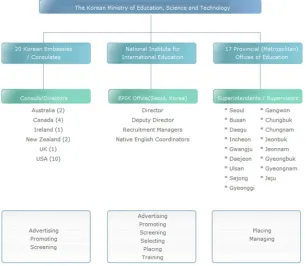
(1) Organisation
As shown in Figure 2.1, EPIK has been largely operated by NIIED with the
cooperation of 20 Korean embassies, consulates and 17 Provincial Offices of
Education (POE) to recruit NETs. NIIED has advertised and promoted the EPIK
scheme all over the world, in particular in English speaking countries through online
and off-line methods, screened new applicants through an application process,
selected them according to required documents and through conducting interviews,
assigned them to 17 POE according to their preferred working area, and organised
several training programmes (e.g. online pre-orientation, main onsite orientation,
additional orientation, in-service training, Korean teachers’ training and reunion).
[image:30.595.187.493.471.737.2]
18
(2) Job Description
NIIED provides specific information regarding EPIK applicants such as eligibility,
salary and benefits, duties, and teaching conditions.
1) Eligibility
There are six main requirements for working as a NET in the EPIK scheme: 1) EPIK
applicants should be a citizen where English is the primary language and must have
studied from the 7th grade (junior high school) in one of the following countries:
Australia, Canada, Ireland, South Africa, New Zealand, the United Kingdom, and the
United States of America; 2) they should hold a minimum of a Bachelor’s degree
from accredited universities; 3) they should be a maximum of 62 years of age; 4)
they should be mentally and physically healthy; 5) they should have a good
command of the English language and 6) they should have the ability and
willingness to adapt to Korean culture and lifestyle.
2) Duties
According to EPIK, there are some general outlines of EPIK teachers’ duties which
are more comprehensively carried out under the guidance of the host Provincial
Office of Education (POE). The general duties stipulated are as follows:
to conduct English conversation classes for Korean teachers and students;
to prepare teaching materials for English language education;
to assist in developing teaching materials for English language education;
to assist with activities related to English language education and other extracurricular activities;
to demonstrate a good command of the English language, both written and spoken;
19 to perform other duties as specified by the host POE.
In addition, during vacation, the EPIK teachers may be required to teach on some
programs such as an English camp, or their school may prefer for them to work on
lesson materials and curricular for the next semester.
3) Salary and Benefits
According to five levels based on their educational background and teaching
experience in Figure 2.2, a different monthly pay scale is given to NETs. Moreover,
the benefits are equally applied to all of the NETs, such as a one-off settlement
allowance, free furnished housing, severance pay, renewal allowance, and
compulsory medical insurance.
20
4) Teaching conditions
NIIED gives guidance to new NETs by providing general information about class
hours, the average number of students in class, the educational system and
school-age, and vacation in a Korean context. In addition, outlines are given on the roles
and responsibilities of KETs and NETs: while the licensed KETs or the Korean
co-teachers are responsible for consulting, directing and cooperating with classwork,
or life in or around school or at home for a NET, the NET should teach students by
collaborating with a Korean co-teacher. As for NETs, total instructional hours do not
exceed 22 hours per week and their employment period is one year (52 weeks).
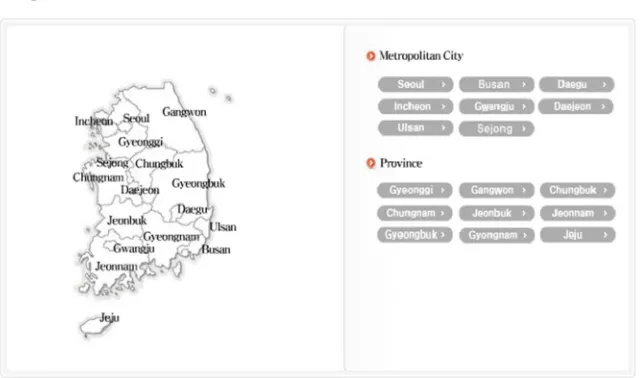
(3) Regions
[image:33.595.152.473.511.700.2]NETs are assigned to 17 provinces including eight Metropolitan cities shown in
Figure 2.3. Each province has the different number of NETs that are needed in their
schools so NIIED controls the number of NETs assigned in each province, even
though NETs mark the preferred province where they want to work when they
submitted their application form.
21
(4) Main onsite orientation
The orientation training programme was enhanced in 2008 and has been organised
by NIIED. New NETs who start teaching English from March 1st (the 1st semester) or
September 1st (the 2nd semester) should participate in the orientation training
programme organised by NIIED, which usually takes place twice a year about 10
days at the end of February or in August. This training programme is designed for
new NETs to understand Korean culture, life, and language, to share useful teaching
methods, resources, and classroom management ideas, to examine Korean
curriculum and Korean school textbooks and find the most effective ways to teach,
and to improve teaching skills through lesson planning or presentation. Figure 2.4
presents a sample of a main onsite orientation programme for new NETs.
22
The detailed information of this training programme will be presented in the
preliminary work in this study.
The next section will illustrate the current status in relation to the
deployment of NETs in Korean EFL classrooms and the implementation of EPIK
described so far.
2.4.2 Current status
In this section, the current status derived from the national reports which MEST
carried out in 2009 and 2010 will be presented in terms of the current progress of
EPIK, team teaching implemented in Korean EFL classrooms and some issues being
discussed by MEST. In addition, I will update some changes in EPIK and primary
English education.
According to Kim and Park (2010), the total number of NETs working in
Korean primary and secondary schools in 16 provinces2 was 8,546 and the total
number of schools where NETs were assigned was 9,186 in 2010 (in some cases, a
NET worked in a couple of schools due to the small scale of the classes of schools in
remote areas). As shown in Figure 2.5, 81.7 percent of public schools in Korea had
at least one NET in their schools.
Provinces Number of schools (A)
Number of Schools where NETs assigned
Rate of schools having a NET(B/A*100) Primary
school
Junior high school
High
school Sum(B)
Seoul 1,274 587 373 252 1,212 95.1%
Busan 611 287 171 51 509 83.3%
Daegu 428 113 81 34 228 53.3%
2
23
Incheon 468 177 103 76 356 76.1%
Kwangju 295 145 85 25 255 86.4%
Daejeon 285 138 85 25 248 87.0%
Ulsan 230 89 61 8 158 68.7%
Gyeonggi 2,128 1,104 551 367 2,022 95.0%
Gangwon 633 282 163 115 560 88.5%
Chungbok 474 133 105 13 251 52.9%
Chungnam 737 332 192 90 614 83.3%
Jeonbuk 751 257 172 74 503 66.9%
Jeonnam 834 298 228 97 623 74.7%
Gyeongbuk 965 402 257 136 795 82.4%
Gyongnam 946 401 236 37 674 71.2%
Jeju 178 106 42 30 178 100%
Sum 11,237 4,851 2,905 1,430 9,186 81.7%
Figure 2.5 The number of schools where NETs were assigned (MEST 2010)
In addition, it was reported that the total number of new NETs trained and
allocated to schools through NIIED was total 1,714 in 2009, total 2,008 in 2010,
total 3,193 in 2011, and total 3,477 in 2012 (NIIED 2013). Compared to the number
of NETs working in schools in 2009, more NETs were recruited and allocated to
Korean schools each year until 2012.
Along with a significant increase in the number of NETs in Korean public
schools since 2007, the roles and responsibilities of NETs and the professional
development for KETs have been discussed in a variety of aspects. EPIK (2010)
summarises the roles of a NET in collaboration with a KET in regular classes as
follows: ‘an input provider’ to offer abundant English, ‘a culture introducer’ to
support a different culture which a NET belongs to, and ‘a buffer’ to give students
an opportunity to be exposed to and get accustomed to facing and talking with a
24
been involved in extra curricula activities such as after class English programmes,
English camps during the vacation period, school English broadcasting, school
events like English speech contests, festivals, or English musical performance, and
conversation courses for KETs.
With regard to KETs, the issues related to the improvement of KETs’ English
competence and teaching techniques have been raised more actively.For example,
MEST has paid more attention to ‘Teaching English Through English’ (TETE) from
KETs, which places more emphasis on KETs’ speciality as English teachers. Despite
some different conditions in each Korean primary school, in general, homeroom
teachers and English subject teachers are involved in regular English classes:
homeroom teachers who take charge of several subjects including English; English
subject teachers who take charge of only an English subject. All of the KETs have
been recommended to use English as the medium instruction. In 2009, Seoul
Metropolitan Office of Education (SMOE) started the TETE policy and the other
provincial Offices of Education implemented it from 2010. SMOE announced a
policy of ‘three strikes out’ for teachers that cannot pass the evaluation for TETE
(Shim 2008: 111). However, Shin (2012) mentions that many KETs do not meet the
expectation of TETE, questioning its practical implementation and effectiveness.
While I was writing up my thesis, there were some changes in EPIK and
primary English education. First, in 2012, SMOE announced that only public primary
schools in Seoul will sustain the EPIK scheme but secondary schools will stop
recruiting NETs from 2013. However, private and specialized schools are not
affected by this decision and the other Metropolitan/Provincial Offices of Education
25
changes of the policy regarding EPIK and recruitment of NETs and around 2,000
NETs will be recruited and trained to work at primary and junior high schools across
the nation in 2013 (NIIED). As for primary English education, the number of English
classes for the 3rd and 4th grades of primary schools increased from one to two
English classes per week in 2010, and the 5th and the 6th grades started having three
English classes per week from the first semester in 2011. Due to an increase in the
number of classes per week, primary schools need more English teachers to cover
the increasing number of English classes in their schools. MEST announced that
4,731 English instructors would take charge of English conversation classes in 2010
and over 2,000 teachers in 2011 would be dispatched to primary and secondary
schools. Despite an ongoing process of policy changes in EPIK and primary English
education, team teaching implementation in a Korean EFL context through EPIK has
had a great impact on the holistic changes taking place in English education in
Korea.
In the next chapter, I will explore an overview of teacher collaboration, team
teaching, language education in team teaching, and the NET schemes in several
East Asia. It will then be followed by discussion of research dilemmas, classroom
26
CHAPTER THREE
Literature review
This study aims to investigate team teaching implemented by KETs and NETs in
Korean primary schools with a focus on their teaching practices and experiences
and to explore their interaction and relationship in these contexts. This chapter will
present the important features of teacher collaboration, which is helpful for
understanding team teaching more broadly. An overview of team teaching will then
be described; this will be followed by an investigation of the educational schemes in
several East Asian countries in relation to the deployment of NETs into EFL
classrooms. Multidimensional perspectives on interaction and relationship between
team teachers will be explored through discussion of research dilemmas,
understanding of contexts, complexity of their interaction and relationship, and
team learning in a social context.
3.1 Teacher collaboration
For many years, teachers have been characterized as having inherently
individualistic and isolated natures in school contexts and the dominant school
structure has emphasised teacher autonomy rather than collaboration (Lortie 1975
cited in Jang 2006). Despite the difficulties of its implementation, however,
collaboration among teachers has increasingly attracted attention as a key to
teachers’ professional development. Teacher development is often made possible
through collaboration (Robert 1998 cited in Mann 2005), as it stimulates teacher
learning and increases opportunities for teacher development in their work
27
exchange ideas and information, to facilitate supportive dialogue and interaction
with colleagues, and to create a collaborative and sharing culture in schools (Tsai
2007). In this light, the significance of teacher collaboration and its contributions
have been advocated by many researchers and educators (Hargreaves 1997;
Johnson 2003; Little 2003; McLaughlin 1997; Welch 1998).
In this section, I will discuss teacher collaboration in terms of teacher
learning, collegiality, and teaming, which are pertinent to crucial features of team
teaching.
3.1.1 Teacher learning
Teacher collaboration can be seen as a positive condition for teacher learning.
According to Welsh and Sheridan (1995: 1 cited in Welsh 1998: 28), collaboration is
‘a dynamic framework for efforts which endorses interdependence and parity
during interactive exchange of resources between at least two partners who work
together in a decision-making process that is influenced by cultural and systemic
factors to achieve common goals’. As reported by several researchers (Dunn &
Shirner 1999; Kwakman 1999; Lohman 2005 cited in Meirink et al. 2010),
collaboration with colleagues leads to a powerful learning environment. While
collaborating with fellow colleagues, teachers can exchange ideas or experiences,
develop and discuss new materials, receive feedback, and provide each other with
moral support (Butler et al. 2004; Johnson 2003; Meirink et al. 2007). Consequently,
teachers are exposed to a variety of sources of information, alternative practices
and critical examination about their teaching practice which reveals their
28
with colleagues, teachers can share knowledge, practice and experience, solve a
problem, and learn from one another. That is, as Prabhu (2003 cited in Mann 2005)
argues, a teacher’s sense of plausibility is developed through interaction with other
teachers’ versions of plausibility. Based on situative and sociocultural perspectives,
interactions between individual teachers are both the means for and the result of
learning (Wertsch et al. 1995 cited in Tang 2012). Moreover, through these
processes, teachers can develop collegiality and create communities or networks of
practice inside or outside the schools, which contribute to professional learning and
growth.
3.1.2 Collegiality
Shulman (1989: 2 cited in Hargreaves 1991: 47) argues that ‘collegiality and
collaboration are also needed to ensure that teachers benefit from their
experiences and continue to grow during their careers’. Hargreaves (ibid.) highlights
‘the creation of productive and supportive collegial relationships among teachers’
as a pre-requisite for teacher development and curriculum development.
Additionally, he divides collaborative working arrangements and relationships
between teachers and their colleagues into two types: One is collaborative
relationships, which are characterised as being ‘spontaneous’, ‘voluntary’,
‘development oriented’, ‘pervasive across time and space’, and ‘unpredictable’. The
other is ‘contrived collegiality’, which is in contrast to collaborative relationships
referred to above. That is, it is ‘administratively regulated’, ‘compulsory’,
‘implementation-oriented’, ‘fixed in time and space’, and ‘predictable’ (op. cit.
29
observation and focused reflective inquiry in ways that extend practice critically,
searching for better alternatives in continuous quest for improvement’ (Hargreaves
1994: 195 cited in Tsai 2007: 20).
Little (1990 cited in Clement & Vandenberghe 2000: 84-85) identifies four
distinctive forms of collegiality and collaboration among teachers, based on the
levels of their interdependence in interaction with other teachers in daily school
practice: ‘storytelling and scanning for ideas’; ‘aid and assistance’; ‘sharing’; and
‘joint work’. In terms of ‘storytelling and scanning for ideas’, team members are
mostly independent as teachers exchange quick stories and anecdotes about
practice, complain, and gripe in staff rooms or hallways, which are often incomplete
accounts. ‘Interchange is neither deep nor focused on problem solving’ (Peterson
1994: 6). As for ‘aid and assistance’, teachers provide help and advice when asked
and do not interfere with the other teacher’s work. They seldom establish deep
relationships of exchange. In the case of ‘sharing’, teachers routinely share
materials and methods and openly exchange ideas and opinions. ‘Joint work’, the
highest and most extended form of collegiality, can be described as ‘shared
responsibility for the work of teaching’ and ‘a collective conception of autonomy’
(Little 1990: 519). While the first three types are relatively weak in sharing more
productive professional relationships, ‘joint work’ provides an opportunity for
teachers to develop deeper ties to one another and to build more trusting and
productive working relationships. This type of interaction is expected to have great
30
3.1.3 Teaming
Teachers work together in ways which accommodate different forms of
collaboration inside and outside the classroom or beyond the school, such as team
teaching, peer observation, peer coaching, support groups, peer conversations, and
mentoring. Teacher teaming involves grouping two or more teachers together with
responsibility for a group of students for instructional purposes. It may involve
interdisciplinary or multidisciplinary teaming and team teaching. In particular,
teachers pair up as a team to help each other to solve teaching problems, develop
teaching practice, and teach together through collaborative interaction. In this
situation, teaming, as a collaborative practice, needs teachers’ active involvement
with their partners’ work and strong collegial relationships between teachers.
As for the traditional classroom context, Creese (2006: 435) criticizes the
dominant conceptualization of the classroom as ‘a place where only one teacher is
interacting with a class of students’. In addition, she argues that this ‘one teacher,
one class model’ is unable to cover the diversity of teaching unisons and
educational provision in our teaching and learning contexts. In this vein, team
teaching by more than two teachers working in the same classroom in partnership
has been implemented as one of the most common collaborative forms.
3.2 Team teaching
One of the most common collaborative partnerships in education, team teaching,
has been widely implemented in diverse educational contexts. In the following
sections, team teaching will be presented in terms of notion, definition, rationale,
31
3.2.1 Notion
In the 1950s, team teaching was first introduced in US primary and secondary
schools where more than two teachers shared a large or combined group of
students (Friend et al. 2010). Subsequently, in the 1960s, it was recommended as a
strategy for reorganizing secondary schools in both the USA and the UK (Warwick
1971 cited in Cook & Friend 1995). Team teaching was adopted in many open
concept schools during the 1970s (Easterby-Smith & Olve 1984). With the
introduction of the reforms of secondary schools and the integration of special
education into general education, co-teaching emerged as another collaborative
teaching model. Initially, the implementation of co-teaching practice in the 1970s
aimed to provide support for increasing the inclusion of students with disabilities
(Friend 2007; Jeon 2010; Murray 2004). That is, pairs of general education teachers
and special educators used co-teaching to share their responsibilities for students in
an inclusive classroom of general education and special education students (Friend
& Cook 2003; Sack 2005). Classroom partnerships specially designed to reach
students with disabilities became more commonplace in the 1980s (Friend 2007).
With regard to its concept and practice, co-teaching entails four components: 1)
more than two teachers are involved; 2) they deliver substantive instruction; 3) they
teach a diverse group of students; 4) their instruction is delivered in a single
classroom or physical space. While team teaching was commonly used in general
education, co-teaching was recognized as a specialized joint teaching model for
students with disabilities (Walther-Thomas 1997 cited in Jang et al. 2010b).
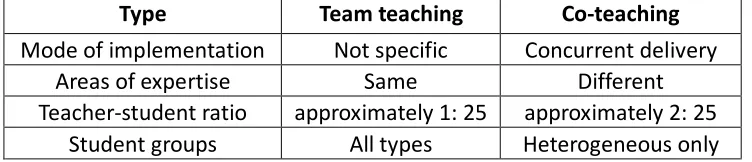
However, synonymous terminologies associated with team teaching, co-teaching