Tree Kernel-based SVM with Structured Syntactic
Know-ledge for BTG-based Phrase Reordering
Min Zhang Haizhou Li
Institute for Infocomm Research
1 Fusionopolis Way,#21-01 Connexis (South Tower)
Singapore 138632
{mzhang,hli}@i2r.a-star.edu.sg
Abstract
Structured syntactic knowledge is important for phrase reordering. This paper proposes us-ing convolution tree kernel over source parse tree to model structured syntactic knowledge for BTG-based phrase reordering in the con-text of statistical machine translation. Our study reveals that the structured syntactic fea-tures over the source phrases are very effective for BTG constraint-based phrase reordering and those features can be well captured by the tree kernel. We further combine the structured features and other commonly-used linear fea-tures into a composite kernel. Experimental re-sults on the NIST MT-2005 Chinese-English translation tasks show that our proposed phrase reordering model statistically signifi-cantly outperforms the baseline methods.
1
Introduction
Phrase-based method (Koehn et al., 2003; Och and Ney, 2004; Koehn et al., 2007) and syntax-based method (Wu, 1997; Yamada and Knight, 2001; Eisner, 2003; Chiang, 2005; Cowan et al., 2006; Marcu et al., 2006; Liu et al., 2007; Zhang et al., 2007c, 2008a, 2008b; Shen et al., 2008; Mi and Huang, 2008) represent the state-of-the-art technologies in statistical machine translation (SMT). As the two technologies are complemen-tary in many ways, an interesting research topic is how to combine the strengths of the two me-thods. Many research efforts have been made to address this issue, which can be summarized into two ideas. One is to add syntax into phrase-based model while another one is to enhance syntax-based model to handle non-syntactic phrases. In this paper, we bring forward the first idea by studying the issue of how to utilize structured
syntactic features for phrase reordering in a phrase-based SMT system with BTG (Bracketing Transduction Grammar) constraints (Wu, 1997).
Word and phrase reordering is a crucial com-ponent in a SMT system. In syntax-based method, word reordering is implicitly addressed by trans-lation rules, thus the performance is subject to parsing errors to a large extent (zhang et al., 2007a) and the impact of syntax on reordering is difficult to single out (Li et al., 2007). In phrase-based method, local word reordering1 can be
ef-fectively captured by phrase pairs directly while local phrase reordering is explicitly modeled by phrase reordering model and distortion model. Recently, many phrase reordering methods have been proposed, ranging from simple distance-based distortion model (Koehn et al., 2003; Och and Ney, 2004), flat reordering model (Wu, 1997; Zens et al., 2004), lexicalized reordering model (Tillmann, 2004; Kumar and Byrne, 2005), to hierarchical phrase-based model (Chiang, 2005; Setiawan et al., 2007) and classifier-based reor-dering model with linear features (Zens and Ney, 2006; Xiong et al., 2006; Zhang et al., 2007a; Xiong et al., 2008). However, one of the major limitations of these advances is the structured syntactic knowledge, which is important to glob-al reordering (Li et glob-al., 2007; Elming, 2008), has not been well exploited. This makes the phrase-based method particularly weak in handling global phrase reordering. From machine learning viewpoint (Vapnik, 1995), it is computationally infeasible to explicitly generate features involv-ing structured information in many NLP
1 This paper follows the term convention of global
reorder-ing and local reorderreorder-ing of Li et al. (2007), between which the distinction is solely defined by reordering distance (whether beyond four source words) (Li et al., 2007).
tions. For example, one cannot enumerate effi-ciently all the sub-tree features for a full parse tree. This would be the reason why structured features are not fully utilized in previous statis-tical feature-based phrase reordering model.
Thanks to the nice property of kernel-based machine learning method that can implicitly ex-plore (structured) features in a high dimensional feature space (Vapnik, 1995), in this paper we propose using convolution tree kernel (Haussler, 1999; Collins and Duffy, 2001) to explore the structured syntactic knowledge for phrase reor-dering and further combine the tree kernel with other diverse linear features into a composite kernel to strengthen the model’s predictive abili-ty. Indeed, using tree kernel methods to mine structured knowledge has shown success in some NLP applications like parsing (Collins and Duffy, 2001), semantic role labeling (Moschitti, 2004; Zhang et al., 2007b), relation extraction (Zhang et al., 2006), pronoun resolution (Yang et al., 2006) and question classification (Zhang and Lee, 2003). However, to our knowledge, such technique still remains unexplored for phrase reordering.
In this paper, we look into the phrase reorder-ing problem in two aspects: 1) how to model and optimize structured features, and 2) how to com-bine the structured features with other linear fea-tures and further integrate them into the log-linear model-based translation framework. Our study shows that: 1) the structured syntactic fea-tures are very useful and 2) our kernel-based model can well explore diverse knowledge, in-cluding previously-used linear features and the structured syntactic features, for phrase reorder-ing. Our model displays one advantage over the previous work that it is able to utilize the struc-tured syntactic features without the need for ex-tensive feature engineering in decoding a parse tree into a set of linear syntactic features.
To have a more insightful evaluation, we de-sign three experiments with three different eval-uation metrics. Experimental results on the NIST MT-2005 Chinese-English translation tasks show that our method statistically significantly outper-forms the baseline methods in term of the three different evaluation metrics.
The rest of the paper is organized as follows. Section 2 introduces the baseline method of BTG-based phrase translation method while sec-tion 3 discusses the proposed method in detail. The experimental results are reported and dis-cussed in section 4. Finally, we conclude the pa-per in section 5.
2
Baseline System and Method
We use the MaxEnt-based BTG translation sys-tem (Xiong et al., 2006) as our baseline. It is a phrase-based SMT system with BTG reordering constraint. The system uses the BTG lexical translation rules ( / ) to translate the source phrase into target phrase , and the BTG merging rules ( , | , ) to combine two neighboring phrases with a straight or inverted order. In the translation model, the BTG lexical rules are weighted with several fea-tures, such as phrase translation, word penalty and language models, in a log-linear form. With the BTG constraint, the reordering model Ω is defined on the two neighboring phrases and
and their order , as follows:
Ω f( , , ) (1) In the baseline system, a MaxEnt-based clas-sifier with boundary words of the two neighbor-ing phrases as features is used to model the merging/reordering order. The baseline MaxEnt-based reordering model is formulized as follows:
Ω ( | , ) ∑ (∑ ( , , )) (∑ ( , , )) (2) where the functions ( , , ) 0,1 are model feature functions using the boundary words of the two neighboring phrases as features, and are feature weights that are trained based on the MaxEnt-based criteria.
3
Tree Kernel-based Phrase Reordering
Model
3.1 Kernel-based Classifier Solution to Phrase Reordering
In this paper, phrase reordering is recast as a classification issue as done in previous work (Xiong et al., 2006 & 2008; Zhang et al., 2007a). In training, we use a machine learning algorithm training on the annotated phrase reordering in-stances that are automatically extracted from word-aligned, source sentence parsed training corpus, to learn a classifier. In testing (decoding), the learned classifier is applied to two adjacent source phrases to decide whether they should be merged (straight) or reordered (inverted) and what their probabilities are, and then these prob-abilities are used as one feature in the log-linear model in a phrase-based decoder.
all classifiers are able to work with kernel me-thods. Only those dot-product-based classifiers can work with kernels by replacing the dot prod-uct with a kernel function, where the kernel func-tion is able to directly calculate the similarity between two (structured) objects without enume-rating them into linear feature vectors. In this paper, we select SVM as our classifier. In this section, we first define the structured syntactic features and introduce the commonly used linear features, and then discuss how to utilize these features by kernel methods together SVM for
phrase reordering
3.2 Structured Syntactic Features
A reordering instance , (see Eq.1) in this paper refers to two adjacent source phrases and to be translated. The structured syn-tactic feature spaces of a reordering instance are defined as the portion of a parse tree of the source sentence that at least covers the span of the reordering instance (i.e. the two neighboring phrases). The syntactic features are defined as all
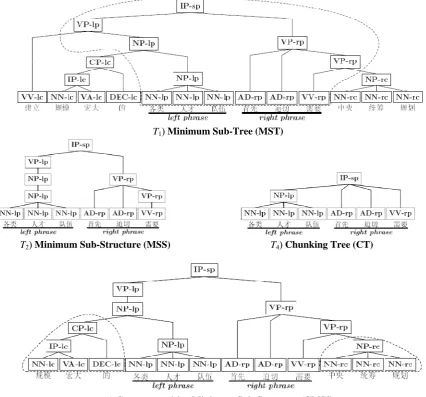
T1) Minimum Sub-Tree (MST)
T2) Minimum Sub-Structure (MSS) T4) Chunking Tree (CT)
[image:3.595.78.505.230.627.2]T3) Context-sensitive Minimum Sub-Structure (CMSS)
Figure 1. Different representations of structured syntactic features of a reordering instance in the example sentence excerpted from our training corpus “…建立/build 规模/scale宏大/mighty 的/of 各类/various types 人才/qualified personnel 队伍/contingent 首先/above all 迫切/urgently 需要/necessary 中央
/central authorities 统筹/overall 规划/planning…(To build a mighty contingent of qualified personnel of various types, it is necessary, above all, for the central authorities to make overall planning.) ”, where “各 类/various types 人才/qualified personnel 队伍/contingent (contingent of qualified personnel of various types)” is the 1st/left phrase and “首先/above all 迫切/urgent 需要/necessary (it is necessary, above all,
…)” is the 2nd/right phrase. Note that different function tags are attached to the grammar tag of each
the possible subtrees in the structured feature spaces. We can see that the structured feature spaces and their features are encapsulated by a full parse tree of source sentences. Thus, it is critical to understand which portion of a parse tree (i.e. structured feature space) is the most ef-fective to represent a reordering instance. Moti-vated by the work of (Zhang et al., 2006), we here examine four cases that contain different sub-structures as shown in Fig. 1.
(1) Minimum Sub-Tree (MST): the sub-tree rooted by the nearest common ancestor of the two phrases. This feature records the minimum sub-structure covering the two phrases and its left and right contexts as shown in Fig 1.T1.
(2) Minimum Sub-Structure (MSS): the smal-lest common sub-structure covering the two phrases. It is enclosed by the shortest path link-ing the two phrases. Thus, its leaf nodes exactly consist of all the phrasal words.
(3) Context-sensitive Minimum Sub-Structure (CMSS): the MSS extending with the 1st left sibling node of the left phrase and the 1st right sibling node of the right phrase and their descen-dants. If sibling is unavailable, then we move to the parent of current node and repeat the same process until the sibling is available or the root of the MST is reached.
(4) Chunking Tree (CT): the base phrase list extracted from the MSS. We prune out all the internal structures of the MSS and only keep the root node and the base phrase list for generating the chunking tree.
Fig. 1 illustrates the different representations of an example reordering instance. T1 is the MST
for the example instance, where the sub-structure circled by a dotted line is the MSS, which is also shown in T2 for clarity. We can see that the MSS
is a subset of the MST. By T2 we would like to
evaluate whether the structured information is effective for phrase reordering while by compar-ing the system performance when uscompar-ing T1 and
T2, we would like to evaluate whether the
struc-tured context information embedded in the MST is useful to phrase reordering. T3 is the CMSS,
where the two sub-structures circled by dotted lines are included as the context to T2 and make
T3 limited context-sensitive. This is to evaluate
whether the limited context information in the CMSS is helpful. By comparing the performance of T1 and T3, we would like to see whether the
larger context in T1 is a noisy feature. T4 is the
CT, where only the basic structured information is kept. By comparing the performance of T2 and
T4, we would like to study whether the high-level
structured syntactic features in T2 are useful to
phrase reordering.
After defining the four structured feature spaces, we further partition each feature space into five parts according to their functionalities. Because it only makes sense to evaluate two par-titions of the same functionality between two reordering instances, the feature space partition leads to a more precise similarity calculation. As shown in Fig 1, all the internal nodes in each par-tition are labeled with a unique function tag in the following way:
• Left Context (-lc): nodes in this partition do not cover any phrase word and they are all in the left of the left phrase.
• Right Context (-rc): nodes in this partition do not cover any phrase word and they are all in the right of the right phrase.
• Left Phrase (-lp): nodes in this partition only cover the first phrase and/or its left context.
• Right Phrase (-rp): nodes in this partition only cover the second phrase and/or its right context.
• Shared Part (-sp): nodes in this partition at least cover both of the two phrases partially. No lexical word is tagged since it is not a part of the structured features, and therefore not par-ticipating in the tree kernel computing.
3.3 Linear Features
In our study, we define the following lexicalized linear features which are easily to be extracted and integrated to our composite kernel:
• Leftmost and rightmost boundary words of the left and right source phrases
• Leftmost and rightmost boundary words of the left and right target phrases
• Internal words of the four phrases (exclud-ing boundary words)
• Target language model (LM) score differ-ence (monotone-inverted)
3.4 Tree Kernel, Composite Kernel and In-tegrating into our Reordering Model
As discussed before, we use convolution tree kernel to capture the structured syntactic feature implicitly by directly computing similarity be-tween the parse-tree representations of two reor-dering instances with explicitly enumerating all the features one by one. In convolution tree ker-nel (Collins and Duffy, 2001), a parse tree
T
is implicitly represented by a vector of integer counts of each sub-tree type (regardless of its ancestors):( )
T
φ
=
(# subtree1(T), …, # subtreen(T))where # subtreei(T) is the occurrence number of
the ith sub-tree type (subtreei) in T. Since the
number of different sub-trees is exponential with the parse tree size, it is computationally infeasi-ble to directly use the feature vector
φ
( )
T
. To solve this computational issue, Collins and Duffy (2001) proposed the following parse tree kernel to calculate the dot product between the above high dimensional vectors implicitly.1 1 2 2
1 1 2 2
1 2 1 2
1 2
1 2
( , ) ( ), ( )
( ) ( )
( , )
((
subtreei) (
subtreei))
i n N n N
n N n N
K T T T T
I n I n
n n
φ
φ
∈ ∈
∈ ∈
=< >
=
= Δ
⋅
∑ ∑
∑
∑ ∑
where N1 and N2 are the sets of nodes in trees T1
and T2, respectively, and Isubtreei( )n is a function
that is 1 iff the subtreei occurs with root at node n
and zero otherwise, and Δ( , )n n1 2 is the number of the common subtrees rooted at n1 and n2, i.e.,
1 2 1 2
( , )
( )
( )
i i
subtree subtree
i
n n
I
n
I
n
Δ
=
∑
⋅
1 2
( , )
n n
Δ
can be further computed efficiently by the following recursive rules:Rule 1: if the productions (CFG rules) at
n
1 and2
n
are different, Δ( , ) 0n n1 2 = ;Rule 2: else if both
n
1 andn
2 are pre-terminals (POS tags), Δ( , ) 1n n1 2 = ×λ;Rule 3: else, 1
( )
1 2 1 1 2
( , ) n c n (1 ( ( , ), ( , )))
j
n n λ = ch n j ch n j
Δ =
∏
+ Δ ,where
nc n
( )
1 is the child number ofn
1, ch(n,j) is the jth child of node n andλ
(0<λ
<1) is the de-cay factor in order to make the kernel value less variable with respect to the subtree sizes. In ad-dition, the recursive Rule 3 holds because given two nodes with the same children, one can con-struct common sub-trees using these children and common sub-trees of further offspring. The timecomplexity for computing this kernel is
1 2
(| | | |)
O N
⋅
N and in practice in near to linear computational time without the need of enume-rating all subtree features.In our study, the linear feature-based similarity is simply calculated using dot-product. We then define the following composite kernel to com-bine the structured features-based and the linear features-based similarities:
( , ) · ( , ) (1 ) · ( , ) (3)
where Ktis the tree kernel over the structured
features and Klis the linear kernel (dot-product)
over the linear features. The composite kernel Kc
is a linear combination of the two individual ker-nels, where the coefficient αis set to its default value 0.3 as that in Moschitti (2004)’s implemen-tation. The kernels return the similarities be-tween two reordering instances based on their features used. Our basic assumption is, the more similar the two reordering instances of x1 and x2
are, the more chance they share the same order. Now let us see how to integrate the kernel functions into SVM. The linear classifier learned by SVM is formulized as:
( ) sgn( i i i i )
f x =
∑
y a x x• +b (4) wherea
iis the weight of a support vectorx
i(i.e., a support reordering instance , in our study),y
i is its class label (1: or -1: in our study) andb
is the intercept of the hyperplane. An input reordering instancex
is classified as positive (negative) if
f x
( )
>0 (( )
f x
<0).Based on the linear classifier, a kernelized SVM can be easily implemented by simply re-placing the dot product
x x
∗
iin Eq (4) with a kernel functionK x x
( , )
i . Thus, the kernelized SVM classifier is formulated as:( ) sgn( i i i ( , )i )
f x =
∑
y a K x x +b (5) whereK x x
( , )
i is eitherK x x
c( , )
i ,K x x
t( , )
i or( , )
l i
K x x
in our study. Following Eq (1), ourreordering model (implemented by the kerne-lized SVM) can be formukerne-lized as follows:
Ω f( , , ) ( | , )
(∑ ( ( , ) )) (6) A reordering instance
x
is classified as straight (or inverted) if ( | ) 0 (or ( | )model and the MaxEnt-based reordering model. The main difference between them lies in that our model is able to utilize structured syntactic features by kernalized SVM while the previous work can only use lexicalized word features by MaxEnt-based classifier.
Finally, because the return value of ( | ) is a distance function rather than a probability, we use a sigmoid function to convert
( | )to a posterior probability as shown using the following to functions and apply it as one feature to the log-linear model in the decod-ing.
( | )
1 ( | )
1 psvm o x
P straight x
e−
=
+ and
( | )
1 ( | )
1 psvm o x
P inverted x
e
= +
where straight represents a positive instance and inverted represents a negative instance.
4
Experiments and Discussion
4.1 Experimental Settings
Basic Settings: we evaluate our method on Chi-nese-English translation task. We use the FBIS corpus as training set, the NIST MT-2002 test set as development (dev) set and the NIST MT-2005 test set as test set. The Stanford parser (Klein and Manning, 2003) is used to parse Chinese sen-tences on the training, dev and test sets. GIZA++ (Och and Ney, 2004) and the heuristics “grow-diag-final-and” are used to generate m-to-n word alignments. The translation model is trained on the FBIS corpus and a 4-gram language model is trained on the Xinhua portion of the English Gi-gaword corpus using the SRILM Toolkits (Stolcke, 2002) with modified Kneser-Ney smoothing (Kenser and Ney, 1995). For the MER training (Och, 2003), we modify Koehn’s MER trainer (Koehn, 2004) to train our system. For significance test, we use Zhang et al’s im-plementation (Zhang et al, 2004).
Baseline Systems: we set three baseline sys-tems: B1) Moses (Koehn et al., 2007) that uses lexicalized unigram reordering model to predict three orientations: monotone, swap and discon-tinuous; B2) MaxEnt-based reordering model with lexical boundary word features only (Xiong et al., 2006); B3) Linguistically annotated reor-dering model for BTG-based (LABTG) SMT (Xiong et al., 2008). For Moses, we used the de-fault settings. We build a CKY-style decoder and integrate the corresponding reordering modelling methods into the decoder to implement the 2nd
and the 3rd baseline systems and our system.
Ex-cept reordering models, all the four systems use the same features in translation model, language model and distortion model as Moses in the log-linear framework. We tune the four systems us-ing the strategies as discussed previously in this section.
Reordering Model Training: we extract all reordering instances from the m-to-n word-aligned training corpus. The reordering instances include the two source phrases, two target phras-es, order label and its corresponding parse tree. We generate the boundary word features from the extracted reordering instances in the same way as discussed in Xiong et al. (2006) and use Zhang’s MaxEnt Tools2 to train a reordering
model for the 2nd baseline system. Similarly, we
use the algorithm 1 in Xiong et al. (2008) to ex-tract features and use the same MaxEnt Tools to train a reordering model for the 3rd baseline
sys-tem. Based on the extracted reordering instances, we generate the four structured features and the linear features, and then use the Tree Kernel Tools (Moschitti, 2004) to train our kernel-based reordering model (linear, tree and composite).
Experimental Design and Evaluation Met-rics: we design three experiments and evaluate them using three metrics.
Classification-based: in the first experiment, we extract all reordering instances and their fea-tures from the dev and test sets, and then use the reordering models trained on the training set to classify (label) those instances extracted from the dev and test sets. In this way, we can isolate the reordering problem from the influence of others, such as translation model, pruning and decoding strategies, to better examine the reordering mod-els’ ability and to give analytical insights into the features. Classification Accuracy (CAcc), the percentage of the correctly labeled instances over all trials, is used as the evaluation metric.
Forced decoding3-based and normal
decoding-based: the two experiments evaluate the reorder-ing models through a real SMT system. The reordering model and the language model are the same in the two experiments. However, in forced decoding, we train two translation models, one using training data only while another using both
2 http://homepages.inf.ed.ac.uk/s0450736/maxent.html 3 A normal SMT decoder filters a translation model
training, dev and test data. By forced decoding, we aim to isolate the reordering problem from those of OOV and lexical selections resulting from imperfect translation model in the context of a real SMT task. Besides the the case-sensitive BLEU-4 (Papineni et al., 2002) used in the two experiments, we design another evaluation me-trics Reordering Accuracy (RAcc) for forced de-coding evaluation. RAcc is the percentage of the adjacent word pairs with correct word order4 over all words in one-best translation results. Similar to BLEU score, we also use the similar Brevity Penalty BP (Papineni et al., 2002) to pe-nalize the short translations in computing RAcc. Finally, please note for the three evaluation me-trics, the higher values represent better perfor-mance.
Feature Spaces CAcc (%) Dev Test Minimum Sub-Tree (MST) 89.87 89.92 Minimum Sub-Structure (MSS) 87.95 87.88 Context-Sensitive MSS (CMSS) 89.11 89.01 Chunking Tree (CT) 86.17 86.21 Linear Features (Kl) 90.79 90.46 Kl w/o using LM feature (Kl-LM) 84.24 84.06 Composite Kernel (Kc: MST+Kl) 92.98 92.67
MST w/o the 5 function tags 86.94 87.03 All are straight (monotonic) 78.92 78.67
Table 1: Performance of our methods on the dev and test sets with different feature combi-nations
4.2 Experimental Results
Classification of Instances: Table 1 reports the performance of our defined four structured fea-tures, linear feature and the composite kernel. The results are summarized as follows.
The last row reports the performance without using any reordering features. We just suppose that all the translations are monotonic, no reor-dering happens. The CAccs of 78.92% and 78.67% serve as the bottom line in our study. Compared with the bottom line, the tree kernels over the 4 structured features are very effective for phrase
4 An adjacent word pair w
iwi+1 in a translation have correct
word order if and only if wi appears before wi+1 in
transla-tion references. Note than the two words may not be adja-cent in the references even if they have correct word order.
reordering since only structured information is used in the tree kernel5.
The CTs performs the worst among the 4 structured features. This suggests that the middle and high-level structures beyond base phrases are very useful for phrase reordering. The MSSs show lower performance than the CMSSs and the MSTs achieve the best performance. This clearly indicates that the structured context in-formation is useful for phrase reordering. For this reason, the subsequent discussions are focused on the MSTs, unless otherwise specified. The MSSs without using the 5 function tags perform much worse than the original ones. This suggests that the partitions of the structured feature spaces are very helpful, which can effectively avoid the undesired matching between partitions of differ-ent functionalities. Comparison of Kl and Kl-LM shows the LM plays an important role in phrase reordering. The composite kernel (Kc) performs much better than the two individual kernels. This suggests that the structured and linear features are complementary and the composite kernel can well integrate them for phrase reordering.
Methods CAcc (%)
Dev Test Minimum Sub-Tree (MST) 89.87 89.92 Linear Features (Kl) 90.79 90.46 Composite Kernel (Kc: MST+Kl) 92.98 92.67 MaxEnt+boundary word (B2) 88.33 86.97
MaxEnt+linguistic features (B3_1) 84.83 83.92
MaxEnt+LABTG (B3: B2+ B3_1) 88.82 88.18
Table 2: Performance comparison of different me-thods
Table 2 compares the performance of the base-line methods with ours. Comparison between B3_1 and MST clearly demonstrates that the structured syntactic features are much more ef-fective than the linear syntactic features that are manually extracted via heuristics. It also suggests that the tree kernel can well capture the struc-tured features implicitly. Kl outperforms B2. This is mainly due to the contribution of LM features. B2 (MaxEnt-based) significantly outperforms Kl-LM in Table 1 (SVM-based). This suggests that phrase reordering may not be a good linearly bi-nary-separable task if only boundary word fea-tures are used. Our composite kernel (Kc)
signifi-cantly outperforms LABTG (B3). This mainly
5 The tree kernel algorithm only compares internal
attributes to the contributions of structured syn-tactic features, LM and the tree kernel.
Forced Decoding: Table 3 compares the per-formance of our composite kernel with that of the LABTG (Baseline 3) in forced decoding. As discussed before, here we try two translation models.
The composite kernel outperforms the LABTG in all test cases. This further validates the effectiveness of the kernel methods in phrase reordering. There are still around 30% words reordered incorrectly even if we use the transla-tion model trained on both training, dev and test sets. This reveals the limitations of current SMT modeling methods and suggests interesting fu-ture work in this area. The source language OOV6 rate in forced decoding (13.6%) is much
higher that in normal decoding (6.22%, see table 4). This is mainly due to the fact that the phrase table in forced decoding is filtered out based on both source and target languages while in normal decoding it is based on source language only. As a result, more phrases are filtered out in the forced decoding. There is 1.4% OOV even if the translation model is trained on the test set. This is due to the incorrect word alignment, large-span word alignment and different English tokeniza-tion strategies used in BLEU-scoring tool and ours.
Methods Test Set (%) RAcc OOV BLEU Composite Kernel (Kc)
+translation model on Training, dev and test
51.03 72.67
13.6 1.41
38.56 62.87
MaxEnt+LABTG (B3) +translation model on training, dev and test
48.96
[image:8.595.66.295.600.696.2]71.45 13.6 1.41 37.32 62.14
Table 3: Performance comparison of forced de-coding
Methods Test Set
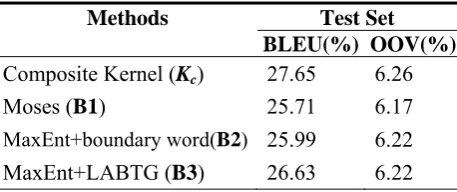
BLEU(%) OOV(%) Composite Kernel (Kc) 27.65 6.26
Moses (B1) 25.71 6.17
MaxEnt+boundary word(B2) 25.99 6.22
MaxEnt+LABTG (B3) 26.63 6.22
Table 4: Performance comparison
6 OOV means a source words has no any English translation
according to the translation model. OOV rate is the percent-age of the number of OOV words over all the source words.
Normal Decoding/Translation: Table 4 reports the translation performance of our system and the three baseline systems.
Moses (B1) and the MaxEnt-based boundary word model (B2) achieve comparable perfor-mance. This means the lexicalized orientation-based reordering model in Moses performs simi-larly to the boundary word-based reordering model since the two models are both lexical word-based. However, theoretically, the Max-Ent-based model may suffer less from data sparseness issue since it does not depends on internal phrasal words and uses MaxEnt to op-timize feature weights while the orientation-based model uses relative frequency of the entire phrases to compute the posterior probabilities. s. The MaxEnt-based LABTG model significantly outperforms (p<0.05) the MaxEnt-based boun-dary word model and the lexicalized orientation-based reordering model. This indicates that the linearly linguistically syntactic information is a useful feature to phrase reordering.
Our composite kernel-based model signifi-cantly outperforms (p<0.01) the three baseline methods. This again proves that the structured syntactic features are much more effective than the linear syntactic features for phrase reordering and the tree kernel method can well capture the informative structured features. The four me-thods show very slight difference in OOV rates. This is mainly due to the difference in implemen-tation detail, such as different OOV penalties and other pruning thresholds.
5
Conclusion and Future Work
features. In addition, we also study how to find the optimal structured feature space and how to partition the structured feature spaces according to their functionalities. Finally, we evaluate our method on the NIST MT-2005 Chinese-English translation tasks. To provide insights into the model, we design three kinds of experiments to-gether with three different evaluation metrics. Experimental results show that the structured features are very effective and our composite kernel can well capture both the structured and the linear features without the need for extensive feature engineering. It also shows that our thod significantly outperforms the baseline me-thods.
The tree kernel-based phrase reordering me-thod is not only applicable to adjacent phrases. It is able to work with any long phrase pairs with gap of any length in-between. We will study this case in the near future. We would also like to use one individual tree kernel for one partition in a structured feature space. In doing so, we are able to give different weights to different partitions according to their functionalities and contribu-tions. Note that these weights can be automati-cally tuned and optimized easily against a dev set.
References
David Chiang. 2005. A hierarchical phrase-based model for SMT. ACL-05. 263-270.
Michael Collins and N. Duffy. 2001. Convolution Kernels for Natural Language. NIPS-2001. M. R. Costa-jussà and J.A.R. Fonollosa. 2006.
Statis-tical Machine Reordering. EMNLP-06. 70-76. Brooke Cowan, Ivona Kucerova and Michael Collins.
2006. A discriminative model for tree-to-tree trans-lation. EMNLP-06. 232-241.
Jason Eisner. 2003. Learning non-isomorphic tree mappings for MT. ACL-03 (companion volume). Jakob Elming. 2008. Syntactic Reordering Integrated
with Phrase-Based SMT. COLING-08. 209-216. Michel Galley and Christopher D. Manning. 2008. A
Simple and Effective Hierarchical Phrase Reorder-ing Model. EMNLP-08. 848-856.
David Haussler. 1999. Convolution Kernels on Dis-crete Structures. TR UCS-CRL-99-10.
T. Joachims. 1998. Text Categorization with SVM: learning with many relevant features. ECML-98. Dan Klein and Christopher D. Manning. 2003.
Accu-rate Unlexicalized Parsing. ACL-03. 423-430. Reinhard Kenser and Hermann Ney. 1995. Improved
backing-off for M-gram language modeling. ICASSP-95, 181-184
Philipp Koehn, F. Och and D. Marcu. 2003. Statistical phrase-based translation. HLT-NAACL-03. Philipp Koehn, H. Hoang, A. Birch, C. C.-Burch, M.
Federico, N. Bertoldi, B. Cowan, W. Shen, C. Mo-ran, R. Zens, C. Dyer, O. Bojar, A. Constantin and E. Herbst. 2007. Moses: Open Source Toolkit for SMT. ACL-07 (poster). 77-180.
Shankar Kumar and William Byrne. 2005. Local Phrase Reordering Models for Statistical Machine Translation. HLT-EMNLP-2005. 161-168.
Chi-Ho Li, Dongdong Zhang, Mu Li, Ming Zhou, Minghui Li and Yi Guan. 2007. A Probabilistic Approach to Syntax-based Reordering for Statis-tical Machine Translation. ACL-07. 720-727. Yang Liu, Yun Huang, Qun Liu and Shouxun Lin.
2007. Forest-to-String Statistical Translation Rules. ACL-07. 704-711.
Daniel Marcu, W. Wang, A. Echihabi and K. Knight. 2006. SPMT: SMT with Syntactified Target Lan-guage Phrases. EMNLP-06. 44-52.
Haitao Mi and Liang Huang. 2008. Forest-based Translation Rule Extraction. EMNLP-08. 206-214. Alessandro Moschitti. 2004. A Study on Convolution
Kernels for Shallow Semantic Parsing. ACL-04. Masaaki Nagata, Kuniko Saito, Kazuhide Yamamoto
and Kazuteru Ohashi. 2006. A Clustered Global Phrase Reordering Model for Statistical Machine Translation. COLING-ACL-06. 713-720.
Franz J. Och and Hermann Ney. 2002. Discriminative training and maximum entropy models for statis-tical machine translation. ACL-02. 295-302. Franz J. Och. 2003. Minimum error rate training in
statistical machine translation. ACL-03. 160-167. Franz J. Och and H. Ney. 2003. A Systematic
Com-parison of Various Statistical Alignment Methods. Computational Linguistics, 29(1):20-51.
Franz J. Och and H. Ney. 2004. The alignment tem-plate approach to statistical machine translation. Computational Linguistics, 30(4):417-449.
Kishore Papineni, S. Roukos, T. and W. Zhu. 2002. BLEU: a method for automatic evaluation of ma-chine translation. ACL-02. 311-318.
Hendra Setiawan, Min-Yen Kan and Haizhou Li. 2007. Ordering Phrases with Function Words. ACL-07. 712-719.
Libin Shen, Jinxi Xu and Ralph Weischedel. 2008. A New String-to-Dependency Machine Translation Algorithm with a Target Dependency Language Model. ACL-HLT-08. 577-585.
Andreas Stolcke. 2002. SRILM - an extensible lan-guage modeling toolkit. ICSLP-02. 901-904. Christoph Tillmann. 2004. A Unigram Orientation
Model for Statistical Machine Translation. HLT-NAACL-04 (short paper).
Chao Wang, M. Collins and P. Koehn. 2007. Chinese Syntactic Reordering for Statistical Machine Translation. EMNLP-CONLL-07. 734-745.
Dekai Wu. 1997. Stochastic inversion transduction grammars and bilingual parsing of parallel corpo-ra. Computational Linguistics, 23(3):377-403. Fei Xia and Michael McCord. 2004. Improving a
Sta-tistical MT System with Automatically Learned Rewrite Patterns. COLING-04.
Deyi Xiong, Qun Liu and Shouxun Lin. 2006. Maxi-mum Entropy Based Phrase Reordering Model for SMT. COLING-ACL-06. 521–528.
Deyi Xiong, Min Zhang, Aiti Aw and Haizhou Li. 2008. A Linguistically Annotated Reordering Mod-el for BTG-based Statistical Machine Translation. ACL-HLT-08 (short paper). 149-152.
Kenji Yamada and K. Knight. 2001. A syntax-based statistical translation model. ACL-01. 523-530. Xiaofeng Yang, Jian Su and Chew Lim Tan. 2006.
Kernel-Based Pronoun Resolution with Structured Syntactic Knowledge. COLING-ACL-06. 41-48. Richard Zens, H. Ney, T. Watanabe and E. Sumita.
2004. Reordering Constraints for Phrase-Based Statistical Machine Translation. COLING-04. Richard Zens and Hermann Ney. 2006.
Discrimina-tive Reordering Models for Statistical Machine Translation. WSMT-2006.
Dell Zhang and W. Lee. 2003. Question classification using support vector machines. SIGIR-03.
Min Zhang, Jie Zhang, Jian Su and GuoDong Zhou. 2006. A Composite Kernel to Extract Relations be-tween Entities with Both Flat and Structured Fea-tures. COLING-ACL-06. 825-832.
Dongdong Zhang, M. Li, C.H. Li and M. Zhou. 2007a. Phrase Reordering Model Integrating Syn-tactic Knowledge for SMT. EMNLP-CONLL-07. 533-540.
Min Zhang, W. Che, A. Aw, C. Tan, G. Zhou, T. Liu and S. Li. 2007b. A Grammar-driven Convolution Tree Kernel for Semantic Role Classification. ACL-07. 200-207.
Min Zhang, Hongfei Jiang, Ai Ti Aw, Jun Sun, Sheng Li and Chew Lim Tan. 2007c. A Tree-to-Tree Alignment-based Model for Statistical Machine Translation.MT-Summit-07. 535-542
Min Zhang, Hongfei Jiang, Ai Ti Aw, Haizhou Li, Chew Lim Tan and Chew Lim Tan and Sheng Li. 2008a. A Tree Sequence Alignment-based Tree-to-Tree Translation Model. ACL-HLT-08. 559-567. Min Zhang, Hongfei Jiang, Haizhou Li, Aiti Aw,
Sheng Li. 2008b. Grammar Comparison Study for Translational Equivalence Modeling and Statistic-al Machine Translation. COLING-08. 1097-1104 Ying Zhang, Stephan Vogel and Alex Waibel. 2004.
Interpreting BLEU/NIST scores: How much