Proceedings of the 9th Workshop on Computational Approaches to Subjectivity, Sentiment and Social Media Analysis, pages 211–216 211
DataSEARCH at IEST 2018: Multiple Word Embedding based Models
for Implicit Emotion Classification of Tweets with Deep Learning
Yasas Senarath
University of Moratuwa, Sri Lanka
Uthayasanker Thayasivam
University of Moratuwa, Sri Lanka
Abstract
This paper describes an approach to solve im-plicit emotion classification with the use of pre-trained word embedding models to train multiple neural networks. The system de-scribed in this paper is composed of a sequen-tial combination of Long Short-Term Memory and Convolutional Neural Network for feature extraction and Feedforward Neural Network for classification. In this paper, we success-fully show that features extracted using multi-ple pre-trained embeddings can be used to im-prove the overall performance of the system with Emoji being one of the significant fea-tures. The evaluations show that our approach outperforms the baseline system by more than 8%without using any external corpus or lex-icon. This approach is ranked 8th in Im-plicit Emotion Shared Task (IEST) at WASSA-2018.
1 Introduction
Emotion classification is a major area of interest within the field of Sentiment Analysis (SA). So-cial media is a great source of emotional content since people are willing to publish their views on them. Twitter is one such platform which enables users to publish micro-blogs otherwise known as Tweets. Although, the tweets are limited by the number of characters, when viewed as a group it can be very significant. Every day, on average, around 500 million tweets are tweeted on Twit-ter. This has attracted much interest from both academia and industries to study about opinions in tweets.
Tweets can generally be considered to contain textual content. However, tweet text is usually in-formal containing much casual forms and emoji, thus bringing challenges in research.
Implicit emotions play a major challenge in emotion identification process in tweets. This is
due to the informal nature of the tweet and lack of methods to properly model such sentences. Here the term “implicit emotion” can be defined as the emotion conveyed in the text without stating the words denoting the emotion directly.
There is an effect of implicit emotions on opin-ion analysis tasks such as emotopin-ion identifica-tion and emoidentifica-tional intensity predicidentifica-tion. How-ever, techniques for modeling implicit emotions in tweets lack the sufficient performance. Thefore, this study makes a major contribution to re-search by exploring methods for properly model-ing a tweet.
Implicit Emotion Shared Task (IEST) (Klinger et al.,2018) hosted by WASSA-20181poses a sim-ilar task of finding the emotion expressed in a tweet out of six basic emotions without the use of the word denoting the emotion. This paper presents our approach to solve the above problem. We were ranked8th in the competition related to this task.
Artificial Neural Networks (ANN) has shown to perform better than conventional machine learn-ing algorithms and has been used in variety of Natural Language Processing tasks (Young et al., 2017). One of the primary objectives of using neu-ral networks is to model the non-linear relation-ships in data, which is observed in textual content frequently. Up to now, a number of studies con-firmed the effectiveness of neural networks as fea-ture extractors rather than the final classifier for opinion mining. A variety of neural network clas-sifiers has been applied to similar tasks such as emotion identification, polarity classification, and other text classification tasks. Feedforward Neural Networks (FNN), Convolutional Neural Networks (CNN) (Kim, 2014), Long Short-Term Memory (LSTM) (Tran and Cheng, 2018; Socher et al.,
2013) networks are commonly used in recent re-lated work. Furthermore, researchers have studied much complex forms of Neural Networks by com-bining CNN and LSTM in different ways.
The rest of the paper is organized as follows: Section 2 will provide a brief description on the dataset, Section 3 describes the system architec-ture, Section4 reports the results and analysis of our system, finally we conclude our work in Sec-tion5along with a discussion on further improve-ments.
2 Dataset
The dataset is labeled based on the emotion word present in the tweet before replacing that emotion word in the text with a placeholder. The dataset is labeled for six basic emotions: Anger, Sad, Joy, Fear, Disgust and Surprise. The complete details of the dataset can be found in the task description paper (Klinger et al.,2018).
3 System Description
The system consists three different components: the preprocessor, feature extractor and classifier. In this study we considered that effective classi-fier trained on the training dataset could be used as a feature extractor as well. This section will be subdivided to accommodate the stated compo-nents separately.
3.1 Preprocessing
The tweets contained in the dataset are prepro-cessed to an extent. In the dataset, the URLs were replaced with “http://url.removed”, mentions with “@USERNAME” and new lines with “[NEW-LINE]”. Additionally, we have performed follow-ing preprocessfollow-ing on the dataset: changfollow-ing target term “[#TRIGGERWORD#]” to “ trigger ” and “[NEWLINE]” to “ newline ”. These changes were performed to correct the tokenization. We have used TweetTokenizer 2 available in python NLTK library for tokenization. In addition to NLTK tokenizer we evaluated our system using a dictionary based tokenizer.
3.2 Feature Extraction
A number of techniques have been developed to extract features for the classifier, some of which are trained on the dataset in order to create fea-tures explicitly. The most basic feature unit is the
2https://www.nltk.org/api/nltk.tokenize.html
ID Model Corpus Corpus Size Dim
TW2V Word2Vec Twitter 400M tweets 400
GW2V Word2Vec Google
News 100B words 300 WFT fastText Wiki 16B tokens 300
WSFT fastText Wiki
[image:2.595.307.526.62.171.2]Subword 16B tokens 300 TGv Glove Twitter 2B tweets 200 E2V Word2Vec Twitter 1661 emoji 300
Table 1: Embedding Models used in Experiments
words. We used words to obtain the Word Vectors from multiple word embedding models trained on different corpses. Although our best performing system was based on word embeddings we devel-oped and evaluated other features as well. In this section we will describe all the features that we have tried out.
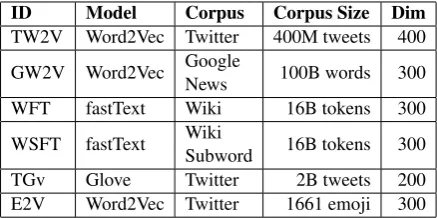
Word Vectors: Table 1summarizes all of the word embedding models we used in our imple-mentation. It illustrates the word embedding tech-niques and the dataset it is trained on and its spe-cific features as well. Additionally, it provides an identifier which we will be using to identify that word embedding in the next sections. Tweets can be represented as a word vector using the word2vec approach (Mikolov et al.,2013). GW2V has been obtained by training Word2vec on part of Google News dataset3. Similarly, Godin et al. (2015) has provided a word2vec model trained on twitter dataset (TW2V)4. Furthermore, fast-Text (Joulin et al., 2016) models are trained on trained on UMBC webbase corpus and statmt.org news dataset with and without subword infoma-tion (WSFT and WFT)5 (Mikolov et al., 2018). Glove (Pennington et al.,2014) embedding (TGv) has been trained on twitter corpus containing two billion tweets6. Eisner et al.(2016) has released emoji2vec (E2V)7a pre-trained embedding model for all Unicode emoji. Intended means of using E2V is as an extension to GW2V.
Transfer Features: Features generated by training a neural classifier on the training dataset, obtained from the last layer (layer before the out-put later).
3https://code.google.com/archive/p/word2vec/ 4
https://www.fredericgodin.com/software/
5
https://fasttext.cc/docs/en/english-vectors.html
6
https://nlp.stanford.edu/projects/glove/
Figure 1: High-level LSTM-CNN Architecture
Section Parameter Value LSTM Num. of units 250
CNN Num. of filters 350 Kernel Sizes 2, 3, 5
Pooling Method Max
Dense Layer Num. of units 50 Activation ReLU
[image:3.595.82.282.297.425.2]Output Layer Num. of Units 6 Activation Softmax
Table 2: Network Parameters for LSTM-CNN
3.3 Classifiers
The trial data provided in the competition is rea-sonably large for evaluating the model perfor-mance. As described in Section3.2, different com-binations of feature extractors were used. Follow-ing the feature extraction process, extracted fea-tures were used to train various neural networks.
3.3.1 LSTM-CNN
Two of the commonly used techniques to model text documents are Convolutional Neural Net-works (CNN) and Long short-term memory (LSTM) networks. Rather than developing the neural network with CNN and LSTM separately, the proposed system is developed using a combi-nation of CNN and LSTM. Figure1illustrates the proposed LSTM-CNN architecture. The hyper pa-rameters selected for this network are tabulated in Table2.
The network parameters are learned by opti-mizing the categorical cross-entropy between ac-tual and predicted category. Optimization is
per-Section Parameter Value
Hidden Layer 1 Num. of Units 50 Activation ReLU
[image:3.595.318.517.300.369.2]Hidden Layer 2 Num. of Units 25 Activation ReLU
Table 3: Network parameters for FNN
[image:3.595.321.521.549.664.2]formed through back propagation via mini-batch gradient descent. A batch size of 256 was used with 5 epochs to train the network. Furthermore, a dropout layer with dropout rate 0.2 is used before the dense layer when training. Adam optimization algorithm (Kingma and Ba, 2014) is used in this study for optimization . We have trained and eval-uated the system with each of the word embedding models stated in Table1.
Figure 2: High-level FNN Architecture
3.3.2 Feed-forward neural network
ID Features Trial Set Test Set Macro
Precision
Macro Recall
Macro
F1
Macro Precision
Macro Recall
Macro
F1
MT W2V T W2V 65.9 65.5 65.5 67.1 67.0 67.0
ME2V GW2V +E2V 63.7 63.6 63.6 65.6 65.1 65.2
MGW2V GW2V 64.4 62.6 62.9 65.4 63.7 63.8
MW T F W T F 65.3 64.1 64.3 65.5 65.1 65.2
MW ST F W ST F 62.5 62.0 62.0 63.9 62.2 62.5
MT Gv T Gv 63.4 63.2 63.2 63.9 63.9 63.9
[image:4.595.90.507.62.205.2]Baseline 60.1 60.1 60.1 - - 59.8
Table 4: Evaluation of LSTM-CNN for different word embeddings
Features Macro Precision
Macro Recall
Macro
F1
F(MT W2V)
++F(ME2V) 68.0 67.8 67.8
F(MT W2V)
++F(MW T F) 67.9 67.8 67.8
F(ME2V)
++F(MW T F) 67.1 66.7 66.8
F(ME2V) ++F(MT W2V) ++F(MW T F)
68.3 68.1 68.1
Baseline - - 59.8
IEST@WASSA
[image:4.595.72.292.242.436.2]2018 Best - - 71.45
Table 5: Results of FNN for different feature combina-tions
documents (Bengio et al., 2003). Furthermore, Tang et al. (2014) has used deep neural network for learning sentiment-specific word embedding.
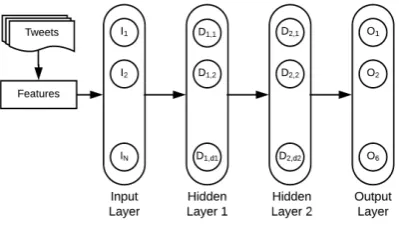
The proposed architecture of FNN is shown in Figure2and related hyper-parameters used in final system are provided in Table3.
Training parameters of the FNN is similar to that of LSTM-CNN model. Dropout layers were used in training after each hidden layer with dropout rate of0.5. Features used to train the FNN are transfered from dense layer of LSTM-CNN models trained with different embedding mod-els. Several feature vectors obtained from LSTM-CNN are concatenated and provided as input to FNN. The final system used features from LSTM-CNN models trained with embeddings: TW2V, GW2V + E2V and WFT.
3.3.3 Optimization
Hyper-parameters of the neural networks should be optimized to gain better performance. They were selected based on the results on the trial set and were optimized with both manual pro-cesses and with Tree of Parzen Estimators (TPE) (Bergstra et al.,2011). However, due to the lack of processing power and time limitations we were not able to perform a comprehensive analysis on different hyper-parameter variations.
3.3.4 Implementation Details
Python is used to implement the system with Keras (Chollet et al., 2015) with Tensor-flow (Abadi et al.) as the backend and Scikit-learn (Pedregosa et al., 2011) being the mostly used external libraries. Hyper-parameter optimization is performed with Hyperopt li-brary (Bergstra et al.,2013). Any hyper-parameter not mentioned in Section3defaults to their default values in respective library. Furthermore, we made our source code and trained models available on-line8.
4 Evaluation and Discussion
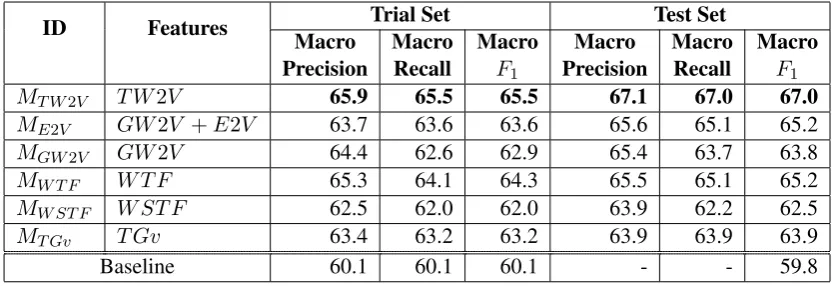
The first set of analyses examined the impact of LSTM-CNN models trained with different word embedding models. The results of the LSTM-CNN analysis are set out in Table 4. The train set evaluation is performed by training model on training dataset evaluating on trial set. Test set training data comprised of both training data and trial data.
It is apparent from this Table4 that the model has performed similarly for both trial dataset and test dataset, achieving similar/ betterF1scores and
variations from one feature to another. We observe
the best performance of the system when using Word2vec trained on twitter. This could be due to the fact that it contains in-domain vocabulary. What stands out in the table is the improvement of results of MGW2V with inclusion of Emoji2Vec.
It can thus be suggested that Emoji provide a sub-stantial support to finding emotion in implicit con-text. Furthermore, we observe that MW T F
per-forms better than MW ST F and can be suggested
that sub-word information provided by the embed-ding is not important in crating the model. An-other noteworthy observation is that all the mod-els indicated in Table 4 outperforms the baseline model in both trial and test cases, thus proving the effectiveness of the proposed model itself for im-plicit emotion prediction task.
In the next part of the analysis we used FNN trained using features extracted from LSTM-CNN models. Table5provides the evaluation results of these models on the test set. ‘++’ is used to repre-sent vector concatenation operation andf(M) de-notes a function that extracts the learned features form model M from the last dense layer in the neural network for a given input text. The evalua-tions are performed using the three best perform-ing LSTM-CNN models: MT W2V, MW T F and
ME2V. We have omitted MGW2V for this
anal-ysis since the word vector used to trainMGW2V is
already contained inME2V.
Results from Table4can be compared with the results in Table 5 which shows that the perfor-mance (precision, recall andF1) of models in the
latter has improved than the individual model vari-ants. Closer inspection of the Table5shows that the best models are obtained when features from
MT W2V andME2V are used together. The overall
best performance is obtained when features from
MT W2V,ME2V andMW T F are concatenated
to-gether.
5 Conclusion
This study is set out to propose a system for im-plicit emotion classification with state-of-the-art neural network classifiers. Additionally we in-vestigate the effectiveness of combinations of dif-ferent pre-trained embedding for implicit emotion classification of Tweets. In this study, a LSTM and a CNN are combined sequentially and trained with different pre-trained word embeddings to be used as a feature generator for a secondary feedforward neural network classifier to make the final
classi-fication. The results of this study indicate that the system performs well in implicit emotion identifi-cation and beats the baseline system by about8%
on the test set.
Furthermore the experiments support the idea that features extracted from several pre-trained word embedding models can be effectively com-bined to improve the overall classification per-formance . The most obvious finding to emerge from this study are that in-domain word embed-dings and Emoji embedembed-dings contribute in im-proving performance of implicit emotion classi-fication. The generalisability of these results is subject to certain limitations. For instance, this research does not focus on fine-tuning the model architectures to different word-embeddings. Al-though this gives a general ground in comparing word-embeddings for this task, it does not provide the justification for individual capabilities. Further research will have to be conducted in order to de-termine the best configurations for individual word embeddings and feature combinations to improve the overall performance of the system.
Acknowledgments
The research was supported by the DataSEARCH research centre for data science, engineering, and analytics at University of Moratuwa, Sri Lanka. We thank all the contributions made by the group to this research. We would also like to thank the organizers of IEST at WASSA-2018 for organiz-ing this shared task.
References
Mart´ın Abadi, Paul Barham, Jianmin Chen, Zhifeng Chen, Andy Davis, Jeffrey Dean, Matthieu Devin, Sanjay Ghemawat, Geoffrey Irving, Michael Isard, et al. Tensorflow: a system for large-scale machine learning.
Yoshua Bengio, R´ejean Ducharme, Pascal Vincent, and Christian Jauvin. 2003. A neural probabilistic lan-guage model. Journal of machine learning research, 3(Feb):1137–1155.
James Bergstra, Dan Yamins, and David D Cox. 2013. Hyperopt: A python library for optimizing the hyperparameters of machine learning algorithms. Citeseer.
Franc¸ois Chollet et al. 2015. Keras. https://
github.com/fchollet/keras.
Ben Eisner, Tim Rockt¨aschel, Isabelle Augenstein, Matko Boˇsnjak, and Sebastian Riedel. 2016. emoji2vec: Learning emoji representations from their description. arXiv preprint arXiv:1609.08359.
Fr´ederic Godin, Baptist Vandersmissen, Wesley De Neve, and Rik Van de Walle. 2015. Multimedia lab@acl wnut ner shared task: Named entity recog-nition for twitter microposts using distributed word representations. InProceedings of the Workshop on Noisy User-generated Text, pages 146–153.
Armand Joulin, Edouard Grave, Piotr Bojanowski, and Tomas Mikolov. 2016. Bag of tricks for efficient text classification. arXiv preprint arXiv:1607.01759.
Yoon Kim. 2014. Convolutional neural net-works for sentence classification. arXiv preprint arXiv:1408.5882.
Diederik P Kingma and Jimmy Ba. 2014. Adam: A method for stochastic optimization. arXiv preprint arXiv:1412.6980.
Roman Klinger, Orph´ee de Clercq, Saif M. Moham-mad, and Alexandra Balahur. 2018. Iest: Wassa-2018 implicit emotions shared task. InProceedings of the 9th Workshop on Computational Approaches to Subjectivity, Sentiment and Social Media Anal-ysis, Brussels, Belgium. Association for Computa-tional Linguistics.
Tomas Mikolov, Kai Chen, Greg Corrado, and Jef-frey Dean. 2013. Efficient estimation of word representations in vector space. arXiv preprint arXiv:1301.3781.
Tomas Mikolov, Edouard Grave, Piotr Bojanowski, Christian Puhrsch, and Armand Joulin. 2018. Ad-vances in pre-training distributed word representa-tions. InProceedings of the International Confer-ence on Language Resources and Evaluation (LREC 2018).
F. Pedregosa, G. Varoquaux, A. Gramfort, V. Michel, B. Thirion, O. Grisel, M. Blondel, P. Pretten-hofer, R. Weiss, V. Dubourg, J. Vanderplas, A. Pas-sos, D. Cournapeau, M. Brucher, M. Perrot, and E. Duchesnay. 2011. Scikit-learn: Machine learning in Python. Journal of Machine Learning Research, 12:2825–2830.
Jeffrey Pennington, Richard Socher, and Christopher Manning. 2014. Glove: Global vectors for word representation. InProceedings of the 2014 confer-ence on empirical methods in natural language pro-cessing (EMNLP), pages 1532–1543.
Richard Socher, Alex Perelygin, Jean Wu, Jason Chuang, Christopher D Manning, Andrew Ng, and Christopher Potts. 2013. Recursive deep models for semantic compositionality over a sentiment tree-bank. In Proceedings of the 2013 conference on
empirical methods in natural language processing, pages 1631–1642.
Duyu Tang, Furu Wei, Bing Qin, Ting Liu, and Ming Zhou. 2014. Coooolll: A deep learning system for twitter sentiment classification. In Proceedings of the 8th international workshop on semantic evalua-tion (SemEval 2014), pages 208–212.
Nam Khanh Tran and Weiwei Cheng. 2018. Mul-tiplicative tree-structured long short-term memory networks for semantic representations. In Proceed-ings of the Seventh Joint Conference on Lexical and Computational Semantics, pages 276–286.