A Comparative Study on Regularization Strategies
for Embedding-based Neural Networks
Hao Peng∗,1 Lili Mou,∗1 Ge Li,†1 Yunchuan Chen,2 Yangyang Lu,1 Zhi Jin1
1Software Institute, Peking University, 100871, P. R. China
{penghao.pku, doublepower.mou}@gmail.com,{lige, luyy11, zhijin}@sei.pku.edu.cn
2University of Chinese Academy of Sciences, [email protected]
Abstract
This paper aims to compare different reg-ularization strategies to address a com-mon phenomenon, severe overfitting, in embedding-based neural networks for NLP. We chose two widely studied neu-ral models and tasks as our testbed. We tried several frequently applied or newly proposed regularization strategies, including penalizing weights (embeddings excluded), penalizing embeddings, re-embedding words, and dropout. We also emphasized on incremental hyperparame-ter tuning, and combining different regu-larizations. The results provide a picture on tuning hyperparameters for neural NLP models.
1 Introduction
Neural networks have exhibited considerable po-tential in various fields (Krizhevsky et al., 2012; Graves et al., 2013). In early years on neural NLP research, neural networks were used in lan-guage modeling (Bengio et al., 2003; Morin and Bengio, 2005; Mnih and Hinton, 2009); recently, they have been applied to various supervised tasks, such as named entity recognition (Collobert and Weston, 2008), sentiment analysis (Socher et al., 2011; Mou et al., 2015), relation classification (Zeng et al., 2014; Xu et al., 2015), etc. In the field of NLP, neural networks are typically combined with word embeddings, which are usually first pre-trained by unsupervised algorithms like Mikolov et al. (2013); then they are fed forward to standard neural models, fine-tuned during supervised learn-ing. However, embedding-based neural networks usually suffer from severe overfitting because of the high dimensionality of parameters.
∗Equal contribution. †Corresponding author.
A curious question is whether we can regular-ize embedding-based NLP neural models to im-prove generalization. Although existing and newly proposed regularization methods might alleviate the problem, their inherent performance in neural NLP models is not clear: the use of embeddings is sparse; the behaviors may be different from those in other scenarios like image recognition. Further, selecting hyperparameters to pursue the best performance by validation is extremely time-consuming, as suggested in Collobert et al. (2011). Therefore, new studies are needed to provide a more complete picture regarding regularization for neural natural language processing. Specifically, we focus on the following research questions in this paper.
RQ 1: How do different regularization strategies typically behave in embedding-based neural networks?
RQ 2: Can regularization coefficients be tuned in-crementally during training so as to ease the burden of hyperparameter tuning?
RQ 3: What is the effect of combining different regularization strategies?
In this paper, we systematically and quan-titatively compared four different regularization strategies, namely penalizing weights, penalizing embeddings, newly proposed word re-embedding (Labutov and Lipson, 2013), and dropout (Srivas-tava et al., 2014). We analyzed these regulariza-tion methods by two widely studied models and tasks. We also emphasized on incremental hyper-parameter tuning and the combination of different regularization methods.
Our experiments provide some interesting re-sults: (1) Regularizations do help generalization, but their effect depends largely on the datasets’
size. (2) Penalizing`2-norm of embeddings helps
optimization as well, improving training accu-racy unexpectedly. (3) Incremental hyperparam-eter tuning achieves similar performance,
tary. (5) The newly proposed re-embedding words method is not effective in our experiments.
2 Tasks, Models, and Setup
Experiment I: Relation extraction. The dataset in this experiment comes from SemEval-2010
Task 8.1 The goal is to classify the relationship
between two marked entities in each sentence. We refer interested readers to recent advances, e.g., Hashimoto et al. (2013), Zeng et al. (2014), and Xu et al. (2015). To make our task and model general, however, we do not consider entity tag-ging information; we do not distinguish the order of two entities either. In total, there are 10 labels,
i.e., 9 different relations plus a defaultother.
Regarding the neural model, we applied Col-lobert’s convolutional neural network (CNN) (Collobert and Weston, 2008) with minor modi-fications. The model comprises a fixed-window
convolutional layer with size equal to 5,0padded
at the end of each sentence; a max pooling layer;
atanhhidden layer; and asoftmaxoutput layer.
Experiment II: Sentiment analysis. This is another testbed for neural NLP, aiming to pre-dict the sentiment of a sentence. The dataset is the Stanford sentiment treebank (Socher et al.,
2011)2; target labels are strongly/weakly
positive/negative, orneutral.
We used the recursive neural network (RNN), which is proposed in Socher et al. (2011), and fur-ther developed in Socher et al. (2012); Irsoy and Cardie (2014). RNNs make use of binarized con-stituency trees, and recursively encode children’s information to their parent’s; the root vector is fi-nally used for sentiment classification.
Experimental Setup. To setup a fair compari-son, we set all layers to be 50-dimensional in ad-vance (rather than by validation). Such setting has been used in previous work like Zhao et al. (2015). Our embeddings are pretrained on the Wikipedia corpus using Collobert and Weston (2008). The learning rate is 0.1 and fixed in Experiment I; for RNN, however, we found learning rate decay helps to prevent parameter blowup (probably due
1http://www.aclweb.org/anthology/S10-1006 2http://nlp.stanford.edu/sentiment/
no effect with granularity 10x. We ran the model 5 times with different initializations. We used mini-batch stochastic gradient descent; gradients are computed by standard backpropagation. For
source code, please refer to our project website.3
It needs to be noticed that, the goal of this paper is not to outperform or reproduce state-of-the-art results. Instead, we would like to have a fair com-parison. The testbed of our work is two widely studied models and tasks, which were not chosen on purpose. During the experiments, we tried to make the comparison as fair as possible. There-fore, we think that the results of this work can be generalized to similar scenarios.
3 Regularization Strategies
In this section, we describe four regularization strategies used in our experiment.
• Penalizing`2-norm of weights. LetEbe the
cross-entropy error for classification, and R
be a regularization term. The overall cost
function isJ =E+λR, whereλis the
co-efficient. In this case, R = kWk2, and the
coefficient is denoted asλW.
• Penalizing `2-norm of embeddings. Some
studies do not distinguish embeddings or connectional weights for regularization (Tai et al., 2015). However, we would like to an-alyze their effect separately, for embeddings
are sparse in use. LetΦdenote embeddings;
then we haveR =kΦk2.
• Re-embedding words (Labutov and Lipson,
2013). SupposeΦ0 denotes the original
em-beddings trained on a large corpus, andΦ
de-notes the embeddings fine-tuned during su-pervised training. We would like to penalize
the norm of the difference betweenΦ0andΦ,
i.e.,R=kΦ0−Φk2. In the limit of penalty to
infinity, the model is mathematically equiv-alent to “frozen embeddings,” where word vectors are used as surface features.
• Dropout (Srivastava et al., 2014). In this
strategy, each neural node is set to 0 with a
predefined dropout probabilitypduring
train-ing; when testing, all nodes are used, with
ac-tivation multiplied by1−p.
0 5 10 15 20 25 Epochs
10 20 30 40 50 60 70 80 90 100
Accuracy (%) λW = 0
λW = 10−5
λW = 10−4
λW = 10−3 Training Validation
(a) Penalizing weights in Experiment I.
0 10 20 30 40 50 60 70 80
Epochs 15
20 25 30 35 40 45 50 55
Accuracy (%) λW = 0
λW = 10−5
λW = 10−4
λW = 10−3 Training Validation
(b) Penalizing weights in Experiment II.
0 5 10 15 20 25
Epochs 10
20 30 40 50 60 70 80 90 100
Accuracy (%) λb = 0
λb = 10−5
λb = 10−4
λb = 10−3 Training Validation
(c) Penalizing embeddings in Experiment I.
0 10 20 30 40 50 60 70 80
Epochs 20
30 40 50 60
Accuracy (%) λb = 0
λb = 10−5
λb = 10−4
λb = 10−3 Training Validation
(d) Penalizing embeddings in Experiment II.
0 5 10 15 20 25
Epochs 10
20 30 40 50 60 70 80 90 100
Accuracy (%) λreembed = 0
λreembed = 10−5
λreembed = 10−4
λreembed = 10−3
Training Validation
(e) Re-embedding words in Experiment I.
0 10 20 30 40 50 60 70 80
Epochs 20
25 30 35 40 45 50 55
Accuracy (%) λreembed = 0
λreembed = 10−5
λreembed = 10−4
λreembed = 10−3
Training Validation
(f) Re-embedding words in Experiment II.
0 5 10 Epochs 15 20 25
10 20 30 40 50 60 70 80 90 100
Accuracy (%)
pdrop = 0
pdrop = 0.1
pdrop = 0.2
pdrop = 0.3
pdrop = 0.4
pdrop = 0.7 Training Validation
(g) Applying dropout in Experiment I.p= 0.5,0.6
are omitted because they are similar to small values.
0 10 20 30 40 50 60 70 80
Epochs 15
20 25 30 35 40 45 50 55
Accuracy (%)
pdrop = 0
pdrop = 0.1
pdrop = 0.2
pdrop = 0.3
pdrop = 0.4
pdrop = 0.5 Training Validation
[image:3.595.88.505.66.699.2](h) Applying dropout in Experiment II.
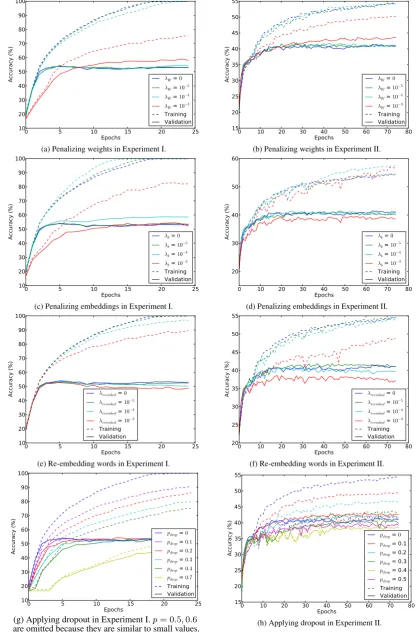
Figure 1: Averaged learning curves. Left: Experiment I, relation extraction with CNN. Right: Experiment II, sentiment
0.84%,41.47±2.85%, respectively. Then we plot in Figure 1 learning curves when each regulariza-tion strategy is applied individually. We report training and validation accuracies through out this paper. The main findings are as follows.
• Penalizing `2-norm of weights helps
gener-alization; the effect depends largely on the size of training set. Experiment I contains 7,000 training samples and the improvement is 6.98%; Experiment II contains more than 150k samples, and the improvement is only 2.07%. Such results are consistent with other machine learning models.
• Penalizing`2-norm of embeddings
unexpect-edly helps optimization (improves training accuracy). One plausible explanation is that since embeddings are trained on a large cor-pus by unsupervised methods, they tend to settle down to large values and may not
per-fectly agree with the tasks of interest. `2
penalty pushes the embeddings towards small values and thus helps optimization. Regard-ing validation accuracy, Experiment I is im-proved by 6.89%, whereas Experiment II has no significant difference.
• Re-embedding words does not improve
gen-eralization. Particularly, in Experiment II, the ultimate accuracy is improved by 0.44, which is not large. Further, too much penalty hurts the models in both experiments. In the
limitλreembedto infinity, re-embedding words
is mathematically equivalent to using embed-dings as surface features, that is, freezing em-beddings. Such strategy is sometimes applied in the literature like Hu et al. (2014), but is not favorable as suggested by the experiment.
• Dropout helps generalization. Under the best
settings, the eventual accuracy is improved by 3.12% and 1.76%, respectively. In our ex-periments, dropout alone is not as useful as
`2penalty. However, other studies report that
dropout is very effective (Irsoy and Cardie, 2014). Our results are not consistent; differ-ent dimensionality may contribute to this dis-agreement, but more experiments are needed to confirm the hypothesis.
perparameters through validation. Unfortunately, training deep neural networks is time-consuming, preventing full grid search from being a practical technique. Things will get easier if we can incre-mentally tune hyperparameters, that is, to train the model without regularization first, and then add penalty.
In this section, we study whether `2 penalty of
weights and embeddings can be tuned incremen-tally. We exclude the dropout strategy because its does not make much sense to incrementally drop out hidden units. Besides, from this section, we only focus on Experiment I due to time and space limit.
Before continuing, we may envision several possibilities on how regularization works.
• (On initial effects) As`2-norm prevents
pa-rameters from growing large, adding it at early stages may cause parameters settling down to local optima. If this is the case, de-layed penalty would help parameters get over local optima, leading to better performance.
• (On eventual effects) `2 penalty lifts
er-ror surface of large weights. Adding such penalty may cause parameters settling down to (a) almost the same catchment basin, or (b) different basins. In case (a), when the penalty is added does not matter much. In case (b), however, it makes difference, because param-eters would have already gravitated to catch-ment basins of larger values before regular-ization is added, which means incremental hyperparameter tuning would be ineffective. To verify the above conjectures, we design four settings: adding penalty (1) at the beginning, (2) before overfitting at epoch 2, (3) at peak perfor-mance (epoch 5), and (4) after overfitting (valida-tion accuracy drops) at epoch 10.
Figure 2 plots the learning curves regarding pe-nalizing weights and embeddings, respectively; baseline (without regularization) is also included.
For both weights and embeddings, all settings yield similar ultimate validation accuracies. This
shows`2 regularization mainly serves as a “local”
0 10 20 30 Epochs40 50 60 70 80 10
20 30 40 50 60 70 80 90 100
Accuracy (%) Reg at epoch 0Reg at epoch 2 Reg at epoch 5 Reg at epoch 10 No regularization Training Validation
(a) Incrementally penalizing`2-norm of weights.
0 10 20 30 Epochs40 50 60 70 80 10
20 30 40 50 60 70 80 90 100
Accuracy (%) Reg at epoch 0Reg at epoch 2 Reg at epoch 5 Reg at epoch 10 No regularization Training Validation
[image:5.595.101.501.63.219.2](b) Incrementally penalizing`2-norm of biases.
Figure 2: Tuning hyperparameters incrementally in Experiment I. Penalty is added at epochs 0, 2, 5, 10, respectively. We chose the coefficients yielding the best performance in Figure 1. The controlled trial (no regularization) is early stopped because the accuracy has already decreased.
λW
λembed 0 10−4 3·10−4 10−3
0 54.02 57.88 59.96 61.00
10−5 54.94 57.82 60.68 62.05
3·10−5 55.68 61.02 64.00 63.15
10−4 60.91 64.00 63.07 60.56
3·10−4 58.92 61.33 59.85 42.93
[image:5.595.91.269.268.365.2]10−3 54.77 56.43 54.05 16.50 Table 1: Accuracy in percentage when we
com-bine`2-norm of weights and embeddings
(Exper-iment I). Bold numbers are among highest accu-racies (greater than peak performance minus 1.5 times standard deviation, i.e., 1.26 in percentage).
λW λembed
p 10–4 3·10–4 10–3 10–5 3·10–5 10–4
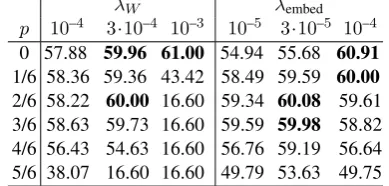
0 57.88 59.96 61.00 54.94 55.68 60.91 1/6 58.36 59.36 43.42 58.49 59.59 60.00 2/6 58.22 60.00 16.60 59.34 60.08 59.61 3/6 58.63 59.73 16.60 59.59 59.98 58.82 4/6 56.43 54.63 16.60 56.76 59.19 56.64 5/6 38.07 16.60 16.60 49.79 53.63 49.75
Table 2: Combining`2regularization and dropout.
Left: connectional weights. Right: embeddings.
(prefers to the dropout rate.)
may not play an important role in training neural networks, if the effect of parameter symmetry is ruled out (Breuel, 2015).
We also observe that regularization helps gener-alization as soon as it is added (Figure 2a), and that regularizing embeddings helps optimization also right after the penalty is applied (Figure 2b).
6 Combination of Regularizations
We are further curious about the behaviors when different regularization methods are combined.
Table 1 shows that combining `2-norm of
weights and embeddings results in a further accu-racy improvement of 3–4 percents from applying
either single one of them. In a certain range of coefficients, weights and embeddings are comple-mentary: given one hyperparameter, we can tune the other to achieve a result among highest ones.
Such compensation is also observed in
penal-izing`2-norm versus dropout (Table 2)—although
the peak performance is obtained by pure`2
regu-larization, applying dropout with small`2penalty
also achieves a similar accuracy. The dropout rate is not very sensitive, provided it is small.
7 Discussion
In this paper, we systematically compared four regularization strategies for embedding-based neural networks in NLP. Based on the experimen-tal results, we answer our research questions as follows. (1) Regularization methods (except re-embedding words) basically help generalization.
Penalizing `2-norm of embeddings unexpectedly
helps optimization as well. Regularization perfor-mance depends largely on the dataset’s size. (2)
`2 penalty mainly acts as a local effect;
hyperpa-rameters can be tuned incrementally. (3)
Combin-ing`2-norm of weights and biases (dropout and`2
penalty) further improves generalization; their co-efficients are mostly complementary within a cer-tain range. These empirical results of regulariza-tion strategies shed some light on tuning neural models for NLP.
Acknowledgments
[image:5.595.83.278.438.531.2]Thomas M. Breuel. 2015. The effects of hyperpa-rameters on sgd training of neural networks. arXiv preprint arXiv:1508.02788.
Ronan Collobert and Jason Weston. 2008. A unified architecture for natural language processing: Deep neural networks with multitask learning. In Pro-ceedings of the 25th International Conference on Machine learning.
Ronan Collobert, Jason Weston, L´eon Bottou, Michael Karlen, Koray Kavukcuoglu, and Pavel Kuksa. 2011. Natural language processing (almost) from scratch. The Journal of Machine Learning Re-search, 12:2493–2537.
Alex Graves, Abdel-rahman Mohamed, and Geoffrey Hinton. 2013. Speech recognition with deep recur-rent neural networks. InProceedings of 2013 IEEE International Conference on Acoustics, Speech and Signal Processing.
Kazuma Hashimoto, Makoto Miwa, Yoshimasa Tsu-ruoka, and Takashi Chikayama. 2013. Simple cus-tomization of recursive neural networks for semantic relation classification. In Proceedings of the 2013 Conference on Empirical Methods in Natural Lan-guage Processing.
Baotian Hu, Zhengdong Lu, Hang Li, and Qingcai Chen. 2014. Convolutional neural network archi-tectures for matching natural language sentences. InAdvances in Neural Information Processing Sys-tems.
Ozan Irsoy and Claire Cardie. 2014. Deep recursive neural networks for compositionality in language. InAdvances in Neural Information Processing Sys-tems.
Alex Krizhevsky, Ilyz Sutskever, and Geoffrey Hinton. 2012. ImageNet classification with deep convolu-tional neural networks. InAdvances in Neural In-formation Processing Systems.
Igor Labutov and Hod Lipson. 2013. Re-embedding words. InProceedings of the 51st Annual Meeting of the Association for Computational Linguistics (Vol-ume 2).
Tomas Mikolov, Ilya Sutskever, Kai Chen, Greg Cor-rado, and Jeffrey Dean. 2013. Distributed represen-tations of words and phrases and their composition-ality. InAdvances in Neural Information Processing Systems.
Andriy Mnih and Geoffrey Hinton. 2009. A scal-able hierarchical distributed language model. In Ad-vances in Neural Information Processing Systems.
Zhi Jin. 2015. Tree-based convolution: A new neu-ral architecture for sentence modeling. In Proceed-ings of Conference on Empirical Methods in Natural Language Processing (to appear).
Andrew Senior, Georg Heigold, Marc’aurelio Ranzato, and Ke Yang. 2013. An empirical study of learning rates in deep neural networks for speech recognition. InProceedings of 2013 IEEE International Confer-ence on Acoustics, Speech and Signal Processing. Richard Socher, Jeffrey Pennington, Eric Huang,
An-drew Ng, and Christopher D. Manning. 2011. Semi-supervised recursive autoencoders for predict-ing sentiment distributions. In Proceedings of the Conference on Empirical Methods in Natural Lan-guage Processing.
Richard Socher, Brody Huval, Christopher D. Man-ning, and Andrew Ng. 2012. Semantic composi-tionality through recursive matrix-vector spaces. In
Proceedings of the 2012 Joint Conference on Empir-ical Methods in Natural Language Processing and Computational Natural Language Learning. Nitish Srivastava, Geoffrey Hinton, Alex Krizhevsky,
Ilya Sutskever, and Ruslan Salakhutdinov. 2014. Dropout: A simple way to prevent neural networks from overfitting. The Journal of Machine Learning Research, pages 1929–1958.
Kai Sheng Tai, Richard Socher, and Christopher D. Manning. 2015. Improved semantic representations from tree-structured long short-term memory net-works. InProceedings of the 53rd Annual Meeting of the Association for Computational Linguistics. Yan Xu, Lili Mou, Ge Li, Yunchuan Chen, Hao Peng,
and Zhi Jin. 2015. Classifying relations via long short term memory networks along shortest depen-dency paths. InProceedings of Conference on Em-pirical Methods in Natural Language Processing (to appear).
Daojian Zeng, Kang Liu, Siwei Lai, Guangyou Zhou, and Jun Zhao. 2014. Relation classification via con-volutional deep neural network. In Proceedings of Computational Linguistics.