Can Symbol Grounding Improve Low-Level NLP?
Word Segmentation as a Case Study
Hirotaka Kameko†, Shinsuke Mori‡, and Yoshimasa Tsuruoka† †Graduate School of Engineering, The University of Tokyo
Hongo, Bunkyo-ku, Tokyo, Japan
{kameko, tsuruoka}@logos.t.u-tokyo.ac.jp ‡Academic Center for Computing and Media Studies, Kyoto University
Yoshida Honmachi, Sakyo-ku, Kyoto, Japan
[email protected] Abstract
We propose a novel framework for im-proving a word segmenter using informa-tion acquired from symbol grounding. We generate a term dictionary in three steps: generating a pseudo-stochastically seg-mented corpus, building a symbol ground-ing model to enumerate word candidates, and filtering them according to the ground-ing scores. We applied our method to game records of Japanese chess with com-mentaries. The experimental results show that the accuracy of a word segmenter can be improved by incorporating the gener-ated dictionary.
1 Introduction
Today we can easily obtain a large amount of text associated with multi-modal information, and there is a growing interest in the use of non-textual information in the natural language pro-cessing (NLP) community. Many of these studies aim to output natural language sentences from a nonlinguistic modality, such as image (Farhadi et al., 2010; Yang et al., 2011; Rohrbach et al., 2013). Kiros et al. (2014) showed that multi-modal infor-mation improves the performance of a language model.
Inspired by these studies, we explore a method for improving the performance of a low-level NLP task using multi-modal information. In this work, we focus on the task of word segmentation (WS) in Japanese. WS is often performed as the first processing step for languages without clear word boundaries, and it is as important as part-of-speech (POS) tagging in English. We assume that a large set of pairs of non-textual data and sentences describing them is available as the information source. In our experiments, the pairs consist of game states inShogi(Japanese chess) and textual
comments on them, which were made by Shogi experts. We enumerate substrings (character se-quences) in the sentences and match them with
Shogi states by a neural network model. The ra-tionale here is that substrings which match with non-language data well tend to be real words.
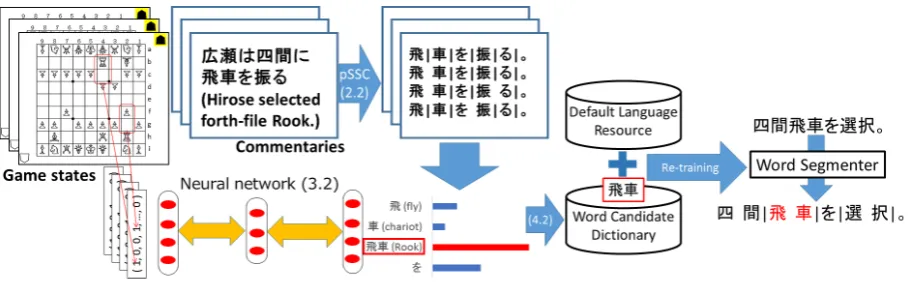
Our method consists of three steps (see Figure 1). First, we segment commentary sentences for a game state in various ways to produce word can-didates. Then, we match them with game states of a Shogi playing program. Finally, we compile the symbol grounding results at all states and incorpo-rate them to an automatic WS. To the best of our knowledge, this is the first result reporting a per-formance improvement in an NLP task by symbol grounding.
2 Stochastically Segmented Corpus
Before symbol grounding, we need to segment the text into words that include probable candi-date words. For this purpose, we use a stochasti-cally segmented corpus (SSC) (Mori and Takuma, 2004). Then we propose to simulate it by a normal (deterministically) segmented corpus to avoid the problem of computational cost.
2.1 Stochastically Segmented Corpora
An SSC is defined as a combination of a raw corpus Cr (hereafter referred to as the character
sequence xnr1 ) and word boundary probabilities of the form Pi, which is the probability that a word boundary exists between two characters xi
andxi+1. These probabilities are estimated by a
model based on logistic regression (LR) (Fan et al., 2008) trained on a manually segmented cor-pus by referring to the surrounding characters1.
Since there are word boundaries before the first character and after the last character of the corpus,
P0=Pnr = 1. The expected frequency of a word 1In the experiment we used the same features as those
used in Neubig et al., (2011). .
Figure 1: Overview of our method.
w in an SSC is calculated as follows: fr(w) =
∑
i∈OPi{∏kj=1−1(1−Pi+j)
}
Pi+k, where O =
{i | xii++1k = w} is the set of all the occurrences of the string matching withw2.
2.2 Pseudo-Stochastically Segmented Corpora
The computational cost (in terms of both time and space) for calculating the expected frequen-cies in an SSC is very high3, so it is not a
prac-tical approach for symbol grounding. In this work, we approximate an SSC using a determinis-tically segmented corpus, which we call a pseudo-stochastically segmented corpus (pSSC). The fol-lowing is the process we use to produce a pSSC from an SSC.
• Fori= 1 tonr−1
1. output a characterxi,
2. generate a random number0≤p <1, 3. output a word boundary ifp < Pior
output nothing otherwise.
Now we have a corpus in the same format as a standard segmented corpus with variable (non-constant) segmentation, where xi and xi+1 are
segmented with the probability of Pi. We
exe-cute the above procedure mtimes and divide the counts bym. The law of large numbers guarantees that the approximation errors decrease to 0 when
m→ ∞.
3 Symbol Grounding
As the target of symbol grounding, we use states (piece positions) of a Shogi game and
commen-2For a detailed explanation and a mathematical proof of
this method, please refer to Mori and Takuma (2004) .
3This is because an SSC has many words and word
frag-ments. Additionally, word 1-gram frequencies must be cal-culated using floating point numbers instead of integers.
taries associated with them. We should note, how-ever, that our framework is general and applica-ble to different types of combinations such as im-age/description pairs (Regneri et al., 2013).
3.1 Game Commentary
The Japanese language is one of the languages without clear word boundaries and we need an au-tomatic WS as the first step of NLP. In Shogi, there are many professional players and many commen-taries about game states are available.
3.2 Grounding Words
We build a symbol grounding model using a Shogi commentary dataset. We use a set of pairs of a Shogi stateSi and a commentary sentence Ci as
the training set. A Shogi stateSiis converted into
a feature vector f(Si). We generatem(in our ex-periment,m = 4) pSSCC′
i fromCi. Ci′ contains m corpora of the same text body but with differ-ent word segmdiffer-entation, C′
ij (j = 1, . . . , m). We
treat these asmpairs of a feature vector of Shogi state f(Si)and a sequence of wordsCij′ . We train
a model which predicts words inC′
ij using f(Si)
as input.
We use a multi-layer perceptron as the predic-tion model. The input is a vector of the features of a state. The hidden layer is a 100-dimensional vector and is activated by a bipolar sigmoid func-tion. Its output is ad-dimensional real-valued vec-tor, each of whose elements indicates whether a word in the vocabulary ofdwords appears in the commentary or not. The output layer is activated by a binary sigmoid function.
We use features of Shogi states which a com-puter Shogi program called Gekisashi (Tsuruoka et al., 2002) uses to evaluate the states in game tree search as input. The features of Shogi states used in this experiment are below:
b) Pieces captured (e.g. the opponent has a bishop).
c) Combinations of a) and b) (e.g. my king is at 7h and the opponent’s rook is at 7b).
d) Other heuristic features.
Among them, a), b) and c) occupy the majority. Unlike normal symbol grounding, the vocabu-lary contains many word candidates appearing in the pSSC generated from the commentaries. Some are real words and some are wrong fragments. These wrong fragments will appear more or less randomly in the commentaries than real words. The perceptron therefore cannot acquire strong re-lation between states and fragments and the output values of the perceptron will be smaller than those of real words.
4 Word Segmentation Using Symbol Grounding Result
This section describes a baseline automatic word segmenter and a method for incorporating the symbol grounding result to it.
4.1 Baseline Word Segmenter
Among many Japanese WS and morphological an-alyzers (word segmentation and POS tagging), we adopt pointwise WS (Neubig et al., 2011), because it is the only word segmenter which is capable of adding new words without POS information.
The input of the pointwise WS is an unseg-mented character sequencex =x1x2· · ·xk. The
word segmenter decides if there is a word bound-aryti = 1or notti = 0 by using support vector
machines (SVMs) (Fan et al., 2008). The features are charactern-grams and character typen-grams (n= 1,2,3) around the decision points in a win-dow with a width of 6 characters. Additional fea-tures are triggered if charactern-grams in the win-dow match with character sequences in the dictio-nary.
4.2 Training a Word Segmenter with Grounded Words
[image:3.595.307.523.64.216.2]As a first trial for incorporating symbol ground-ing results to an NLP task, we propose to gener-ate a dictionary based on the symbol grounding result. We can expect that the word candidates that are given high scores by the perceptron in the symbol grounding result have strong relationship to the positions. In other words, we can make a good dictionary by selecting word candidates in descending order of the scores. As a method for
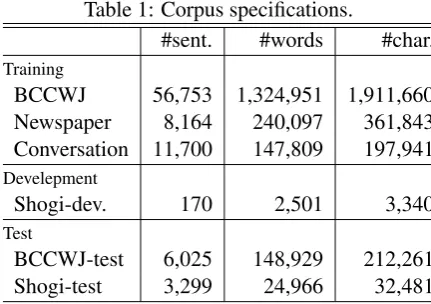
Table 1: Corpus specifications.
#sent. #words #char.
Training
BCCWJ 56,753 1,324,951 1,911,660 Newspaper 8,164 240,097 361,843 Conversation 11,700 147,809 197,941
Develepment
Shogi-dev. 170 2,501 3,340
Test
BCCWJ-test 6,025 148,929 212,261 Shogi-test 3,299 24,966 32,481
taking all the occurrences into account, we test the following three functions:
sum: the summation of the scores of all the out-put vectors,
ave: the average of them,
max: the maximum in them.
First, we acquire aV-dimensional real-valued vec-tor for each Shogi stateSi as the result of symbol grounding. Then, for each candidate in C′
ij, we
get the element of the vector which corresponds to the candidate as the score of the candidate. After that, we get the summation of, the average of, or the maximum in the scores of the same candidate over the whole dataset.
Finally we select the topRpercent of word can-didates in descending order of the value ofsum,
ave, or max and add them to the WS dictionary and retrain the model.
5 Evaluation
We conducted word segmentation experiments in the following settings.
5.1 Corpora
The annotated corpus we used to build the base-line word segmenter is the manually annotated part (core data) of the Balanced Corpus of Con-temporary Written Japanese (BCCWJ) (Maekawa, 2008), plus newspaper articles and daily conver-sation sentences. We also used a 234,652-word dictionary (UniDic) provided with the BCCWJ. A small portion of the BCCWJ core data is re-served for testing. In addition, we manually seg-mented sentences randomly obtained from Shogi commentaries. We divided these sentences into two parts: a development set and a test set. Ta-ble 1 shows the details of these corpora.
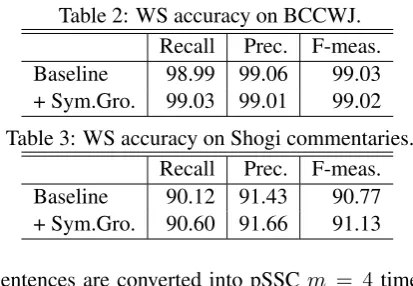
Table 2: WS accuracy on BCCWJ. Recall Prec. F-meas. Baseline 98.99 99.06 99.03 + Sym.Gro. 99.03 99.01 99.02 Table 3: WS accuracy on Shogi commentaries.
Recall Prec. F-meas. Baseline 90.12 91.43 90.77 + Sym.Gro. 90.60 91.66 91.13
sentences are converted into pSSC m = 4 times by an LR word segmentation model trained from the training data in Table 1 and sent to the symbol grounding module.
5.2 Word Segmentation Systems
We built the following two word segmentation models (Neubig et al., 2011) to evaluate our framework.
Baseline: The model is trained from training data shown in Table 1 and UniDic.
+Sym.Gro.: The model is trained from the lan-guage resources for the Baseline and the symbol grounding result.
To decide the function and the value ofR for
+Sym.Gro. (see Section 4.2), we measured the accuracies on the development set of all the com-binations. The best combination was sum and
R = 0.0114. In this case, 127 words were added
to the dictionary.
5.3 Results and Discussion
Following the standard in word segmentation ex-periments, the evaluation criteria are recall, preci-sion, and F-measure (their harmonic mean).
Table 2 and 3 show WS accuracies on BCCWJ-test and Shogi-BCCWJ-test, respectively. The difference in accuracy of the baseline method on BCCWJ-test and Shogi-test shows that WS of Shogi commen-taries is very difficult. Like many other domains, Shogi commentaries contain many special words and expressions, which decrease the accuracy.
When we compare the F-measures on Shogi-test (Table 3),+Sym.Gro. outperformsBaseline. The improvement is statistically significant (at 5% level). The error reduction ratio is comparable to a natural annotation case (Liu et al., 2014), despite the fact that our method is unsupervised except for
4In addition we measured the accuracies on the test set of
all the combinations and found that the same function and the value of the parameter are the best. This indicates the stability of the function and the parameter.
a hyperparameter. Thus we can say that WS im-provement by symbol grounding is as valuable as the annotation additions.
From a close look at the comparison of the re-call and the precision, we see that the improve-ment in the recall is higher than that of the preci-sion. This result shows that the symbol grounding successfully acquired new words with a few erro-neous words. As the final remark, the result on the general domain (Table 2) shows that our frame-work does not cause a severe performance degra-dation in the general domain.
6 Related Work
The NLP task we focus on in this paper is word segmentation. One of the first empirical methods was based on a hidden Markov model (Nagata, 1994). In parallel, there were attempts at solv-ing Chinese word segmentation in a similar way (Sproat and Chang, 1996). These methods take words as the modeling unit.
Recently, Neubig et al. (2011) have presented a method for directly deciding whether there is a word boundary or not at each point between char-acters. For Chinese word segmentation, there are some attempts at tagging characters with BIES tags (Xue, 2003) by a sequence labeller such as CRFs (Lafferty et al., 2001), where B, I, E, and S means the beginning of a word, intermediate of a word, the end of a word, and a single charac-ter word, respectively. The pointwise WS can be seen as character tagging with the BI tag system, in which there is no constraint between neighbor-ing tags. For Japanese WS, our preliminary exper-iments showed that the combination of the BI tag system with SVMs is slightly better than the BIES tag system with CRFs. This is another reason why we used the former in this paper. Our extension of word segmentation is, however, applicable to the BIES/CRFs combination as well.
Kuro-hashi (2008) proposed an online method in a sim-ilar setting. In contrast to these studies, this paper proposes to use other modalities, game states as the first trial, than languages.
7 Conclusion
We have described an unsupervised method for improving word segmentation based on symbol grounding results. To extract word candidates from raw sentences, we first segment sentences stochastically, and then match the word candidate sequences with game states that are described by the sentences. Finally, we selected word candi-dates referring to the grounding scores. The exper-imental results showed that we can improve word segmentation by using symbol grounding results. Our framework is general and it is worth testing on other NLP tasks. As future work, we will apply other deep neural network models to our approach. It is interesting to apply the symbol grounding re-sults to an embedding model-based word segmen-tation approach (Ma and Hinrichs, 2015). It is also interesting to extend our method to deal with other types of non-textual information such as images and economic indices.
Acknowledgment
We thank the anonymous reviewers for their help-ful comments and suggestions. This work was supported by JSPS Grants-in-Aid for Scientific Research Grant Number 26540190.
References
Rong-En Fan, Kai-Wei Chang, Cho-Jui Hsieh, Xiang-Rui Wang, and Chih-Jen Lin. 2008. LIBLINEAR: A library for large linear classification. Journal of Machine Learning Research, 9:1871–1874.
Ali Farhadi, Mohsen Hejrati, Mohammad Amin Sadeghi, Peter Young, Cyrus Rashtchian, Julia Hockenmaier, and David Forsyth. 2010. Every pic-ture tells a story: Generating sentences from images. InProceedings of the 11th European Conference on Computer Vision, pages 15–29.
Wenbin Jiang, Meng Sun, Yajuan Lu, Yating Yang, and Qun Liu. 2013. Discriminative learning with natu-ral annotations: Word segmentation as a case study. InProceedings of the 51st Annual Meeting of the As-sociation for Computational Linguistics, pages 761– 769.
Ryan Kiros, Ruslan Salakhutdinov, and Rich Zemel. 2014. Multimodal neural language models. In Pro-ceedings of the 31st International Conference on Machine Learning, pages 595–603.
John Lafferty, Andrew McCallum, and Fernando Pereira. 2001. Conditional random fields: Prob-abilistic models for segmenting and labeling se-quence data. In Proceedings of the Eighteenth In-ternational Conference on Machine Learning, pages 282–289.
Yijia Liu, Yue Zhang, Wangxiang Che, Ting Liu, and Fan Wu. 2014. Domain adaptation for CRF-based Chinese word segmentation using free annotations. In Proceedings of the 2014 Conference on Empiri-cal Methods in Natural Language Processing, pages 864–874.
Jianqiang Ma and Erhard Hinrichs. 2015. Accurate linear-time Chinese word segmentation via embed-ding matching. InProceedings of the 53rd Annual Meeting of the Association for Computational Lin-guistics, pages 1733–1743.
Kikuo Maekawa. 2008. Balanced corpus of con-temporary written Japanese. In Proceedings of the 6th Workshop on Asian Language Resources, pages 101–102.
Shinsuke Mori and Makoto Nagao. 1996. Word ex-traction from corpora and its part-of-speech estima-tion using distribuestima-tional analysis. InProceedings of the 16th International Conference on Computational Linguistics, pages 1119–1122.
Shinsuke Mori and Daisuke Takuma. 2004. Word n-gram probability estimation from a Japanese raw corpus. InProceedings of the Eighth International Conference on Speech and Language Processing, pages 1037–1040.
Yugo Murawaki and Sadao Kurohashi. 2008. Online acquisition of Japanese unknown morphemes using morphological constraints. In Proceedings of the 2008 Conference on Empirical Methods in Natural Language Processing, pages 429–437.
Masaaki Nagata. 1994. A stochastic Japanese mor-phological analyzer using a forward-DP backward-A∗ N-best search algorithm. In Proceedings of
the 15th International Conference on Computational Linguistics, pages 201–207.
Graham Neubig, Yosuke Nakata, and Shinsuke Mori. 2011. Pointwise prediction for robust, adaptable Japanese morphological analysis. InProceedings of the 49th Annual Meeting of the Association for Com-putational Linguistics, pages 529–533.
Michaela Regneri, Marcus Rohrbach, Dominikus Wet-zel, Stefan Thater, Bernt Schiele, and Manfred Pinkal. 2013. Grounding action descriptions in videos. Transactions of the Association for Com-putational Linguistics, 1:25–36.
Richard Sproat and Chilin Shih William Gale Nancy Chang. 1996. A stochastic finite-state word-segmentation algorithm for Chinese.Computational Linguistics, 22(3):377–404.
Yuta Tsuboi, Hisashi Kashima, Shinsuke Mori, Hiroki Oda, and Yuji Matsumoto. 2008. Training condi-tional random fields using incomplete annotations. InProceedings of the 22nd International Conference on Computational Linguistics, pages 897–904. Yoshimasa Tsuruoka, Daisaku Yokoyama, and Takashi
Chikayama. 2002. Game-tree search algorithm based on realization probability. ICGA Journal, 25(3):145–152.
N. Xue. 2003. Chinese word segmentation as charac-ter tagging.International Journal of Computational Linguistics and Chinese, 8(1):29–48.
Fan Yang and Paul Vozila. 2014. Semi-supervised Chinese word segmentation using partial-label learning with conditional random fields. In Proceed-ings of the 2014 Conference on Empirical Methods in Natural Language Processing, pages 90–98. Yezhou Yang, Ching Lik Teo, Hal Daum´e III, and