http://wrap.warwick.ac.uk
Original citation:
Asadipour, Ali, Debattista, Kurt and Chalmers, Alan (2015) A game-based training
approach to enhance human hand motor learning and control abilities. In: 7th
International Conference on Games and Virtual Worlds for Serious Applications
(VS-Games 2015), Skövde, Sweden, 16-18 Sep 2015. Published in: 2015 7th International
Conference on Games and Virtual Worlds for Serious Applications (VS-Games) pp. 1-6.
Permanent WRAP url:
http://wrap.warwick.ac.uk/74424
Copyright and reuse:
The Warwick Research Archive Portal (WRAP) makes this work by researchers of the
University of Warwick available open access under the following conditions. Copyright ©
and all moral rights to the version of the paper presented here belong to the individual
author(s) and/or other copyright owners. To the extent reasonable and practicable the
material made available in WRAP has been checked for eligibility before being made
available.
Copies of full items can be used for personal research or study, educational, or not-for
profit purposes without prior permission or charge. Provided that the authors, title and
full bibliographic details are credited, a hyperlink and/or URL is given for the original
metadata page and the content is not changed in any way.
Publisher’s statement:
“© 2015 IEEE. Personal use of this material is permitted. Permission from IEEE must be
obtained for all other uses, in any current or future media, including reprinting
/republishing this material for advertising or promotional purposes, creating new
collective works, for resale or redistribution to servers or lists, or reuse of any
copyrighted component of this work in other works.”
A note on versions:
The version presented here may differ from the published version or, version of record, if
you wish to cite this item you are advised to consult the publisher’s version. Please see
the ‘permanent WRAP url’ above for details on accessing the published version and note
that access may require a subscription.
A Game-based Training Approach to Enhance
Human Hand Motor Learning and Control Abilities
Ali Asadipour
1, Kurt Debattista and Alan Chalmers
Visualisation Group, WMGUniversity of Warwick UK
1Email: [email protected]
Abstract—This work presents a serious game designed to improve the performance in users’ control abilities applied to pressure sensitivity. In particular, the aim of this work is part of a larger goal of providing medical students with further opportunities of palpation experiences and assistance as part of their education. Typically medical students are limited by the number of volunteers they can practice on and the amount of time they can interact with more experienced practitioners to further develop fundamental palpation skills. Correct palpation skills are crucial as they inform the diagnosis in a large number of healthcare fields and a skill required by most healthcare professionals. The ability to be able to enhance the educational process of healthcare professionals’ palpation skills could lead to a more holistic student experience. This work presents a serious game in which one aspect of palpation, hand control ability through the correct application of pressure to a patient, is the target for user improvement. A serious game modelled on the infinite runner genre was designed to be controlled via an input device developed in-house with off-the-shelf components that translates real-world pressure to in-game movement. The game was tested in a participant trial involving a game-playing group (n= 15) and a control group (n = 15) and a significant improvement in a blind-folded pressure test was observed for the game-playing group. User feedback via a questionnaire also showed a positive response of the game.
I. INTRODUCTION
The efficacy of serious games as a training approach has become widely accepted and as a consequence serious games are beginning to be used in a wide variety of domains. Immer-sion, pleasure and competition are key characteristics of games that enhance user engagement in training activities. Apart from research studies even commercial companies are now interested in taking part in the development and deployment of educational games [1].
One of the main domains demonstrating the fruitfulness of serious games is healthcare [2]. A number of reasons have lead to the success of serious games for healthcare. Ethical restrictions in medical training mean that certain procedures cannot be frequently tested and explored by practitioners. Similarly, a lack of available patients during training entails limited familiarity with the application of procedures across a varying number of ages, genders and body types. Furthermore, the demands for patients’ growing thirst for health information has led to health professionals providing novel digital-based interventions.
Current challenges in medical education are particularly
difficult when the possibilities of experiencing training in that activity are rare. Game-based solutions can provide an enhanced experience to the existing educational process for such cases [3, 4]. One of the most common medical processes which are carried out by most medical practitioners in a very large variety of conditions and for a diverse number of applications is palpation [5, 6]. Palpation plays an important role in the initial examination of patients and is a crucial initial diagnosis [7] based significantly on haptic sensory feedback. While visual and acoustic digital healthcare practices are becoming more common due to the ubiquitous nature of video and audio displays and their use in both entertainment and real-world applications, the lack of readily available haptic devices has meant very little progress has been made in the areas of motion and pressure sensitivity control within the healthcare domains.
The following section presents background and related work. Descriptive information of the three technologies which are used in this study is discussed in Section III. The ex-perimental design and results are discussed in IV. Finally future potentials for extending this study and conclusions are presented in V.
II. BACKGROUND ANDRELATEDWORK
In general, applications of serious games in healthcare can be classified by their target audience [13] as follows:
• Medical education
• Patient intervention
• Public involvement
Games dedicated to medical education are those that help medical professionals to improve their skills while performing certain tasks. Patient intervention are targeted at patients rather than the medical professionals. Such patient-oriented training games help enhance individuals’ knowledge about their condition and to also help improve their engagement in their treatment process. Public involvement applications are directed at the general public and are focused on raising awareness of public health issues and providing motivation for potential behavioural change. A large number of healthcare-related serious games have been developed [2] and we provide a small set of examples in the following.
In terms of medical education and awareness Graafland et al. [14] presented a survey on medical education and surgical skills across 25 publications which comprised 30 games. They explained that games developed for the purpose of such serious applications required the use of further validation before being deployed as there was a lack of robust evaluation for the surveyed games. Dunwell et al. [15] presented a serious game to help create awareness of healthcare-associated infections within wards. They provide feedback and findings on the deployment of the game across 13 hospital wards in the United Kingdom. The serious game we present in this paper could also be considered as part of the medical education sub-category of serious games.
An example of a patient intervention game was the Re-Mission game for cancer patients. Positive behavioral changes were reported on pediatric patients who were diagnosed with cancer by playing this video game [16]. Another patient intervention example was provided by Carmeli et al. [17]. The authors presented a serious game for the improvement of motor, sensory and cognitive performance in rehabilitation of stroke patients (with upper limb impairments) to conduct everyday functional tasks efficiently. An interactive tool was used as an input device for the game to measure range of motion and finger and wrist speed. Results demonstrated an improvement in movements for users.
[image:3.612.320.571.52.236.2]An example of increasing public involvement was presen-ted by Boulos et al. [18] environment to raise public awareness about sexual health. An online 3D virtual world such as Second Life (SL) with social networking capabilities has been surveyed to highlight positive impact on its audience. Brown et al. [19] also presented a serious game dealing with sex education in which an intervention mapping approach was used
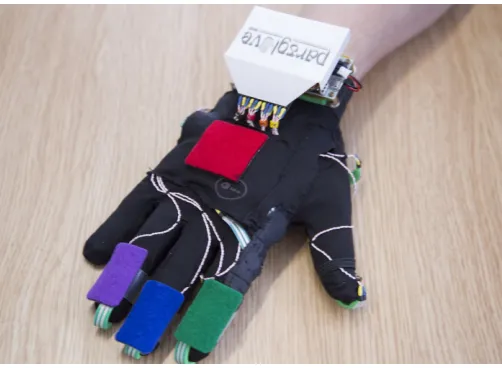
Figure 1. ParsGlove is an innovative wearable interface which is designed and developed to capture the human hands ergonomics and to provide this information as an interactive input both for the game and the application.
in the development and the design of the game. Scarle et al. [10] presented a serious game that had two main goals focusing on public involvement. Firstly, it was targeted at raising the awareness of poor eating habits at primary school children that has been becoming one of the main causes of the rising obesity epidemic and, secondly, through the application of motion controls that enabled the participant to reduce the amount of on-screen time in which the game player was physically inactive.
III. SERIOUSGAME ANDINPUTDEVICE
This section presents the overall framework that has been used for this work. Three key technologies including a serious game were developed to improve pressure sensitivity learning. The input device is a glove developed in-house and can read pressure the amount of pressure applied accurately in Newtons. An application, DigiScale, was developed to help facilitate the input procedure via a user friendly interface. Finally, a serious game was implemented to facilitate the learning of pressure sensitivity for the user.
A. Input Device
A wearable measurement interface, ParsGlove (see Figure 1) has been developed under formal R&D discussions with with medical professionals. It is designed to capture the ergonomics of the human hand during dexterous interaction with the environment. It was essential in our main goals to use the full capabilities of the glove to capture applied pressures, orientations and location parameters although for this work the focus is only on the pressure input.
B. Application
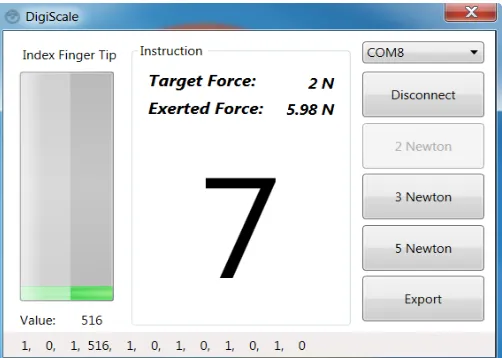
DigiScale is a Graphical User Interface (GUI) specifically developed for this experiment to deliver visual feedback for the force exerted by the tip of users’ index fingers. DigiS-cale has two sections: an information panel providing visual information directly to the user and a toolkit panel for the research investigator. Figure 2 shows a screenshot of DigiScale demonstrating a target force set to 2 Newtons and a sampling timer having collected 3 seconds of data out of a total of 10 seconds (with 7 seconds remaining as shown in the figure).
Figure 2. The DigiScale application is designed to deliver visual feedback on the exerted force by the user and to collect samples form the user performance.
The information panel is designed to provide visual feed-back of applied forces by the user, the target force level in each task and a countdown timer. The toolkit panel is designed to provide connectivity options to pair ParsGlove with DigiScale, three buttons to set the target force levels in each task and finally an export button to persist recorded samples at the end of each session. The application has capabilities to read con-tinuous data streams over the Bluetooth standard which permits communication with the glove. The application could be run on any normal PC without any specific hardware or software requirements. The only requirement for this application is a Bluetooth receiver.
C. Game
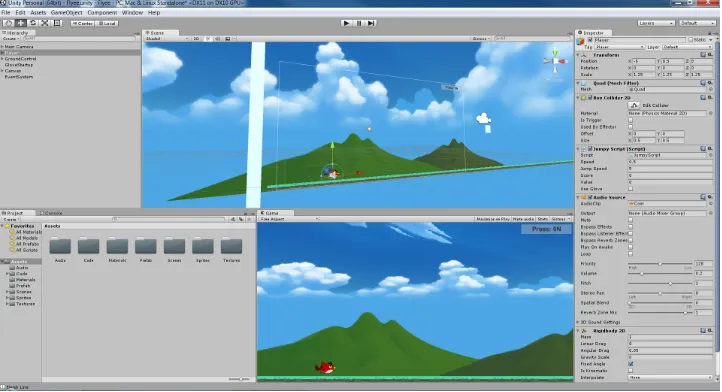
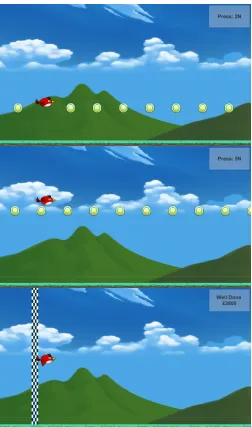
To provide game-based training to help improve perform-ance, a 2D game was developed in the Unity 3D game engine. The game assets were adapted from free assets made available from the Unity store. The game was designed to interface with the ParsGlove playing the role of the game controller. Figure 3 illustrates a number of screenshots of the game in action. Figure 4 shows the game as it is being developed.
The goal of the game is to help users improve their pressure sensitivity by controlling a flying bird that soars higher based on the amount of pressure applied by the index finger of the user. The pressure applied is the only form of input. The gameplay is inspired by the infinite runner genre of games; although the play sessions have been limited in the interest of time. The objective of the game is for the bird to collect
coins that appear randomly at three possible heights within the environment. The coins are randomly generated in different quantities from 5 to 15. Auditory feedback is also provided on successful coin collection.
The heights chosen correspond to the application of three levels of force. The three force levels are 2, 3 and 5 Newtons coinciding with very light to medium pressure. These forces were established through a pre-study with medical profession-als in a process discussed further in Section IV-A. It is crucial for a medical student to control his hand in a dexterous manner to perform different abdominal palpation tasks. Hence, a very light amount of force such as 2 Newtons could be extremely challenging for a novice. Design of different tasks in game-based and application-game-based approaches were established on these guidelines.
A collision detection function is implemented to detect if the bird avatar hits a coin. The box collider used for coin to bird intersection has a buffer equivalent to ±0.25
Newtons along the height dimension. Players should collect more coins in order to achieve a better score at the finish line. A slight increase in the flying speed during the game as well as random generation of coins makes it more challenging for the player and has the goal of keeping the game interesting. An information panel is placed on the top right corner of the game screen to show which the next coin level is. This is demonstrated in Newtons for the user to form an association with the amount of pressure to be applied and the numeric value of the force. The information panel also provides a final score at the finish line. The screen height is normalised to represent 0 to 10 Newtons from bottom to top. Although, the player could reach higher levels of force by pressing harder, the limitation of 10 Newtons was chosen to meet safety regulations.
IV. EXPERIMENT
In order to evaluate whether the game discussed in the previous section improves pressure sensitivity a participant-focused experiment was run. This experiment intends to ex-plore if visual and auditory feedback of applied forces in the form of a game-based training approach could improve motor learning and control abilities on non-medical participants.
A. Method
[image:4.612.50.301.182.361.2]Figure 4. The game being developed within the Unity environment.
of all the medical professionals completing three palpation tasks (liver edge, deep and superficial) for all the patients. All data was captured and analysed and the goals of 2,3,5
Newtons were identified based on the mean force across the medical professionals in each task across the body types.
[image:5.612.53.296.546.672.2]Table I shows an overview of the experimental design and training methods for each group. The familiarisation phase allowed the participants to acquaint themselves with the equip-ment and saw the actual value they were pressing on DigiScale. In the final test (no visual feedback) the participants could not see how much pressure they were applying on the display and had to rely only on their pressure sensitivity training. The difference between the target value and the recorded value (in Newtons) for the no visual test was used as the dependent variable. The null hypothesis H0 in this experiment was that there is no difference between the two groups in the accuracy of the exerted target force for the no visual feedback test session. The software used for the familiarisation DigiScale was significantly different from the environment found in the game to avoid any bias of familiarisation that may have led to the game playing group to have an unfair advantage during the testing phase.
Table I. EXPERIMENTALDESIGN
Group A Group B
Training Visual Feedback (GUI)
Visual Feedback (Game)
Familiarisation Visual Feedback(GUI) Visual Feedback(GUI)
Test No Visual
Feedback
No Visual Feedback
B. Materials
The primary materials used correspond to the three techno-logies discussed in Section III. DigiScale was used to convert the raw sensor value from the glove to force in Newtons and to provide visual feedback on the exerted force by the user for
the Training and Familiarisation phases. Two TFT displays were used in duplicate mode to provide visual feedback for each participant and to let the research investigator monitor the experiment’s progress. An ultra thin powder coated polyvinyl glove was used to meet hygiene requirements prior to provide the measurement glove to participants.
C. Participants
Thirty participants took part in this experiment in two groups of fifteen with seven females and one left handed participant. Participants all had normal or corrected to normal vision. Participants were members of staff or students con-tacted via internal university email. A Participant Information Leaflet and related ethics documentation were attached to the invitation email before the experiment day to debrief the participants about details prior to the experiment. Participation in this experiment was entirely voluntarily with the right to withdraw at any point.
D. Procedures
Each participant had been debriefed about the experimental steps by research investigators and via email prior to data collection. Each participant was asked to wear a powder coated ultra thin polyvinyl glove and confirm if the sensor on the index finger tip was positioned correctly.
Group A had 5 minutes training with DigiScale application. Group B had the same duration of training with the game in three rounds with one minute intervals between them. The reason for repeating the training for three attempts for the game group was to provide the player with variety within the game environment as aspects of the game are randomised.
Figure 3. A game-based training approach is proposed by this experiment to help users improve their pressure sensitivity by controlling a flying bird that soars higher based on the amount of pressure applied by the index finger of the user. The final figure demonstrates the score that is displayed at the end of a run. Each captured coin is worth 100.
each target force the following objectives need to be achieved by each participant in each test.
• To reach the given target force level
• To maintain that target force level for 10 seconds.
E. Results
Results for each target force was obtained via the difference in target and recorded force for each observation. The mean exerted force (µi) for each target force level (fi) is calculated
from collected samples for each participant. The absolute difference from the target force is calculated as:
δi=|µi−fi|
The mean of the delta values for all three target force levelsfi(2, 3 and 5 Newtons) were computed as a final result
for each participant. A non-parametric Mann-Whitney test has been selected to analyse the results due to the non-parametric nature of the data.
The accuracy in the exerted target force for the no-visual test for participants in group B, who were trained using our game approach (M dn= 0.86), differed significantly from the participants in group A, who trained using the application only approach (M dn = 1.56), U = 61, z = −2.137, p < .05, r=−0.36and thus H0 is rejected.
This result may highlight the potential role of game-based training on cognitive and control motor learning abilities. One possible reason for this achievement is an improvement in the understanding of the approximate force and sensitivity for the required pressure instilled while playing the game. Another potential advantage of game-based training is the competition factor characteristic of games. It was observed during the experiment that participants in group B were keen to beat their previous best score in each round which may have led to better focus and concentration on the requested test.
F. Qualitative Feedback
In order to form an understanding of whether the game was considered an enjoyable experience, and whether it was well designed and engaging a number of questions were asked to the group that played the game. An electronic questionnaire was sent via email to each participant in the game group (n=15) to collect their reflective feedback on their experience when playing the game. A total of six questions were asked to rank key features of the game from 1 to 5 (e.g for first question the answer is made from Not at all, Slightly, Moderately, Very, Extremely ”Enjoyable”). Fourteen out of fifteen participants replied and a mean scores for each question are reported in Table II.
Table II. QUESTIONNAIR
Questions Score
Did you enjoy playing this game? 3.85
Did you engage with this game? 3.85
How would you rank this game in terms of design? 3.85
Did you feel any improvement in controlling your force
level each time you have played this game? 3.77
Would you play the game again in future? 3.46
Would you recommend this game to a friend? 3.54
[image:6.612.323.565.474.650.2]based on this feedback, the game design seems to have been for the most part successful.
V. CONCLUSIONS ANDFUTUREWORK
This work has presented a serious game that attempts to teach participants the correct application of pressure by controlling a virtual character on screen via a pressure sensitive input device that rewards players with accurate and controlled input. The results demonstrate that those players that played the game performed significantly better than a control group in a subsequent no-visual task within a very different environment from the game itself. Moreover, questionnaire responses indic-ate that the game is enjoyable and engaging. It is important to indicate that while this game has appeared to have been successful it is part of a larger framework that is required in order to make automated or assisted palpation training successful.
Future work will look into enhancing this experience by using all the input sensors on the glove, and the capability of the system to capture location and orientation data. This can be then used for the development of a serious simulator or serious game. Furthermore, palpation is not the only applica-tion that requires pressure sensitivity and modificaapplica-tions to the main game to adapt to the range of sensitivities of various applications can aid pressure sensitivity training in other fields eq. training for musical instruments.
ACKNOWLEDGMENT
Grateful acknowledgement is made to members of staff and students in WMG for their participation and support. We would like to thank Unity and Creepy Cat for making available the 2D Game Starter Assets used to prepare the game used in this publication. Debattista is partially supported by a Royal Society Industrial Fellowship.
REFERENCES
[1] D. Wortley, “Immersive technology strategies,” Simula-tion & Gaming, vol. 44, no. 2-3, pp. 452–465, 2013. [2] S. Arnab, I. Dunwell, and K. Debattista,Serious Games
for Healthcare: Applications and Implications:
Applica-tions and ImplicaApplica-tions. IGI Global, 2012.
[3] A. Sliney and D. Murphy, “Jdoc: A serious game for medical learning,” inAdvances in Computer-Human
In-teraction, 2008 First International Conference on, Feb
2008, pp. 131–136.
[4] T. Susi, M. Johannesson, and P. Backlund, “Serious games: An overview,” 2007.
[5] J. Macleod, G. Douglas, E. F. Nicol, and C. E. Robertson,
Macleod’s clinical examination. Elsevier Health
Sci-ences, 2009.
[6] V. Patel and J. Morrissey, Practical and professional clinical skills. Oxford University Press, 2011.
[7] J. Goodwin, “The importance of clinical skills,” BMJ, vol. 310, no. 6990, pp. 1281–1282, 1995.
[8] R. J. Duvivier, K. van Geel, J. van Dalen, A. J. Scherp-bier, and C. P. van der Vleuten, “Learning physical examination skills outside timetabled training sessions: what happens and why?” Advances in health sciences education, vol. 17, no. 3, pp. 339–355, 2012.
[9] M. Gotsis, “Games, virtual reality, and the pursuit of happiness,”Computer Graphics and Applications, IEEE, vol. 29, no. 5, pp. 14–19, Sept 2009.
[10] S. Scarle, I. Dunwell, T. Bashford-Rogers, E. Selmanovic, K. Debattista, A. Chalmers, J. Powell, and W. Robertson, “Complete motion control of a serious game against obesity in children,” in Games and Virtual Worlds for Serious Applications (VS-GAMES), 2011 Third
Interna-tional Conference on, May 2011, pp. 178–179.
[11] C. Schonauer, T. Pintaric, H. Kaufmann, S. Jansen Kos-terink, and M. Vollenbroek-Hutten, “Chronic pain rehab-ilitation with a serious game using multimodal input,” in
Virtual Rehabilitation (ICVR), 2011 International Con-ference on, June 2011, pp. 1–8.
[12] S. Saini, D. Rambli, S. Sulaiman, M. Zakaria, and S. Shukri, “A low-cost game framework for a home-based stroke rehabilitation system,” inComputer Inform-ation Science (ICCIS), 2012 InternInform-ational Conference on, vol. 1, June 2012, pp. 55–60.
[13] M. N. Kamel Boulos. (2011) Healthcybermap. [Online]. Available: http://www.healthcybermap.org/
[14] M. Graafland, J. M. Schraagen, and M. P. Schijven, “Systematic review of serious games for medical education and surgical skills training,”British Journal of Surgery, vol. 99, no. 10, pp. 1322–1330, 2012. [Online]. Available: http://dx.doi.org/10.1002/bjs.8819
[15] I. Dunwell and S. Jarvis, “A serious game for on-the-ward infection control awareness training: Ward off infection,” Serious Games for Healthcare: Applications and Implications: Applications and Implications, p. 233, 2012.
[16] P. M. Kato, S. W. Cole, A. S. Bradlyn, and B. H. Pollock, “A video game improves behavioral outcomes in adolescents and young adults with cancer: a randomized trial,”Pediatrics, vol. 122, no. 2, pp. e305–e317, 2008. [17] E. Carmeli, J.-J. Vatine, S. Peleg, G. Bartur, and E. Elbo,
“Upper limb rehabilitation using augmented feedback: Impairment focused augmented feedback with handtutor,” inVirtual Rehabilitation International Conference, 2009, June 2009, pp. 220–220.
[18] M. N. Kamel Boulos, L. Hetherington, and S. Wheeler, “Second life: an overview of the potential of 3-d virtual worl3-ds in me3-dical an3-d health e3-ducation,”
Health Information & Libraries Journal, vol. 24,
no. 4, pp. 233–245, 2007. [Online]. Available: http://dx.doi.org/10.1111/j.1471-1842.2007.00733.x [19] K. E. Brown, J. Bayley, and K. Newby, “Serious game