Chair of Technology Management Dr. A.G. Sigurdardottir Prof. Dr. Holger Schiele
Master Thesis Business Administration
Supplier satisfaction and negotiation behaviour Marline Janssen
S1600850
[email protected] Number of pages/words: 57 / 18.067 Bibliography programme used: Endnote
Abstract: Negotiation is a fundamental part of business relationships. Negotiation strategies will have different effects on the relation between buyer and supplier. This paper investigates the satisfaction of suppliers with their buyers in relation to their use of negotiation styles and tactics. It shows that the accommodating and collaborating negotiation styles are being used when a supplier is satisfied with the customer. It also indicates that integrative negotiation tactics are used when the supplier is satisfied with the customer. Furthermore, it was found that distributive tactics are used when suppliers are not satisfied with customers. Nevertheless, no significant relationships were found for the avoiding, competing and compromising negotiation styles.
Enschede, 6 March 2019
INDEX OF FIGURES AND TABLES ... 3
1.1. BUYER/SUPPLIER NEGOTIATIONS HAVE BEEN DESCRIBED AS ONE OF THE MOST DEMANDING AND SOPHISTICATED ACTIVITIES IN BUSINESS
RELATIONSHIPS ... 3
2. PREVIOUS RESEARCH ... 5 2.1 THE RISK OF NOT BEING A PREFERRED CUSTOMER DOES NOT AFFECT ALL CUSTOMERS EQUALLY ... 5 2.2 THE CORE ASSUMPTION OF “THE CIRCLE OF PREFERRED CUSTOMERSHIP” IS THAT THERE IS NO EQUAL TREATMENT OF THE CUSTOMERS ... 8
2.3 “CUSTOMER ATTRACTIVENESS IS THE STRATEGY OF THE BUYER THAT FOCUSES ON
IMPROVING SUPPLIER DEDICATION TO ITSELF IN RELATION TO COMPETITORS” ... 10
2.4 SUPPLIER SATISFACTION ... 14 2.4.1. Supplier satisfaction is a fundamental aspect of buyer supplier relationships ... 14
2.4.2. Growth opportunity; relational behaviour and profitability have a positive effect on supplier satisfaction ... 17 2.5 TRUST IN RELATION TO SUPPLIER SATISFACTION ... 21
2.6. PREFERRED CUSTOMER STATUS ... 22 2.6.1. Preferred Customer Status: “A buyer to whom the supplier allocates better resources than less preferred buyers” ... 22
2.6.2. Customers could gain better quality, service and prices when they have a preferred customer status ... 24 2.7. THE CONCEPT OF NEGOTIATION ... 27
2.71. Negotiation: “A discussion in which the interested parties exchange information and come to an agreement” ... 27
2.7.2. The effectiveness of the negotiation style depends on the situation and on the ability with which the style is used ... 29 2.7.3 The different negotiation tactics have differences in orientation and these differences lead to different goals ... 32
2.7.4 Negotiation techniques: “ a series of steps, methods and rules that are applied by two or more people trying to reach an agreement that minimizes the differences in their points of view” ... 34 3. HYPOTHESES ... 35 3.1. SUPPLIER SATISFACTION AFFECTS NEGOTIATION TACTICS AND NEGOTIATION STYLES ... 35
3.3 A QUANTITATIVE RESEARCH DESIGN IN THE FORM OF AN ONLINE SURVEY WAS USED TO CONDUCT THE RESEARCH ... 38
4. ANALYSIS ... 40 4.1 THE SAMPLE CHARACTERISTICS SHOW THAT THE SURVEY WAS FILLED IN BY A VERY
DIFFERENT GROUP OF PEOPLE ... 41
5.1 SUPPLIERS USE THE COLLABORATING AND ACCOMMODATING STYLE DURING NEGOTIATIONS WITH CUSTOMERS THAT SATISFY THEM. ... 42
6.1 SATISFACTION OF THE SUPPLIER LEADS TO THE USE OF INTEGRATIVE TACTICS BY THE SUPPLIER ... 43
7.1 THE USE OF THE NEGOTIATION BEHAVIOUR OF THE SUPPLIER DEPENDS ON THE LEVEL OF SATISFACTION ... 48
7.2 SIGNIFICANT POSITIVE RELATIONSHIPS WERE FOUND FOR INTEGRATIVE TACTICS, AND ACCOMMODATING AND COLLABORATING STYLES ... 49
7.3 THIS RESEARCH CAN BE REPLICATED IN COMBINATION WITH HOFSTEDE’S CULTURAL MODEL OR WITH OTHER TYPES OF NEGOTIATION ... 49
A. APPENDICES ... 60 A.1 SURVEY ... 60
INDEX OF FIGURES AND TABLES
1. Table 1: the drivers of customer attractiveness – adapted from Hüttinger et al. (2012). ……….15
2. Table 2: the drivers of supplier satisfaction – adapted from Hüttinger et al. (2012)………...………19 3. Table 3: The benefits of supplier satisfaction………..22 4. Table 4: the benefits of preferred customer status………...26 5. Table 5: the antecedents of preferred customer status – adapted from Hüttinger et al.
(2014)………..27 6. Figure 1: The research model of this research……….42 7. Table 6: The relationship between the negotiation styles and supplier
satisfaction………54 8. Table 7: the relationships between the negotiation styles and supplier satisfaction,
moderated by negotiation tactics………..54 9. Table 8: the relationships between the negotiation tactics and supplier
satisfaction………54 10. Table 9: the relationships between the negotiation styles en preferred customer status………...55 11. Table 10: The hypotheses of this research………..….55
1.1. Buyer/supplier negotiations have been described as one of the most demanding and sophisticated activities in business relationships
by firms highly classified and very sensitive. Thus, reviling those kind of information might negatively influence the firm’s competitive advantage.
Hence, due to the difficulties gaining access to information regarding actual buyer/supplier negotiation behaviour, asking buyers or suppliers about their behaviour and their level of satisfaction can provide valuable indications towards the reality.
Building on the existing literature and the notion of that the negotiation process can lead to (dis) satisfaction of both parties involved (Atkin & Rinehart, 2006, p. 48), the purpose of this paper is to understand better the relationship between satisfied suppliers and their customers by relating it to their negotiation behaviour. Thus, the following research question is proposed:
RQ1: How does supplier negotiation behaviour influence the degree of satisfaction perceived by suppliers?
Research in the area of negotiation behaviour and supplier satisfaction has increased recently. Most recent study focus on supplier negotiation behaviour and how it affects satisfaction from the customer perspective (Saorín-Iborra & Cubillo, 2018), while the supplier perspective still remains relatively unknown. This creates a gap in the literature and in order to fully understand the phenomenon, it is important to analyse it from all relevant angles.
To answer the research question, first a theoretical framework is presented with relevant concepts on supplier satisfaction, negotiation styles and tactics. Then the research methodology is described in section three. This section will explain the research methods and data collection. The fourth section will show the results of the research. Fifth, the results will be discussed and finally, a conclusion is given.
2. Previous research
The traditional supply chain is defined as “an integrated manufacturing process wherein raw materials are manufactured into final products, then delivered to customers” (Beamon, 1999, p. 9). The primary focus of a supply chain is on one key outcome (e.g. speed). These supply chains have been viewed as a process of moving materials (Ketchen Jr & Hult, 2007, p. 574). The bullwhip effect is present in traditional supply chains, because the actual demand is not visible, which could lead to dynamic distortions (Holweg, Disney, Holmström, & Småros, 2005, p. 11). Traditional supply chains are reactive, because they have a modest ability to respond to changes. They also have a limited adaptability (Ketchen Jr & Hult, 2007, p. 574). Today, the industrial world is a global network of demand and supply linkages. The reason that this network is global is because the Internet has shortened the distance between companies. “This has created complex supply chain systems with multiple physical and virtual relationships, and multiple internal and external interfaces” (Asbjørnslett, 2009, p. 15). There are multiple important aspects of these supply chains (Asbjørnslett, 2009, p. 16). First, high demands are put on quality, regularity and dependability. Second, the product has to be available when it is needed and as promised. Third, there is less tolerance for failure. Supply chains are a strategic weapon, proactive and they have the ability to adapt to certain situations (Ketchen Jr & Hult, 2007, p. 574). In summary, supply chain systems are changing from a process of moving materials to long complex supply chains, which are reflecting the dynamic and global market place (Asbjørnslett, 2009, p. 16). Furthermore, high performance supply chain management is fundamental to sustain competitive in the current market (Nejma, Zair, Cherkaoui, & Fourka, 2019, p. 175). It is one of the most significant capabilities in today’s complex markets (Jahani, Azmi Murad, bin Sulaiman, & Selamat, 2015, p. 180).
chain risk can be defined as “the chance of an undesired event associated with the inbound supply of goods and/or services, which has a detrimental effect on the purchasing firm and prevent it from meeting customers’ demand within anticipated cost and time” (Hoffmann et al., 2013, p. 201). There are several types of supply chain risks. Jahani et al. explains several risks and states in this paper that “unsatisfied customers, information overload and high uncertainty are the main challenges that are faced by today’s supply chains” (Jahani et al., 2015, p. 180). Harland et al. explain several forms in their research (Harland, Brenchley, & Walker, 2003, p. 53). First, financial risks can have devastating effects on a company’s health. Second, legal risk exposes the company to litigation. Third, customer risk affects the demand that the customer the places. Finally, a novel type of risk will be explained below. As has been mentioned before in the introduction of this thesis, the reverse marketing concept has the perspective that buyers are competing with other buyers for the resources of the supplier. Cordón and Vollmann explain the issue of finding suitable suppliers in their book. Furthermore, they observe that “really good” suppliers are in demand (Cordón & Vollmann, 2008, p. 55). The ability to establish and maintain relationships with these “really good” suppliers can lead to a competitive advantage (Gold, Seuring, & Beske, 2010, p. 230). The reason for that is because when one customer is treated better than the other customers of a supplier, that customer can get a competitive advantage over the other customers (e.g. better resource allocation). This, however, creates a new type of supply risk, in which a customer is treated less advantageously than other customers (Reichenbachs, Schiele, & Hoffmann, 2017, p. 352). This means that being a preferred customer is a risk management tool (Schlegel & Trent, 2016). The main difference between a strategic supply risk (e.g. not being a preferred customer) and other types of supply chain risk is that only some customers are affected by a strategic supply chain risks, while all customers are affected by other types of supply chain risks (e.g. bankruptcy) (Reichenbachs et al., 2017, p. 356). A second distinction of a strategic supply risk is that this type of risk is latently present, but it is probable to develop during an economic boom (Reichenbachs et al., 2017, p. 355). One way to deal with this supply chain risk is to collaborate with the supplier in such a way that mutual benefits are produced (Reichenbachs et al., 2017, p. 362).
Second, supplier satisfaction will be examined. A buyer want to satisfy the supplier in order to receive benefits. Third, preferred customer status is explained. Receiving this status will give the buyer certain benefits over other buyers.
2.2 The core assumption of “The Circle of Preferred Customership” is that there is no equal treatment of the customers
To better understand supplier satisfaction and preferred customer status, the relationship between these concepts has to be investigated. Several researchers have discussed that supplier satisfaction, customer attractiveness and preferred customer status influene whether the buying firms will gain a preferential treatment (Schiele, Veldman, & Hüttinger, 2012; Schiele, Veldman, Hüttinger, & Pulles, 2012).
Schiele recalls in his “Handbook of Operations” that two fundamental changes have occurred in the supply chain during the last two decades (Schiele, p. 40). First, the depth of production decreased due to a concentration on core competencies and outsourcing of remaining functions. This principle is based on the transaction cost economics theory, which states that each economic transaction incurs transaction costs. The firm has to make the make-or-buy decision based on these transaction costs (Williamson, 2008, p. 5). High transaction costs imply that the firms has to outsource the product or service and low transaction costs imply that the firm has to perform the product/service in-house.
Hüttinger et al. performed a literature review on preferred customer status and supplier satisfaction. In this review they created “The Circle of Preferred Customership” (Hüttinger et al., 2012). This process of achieving preferred customer status has three steps (Hüttinger et al., 2012). First, there is the assumption that no relationship has occurred before between the parties. Subsequently, in order to start a relationship, the supplier has to be appealed to the customer (Hüttinger et al., 2012, p. 1202). If the supplier wants to intensify the relationship, customer attractiveness is a necessary condition. The satisfaction of the supplier might increase over time. The expectations of the satisfaction level of the supplier have to be met in order for the customer to gain a preferred customer status (Hüttinger et al., 2012, p. 1194). This is the final step of the Circle. The core assumption is that there is no equal treatment of the customers, because suppliers cannot give the best resources to all of the customers (Schiele, p. 40). When the buyer has received a preferential status, the supplier can reward the buyer with preferential resource allocation (Schiele, p. 40). There are several examples of this: a supplier can give a preferential buyer better and faster service. Second, the supplier can reward a preferential buyer with cost advantages. Moreover, the supplier can allocate its best personnel to a joint product development team (Steinle & Schiele, 2008, p. 11). Finally, the supplier can customise the products according to the wishes of the customer. This preferential status increases the attractiveness of the customer. This will make the Circle start again (Hüttinger et al., 2012, p. 1203).
The next sections will go deeper into the different steps of The Preferred Customer Circle. There will be started with the concept of customer attractiveness. Subsequently the concept of supplier satisfaction will be discussed and finally, preferred customer status will be described.
2.3 “Customer attractiveness is the strategy of the buyer that focuses on improving supplier dedication to itself in relation to competitors”
The recent increase of popularity of the concept of customer attractiveness in literature can be traced back to the two fundamental changes in the supply chain. Many scholars have researched the concept of reverse marketing (Blenkhorn & Banting, 1991; Leenders & Blenkhorn, 1988; Plank & Francis, 2001). A scenario in which buyers are competing with each other for the suppliers instead of the scenario of traditional marketing, in which suppliers are competing over buyers (Blenkhorn & Banting, 1991, p. 186). Buyers want to obtain the best resources from the supplier and in order to get that, they are trying to become more attractive then other buyers.
Many researchers have looked into customer attractiveness (Hüttinger et al., 2012; La Rocca, Caruana, & Snehota, 2012; Schiele, Calvi, & Gibbert, 2012). In 2006, Ellegaard and Ritter (2006) developed a definition and conceptualization of customer attractiveness. In 2008, Hovmøller Mortensen, Vagn Freytag, and Stentoft Arlbjørn (2008) proposed a maturity model for customer attractiveness in the supply chain. In 2012, Schiele, Calvi, et al. (2012) proposed in a model in which they link customer attractiveness to supplier satisfaction and preferred customer status. Furthermore in 2012, Hüttinger et al. (2012)created a literature review of the drivers and antecedents of customer attractiveness. In 2016, Pulles, Schiele, Veldman, and Hüttinger (2016) discuss the impact of customer attractiveness and supplier satisfaction on becoming a preferred customer. The first stream of literature on customer attractiveness focused on the role of the human factors, while the second stream of literature focused on relational embeddedness of the relationship. The third stream focused on relationship characteristics (Patrucco et al., 2018, p. 2).
and so they may not dedicate their resources equally to all customers, thus becoming highly selective” (Patrucco et al., 2018, p. 2). The research on customer attractiveness is linked many times to supplier satisfaction and preferred customer status (Hüttinger et al., 2012; Pulles et al., 2016; Schiele, Calvi, et al., 2012). The research focuses on the buyer, the supplier, and their relationship, consequences of the relationship, the alternative relationships and the alternative outcomes of these relationships (Schiele, Calvi, et al., 2012). Customer attractiveness is also often linked to social exchange theory (Schiele, p. 41), as has been mentioned before in the last chapter. Customers have to be more attractive than alternatives in order to become a preferred customer. This means that customer attractiveness and supplier satisfaction are also depended on external factors, such as the attractiveness of competitors (Makkonen, Vuori, & Puranen, 2016, p. 164). Moreover, customer attractiveness has also been linked to trust, commitment and value (Harris, O'malley, & Patterson, 2003, p. 12).
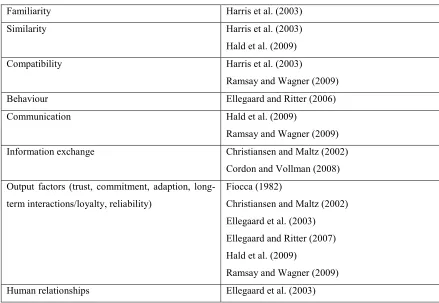
Customer attractiveness can be defined as: “the extent to which relational partners perceive past, current, future or potential partners as professionally appealing in terms of their ability to provide superior economic benefits, access to important resources and social compatibility” (Harris et al., 2003, p. 12). It has been argued that attractiveness is a fundamental aspect in the development of inter-personal relationships (Byrne, 1971). Furthermore, it has been agreed upon in literature that the attractiveness of a partner in a business relationship is a matter of economic outcomes for the parties (Halinen, 2012, p. 59). Moreover, customer attractiveness is assumed to be the expected economic and social reward-cost consequences of the relationship (Halinen, 2012, p. 59). Customer attractiveness has also been linked to collaboration and satisfaction (La Rocca et al., 2012, p. 1242).
Ellegaard, Johansen, and Drejer (2003, p. 354) conducted a case study on customer attractiveness and argued that human relationships are a fundamental factor in determining customer attractiveness. Moreover, Harris et al. (2003, pp. 14-18)found that customers who enjoy geographical proximity, functional proximity and repeated exposure are more attractive. Finally, Ellegaard and Ritter (2006, p. 1) argue that attractiveness is determined by three areas: value creation, the interaction process and emotions.
Drivers of customer attractiveness Reference
Market factors
Size (dollars) Fioca (1982) Size of key segments Fioca (1982)
Growth rate Fioca (1982)
Hald et al. (2009)
Ramsey and Wagner (2009) Price sensitivity Fioca (1982)
Access to new markets Christansen and Maltz (2002) Ellegaard and Ritter (2007) Hald et al. (2009)
Competition factors
Types of competitors Fioca (1982) Degree of concentration Fioca (1982) Changes in type and mix Fioca (1982) Substitution by new technology Fioca (1982) Degrees and types of integration Fioca (1982) Financial and economic factors
Contribution margins Fioca (1982)
Ellegaard and Ritter (2007) Ramsay and Wagner (2009) Leveraging factors Fioca (1982)
Entry barriers Fioca (1982) Capacity utilization Fioca (1982)
Price/volume Ellegaard and Ritter (2007) Hald et al. (2009)
Ramsay and Wagner (2009) Cost elements Ramsay and Wagner (2009) Value creation Ellegaard and Ritter (2006) (2007)
Negotiation pressure Ramsay and Wagner (2009) Technology factors
Maturity and frequency of changes Fioca (1982)
Complexity Fioca (1982)
Differentiation Fioca (1982) Patents and copy right Fioca (1982) Customer’s ability to cope with changes Fiocca (1982)
Ramsay and Wagner (2009) Depth of Skill Fiocca (1982)
Ramsay and Wagner (2009) Types of technological skill Fiocca (1982)
Commitment to innovation Christianses and Maltz (2002) Ellegaard and Ritter (2007) Knowledge transfer Christianses and Maltz (2002) Supplier trainings and visits Christianses and Maltz (2002)
Ramsay and wagner (2009) Early R&D involvement and joint improvement Ramsay and Wagner (2009)
Cordon and Vollman (2008) Socio-political factors
Geographical proximity Harris et al. (2003) Functional proximity Harris et al. (2003) Changes in the environment Fioca (1982) Risk factors
Risk sharing Christianses and Maltz (2002) Ramsey and Wagner (2009) Standardisation of product Christiansen and Maltz (2002) Dependence Christiansen and Maltz (2002)
Harris et al. (2003) Hald et al. (2009)
Ramsay and Wagner (2009) Level of transaction-specific assets Hald et al. (2009)
Demand stability Ramsay and Wager (2009) Repeated exposure Harris et al. (2003) Social factors
Possibilities for extensive face-to-face contact Christiansen and Maltz (2002) Ramsay and Wagner (2009) Supplier participation in internal teams Ramsay and Wagner (2009) Tight personal relations Ellegaard et al. (2003)
Familiarity Harris et al. (2003) Similarity Harris et al. (2003) Hald et al. (2009) Compatibility Harris et al. (2003)
Ramsay and Wagner (2009) Behaviour Ellegaard and Ritter (2006) Communication Hald et al. (2009)
Ramsay and Wagner (2009) Information exchange Christiansen and Maltz (2002)
Cordon and Vollman (2008) Output factors (trust, commitment, adaption,
long-term interactions/loyalty, reliability)
Fiocca (1982)
Christiansen and Maltz (2002) Ellegaard et al. (2003) Ellegaard and Ritter (2007) Hald et al. (2009)
[image:14.595.113.552.81.384.2]Ramsay and Wagner (2009) Human relationships Ellegaard et al. (2003)
Table 1: the drivers of customer attractiveness – adapted from Hüttinger et al. (2012).
In the next section, the second step of the preferred customer circle will be described, namely the construct of supplier satisfaction. There will be started with an introduction into supplier satisfaction. Next, the antecedents and benefits will be described. Finally, dependency and power will be considered.
2.4 Supplier satisfaction
merged into the daily activities (Wong, 2000, p. 1). In 2003, (Maunu) found the first possible antecedents of supplier satisfaction. These included: profitability, agreements, early supplier involvement, business continuity, forecasting/planning, roles and responsibilities, openness and trust, feedback, and value of the buying company (Maunu, 2002, p. 97).
In 2010, Nyaga et al. (2010) investigated how collaborative activities of the buyer and supplier affect supplier satisfaction and performance. They implicated that the actions that buyers and suppliers take to advance trust and commitment will increase the relationship benefits (Nyaga et al., 2010, p. 111). In 2012, Schiele, Calvi, et al. (2012) discussed the preferred customer circle and connected the concepts of customer attractiveness, supplier satisfaction and preferred customer status. In 2014, Hüttinger, Schiele, and Schröer (2014) made an overview of the antecedents of customer attractiveness, supplier satisfaction and preferred customer status. They concluded that growth opportunity, reliability, and relational behaviour have a positive influence on supplier satisfaction (Hüttinger et al., 2014, p. 697). In 2016, Vos et al. (2016) expanded the study of Hüttinger (2014). They found that profitability is also an antecedent of supplier satisfaction. Hence, over the years, scholars have looked into many different aspects of supplier satisfaction. In 2017, Caniëls, Vos, Schiele, and Pulles (2017)investigated whether asymmetric relationships between buyer and suppliers can lead to the satisfaction of the supplier.
Supplier satisfaction can be defined as “a suppliers feeling of fairness with regard to buyer’s incentives and supplier’s contributions within an industrial buyer-seller relationship as relates to the supplier’s need fulfilment”(Essig & Amann, 2009, p. 104). The relationship between buyer and seller influences the satisfaction of the supplier (Forker & Stannack, 2000, p. 35). When supplier satisfaction is achieved, the quality of the relation between buyer and seller is in accordance with the expectations of the supplier (Schiele, Calvi, et al., 2012, p. 1181). While the satisfaction of suppliers has a positive effect on buyer performance (Baxter, 2012; Ghijsen, Semeijn, & Ernstson, 2010), dissatisfied suppliers may commit to relationship with other buyers. This could lead to a deterioration of the performance of the buyer (Caniëls et al., 2017, p. 2).
also called “fit for purpose” relationship (Routroy, 2018, p. 2344). These agreements are made with key suppliers that the buyer wants to collaborate deeply with and have a future perspective (Routroy, 2018, p. 2345). The buyer needs the best suppliers in order to create the best supply chain. However, this is difficult in reality, because good suppliers are scarce. This means that the buyer has to practice the preferred supplier concept (Routroy, 2018, p. 2345). There are several reasons why buyers are pushed to exercise the preferred supplier concept, e.g., buyers have to compete with other buyers for the allocation of the best resources; the reduction of the supply base size with a small group of key suppliers; the recognition and rewarding of preferred suppliers; and the protect itself from a scarcity of supply (Routroy, 2018, p. 2345).
Satisfaction is directly linked to value creation and the quality of the relation (Vos et al., 2016). Pulles et al. (2016, p. 131) argue that supplier satisfaction stands on the relationship’s perceived value. Buying firms create value and fulfil the relationship investments of the supplier (Essig & Amann, 2009, p. 107). Caniëls et al. (2017, p. 2). argue that supplier satisfaction has strategic value for buyers. It has been argued that it has a positive effect on buyer performance, because buyers can receive resources from supplier that they could not have obtained otherwise (Baxter, 2012; Ghijsen et al., 2010). This is in line with the findings of Pulles et al. (2016, p. 136), who concluded that supplier satisfaction has a positive effect on supplier’s resource allocation. These resources are able to give a firm a competitive advantage (Koufteros, Vickery, & Dröge, 2012, p. 96).
2.4.2. Growth opportunity; relational behaviour and profitability have a positive effect on supplier satisfaction
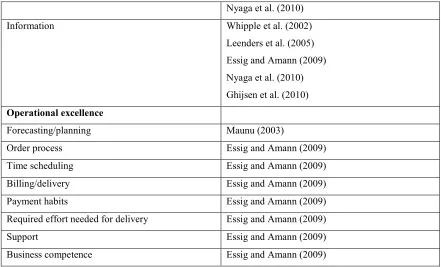
Several authors have defined antecedents of supplier satisfaction. Examples of these antecedents are: early supplier involvement, joint relationship effort, bargaining position and supplier development (Essig & Amann, 2009; Ghijsen et al., 2010; Nyaga et al., 2010). As has been mentioned before, in 2003, Maunu (2002, p. 97) found the first possible antecedents of supplier satisfaction: profitability, agreements, early supplier involvement, business continuity, forecasting/planning, roles and responsibilities, openness and trust, feedback, and value of the buying company. Subsequently, in 2005, Leeders, Johnson, Flynn, and Fearon (2006) found the following antecedents of supplier satisfaction: response to supplier requests, ordering substantial volumes, long-term time horizons, cooperative relationships, communication, and information. Benton and Maloni (2005, p. 15)investigated the influence of power in buyer-supplier relationships in 2005. They found that cooperative relationships, reward-mediated power sources, and non-mediated power sources are antecedents of supplier satisfaction.
In 2009, Essig and Amann (2009) conducted a survey in which they distinguished the antecedents of supplier satisfaction into strategic, operative and accompanying levels. They found the following antecedents: early supplier involvement, technical competence, bargaining position, adherence to agreements, cooperative relationships, communication, order process, time scheduling, billing, payment habits, required effort needed for delivery, support, and business competence (Essig & Amann, 2009, p. 111). In 2014, Hüttinger et al. (2014, p. 712). tested a new model with eight relational antecedents. They concluded that growth opportunity; reliability and relational behaviour have an influence on supplier satisfaction . These results are in accordance with previous studies that concluded that relational behaviour and atmosphere are fundamental in the relationship between buyer and seller (Benton & Maloni, 2005; Forker & Stannack, 2000). Growth opportunity however is a new antecedent that (Hüttinger et al., 2014) introduced. In 2016, Vos et al. (2016, p. 4618)replicate and extends the previous research on antecedents of supplier satisfaction. They found that growth opportunity; relational behaviour and profitability have a positive effect on supplier satisfaction.
R&D
Early supplier involvement Maunu (2003)
Essig and Amann (2009) Technical competence Essig and Amann (2009) Supplier development Ghijsen et al. (2010) Response to supplier request and suggestions for
improvement
Leenders et al. (2005) Essig and Amann (2009) Joint relationship effort Nyaga et al. (2010) Supply value
Profitability Maunu (2003)
Bargaining position Essig and Amann (2009) Substantial volumes Leenders et al. (2005) Long-term time horizons Maunu (2003)
Leenders et al. (2005) Adherence to agreements Maunu (2003)
Essig and Amann (2009) Cooperative Relationships Wong (2000)
Forker and Stannack (2000) Benton and Maloni (2005) Leenders et al. (2005) Essig and Amann (2009) Commitment to supplier satisfaction Wong (2000)
Dedicated investment Nyaga et al. (2010) Reward mediated power sources Benton and Maloni (2005) Non mediated power sources Benton and Maloni (2005) Recommendations Ghijsen et al. (2010) Growth opportunity Hüttinger et al. (2014) Reliability Hüttinger et al. (2014) Relational behaviour Hüttinger et al. (2014) Mode of interaction
Communication Maunu (2003) Leenders et al. (2005) Essig and Amann (2009) Structure Essig and Amann (2009)
Maunu (2003)
Reaction Forker and Stannack (2000) Wong (2000)
Maunu (2003)
Nyaga et al. (2010) Information Whipple et al. (2002)
Leenders et al. (2005) Essig and Amann (2009) Nyaga et al. (2010) Ghijsen et al. (2010) Operational excellence
Forecasting/planning Maunu (2003)
[image:19.595.113.554.84.351.2]Order process Essig and Amann (2009) Time scheduling Essig and Amann (2009) Billing/delivery Essig and Amann (2009) Payment habits Essig and Amann (2009) Required effort needed for delivery Essig and Amann (2009) Support Essig and Amann (2009) Business competence Essig and Amann (2009)
Table 2: the drivers of supplier satisfaction – adapted from Hüttinger et al. (2012)
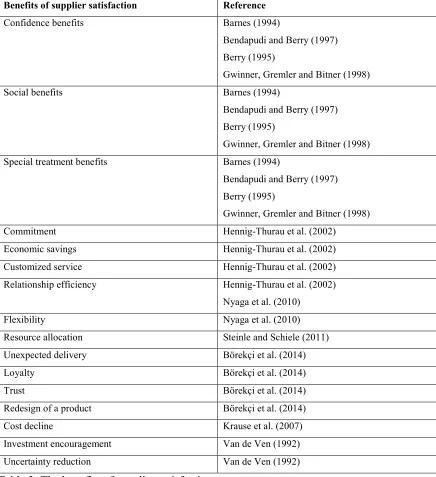
Not only the drivers of supplier satisfaction can provide useful insight into the concept of supplier satisfaction, but also the benefits are important. The construct of supplier satisfaction can award a buyer a preferred customer status (C. S. Kumar & Routroy, 2017, p. 96). This could lead to several benefits for the buyer. There are several categories of benefits discussed in the literature. Hennig-Thurau, Gwinner, and Gremler (2002, p. 236) discuss relational benefits in their paper. They state that relational benefits are a consequence of long-term relationships or mutual trust. Lapierre (2000) discusses the product, service and relationship benefits categories. Finally, Li (2011) distinguished benefits into special treatment benefits, value-added benefits and collaborative benefits.
Benefits of supplier satisfaction Reference Confidence benefits Barnes (1994)
Bendapudi and Berry (1997) Berry (1995)
Gwinner, Gremler and Bitner (1998) Social benefits Barnes (1994)
Bendapudi and Berry (1997) Berry (1995)
Gwinner, Gremler and Bitner (1998) Special treatment benefits Barnes (1994)
Bendapudi and Berry (1997) Berry (1995)
Gwinner, Gremler and Bitner (1998) Commitment Hennig-Thurau et al. (2002)
Economic savings Hennig-Thurau et al. (2002) Customized service Hennig-Thurau et al. (2002) Relationship efficiency Hennig-Thurau et al. (2002)
Nyaga et al. (2010) Flexibility Nyaga et al. (2010) Resource allocation Steinle and Schiele (2011) Unexpected delivery Börekçi et al. (2014) Loyalty Börekçi et al. (2014)
Trust Börekçi et al. (2014)
[image:20.595.116.552.87.564.2]Redesign of a product Börekçi et al. (2014) Cost decline Krause et al. (2007) Investment encouragement Van de Ven (1992) Uncertainty reduction Van de Ven (1992) Table 3: The benefits of supplier satisfaction
supply a firm with crucial information that can prevent a problem from turning into a conflict (Pearson & Gritzmacher, 1990, p. 94).
2.5 Trust in relation to supplier satisfaction
Since firms frequently negotiate relationships that last a long time (Sharland, 2001), the issue of trust is particularly important. In general, trust matters for the ultimate satisfaction (Zaheer, McEvily, & Perrone, 1998). Trust is commonly viewed as a multi-dimensional construct including the dimensions of affect, cognition, intent and behaviour (Moorman, Deshpande, & Zaltman, 1993). Trust has been defined by many scholars(N. Kumar, 1996), from different angles and seen from the view of benevolence, integrity, competence, predictability and openness . In this paper trust is defined in buyer-supplier relationship as “a willingness to rely on an exchange partner in whom one has confidence”.
The subsequent section will discuss the third step of the preferred customer circle, namely the concept of preferred customer status. When the supplier is satisfied the customer can gain a preferred customer status. In order to gain better insights into preferred customer status, one has to investigate how it is related to supplier satisfaction. There will be started with an introduction of preferred customer status. Next, the antecedents, benefits and enablers will be examined.
2.6. Preferred customer status
2.6.1. Preferred Customer Status: “A buyer to whom the supplier allocates better resources than less preferred buyers”
Being more satisfactory than other buyers and receiving the preferred customer status is the third step of the preferred customer circle. Buyers long for a preferential treatment from the supplier over other competitors (Hüttinger et al., 2014, p. 1194). The reason for this is because this preferential treatment can give them benefits that could lead to a competitive advantage (Hunt & Davis, 2008; Petersen, Handfield, Lawson, & Cousins, 2008). In order for firms to gain a competitive advantage they should obtain better resources than their competitors (Hult, Ketchen, & Arrfelt, 2007; Insead & Chatain, 2008). Buyers can gain these benefits by becoming a preferred customer. Companies need this preferred customer status to stay ahead of the competition. They need to work together as one competent supply chain in order to defeat the competition (Routroy, 2018, p. 2344). Every firm in this supply chain has an effect on the total supply chain. This effect can either be positive or negative. So in order for a firm to gain a competitive advantage, its suppliers should also bring value to the supply chain (Routroy, 2018, p. 2344). The fact that most discrepancies in the supply chain come from the supplier’s side, made firms realise that they either have to develop the supplier or accept the negative consequences (Routroy, 2018, p. 2344). Schiele et al. argue that buying firms should consider suppliers as a source of competitive advantage and should attempt to become a preferred customer (Schiele, Veldman, & Hüttinger, 2011). Pulles et al. (2016, p. 412) states that preferred customer status has a positive effect on buyer-supplier innovation.
al., 2012; Pulles et al., 2016). The beginning of this research can be traced back to 1970, when Brokaw and Davisson (1976) found that suppliers rank their customers on the basis of certain aspects and factors. In 1988, Leenders and Blenkhorn (1988) build on the work of Brokaw and Davisson and stated that buying firms should engage in reverse marketing and become attractive for suppliers. Subsequently, in 1992, Moody (1992) discovered the characteristics of best buyers. In 2007, Bew (2007) published a paper with the benefits of preferred customership. Next, in 2012, (Hüttinger et al., 2012; Schiele, Veldman, & Hüttinger, 2012) created the circle of preferred customership. In 2016, Pulles et al. (2016) found that preferential resource allocation is connected to gaining a competitive advantage.
In order to become a preferred customer, the relationship between buyer and seller has to be satisfying. Schiele, Calvi, et al. (2012) argue that when the supplier perceives a positive assumption towards the relationship, the customer is seen as attractive. Hüttinger et al. (2012, p. 1195) argue that the buyers that satisfy the suppliers the most can collect the best resources and can eventually receive a preferred status over other buyers. The process of allocating resources between customers is a selective process (Mitsuhashi & Greve, 2009, p. 20). The best resources are not divided equally. As has been mentioned before customers are competing with each other over suppliers (Leenders & Blenkhorn, 1988, p. 2). Pulles et al. (2016, p. 130) concluded that satisfied suppliers have a higher tendency to award buyers with a preferential status. This finding was also confirmed by (Vos et al., 2016). Supplier satisfaction could be necessary condition for gaining preferential customer status (Hüttinger et al., 2012; Schiele, Calvi, et al., 2012). Ulaga and Eggert (2006) found that buyers could increase their value by improving buying conditions in terms of price and volume and knowhow, reputation, innovation and access to new markets
Bew (2007) conducted a survey among suppliers and found the following three things: (1) 75% of the suppliers offer rare products or services to preferred customers. (2) 82% of the suppliers display that preferred customers are the first ones to have access to new products and technologies and (3) 87% of the suppliers offer better prices to their preferred customers.
supplier and becoming a preferred customer, firms are more likely to obtain these benefits from the supplier. Moreover, they propose a model for the process of the development of a new product with 3 stages. In stage 1, there are three inducements, the share of sales, supplier involvement and relational reliability. These inducements affect the attractiveness of the buyer. In stage 2, the supplier decided whether the buyer is rewarded with preferential buyer status. If the buyer becomes a preferred customer, it will gain access to new technological innovations, stage 3.
2.6.2. Customers could gain better quality, service and prices when they have a preferred customer status
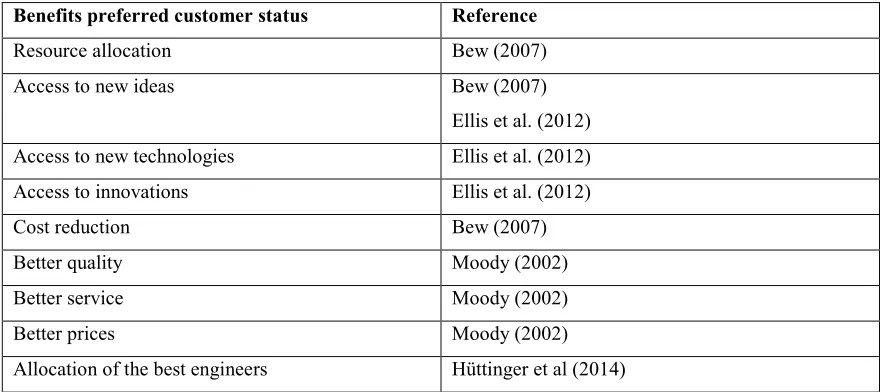
Several scholars have looked into the benefits of preferred customer status. (Bew, 2007) conducted a survey among suppliers and found the following benefits of preferred customer status: preferential treatment of material allocation, first access to new ideas, and opportunities of cost reduction. Furthermore, (Moody, 1992) conducted a survey to describe a “best customer”. She argues that customers could gain better quality, service and prices when they have a preferred customer status. Additionally, (Hüttinger et al., 2012)found that the allocation of the best engineers to a project and offering a new idea to the preferred customer first are benefits of being a preferred customer. Moreover, (Wagner, Hennig-Thurau, & Rudolph, 2009, p. 69) argues that suppliers can also award buyers a preferential customer status for motivational reasons. This could increase future sales for example. (Ellis et al., 2012, p. 1259) conducted a survey describing 233 buying situations and found that access to innovations and new technologies are benefits of being a preferred customer.
Benefits preferred customer status Reference
Resource allocation Bew (2007) Access to new ideas Bew (2007)
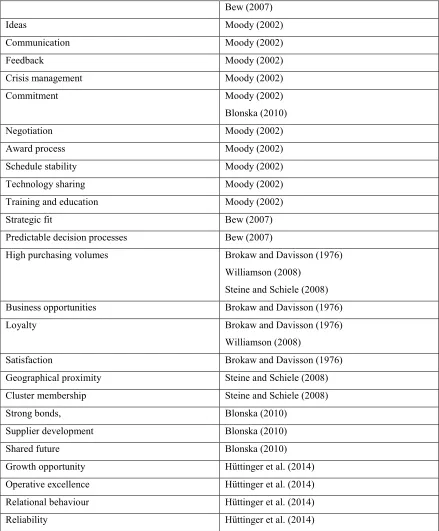
[image:24.595.113.554.574.770.2](Moody, 1992) looked into the antecedents of a preferred customer status. She conducted a survey and asked suppliers to rank the importance of 24 characteristics in the relationship with the customer. She found that early supplier involvement, mutual trust, involvement in product design, quality initiatives, profitability, schedule sharing, response to cost reduction ideas, communication and feedback, crisis management and commitment were characteristics of a ‘best customer’ (Moody, 1992, p. 52). She also found that negotiation; award process, schedule stability, technology sharing, and training and education were not rated very high. Furthermore, (Bew, 2007, p. 3) found that strategic fit, predictable decisions processes and cost to serve a customer are possible drivers of preferred customer status.
(Brokaw & Davisson, 1976) found that high purchasing volumes, business opportunities, loyalty, and satisfaction are drivers of preferred customer status. Additionally, (Williamson, 2008, p. 9) found that high purchase volumes and loyalty are antecedents of preferred customer status. However, Williamson also found that preferred customers pay higher prices, because these prices are linked to a premium that is paid to suppliers to gain a preferential status. This finding is in contrast with (Moody, 1992, p. 57), who found that preferred customers get better prices. (Steinle & Schiele, 2008, p. 11) found that high purchasing volumes, geographical proximity and cluster membership are antecedents of preferred customer status. Moreover, (Blonska, 2010, pp. 26-40) found that trust, commitment, strong bonds, supplier development and shared future are antecedents of preferred customer status. (Hüttinger et al., 2014, p. 712)argues that growth opportunity, operative excellence, relational behaviour and reliability influence preferred customer status positively. Finally, (Vos et al., 2016) found that supplier satisfaction has a positive impact on preferred customer status.
Drivers of preferred customer status Reference
Early supplier involvement Moody (2002)
Mutual trust Moody (2002)
Bew (2007)
Ideas Moody (2002)
Communication Moody (2002)
Feedback Moody (2002)
Crisis management Moody (2002)
Commitment Moody (2002)
Blonska (2010)
Negotiation Moody (2002)
Award process Moody (2002) Schedule stability Moody (2002) Technology sharing Moody (2002) Training and education Moody (2002)
Strategic fit Bew (2007)
Predictable decision processes Bew (2007)
High purchasing volumes Brokaw and Davisson (1976) Williamson (2008)
Steine and Schiele (2008) Business opportunities Brokaw and Davisson (1976) Loyalty Brokaw and Davisson (1976)
Williamson (2008)
Satisfaction Brokaw and Davisson (1976) Geographical proximity Steine and Schiele (2008) Cluster membership Steine and Schiele (2008) Strong bonds, Blonska (2010)
[image:26.595.114.553.85.616.2]Supplier development Blonska (2010) Shared future Blonska (2010) Growth opportunity Hüttinger et al. (2014) Operative excellence Hüttinger et al. (2014) Relational behaviour Hüttinger et al. (2014) Reliability Hüttinger et al. (2014)
Table 5: the antecedents of preferred customer status – adapted from Hüttinger et al. (2014)
the supplier, while mutual visits by competent personnel, buyer-supplier coordination, buyer-supplier compliance, trust, buyer-supplier communication and buyer-supplier cooperation are the most promising preferred customer enablers to dissatisfy the supplier (C. S. Kumar & Routroy, 2017, p. 10).
The following section will discuss negotiation. Companies have to negotiate about certain cases, that is why understanding the concept is important. First the subject of negotiation will be introduced. Subsequently, different negotiation styles will be discussed. Next, there will be further looked into the negotiation tactics.Finally, the antecedents and consequences will be described.
2.7. The concept of negotiation
2.71. Negotiation: “A discussion in which the interested parties exchange information and come to an agreement”
There are many definitions given for negotiation over the years. First, negotiation can be defined as “a discussion in which the interested parties exchange information and come to an agreement” (Davis, Smith, & Erman, 1988, p. 10). According to (Davis et al., 1988, p. 10) a negotiation has three fundamental components: (1) the information is exchanged in two ways, (2) both parties that negotiate evaluate the information from their own perspective, and (3) the final agreement is reached by mutual selection. Second, (Pruitt, 2013, p. 1) defines negotiation as “a process by which a joint decision is made by two or more parties. The parties first verbalise contradictory demands and then move towards agreement by a process of concession making or search for new alternatives. Subsequently, (Beer et al., 1999, p. 2) define negotiation as any communicative process that results in mutually acceptable agreements. Fourthly, (Anastakis, 2003, p. 74) define it as “a strategy to resolve a divergence of interests, be they real or perceived, where common interests also exists”. The definition of Davis et al is chosen in this thesis, since it is the most elaborated one and matches the best with the context of this thesis.
The literature on negotiation can be divided into speculative and empirical research. Speculative theory was the earlier tradition and can be split into two forms: formal models and looser set of ideas (Pruitt, 2013, p. 10). The formal models were developed by economist and game theorists, while the looser set of ideas are built on unsystematic observations. Empirical research is more popular nowadays. This type of research can be divided into field studies and experiments. (Pruitt, 2013, p. 9) provides one with two advantages of studying negotiation. Firstly, when one understands the micro processes that are associated with negotiation, one can assist in recognizing the macro conditions that affect social phenomena. Secondly, the theory of micro processes can help disclosing remedies for difficulties when the basic sources cannot be affected.
These tactics have differences in orientation and will lead to different outcomes (Lee, 2009, p. 14). Since the negotiator wants to maximize its profit, it is fundamental to choose the negotiation strategy including the right combination of negotiation tactic and negotiation style. These differences in tactics and styles could also have effects on other types of negotiation: e.g., mail negotiation, online negotiation and negotiation over the phone. This will be interesting to investigate because negotiators can see non-verbal cues in face-to-face negotiation that cannot be seen in these other types of negotiations. An additional important aspect of face-to-face negotiation is the presence of non-verbal cues, such as posture, body language. Several studies have stated, that humans look at non-verbal cues to check whether they match with the verbal ones (Ekman & Friesen, 1974; Ekman, Friesen, O'sullivan, & Scherer, 1980). Moreover, humans also rely on verbal cues to determine the personality of another person (Isbister & Nass, 2000, p. 253).
A fundamental aspect of negotiations is the attractiveness of the negotiator. Several studies have shown that the attractiveness of a negotiator is positively related to the satisfaction of the partner (Adler et al., 1992; Graham, 1986; Rubin & Brown, 2013). A second aspect of negotiation is the role of the negotiator (i.e. buyer or seller). This role of the negotiator has different outcomes in different cultures, e.g. Japanese buyers get higher profits than Japanese sellers, while there are no differences in the US between buyer and seller (Graham, Kim, Lin, & Robinson, 1988). The reason for this is that in the past buyers were considered honoured guests in Japan, while sellers were considered little more than beggars (Schmidt, 1979, p. 2). Furthermore, (Hall, 1976, p. 129) concludes that communication, as a dimension of culture has to be a very important factor of negotiation. Moreover, (Schmidt, 1979) states that status has a fundamental influence on negotiations, e.g. in China and Taiwan.
2.7.2. The effectiveness of the negotiation style depends on the situation and on the ability with which the style is used
called the negotiation strategy, which refers to as” interaction patterns used by parties in conflict to achieve resolution (Ganesan, 1993, p. 184). The five negotiation styles are: competing, collaborating, compromising, avoiding and accommodating (Kilmann & Thomas, 1977, p. 14).
First, competing (assertive and uncooperative) is a method in which a person puts its own concerns before another persons concerns. Power is an important factor in this method (Thomas & Kilmann, 1974, p. 8). (Emerson, 1962, p. 32) defines it as “the power of actor A over actor B is the amount of resistance on the part of B which can be potentially overcome by A. Power is important, because negotiators that use the competing style use whatever power necessary to win at the other party’s expense (Thomas, 2008, p. 3). Second, accommodating (unassertive and cooperative) is a technique in which one puts the concerns of another person before its own concerns. The concept of self-sacrifice is present in this technique (Thomas & Kilmann, 1974, p. 8). Furthermore, avoiding (unassertive and uncooperative) means that the person does not address the conflict. Fourth, collaborating (assertive and cooperative) is a method in which persons work together to a find a solution, which satisfies them all (Thomas & Kilmann, 1974, p. 8). Finally, compromising (intermediate assertive and cooperative) is a technique, which aims to discover a mutually satisfying solution for both parties. It is placed in the middle between competing and accommodating (Thomas & Kilmann, 1974, p. 9). There is no right method for negotiation. The effectiveness of the method depends on aspects of the situation and on the ability with which the techniques are used (Thomas & Kilmann, 1974, p. 9). These styles will be explained more in depth below.
Second, negotiators that use the accommodating style sacrifice their own needs to satisfy the other party (Ma, 2007, p. 105). Accommodating can be defined as “an attempt to sooth the other person and seek harmony (Kilmann & Thomas, 1975; P. Greeff, 2000; Thomas & Kilmann, 1978). The accommodating style is unassertive and cooperative. This style has a self-sacrificing nature (Ma, 2007, p. 105). Furthermore, this accommodating leads to low individual profits and low satisfaction levels (Ma, 2007, p. 105). (Zhang, Harwood, & Hummert, 2005, p. 5) state that the accommodating style stresses the harmony in the relationship. There are several typical behaviours for this style: identifying the wishes of the other party; asserting the position of the other party, putting the blame of the problem on itself; and apologizing. Finally, several studies have shown that men favour the avoiding style, while women prefer the accommodating style (Haferkamp, 1991; Mackey & O'Brien, 1998; P. Greeff, 2000).
Third, (Wall Jr & Nolan, 1987, p. 191) define the avoidance style as “tactics that minimize explicit discussion of conflicts. This could vary between total avoidance and indirect references of the situation. A person that uses this style is not able to satisfy both its own and the other party’s needs (Lee, 2009, p. 14). Furthermore, people that use this style have “low concern for self and others style, which has been associated with withdrawal, buck-passing or sidestepping situations” (Lee, 2009, p. 14). (Sillars, Coletti, Parry, & Rogers, 1982)state that “avoidance includes those tactics that minimize explicit discussion of conflicts”. The avoidance style can be beneficial in two situations (Lee, 2009, p. 14). First, in trivial situations and second, when the negative effects of the confrontation of the other party are larger than the benefits. Finally, (Wall Jr & Nolan, 1987, p. 188)states that less satisfaction is linked to the avoidance style than to integrative styles.
Finally, the compromising style lies between the competing and accommodating style (Ma, 2007, p. 105). This style is assertive and cooperative (Thomas & Kilmann, 1978, p. 1139). “Compromising is a zero-sum approach with a distributive intent, having a flavour of giving to keep the peace” (Ma, 2007, p. 106). Negotiators that use the compromising style give up something the reach a decision that is mutually acceptable. This style is appropriate when the parties have mutually exclusive goals or when two equal parties have reached a stalemate in their negotiations (Lee, 2009, p. 14). However, when a negotiator leans heavily on this style it could be dysfunctional, because when a negotiator uses this style repeatedly, he/she will keep giving up certain interests to make a compromise.
2.7.3 The different negotiation tactics have differences in orientation and these differences lead to different goals
A distinction can be made between different negotiation tactics. “Negotiation tactics are functions that define the actions or moves to be made at each point of the negotiation process” (Lopes, Mamede, Novais, & Coelho, 2001, p. 3). The different tactics have differences in orientation and these differences lead to different goals (Olekalns, Smith, & Walsh, 1996, p. 68). Moreover, there is support in the literature that these differences lead to different negotiation outcomes. This thesis will look further into the integrative and the distributive negotiation tactic. The integrative tactic can be viewed as a win-win negotiation, while the distributive tactic can be viewed as a win-lose negotiation (Barry & Friedman, 1998, p. 346). However, (Weingart et al., 1996, p. 1207)state that both groups of tactics are necessary to reach a satisfying outcome. According to (Bazerman & Lewicki, 1985, p. 1985), the choice between the integrative and the distributive technique can create some tension when one wants to increase either the distributive or the integrative size. The next sections will look further into the two groups of tactics.
behaviours”. In this thesis, the definition of Wall and Nolan will be followed, because it matches with the context of this thesis. In the distributive dimension, one party wins at the expense of the other party. One could say that it could lead to a win-lose situation (Wall Jr & Nolan, 1987, p. 1987). One could assume that the party that loses something will see this as a destructive conflict. The interests of the parties involved are negatively correlated in these situations (Barry & Friedman, 1998#348).
Integrative, also known as collaborative, negotiation tactics have a problem solving orientation. These tactics focus on the identification of the common goals (Olekalns et al., 1996, p. 68). Many definitions of integrative tactics have been described over the years. First, (Barry & Friedman, 1998, p. 346)refer to it as “non-zero-sum encounters in which there is the possibility for joint gain from the negotiation”. Second, integrative tactics are described by (Sillars et al., 1982, p. 83) as “verbally cooperative behaviours or statements that pursue mutually favourable resolutions of conflicts”. Finally,(Bolman Pullins, Haugtvedt, Dickson, Fine, & Lewicki, 2000, p. 468). describe integrative negotiation as “a process of discussion to reach an agreement that meets the objectives of both parties”. The definition of Barry and Friedman is followed in this thesis, since it is the best match with the context of this thesis. There is no conflict between the parties in this type of negotiation situation. Moreover, (Pruitt, 1983) states that integrative tactics not only focus on the accomplishment of its own goals, but also of the goals of the other party. Furthermore, the exchange of information is fundamental for integrative tactics. The use of integrative tactics is more likely to lead to mutually satisfying and productive relationships(Bolman Pullins et al., 2000, p. 468). The integrative dimension can be seen as a win-win situation, in which negotiators will see conflict as something productive (Wall Jr & Nolan, 1987, p. 191). Additionally, the integrative dimension is correlated with higher degrees of satisfaction.
reason for this is because the competing style is power oriented and the avoiding style does not want to address the issue. The compromising style can be seen as in-between both categories, because it consists of elements from both of the categories. It is fundamental to choose the right negotiation strategy, which includes the right combination of negotiation tactics with the right negotiation style. The right combination of tactics and style will maximize shareholder value.
2.7.4 Negotiation techniques: “ a series of steps, methods and rules that are applied by two or more people trying to reach an agreement that minimizes the differences in their points of view”
(Song, Xie, & Dyer, 2000)looked into the antecedents of negotiation techniques. Negotiation techniques can be defined as “ a series of steps, methods and rules that are applied by two or more people trying to reach an agreement that minimizes the differences in their points of view” (Tito, Estebanez, Magdaleno, de Oliveira, & Kalinowski, p. 518). The difference between negotiation tactics and negotiation techniques is that negotiation techniques specify a set of series, methods and rules of negotiation, while negotiation tactics focus on the actions and movements of negotiation. (Song et al., 2000, p. 61) found that goal incongruity increases avoiding behaviour, while it decreases collaborating behaviour. Further, they found that management support for integration decreases avoiding behaviour, whereas it increasing collaborating behaviour. Moreover, (Song et al., 2000, p. 61) argue that participative management decreased avoiding behaviour, while it increases collaborating behaviour. Additionally, early involvement decreases avoiding behaviour, while it increases collaborating behaviour.
(Song et al., 2000) also looked into the consequences of negotiation techniques. They found that there is a positive effect of management support for cross-functional integration on the use of collaborating behaviour. Furthermore, they found that avoiding behaviour lowers functional integration. Additionally, collaborating behaviour increases cross-functional integration (Song et al., 2000, p. 61)
Negotiation is a fundamental activity for companies. The different negotiation styles and tactics will affect the outcome, which affect the satisfaction of the supplier. The next section is going to describe the hypotheses of this thesis and it is going deeper in to the research methodology of this research. It starts with the explanations of the hypotheses that are going to be tested and subsequently the research model will be discussed.
3. Hypotheses
3.1. Supplier satisfaction affects negotiation tactics and negotiation styles
One can expect that satisfied suppliers will use integrative tactics during negotiations with customers. This can be explained by the fact that suppliers trust this customer and want to create a mutually beneficial situation. Integrative tactics want to reach an agreement that satisfies the wishes of all parties. (De Dreu, Weingart, & Kwon, 2000, p. 890)state that integrative negotiation tactics will reach higher outcomes than negotiations that have a 50/50 outcome. Integrative outcomes can lead to more profitability for both parties, which is an antecedent of supplier satisfaction (Maunu, 2002, p. 97) That is why the following hypothesis is formed:
H1: Suppliers that are satisfied with a customer will use integrative tactics during negotiations.
Based on previous research, one can expect that dissatisfied suppliers will use distributive tactics during negotiations with their buyers. When using distributive tactics, one wants to divide the resources competitively, which will lead to a win-lose outcome (Bolman Pullins et al., 2000; Wall Jr & Nolan, 1987). A reason for the competitive distribution of resources can be that the supplier does not trust the customer and wants to gain the most profit possible. (Beersma & De Dreu, 2002, p. 227) state that distributive negotiations lead to lower joint outcomes and have a less positive group climate. One could expect that when there are lower joint outcomes, the supplier will be less satisfied. The following hypothesis has been formed:
It is also important to understand negotiation styles. These different types of styles show what is seen as normal behaviour in certain cultures. This is important to understand when one is negotiation with people from different cultures. Negotiation styles can be categorized into different negotiation tactics. This paper will investigate the effects of the negotiation styles on supplier satisfaction.
It can be expected that suppliers will use the competing negotiation style when negotiating with buyers that do not satisfy them. This can be explained by the fact that the supplier does not trust the buyer. The supplier will use the competing style to protect his resources and gain as much profit that s/he can. (Perdue, 1992) found that buyers using the competing negotiation style employ competitive and aggressive actions during purchase negotiations. It can be assumed that being competitive and aggressive will have negative effects on the buyer-supplier relationship,as people do not like aggressive behaviour. Hence, the following hypothesis has been formed:
H3: Suppliers use the competing negotiation style when they are negotiating with customers that do not reach their level of satisfaction.
When a person uses the avoiding style, s/he does not want to face problems or issues. This means that this person is not able to satisfy its own needs and the needs of the other party, because the issue will stay unaddressed (Lee, 2009, p. 14). (Alberts & Driscoll, 1992)found that avoiding conflict is dysfunctional to a relationship. One can argue that suppliers will use this style when they are not satisfied with they buyer. A reason for this could be that they are negotiating with a new customer. The supplier does not know whether they can trust the customer yet. Hence, the following hypothesis is formed.
H4: Suppliers use the avoiding negotiation style when they are negotiating with customers that do not reach their level of satisfaction.
When a supplier uses this style, it will give larger concessions to satisfy the buyer. This can be explained by the fact that the supplier trusts the customer. An example of this is that the supplier wants to become a supplier of a large or important customer. The supplier trusts that they will gain benefits from the relationships in the future. Therefore, it is assumed that satisfied suppliers will use this style, because the supplier puts it own needs aside to satisfy the buyer.
H5: Suppliers use the accommodating negotiation style when they are negotiating with customers that reach their level of satisfaction.
The compromising style fits between the avoiding and collaborating styles and between the accommodating and competing styles. (Van De Vliert & Hordijk, 1989)found that compromising is closer related to collaborating and accommodating than to avoiding and competing. Several studies found that the compromising style shows consistent results in satisfaction (Burke, 1970; Rahim & Buntzman, 1989). Negotiators that use the compromising style give up some value to reach a decision that is mutually acceptable. It can be assumed that suppliers will use this style when they do not trust their customer completely. The supplier does want to give up some value to create a 50/50 outcome to give the customer the benefit of the doubt. Hence, the following hypothesis has been formed:
H6: Suppliers use the compromising negotiation style when they are negotiating with customers that reach a moderate level of satisfaction.
order to draw valid and reliable conclusions from the research, a minimum of 100 respondents is needed. Since the questionnaire is given to different people with different job positions from different industries, the unit of analysis can be defined as people that work at/own a company and have contact with customers. The people from the same industry will be grouped together in order to investigate whether there are differences between the industries.
The quantitative research in this thesis was conducted in the form of a survey. (Babbie, 2010) defines a survey as “a document containing questions designed to solicit information appropriate for analysis. This survey was conducted online. The reason for this is because it is easy to reach people online. Furthermore, online surveys have relatively low costs and great access. A disadvantage of an online survey is that it is impersonal. This could have the effect that people will not complete the survey or will not fill it in appropriately (Babbie, 2010). The risk of incomplete surveys was narrowed by making all of the survey questions mandatory.
Qualtrics was used as the survey distribution programme. The survey was anonymous. The advantage of this, is that people are more likely to be honest in their answers because people know that their survey cannot be traced back to them (De Vaus & de Vaus, 2001, p. 11). The survey was sent to several companies in different industries and posted on LinkedIn. The survey consisted of four parts: supplier satisfaction, preferred customer, communication and negotiation. The survey existed of 20questions. The survey questions were based on several valid surveys: Thomas & Killman (1977) Walton and Mckersie (1993), Olekalns et al (1996), Rahim (2001), Pulles et al. (2014), Hüttinger et al. (2014), Praas (2016), Vos et al. (2016), Pulles (2017), Sigurdardottir et al. (2017).
respondent had to fill in how long they know BuyingFirmXY, how long their worked for their company, what their job position is and whether they know BuyingFirmXY well enough to answer all of the questions. The advantage of open questions is that people can fill in their own answer. However, the disadvantage is that, there are risks for the researcher in terms of data processing.
The survey was distributed by email in the period from September 25th to 18th October via de survey tool Qualtrics. The survey was posted on LinkedIn and was shared by several people with large networks. 103 respondents filled in the survey. Once the data were collected, they were imported into SPSS. The irrelevant data were removed from the data set, which also included the data of 3 surveys, which were not filled in appropriately. This means that a sample size of 100 responses was used for the analysis. There were no missing values in the data set, due to the fact that all of the questions in the survey were mandatory. The respondents were asked what their job position is. The results were analysed and the job positions were categorized into 5 categories: 1) owner/director, 2) sales agent, 3) office employee, 4) manager, 5) engineer. The industries in which the respondent operate were divided into 16 different industries: Trade, Electrical, Construction, Metal, Care, Textile, Plastic, Recreation, Technical, Food and Drink, Financial, IT, Catering, Interior, Environment, and Medical.
To guarantee that valid and reliable measurement tools were used, the factor analysis and the reliability analysis were applied. Factor analysis and the reliability analysis have shown that several questions had to be removed from the data set. Subsequently, in order to test hypothesis 1 to 5 a regression analysis with a moderator variable was used. To test hypothesis 6 to 10, the simple regression test was used. In order to see whether there are any differences between the different industries cross tabs were used.