warwick.ac.uk/lib-publications
A Thesis Submitted for the Degree of PhD at the University of Warwick
Permanent WRAP URL:
http://wrap.warwick.ac.uk/90327
Copyright and reuse:
This thesis is made available online and is protected by original copyright.
Please scroll down to view the document itself.
Please refer to the repository record for this item for information to help you to cite it.
Our policy information is available from the repository home page.
Facial Expression Recognition under Harsh Lighting
using High Dynamic Range Imaging
by
Emmanuel Omotayo Ige (B.Sc Maths, M.Sc Computer Science)
Thesis
Submitted to the University of Warwick for the degree of
Doctor of Philosophy
Warwick Manufacturing Group
Contents
Acknowledgments vi
Declarations vii
List of Tables viii
List of Figures x
Abbreviations xiii
Publications xv
Abstract xvii
Chapter 1 Introduction 1
1.1 Facial Expression Recognition . . . 3
1.1.1 Facial Expression Recognition Pipeline . . . 5
1.2 Face Recognition . . . 5
1.3 Image Lighting Conditions . . . 6
1.3.1 Image Enhancement . . . 7
1.4 High Dynamic Range Imaging . . . 9
1.5 Research Challenges . . . 10
1.6 Aims and Objectives . . . 12
1.6.2 Objectives . . . 12
1.7 Research Questions . . . 13
1.8 Approach . . . 14
1.9 Thesis Outline . . . 14
Chapter 2 Facial Expression Recognition System Review 16 2.1 Introduction . . . 16
2.2 Facial Expression Analysis . . . 17
2.2.1 Face Detection . . . 18
2.2.2 Face Normalisation . . . 19
2.2.3 Face Segmentation . . . 21
2.3 Facial Parameter Coding Systems . . . 22
2.4 Facial Feature Extraction Methods . . . 23
2.5 Facial Feature Representation . . . 24
2.5.1 PCA . . . 25
2.5.2 ICA . . . 27
2.5.3 LDA . . . 28
2.6 Facial Classification . . . 29
2.6.1 Emotions Interpretation . . . 31
2.6.2 SVM . . . 33
2.7 Facial Expression Recognition . . . 36
2.7.1 Facial Expression Architecture . . . 38
2.8 Existing Databases . . . 40
2.9 Facial Expression Recognition Methods . . . 44
2.10 Summary . . . 46
Chapter 3 High Dynamic Range Imaging Review 47 3.1 Introduction . . . 47
3.3 High Dynamic Range Capture . . . 52
3.4 Tone Mapping . . . 54
3.4.1 Global Tone Mapping Operators . . . 54
3.4.2 Local Tone Mapping Operators . . . 57
3.5 HDR Facial Expressions Database . . . 58
3.6 Summary . . . 58
Chapter 4 Research Methodology 59 4.1 Introduction . . . 59
4.2 The Methodology . . . 60
4.2.1 Pre-processing/FER Research Method . . . 61
4.2.2 Face Recognition Research Method . . . 63
4.2.3 HDR Database Evaluation Method . . . 65
4.3 Software and Programming Language . . . 67
4.3.1 Speeded-up robust features (SURF) . . . 67
4.3.2 Local Binary Pattern (LBP) . . . 68
4.3.3 Deep Neural network (CNN) . . . 68
Chapter 5 Facial Expression Recognition under Complex Lighting 70 5.1 Introduction . . . 70
5.2 Pre-Processing Techniques . . . 71
5.3 Facial Expression Recognition Under Harsh Lighting Conditions . . 74
5.4 Facial Expression Recognition Method . . . 75
5.5 Facial Expression Databases . . . 77
5.6 Experiments, Results and Discussion . . . 80
5.6.1 Results for the HDR methods . . . 82
Chapter 6 Face Recognition under Complex Lighting Conditions 86
6.1 Introduction . . . 86
6.1.1 HDR tone-mapping . . . 89
6.2 Face Recognition . . . 91
6.2.1 SURF using BOF Technique . . . 91
6.2.2 Face Classification . . . 94
6.2.3 Normalised Discrete Cosine Transform (NDCT) . . . 94
6.3 Results and Discussion . . . 95
6.3.1 Overall FR performance . . . 97
6.3.2 Comparison of FR performance with disjoint training and testing set . . . 98
6.4 Summary . . . 101
Chapter 7 Evaluating FER under Harsh Lighting with an Enhanced HDR Database 103 7.1 Introduction . . . 103
7.2 Facial Expression Recognition under Harsh Lighting Conditions . . . 105
7.3 Choice of Facial Expressions . . . 107
7.4 High Dynamic Range Database . . . 108
7.4.1 Speeded-Up Robust Features, Bag of Features and Support Vector Machines . . . 109
7.4.2 Classification with Support Vector Machines (SVMs) . . . 111
7.4.3 Deep Learning Approach . . . 112
7.5 Results and Discussion . . . 114
7.5.1 Overall Face Recognition performance . . . 115
7.5.2 Facial Expression Recognition with Combined Lights . . . 115
7.5.3 Facial Expression Recognition with Separate Lights . . . 117
Chapter 8 Conclusions 121
8.1 Effect of Image Enhancement . . . 122
8.2 Facial Expression Recognition . . . 124
8.3 Face Recognition . . . 124
8.4 Facial Expression Recognition under Harsh Lighting with an Enhanced HDR Database . . . 125
8.5 Contributions . . . 126
8.6 Limitations . . . 127
8.7 Future Work . . . 127
8.8 Final Remarks . . . 128
Acknowledgments
First, I thank God Almighty, the source of my inspiration and success throughout the PhD program.
Many thanks to my supervisors Professor Alan Chalmers and Dr Kurt Debattista for taking me on in the darkest time, giving me the opportunity to continue my PhD. I am forever grateful for the invaluable advice, encouragement and support. God bless!
For the good memories and time spent in the Visualisation group - Dr Carlo, Dr. Tom, Dr. Ali, Ratnajit, Stratou, Josh, Jon, Demalyah, Tim, Martin, Pina, Rusella, my thanks to you all.
To other friends around during my stay - Dr. Nentawe, Chinedu, Daniel, Ade, Martins, Fatima, Alaa, Elaine, you guys are jolly good friends.
Special thanks to my wife, Francisca and children, Laura, Lewis and Lionel for their love and sacrifices. Thanks for being patient when I am always away in the lab.
My sincere gratitude to Bolanle Obash for her encouragement and financial support when most needed.
My family have always been a source of support and prayers to me - My mum, brothers and sisters, I remain grateful.
Declarations
The work in this thesis is original and no portion of work referred to here has been submitted in support of an application for another degree or qualification of this or any other university or institute of learning.
Signed:
List of Tables
2.1 Facial muscles description of FACS - AUs. [FE78] . . . 31 2.2 Characteristics of facial expression databases . . . 41 4.1 Overall Methodology Outline . . . 60 5.1 FER accuracy on pre-processed datasets (Opt-exp, mJAFFE and
SFEW)(%). AHE=adaptive histogram equalisation, WF=wiener filter, NDCT=normalised discrete cosine transform and GC=gamma correction. . . 83 5.2 Recognition accuracy with LBP+SVM and SURF+SVM algorithms
(%) on the tone mapping operators for the HDR-lab dataset. Exponential (exp), Logarithmic (log), Mantiuk et. al. (Mant-tmo), N-Img=number of images. . . 83 5.3 6-class classification accuracy with LBP+SVM (%).1st row
of each dataset=correct classification, 2nd row of each dataset=mis-classification. ang=anger, dis=disgust, fea=fear, hap=happiness, sad=sadness, sur=surprise. . . 84 5.4 6-class classification rates with SURF+SVM (%). 1st row
6.1 Face Recognition rates with naive, NDCT, Opt_exp and TMO
datasets (%). . . 100
6.2 Recognition rate base on individual lighting conditions. BL (back_light), LL (left_light), Ovh (overhead_light) (%). . . 100
6.3 FR based on Naive (0thexposure). Recognition rate 82%. . . 100
6.4 FR based on NDCT. Recognition rate 84%. . . 100
6.5 FR based on optimal exposure. Recognition rate 87%. . . 101
6.6 FR based on Lg_TMO. Recognition rate 87.7%. . . 101
6.7 FR based on DA_TMO. Recognition rate 93%. . . 101
6.8 Summary of Precision across the 3 lights and 5 datasets (%) . . . 101
7.1 Confusion matrix for combine lights - FER with DA_TMO, Dr_TMO, Lg_TMO and Re_TMO. (SBS) . . . 117
7.2 Confusion matrix for combine lights - FER with DA_TMO, Dr_TMO, Lg_TMO and Re_TMO. (CNN) . . . 117
7.3 Summary of confusion matrix showing true positives and the average recognition rates of FER on separate lights with Naive, Opt_exp, DA_TMO, Dr_TMO, Lg_TMO and Re_TMO datasets using SBS technique (%). . . 118
List of Figures
1.1 Sample human emotional faces . . . 2 1.2 Facial expression recognition pipeline representing the stages
through which images and videos pass from input to output. Different processing is involved at each stage depending on the intended application. . . 5 1.3 Facial expression recognition/Face recognition processing stages. . . 6 1.4 Sample faces under harsh lighting . . . 7 1.5 Original image with half of the face in shadow. With most values in
the histogram towards the dark region of the intensity range . . . 8 1.6 Contrast of the original image adjusted using histogram
equalisation. The histogram equalisation function tries to match a flat histogram with 64 bins, which is the default behaviour . . . 8 1.7 (a) In low exposure it is possible to see information in the highlights,
1.8 Sample images of the same person in the same pose under different lighting conditions . . . 11 1.9 Sample facial expression images under harsh lighting. From left:
cast shadow, partial occlusion and saturated areas. . . 12 2.1 Face detection with the Viola-Jones algorithm which uses a cascade
object detector to detect the presented face [VJ01]. . . 18 2.2 Categorisation of facial feature extraction methods . . . 24 2.3 Sample action units from the Cohn-Kanade Database [TKC01] . . . . 29 2.4 Facial annotation using Action Units from the FACS framework. . . . 30 2.5 Plutchik’s wheel of emotions [Gol14] . . . 33 2.6 Sample FER Architecture . . . 39 2.7 Sample Six Basic Emotions from the JAFFE database. Starting from
top, we have angry, disgust, fear, happy, sad and surprise . . . 41 2.8 Sample Six Basic Emotions from the mJAFFE database.Starting from
top, we have angry, disgust, fear, happy, sad and surprise . . . 42 2.9 Sample Six Basic Emotions from the SFEW database. Starting from
top, we have angry, disgust, fear, happy, sad and surprise . . . 43 3.1 Example of 10 : 1 CR. . . 50 3.2 Scanline representing luminance. For example, for a scene showing
the interior of an office with a sunlit view outside the window will have a dynamic range of approximately100,000:1 . . . 50 3.3 Image captured in awell exposedscene. No difficulty with dynamic
range. . . 51 3.4 Seven bracketed LDR images captured under harsh lighting
5.1 Pipeline for image enhancement techniques through different
pre-processing steps. . . 72
5.2 Sample images with harsh lighting. . . 75
5.3 Facial Expression Recognition Pipeline. . . 77
5.4 Sample of the 7 bracketed images from the HDR-lab dataset. . . 78
5.5 Set up for HDR-lab data capture. . . 79
5.6 Sample images from the Improved JAFFE (mJAFFE) dataset . . . 79
5.7 Sample images from the SFEW dataset. . . 79
5.8 Original LDR and tone mapped images from the HDR-lab dataset. . 80
6.1 Schematic diagram of the illumination setup. . . 89
6.2 Sample tone mapped faces from our HDR dataset captured under different light. . . 91
6.3 Face recognition pipeline. . . 96
Abbreviations
HDR - high dynamic range LDR - low dynamic range Opt-exp - optimal exposure
FER - facial expression recognition FR - face recognition
SURF - speeded-up robust features BOF - bag of features
LBP - local binary pattern SVM - support vector machine CNN - convolutional neural network FACS - facial action coding system AU - action unit
AHE - adaptive histogram equalisation NDCT - normalised discrete cosine transform WF - wiener filter
GC - gamma correction
JAFFE - Japanese female facial expression
mJAFFE - modified Japanese female facial expression SFEW - static facial expression in the wild
BL - back light
TMO - tone mapping operator DA - display adaptive
Dr - drago Re - reinhard
SBS - surf, bag of feature, svm PCA - principal component analysis ICA - independent component analysis LDA - linear discriminant analysis CR - contrast ratio
EV - exposure value
Publications
The results of the following publications have been summarised within this thesis:
Peer Review Conference Papers
1. Ige, E. O., Debattista, K. and Chalmers, A., 2016, June, Towards High Dynamic Range (HDR) Based Facial Expression Recognition under Complex Lighting, in proceedings of the 33rd International Conference on Computer Graphics, (CGI’16), ACM, Heralklion, Greece, June 28 - July 01, pp. 49-52. 2. Ige, E. O., Debattista, K., Mukhajee, R. and Chalmers, A., 2016, Exploring
Face Recognition under Complex Lighting Conditions with High Dynamic Range (HDR) Imaging, in proceedings of the International Conference on Computer Graphics and Visual Computing (CGVC’16), September 2016.
Journal Paper
Other Conference Papers
1. Ige, E. O., HDR Based Facial Expression Recognition Under Complex Lighting, WMG Doctoral Research and Innovation Conference, IMC and IDL, University of Warwick, 21 June 2016.
2. Ige, E. O., Comparison of Subjective Methods for Image Quality Assessment, WMG Doctoral Research and Innovation Conference, IMC and IDL, University of Warwick, 10-11 July 2014.
3. Ige, E. O., Facial Expression Recognition: Is the Technology Threat to Privacy? Presentation at Cafe Workshop Scientific Doctoral Presentation Series, 12th December, 2012, postgraduate research skills of the University of Warwick.
Poster Presentations
1. The Science and Psychology of Facial Expression Recognition of Emotions, presented at the International School on Biometrics for Secure Authentication: Understanding Man-Machine Interactions in Forensics and Security Applications, Algehro Italy, June 2012.
2. Does Facial Lighting Affect Interpretation of Facial Expression of Emotions? 2nd Workshop on Visual Image Interpretation in Humans and Machines (ViiHM), Bailbrook House, Bath, Somerset, 1-2 July 2015.
Abstract
Facial information can reveal the emotional status of individuals. Although traditional cameras can capture this information, such cameras struggle to acquire the necessary information in extreme lighting conditions. This thesis aim to investigate whether High Dynamic Range (HDR) imaging can capture human facial expression under complex lighting conditions, and in doing so, enhance Facial Expression Recognition (FER) performance. The techniques presented in this thesis focus on developing a baseline for images captured in scenes with harsh lighting conditions, where Low Dynamic Range (LDR) images have difficulty capturing the full range of light in a single exposure. The thesis considers unprocessed images and a variety of pre-processing methods to examine whether reducing the impact of large lighting variations could improve the quality of an input image.
Chapter 1
Introduction
"Most of the problems in life are because of two reason - we act without thinking or we keep thinking without acting."
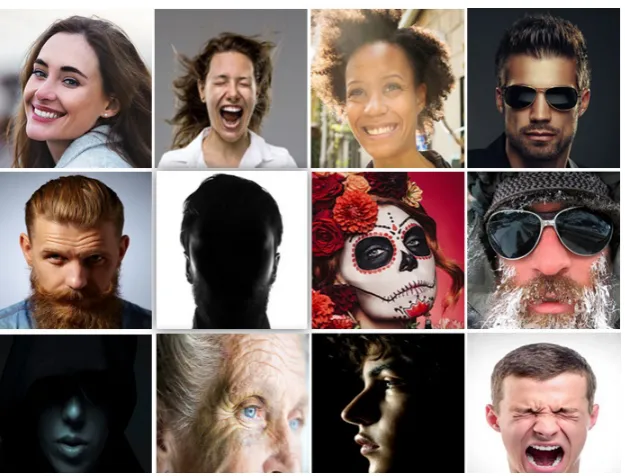
In a world of over six billion different faces, each human face is unique. Each face is a source of rich information. It can reveal character, cultural identity, age, gender, beauty, personality, emotions. Figure 1.1 shows sample human faces. The face can convey different information, it can sometimes be used as a source of meaningful information and can also be a confusing source of information. For example, a prematurely wrinkled face in a young person could mislead interpretation of expressions of emotions. Furthermore, the face is a location for sensory input and communication output [EFE13]. Charles Darwin [Dar72] described a face as an important source of evidence to describe human character, for example, the facial muscles activities aid the making of expressions. Through the facial muscles, humans are able to show and share social information with others and even engage in non-verbal communication. This can provide rich information about people’s intention or mind set [SB10].
Figure 1.1: Sample human emotional faces
emotion perception exist, for example, can people be judged based on their facial expressions? Does a smile indicate a person is happy or insincere? Does squinting show concentration or mistrust? Facial expression is displayed when muscles beneath the facial skin move. This movement can reveal the current focus of attention, synchronise a dialogue, and signal comprehension or disagreement. Furthermore, it can convey social and emotional information between humans and, as some researchers believe, these are the primary means of non-verbal communications. According to [Meh08], in a conversation, whether the listener feels liked or disliked amounts only to 7% of the spoken word, 38% on vocal utterances and 55% on facial expressions based on emotions.
can be extracted and interpreted from facial expressions, its interpretation relies heavily on the information collected from the face. For example, as we laugh or frown we are putting our emotions on display, allowing others to infer our current emotional state. Therefore, the knowledge of how much information the face provides is necessary to interpret emotions. Research reveals that emotions control our actions. It is thought that emotions have developed via the adaptive values in human fundamental life styles [Ekm92]. The human affective state and the associated behavioural expressions constitute an important part of our life. It has been established that they are reflected in the way we behave, make decisions and communicate with others, which means that the affective state of humans influences their actions and of others around them [RWHJ13].
Researchers in the face domain have raised a series of theories to answer the question,"can a computer recognise a face as the same when presented under different lighting conditions?" This thesis will carry out a study in order to provide an answer to the question. In doing so, the focus is restricted to one area of facial information - facial expression. The aim is to concentrate upon questions on how the face provides information about facial expressions and what are the challenges associated with the study of facial expressions. For example,does the face provide accurate information about expressions when presented under harsh lighting conditions?
This thesis proposes HDR imaging techniques to aid the analysis of facial expression recognition of emotions with images captured under harsh lighting conditions such that the process of image pre-processing can be avoided in the FER processing system.
1.1
Facial Expression Recognition
techniques relies heavily on a number of factors such as, the type of image/video data, condition of the image/video data and the application areas involved. To put that in perspective, first, an understanding of the condition of the data provided is optimal, followed by a robust feature identification and extraction technique for extracting useful features. On top of that, the feature extraction technique should be able to provide adequate features for the learning/classification techniques.
FER is highly beneficial for diverse application areas. With FER, we can test the impact of any content, product or service that is associated with the elicitation of emotional arousal and facial responses. For example, in physical objects such as food or packages, videos and images, sounds, smell, sense of touch stimuli and so on.
Recently, facial expressions of emotion recognition techniques have been adopted in academic research and commercial fields in prominent areas such as media testing and advertisement, consumer neuroscience and neuromarketing, clinical psychology and psychotherapy, medical applications and plastic surgery, software user interface and website design, engineering of artificial social agents (avatars), educational technology and workplace stress assessment. It is this wide range of applications that has produced a surge of interest in machine analysis of facial expressions.
FR and FER systems use similar processing methods. For example, face detection is a technique used in both FR and FER systems. Therefore, in the course of this research, an investigation will be carried out into how FR performance can be improved when presented with images under complex lighting conditions.
1.1.1 Facial Expression Recognition Pipeline
One of the contributions of this thesis is the exploration of the existing facial expression recognition techniques used for dealing with images affected with harsh lighting conditions. Therefore, there is the need to introduce the FER pipeline. A generic FER system pipeline involves, data/video capturing, feature
Figure 1.2: Facial expression recognition pipeline representing the stages through which images and videos pass from input to output. Different processing is involved at each stage depending on the intended application.
identification/extraction and learning/classification as shown in Figure 1.2. Each stage of the basic FER pipeline constitutes a set of established functions and operations which takes an image(s), pre-processes it (if needed), performs feature extraction and makes classification based on defined classes depending on the intended applications. Each stage is examined in more detail in the course of this thesis. The focus is on avoiding the need for the pre-processing stage.
1.2
Face Recognition
fully control in real-world environments. Thus, face recognition systems suffer a significant performance drop with these constraints. Amongst these factors, the focus in this thesis is on harsh lighting conditions. In Chapter 5, FR under complex lighting conditions is discussed.
Most FER and FR software has relied on images captured from an existing database. To be effective and accurate, the images captured need to be of a face with little variance of light as in the case of images in the database. In most instances, if the images were not taken in a controlled environment, small changes in light could reduce the effectiveness of the system. For example, Figure 1.3 shows FER/FR processing stages. In order to give more understanding to this, issues of image
Figure 1.3: Facial expression recognition/Face recognition processing stages. lighting conditions will be explored further.
1.3
Image Lighting Conditions
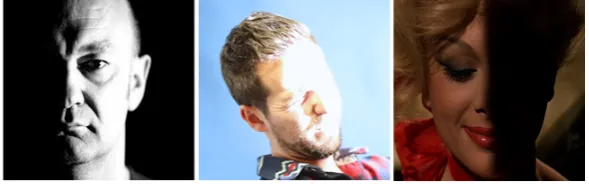
Figure 1.4: Sample faces under harsh lighting
controlled lit scenes, where faces of the subjects are perfectly lit and stable to ensure flawless capture. Certainly, the recovering of the geometry and texture of presented faces is very important to any image processing system [WLH03]. This can particularly be difficult when the images are captured under harsh lighting conditions, and even more challenging when cast shadows, saturated areas and partial occlusions are present. Harsh lighting is produced when dark shadow is formed due to large contrast between the light and dark areas in an image. However, it has been reported that approximation errors become large in the presence of images under harsh lighting conditions [WLH∗07]. Adini et al [AMU97] show that changing illumination direction could influence the perception of object characteristics such as 3D shape and location. Therefore, changes in lighting result in large image differences. Such changes can be even larger when varying the identity of the subject.
1.3.1 Image Enhancement
image distinguishable from another image and the background. An example of a non-linear contrast enhancement is histogram equalisation in which the original histogram is redistributed to produce a uniform population density of pixels along the horizontal axis. This stretch applies the greatest contrast enhancement to the most populated range or brightness values in the original image. In Figure 1.6, the intensity range of the darkest values are preferentially stretched, which results in maximum contrast. The uniform distribution stretch strongly saturates darkness values at the sparsely populated light and dark regions of the original histogram.
Figure 1.5: Original image with half of the face in shadow. With most values in the histogram towards the dark region of the intensity range
1.4
High Dynamic Range Imaging
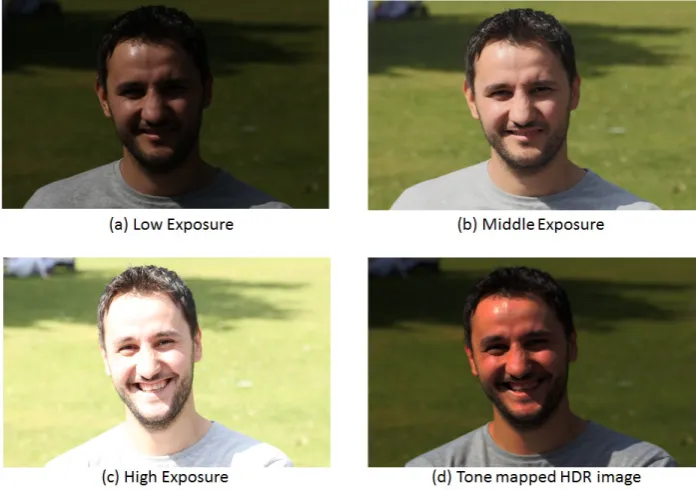
[image:28.595.146.496.352.597.2]Traditional imaging techniques, known as Low Dynamic Range (LDR) imaging is able to capture a limited dynamic range of a scene. This results in over-exposed (or white) pixels and under-exposed (or black) pixels within the LDR image at places where details would be expected. Where the dark and bright regions of a scene can be recorded at the same time onto an image/video, for example, when capturing images on a sunny day through a window, choices need to be made on whether to capture either the background sky and highlights or capture the scene details in the shadow, although both will be visible to the observer, as shown in Figure 1.7. HDR imaging techniques typically capture multiple exposures of the same scene
and combine these into a single image. This allows all the scene data to be captured; there are no more under or over-exposed pixels. HDR images can be converted to an LDR image through a process known as tone mapping [BADC11].
1.5
Research Challenges
In spite of the fact that in the FER research community a number of different approaches have been developed, the recognition of facial expressions in complex lighting scenarios remains an unresolved problem. There are several instances where due to different environmental factors, it is not always possible to get a suitably illuminated image. In such cases, machine learning and object recognition techniques may lose their effectiveness. In this thesis, the use of HDR to improve FER will be investigated to overcome this problem. The research challenges are:
1. In reality, most of the image data captured will not be under ’ideal’ studio lighting conditions, where the face of the subject is perfectly lit and stable to avoid imperfections. However, most FER systems have been developed for environments with homogeneous lighting condition, such as outdoors, indoors, through a window or in a low light visibility area.
this as one of the essential motivations for this thesis.
Figure 1.8: Sample images of the same person in the same pose under different lighting conditions
3. The effects of lighting in smaller image regions can appear homogeneous [WLH∗07] and can become worse if the majority of the pixels in the region are problematic. Therefore, the full image information cannot be correctly recovered, for example, in cast shadows, saturated areas or when there are large lighting estimation errors, Figure 1.8 (left) and Figure 1.9 (right). Thus, arbitrary lighting conditions, occlusion, low image resolution, pose, differences in expressions across different cultures and other parameters, such as camera capability, can make FER tasks even harder [PSO∗07].
Figure 1.9: Sample facial expression images under harsh lighting. From left: cast shadow, partial occlusion and saturated areas.
1.6
Aims and Objectives
1.6.1 Aims
The research reported in this thesis aims at targeting the deficiencies and limitations of the existing FER systems with images captured under harsh lighting conditions. Most FER studies have directed a great deal of attention on data from images with relatively uniform illumination. The key challenge will be how to achieve optimal performance via pre-processing, feature extraction and classification, under harsh lighting conditions. Due to the growing need to recognise emotions or track how people react through their facial expressions for applications requiring images captured under rapid light changes, the current systems built on lab collected data are not designed to generalise to such scenarios. Therefore, the general objective of this thesis is on improving the performance of facial expression applications in scenes where harsh lighting conditions can be expected and full image information is not necessarily given, and where the traditional LDR imaging techniques struggle to cope with the lighting changes.
1.6.2 Objectives
The following are the specific objectives of the thesis:
• Investigate how to recognise emotions from images showing facial expressions in harsh lighting conditions without first pre-processing the input image.
• Build a FER system with high level of insensitivity to changes in light. In particular, we consider whether HDR provides a significant improvement for FER systems due to its capability of allowing the capture and manipulation of natural scene luminance ensuring all details in a scene are captured no matter what the lighting conditions.
• Find out whether tone mapping methods are sufficient for improving performance of facial expression recognition systems.
• Validate the level of performance that can be achieved with HDR methods under different lighting conditions for FER tasks
• Examine whether lighting a face from different directions does have a significant effect on recognition.
1.7
Research Questions
The thesis attempts to answer the following research questions:
• How are current methods used for facial expression recognition problems coping in the presence of data presented under harsh lighting conditions? • Are some of the image enhancement techniques adopted able to boost facial
expression recognition tasks? If so, can this performance be enhanced? • Can a HDR method help to reduce loss of information when used as an
alternative to image enhancement?
1.8
Approach
The steps to answer the research questions are as follows:
1. Sets of images will be captured under harsh lighting conditions to investigate whether pre-processing tasks holds value for FER.
2. FER experiments will be conducted using the original images versus the pre-processed images.
3. A facial expression dataset of HDR images will be created. Machine learning methods, Local Binary Pattern (LBP), Speeded-up Robust Features (SURF) and Support Vector Machines (SVMs) will be used to conduct emotion recognition experiments.
4. HDR will be investigated as to whether it can benefit FR systems.
1.9
Thesis Outline
The thesis consists of eight chapters which are organised as follows:
• Chapter 2 provides an overview of the methods and techniques used for facial expression recognition analysis. It covers face recognition, emotion recognition, classification and facial expression databases.
• Chapter 3 details the fundamental concepts of High Dynamic Range imaging. It gives the difference between LDR and HDR imaging. Different types of tone mapping operators (TMOs) are discussed. This is followed by discussion on the elements of HDR imaging as it relates to capture and post processing.
whether HDR can be useful in addressing the limitations of the LDR imaging methods in handling scenes with harsh lighting conditions.
• Chapter 5 investigates the effects of HDR tone mapping methods in the presence of complex lighting conditions for FER. A database was created with strong shadow affecting half of the face. Image processing methods were used to conduct emotion recognition in order to create a bench mark for further experiments.
• Chapter 6 presents an investigation exploring whether HDR can benefit face recognition. A new database was created under three different lighting scenarios. Existing face recognition methods were used to test HDR imaging performance on face recognition systems and, comparisons were made for further validation of the new HDR facial expressions database.
• Chapter 7 validates the new HDR database by investigating the performance of FER tasks on the database. Two facial expression algorithms were implemented in order for performance comparison. The results of these are used to create a benchmark for the created HDR facial expression database for the research community.
Chapter 2
Facial Expression Recognition
System Review
"The secret of change is to focus all of your energy, not on fighting the old, but on building the new." Socrates
2.1
Introduction
Facial expression reveals not only the facial motions, but also subtle changes under lighting and appearance [WLH∗07]. These changes are important details for visual cues, but could also be difficult to synthesise.
A number of traditional approaches for processing images under harsh lighting conditions have been proposed: normalisation, illumination extracting or representation, such as spherical harmonics or illumination cone [LHK05,ZS03,
2.2
Facial Expression Analysis
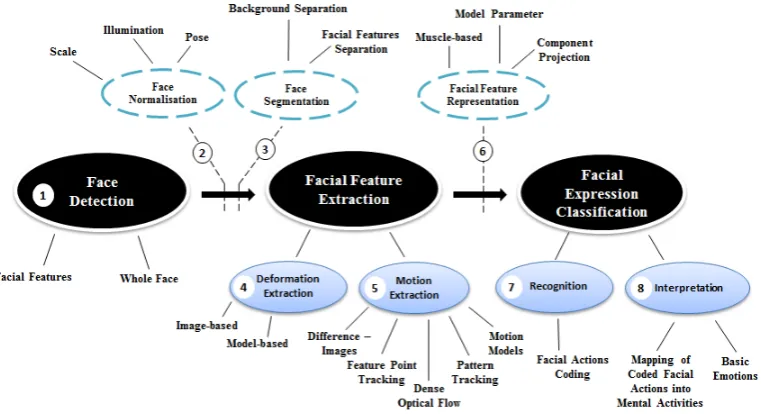
Facial expression analysis can be categorised into video-based and image-based. The focus of this thesis is on the image-based. Facial expression analysis usually starts with face detection in videos or images. However, this may not be the case when using already pre-processed data. Face detection is an essential pre-processing task carried out before performing face/facial expression recognition. Another pre-processing task is face normalisation. Closely linked to face detection is face segmentation. Some applications may require face segmentation as a necessary step, whereas some may not. With FER of emotions, the use of facial parameter coding systems is very important as a metric for measuring facial expressions. To evaluate facial expressions data for emotion recognition, the facial features need to be extracted. This can be carried out using three methods - muscle based, model based and motion based. More than two of these methods can be combined as hybrid methods. The final step of a FER system is facial feature classification into different expressions.
Facial expression analysis can be summarised in three different ways [WLH∗07]
• Tracking of facial electromyographic activity (fEMG)
• By live observation and manual coding of facial activity, using the facial action coding system (FACS)
• By automatic facial expression analysis using computer-vision algorithms, which is the focus of this thesis.
2.2.1 Face Detection
Face detection is a procedure for finding the position of a face in an image/video [KMM10]. The traditional (commonly used) algorithm for face detection is the Viola Jones cascade classifier [VJ01], a method that uses the Haar-like features, which are efficiently calculated using the integral image. The results of face detection enables tasks in facial analysis such as facial expression recognition and face recognition on focused image areas. The goal of face detection or tracking module is to determine in a given arbitrary image/video whether or not there are any faces in the image/video and if present, return its location and the extent of each face. Locating a face within the image/video is referred to as face detection or face localisation, while face tracking is the tracking of a face across the different frames of a video sequence [KMM10]. Figure 2.1 shows an example of face detection in an image. .
Figure 2.1: Face detection with the Viola-Jones algorithm which uses a cascade object detector to detect the presented face [VJ01].
facial pose, orientation, etc [LZY12]. The authors Fanelli et al [FDG∗13], proposed a face detection algorithm based on the Haar-like features extracted from a range of data used as features in random forest decision nodes. This face detection algorithm was used to demonstrate the ability of handling large rotations, partial occlusions and the noisy depth data acquired using commercial sensors. Recently [FB15] introduced a novel statistical framework for face detection and facial expression recognition. The framework is based on the Dirichlet process mixture of generalised Dirichlet distributions, which they used to model the local binary pattern features. They adopted a localised feature selection scheme, which they reported showed superior performance over the traditional method. They illustrated their results using synthetic data adopted to carry out face detection and FER [FB15].
2.2.2 Face Normalisation
Face normalisation plays an important role in facial analysis. In the image processing domain, normalization is a process involving changing the range of pixel intensity values [HYH∗05]. The purpose of face normalisation is to bring the image into a range that is more familiar or normal to the scene. Normalization can sometimes be referred to as contrast stretching or histogram stretching [GW08]. In digital signal processing (DSP), face normalisation is referred to as dynamic range expansion [GW08]. Contrast stretching is a simple image enhancement technique employed to improve image contrast by stretching its range of intensity values, where a scaling function is usually applied to the image pixel values. With contrast stretching, the upper and lower pixel value limits are usually specified over which the image is to be normalised. Most often, the limits are the allowable minimum and maximum pixel values for the image [HYH∗05]. To put this in perspective, let Xoriginal = {Xoriginal[n1,n2,n3] | 1 ≤ n1 ≤ N
0
1, 1 ≤ n2 ≤ N
0
2, 1 ≤ n3 ≤ 3 |}
image andn3 represents the three colour channels (RGB) for colour images. For
example, an imageX = {X[n1,n2,n3] | 1 ≤ n1 ≤ N1, 1 ≤ n2 ≤ N2, 1≤ n3 ≤ 3 |}
can be used to represent a certain facial image containing a face. Conversely, with a greyscale image the colour components are ignored,Xoriginal[n1,n2]. It is worth
noting that for an 8 bits grey scale image the lower and upper limits are between 0 and 255. The traditional normalisation method scans the image in order to find the lowest and highest pixel values present in the image. Afterwards, each of the pixel is scaled to a new value as presented in the equation below [BKW∗08]:
Xnorm[n1,n2] = (X[n1,n2]−xmin)(
255−0
xmax−xmin
) +xmin (2.1)
xmax= max∀n1,∀n2{X[n1,n2]} (2.2)
and
xmin =min∀n1,∀n2{X[n1,n2]} (2.3)
wherexminandxmaxare the lowest and highest pixel values present in the image.
condition. These are iteratively estimated by minimising the differences in pixel colour between the image and the rendered morphed model. Similarly, changes in facial light has been shown in [AMU97] to introduce bigger changes in the image facial appearance than the head pose. Various techniques have been proposed to address this problem. The authors in [Sha97] observe that images generated under unstable lighting conditions can be represented in the 3D linear subspace.
2.2.3 Face Segmentation
Face segmentation is essential for face classification for facial expression analysis. It involves partitioning in order to separate the facial pixels from all other background pixels [PP06]. The simplest methods of face segmentation are based on the skin colour, although, face segmentation could provide more satisfactory results. However, some of the pixels may be incorrectly labelled due to the issues of changing light, specular reflections or background clutter. Recently, face segmentation algorithms have been designed incorporating, in addition to the data driven part, a face model, such as the information about the variability of face shape in the form of point distribution model [JWYh09]. Pantic and Patras [PP06] present a system for automatic recognition of facial action units. Their algorithm performs both automatic segmentation of an input video into facial expressions pictured and recognition of temporal segments: onset, apex, offset of 27 Action Units (see below) occurring alone or in a combination in the input face profile video. They reported a recognition rate of 87%. Segmentation can also be implemented with active contour using implicit and explicit shape representation. A recent method by [WCL11] proposed the use of constraint local models which jointly minimises the regularised misalignment error over predefined facial landmarks using a prior shape model and a local patch based landmark appearance model.
towards facial expression recognition is discussed.
2.3
Facial Parameter Coding Systems
Facial expression metrics need to be measured and represented in a consistent way in order to improve the discrimination of facial expression data. Various measurement systems have been proposed in the past. The most widely used are the Facial Action Coding System (FACS) [EF78], Facial Animation Parameter (FAPs) [DC10], the facial expression spatial charts and the maximally discriminative facial movement coding system (MAX) [IW79].
The most widely adopted scheme is FACS. This represents a fully standardized classification system of facial expressions. Due to its subjective nature, being coded by humans, FACS carried out on a face, could be biased and annotating images is time consuming. This makes the encoding of all the visually discriminative facial expressions on the human face possible. In the FACS framework, the occurrence of facial expressions is the combinations of elementary components called Action Units (AUs). Each AU corresponds to an individual face muscle group, which can be identified by code such as AU1, AU2, etc. There are about 44 unique AUs, each one of which reflects distinct momentary changes in facial appearance. The intensity of each AU is determined by action descriptors with the addition of a letter in the range A-E (A: trace,..., E: maximum, e.g. AU 12D) [KSMEK13].
of the deformation that is caused on the neutral model. For example, a small smile versus a big smile.
2.4
Facial Feature Extraction Methods
Accurate feature extraction is an important task in the process of FER [EF03]. Flaws in the process are likely to result in a biased recognition. Therefore, in order to evaluate facial expressions for emotion recognition, there is the need for the extraction of facial features that are specifically required for processing the data. Facial features can be divided into stable and transient. Permanent facial features such as, the lips, mouth, eyes or furrows that have become permanent due to age are stable facial features. Stable facial features can be deformed due to muscles movement to give facial expressions. Temporary facial movements or deformation appear mainly around the regions of the mouth, eyes and cheeks. These result when feelings or emotion are being expressed and can be categorised as transient facial features.
Existing methods of facial feature extraction for FER focus on extracting features from the whole face, an approach known as holistic [EF03]. Extracting specific facial regions of interest such as, the mouth, nose or eyes, is typically a local approach [EF03]. Whilst these two approaches can be used interchangeably, in reality, the holistic approach provides a complete picture of the facial information, sometimes, facial expression can significantly affect specific facial regions. Therefore, in such cases, the local approach which provides specific details and distinguishable information could be an option [DHS12].
methods is another category. Figure 2.2 shows a categorisation of facial feature extraction methods.
Figure 2.2: Categorisation of facial feature extraction methods
2.5
Facial Feature Representation
Facial feature representation is to derive a set of features from original face images to effectively represent faces [DBBB03]. A successful facial feature representation method should be able to obtain an optimal facial feature representation from the presented image data. This should minimise the within-class variations of the expressions, while maximising the between-class variations in order to perform robust and accurate classification [LPR14]. This could come with some challenges capable of reducing the classifier’s accuracy and speed, such as the existence of a high number of extracted features, the quality and amount of data being analysed in the processing circles [LWY∗13]. In essence, if inadequate features are used, even the best classifier could fail to achieve accurate recognition. Therefore, the classification performance highly depends on a proper feature selection/representation [DBBB03].
of increasing the algorithms computational cost. Another kind of method to represent faces is to model the appearance changes of faces. These methods (dimensionality reduction) are used to project the high dimensional variables to a lower dimensional feature subspace. Holistic spatial analysis including Principal Component Analysis (PCA) [BS14], Independent Component Analysis (ICA) [LMMHM01], Linear Discriminant Analysis (LDA) [EC97], and Gabor wavelet analysis [SGM09], have been applied to either the whole face or to specific facial regions to extract facial appearance changes. Ideally a dimensionality reduction technique should be incorporated into every face analysis system. However, for FER, it can be avoided since the dimension of the extracted features depends significantly on the feature extraction method and this can only affect some of the classification methods [LLSC13].
2.5.1 PCA
In order to get around the problem of high dimensionality, a linear combination of features is carried out to reduce the dimensionality [DHS12]. It is a method to linearly compress the features, by projecting the high dimensional data onto a lower dimensional space, while retaining as much as possible the variations present in the data set. PCA is one of the approaches used for finding effective linear information in order to transform the input variables into a new set of variables - the uncorrelated and ordered principal components, such that the first few components retains most of the variation information present in all of the origin. For example, an image vector with 65,536 pixels (256×256) might be projected into a subspace with only 100-300 dimensions. Several studies involving FER using the appearance based approach apply PCA prior to expression classification, for example [DBBB03] and [FL03]. Rudovic et al [RPP12], proposed an effective simultaneous FER of multiple emotions and their intensity estimation. PCA was used to construct a low dimensional input data representation in order to preserve discriminative information about various facial expressions of emotions and their intensities while being invariant to intra-and inter-subject variations.
Given that each feature vector Z, is a column vector of M-dimensions or M-elements, consider a set ofNf feature vectors, which forms a feature matrix with
one feature vector per column. Therefore,
Z={Z[m,n]|1≤m≤ M, 1≤n≤ Nf |} (2.4)
PCA can be used to find a linear transformation through mapping of the original M dimensional feature space into L dimensional feature subspace, where normallyL< M. The new vectors can be defined by:
and
y=wTpcaz (2.6) wherewpcais the linearM×Ltransformation matrix, the superscriptTdenotes the
transpose of matrix and the columns ofwpcaare theLeigenvectors associated with
theLlargest eigenvalues of the covariance matrixcwhich is given by:
c= 1
Nf Nf
∑
n=1
(z[m,n]−zµ[m])(z[m,n]−zµ[m])T (2.7)
and
zµ[m] =
1
Nf Nf
∑
n=1
z[m,n] (2.8) wherezµ[m]for 1≤ m≤ M, is the mean of all feature vectors.
2.5.2 ICA
ICA is a generalisation of the PCA method, in which the goal is to find a linear representation of data so that the components are statistically independent [LMMHM01]. It is the most common method for generating spatially localised features in order to produce basis vectors that can make it statistically independent. Basically, the performance of ICA depends on the task to achieve, as well as the algorithm used to approximate ICA and the number of subspace dimensions retained. Two lines of different applications of ICA exist for data intended to be used for FER: ICA can be applied so as to treat images as random variables and pixels as observations, or the reverse, to treat pixels as random variables and images as observations.
yields the highest performance for identifying faces, while the InfoMax algorithm configured according to ICA architecture II was better for recognising facial actions [DBBB03].
2.5.3 LDA
Similar to PCA and ICA, LDA is a linear technique that projects the data onto a lower-dimensional vector space such that the ratio of the between-class distance to the within-class distance is maximised, thus achieving maximum discrimination [EC97]. The facial expression and analysis study, Wang, et al [WLL∗10] used spontaneous visible images on front lighting using several typical methods, such as the eigenface (PCA), fisherface (PCA+LDA), the Active Appearance Model (AAM) and the combined AAM-based+LDA (AAM+LDA). They used PCA and PCA+LDA to recognise expression from spontaneous infrared thermal images. They claimed that LDA improves the rates of recognition in discrete dimensional expression recognition, while, it causes the performance to progressively worsen the emotion recognition category [WLL∗10].
2.6
Facial Classification
[image:48.595.130.511.463.645.2]Classification is the final stage of any facial expression analysis system [NPDlT08]. This often comes after any face detection and feature extraction. Thus, it is the process by which class labels are attributed to a set of facial measurements. Essentially, the classification process aims to correctly categorise the extracted features into different facial expressions of emotions. This can be achieved as facial expression interpretation or as facial expression recognition. When interpreting facial expressions, specific facial patterns are classified into mental activities or emotions. This involves directly associating the facial expressions with a predefined number of emotions or mental activity categories. Facial expression has been described at different levels [BT03]. The most widely used is the FACS, which is a human-observer based system developed to capture subtle changes in facial expressions. As mentioned in Section 2.3, FACS contains the most perceptible facial changes used to describe facial expressions by Action Units (AUs). Sample AUs extracted from the Cohn-Kanade database are shown in Figure 2.3.
recognised AUs or the six basic emotions. If the output are AUs, each of them gives an estimate of the probability of the input image consisting of the associated AUs as show in Figure 2.4
Table 2.1: Facial muscles description of FACS - AUs. [FE78]
Emotion Darwin’s description FACS, AUs
Ekman’s description
Anger
Nostrils raised, mouth compresses, furrowed brow, eyes wide open, head erect
4, 5, 24, 38 Contempt
Lip protrusion, nose wrinkle, eyelid partial closure, eyes turn away, upper lip raised
9, 10, 22, 41, 61 or 62 Disgust
Lower lip turned down, upper lip raised, mouth open, out protruding lips, tongue protruded
10, 16, 22, 25 or 26 Fear Eyes open, mouth open, lips
retracted, eye brows raised 1, 2, 5, 20 Happiness Eyes sparkle, under eyes skin wrinkle,
mouth drawn back to corner 6, 12 Sadness Mouth corner depressed, eyebrows inner
corner raised 1, 15 Surprise Eyebrows raised, mouth open, eyes
open, lips protruded 1, 2, 5, 25 or 26
(HMMs), Dynamic Bayesian Networks (DBNs) and the Naive Bayes Classifiers (NBCs) are popular supervised learning methods [PP06]. Popular unsupervised learning methods are the geometric-invariant clustering algorithms, aligned cluster analysis (ACA) and the Active Appearance Models (AAMs) [PP06].
2.6.1 Emotions Interpretation
Two approaches used to interpret emotion interpretation from facial expressions data are message judgement and sign judgement. In message judgement, emotions or social signals are read out of the face in the same way as the observers’ interpretation. With sign judgement, less emphasis is placed on the expression semantics, but more on higher level decision making. Sign judgement is widely used in psychology research, expression synthesis and affective computing [Coh07].
for only a few seconds, but are rarely more than 5s or less than 250ms [SSM12]. In order to track and interpret them, the location of the facial actions, the intensities and dynamics are very important. Facial expression intensities can be measured either by determining the geometric deformation of the facial features or the density of wrinkles present in certain facial regions. For example, anger is communicated by lowering the eyebrows and tightening of the lips, surprise is characterised by raising of the eyebrows and opening of the mouth, while smile is communicated by the magnitude of cheek and the raising of the lip corner as well as wrinkle displays [EF03].
In the research community, the interest has been to classify human emotions into some specific categories. This was led by the early research work of [EF71], in which theories that divides and categorise emotions are provided. Similarly, the early philosophy of mind [Plu01] put forward that all emotions can be categorised into basic classes (pleasure and pain). The philosophy of mind theory is described using the wheel of emotions [EF71]. This presents eight primary emotion dimensions arranged in pairs of four opposites -joy vs sadness, trust vs disgust, anger vs fear and surprise vs anticipation. Apart from the primary emotions, other emotions can be identified from their intensity differences and the mix of primary emotions. Figure 2.5 shows the wheel of emotion. Facial expression are one of the many correlates of emotions, since they are the most apparent ones. Humans are able to produce a lot of slightly varying sets of facial expressions, however, there is a small number of categories of distinctive facial configurations that almost every one associates with certain emotions, irrespective of their gender, age, cultural background and socialisation history. The categories of basic emotions areanger, disgust, fear, happiness, sad and surprise [CB03]. Based on research findings almost everyone can produce and recognise the basic facial expressions of these emotions has led to the assumption that they are universal emotions [TKC05].
Figure 2.5: Plutchik’s wheel of emotions [Gol14]
activity and a degree of pleasure/displeasure. They are closely related to the physiological and psychological levels of arousal to specific emotions. In neurobiology, emotions are taken as complex action programs triggered by the presence of certain external or internal stimuli, of which facial expressions is one of the elements [Mür15]. Computer vision systems can be used to extract and interpret emotions from facial expressions by studying specific facial regions or geometry of the facial structures. Emotion classification can lead into the identification of basic emotions and the estimation of psychological status of an individual. The SVMs classifier will be described in the next section.
2.6.2 SVM
This thesis is more concerned with the classification problem. Given labelled training data (supervised learning), the algorithm outputs an optimal hyperplane which categorizes new examples. SVMs are thus based on the concept of decision planes that define decision boundaries. A decision plane is one that separates a set of objects having different class memberships.
Improving a classifier’s effectiveness has been an area of in-depth machine learning research [CVL07]. A lot of research works in this domain have been successfully applied to pattern classification problems, particularly facial expressions classification, for example [NPDlT08,CVBM02]. The SVM decision hyperplane can be defined by an intercept term, z and a decision hyperplane normal vectord, which is perpendicular to the hyperplane [DHS12]. The vector is referred to as the weight vector. Letχbe a set ofNslabelled training set
χ= (Xif,ci)|cie{−1, 1}, 1≤i≤ Ns (2.9)
whereXif are the training samples andciis the class labelXif. The linear classifier (h(Xf))typically try to find a decision function given by:
h(Xf) =sgn(hd,Xfi+Z) (2.10) and
sgn(τ) =
1,τ≥0
−1,τ<0
(2.11) wheredis the decision hyperplane normal vector andzis intercept term.
h(Xf)e{−1, 1}yields a label (-1 indicates one class and +1 indicates the other
class) for an unseen exampleXf. The SVM linear classifier relies on a dot product between data point vectors.
hsvm(Xf) =sgn( Ns
∑
i=1
αiciK(Xif,Xf) +z) (2.12)
where theαi are Lagrange multipliers of a dual optimisation problem.
If in the optimal solution, all of the αi are shown to be non-zero, then that is
those training points nearest in neighbour to the hyperplane. This is referred to as the support vectors. This brought about spareness in the solution and gave rise to efficient approaches to optimisation [WMC∗00]. Once a decision function is reached, the classification of the unseen examples (Xf) are checked to ascertain where on the hyperplane these lies. Technically, the SVMs carry out implicit embedding of data into a high dimensional feature space, where the separation of data that are only separable with nonlinear rules will be carried out in input space [MEK03]. In order to achieve this, the learning algorithm is formulated to make use of the kernel functions, which will allow for the efficient computation of the inner products directly in the future space, without the need for explicit embedding. A kernel function (K) in the expanded future form, corresponds to a dot product. The Equation 2.13 describes the kernel function
K(Xif,Xjf) =hφ(Xif)T.φ(Xjf)i (2.13)
whereφis a nonlinear, mapping function which embeds input vectors into feature
space. Using a kernel function, SVM can be used as an alternative training method for polynomial, radial basis function (RBF) and multi-layer perceptron (MLP) neural network classifiers in which the weights of the network are found by solving a quadratic programming problem with linear constraints, rather than by solving a non-convex and unconstrained minimisation problem as in standard neural network training. The native RBF is usually given by a Gaussian distribution
K(Xif,Xjf) =exp[kXif −X f jk2
wherek • kis the Euclidean distance between two vectors. In 2.14, the output of the kernel is dependent on the Euclidean distance ofXjf fromXif. By convention, the output will be one support vector and the other the testing data point. The centre of the RBF becomes the support vector andφis used as the variable to determine
the area of influence of the support vector over the data space [PFW∗11]. A φ
with large value will be an advantage to give a smoother decision surface and more regular decision boundary. With a larger φ, the RBF will allow a support
vector to have a strong influence over a larger area. Also, a larger α value has
the potential of increasing the value ofαi in the Equation 2.12. Generally, when
a support vector influences a larger area, all support vectors in the neighbouring area will also increase inαivalue in order to counter the influence, so that all theαi
will reach a balance at a larger magnitude. On another perspective, a larger value ofαiwill reduce the number of support vectors, with a larger space covered - fewer
αiwill therefore be needed to define a boundary.
2.7
Facial Expression Recognition
Ekman et al [EF71] carried out an important step in facial expression analysis. They identified six universal facial expressions that corresponds to specific emotions which are expressed in the same way independent of age, gender or cultural affiliations the world over.
Facial expression analysis can be carried using two popular classes:
of the facial expression for this approach uses the FACS framework, which describes facial expressions by activation of the AUs in the face. Thus, FACS [FE78] is a technique for the measurement of facial movement, where each AU is a single intra-face movement and the contraction of specific facial muscles. FACS and AUs have been described in Section 2.3. Sample facial annotation using FACS and AUs framework is presented in Figure 2.4. The advantage of this technique is its flexibility. Combining activated action units are indicative for many states of mind apart from emotions, for example, confusion, pain, fatigue etc. On the contrary, manually labelling images/image sequences is a tedious task and, much effort is needed to analyse this task [ZPRH09]. A non person-specific approach has been proposed in [BLF∗06], where an image-based system is developed to recognise the activation of 27 different facial AUs by applying Gabor-wavelets to the facial region and utilising SVMs and AdaBoost for classification.
2. The other approach is facial expression analysis that determines a complete facial expression. This is usually done with a specific semantic (angry, happiness, pains, etc). Here, predefined facial expressions rather than a single facial action is dedicated to classifying the six universal facial expression of Ekman et al [EF71]. In this approach, facial expression can be considered static, that is, as a fixed face state, or dynamic, that is, as intra-face movement. In the work of [WLF∗09], an image-based approach was followed to determine smiles. The system relied on AdaBoost and SVMs to determine the facial expression from convolution of image data with Gabor energy filter.
were thus built to know the location of the face of facial landmarks. Also facial expression analysis were restricted to acted and exaggerated basic emotions. To date, though, remarkable progress has been made in the field of facial expression analysis [SI92]. In addition, the physiognomies of faces vary considerably between different people. This is attributed to the differences in age, ethnicity, gender, facial hair, cosmetic products and occlusions such as glasses, scarf and hair. As a result, the automation of facial expressions task becomes more complex. Also faces may appear different because of pose and changing light. Therefore, in order to achieve a meaningful result, these variations have to be addressed at different stages of an automatic facial expression analysis pipeline.
2.7.1 Facial Expression Architecture
Generally, a duality of task exist between face recognition (FR) and facial expression recognition (FER). In the literature, similar structure and processing techniques are often used for both tasks. In both tasks, there is the consideration of what is wanted for FR or FER. Thus, faces convey other information such as the identity of a person in addition to expressions. Personal identity information conveyed by the face is an unwanted source of variability for FER tasks. In line with that, the variability arising from facial expression is unwanted in face recognition. Therefore, the uniqueness of the face is the central criteria for the recognition task. In order to adhere to the classical pattern recognition model, FER tasks usually take the form of a sequential configuration in the following way: image acquisition, pre-processing, feature extraction, classification and sometimes post-processing. The individual stages of the FER architecture is presented in Figure 2.6
Figure 2.6: Sample FER Architecture
the estimation of optical flow is prone to distortion by the nonrigid motion and changing lighting conditions. This can lead to inaccuracy of image recognition. Also facial geometry has been used in facial representations, where shapes and locations of facial components are extracted [PP06]. In [ZLSA98], the authors used the geometric position of 34 fiducial points as facial features to represent facial images.
of these images can be represented with a brightness functiong(x,y,t)referred to as temporal image sequence.
2.8
Existing Databases
Several databases have been proposed which contain facial images for computer vision purposes, including [LAKG98,DGLG11a]. These databases consist either of single images or image sequences, mainly captured in laboratory conditions. The information on the databases content is usually provided by the database authors. Depending on the purpose of the database, this is called "meta-data" and includes the person’s identity, facial expression, action unit activation, annotated facial components or landmarks.
Table 2.2: Characteristics of facial expression databases
Name Expression description No.Subjects Characteristics Views
AR
[Martinez & Benavente, 1998] 3 basic emotions 126
Glasses, scarf,
different illumination Frontal AT&T (formerly ORL
[Samaria & Harter, 1994] 2 basic emotions 30 Glasses, varying lighting Frontal BU-3DFE [Yin et al., 2006] 6 basic emotions 100 4 levels of intensity (3D) Frontal, 45, -45 Cohn-Kanade
[Lucey, Patrick et al., 2000] 7 basic emotions 97 Uniform lighting Frontal, 30 degrees
JAFFE [J. et al., 1998] 6 basic emotions 10 Uniform lighting Frontal
MMI [Pantic et al., 2005] 6 basic emotions 90 Glass, facial hair Frontal, profile
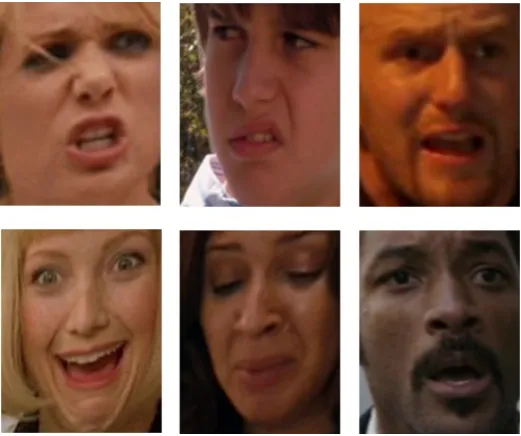
SFEW 6 basic emotions 95 Non-uniform lighting Frontal
PIE [Sim et al., 2002] 4 expressions 68 43 lighting conditions Frontal
NimStim
[Tottenham et al 2009] 6 basic emotion 31 Uniform lighting Frontal
MultiPIE [Gross et al., 2007] 6 basic emotions 43 Frontal
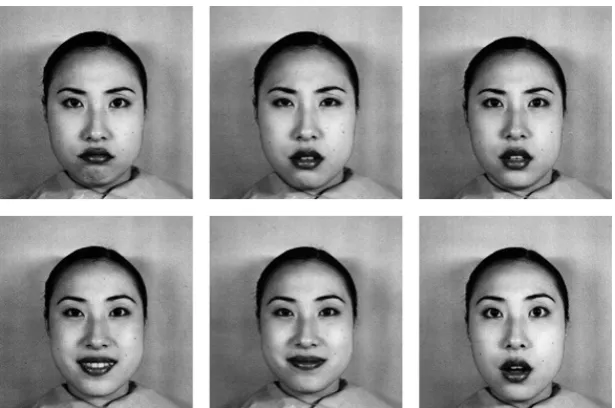
[image:60.595.167.475.454.658.2]mJAFFE: The JAFFE [LAKG98] facial expression database has been extensively used for facial expression analysis. Each female has two to four samples for each expression, totalling 213 greyscale facial expressions images from 10 Japanese female actresses. It consists of six basic emotions (anger, disgust, fear, happiness, sadness, surprise and neutral). The expressions expressed by each picture were subjectively tested on 60 Japanese volunteers. Each image is of size 256×256. Figure 2.7 shows a sample image from the JAFFE database.
Since the JAFFE database is a standard database that has been accepted and used on a number of occasions for validating facial expression experiments. We decided to create a modified version of JAFFE called mJAFFE (modified JAFFE) with a Photoshop script by making: shadow, high contrast, low contrast, overexpose and underexpose lighting conditions. This is in order to make an artificial lighting conditions close to the HDR database, for the purpose of validation the FER experiments. Figure 2.8 shows a sample image from the mJAFFE database.
Figure 2.8: Sample Six Basic Emotions from the mJAFFE database. Starting from top, we have angry, disgust, fear, happy, sad and surprise
Figure 2.9: Sample Six Basic Emotions from the SFEW database. Starting from top, we have angry, disgust, fear, happy, sad and surprise
Image Acquisition
In image processing, image acquisition usually involves retrieving images from a source that is automatically capturing images [CB03]. For example, real-time image acquisition creates a stream of files that can be automatically processed, queued for later work, or stitched into a single media format. There are methods of image acquisitions in image processing that actually uses acquisition devices, for example, using digital cameras to acquire images to build accurate models of different scenes.
reproduced under the same conditions so that inconsistency factors are easier to locate and eliminate.
In this thesis, due to the type of images used (those under harsh lighting conditions), it is important to relate an image to the scene light from which it was captured. In practice, often, facial images are subjected to changes in viewpoints, lighting conditions and expressions, wherefore providing clear, highly detailed images still needs more improvement. For instance, one of the key elements in getting a good image is how well the camera can cope with the scene changes in lighting and weather conditions. Even with the best camera on the market, image variability is still an issue. The first issue is how to choose the best features to represent the face in order to deal with the facial variability.
2.9
Facial Expression Recognition Methods
an image is unevenly illuminated and another portion is in overly bright sunlight. The idea is to improve the contrast in both parts of the image without creating an unnatural result.
The traditional approaches [LHK05,TT10] for performing FER tasks using data affected with harsh lighting conditions can be categorised in the following ways:
1. Direct appearance-based methods. In this approach, training samples are usually collected under different lighting conditions and used directly to learn a global model of the collected illumination variations samples. This is done without performing lighting pre-processing on the images. Examples of this method are the linear subspace and the manifold model [TT10]. This methods classifies based on the lighting variations present in the new images. It has been observed that direct learning using this method makes few assumptions on the results, and it requires a large amount of training samples and an expressive feature set.
![Figure 2.3: Sample action units from the Cohn-Kanade Database [TKC01]](https://thumb-us.123doks.com/thumbv2/123dok_us/9492750.455144/48.595.130.511.463.645/figure-sample-action-units-from-cohn-kanade-database.webp)
![Table 2.1: Facial muscles description of FACS - AUs. [FE78]](https://thumb-us.123doks.com/thumbv2/123dok_us/9492750.455144/50.595.122.520.115.396/table-facial-muscles-description-of-facs-aus-fe.webp)
![Figure 2.5: Plutchik’s wheel of emotions [Gol14]](https://thumb-us.123doks.com/thumbv2/123dok_us/9492750.455144/52.595.207.430.109.335/figure-plutchik-s-wheel-of-emotions-gol.webp)