PEDIATRICS (ISSN 0031 4005). Copyright © 1987 by the American Academy of Pediatrics.
SUPPLEMENT
797
Dietary
Intakes
Theresa
A. Nicklas,
DrPH,
Rosanne
P. Fams,
MS Hyg,
Carolyn
Major,
RD, Gail C. Frank,
DrPH,
Larry
S. Webber,
PhD,
James
L Cresanta,
MD, and
Gerald
S. Berenson,
MD
From the Departments of Medicine, Public Health and Preventive Medicine, Biometry, and
Pediatrics, Louisiana State University Medical Center, and Department of Health and
Human Resources, Office of PreventWe and Public Health Services, New Orleans
ABSTRACT. Dietary patterns and racial differences in
nutrient intake were observed in children 6 months to 4
years of age in the Bogalusa Heart Study. Even in this
sample of young children, the composition of the intakes
of the majority of children was not compatible with
prudent recommendations of less than 35% and 10% of
energy from total and saturated fat, respectively. Mean cholesterol intake of the 4-year-old children (390 mg) was approximately one half of the average daily adult levels. The polyunsaturated to saturated fatty acid ratio ranged from 0.41 to 0.53 and sucrose to starch ratio from 1.32 to 1.57, reflecting a high saturated fat and sucrose
intake. White children had greater intakes of sucrose
than black children; however, total fat and cholesterol intakes were greater in black children. Gender differences were noted among the 2, 3, and 4-year-old children: energy, sugar, and starch intakee were greater in boys, and cholesterol intake per 1,000 kcal was greater in girls. Mean intakes per 1,000 kcal in Bogalusa were higher for fat and carbohydrate and lower for protein than reported in the Second Health and Nutrition Examination Survey.
However, when the National Research Council
recom-mended dietary allowances for protein and energy are used for comparison, a more than adequate intake was noted in these children. The data found in this newborn-infant cohort contribute information regarding the early development of dietary habits that likely influence eating behavior in later childhood and adolescence. Pediatrics
1987;80(suppl):797-806; cardiovascular risk factor,
ather-ogenic diet, nutrition.
ABBREVIATIONS. HANES II, Second Health and Nutrition Examination Survey; RDA, recommended dietary allowances.
In the United States, the transition during
in-fancy to a varied intake during childhood is a crucial
period in the nutritional history of children. Foods
offered to children and the supportive environment
in which children learn to select foods establish a
foundation for development of food habits.’3 Food
patterns and eating behaviors established during
the early years influence the development of
car-diovascular &sease.
Development of atherosclerotic fatty streaks and
fibrous plaques begins in childhood.7 The severity of atherosclerosis in the aorta and coronary arteries of children is related to elevated concentrations of serum low-density lipoprotein cholesterol8 and total
cholesterol9 which are influenced by diet in both
infants and children.5 Diet has been recognized
as an important environmental determinant of
car-diovascular disease risk. Consequently, alteration
of eating habits in early childhood may delay or
prevent cardiovascular disease development.’0
Food patterns during infancy and adolescence
have been evaluated, and age- and gender-specific
differences in nutrient and energy intakes
ex-ist.’6 Socioeconomic factors and cultural dietary patterns also affect intake variations.’7”8 However, there is a paucity of information on racial compar-isons of dietary patterns of infants and preschool
children. Data from the Second Health and
Nutni-tion Examination Survey (HANES II)’ describe
dietary intake ofyoung children by race and gender.
Description of dietary intake in the HANES II
study is limited to macronutrients, vitamins, and
minerals Of interest to professionals in cardiovas-cular health is the racial and gender differences in
intakes of cholesterol and specific types of fat and
carbohydrate. Of additional interest is the
contri-bution of meals and snacks to energy intake in this
age group, thus targeting possible areas to make
positive changes in eating habits. Furthermore,
urn-ited data are available on the development of
die-tary intakes for longitudinal cohorts of infants. Five
repeated measures of dietary intake have been
ob-tamed and are presented in this study.
The present study has a three-fold purpose: (1)
at Viet Nam:AAP Sponsored on September 7, 2020
www.aappublications.org/news
Race/Gender No. (%) of Children
Gmo lyr 2yr 3yr 4yr
White boys 41 (33) 33 (33) 42 (31) 35 (33) 59 (27)
White girls 40 (32) 27 (27) 39 (29) 29 (27) 60 (27)
Black boys 21 (17) 17 (18) 30 (22) 24 (23) 49 (22)
Black girls 23 (18) 22 (22) 24 (18) 18 (17) 51 (24)
to
describe the dietary intake of a cohort of infants from 6 months to 4 years of age; (2) to evaluate age, race, and gender differences in intakes; (3) tocom-pare the observations with the National Academy
of Sciences’ Recommended Dietary Allowances
(RDA)2#{176}and recommendations of the American
Heart Association.2’
MATERIALS AND METHODS
Population
Written informed consent was obtained from
each child’s parent or guardian prior to
participa-tion in each examination. A detailed description of
the study design, participation, and protocols is
reported elsewhere.22’23 Briefly, all children born between Jan 1, 1974, and June 30, 1975, to mothers
who resided in ward 4 (Bogalusa) of Washington
Parish, Louisiana, were eligible to participate. The
study population by race, gender, and age for the
dietary surveys is shown in Table 1. A random
sample of 125 mothers (81 white, 44 black)
attend-ing the 6-month screening responded to a 24-hour
dietary recall interview to quantitate their infants’
usual day’s total dietary intake. At the 1-year
screening, 99 (79%) ofthese same mothers reported dietary recalls for their infants.6 Subsequently, at the 2-, 3-, and 4-year screenings, 135, 106, and 219 mothers (54% white, 46% black), respectively,
corn-pleted 24-hour dietary recalls. Twenty-four hour
recalls were not collected at the 7-year screening.
Fifty mothers responded to the dietary interview
all five times.
Dietary
Method
Trained interviewers collected all of the 24-hour
recalls.24 Interviewers participated in rigorous
training sessions and pilot surveys prior to the
study. The respondent was usually the mother or
other care giver such as the child’s grandmother.
When mothers were not present for the recall
in-terview, follow-up phone calls or home visits
yen-fled the care giver’s responses. A standardized pro-tocol,24 graduated infant food models for quanti-tation, a product identification notebook for snack probing, and family recipe collection24 were used to ensure the collection of reliable and complete
infor-TABLE 1. Dietary Interview Population Bogalusa Heart Study
mation. Nutrient analyses of commercially
pre-pared infant foods (Gerber Products Co), coupled
with the extended table of nutrient values, a
de-tailed and extensive data base, provided data for
nutrient composition.2 Quality control checks
for fat, carbohydrate, and vitamins have been
re-ported in detail.3032 Duplicate recalls were obtained
from a 10% random subsample of the 6-month-old
study population to test reproducibility of the
method.33
Statistical
Analyses
All analyses were performed with the Statistical
Analysis System. Descriptive statistics (means,
standard deviations, ranges, percentiles)
summa-nize the data. Analysis of variance techniques were used to test for race and gender differences for each
nutrient. Logarithmic transformation was applied
to approach Gaussian distributions, but
untrans-formed means are reported here. Raw data and data
adjusted per 1,000 kcal and per kilogram of body
weight were examined.
Analysis includes a nutritional breakdown of the
total 24-hour period and each ingestion period, eg,
meals and snacks. In development of the 24-hour
recall method, a meal was defined as a mixture of
foods or a food that approximately yields the
nutri-tive value of milk. The food contact period that is
of the greater nutritive value and/or the greater
quantity and/on is eaten at home was coded as
supper. The other is coded as afternoon on evening snack. Nutrient intake of snacks is an accumulation of all snacks consumed in a 24-hour period.
Each child’s intake of energy and protein was
classified into one of four categories for comparison with the RDA2#{176}as follows: <#{189}RDA; between #{189}
RDA and % RDA; between % RDA and RDA;
greaten than RDA. Intakes of dietary cholesterol,
carbohydrate, and fat were compared with the
American Heart Association recommendations for
a prudent diet.21’35
RESULTS
Composition of Dietary Intakes
The mean intakes of selected dietary components
are shown in Table 2. Mean total energy increased
Cohort-.< at: U a, at: . 0 a, Cl) 5, 0 0 0 0
2
4,z
5 _-_-)_C) C) ‘-4 CO CO 0 at) N CO Ci a at) C) ,. 0 0) ‘ 00 C0CiCiCO’-4 #{149}
CD 0 Ci CO 0 N N at) at)CO CO 0 0) Ci C) CO N at) 00 .-.at)CiCi_Ci_
- - at) CO Ci ‘‘ 0) Ci #{149}
ci . C) at)) at) ‘-: o ‘at. CO
- - 00 N 0 - .: at) 00
__‘Ci_ #{149}
Co 1o R
atSat
. CO4 - ‘- -
‘.-VI VI at) VI a, a 0 , a a, a, a, 4, a
2.
a S.-I. 2 2
-0 ‘ - C) U
a . a s n a,
Qa 0 C/) Cl) Cl) Cl) Za
0 a a, a
a
E 0 0 a,‘ ‘. - Co C) C’ CD CO O CO t-
-Lo O) N CO N 0 ‘I’ W CD - 0
c’t .‘ c.i - #{149}‘- ‘‘
-c’ ‘‘
Co N tO LO 10 Lt LO 0) © O N
-- - t-. Co a 0 a . r’- w - at)
‘O) C’4
- c1at N c ‘‘ ‘‘ O
-01 at) W c D 0) ‘. CO It) CD - at) - .,-.
CD c oi t’- C) ‘ W CD C’ at)
__t- #{149}-‘c ‘-‘--.-‘
cI
0 C’) 0 0 at) ci c ci
‘, N N N - - 0) C’ a
-U) N ci 0 at) at) at
c’)_ N Ci - - ‘- -
-ci ‘‘
t’: aq o -#{149}‘.s c O -#{149}
-,. 0 at) at) CO t’- .
Q ,. 5 ci ca a N C at)
0
#{149}.-ci”-ci
ci ,- c to CD CO CO aa C)
0t-
“ci’.
-N
C 0 0 N ‘. Ci N
N N N C) N C’) N N CO C)
c . N C’) at) C)
Sw ‘-‘ci’-’ -“-‘
ci
Co - c at) C Ci N C’) 0 0 at) - ci at) Ci D CO C’) at) C) ‘
N
-N
0 at) 0 0 CD C) ‘‘ at) at) .. - o at) at Ci 5) c ‘ ci c
-. . - at) Ci C) CO Ci
ce_co ... -‘
-“, - ‘. ci N CD at) Ci C) C Ci
C’()
-CO “I’ 0 C Ci C’) N D
-. at) Ci - CO at) C’) Ci C CO Ci
o) ,-.
C) c O ca co N 0) at) at) at) N at)‘. Co ci ci - ci at)ci ci co ci ci
c) -,-. ,‘
0 0 ai 0 0 ‘ Ci C3 CO CO
N D C) Ci . Ci 0 0) Ci C at)
CO 0 Ci - CO at) CO‘-4 0) CO CO Ci
o)
‘-0) . -. #. -CO’-4
0 CD‘-4 0 CO N C-I ‘ at)Ci -atCo-©o
C) at)CO at) CO -
-- 0 CO ‘ at) - ‘. at)
‘ 0 at) CO ca CO ci - .., .- ‘
0)a .
0 at)00 CO CO N ‘‘ #{232}N at)Ci
- - C) CO N C N Ci 00
0) at) CO ‘4 at) ‘‘
- o - C) it) C) N at) at)Ci
- - ‘ - ci co o o
..- 0) CO CO - at) Ci - ‘‘
0 ‘
CO 0 at) N N - Ci CD at) ,-4
a)at000
‘-‘ 0 ‘ CO - C Ci Ci
- ,‘
D 6t itt) f’
‘- CO CO CO - ‘. Ci
-0 -. ..
C) N CO Ci “5 CO CD ) N ‘‘ Ci
0 CO ,-4 ca o CO. 00
. CO‘-4 Ci
-N 0) N CO C) CO 0 0) N ‘‘ Ci 0 CO N CO at)ci - at) CO 00
‘-, C) CO CO - . Ci
--.---- NS
0) 0) ‘-4 at) Ci CO - Ci N ‘. Ci
0 - CO - D at) 00
‘. CO‘-4 Ci
-Ci - 0 0 - ‘. CO Ci CO CO CO
- 0) W at) - 0 ‘‘ c at)00
at)CiCiCO
at Viet Nam:AAP Sponsored on September 7, 2020
www.aappublications.org/news
TABLE
3.
Macronutrient Intakes as Percentages of Energy for Infants and Children 6 Months to 4 Years of Age byRace, Newborn Cohort-Bogalusa Heart Study*
Dietary Component 6 mo 1 yr 2 yr 3 yr 4 yr
White Black White Black White Black White Black White Black
Energy (kcal) Carbohydrates (%) Fat (%) Protein (%) 937 58b 33 13 970 51 38’ 12 1,365 51 37 14 1,342 48 40 13 1,813 49 39 12 2,089 48 40 13 2,007 53” 36 12 2,399 48 40 13 2,128 51 38 13 2,413 50 39 12 *Race comparisons: a p < .05; bj < .01; C <
with age, from 949 calories at 6 months of age to
2,258 calories at 4 years of age. Protein,
canbohy-drate, and fat intakes were lowest at 6 months, had doubled by 3 years, and almost tripled by 4 years of
age. More than 75% of the protein intake came
from animal sources, yielding an animal to vegeta-ble protein ratio of 3:1. The sucrose to stanch ratio
was 1.3 at 6 months, 1.7 at 3 years, and 1.6 at 4
years of age. The percentage of carbohydrate
de-nived from sucrose sources was 25% at 6 months
but approximately 40% at older ages. Total fat
intake also increased with age. Saturated fat was
consistently high, resulting in a polyunsaturated to
saturated ratio of 0.5 or less. Mean cholesterol
intakes were 110, 246, 376, 347, and 390 mg/d from
youngest to oldest ages, respectively.
Racial Contrasts
in Dietary
Intake
Racial differences of dietary intakes were noted
(Table 2). Total energy intake of black children
was significantly higher (P
.05)
than whitechil-then at 2, 3, and 4 years of age. No consistent racial differences were detected in total protein and total carbohydrate intake. Starch intake varied
signifi-cantly between racial groups and was higher for
black children at 3 and 4 years of age (P
s
.01).However, sucrose intakes were slightly higher for
white than black children at 6 months and 1 and 3
years of age. Total fat intake was significantly
higher for black children at 6 months and 3 and 4
years (P
.05),
averaging 5 to 17 g higher than forwhite children.
The percentage of energy from protein,
canbo-hydrate, and fat are given in Table 3. Protein
provided 12% to 14% ofthe kilocalonies for children
in both races and at all ages. For both white and
black children, more than 30% of energy came from
fat sources. Percentage of energy from
canbohy-drates ranged from 47% to 57% across ages and was
higher among white than black children. The
per-centage of energy from fat was slightly higher
among the black children in all age groups.
Dietary components were expressed pen 1,000
kcal to evaluate nutrient density (Table 4). All
6-month-old infants had higher intakes of
carbohy-drate pen 1,000 kcal than fat and protein pen 1,000
kcal. Mean carbohydrate intake per 1,000 kcal
de-creased slightly from 6 months to 4 years of age.
Carbohydrate intakes pen 1,000 kcal were
consis-tently higher in white children at all ages, whereas total fat intake pen 1,000 kcal was higher in black
children. For all children, total sugar intake
de-creased from 95 g at 6 months to 74 g at 4 years of
age. The percentage of carbohydrate from sucrose
increased almost twofold with age: 25% at 6 months
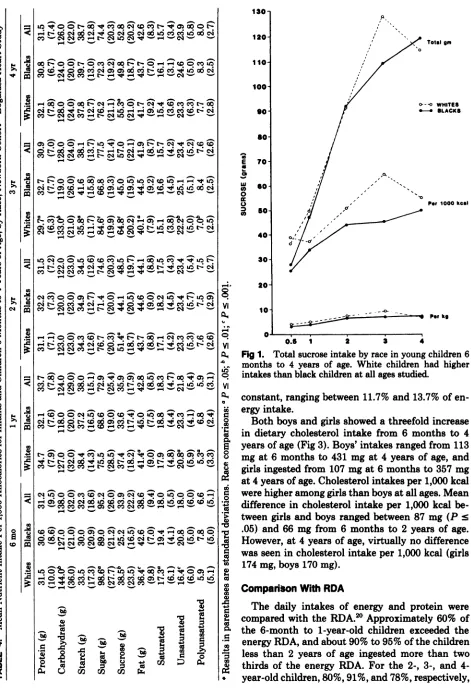
to 42% by 4 years. White children had greaten
sucrose intakes than black children at all ages (Fig
1). Total fat intake pen 1,000 kcal exceeded 30 g for
all ages. Black children consistently had higher
intakes than white children (Fig. 2). Saturated fat
made up 37% to 47% of total fat intake in all
children.
Both races exhibited a marked increase in mean
cholesterol intake from 6 months to 4 years of age
(Fig. 3). Cholesterol intake in black children ranged
from 146 mg at 6 months to 428 mg at 4 years of
age (threefold increase) and in white children from 91 mg to 359 mg (fourfold increase). Cholesterol
pen 1,000 kcal was higher in black than white
chil-dren at each time period. The difference in choles-tenol intakes varied greatly between black and white children at 6 months: 92 and 130 mg, respectively. At 1 year of age, the difference remained for white and black children: 159 and 221 mg, respectively.
However, by 4 years of age, no difference was
ob-served: 171 and 173 mg, respectively.
Gender
Differences
Gender differences in intakes were noted mostly
among the 2- to 4-year-old children in energy, total
sugar, and stanch intakes (boys more than girls, P
<
.05).
When intake was evaluated per 1,000 kcal,polyunsaturated fatty acid at 2 years and
choles-tenol and protein at 3 years of age were significantly greaten for girls (P s .05).
The percentage of energy from protein,
carbo-hydrate, and fat was similar for both boys and girls.
From 6 months to 4 years of age, percentage of
energy from fat increased slightly and the
percent-age of energy derived from carbohydrate sources
I 30
*
, cLad
, ‘‘ 120 , ‘. Totalgm
Cl) S
0
#{149}e a, 5”
. 110 /
0cat) ‘5
CO Ci Ci CO N ‘-4 ‘ ‘ “‘ ‘‘ Ci ‘‘ ‘
,_4 S.__ SS SS S
a,
100 “S
.‘ 0SCiSN’CO’t “ o’--OWHITE$
NL1)COCOWt’-Ci
go
.-.BLACICSCO Ci Ci CO t-. Ci at) Ci ‘ ‘ Ci ‘
-5-- 5.- S.,
0
- 80
0 = a 8’ o - N LC) ‘ 0 - C) N N C-I ‘‘ Ci 0
0
C’) Ci CO ‘-4 t- C-I at) Ci ‘ ‘-4 ‘ Ci ‘ ‘
Ia E 70
2
I
z
iti&tS SO ,‘ ,‘-S CO C’) ‘ “l C “u’4 0 “I’ ‘-4 ‘ ‘‘ ‘-4 ‘‘ Ci ‘‘ ‘‘ 0 ,‘ ,‘
4, - -, 5-, 5.- S So
C? C., : P.r 1000 kcal
a 80 6
.0 :
G :
ciCOCO’Ci”-0 _ 3
CO Ci ci CO N Ci ‘ r4 ‘‘ , Ci ‘“
4, .
:;a
-- 20
‘4 a,
0 ta
.a , VI
.2
ci C’) CiCiCO4NCiC’4”’,4’’Ci”’ ‘ 10, Psrkg
#{176} ‘ ‘ S S S
o a V’ o I 2 3 4
: CO ‘ Ci CO N Ci LI) d’ ‘- - ci ‘-‘ ‘-V I
- S.- -4 Fig 1. Total sucrose intake by race in young children 6
months to 4 years of age. White children had higher
=
N 0 0 C) C) C) c CO N ‘ C) intakes than black children at all ages studied
, VI
a CO Ci Ci CO N ci CO 4 ‘t ‘“ Ci ‘ “‘
constant, ranging between 11.7% and 13.7% of
en---. -S-S SS
. a,
. erY intake.
‘ . e r- ad t- c#{243}c a c r- at t c i’ co ‘‘ o ci Both boys and girls showed a threefold increase
CO ‘ r Ci CO ‘-4 O - C’) ‘-4 ‘‘ ‘‘ ‘-4 Ci
- - 5-.. ...S #{149}5S -., . in dietary cholesterol intake from 6 months to 4
‘I
c4 a, SS 5S #S E years of age (Fig 3). Boys’ intakes ranged from 113
N 0 S at) ‘ ;‘ 0) cc & a & c
8
mg at 6 months to 431 mg at 4 years of age, and. : ginlsingestedfromlO7mgat6monthsto357mg
, : CO Ci C’) C’) - N Ci CO -t ‘ ‘‘ Ci
-5-- 5- S #{149}_
at 4 years of age. Cholesterol intakes per 1,000 kcal
.. a,;
C 0 6’ C’) D Ci
:
cn o 0 ‘ ca were higher among girls than boys at all ages. Mean0 CLt .
differenceincholesterolintakepenl,000kcalbe-- CO CO CO CO ‘-4 0) Ci CO Ci CO ‘ ‘-4 ‘‘ ‘‘
- S SS
- . tween girls and boys ranged between 87 mg (P
ta a, ,,
I
#{176}#{176}#{176} 0 Ci 0 ‘ ‘-4 0 .05) and 66 mg from 6 months to 2 years of age.- 0_t- , Howeven,at4yearsofage,virtuallynodiffenence
was seen in cholesterol intake per 1,000 kcal (girls Co CO ‘‘ Ci Ct) Ci Ci Ci ‘
a
a, a, 174 mg, boys 170 mg).
,
000CDLt)Lt
. CO “u’CO CO 0) Ci CO Ci CO - ‘ ‘-.‘ Ca
,- S.- S S 4)
Comparison
With RDA
Ca 4,
z
:
The daily intakes of energy and protein were. compared with the RDA.#{176}Approximately 60% of
I,
:
-:
:
- the 6-month to 1-year-old children exceeded theCa
2
.E‘.4 Ca energy RDA, and about 90% to 95% of the children
i
:
- ‘‘:
- less than 2 years of age ingested more than twoCa ‘
a. Cl) thirds of the energy RDA. For the 2-, 3-, and
4-4 0 1/) CI’) Cl) r year-old children, 80%, 91%, and 78%, respectively,
SUPPLEMENT 801
at Viet Nam:AAP Sponsored on September 7, 2020
www.aappublications.org/news
Total gm
OS-0 WHITES 100
90
8O
70
60
50
40
30
20-
10-.-. BLACKS
I,, 55- Per 1000 kcal
0/”
d
3 4
AGE (years)
Fig 2. Total fat intake by race in young children 6 months to children had higher intakes than white children at all ages studied.
4 years of age. Black
I 1O
U,
E
U,
LA.
:-. :-j-:--:-::-T Per kg
, J
0.5 1 2
exceeded the energy RDA, and 97% to 100% of the
2- to 4-year-old children ingested more than two
thirds of the energy RDA. The protein RDA was
met or exceeded by 87% ofthe 6-month-old children and 99% of the 1-year old children. Approximately
97% to 100% of the 2- to 4-year-old children had
intakes greater than the protein RDA.
Distribution of Dietary
Intake
by Meal Pattern
For the total sample of young children 6 months
to 4 years of age, 97% to 100% ate breakfast, 95%
to 100% ate lunch, 88% to 98% ate dinner, and 98%
to 100% ate snacks.
The contribution of energy intake by eating
pe-nod for children 6 months to 4 years of age is shown in Fig. 4. Snacks provided the most energy, mainly
from carbohydrates; breakfast, lunch, and dinner
each provided approximately 15% to 25% of the
energy intake. A closer examination of the
contni-bution of snacks to total energy intake shows that
at 6 months, snacks contributed 50%; whereas at 4
years, snacks declined to 31% of the energy intake.
(The high percentage of total energy from snacks
at 6 months may be related to the small, frequent bottle feedings occurring at this age.) Snacks among older children were high in sucrose and fat, a
pat-tern similar to that seen among 10-year-old
Boga-lusa children.37
DISCUSSION
Because dietary intake is one of the most impor-tant environmental factors related to
cardiovascu-lan disease risk, determining the development of
p., i000 acci
C
150-100#{149}
.J
)
at
I, L#{224} -I
3
p., ioo kcei
p., kg
05 1 2 3 4
0-s ; 4
AGE (years)
Fig 3. Total cholesterol intake by race or gender in young children 6 months to 4 years
of age. Black children had higher intakes than white children at all ages studied. Choles-terol intakes per 1,000 kcal were higher among girls than boys at all ages.
100
80
60
P E R
C E
N T
6 MO
= BREAKFAST
- SNACKS
3 4 AGE
‘/1//I, LUNCH S\\\\\’ DPINER
410 - Blacks .-. Whites -- Boys --- Girls .-.
SUPPLEMENT 803
400
380
-300
250
200
so
30#{149}
25
-
20-
Is-
10-0J
Total mg
p., a9
Fig 4. Percentage of energy intake by meal period for
young children 6 months to 4 years of age. Snacks
pro-vided most calories, mainly from carbohydrate; breakfast,
lunch, and dinner each provided approximately same
amount of calories (15% to 25%).
and gender differences in intake in this total
corn-munity study are compared with national surveys’9
and other selected samples.’3’6
The dietary intakes of Bogalusa children are
comparable with national survey data.’9 Intakes of
protein, fat, and carbohydrate by gender and age
for preschool children studied from 1976 to 1980
were reported by HANES II.’ A comparison of
mean intakes in Bogalusa and HANES II is
pre-sented in Table 5 with the caveats that (1) the age
groups reported are not identical in the two studies
Toiil mg
and (2) the variability of intakes is large in such
surveys.
For 6-month-old infants, Bogalusa children had
slightly higher mean fat and carbohydrate and
somewhat lower protein intakes per 1,000 kcal than
did 6- to 11-month old infants in the HANES II.
Bogalusa children 1 to 4 years of age showed higher
fat intakes and lower protein intakes than did 1- to
5-year-old children in the HANES II, but
carbo-hydrate intakes were similar across the ages. Mean
macronutnient data expressed per 1,000 kcal for
Bogalusa preschool children are consistent with
national data.
Nutrition of preschool children in the United
States has been investigated by several
research-ers.”’8 Energy intakes of Bogalusa children are
higher than earlier reports,”’3 particularly for
boys. Comparison of energy intakes in Bogalusa to
children from the north central region ofthe United
States show Bogalusa intakes to be 3% and 8%
higher for boys and girls, respectively, at 6 months,
but 26% and 42% higher at 4 years of age. The
difference could reflect a more recent tendency to
overfeed infants and young children. Four-year-old
Bogalusa children are consuming more energy than
6- to 9-year-old schoolchildren in Iowa,’6
Cincin-nati, Ohio and Columbia, MD,38 and the same
amount as Bogalusa 10-year-old children.37’39’4#{176}
Gender differences in energy intakes begin at
at Viet Nam:AAP Sponsored on September 7, 2020
www.aappublications.org/news
TABLE 5. Mean Intakes of Selected Diet Components of Preschool Children by Gender and Age in Bogalusa and the Second Health and Nutrition Examination
Sun-vey (HANES II)
Study Age, Gender, Protein Fat Carbohydrate
and Study Group (g/1,000 (g/1,000 (g/1,000
kcal) kcal) kcal)
6-il mo
Boys
Bogalusa 30 38 142
HANES II 41 35 131
Girls
Bogalusa 33 39 134
HANES II 39 37 128
1 yr
Boys, Bogalusa 34 43 122
Girls, Bogalusa 33 42 126
2 yr
Boys, Bogalusa 30 44 123
Girls, Bogalusa 33 44 120
1-2 yr
Boys, HANES II 37 39 128
Girls, HANES II 38 39 126
3yr
Boys, Bogalu8a 30 42 129
Girls, Bogalusa 32 42 126
4 yr
Boys, Bogalusa 32 43 126
Girls, Bogalusa 31 43 127
3-5 yr
Boys, HANES II 36 39 129
Girls, HANES II 36 39 128
birth, with differences more pronounced after 6
months of age. This suggests that differences in
size for boys and girls41’42 need to be considered
when recommending dietary allowances for energy
intakes of children younger than 10 years.
Filer and Martinez reported the results of a
nationwide study of the diets of 4,000
repnesenta-tive 6-month-old infants in 1964. The mean energy
intake was 822 kcal, slightly less than in Bogalusa.
Protein intake of the total infant population was
38 g (slightly higher than in Bogalusa), total fat
intake was 37 g, and carbohydrate intake was 86 g
(about 40% less than in Bogalusa). A different
eating pattern is seen among 6-month-old Bogalusa
children. The lower mean protein intake (30 g) and
higher energy (949 kcal) and carbohydrate intake
(130 g) reflect a change in eating behavior that has developed during the past 20 years. Total fat intake
has not changed with time. However, the mean fat
intakes (37 g) are higher than the prudent
recorn-mendations of American Heart Association.2’ The
saturated fatty acid intakes at 16% to 14% of energy
found in this study are also similar to reported
values for older Bogalusa children39”#{176}and adults.”
More than 55% of the children exceeded the RDA2#{176}
for protein and energy.
Mean cholesterol intakes of our samples range
from 110 to 390 mg/d. By 2 years of age, mean
cholesterol intake exceeded the 300-mg/d
recom-mendation. In fact, at 2 years of age, only 38% of
white and 24% of black children met the prudent
diet recommendation of 100 mg/1,000 kcal. At 3
years of age, 38% of white and 17% of black
chil-dren, and at 4 years of age 45% of white and 32%
of black children, had cholesterol intakes that met the American Heart Association recommendation. The basis of the racial difference in cholesterol intake may be due to the type of milk introduced
during infancy. Fans et al6 found that white
chil-dren drank more cow’s milk than black children,
who consumed a milk-based formula at 6 months
and 1 year of age. It is possible that this difference
diminishes as consumption of milk decreases and
solid foods increase. Fat, saturated fat, and
choles-terol intakes of newborns and infants with lower
than recommended polyunsaturated to saturated
ratios reflect patterns that may contribute to the
risk of cardiovascular disease in the adult popula-tion.4’45’
A moderate total carbohydrate eating pattern can
be misleading, unless the proportions of complex
and simple carbohydrates are examined. Total
sugar intake increased from 89.7 g at 6 months to
164.0 g at 4 years of age in Bogalusa children.
Morgan and Zabik46 reported an average daily total
sugar consumption of 134 g in a cross-sectional
sample of children ages 5 to 12 years. In fact,
Bogalusa children at 2 years of age are consuming more total sugar than 9- to 10-year-old children.3’
Milk, followed by sweetened carbonated
bever-ages, contributed the greatest amount of dietary
total sugar.47 Milk consumption peaks at 6 months
of age and slowly declines with age thereafter. This explains why infants have a noticeably higher total sugar intake (95.2 g) at 6 months of age, primarily
the sugar lactose, which decreases to 74.4 g at age
4 years. This decrease is counterbalanced with an
increasingly high sucrose intake. The percentage of
carbohydrates derived from sucrose increases with
age almost twofold in Bogalusa children, with white children having higher intakes than black children.
Snacks represent approximately one third of the
daily energy intake and two fifths of the total
carbohydrate (primarily sucrose) intake in the diets
of 1- to 4-year-old children. These findings have
obvious implications for early prevention of obesity, dental caries, and cardiovascular disease.
IMPLICATIONS
In this report of a newborn-infant cohort in
Bo-galusa we described the development of dietary
behav-SUPPLEMENT 805
ions in late childhood and adolescence. These
ob-servations indicate that racial differences in dietary intake exist as early as 6 months of age and persist
for some children until 4 years of age. To
under-stand the history of cardiovascular disease, food
patterns established during infancy and early child-hood for both races need continuous documentation and evaluation. These patterns should be described for different races and at various stages of growth
and development. Only with vigilant monitoring of
eating patterns in children can we identify intake,
explore the relationship between diet and
cardio-vascular risk factors, and develop a rationale for
dietary change to promote cardiovascular health.
REFERENCES
1. Eppright ES, Fox HM, Fryer BA, et al: Eating behavior of preschool children. J Nutr Educ 1969;1:16-19
2. Dierks EC, Morse LM: Food habits and nutrient intakes of preschool children. J Am Diet Assoc 1965;47:292-296
3. Fryer BA, Lamkin GH, Vivian VM, et al: Diets of preschool children in the North Central Region: Calories, protein, fat, and carbohydrate. J Am Diet Assoc 1971;59:228-232
4. Berenson GS, Blonde CV, Farris RP, et al: Cardiovascular disease risk factor variables during the first year of life. Am
J Dis Child 1979;133:1049-1057
5. Berenson GS, Foster TA, Frank GC, et al: Cardiovascular disease risk factor variables at the preschool age: The Bo-galusa heart study. Circulation 1978;57:603-612
6. Farris RP, Frank GC, Webber LS, et al: Influence of milk source on serum lipids and lipoproteins during the first year oflife, Bogalusa heart study. Am J Clin Nutr 1982;35:42-49
7. Strong JP, McGill HC Jr-i The pediatric aspects of athero-sclerosis. J Atheroscier Res 1969;9:251-265
8. Newman WP, Freedman DS, Voors AW, et al: Relation of
serum lipoprotein levels and systolic blood pressure to early atherosclerosis: The Bogalusa heart study. N Engi J Med
1986;314:138-.144
9. Newman WP III, Strong JP: Natural history Geographic pathology and pediatric aspects ofatherosclerosis, in Strong WB (ed): Atherosclerosis: Its Pediatric Aspects. New York, Grune & Stratton, Inc, 1978, pp 15-40
10. Glueck CJ, McGill Hc Jr, Shank RE: Value and safety of diet modification to control hyperlipidemia in childhood Ad Hoc Committee of the Steering Committee for Medical and Community Program of the American Heart Association, abstracted. Circulation 1978;58:381A
11. Beal VA: Nutritional intake of children: I. calories, carbo-hydrate, fat and protein. J Nutr 1953;50:223-232
12. Beal VA: Dietary intake of individuals followed through infancy and childhood. Am J Public Health 1961;51:1108-1117
13. Eppright ES, Fox HM, Fryer BA, et al: Nutrition of infants and preschool children in the north central region of the U.S.A. World Rev Nutr Diet 1972;14:269-332
14. Beal VA: On the acceptance of solid foods and other food patterns, of infants and children. Pediatrics 1957;20:448-456
15. Guthrie HA: Nutritional intake of infants. J Am Diet Assoc
1963;43:120-124
16. Eppright ES, Sidwell VD, Swanson PP: Nutritive value of the diets of Iowa school children. J Nutr 1954;54:371-388 17. Kerry E, Crispin 5, Fox HM, et al: Nutritional status of
preschool children: I. Dietary and biochemical findings. Am
J Clin Nu.tr 1968;21:1274-1279
18. Crispin 5, Kerrey E, Fox HM, et al: Nutritional status of preschool children: II. Anthropometric measurements and interrelationships. Am J Clin Nutr 1961;2:1280-1284
19. Dietary Intake Source Dato United States 1976-1980, Vital
and Health Statistics, U.S. Department Health and Human Services, Public Health Service National Center for Health Statistics series 11, No. 231, publication No. (PHS) 83-1681. Government Printing Office, 1983, pp 1,2,48-53
20. Food and Nutrition Board Recommended Dietary
Allow-ances, rev ed 8. Washington, DC, National Academy of
Science, 1974
21. Weidman W Jr, Kwiterovich P, Jesse MJ, et al: AHA
Committee Report-Diet in the healthy chil& Task Force Committee of the Nutrition Committee and the Cardiovas-cular Disease in the Young, Council of the American Heart Association. CircuLation 1983,67:1411A-1414A
22. Webber LS, Frank GC, Smoak CG, et a!: Cardiovascular risk factors from birth to seven years of age: The Bogalusa heart study: I. Design and participation. Pediatrics
1987;80(suppl):767-778
23. Berenson GS, Blonde CV, Webber LS (eds): Cardiovascular
Pmfile of Preschool Children in a Biracial Community
(Bo-galusa, Louisiana)-Bogalusa Heart Study, 1974,
mono-graph, Library of Congress No. 81-52250. Louisiana State University Specialized Center of Research-Arteriosclerosis (SCOR-A), 1981
24. Frank GC, Farris RP, Major C: In-House Dietary Studies
Methodology, ed 2. New Orleans, LOUisiana State University
Medical Center, 1978
25. Moore MC, Judlin BC, Kennemur PM: Using graduated
food models in taking dietary histories J Am Diet Assoc
1967;31:447-450
26. Moore MC, Goodlloe MH: Extended Table ofNutrient Values
(ETNV). New Orleans, Louisiana State University Medical
Center, 1982
27. Goodloe MH, Waters G, Quinlan CB, et al: Studies in
atherosclerosis: IV: Electronic computers in the processing ofdietary data. Am J Clin Nutr 1963;13:304-311
28. Hankins GJ, Eccles TJ, Judlin BC, et al: Data processing of dietary survey data-Old and new: I. A computer system for processing dietary data. JAm Diet Assoc 1965;46:387-394 29. Moore MC: Guidelines for Use of IDIF System of Dietary
Calculations. Atlanta, International Dietary Information
Foundation, Inc, 1983
30. Farris RP, Cresanta JL, Frank GC, et al: Dietary studies of children from a biracial population: Intakes of fat and fatty acids in 10 and 13 years olds. Am J Clin Nutr 1984;39:114-128
31. Farris RP, Cresanta JL, Frank GC, et al: Dietary studies of children from a biracial population: Intakes of carbohydrate and fiber in 10 and 13 year olds. JAm Coil Nutr 1985;4:421-435
32. Farris RP, Cresanta JL, Frank GC, et al: Dietary studies of children from a biracial population: Intakes of vitamins in 10 and 13 year olds. J Am Coil Nutr 1985;4:539-552
33. Frank GC, Berenson GS, Schilling PE, et al: Adapting the 24-hr dietary recall for epidemiologic studies of school chil-dren. J Am Diet Assoc 1977;71:26-31
34. SAS User’s Guide: Basics, ed 1982. Cary, NC, SAS Institute
Statistical Analysis System, 1982
35. Grundy SM, Bilheimer D, Blackburn H, et al: AHA
com-mittee report: Rationale of the diet-heart statement of the American Heart Association. Circulation 1982;65:839A-854A
36. Frank GC, Webber LS, Berenson GS: Dietary studies of
infants and children: The Bogalusa heart study, in Coates T, Petersen A, Perry C (eds): Promoting Adolescent Health
A Dialogue on Research and Practice. New York, Academic
Press, 1982, pp 329-3M
37. Frank GC, Berenson GS, Webber LS: Dietary studies and the relationship of diet to cardiovascular disease risk factor variables in 10 year old children-The Bogalusa heart study.
Am J Clin Nutr 1978;31:328-340
38. Saltz KM, Tamir I, Ernst N, et al: Selected nutrient intakes of free-living white children ages 6-19 years: The Lipid Research Clinics program prevalence study. Pediatr Res
1983;17:124-130
at Viet Nam:AAP Sponsored on September 7, 2020
www.aappublications.org/news
39. Farris RP, Cresanta JL, Croft JB, et al: Macronutrient
intakes of 10 year old children 1973-1982. JAm Diet Assoc,
in press, 1987
40. Frank GC, Farris RP, Cresanta JL, et a!: Dietary trends of 10- and 13-year-old children in a biracial community-The Bogalusa heart study. Prey Med 1985;14:123-139
41. Tanner JM: Human Growth, symposium of the Society for the Study of Human Biology, No. 3, Oxford, England Per-gamon Press, 1960
42. Foster TA, Voors AW, Webber LS, et al: Anthropometric and maturation measurements of children, ages 5 to 14 years, in a biracial community-The Bogalusa heart study.
Am J Clin Nutr 1977;30:582-591
43. Filer L.J Jr, Martinez GA Intake of selected nutrients by infants in the United States: An evaluation of 4,000 repre-sentative six-month-olds. Clin Pediatr 1964;3:633-645
44. Kannel WB, Gordon T: The Framingham Study: An
Epi-demiOIOgiCaI Investigation of Cardiovascular Disease, section
24: The Framingham Diet Study: Diet and the Regulation of
serum cholesteroL US Department of Health, Education,
and Welfare, Public Health Service, NIH. Government Printing Office, 1971
45. Berenson GS, McMahan CA, Voors AW, et al:
Cardiovas-cular Risk Factors in Children: The Early Natural History of
Atherosclerosis and Essential Hypertension. New York,
Ox-ford University Press, 1980
46. Morgan KJ, Zabik ME: Amount and food sources of total sugar intake by children ages 5 to 12 years. Am J Clin Nutr
1981;34:404-413
47. Berenson GS (ed): Causation of Cardiovascular Risk Factors
in ChiWren. Perspectives on Cardiovascular Risk in Early
1987;80;797
Pediatrics
James L. Cresanta and Gerald S. Berenson
Theresa A. Nicklas, Rosanne P. Farris, Carolyn Major, Gail C. Frank, Larry S. Webber,
Dietary Intakes
Services
Updated Information &
http://pediatrics.aappublications.org/content/80/5/797
including high resolution figures, can be found at:
Permissions & Licensing
http://www.aappublications.org/site/misc/Permissions.xhtml
entirety can be found online at:
Information about reproducing this article in parts (figures, tables) or in its
Reprints
http://www.aappublications.org/site/misc/reprints.xhtml
Information about ordering reprints can be found online:
at Viet Nam:AAP Sponsored on September 7, 2020
www.aappublications.org/news