warwick.ac.uk/lib-publications
Original citation:
Despotou, George, Matragkas, Nicholas and Arvanitis, Theodoros N. (2016) Converting text
to structured models of healthcare services. In: 14th International Conference on
Informatics, Management and Technology in Healthcare, Athens, 1-3 Jul 2016. Published in:
Studies in health technology and informatics, 226 pp. 123-126.
Permanent WRAP URL:
http://wrap.warwick.ac.uk/79694
Copyright and reuse:
The Warwick Research Archive Portal (WRAP) makes this work by researchers of the
University of Warwick available open access under the following conditions. Copyright ©
and all moral rights to the version of the paper presented here belong to the individual
author(s) and/or other copyright owners. To the extent reasonable and practicable the
material made available in WRAP has been checked for eligibility before being made
available.
Copies of full items can be used for personal research or study, educational, or not-for-profit
purposes without prior permission or charge. Provided that the authors, title and full
bibliographic details are credited, a hyperlink and/or URL is given for the original metadata
page and the content is not changed in any way.
Publisher’s statement:
“The final publication is available at IOS Press
http://dx.doi.org/10.3233/978-1-61499-664-4-123
”
A note on versions:
The version presented here may differ from the published version or, version of record, if
you wish to cite this item you are advised to consult the publisher’s version. Please see the
‘permanent WRAP URL’ above for details on accessing the published version and note that
access may require a subscription.
Converting text to structured models of
healthcare services
George DESPOTOUa,1, Nicholas MATRAGKASb, Theodoros N. ARVANITISa a Institute of Digital Healthcare, WMG, University of Warwick. UK
b Department of Computer Science, University of Hull, UK
Abstract. The paper presents a concise method for transforming textual representations of healthcare services, to a structured, semantically unambiguous modelling language. Employing the method can create structured models of the services that can then be analysed either manually or automatically.
Keywords. Health IT, healthcare services modelling, BPMN
Introduction
It is common practice that whenever we define, document or analyse a healthcare service, to use some description that will represent the actual service. This representation can include textual descriptions in documents, but also graphical notations, which are more easily perceived. For example, consider the pathways offered as guidance by organisations such as the UK National Institute for Health and Care Excellence (NICE). The diagrams, as well as the accompanying text, communicate medical knowledge, representing how treatment is recommended to be implemented in reality.
However, these approaches are not always standardised; natural language representations depend on the expression and writing skills of those documenting the service as well as of those reading the text. Whereas, graphical descriptions use symbology that appeal to the assumption that the reader will interpret the symbol in the way whoever used it intended. However, this is not always the case, leading to potential misunderstandings that could undermine the confidence that we have in the model. For example, consider within a healthcare organisation, the type of diagrams that clinicians and ICT personnel may use. In many cases such differences can be the source of contention and misunderstandings, despite referring to the same service.
Creating a standardised representation of a service is an important step to definition, analysis and implementation of the service. The paper presents a concise method aimed at healthcare professionals, as a stepping-stone to converting ad-hoc models to formal modelling frameworks. Using the guidance will result in a set of models that can be used to interact with other views such as those by ICT staff.
1.Concepts of modelling
A model is a representation of a selected part of the world, which is called System Under Study (SUS)2. This representation captures only the important aspects of a SUS
1 Corresponding Author. Email: [email protected]
from a specific point of view and for a particular purpose [1]. This supports simplification and comprehensibility of the world, offering numerous advantages such as: (a)
documentation of parts of the system, of interest to each stakeholder group; (b) a common means of communication between stakeholders (e.g. doctors and ICT personnel); (c) safety or fit-for-purpose analysis of the (candidate) service; (d) refinement of the high level service to specific medical, technical and process details, through incremental information enrichment of the models; and (e) provide a computer readable representation of the service allowing complex simulations difficult to achieve manually. Models are created using modelling languages, often optimised for specific domains. By and large, a modelling language consists of a semantic definition of its concepts (i.e. a dictionary), and a set of rules (i.e. a grammar) on how the concepts can be used to create real world representations. Often, a graphic definition (i.e. notation) accompanies the language, enabling graphical depiction of objects (e.g. a map legend). Models need to be validated and verified. The former covers the degree with which a model represents reality; whereas the latter covers the correctness of the model with respect to the rules of the modelling language used.
Modelling can be beneficial for systems engineering. Models can capture requirements and domain knowledge in a way that all stakeholders can understand them [2]. Moreover, models facilitate the design of systems by enabling the organisation, discovery, examination, filtering, and manipulation of information about the world. Sussman [3] and Buede [4] stress the importance of using models to gain insight into complex systems, and to negotiate with conflicting parties. Model-based reasoning is a form of exploring and learning about the world using models [5]. In [6] the authors compare model-based and document-based design approaches. Structured and rigorously-defined models compared to unstructured textual descriptions provide clear, and unambiguous definitions of system design [7,8,9].
2.A Set of Minimum Concepts
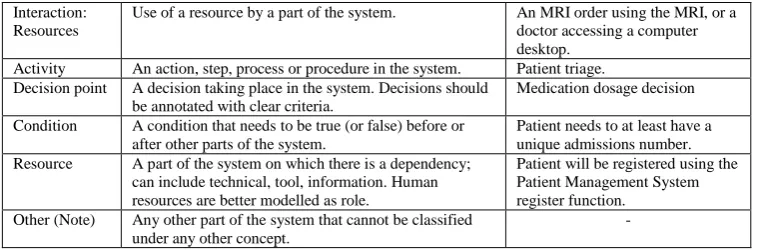
Table 1 illustrates the set of concepts, which the method advises to be used for consideration. This is a minimum set of concepts that should be considered and will constitute the basis for further development. Depending on application of the method, users may add their own definitions to increase the expressive power of the output. The method is using as a target framework for modelling a number of concepts that are seen in the BPMN modelling language as well as enterprise modelling frameworks. BPMN is a language focusing on the operational aspect of a service, mainly focusing on the activities, exchange of information and control, as well as timing dependencies (Table 1 illustrates examples of how they are used).
Table 1 – The concepts recommended for consideration
Concept Definition Example
Capability An abstraction of another model, the details of which we are not interested in. Capabilities can be associated with each other and contained with each other.
Patient registration is associated with the MRI examination.
Roles An element in the system that offers a distinct se of capabilities. Usually will refer to people.
Nurse, anaesthesiologist, surgeon.
Interaction: Information
An exchange of information between two parts of the system.
Exchange of symptoms between patient and nurse.
Interaction: Command
A message of command between two parts of the system.
Interaction: Resources
Use of a resource by a part of the system. An MRI order using the MRI, or a doctor accessing a computer desktop.
Activity An action, step, process or procedure in the system. Patient triage. Decision point A decision taking place in the system. Decisions should
be annotated with clear criteria.
Medication dosage decision
Condition A condition that needs to be true (or false) before or after other parts of the system.
Patient needs to at least have a unique admissions number. Resource A part of the system on which there is a dependency;
can include technical, tool, information. Human resources are better modelled as role.
Patient will be registered using the Patient Management System register function.
Other (Note) Any other part of the system that cannot be classified under any other concept.
-
3.From ad-hoc to structured modelling
1. Define the scope of the service
This step of the process will set the boundaries of the service that will be documented. Many services will depend on or be a dependency to another service. It is not realistic to expect modelling of the entire operation of an organisation, but is expected to separate this into more manageable pieces. This step will define the boundaries of the service, or part of the service that is defined.
2. Collate all diagrams and
documentation
In this step, all documents about the service will need to be collated. The purpose of the step is to find the description of the service whether this is tacit, or explicit. In order to address the former case, peer reviewing and asking for input is necessary. Often, aspects of the operation of a service will be embedded into the culture of staff (i.e. how we do things), which cannot be found documented explicitly. This step should reveal any such aspects.
3. Identify and match concepts
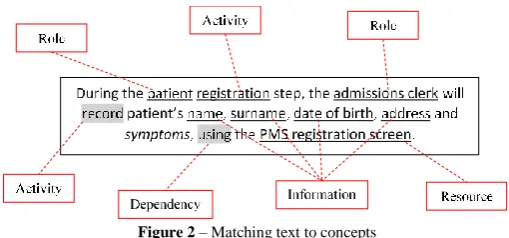
During this step the concept participants should identify the concepts in the existing models and match them with the suggested concepts. For example, a pathway step can be seen as an activity, whereas the textual reference to guidance can be seen as a dependency (information dependency). As a rule of thumb, it often is useful to identify the nouns, verbs and adverbs in the text as they will usually denote a concept, event or action and a condition respectively. Each underlined word can then be recorded in a table under the respective concept (from Table 1) column.
4. If not all concepts are matched
[image:4.595.121.500.155.280.2]There may be cases when a concept identified in an ad-hoc model does not correspond to the list of proposed concepts. In this case a new type can be defined. However, justification should be given, as to why the existing concepts do not adequately capture the intended semantics. Provided sufficient justification, the new concept should be defined by a) specifying what it means (semantics) b) specifying how it is used (i.e. with which other concepts is it associated) and c) how it is represented graphically. There may be occasions when a choice will be made that
Figure 2 – Matching text to concepts
5. Create the models
In this step the part of the service that was defined in the scope of applying the method, is developed using the specified modelling concepts.
Conclusions
Documentation of operational details of the service is crucial for the design of the service; for example, specifying the dependencies amongst (clinical and non-clinical) stakeholders. Converting free text representations of healthcare services, to a structured purpose specific language offers numerous benefits, by overcoming ambiguity and incorporating graphical rendering. Organisations have numerous services specified in a mixture of free text and (mostly) ad-hoc notations. The method presented in the paper offers clinical personnel a quick guide to structuring existing ad-hoc models, to structured models. It is important for clinicians to have ownership of this process. Clinicians are the experts in the medical part of the service, but without necessarily having the required training to create (time-consuming) models with more complex established languages. The output of the method can then be given to business analysts for further analysis and refinement. The method has shown good initial results, enabling clinicians to communicate unambiguous models, which were subsequently used for safety analysis.
References
[1]J. Ludewig, “Models in software engineering—An introduction,” Software and Systems Modelling, vol. 1, pp. 5–14, Mar. 2003.
[2]J. Rumbaugh, I. Jacobson, and G. Booch, The Unified Modeling Language Reference Manual. Reading, MA: Addison-Wesley Longman, 1999.
[3]J. Sussman, Introduction to Transportation Systems. Dedham, MA: Artech House, 2000.
[4] D. Buede, The Engineering Design of Systems—Models and Methods, 2nd ed. New York: Wiley, 2009. [5]Stanford Encyclopedia of Philosophy. Models in Science. [Online]. (2006). Available:
http:/plato.stanford.edu/entries/models science
[6]Baker, L., Clemente, P., Cohen, B., Permenter, L., Purves, B. and Salmon, P., 2000. Foundational concepts for model driven system design. INCOSE Model Driven System Design Interest Group, 16. Vancouver [7]Hutchinson, J., Whittle, J., Rouncefield, M. and Kristoffersen, S., 2011, May. Empirical assessment of
MDE in industry. In Proceedings of the 33rd International Conference on Software Engineering (pp. 471-480). ACM.
[8]Mohagheghi, P. and Dehlen, V., 2008, June. Where is the proof?-a review of experiences from applying mde in industry. In Model Driven Architecture–Foundations and Applications (pp. 432-443). Springer Berlin Heidelberg.