warwick.ac.uk/lib-publications
Manuscript version: Author’s Accepted Manuscript
The version presented in WRAP is the author’s accepted manuscript and may differ from the published version or Version of Record.
Persistent WRAP URL:
http://wrap.warwick.ac.uk/125663
How to cite:
Please refer to published version for the most recent bibliographic citation information. If a published version is known of, the repository item page linked to above, will contain details on accessing it.
Copyright and reuse:
The Warwick Research Archive Portal (WRAP) makes this work by researchers of the University of Warwick available open access under the following conditions.
Copyright © and all moral rights to the version of the paper presented here belong to the individual author(s) and/or other copyright owners. To the extent reasonable and
practicable the material made available in WRAP has been checked for eligibility before being made available.
Copies of full items can be used for personal research or study, educational, or not-for-profit purposes without prior permission or charge. Provided that the authors, title and full
bibliographic details are credited, a hyperlink and/or URL is given for the original metadata page and the content is not changed in any way.
Publisher’s statement:
Please refer to the repository item page, publisher’s statement section, for further information.
SAM CHOW
Abstract. Denote by s(r)0 the least integer such that ifs > s (r)
0 , and F
is a cubic form with real coefficients ins variables that splits intorparts, thenF takes arbitrarily small values at nonzero integral points. We bound s(r)0 forr66.
1. Introduction
Let F be an indefinite homogeneous polynomial of degree d > 2 in s vari-ables, with real coefficients. The form F takes small values if there exists
x∈Zs\ {0} such that
|F(x)|<1. (1.1) Schmidt [18] showed that if d is odd then there exists s0 =s0(d) such that if
s>s0 then F takes small values.
Henceforth, let s0 be the least integer with the above property, whenever
such an integer exists. Naturally we seek upper bounds fors0. For cubic forms,
Freeman [8] holds the record s0(3) 6 359 551 882, improving significantly on
previous work of Pitman [17]. Contrastingly, Baker, Br¨udern and Wooley [2] have shown that any additive cubic form in seven variables takes small values (Baker [1] had already shown this for integral forms).
We consider an intermediate case where only some additive structure is present, a game recently played in a different context by Browning [3] (see also [4]) and continued by Dai and Xue [7]. Let r be a positive integer. A cubic form F in s variables splits into r parts if there exist positive integers a1, . . . , ar and nonzero cubic formsC1, . . . , Cr such that a1+. . .+ar =s and
F(x1, . . . , xs) = r
X
j=1
Cj(xAj−1+1, . . . , xAj),
where A0 = 0 and Aj = a1 +. . .+aj for j = 1,2, . . . , r. Denote by s(0r) the
least integer such that if F is a cubic form that splits intor parts ands>s(0r) then F takes small values.
Theorem 1.1.
s(1)0 6358 817 445, s(2)0 6120 897 257, s(3)0 635 042 291,
s(4)0 68 324 100, s(5)0 61 164 774, s(6)0 677 027.
2010Mathematics Subject Classification. 11D75, 11E76.
Key words and phrases. Diophantine inequalities, forms in many variables.
Note that if s>s(0r) and η >0 then the inequality
|F(x)|< η
has a nontrivial solution for any cubic form F that splits into r parts, since the form η−1F takes small values. Note also that any cubic form that splits
into seven parts takes small values, since any additive cubic form in seven variables takes small values. The improvement in s(1)0 =s0(3) is obtained via
two suggestions made in the introduction of [8]. Though this improvement is minor, we will justify it, since the ideas will also improve our other bounds and perhaps future related results. If one assumed that the parts were of roughly equal dimensionsa1, . . . , ar, then much better bounds could be obtained. For
instance our methods easily show that ifF splits into three parts of dimension at least 270 187 then F takes small values.
We briefly discuss the case that F has integer coefficients, wherein the in-equality (1.1) reduces to F(x) = 0. Heath-Brown [10] has shown that 14 variables suffice to ensure that a cubic form has a nontrivial zero, improving on Davenport’s already spectacular previous record [6] of 16 variables. Under the additional premise thatF is nonsingular, Heath-Brown [9] proved that only ten variables are necessary. This has been sharpened by Hooley [12, 13, 14, 15], who established the Hasse principle for nonary cubic forms defining hypersur-faces with at most ordinary double points.
For quadratic forms we have Margulis’ celebrated proof of the Oppenheim conjecture (see [16]). This states that the values taken at integral points by an indefinite quadratic form in at least three variables, whose coefficients are not all in rational ratio, are dense on the real line. Margulis’ result shows thats0(2)65, since Meyer demonstrated that indefinite quadratic forms with
integer coefficients in at least five variables represent zero nontrivially (see [19]). In facts0(2) = 5, for ifp≡3 mod 4 is a prime then
a2+b2−p(c2+d2) = 0
has no nontrivial integer solutions.
Now we summarise some of Freeman and Wooley’s work on additive forms (see [20]). LetF(d) denote the least integertsuch that any indefinite diagonal form of degreedwith real coefficients in at least tvariables takes small values. Then
F(4) 612, F(5)618 and
F(d)6d(logd+ log logd+ 2 +o(1)).
Our discussion up to this point implies that F(2) = 5 andF(3)67.
solution to a diophantine inequality for additive cubic forms, and for this we use the work of Br¨udern [5].
This paper is organised as follows. In§2, we slightly modify some results of Freeman [8], thereby obtaining the bound s(1)0 6 358 817 445. We then recall two results of Br¨udern [5]. In§3, we elaborate on our strategy for deducing the remaining bounds stated in Theorem 1.1. We quasi-diagonalise using different exponents for different parts. In§4 we implement our strategy.
Bold face will be used for vectors, for instance we shall abbreviate (u1, . . . , un)
to u and write |u| = max|ui|. For a form F, denote by |F| the maximum of
the absolute values of its coefficients.
The author thanks his supervisor Trevor Wooley for suggesting this problem, as well as for his continued support and encouragement.
2. Preliminary manoeuvres
In [8], “a trick used by Pitman [17]” is asserted to gives0(3) 6359 547 172.
Our treatment of this more closely resembles [11, p. 10]. Note that a finite number of integral vectors are linearly dependent overZif and only if they are linearly dependent over R.
Lemma 2.1. Let F be a cubic form with real coefficients in s variables, let E be a positive real number, and let n > 2 be an integer. Let N > 0 be sufficiently large in terms of E and F. Suppose there exist linearly dependent nonzero vectors x1, . . . ,xn ∈Zs such that for any u∈Rn we have
F(u1x1+. . .+unxn) =
X
i6n
F(xi)u3i +O(N
−E|u|3), (2.1)
where the implicit constant may depend on F. Then F takes small values.
Proof. There exists c∈Zn− {0} such that
c1x1 =c2x2+. . .+cnxn,
and without loss of generality c2 > |ci| for i = 1,2, . . . , n. Specialising u =
(c1, c2,0, . . . ,0) in (2.1) yields
F(c1x1+c2x2) =c31F(x1) +c32F(x2) +O(N−Ec32),
and we also have
F(c1x1+c2x2) =F(2c2x2+c3x3+. . .+cnxn)
= 8c32F(x2) +
n
X
i=3
c3iF(xi) +O(N−Ec32),
so
c31F(x1) = 7c32F(x2) +
n
X
i=3
Moreover,
c31F(x1) =F(c1x1) = F(c2x2+. . .+cnxn)
=
n
X
i=2
c3iF(xi) +O(N−Ec32). (2.3)
Equations (2.2) and (2.3) yield
F(x2)N−E.
Since N is large we conclude that|F(x2)|<1, so F takes small values.
The following is the same as [8, Definition 2], except we do not insist that the quasi-diagonalising vectors be linearly independent.
Definition 2.2. Letnbe a positive integer and E a positive real number. Let ˆ
w(3n)(E) be the least nonnegative integer t such that if F is a form in more thantvariables andN is sufficiently large in terms ofsandE, then there exist
x1, . . . ,xn ∈ Zs\ {0} with |xj| 6 N for j = 1,2, . . . , n such that if u ∈ Rn then
F(u1x1+. . .+unxn) =
X
i6n
F(xi)u3i +O(N−E|F| · |u|3).
Lemma 2.3. Let 0 < δ < 1, let E1, E2 and E3 be positive real numbers, and
let n be a positive integer. Put
E = min(E1δ+δ−3, E2−E2δ−3δ, E3−2), M = ˆw (n) 3 (E2)
and
s= 1 +w(0)1 (n(n+ 1)/2, E3),
where w1(·)(·,·) is the positive integer defined in [8, Definition 1]. Assume that E >0. Then
ˆ
w3(n+1)(E)6max(s−1, w1(M)(s(s+ 1)/2, E1)).
Proof. We follow, mutatis mutandis, the proof of [8, Lemma 3]. Let
B >max(s−1, w(1M)(s(s+ 1)/2, E1)),
let F be a cubic form with real coefficients in B variables, and let N > 0 be large. Again T is a subspace of RB, but now x is free to be any vector in RB, and d
1, . . . ,dM+1 are not restricted to lie in U either. The vectors
a1, . . . ,an ∈ ZM+1 \ {0} are no longer necessarily linearly independent. The independence of the vectorsd1, . . . ,dM+1 nonetheless ensures that the vectors
bi are nonzero. The rest of the proof is identical to that of [8, Lemma 3].
The next corollary now follows in the same way as [8, Corollary 2].
Corollary 2.4. Let 0 < δ < 1, let E be a positive real number, let n be a positive integer, and put
Then
ˆ
w(3n+1)(E)6ds(s+ 1)(E+ 3)/(2δ)e+ ˆw(3n)((E+ 3δ)/(1−δ)).
We can now follow the proof of [8, Theorem 1] on [8, p. 34], for ifx1, . . . ,x9
were linearly dependent then F would take small values by Lemma 2.1. This leads to the following observation.
Lemma 2.5. Let ε be a positive real number, and let F be a real cubic form in s variables. Putn = 9, write E = 24 +ε, and letN >0be sufficiently large in terms of E and F. Suppose there exist x1, . . . ,x9 ∈Zs\ {0} with |xi|6N for i = 1,2, . . . ,9 such that (2.1) holds for any u ∈ R9. Then F takes small
values.
In particulars(1)0 =s0(3)61 + ˆw (9)
3 (24 +ε), so it remains to bound ˆw (9) 3 (24 +
ε) for some positive real number ε. To do so, we apply Corollary 2.4 eight times in succession, with well-chosen parameters δ. Firstly, ˆw3(1)(E1) = 0 for
any positive real number E1. For n = 1,2, . . . ,8, Corollary 2.4 recursively
bounds ˆw(3n+1)(En+1), where
En+1 = (1−δn)En−3δn.
Given E9 = 24 +ε, note that E8, . . . , E1 are determined by δ8, . . . , δ1.
Using Freeman’s choice of parametersδ8, . . . , δ1on [8, p. 35] andε= 0.00001
yields ˆw(9)3 (24 + ε) 6 359 547 171, which recovers s0(3) 6 359 547 172, as
claimed in [8]. With δ1 = 0.99999999999 and ε = 10−13, the choice of
param-eters given in Table 1 yields ˆw3(9)(24 +ε)6358 817 444, so
s(1)0 =s0(3)6358 817 445.
We use this method to obtain upper bounds for general ˆw3(n)(E). The bound obtained is a function ofδn−1, . . . , δ1, so a numerical optimisation procedure is
necessary. We choose δ1 = 0.99999999999, and optimise the remaining
param-eters using the Microsoft Excel ‘Solver’, choosing the ‘Evolutionary’ method. We shall also need the following results of Br¨udern.
Theorem 2.6. [5, p. 2] Let θ > 0, and let λ ∈ R9 with |λ
1|, . . . ,|λ9| > 1.
Then there exists a solution t∈Z9 to the system
|λ1t31+. . .+λ9t39|<1, 0<
X
i69
|λit3i| |λ1· · ·λ9|1+θ.
Theorem 2.7. [5, p. 1] Let θ > 0, and let λ ∈ R8 with |λ
1|, . . . ,|λ8| > 1.
Then there exists a solution t∈Z8 to the system
|λ1t31+. . .+λ8t38|<1, 0<
X
i68
3. Strategy
For the remainder of this paper, letF be a cubic form with real coefficients in s variables that splits into r parts of dimensions a1 6 . . . 6 ar, put ε =
10−13, and let N denote a large positive real number. Implicit constants in Vinogradov and Landau notation may henceforth depend on F.
We expect good bounds if many of our parts are large, since we can then quasi-diagonalise each large part. For example, if r > 3 and a1 > wˆ
(3) 3 (24 +
ε) then F takes small values, by Lemma 2.5. (By the procedure outlined after Lemma 2.5, with δ2 = 0.480769, we obtain ˆw
(3)
3 (24 +ε) 6 270 186.)
Consequently, in proving Theorem 1.1, we need a method that is effective in the case thata1, . . . , ar−2are small. We will either quasi-diagonalise the largest
part or the largest two parts.
Case: r= 2,3,4. Here we use nine quasi-diagonalising vectors.
Lemma 3.1. Supposear−1 <(s−wˆ (10−r)
3 (27−3r+ε))/(r−1). Then F takes
small values.
Proof. Now ar > s−(r−1)ar−1 > wˆ (10−r)
3 (E), where E = 27−3r+ε. By
letting xi be the (Ai−1+ 1)st standard basis vector for i= 1,2, . . . , r−1 and
choosing xr, . . . ,x9 ∈ Zs\ {0} using the definition of ˆw (10−r)
3 (E), we deduce
for all u∈R9 that
F(u1x1+. . .+u9x9) =
X
i69
F(xi)u3i +O(N
−Ec), (3.1)
where c= max(|ur|, . . . ,|u9|)3. For j = 1, . . . , r−1 we haveF(xj)1, while
for i=r, . . . ,9 we have |xi|6N, and soF(xi)N3.
We may assume that|F(x1)|, . . . ,|F(x9)|>1, since otherwiseF takes small
values. Letθ be sufficiently small compared toε= 10−13. By Theorem 2.6 we
may choose u∈Z9\ {0} such that
X
i69
2F(xi)u3i
<1
and c (N3)9−r+θ, giving |F(u1x1+. . .+u9x9)| < 1. This implies that F
takes small values, for if x1, . . . ,x9 were linearly dependent then by (3.1) we
could apply Lemma 2.1.
We wish to show thatF takes small values. By Lemma 3.1 we may assume in the sequel that
ar−1 >(s−wˆ (10−r)
3 (27−3r+ε))/(r−1). (3.2)
In this case we might quasi-diagonalise the largest two parts.
Lemma 3.2. Let E1 >3 and E2 be real numbers satisfying
(E1−3)(E2−3(8−r))>18(9−r).
Suppose ar−1 >wˆ (2)
3 (E1) and ar >wˆ
(9−r)
Proof. Since E1 >3 + 18(9−r)/(E2−3(8−r)) we may chooseα > 6/(E2−
3(8−r)) such that E1 >3 + 3α(9−r). Let wi be the (Ai−1+ 1)st standard
basis vector for i= 1,2, . . . , r−2. There exist x1,x2,y1, . . . ,y9−r ∈Zs\ {0}
such that |xj| 6 N (j = 1,2), |yk| 6 Nα (k = 1,2, . . . ,9−r) and for any t∈Rr−2,u∈
R2 and v∈R9−r we have
F(z) = X
i6r−2
F(wi)t3i +
X
j62
F(xj)u3j +
X
k69−r
F(yk)vk3
+O(N−E1|u|3 +N−αE2|v|3), (3.3)
where z=t1w1+. . .+tr−2wr−2+u1x1+u2x2+v1y1+. . .+v9−ry9−r.
Let θ > 0 be small in terms of E1, E2 and α. We may assume that
|F(wi)|,|F(xj)|,|F(yk)|>1, since otherwiseF takes small values. Forj = 1,2
and k = 1,2, . . . ,9−r we have F(xj)N3 and F(yk)N3α. By Theorem
2.6 we may choose nonzero vectors t∈Zr−2,u ∈
Z2 and v∈Z9−r satisfying
|u|3 N3(N3α)9−rNθ, |v|3 (N3)2(N3α)8−rNθ (3.4)
and
X
i6r−2
2F(wi)t3i +
X
j62
2F(xj)u3j +
X
k69−r
2F(yk)vk3
<1. (3.5)
Substituting (3.4) into (3.3) yields
F(z) = X
i6r−2
F(wi)t3i +
X
j62
F(xj)u3j +
X
k69−r
F(yk)vk3+O(N
E+θ), (3.6)
whereE = max(3 + 3α(9−r)−E1,3(2 +α(8−r))−αE2)<0. Since θis small
we also haveE+θ <0. Combining (3.5) and (3.6) now yields |F(z)|<1. This implies thatF takes small values, for if w1, . . . ,wr−2,x1,x2,y1, . . . ,y9−r were
linearly dependent then by (3.3) we could apply Lemma 2.1.
Choose E1 so that
(s−wˆ3(10−r)(27−3r+ε))/(r−1)>wˆ(2)3 (E1). (3.7)
It is advantageous to chooseE1 only slightly smaller than is necessary for (3.7).
By (3.2) we now havear−1 >wˆ (2)
3 (E1). We needsto be large enough to ensure
that we can choose E1 >3. ChooseE2 so that
(E1−3)(E2−3(8−r))>18(9−r). (3.8)
It is advantageous to choose E2 only slightly larger than is necessary for (3.8).
In view of Lemma 3.2 we may assume thatar 6wˆ(9
−r)
3 (E2), which implies that
ar−1 >(s−wˆ (9−r)
3 (E2))/(r−1).
Ifsis large enough then this bound will be better than our initial bound (3.2), in which case we can repeat this procedure until a contradiction is reached. This would imply that F takes small values.
ˆ
w(103 −r)(27−3r+ε). Little is lost, therefore, from the guesswork and computer optimisation involved here.
Case: r = 5,6. Here we can achieve better bounds using eight quasi-diagonalising vectors. We use the following analogously-proven variants of Lemmas 3.1 and 3.2. These rely on Theorem 2.7 instead of Theorem 2.6 as a key ingredient.
Lemma 3.3. Suppose (r−1)ar−1 < s−wˆ(9
−r)
3 (ε−3 + 45(9−r)/8). Then F
takes small values.
Lemma 3.4. Let E1 and E2 be real numbers suchH1 >0 and H1H2 >8−r,
where H1 = (4E1−33)/45 and H2 = r−8 + 8(E2 + 3)/45. Suppose ar−1 >
ˆ
w(2)3 (E1) and ar >wˆ
(8−r)
3 (E2). Then F takes small values.
The strategy in this case is much the same. Again the upper bound that we obtain for s(0r) is not much greater than the theoretical limit of our approach, which is now our upper bound for ˆw3(9−r)(ε−3 + 45(9−r)/8).
4. Implementation
Our bounds for ˆw(3n)(E) are gotten via the procedure outlined after Lemma 2.5. When n > 3, we specify our choices of δn−1, . . . , δ2 in §5, so that the
reader may easily verify these bounds.
Case: r = 2. Assume for the sake of contradiction that s > 120 897 257 and F does not take small values. From Table 1 we see that ˆw3(8)(21 +ε) 6 120 893 893, so by Lemma 3.1 we have
a1 >120 897 257−120 893 893>wˆ (2)
3 (14.6992).
Lemma 3.2 now gives
a2 6wˆ (7)
3 (28.77)6120 847 458
(see Table 2). Now a1 >49 799>wˆ (2)
3 (42), so by Lemma 3.2 we have
a2 6wˆ (7)
3 (21.2308)<54 000 000< s/2
(see Table 2), contradiction.
Case: r = 3. Assume for the sake of contradiction that s > 35 042 291 and F does not take small values. From Table 3 we see that ˆw3(7)(18 +ε) 6 35 037 484, so by Lemma 3.1 we have
a2 >(35 042 291−35 037 484)/2>wˆ (2)
3 (12.705).
Lemma 3.2 now gives
a3 6wˆ (6)
3 (26.1283)634 956 075
(see Table 3). Now a2 >43 108>wˆ (2)
3 (40), so by Lemma 3.2 we have
a3 6wˆ (6)
(see Table 4). Now a2 >10 000 000>wˆ (2)
3 (267), so by Lemma 3.2 we have
a3 6wˆ (6)
3 (15.41)<9 000 000< s/3
(see Table 4), contradiction.
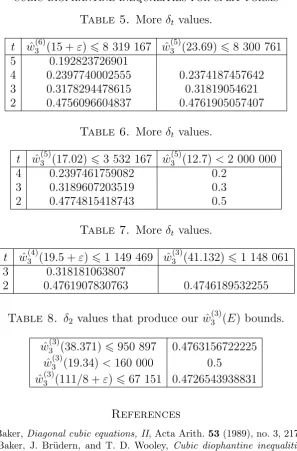
Case: r = 4. Assume for the sake of contradiction thats>8 324 100 andF does not take small values. From Table 5 we see that ˆw(6)3 (15 +ε)68 319 167, so by Lemma 3.1 we have
a3 >(8 324 100−8 319 167)/3>wˆ (2)
3 (10.6989).
Lemma 3.2 now gives
a4 6wˆ (5)
3 (23.69)68 300 761
(see Table 5). Now a3 >7 779>wˆ (2)
3 (20.935), so by Lemma 3.2 we have
a4 6wˆ (5)
3 (17.02)63 532 167
(see Table 6). Now a3 >1 597 311>wˆ3(2)(143), so by Lemma 3.2 we have
a4 6wˆ (5)
3 (12.7)<2 000 000< s/4
(see Table 6), contradiction.
Case: r = 5. Assume for the sake of contradiction thats>1 164 774 andF does not take small values. From Table 7 we see that ˆw(4)3 (19.5+ε)61 149 469, so by Lemma 3.3 we have
a4 >(1 164 774−1 149 469)/4>wˆ (2)
3 (15.215),
so by Lemma 3.4 we have
a5 6wˆ (3)
3 (41.132)61 148 061
(see Table 7). Now a4 >4 178>wˆ (2)
3 (16), so by Lemma 3.4 we have
a5 6wˆ (3)
3 (38.371)6950 897
(see Table 8). Now a4 >53 469>wˆ(2)3 (43), so by Lemma 3.4 we have
a5 6wˆ (3)
3 (19.34) <160 000< s/5
(see Table 8), contradiction.
Case: r = 6. Assume for the sake of contradiction that s> 77 027 and F does not take small values. From Table 8 we see that ˆw3(3)(111/8 +ε)667 151. By Lemma 3.3 we have
a5 >(77 027−67 151)/5>wˆ (2)
3 (11.52),
so by Lemma 3.4 we have
a6 6wˆ (2)
3 (47)666 301.
Now a5 >2 145>wˆ (2)
3 (12), so by Lemma 3.4 we have
a6 6wˆ (2)
Now a5 >5 253>wˆ (2)
3 (17.76), so by Lemma 3.4 we have
a6 6wˆ(2)3 (21.56)68 621< s/6,
contradiction.
5. Appendix
Table 1. δt values that produce our ˆw
(n)
3 (E) bounds.
t wˆ(9)3 (24 +ε)6358 817 444 wˆ3(8)(21 +ε)6120 893 893 8 0.1219508888575
7 0.1390000051495 0.1384533753495 6 0.1616363780159 0.1609356877609 5 0.1916509521206 0.1922156002865 4 0.2380722861783 0.2388890203917 3 0.3174342105461 0.3164554189125 2 0.47495682232 0.4768207640774
Table 2. Moreδt values.
t wˆ3(7)(28.77)6120 847 458 wˆ(7)3 (21.2308)<54 000 000
6 0.1609827599744 0.16
5 0.1926282407656 0.2
4 0.2394541535068 0.24
3 0.3173479381534 0.3
2 0.4778402527145 0.5
Table 3. Moreδt values.
t wˆ(7)3 (18 +ε)635 037 484 wˆ3(6)(26.1283)634 956 075 6 0.1622320717848
5 0.1913883878295 0.190875904156 4 0.237715626746 0.2394408722191 3 0.3184353150435 0.3173069790669 2 0.4766081301145 0.4747480051924
Table 4. Moreδt values.
t wˆ3(6)(17.919)<13 000 000 wˆ(6)3 (15.41)<9 000 000
5 0.1922987759852 0.2
4 0.2382521051977 0.24
3 0.3199994105886 0.3
Table 5. Moreδt values.
t wˆ3(6)(15 +ε)68 319 167 wˆ(5)3 (23.69)68 300 761 5 0.192823726901
[image:12.544.124.422.57.509.2]4 0.2397740002555 0.2374187457642 3 0.3178294478615 0.31819054621 2 0.4756096604837 0.4761905057407
Table 6. Moreδt values.
t wˆ3(5)(17.02)63 532 167 wˆ(5)3 (12.7)<2 000 000 4 0.2397461759082 0.2
3 0.3189607203519 0.3 2 0.4774815418743 0.5
Table 7. Moreδt values.
t wˆ(4)3 (19.5 +ε)61 149 469 wˆ3(3)(41.132)61 148 061 3 0.318181063807
2 0.4761907830763 0.4746189532255
Table 8. δ2 values that produce our ˆw (3)
3 (E) bounds.
ˆ
w3(3)(38.371)6950 897 0.4763156722225 ˆ
w(3)3 (19.34) <160 000 0.5 ˆ
w(3)3 (111/8 +ε)667 151 0.4726543938831
References
[1] R. C. Baker, Diagonal cubic equations, II, Acta Arith.53(1989), no. 3, 217–250. [2] R. C. Baker, J. Br¨udern, and T. D. Wooley, Cubic diophantine inequalities,
Mathe-matika42(1995), no. 2, 264–277.
[3] T. D. Browning,Rational points on cubic hypersurfaces that split off a form, Compos. Math.146(2010), no. 4, 853–885.
[4] T. D. Browning, Counting rational points on cubic hypersurfaces: corrigendum, Math-ematika, to appear.
[5] J. Br¨udern,Cubic diophantine inequalities, II, J. London Math. Soc. (2)53(1996), no. 1, 1–18.
[6] H. Davenport, Cubic forms in sixteen variables, Proc. Roy. Soc. Ser. A 272 (1963), 285–303.
[7] H. Dai and B. Xue,Rational points on cubic hypersurfaces that split off two forms, Bull. London Math. Soc., to appear, arXiv:1211.4215.
[8] D. E. Freeman,One cubic diophantine inequality, J. London Math. Soc. (2) 61(2000), no. 1, 25–35.
[9] D. R. Heath-Brown, Cubic forms in ten variables, Proc. London Math. Soc. (3) 47
(1983), no. 2, 225–257.
[11] D. R. Heath-Brown,Zeros of p-adic forms, Proc. London Math. Soc. (3)100 (2010), no. 2, 560–584.
[12] C. Hooley,On nonary cubic forms, J. Reine Angew. Math.386(1988), 32–98. [13] C. Hooley,On nonary cubic forms: II, J. Reine Angew. Math.415(1991), 95–165. [14] C. Hooley,On nonary cubic forms: III, J. Reine Angew. Math.456(1994), 53–63. [15] C. Hooley,On nonary cubic forms: IV, J. Reine Angew. Math.960(2013), 23–39. [16] G. A. Margulis,Oppenheim conjecture, Fields Medallists’ lectures, 272–327, World Sci.
Ser. 20th Century Math.5, World Sci. Publ., River Edge, NJ, 1997. [17] J. Pitman,Cubic inequalities, J. London Math. Soc.43 (1968), 119–126.
[18] W. M. Schmidt, Diophantine inequalities for forms of odd degree, Adv. in Math. 38
(1980), no. 2, 128–151.
[19] J.-P. Serre,A course in arithmetic, Springer-Verlag, 1973.
[20] T. D. Wooley,On diophantine inequalities: Freeman’s asymptotic formulae, Proceedings of the Session in Analytic Number Theory and Diophantine Equations, 32 pp., Bonner Math. Schriften360,Univ. Bonn, Bonn, 2003.
School of Mathematics, University of Bristol, University Walk, Clifton, Bristol BS8 1TW, United Kingdom