ISSN Online: 2327-5227 ISSN Print: 2327-5219
DOI: 10.4236/jcc.2019.71001 Jan. 8, 2019 1 Journal of Computer and Communications
Big Data Framework for Kenya’s County
Governments
Alex Munyole Luvembe
1, Hillary Mutai
21Information Communication and Technology Center, University of Nairobi, Nairobi, Kenya 2Turnkey Africa Ltd., Nairobi, Kenya
Abstract
Digitalization is transforming governments across the globe. At the national level, down to regional and multiple departments in the public institutions, unprecedented change is occurring exponentially as a result of massive digita-lization. Digitalization is compelling governments at all levels to embrace vo-luminous data and institute appropriate multi-channel platforms to support digital transformation. While this is the case, most governments have been caught unprepared thwarting maximum benefits spurred by digitalization. Inherently, the social media and e-participation tools for generating huge amount of data have convoluted most governments’ appetite in Big Data management. This situation is further compounded with the slow pace of adoption of these technological tools by citizens and the public sectors. For enhanced e-citizen satisfaction and engagement, as well as e-participation processes, public institutions need to promote engagement and collaboration. In view of advancing benefits to their citizens, public institutions need to in-stitute appropriate measures to collect citizen’s data. The information col-lected is vital for public institutions in actualizing what services the citizens want. Using literature reviews and cases, the authors examine Big Data bene-fits in counties and propose a Big Data model to improve efficiency of e-governance services and productivity in county governments. The authors demonstrate Big Data framework has the aptitude of molding citizen’s opinion in county decision making process. Better use of e-technologies is shown in the proposed model which illustrates sharing resources among various data ana-lytics sources. Our proposed framework based on Big Data anaana-lytics is a via-ble initiative to progress effectiveness and productivity, strengthen citizen engagement and participation and encourage decision-making in e-governance services delivery in the counties.
Keywords
E-Governance, Big Data Analytics, Social Media, Counties How to cite this paper: Luvembe, A.M.
and Mutai, H. (2019) Big Data Framework for Kenya’s County Governments. Journal of Computer and Communications, 7, 1-9. https://doi.org/10.4236/jcc.2019.71001
Received: November 29, 2018 Accepted: January 5, 2019 Published: January 8, 2019
Copyright © 2019 by author(s) and Scientific Research Publishing Inc. This work is licensed under the Creative Commons Attribution International License (CC BY 4.0).
DOI: 10.4236/jcc.2019.71001 2 Journal of Computer and Communications
1. Introduction
Big Data analytics has gained much attention in recent years due to its ability to streamline e-governance. Big Data is massive, dynamic and varied. It cannot be managed through traditional data processing techniques. One way to strengthen Big Data to support e-governance is to have a framework that governs the use and management of Big Data in governments, and there have been extensive inquiries regarding appropriate Big Data framework [1].
A Big Data framework based on Mesos/Yam as a resource manager was used to increase efficiency and effectiveness in Nigerian public institutions [1]. In the Netherlands, a framework based on Big Data for Dutch Public sector was de-signed using three aspects which included organizational capabilities, maturity and alignment [2]. Yet, in another study in India, a model was presented where government services were run on a centralized data center and shared among multiple devices to support e-services in government [3]. Also, some authors de-signed a framework based on Hadoop, PDW, SSRS, SSAS and SharePoint soft-ware to improve real-time reporting for Indian e-government projects [4]. More recently, a framework to guide data implementation in South Korea’s National Pension Service was designed to manage pension services across South Korea [5]. In Kenya, Jack proposed a framework for the utilization of e-government services to determine the extent to which citizens would use e-government ser-vices [6]. In a similar line, Wilfred proposed an integrated architecture frame-work for e-government in the public sector [2]. The framework sought to align IT infrastructure with government business process management.
Most studies undertaken reveal several attempts to govern BD in govern-ments. However, most of these studies have focused on the central government, rather than devolved government units [1] [2] [3] [4]. Besides, these studies have focused on specific countries. While these studies acknowledge more that have been achieved in various jurisdictions, it is important to note that contextualiza-tion of Big Data is imperative for development. To emphasize, data context in-dicators should not be interpreted in isolation but aligned with the locale it ori-ginates. Undeniably, it is acknowledged that developing countries such as Kenya face countless technological challenges and hence, they need more home-grown studies to bridge existing knowledge gaps [7].
2. E-Government and Big Data Analytics
2.1. E-Government
DOI: 10.4236/jcc.2019.71001 3 Journal of Computer and Communications decreases time wastage [8].
E-government was pioneered by the Kenyan government in 2004 [9]. The strategy was endeavored at creating unanimity and order in government ICT leadership which was disjointed at the time. Each public entity was pursuing own ICT agenda. The government consolidated all these agendas to address this problem. The ICT Authority was conceived and charged with the responsibility of overseeing, coordinating and formulating ICT guidelines at both the county, national and international levels [10] [11].
At the National level, e-governance initiatives realized are vast. They include the Personnel and Payroll system (IPPD), Local Authorities Integrated Financial Operations Management System (LAIFOMS), Integrated Taxation Management Systems (TIMS), Financial Management System (IFMIS), and the Education Management Information System (EMIS). Currently, these E-Systems are meant for general administration and are the main online systems used to render ser-vices to the citizen on a daily basis [12]. Majority of these systems functions in silos, for instance, the Immigration Information System, the Education System, the National Tax System and the Legal Information System operate at depart-mental levels [10]. Besides, e-governance systems such as the Public Tender Sys-tem, the National ID and the Examination Result and Selection System are widely used though limited in service provision because, in some instances, the information exchange occurs manually across these systems.
2.2. Benefits of Big Data in the Counties
Big Data is a concept compelling governments improve transparency, effective-ness and efficiency. This is analogous to the objectives of e-government devel-opment. Big Data is averred as an enabler of e-government develdevel-opment. As devolved government units, counties can leverage on the Big Data technology to improve performance while reducing costs [12]. A number of examinations have been conducted to buttress the benefits Big Data can offer to counties. In reve-nue accountability, the Kenya Transparency and Communications Infrastructure Project (KTCIP) initiative recognizes the benefits of Big Data in the Counties. It views that Big Data encourages effectiveness and efficiency in revenue manage-ment [13]. The KTCIP has minimized loss of returns, mitigated gaps in revenue collection and streamlined management systems in Kenya’s county governments. Synchronizing the counties’ KTCIP with the national government’s Integrated Financial Management Information system and connecting both to a unified communication system has enabled counties act in reaction to the claim to offer better services to their citizens. Working closely with the national government has facilitated counties advance service delivery using ICT technologies attract-ing good governance and transparency in the management of county govern-ment’s resources and affairs.
DOI: 10.4236/jcc.2019.71001 4 Journal of Computer and Communications IBM has revolutionized garbage collection by installing sensors [14]. The sensors manage garbage collection fleets and also construct a wealth of valuable data re-garding road quality. Connected on 10 garbage fleets, these sensors help in data collection and analysis, making real time decisions to mitigate city’s problems in garbage collection.
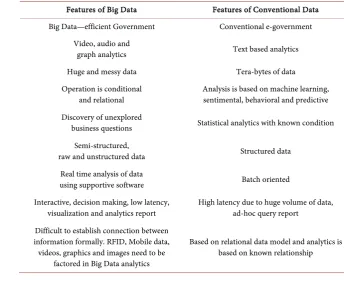
[image:4.595.190.535.449.735.2]In the agricultural sector, tremendous benefits as a result of the Kenya’s Open Data Portal have been demonstrated. The portal has improved transparency in access to accurate data. Access to this data has promoted, accelerated and con-tributed to food security and economic development in most counties [15]. Open Data Portal provides datasets, support quality, and guarantees better visu-alization of data generated and provides interactive and timely feedback to citi-zens and public entities. All these benefits have helped county governments realize answers to multifaceted questions on climate change, sustainable and productive agricultural development. These studies reveal Big Data ensures county governments addresses the demands of its citizen, improves policy eval-uation, design and execute appropriate strategies besides increasing transparen-cy [16]. These assertions demonstrate Big Data is an enabler of e-government in the Counties. It has the potential of structurally improving reforms and embrace what is referred to as “transformational governments”. Big data provides a plat-form where Counties enhance service delivery to its citizens unlike traditional based model (Table 1). Effective implementation of e-government system needs a resilient integration process, budget, data and technology [17]. In all these, da-ta and technology are critical components.
Table 1. Features of Big Data analytics vs. conventional data.
Features of Big Data Features of Conventional Data Big Data—efficient Government Conventional e-government
Video, audio and
graph analytics Text based analytics Huge and messy data Tera-bytes of data Operation is conditional
and relational Analysis is based on machine learning, sentimental, behavioral and predictive Discovery of unexplored
business questions Statistical analytics with known condition Semi-structured,
raw and unstructured data Structured data Real time analysis of data
using supportive software Batch oriented Interactive, decision making, low latency,
visualization and analytics report High latency due to huge volume of data, ad-hoc query report Difficult to establish connection between
information formally. RFID, Mobile data, videos, graphics and images need to be
factored in Big Data analytics
DOI: 10.4236/jcc.2019.71001 5 Journal of Computer and Communications Cases
1) Regulatory Compliance
Big Data is crucial for managing natural resources such as water, forests and soil. Policy makers can use Big Data to determine the quality of these resources and if they fulfill environmental regulations.
2) Health Services
From accident reports, social services, disease monitoring, data from hospitals and other sources gives a comprehensive insights of community health trend. For example, a particular region may experience more incidents of sickness be-cause of unknown toxins and Big Data can be embraced to track this or give in-formed advice on the distribution of vaccines.
3) Law Enforcement
Big Data is a valuable component in Law enforcement. Undeniably, security agencies extract valuable from Big Data. The military and the police among oth-ers are assimilating crime statistics, arrest records and social media to identify hot spots that require additional coverage.
4) Tax Fraud
Billions of shillings in uncollected taxes and fraudulent claims are being re-covered courtesy of Big Data. Big Data is central in detecting fraudulent refunds when matched with tax information against billions of personal records
5) Answering Unexplored Questions
Past studies have shown that conventional analysis was limited in terms of examining hidden correlations and patterns from multiple datasets. Besides, it was expansive, multifaceted and involving in extracting acumen from huge da-tasets. Big Data analytics gives a significant level of precision, guaranteeing anal-ysis and scientific conclusions as grounds for decision making in mission critical systems.
6) Innovating for Growth
Big Data is evolving at an exponential rate and is poised to reduce cost of ana-lytics significantly and enhance service delivery through optimizing public re-sources, waste reduction, fraud detection, and traffic utilization among others.
As shown in Table 1, Big Data has inherent capabilities. It defines an efficient government, encourages real time data analysis and supports interactions. Therefore, a democratic country like Kenya is poised to better serve its citizen, make smarter decisions, encourage citizen participation, improve fiscal perfor-mance, support safer communities, and encourages greater innovation and en-gages citizens with Big Data analytics.
3. Framework Based on Big Data for County Governments
Analytics of Big Data can be classified as management of resources, organization of data, discovery of data, support decision and visualization
3.1. Management of Resources
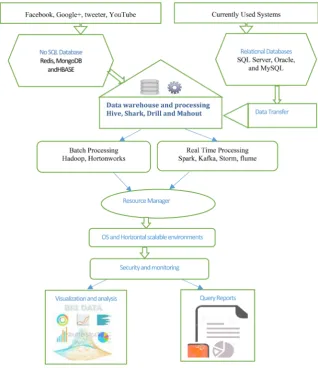
DOI: 10.4236/jcc.2019.71001 6 Journal of Computer and Communications organization resources. There exist numerous studies and popular literatures containing various types of Big Data imitative but they have varying strengths and face their own challenges in solving problems of various existing and emerging applications (Figure 1). Mesos and Yarn provided solution to Re-source management and scheduling platform of various frameworks Capabilities such as performance, sharing of data, operation and resource utilization as re-quired by companies to be deployed and run on the same cluster.
3.2. Organization of Data
[image:6.595.214.533.340.709.2]The main aim of organizing data is to achieve quality of the highest level and accessible data for Big Data analytics and business intelligence. This is achieved through processing and preparing structured and unstructured data for analysis (Figure 1). There exist various data models such NoSQL and Relational Data-base Management System (RDBMS). Sqoop connector provides interaction be-tween RDBMS and Big Data analytics Stack. This connector tool facilitates transfer of bulk data between RDBMS (Oracle, and Mssql) and Hadoop related system (Hbase and Hive) (Figure 1).
DOI: 10.4236/jcc.2019.71001 7 Journal of Computer and Communications
3.3. Unexplored Opportunities Exploration and Data Analytics
There exist various computing data analytics frameworks that support data processing. Map Reduce, Hadoop and Storm, supports offline, batch and online data processing respectively (Figure 1).3.4. Visualization and Decision Support
To efficiently present outcome of Big Data analytics, there exists an advanced user friendly tool that does data processing for human conception (Figure 1). This tool also demonstrate trends or events such as Comparative Behavioral and Predictive analysis which help in reporting, animation and dashboards repre-sentation of information from different sources, this allows support decision making based on the data analysis.
4. Global Perspectives of Big Data and Governments
The Indian government has implemented diverse Big Data initiatives to support e-government. A Crime and Criminal Network Tracking System (CCTNS) has been implemented to enable government better provide citizen centered services [16] [18]. Currently, CCTNS connects 14,000 police stations across the country. The system facilitates crime investigation, detection and prevention. The Unique Identity Project (UIP) is also a Big Data initiative spearheaded by the govern-ment of India [18]. The initiative has 1 billion registered users. The initiative has been famed as a key project in reducing fraud, supporting financial inclusion, facilitating economic growth and security and providing efficiency in service de-livery.
In the United States, the Houston city government implemented a dedicated open data portal, http://mycity.houstontx.gov/ to openly share government owned data with businesses, its employees and citizens [18]. The platform is op-erated by the Department of Planning and Development. The Department mon-itors the usage trend to understand and stimulate the external demand for Big Data in the communities. Using Big Data, the city government is able to map the potholes locations and to optimize the repair vehicles best routes for dispatch in the most optimal way. The Big Data has granted the city government a long term, clearer view for better planning for road infrastructure. Moreover, through analysis of Big Data generated via GPS on the city’s solid waste trucks for city-wide garbage collections, service routes have been optimized. Indeed, this has resulted in 60 percent cost reduction in the public service [19].
DOI: 10.4236/jcc.2019.71001 8 Journal of Computer and Communications through mobile phones. More than 30,000 taxpayers are able to assess their taxes online using a tax calculator. Moreover, the system covers police stations, vul-nerable groups in Cox’s Bazaae and Sirajgong are alerted of impending disaster using SMS and more than 130,000 have used the system to apply for admission to Jagannath and Shahjalal universities using an SMS. More than 22 universities in the country are using the system.
In an attempt to bring government closer to its citizens, the Cape Verde gov-ernment implemented the National Identification System (NIS). NIS was aimed at enhancing efficiency in the government and bringing services closer to the people through ICT resources [20]. The NIS computerized Cape Verde’s elec-toral lists creating two “Citizen” “Houses” in Sal and Praia to provide services such as e-business registration certificates and e-birth certificates. United Na-tions Development Programme 2013 illustrates that NIS increased efficiency in elections and enhanced citizen participation in the process of voting. By compu-terizing the electronic process and identifying voters electronically, Cape Verde increased its citizens confidence in the election and this might be reason why the level of participation in 2008 elections were high [20]. Besides, the initiative achieved the cross-cutting issue of access to ICT and connectivity by investing in public information infrastructure making Cape Verde a top performer in ICTs and e-governance in Africa. NIS has made the marginalized and the poor citi-zens of Sal and Praia to access government services and information related to birth certificates, passports and other identification documents.
5. Conclusion
A majority of current county e-governance applications exist in silos. They are better situated to manage structured data. Therefore, sharing data among mul-tiple applications becomes a challenge. Across the world, countries are embrac-ing Big Data analytics in areas such as natural disaster prevention management, education, transportation, agriculture, crime prevention and healthcare. With increasing population coupled with devolution of services, Kenya’s counties can benefit by using Big Data analytics for making decisions and providing citizens with better services. Our proposed Big Data framework is a valuable approach and supports counties in delivering effective services to their citizens. Further, resource management mechanism in the model can use data center resources leading to optimized service.
Conflicts of Interest
The authors declare no conflicts of interest regarding the publication of this pa-per.
References
DOI: 10.4236/jcc.2019.71001 9 Journal of Computer and Communications [2] Wilfred, O.O. (2012) A Framework for E-Government Development (A Case of
Kenyan Government). Jomo Kenyatta Library, University of Nairobi, Nairobi. [3] Rajagopalan, M.R. and Vellaipandiyan, S. (2013) Big Data Framework for National
E-Governance Plan. 11th International Conference on ICT and Knowledge Engi-neering, Bangkok, 20-22 November 2013.
[4] Sanyal, M.K., Das, S. and Bhadra, S. (2015) Big Data Analysis for Indian E-Government Projects—A Proposed Framework to Improve Real Time Reporting. Information Systems Design and Intelligent Applications, 3, 659-667.
[5] Kim, H.Y. and Cho, J. (2017) Data Governance Framework for Big Data Imple-mentation with a Case of Korea. IEEE 6th International Congress on Big Data, Ho-nolulu, 25-30 June 2017, 384-391.
[6] Jack, O. (2012) A Framework for Utilization of E-Government Services in Kenya. [7] Ahmad, M.O., Markkula, J. and Oivo, M. (2011) Factors Influencing the Adoption
of E-Government Services in Pakistan. International Conference on E-Business and E-Government (ICEE), Shanghai, 6-8 May 2011, 56-89.
[8] Morabito, V. (2015) Big Data and Analytics: Strategic and Organizational Impacts. Springer, New York, 1-183.
[9] Wamoto, F.O. (2015) E-Government Implementation in Kenya, an Evaluation of Factors Hindering or Promoting E-Government Successful Implementation. Inter-national Journal of Computer Applications Technology Research, 4, 906-915. [10] Imbamba, E.N. and Kimile, N. (2017) A Review of the Status of E-Government
Im-plementation in Kenya. Regional Journal of Information and Knowledge Manage-ment, 2, 14-28.
[11] Zachary, O.B. and Jared, O.O. (2015) Characterising E-Participation Levels in E-Governance. International Journal of Scientific Research and Innovative Tech-nology, 2, 157-166.
[12] ICT Authority of Kenya (2013) ICT Authority Strategic Plan: 2013-2018. ICT Au-thority of Kenya, Nairobi, 70.
[13] Bank, W. (2014) Innovative Technologies to Help County Governments Improve Service Delivery.
[14] Nixon, K. (2015) Business of Big Data and Kenya’s Place in the Thriving Market. [15] Nyaggah, M. (2017) Kenya Opens Up Agricultural Data.
[16] Elezaj, O., Tole, D. and Baci, N. (2018) Big Data in E-Government Environments: Albania as a Case Study Ogerta Elezaj. Academic Journal of Interdisciplinary Stu-dies, 7, 117-124.
[17] Waema, T.M. and Adera, E.O. (2011) Local Governance and ICTs in Africa. Inter-national Development Research Centre, Nairobi, 1-382.
[18] E.E. (2017) Big Data in Governance in India. In: Hickok, E., Chattapadhyay, S. and Abraham, S., Eds., Big Data in Governance in India: Case Studies, Centre for Inter-net and Society (India), Bangalore.
[19] UNDP (2013) From Connectivity to Service Delivery. United Nations Development Programme, New York.