PRACTICAL APPROACH
S. Kaasalainen1, L. Twisdale
1
AMEC NSS, Toronto, Ontario, Canada
2
Applied Research Associates, Raleigh, North Carolina
ABSTRACT
Following the March 2011 Fukushima Daaichi event in Japan nuclear regulators throughout the world have requested licensees to review their safety cases for externa
interest in the assessment of High Wind events using Probabilistic Techniques. In general terms, the requirements for performing a High Wind Probabilistic Risk Assessment (PRA) are provided in Part 7 of the ASME Standard RA-Sa-2009 “Level 1/Large Ea
for Nuclear Power Plant Applications”. However, unlike seismic PRA or Fire PRA, where significant effort have been expended recently to develop standardized
guidance available for the conduct of High Wind PRA beyond the high level guidance provided in the ASME Standard. With the renewed interest in High Wind PRA at the same time as other PRA studies are continuing, there is a need to derive practical approa
meet the requirements of the ASME Standard in a cost effective and efficient manner. This paper examines the high level requirements of the ASME High Wind PRA Standard and summarizes how they can be met following a straight-forward, practical approach.
INTRODUCTION
The High Wind PRA ASME Standard lists the following three technical areas as necessary to complete a High Wind PRA study:
- High Wind Hazard Analysis - High Wind Fragility Analysis
- High Wind Plant Response Model and Risk Quantification
The execution of a High Wind PRA study essentially follows the above elements in order, with some need for flexibility and iteration. In practice it is necessary to begin the study by considering the High Wind Plant Response Model in order to establish a set of structures, systems and components (SSCs) that need to then be considered for fragility analysis. This list of credited SSCs or “targets” can be refined as the assessment progresses and new insights are gai
building housing the standby emergency electrical generators are highly vulnerable to wind damage at relatively low wind speeds, then the analysis may not need to consider a number of targets that were initially identified where standby emergency power is needed for them to operator (e.g., standby water pumps).
In addition to the major technical elements of a High Wind PRA, this paper also discuss supporting tasks needed for the successful implementat
walkdown planning and execution, approaches for counting potential wind missile sources, combining fragilities for different failure modes and methodologies for assessing uncertainties.
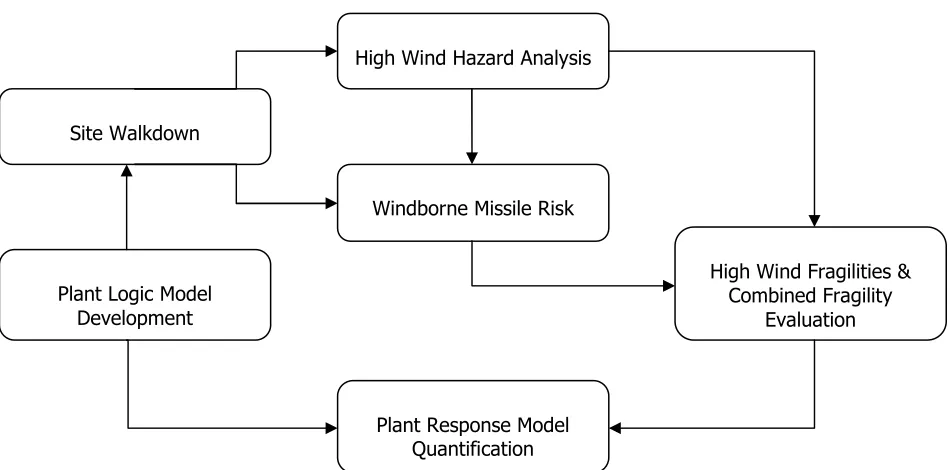
is illustrated in Figure 1 - each task
PRACTICAL APPROACH TO IMPLEMENT LEVEL-1 HIGH WIND
, L. Twisdale2, A. Saudy1, P. Vickery2 and M. Gerchikov AMEC NSS, Toronto, Ontario, Canada ([email protected])
Applied Research Associates, Raleigh, North Carolina, USA
Following the March 2011 Fukushima Daaichi event in Japan nuclear regulators throughout the world have requested licensees to review their safety cases for external events. This has
interest in the assessment of High Wind events using Probabilistic Techniques. In general terms, the requirements for performing a High Wind Probabilistic Risk Assessment (PRA) are provided in Part 7 of 2009 “Level 1/Large Early Release Frequency Probabilistic Risk Assessment for Nuclear Power Plant Applications”. However, unlike seismic PRA or Fire PRA, where significant effort have been expended recently to develop standardized modeling approaches, there is little
guidance available for the conduct of High Wind PRA beyond the high level guidance provided in the ASME Standard. With the renewed interest in High Wind PRA at the same time as other PRA studies are continuing, there is a need to derive practical approaches for executing High Wind PRA studies that meet the requirements of the ASME Standard in a cost effective and efficient manner. This paper examines the high level requirements of the ASME High Wind PRA Standard and summarizes how they
forward, practical approach.
The High Wind PRA ASME Standard lists the following three technical areas as necessary to
High Wind Hazard Analysis High Wind Fragility Analysis
t Response Model and Risk Quantification
The execution of a High Wind PRA study essentially follows the above elements in order, with some need for flexibility and iteration. In practice it is necessary to begin the study by considering the nt Response Model in order to establish a set of structures, systems and components (SSCs) that need to then be considered for fragility analysis. This list of credited SSCs or “targets” can be refined as the assessment progresses and new insights are gained. For example, if it is determined that the building housing the standby emergency electrical generators are highly vulnerable to wind damage at relatively low wind speeds, then the analysis may not need to consider a number of targets that were lly identified where standby emergency power is needed for them to operator (e.g., standby water
In addition to the major technical elements of a High Wind PRA, this paper also discuss supporting tasks needed for the successful implementation of a High Wind PRA project. These include walkdown planning and execution, approaches for counting potential wind missile sources, combining fragilities for different failure modes and methodologies for assessing uncertainties. The overall process
is then described one-by-one.
1 HIGH WIND PRA
M. Gerchikov1
Following the March 2011 Fukushima Daaichi event in Japan nuclear regulators throughout the l events. This has led to a renewed interest in the assessment of High Wind events using Probabilistic Techniques. In general terms, the requirements for performing a High Wind Probabilistic Risk Assessment (PRA) are provided in Part 7 of rly Release Frequency Probabilistic Risk Assessment for Nuclear Power Plant Applications”. However, unlike seismic PRA or Fire PRA, where significant approaches, there is little practical guidance available for the conduct of High Wind PRA beyond the high level guidance provided in the ASME Standard. With the renewed interest in High Wind PRA at the same time as other PRA studies ches for executing High Wind PRA studies that meet the requirements of the ASME Standard in a cost effective and efficient manner. This paper examines the high level requirements of the ASME High Wind PRA Standard and summarizes how they
The High Wind PRA ASME Standard lists the following three technical areas as necessary to
The execution of a High Wind PRA study essentially follows the above elements in order, with some need for flexibility and iteration. In practice it is necessary to begin the study by considering the nt Response Model in order to establish a set of structures, systems and components (SSCs) that need to then be considered for fragility analysis. This list of credited SSCs or “targets” can be ned. For example, if it is determined that the building housing the standby emergency electrical generators are highly vulnerable to wind damage at relatively low wind speeds, then the analysis may not need to consider a number of targets that were lly identified where standby emergency power is needed for them to operator (e.g., standby water
Figure 1. High Wind Hazard Assessment Overview
HIGH WIND HAZARD ANALYSIS
The purpose of the high wind hazard analysis is the evaluation of the frequency and intensity of occurrence of various straight wind and tornado wind hazards based on site-specific and region-specific data. The spatial extent of these hazards are analyzed or estimated based on available data sets.
The analysis methodology for high wind hazards depends on the hazard type. The first step in the methodology is to identify the potential contributing wind hazards at the site. The primary hazards that should be considered include straight winds (thunderstorms and extra-tropical cyclones), hurricanes, and tornadoes. Thunderstorm and non-thunderstorm winds can be analysed by the methods of Gomes and Vickery (1978) and Twisdale and Vickery (1992). Hurricane risk can be evaluated from Vickery et al (2009, 2011). The wind hazard curves are developed for peak gusts in open terrain at 10 m height. Terrain, height, and averaging time adjustments shall be performed to adjust gust wind data to 3-second gust speed at a height of 10m in flat open terrain, (ESDU (1982, 1983) and Masters et al (2010))
Epistemic (modeling) and aleatory (randomness) uncertainties are considered in the development of each family of wind hazard curves. For straight-line winds, the uncertainty analysis may include effect of surface roughness (terrain), corrections for anemometer height, and assumptions introduced using wind data for stations distant from the site. In addition, sources of uncertainties include errors in adjustments for gust averaging times, statistical model and method of analysis, and length of record, (Simiu and Scanlon, 1996).
Uncertainty analysis for tornado winds shall reflect the many sources of modeling uncertainties used in the model. These factors include screening rate, EF or scale probability distribution, EF or F-scale wind speed uncertainties, path length and width distributions, and overall method of analysis (Twisdale, 1983). Random variables include direction, intensity, path length, path width and within path intensity variation.
High Wind Hazard Analysis
Site Walkdown
Windborne Missile Risk
High Wind Fragilities & Combined Fragility
Evaluation
Plant Response Model Quantification Plant Logic Model
DEVELOPMENT OF THE PLANT LOGIC MODEL
The high-level plant logic for the High Wind PRA model forms the basis for the SSCs to be credited for the various high wind scenarios. The high wind plant logic model examines the response of plant SSCs to the defined high wind hazard, and then combines this response with the response of the plant to the resulting initiating event, given the degraded condition of plant SSCs due to the hazard.
The starting point for any PRA analysis is the occurrence of an event which perturbs the normal operation of the reactor to the extent that a shutdown and possibly an alternative method of heat removal are required. The high wind scenario development is finalized by modifying or developing new fault trees, completing high wind accident sequence models (event trees), and identifying susceptible SSCs that are included in the PRA model. Individual SSCs that are failed by a high wind initiator need to be included in their respective fault tree. It is necessary to consider the effects of varying severities of high winds on the plant structures and equipment to identify the condition of the plant immediately after a high wind event. This will allow the identification of what equipment would be available to provide decay heat removal and maintain the fuel in a stable state.
High winds and tornado missiles can cause failures that are not explicitly represented in the internal events models, due to damage to building structures. These failures can affect distribution systems, externally located tanks and pipe work connecting between buildings that can then affect safety functions. The failure of these items must also be included in the logic models. It is therefore necessary to identify the specific failure mode represented by the high wind failure, identify the equipment and safety functions affected by the failure, including consideration of systems interactions, and then incorporate the basic event for this high wind failure so as to represent these impacts.
For many high wind failure modes, the physical locations and proximity of other structures and components can be important in defining the plant impact. Secondary failures resulting from such spatial interactions must be considered, e.g., roof collapse leading to missile generation impacting an adjacent building, or one building falling on top of another. Such dependencies are taken into account during the high wind walkdown as part of the information gathering process and shall be included in the PRA model.
Consistent with the ASME Standard for High Wind PRA, in general, structural frame failures of buildings are conservatively assumed to fail all equipment inside the building. Partial failures of wall cladding and roof deck may not result in loss of internal equipment. A sensitivity analysis may be performed in which internal equipment is damaged from any partial failure of the wall cladding or roof deck. The structural interactions for these failure modes are estimated on a case by case basis.
There may be additional items which the operator may interact with prior to the initiating event that may impact the way a high wind scenario might develop. For example, leaving a vent, window or door open may impact the severity of the damage to a structure (e.g., allows a differential pressure to damage a building that would otherwise be structurally sealed). The analysis should consider the state of vents or other apertures (e.g., doors) in the fragility analysis. Where the fragility analysis conservatively models a vent or other aperture in the incorrect (or open) position, a probability of the building being in that state may be applied representing the likelihood that an operator fails to place the building in its normal, safe state following access to the building.
model is required. In quantifying human error probabilities in the High Wind PRA relevant procedures will be reviewed and an evaluation of the scenario specific performance shaping factors (such as time available vs. time required, accessibility, and level of stress) will be performed.
Once the plant logic model is developed a list of credited SSCs can be derived. The process of developing a list of credited SSCs is similar to the development of a Seismic Equipment List (SEL) needed to support a Seismic PRA. The key steps include the following:
• Start with all components already considered in the internal-events PRA model for FDC2 that are associated with the mitigating systems credited in the event tree(s) developed for the various high wind scenarios.
• Add passive components, perhaps screened from the internal-events model, but whose failure could affect the safety functions modeled in the PRA (e.g. tanks, cabinets, panels, cable trays, HVAC ducting, buildings). This information can be extracted directly from the plant specific SEL if one exists.
• Add the structures that house the components considered in the internal events PRA and passive components.
The “structures” protecting the credited SSCs from the hazard are of primary interest in the High Wind PRA. Hence, the list of credited SSCs derived following the above steps will be narrowed down to a list of “Target SSCs” for purposes of evaluating fragilities.
SITE WALKDOWN
The high wind hazard walkdown is carried out by a team of experts supported by plant engineers. The main purpose of the walkdown is to visually inspect all buildings externally and internally that contain SSCs credited in the high wind PRA. In addition, the walkdown assists in defining potential failure mechanisms of the SSCs (e.g., roof fail, building collapse, exhaust/vent collapse, hostile environment, and functionality). Potential interaction with other nearby SSCs that are not credited in the PRA is addressed as well during the site walkdown. The walkdown also includes a windborne missile survey for missile hazard assessment.
In general, the equipment walkdown is focused on the vulnerability of the equipment itself, buildings housing the equipment, connections between the equipment and the environment through vents, exhausts and connections with other systems. In addition, it is necessary to identify potential for human errors which may impact wind fragility evaluation, e.g. leaving a door open.
The missile survey captures a snapshot of the potential missiles at the site. The survey data is used as a key input to a stochastic model of the potential missiles at the site during the remaining plant lifetime. Random variations in the numbers and locations of potential missiles are factored into the stochastic model. The stochastic model treats variations in missile populations in various spatial zones at the plant and considers staging locations of materials for outages and other maintenance conditions. Plant personnel are interviewed and considerations of operating experience and missile sources are factored into the development of the probabilistic missile population model.
WINDBORNE MISSILE FRAGILITY
failure modes are considered structural interactions and are modeled as part of wind pressure fragility analysis.
Plant targets may include individual SSCs, small buildings, or areas within large buildings. The determination of how to model the SSCs as targets is performed as part of the overall fragility analysis. The missile fragilities separately quantify the missile risk to each SSC using appropriate missile failure mode fragilities. In summary, certain targets may not be modeled with separate missile fragility functions: for example, targets within highly vulnerable buildings in which the failure of the building is assumed to fail the interior targets.
The windborne missile risk analysis methodology considers the risk from all potential missiles at and near the site. The methodology includes consideration of:
− High wind hazard windfields, including translation, rotation, and vertical wind velocities.
− Spatial extent and the vertical velocity profile of wind.
− A spectrum of potential missiles at the site.
− Missile aerodynamics and trajectory analysis.
− Risk of missile impact/damage to a target or SSC.
The windborne missile risk considers failure of building components in the determination of flying missile risk and missile fragilities for targets. The failed building components such as cladding, roof top equipment, roof elements, and loose contents are assumed to be available missiles at appropriate wind speeds associated with the failure of the building envelope components for that building type.
Windborne missile fragility is defined as the probability of target damage (failure) from windborne missiles for a given value of peak gust wind speed. Fragility functions are developed for each SSC subject to windborne missile risk. A single hazard developed set of missile fragility functions may be used for all hazards provided the fragility functions are shown to be conservative for other hazards. Missile fragility functions specific to individual hazards may be developed to address cases where the single hazard missile fragility function is judged to be non-conservative for application to other hazards.
The EPRI-developed TORMIS methodology (Twisdale et al1978a, 1978b & 1981) was designed to estimate the probability of tornado missile impact and damage to nuclear power plant structures and components. Analysis using the TORMIS approach provides information on windborne/tornado missile impact and damage probabilities for individual components and systems of components subjected to tornado missile effects. The TORMIS methodology employs Monte Carlo techniques to assess the probability that tornado missile strikes will cause unacceptable damage to safety-related plant features. The TORMIS methodology and use of the TORMIS code has been reviewed and accepted for nuclear power plant tornado missile risk analyses, as discussed in the US Nuclear Regulatory Commission Safety Evaluation Report (1983). A Regulatory Issue Summary that discussed appropriate usage of TORMIS was issued in 2008.
Both epistemic (modeling) and aleatory (randomness) uncertainties are considered in the development of the windborne missile fragilities. Sources of epistemic uncertainties include use of a limited set of missiles to represent all potential missiles and incomplete aerodynamic information for most missiles. In addition, the epistemic uncertainties accounts for the use of simplified models for missiles interaction and initial conditions, missile trajectory, plant damage and wind fields and flows within the plant. Sources of aleatory uncertainties include statistical uncertainties resulting from finite number of simulations and randomness of tornado strike path with respect to plant targets and randomness of missiles at the plant site over time and location. Expert judgment and sensitivity analysis are applied to quantify the epistemic uncertainties. Aleatory uncertainties are addressed in the missile probabilistic modeling. For example, for tornadoes, these uncertainties are propagated through stochastic modeling of missile sources; probability distributions of missile position; random positions of the tornado centerline hitting the path; random tornado path directions, sampled from the distribution of path directions; and probabilistic wind field modeling to reflect variations in the detailed 3-D wind flow within a tornado.
WIND PRESSURE FRAGILITIES
Wind pressure fragility is defined as the conditional probability of failure for a given peak gust wind speed. The results of the evaluation are presented as fragility curves which give the probability of failure with change in wind speed at various confidence levels. The general objective of the wind fragility study is to assess the aerodynamic wind forces which may result in damage to buildings housing safety-related equipment and their contents and to determine associated uncertainty. The widely-used method of estimating fragilities of structures and components is based on the concepts for seismic fragility analysis, (Ravindra (1984) and EPRI (1994)). This is consistent with the approach of ASME/ANS which discusses elements of the application of the methods.
The wind fragility analyses generally used in nuclear plant PRAs assumes that all the structural elements that comprise the building envelope perform to the same level as the design of the structure. As stated above, failure of the building envelope will be associated with the failure of interior SSCs through structural interaction conditional probabilities. For example, roof deck failure may be assumed to result in failure of SSC equipment below the roof deck that is either not qualified for water ingress or has equipment vulnerable to impacts from roof deck elements. The proposed approach considers these aspects of buildings housing key SSCs, and focuses on their exterior envelope rather than individual SSCs. A deterministic capacity evaluation is used to develop the wind fragilities for each building that houses SSCs and for externally located SSCs. The wind fragilities are then combined with missile fragilities. The capacity evaluation is carried out in two steps: (a) determine structural capacity, and (b) calculate wind fragility, including uncertainty. The structural capacity is determined via a review of existing assessments and/or design calculations. In case the design information are unavailable, a code-based estimate of structural capacity is used.
Therefore, target structures are categorized according to the lateral load carrying mechanism, (ASCE 7-10 and FEMA). In addition, features such as exterior attachments susceptible to collapse (steel stairs, ladders, exhaust stacks, hatch lids, etc.) will be identified for potential analysis. The objective is to determine the wind capacity of the building exterior envelope and the corresponding safety margin. Where additional data such as wind tunnel tests are available, these may be used to assist in/support the determination of the demand.
reviewed to obtain the required information. If wind capacity analysis supporting original design is available then it is reviewed to evaluate consistency with current standards and to identify safety factors to be credited in determining wind capacity. The safety factors may be a function of building type, load and design approach. Such factors may already have been determined during structural design, or may need to be derived based on available information from design manuals, structural design, walkdown inputs and engineering judgment. For example, credited safety factors may account for: design safety margins, conversion from first-yield failure to full plasticity failure, conversion from pressure to wind speed, and building conditions. If the supporting design information are unavailable, an estimate of the wind loading margin will be derived by taking account for the changes from the demands imposed by the standards applicable at the time of construction.
Once the design review and walkdown are completed, the fragility assessment can be conducted. Fragilities are developed for the failure of different structural parts such as main wind resisting frames, roof deck, wall cladding, and protruding elements. Failure modes are developed for each part, taking internal pressures effects into account. Combined wind and missile fragility will be determined by analyzing potential impact of failure of the structure on system functioning. The system functional failure may be due to integrity factors; e.g. roof falling on vulnerable components, or due to environmental factors; e.g. water ingress.
Fragility functions will be developed by determining frequency of failure taking into account variability in gust speed and direction, and uncertainty and randomness factors to reflect epistemic and aleatory uncertainties respectively, consistent with ASME/ANS standard. The randomness and uncertainties associated with the capacity factors depend on the type of the structure, the analysis methodologies, assumptions of level and directions of wind loading, and the sufficiency of reviewed design information. Expert judgment and sensitivity analysis are applied to quantify the uncertainties.
Derived missile fragilities are combined with wind fragilities for each of the considered wind speed intervals. In the absence of detailed analyses/data, statistical independence of failure modes is often assumed. Statistical independence is more conservative than assuming positively correlated failure modes (Ang and Tang, 1984). It should be noted that negatively correlated failure modes are the most conservative; however this assumption is both unrealistic and overly conservative.
RISK QUANTIFICATION
A detailed risk assessment involving the amalgamating of results of wind and missile hazard and fragility analyses is performed. Quantification of the High Wind PRA models requires the integration of the high wind hazard and fragility information with the overall plant PRA logic model. This involves linking the fragility information to appropriate sequences and basic events in the plant logic model. The high wind hazard curve used in the high wind hazard characterization is then integrated with the plant logic model containing the fragility information to determine high wind risk in terms of SCD. In addition to providing the overall frequencies for each sequence, this quantification identifies dominant accident sequences, component failures, and human actions with respect to high wind risk.
non-high wind initiating events. By summing the frequencies of non-high wind sequences over all non-high wind initiating events, the end state frequencies for high wind risk can be determined.
The cutsets obtained from the PRA quantification step will contain a single Wind IE combined with mitigating system failures due to random failures, high wind failures and operator actions. Some cutsets will be obtained with multiple wind failures. In these cases, it is implicitly assumed that the high wind failures are independent of one another (Base Case). A sensitivity case should be performed where building failures are assumed to be correlated, for example, assume complete dependence by taking the “Max.” wind failure probability.
CONCLUSIONS
This paper presents a concise, yet robust methodology for complying with Part 7 of the ASME Standard RA-Sa-2009 “Level 1/Large Early Release Frequency Probabilistic Risk Assessment for Nuclear Power Plant Applications”. AMEC and ARA have implemented the above methods at one Canadian plant and are currently conducting studies for several other Canadian plants. Given the High Wind PRA methods are not mature, refinements and enhancements to the methodologies are evolving. For example, the number of discrete wind initiating events to be defined was nominally set equivalent to the Fujita scale (F1 through F5), however, a more accurate risk quantification is obtained with a more refined set of IE bins. Despite these refinements, the overall methodology presented in this paper is working to enable a good first pass at quantifying High Wind risk at nuclear power stations.
REFERENCES
Ang, H.-S. A. and Wilson H. T. (1984). Probability Concepts in Engineering Planning and Design, Vol II., John Wiley & Sons.
American Society of Civil Engineers (2010). ASCE/SEI Standard 7-10 Minimum Design Loads for
Buildings and Other Structures.
American Society of Mechanical Engineers & American Nuclear Society (2009). ASME/ANS RA-Sa-2009 Addenda to ASME/ANS RA-S-2008 Standard for Level 1/Large Early Release Frequency
Probabilistic Risk Assessment for Nuclear Power Plant Applications.
Electric Power Research Institute (1994). EPRI-TR-103959 Methodology for Developing Seismic Fragilities.
ESDU (1982), “Strong Winds in the Atmospheric Boundary Layer, Part 1: Mean Hourly Wind Speed”,
Engineering Sciences Data Unit Item No. 82026, London, England.
ESDU (1983), “Strong Winds in the Atomspheric Boundary Layer, Part 2: Discrete Gust Speeds”,
Engineering Sciences Data Unit Item No. 83045, London, England.
Federal Emergency Management Agency. Hazus®-MH MR5, Earthquake Loss Estimation Methodology
Advanced Engineering Building Module (AEBM) Technical and User’s Manual.
Gomes, L. and Vickery, B.J. (1978), “Extreme Wind Speeds in Mixed Wind Climates”, J. Wind Eng. Ind.
Aerod., 2, 331-344.
Masters, F., Vickery, P. J., Bacon, P., and Rappaport, E. N. (2010). "Toward objective standardized intensity estimates from surface wind speed observations," Bull. Amer. Meteor. Soc., vol. 91, 1665-1681.
National Research Council Canada. (2010). National Building Code of Canada.
Ravindra, M. K. and Kennedy, R. P. (1984). "Seismic Fragilities for NuclearPower Plant Risk Studies,"
Nuclear Engineering and Design, vol. 79, 347-68.
Simiu, E. and Scanlan, R. (1996). Wind Effects On Structures, 3rd ed., John Wiley and Sons.
Twisdale, L. A., et al (1978b). “Tornado Missile Risk Analysis - Appendices,” NP-769, Electric Power
Research Institute, Paolo Alto, California.
Twisdale, L. A., et al (1981). “Tornado Missile Risk Evaluation Methodology,” EPRI-NP-2005, Volumes 1 & 2 Electric Power Research Institute, Paolo Alto, California.
Twisdale, L. A. and Dunn, W.L. (1983). “Probabilistic Analysis of Tornado Wind Risks”, Journal of
Structural Engineering, Volume 109, Number 2.
Twisdale, L.A., and Vickery, P.J., (1992), “Research on Thunderstorm Wind Design Parameters”, J. Wind
Eng., Ind. Aerod., 41-44, 545-556.
Twisdale, L. A., Vickery, P. J. and Hardy, M. B. (1993). "Uncertainties in the Prediction of Hurricane Windspeeds," Proc. Of ASCE Conference on Hurricanes of 1992: Lessons Learned and
Implications for the Future, 706-715.
US NRC. (2008). Regulatory Issue Summary 2008-14 Use of TORMIS Computer Code For Assessment
of Tornado Missile Protection.
US NRC. (1983). Safety Evaluation Report Electric Power Research Institute (EPRI) Topical Reports
Concerning Tornado Missile Probabilistic Risk Assessment (PRA) Methodology.
Vickery, P.J., Wadhera, D., Twisdale, Jr., L.A., and F.M. Lavelle (2009). “United States Hurricane Wind Speed Risk and Uncertainty”, Journal of Structural Engineering. 135, 301-320.
Vickery, P.J., Wadhera, D. and Twisdale, Jr., L.A. (2011) Technical Basis for Regulatory Guidance on Design-Basis Hurricane Wind Speeds for Nuclear Power Plants”, NUREG/CR-7005, US Nuclear Regulatory Commission (NRC).
Yip, T. and Auld, H. (1993). "Updating the 1995 National building code of Canada wind pressures,"
COPYRIGHT TRANSFER AGREEMENT
The below text in italic is for your information and agreement prior to submittal of the paper.
The author(s) warrants that the submitted manuscript is the original work of the author(s) and has never been published in its present form.
The Lead Author, with the consent of all other authors, by submitting the manuscript for publication in SMiRT-22 transactions, hereby transfers copyright interest in the submitted manuscript to IASMiRT subject to the following.
• The Lead Author and all coauthors retain the right to revise, adapt, prepare derivative/
expanded works, present orally, or distribute the work.
• In all instances where the work is prepared as a "work made for hire" for an employer, the
employer(s) of the author(s) retain(s) the right to revise, adapt, prepare derivative/expanded works, publish, reprint, reproduce, and distribute the work provided that such use is for the promotion of its business enterprise and does not imply the endorsement of IASMiRT.
• It is recognized that an author who is a U.S. Government employee and who has participated
in the submitted work does not own copyright in it.