Characterizing Rhizodegradation of the Insecticide
Bifenthrin in Two Soil Types
Xuan Le, Dafeng Hui, Emmanuel Kudjo Dzantor*
College of Agriculture, Human and Natural Sciences, Tennessee State University, Nashville, USA. E-mail: *[email protected]
Received May 24th, 2011; revised July 8th, 2011; accepted August 19th, 2011.
ABSTRACT
Rhizodegradation is a process by which plant-supplied substrates stimulate microbial populations in plant root zones
(rhizospheres) to cause removal of undesirable levels of contaminants in soil. This study characterized rhizodegrada-tion of the insecticide bifenthrin in Armour silt loam and Sullivan fine sandy loam soils that were planted with switch-grass, big bluestem, and alfalfa. After six weeks in soils, plate dilution frequency assays (PDFA) of bacterial popula-tions were higher in all planted soils than in unplanted ones. Planted Sullivan soils contained higher bacteria than cor-responding Armour soils and alfalfa rhizospheres of both soil types contained highest bacteria. Bacterial populations generally increased between week 6 and week 10, before declining in each treatment at week 12. Carbon utilization patterns (CUP) of bacterial communities, measured as color development on BIOLOG plates, were higher in planted soils than in unplanted ones. Principal Component Analysis (PCA) constructed patterns based on different extents of color development; these patterns were used to relate microbial communities in the different treatments. Gas chroma-tography (GC-ECD) showed that significantly more bifenthrin dissipated in planted soils than unplanted ones. Different levels of bifenthrin were recovered in planted soils but the differences were generally not significant. Data are being evaluated further to provide a basis for the development of strategies for enhancing rhizodegradation of soils contami-nated with bifenthrin.
Keywords: Rhizodegradation, Microbial Community, Substrate Utilization Patters, Biolog, Bifenthrin, Pesticide
Dissipation
1. Introduction
Soil contamination with xenobiotic contaminants includ-ing pesticides poses great threats to human and ecosys-tem health. Phytoremediation is currently recognized as the one of the most cost-effective and appealing ap-proaches for cleaning up soils contaminated with a broad range of xenobiotic chemicals. The appeal of phytoreme-diation derives from its applicability across a broad range of environmental matrices and types of contaminants when the appropriate plant and plant systems are used. Thus, phytoremediation strategies have been used or ex-plored for remediating or mitigating soils, sediments and water contaminated with inorganic substances including toxic metals [1] nutrients [2] and propellants [3] as well organic contaminants such as polyaromatic hydrocarbons [4] nitroaromatic compounds [5] polychlorinated bi-phenyls [6] and pesticides [7] An aspect of phytoreme-diation of organic contaminants is rhizodegradation, a process in which plant-supplied substrates stimulate
mi-crobial communities in plant root zones (rhizospheres) to cause contaminant dissipation.
major phytoremediation processes of uptake and translo-cation into plant tissues where they could be metabo-lized.
The purpose of this study is to understand and charac-terize the microbial components involved in the dissipa-tion of bifenthrin in soils to provide a basis for strategies that may be used to mitigate its undesirable intrusions in soil and potentially water.
2. Materials and Methods
2.1. Materials
2.1.1. Soils
The two soil types used in this study were Armour silt loam (fine-silty, mixed, thermic Ultic Hapludalfs, and Sullivan fine sandy loam (fine-loamy siliceous, active,
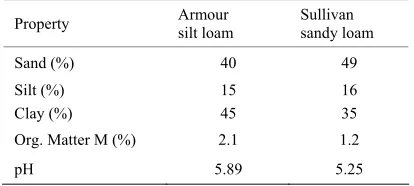
[image:2.595.69.276.626.719.2]thermic Dystric Flaventic Eutrudets). Armour silt loam was collected from Tennessee State University Agricul-tural Experimental Station in Nashville, TN, and Sullivan sandy loam was collected from Tennessee Technological University Experimental Station in Cookeville, TN. They are heretofore designated as Armour and Sullivan soils respectively. Characteristics of both soils are presented in
Table 1. Surface soils were collected, sieved through
2-mm sieve and stored in a refrigerator at 4˚C until used.
2.1.2. Crops
Two grasses and one legume were selected for these in-vestigations. The grasses were switchgrass (Panicum virgatum L.) and big bluestem (Andropogon gerardii
Vitman), and the legume was alfalfa (Medicago sativa
L.). They were among crops that our laboratory has pre-viously investigated for phytoremediation of soils con-taminated with dursban, flagships and chlordane (11). Seeds of Alamo variety of switchgrass and Roundtree variety of big bluestem were obtained from Star Seed Inc., Osborne, KS and seeds of Savannah variety of al-falfa were provided by the USDA Germplasm Research Information Network, Beltsville, MD. The plants were hereafter designated as AL (alfalfa), BB (big bluestem) and SG (switchgrass).
2.1.3. Pesticide
Bifenthrin was tested as a 7.9 % a.i. emulsifiable concen-trate distributed as Talstar® by FMC Corp. Standard so-
Table 1. Characteristics of armour and sullivan soils.
Property Armour silt loam Sullivan sandy loam
Sand (%) 40 49
Silt (%) 15 16
Clay (%) 45 35
Org. Matter M (%) 2.1 1.2
pH 5.89 5.25
lution of bifenthrin in methanol and neat compound(98% purity) were obtained from ChemService, West Chester, PA. These materials were used as external standard for determining concentration of the insecticide at any time during incubation in soil, and to prepare stock solution for determining extraction efficiency of bifenthrin from the soils, respectively.
2.2. Experimental Approaches
2.2.1. Soil Fortification
Soils were fortified with Talstar to produce a nominal bifenthrin concentration of 10 mg·kg–1. Fortified soils
were sieved at least twice and they stored in the refrig-erator at 4˚C until used.
2.2.2. Moisture Replacement Plant Growth System (Microcosm)
Plants were grown in Moisture Replacement System (MRS) described by Dzantor andWoolston [12]. Essen-tially, each MRS unit consists of polyfoam-insulated box that is divided into two halves. The upper half is drilled with holes that fit snugly 50 mL conical tubes, which held soil. The lower half serves as reservoir for water and nutrients. Wicks were inserted through the bottom of the tubes such that they protrude about a third way into soil while the rest extends into the reservoir. The reservoir has a working volume of about nine liters (9 L) and when the system is in operation, the wicks supply water and nutrients via hydraulic gradient to the soil.
2.2.3. Plant Harvesting
At intervals of 4, 6, 10, and 12 weeks, unplanted and rhizosphere soils were sampled for chemical and micro-biological analyses. During harvesting, entire contents of conical tubes were removed and the shoots of the plants were severed at the soil surface. At this stage of growth, all the belowground parts of the microcosm were consid-ered to be rhizosphere material. This material was mac-erated and mixed thoroughly using flamed utensils and procedures to avoid cross contamination of samples by microbes or chemical residues. Portions of the samples were placed in sterile Whil-Pak® bags (VWR Scientific,
Suwannee, GA) and stored in the refrigerator at 4oC for
more than 48 hours before they were analyzed for micro-biological parameters. The remaining portions of rhizosphere soils were stored at –30˚C until analyzed for bifenthrin concentrations.
2.3. Analytical Approaches
2.3.1. Microbiological Analysis
onto appropriately marked agar plates. After incubation, total number of positive spots on the marked plates is recorded and referenced to statistical tables to provide estimates the most probable number of bacteria in soil.
For profiling microbial communities, 150 microliters of suspension from a selected dilution from the PDFA procedure (10–2) were plated into 96-well BIOLOG
EcoPlates (Biolog Inc., Hayward CA). The plates contain 31 carbon substrates that are replicated three times on each plate with 3 control wells containing water. Each well contains a colorless respiration indicator, tetra-zolium chloride, which turns purple with respiratory ac-tivity in the wells, with the intensity of color develop-ment a measure of extent to which a particular substrate is utilized. For qualitative analyses, individual substrates on the Biolog plate were grouped into categories as fol-lows (number substrates/per category in parentheses): carbohydrates (7), amino acids (6), carboxylic acids (10), polymers (4) esters (3) and amines (2). Average well color development at 590 nm (A590) of each category was
plotted against duration of incubation to provide a graphical comparison into substrate utilization under the influences of different rhizospheres.
2.3.2 Chemical Analyses
Bifenthrin residues were extracted from soil with ethyl acetate using a rotary shaker protocol as described pre-viously for PCB contaminated soils except extracts were not subjected to sulfuric acid cleanup [12]. The extracts were analyzed by electron capture gas chromatography using an Agilent 6890 system with a JW Scientific DB 608 capillary column (30m x 0.25mm x 0.25μm). Oven temperature was programmed from an initial 80oC rising
at a rate of 15˚C/minute to 320˚C. Injector and detector temperatures were 250˚C and 300˚C respectively. Carrier gas was He at a constant flow rate of 2 ml/min and make-up gas was Ar-CH4 at 58 ml/min.
2.3.3. Data Analysis
Data were analyzed using the SAS system (SAS Institute, Cary, N.C.). Dissipation of bifenthrin was analyzed using
Analysis of Variance (ANOVA) considering 2 soil types and 4 planting (3 plant types and 1 no-plant) treatments. Carbon substrate utilization profiling of microbial com-munities in soil were assessed as absorbances on Biolog Ecoplates after correcting for water. Values of absorb-ance were plotted against time to provide a qualitative representation of different profiles communities. Prin-cipal Component Analysis (PCA) constructed patterns based on different extents of color development on Biolog plates. These patterns were used to relate carbon substrate utilization by microbial communities in the different soil types.
3. Results and Discussions
3.1. Plate Dilution Frequency Assay for
Characterizing Bacterial Populations in Soil
We employed traditional as well as contemporary tech-niques to provide a clearer picture of the microbial com-ponents that involved in rhizodegradation of bifenthrin in soil. The traditional method used was the Plate Dilution Frequency Assay [13] a variation of the Most Probable Number (MPN) for estimating live counts of bacteria in a soil. The contemporary approach involved physiological profiling of microbial communities in soil using carbon substrate utilization patterns (CUPs) also known as the BIOLOG method.
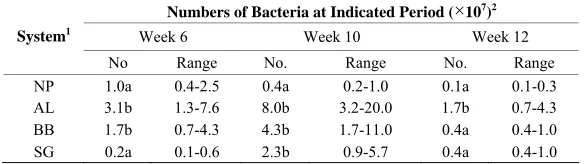
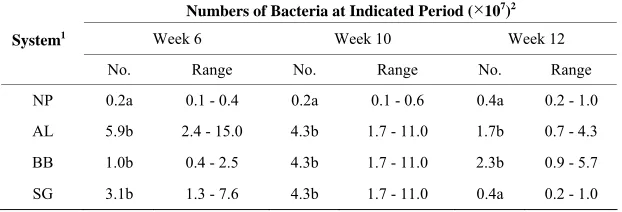
As expected, both soil types contained significantly higher numbers of bacteria when they were planted than when they were bare (Tables 1 and 2). Estimates of
bac-terial populations after six weeks of incubation in mi-crocosms were 1.0 × 10⁷ bacteria in unplanted Armour
soil and 0.2 × 10⁷ bacteria in Sullivan soils.
Enumerations were started at week six when visual observation indicated that soil in the MRS microcosms could be considered as rhizosphere material. At that time, Armour soils planted with AL contained 3.1 × 10⁷
bacte-ria, increasing to 8.0 × 10⁷ at week 10 before declining to
[image:3.595.152.445.606.688.2]1.7 × 10⁷ at week 12 (
Table 2). Similar patterns of
bacte-rial population dynamics were found in BB and SG-planted Armour soils. In the former, bacteria popu
Table 2. Plate dilution frequency assay (PDFA) of bacteria in bifenthrin-fortified armour soil.
Numbers of Bacteria at Indicated Period (×107)2
Week 6 Week 10 Week 12
System1
No Range No. Range No. Range NP 1.0a 0.4-2.5 0.4a 0.2-1.0 0.1a 0.1-0.3 AL 3.1b 1.3-7.6 8.0b 3.2-20.0 1.7b 0.7-4.3 BB 1.7b 0.7-4.3 4.3b 1.7-11.0 0.4a 0.4-1.0 SG 0.2a 0.1-0.6 2.3b 0.9-5.7 0.4a 0.4-1.0
1No plant, NP; alfalfa, AL; big bluestem, BB; switchgrass, SG; 2Bacterial numbers in a column
lating rose from1.7 × 107 to 4.3 × 10⁷ before dropping
to 0.4 × 10⁷ at week 12. In SG-planted Armour soils,
bac-terial numbers at week 6 were 0.2 × 10⁷ increasing over
10 fold to 2.3 × 10⁷ at week 10 before declining to 0.4 ×
107at week 12.
Overall, PDFA estimates of bacteria in planted Sulli-van soils showed trends that were similar to those in Armour soils, except in the former soil, bacterial popula-tions under the influence of AL appeared to have reached a higher level sometime before enumeration was per-formed at week 6 (Table 3). At that time, bacterial
popu-lations were 5.9 × 10⁷, but instead of increasing at week
10 as seen in Amour soil, we found a slight decrease to 4.3 × 10⁷. This observation was important; it strongly
pointed to growth rate differences between bacterial populations in AL-planted Armour and AL-planted Sul-livan soils.
In these studies, we used traditional plate counts for characterizing bacterial components of rhizodegradation in soil. Limitations of plate count methods have been well documented [15,16] nonetheless, these methods remain the ‘gold standard’ in microbiology, providing relatively inexpensive and well-tested characterization of microbial phenomena in matrices. The PDFA that we used in this study is a relatively simple, resource and time conserving approach to microbial characterization, which provides results that are a function of a dilution series rather one dilution [13]. By its derivation, the PDFA is characteristically associated with wide confi-dence limits [13] as our results demonstrated. However, important trends such as an apparent difference in growth
rate of populations of the two soils were revealed. Ac-cordingly, the PDFA can be valuable in side-by-side comparisons for observations in soils, especially when used together with contemporary approaches such as community profiling [16] and molecular methods [17]
3.2. Carbon Utilization Profiling of Microbial Communities
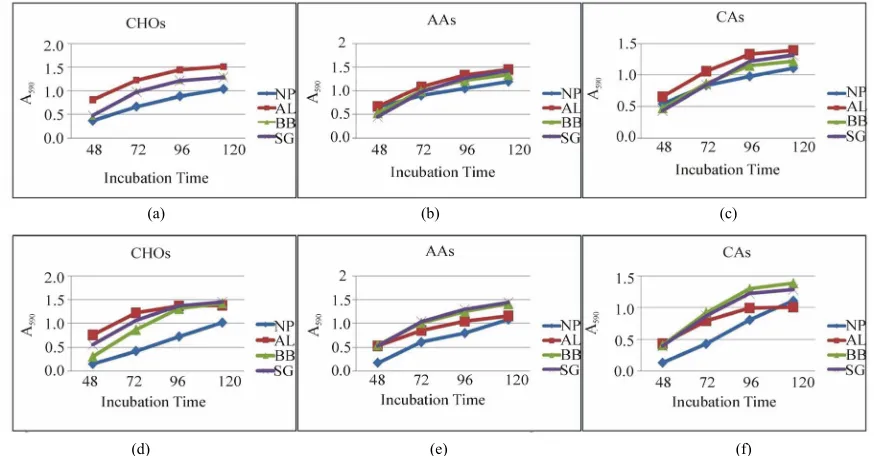
For these studies, we employed carbon substrate profil-ing (so-called BIOLOG method) as the contemporary approach for characterizing microbial components in the rhizodegradation of bifenthrin in soils. Results of CUP analysis for the major substrate groups, namely carbohy-drates (CHOs), amino acids (AAs) and carboxylic acids (CAs) are presented in Figures 1(a)-(f). For brevity, the
plots shown are for community profiles in week 10 only. As predicted by PDFA estimates, substrate utilization was higher in all planted soil communities than in un-planted ones. Among Armour rhizosphere soils, CHO utilization was highest for microbial communities asso-ciated with AL; there were no differences in CHO utili-zation by communities in SG and BB rhizospheres ( Fig-ures 1(a)-(c)). In other words, three microbial
communi-ties could be adequately separated based on their CHO utilization as high (AL), medium (BB and SG), and low (NP). Utilization of AAs and CAs was also highest in AL rhizospheres; however, the relative magnitudes of the differences between the substrate utilization these sub-strates in the rhizospheres or unplanted soil were not as pronounced (Figures 3-5).
[image:4.595.143.454.493.599.2]Substrate utilization of rhizosphere microbial commu-
Table 3. Plate dilution frequency assay (PDFA) of bacteria in bifenthrin-fortified sullivan soils.
Numbers of Bacteria at Indicated Period (×107)2
Week 6 Week 10 Week 12
System1
No. Range No. Range No. Range
NP 0.2a 0.1 - 0.4 0.2a 0.1 - 0.6 0.4a 0.2 - 1.0
AL 5.9b 2.4 - 15.0 4.3b 1.7 - 11.0 1.7b 0.7 - 4.3
BB 1.0b 0.4 - 2.5 4.3b 1.7 - 11.0 2.3b 0.9 - 5.7
SG 3.1b 1.3 - 7.6 4.3b 1.7 - 11.0 0.4a 0.2 - 1.0
1No plant, NP; alfalfa, AL; big bluestem, BB; switchgrass, SG; 2Bacterial numbers in a column with
[image:4.595.137.453.665.719.2]same letters are not significantly different; levels of significance and 95% confidence limits were cal-culated as described by Fisher and Yates cited by Harris and Sommers (13)
Table 4. Analysis of variance (ANOVA) of bifenthrin recoveries from two soil types and four planting treatments after 12 weeks.
Source of Variation F P-value
Soil Type Plant Treatment Soil-Plant Interactions
51.91 28.30 0.90
Table 5. Dissipation of bifenthrin in unplanted and planted Armour soils.
% of Initial Bifenthrin Recovered after Indicated Period System1
Week 4 Week 6 Week 10 Week 12
NP 97.1 (10.8)a 97.1 (2.9)a 112.1(5.4)a 73.7 (0.2)a
AL 80.1 (7.1)b 71.3 (8.7)bc 70.3 (17.9)b 48.7 (0.5)c
BB 70.8 (1.5)b 64.1 (7.9)c 67.1 (14.4)b 54.3 (0.2)c
SG 76.7 (11.3)b 81.6 (14.7)b 67.8 (24.1)b 64.4 (0.2)b
1/Mean percentage of initial added bifenthrin recovered after 4, 6, 10 and 12 weeks. Number in paren-theses are standard deviations of means of four replicates. Means within a column followed by the same letter are not significantly different at α = 0.05 level. NP: No Plant; AL: Alfalfa; BB: Big Blue-stem; SG: Switchgrass.
(a) (b) (c)
[image:5.595.79.516.224.452.2](d) (e) (f)
Figure 1. Qualitative carbon substrate utilizationpatterns of microbial communities in Armour (a-c) and Sullivan (d-f) soils. CHOs, carbohydrates; AAs, amino acids; CAs, carboxylic acids.
nities in Sullivan soil produced a more mixed pattern than those observed for Armour rhizospheres. In Sullivan soil, utilization of CHOs was slightly higher in AL rhizospheres but became undistinguishable as incubation period increased (Figures 1(d)-(f)). Perhaps more
re-markably, our PDFA observations reported above were accurately reflected by CUP data.
The Biolog carbon utilization profiling is now widely accepted as by far a more appropriate approach for char-acterizing microbial populations in a broad range of ma-trices (16,18,19). However, it is not without its own limitations. Issues of inoculum size and optimum incuba-tion time for different communities are important con-sideration in the meaningful use of the procedure (19).
Perhaps more importantly, the Biolog procedure gener-ates data that is not readily interpretable to provide func-tionally relevant information.
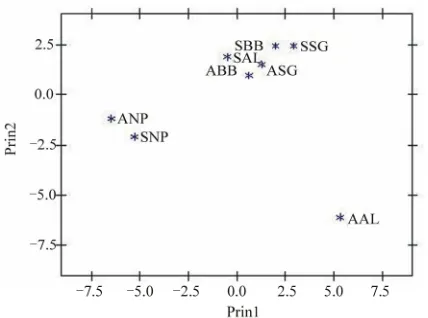
Currently, the most common approach to Biolog data interpretation for Biolog involves Principal Component
Analysis (PCA), which allows identification of patterns based on differences in color development that might be used to explain observations. PCA analysis of Biolog data from our study is shown in Figure 2. PCA analysis
in our study generated three categories: (1) unplanted Armour and Sullivan rhizospheres; (2) the other planting treatments except (3) AL-planted Armour rhizosphere only. There was no difficulty in explaining the clustering together of unplanted soil. Likewise, grouping all planted soils together did not appear to be an aberrant observa-tion; however, we have not found any obvious practical explanation for the distinct separation AL-planted Armor soils. The significance of this observation is undergoing further evaluation.
3.3. Dissipation of Bifenthrin in Armour and Sullivan Soils
Figure 2. PCA of carbon utilization profiles of microbial communities in bifenthrin-fortified Armour and Sullivan soils at week 10. Soil type: Armour (A); Sullivan (S) Plant-ing system: No plant, NP; alfalfa, AL; big bluestem, BB; switchgrass, SG.
significantly influenced dissipation of bifenthrin in soil (Table 4). There were no soil x plant interactions
Dissipation of bifenthrin in Armour soil is illustrated in Table 5. Beginning in week 4, significantly more
bifenthrin was recovered from unplanted soils than in planted ones. After 12 weeks, about 74% of initially added bifenthrin was recovered in unplanted soil in con-trast, 49%, 54% and 64% of the same initial level was recovered in AL, BB and SG rhizospheres respectively.
Disipation of bifenthrin in Sullivan soil followed a trend similar to one in Armour soil, except the differences between unplanted and planted soils were not manifest in soil samples until week 6, instead week 4 for Armour soil. By week 12, 66% of the initial bifenthrin application were recovered in unplanted Sullivan soil; in contrast, 37%, 45% and 36% respectively in planted soils (Table 6).
4. Conclusions
The goal of this study is to understand and characterize the microbial components involved in the rhizodegrada-tion so strategies may be developed to mitigate undesir-able intrusions of the xenobiotic compounds in soil and potentially water. We used plate dilution frequency assay (PDFA) and carbon substrate utilization profiling (CUP) to characterize microbial communities in Armour silt loam and Sullivan sandy loam soils that were forti-fied with the insecticide bifenthrin and planted with al-falfa, big bluestem and switchgrass. Our objective was to determine whether a relationship could be established to relate microbial communities to dissipation of the insec-ticide in soil. We concluded as follows:
1) Overall, higher microbial populations were found in planted soils than in unplanted ones. Among those planted, Sullivan soils contained higher bacterial popula-
Table 6. Dissipation of bifenthrin in unplanted and planted Sullivan soils.
% of Initial Bifenthrin Recovered after Indicated Period System1
Week 4 Week 6 Week 10 Week 12
NP 69.0 (7.1)a 81.0 (1.8)a 83.5(7.4)a 66.5 (0.4)a AL 58.1 (6.2)a 51.3 (6.2)bc 59.9(21.0)bc 36.7 (0.5)b BB 67.7 (4.4)a 59.7 (6.9)b 41.2 (9.4)c 45.4 (0.6)b SG 68.5 (7.4)a 47.2 (8.5)c 62.3 (7.0)b 36.0 (0.6)b
1/Mean percentage of initial added bifenthrin recovered after 4, 6, 10 and 12 weeks. Number in parentheses are standard deviations of means of four replicates. Means within a column followed by the same letter are not sig-nificantly different at α = 0.05 level. NP: No Plant; AL: Alfalfa; BB: Big Bluestem; SG: Switchgrass.
tions than Armor soils. Furthermore, the highest popula-tions of bacteria were found in both soil types when they were planted with alfalfa.
2) Carbon utilization profiles measured by the Biolog procedure for carbohydrates, amino acids and carboxylic acids were higher in planted soils than unplanted. CUP was accurately reflected by bacterial populations in soil; additionally, it suggested differences in growth rate of microbial communities in two soils.
3) Principal Component Analysis (PCA) separated CUP data into three group namely, unplanted soils, al-falfa-planted Armour soils, and all other planting treat-ments. The significance of this observation is not imme-diately obvious.
4) As expected, significantly more bifenthrin was re-covered in both unplanted Armour and Sullivan soils than in planted ones. Furthermore, dissipation of bifen-thrin was generally higher in Sullivan than in Armour soils.
5) We are evaluating microbiological data vis-à-vis bifenthrin dissipation to establish a relationship, which could be a major step toward identification of major in-dividuals or consortia of microorganisms that are most important in the dissipation of bifenthrin in soil.
REFERENCES
[1] R. L. Chaney, J. S. Angle, C. L. Broadhurst, C. A. Peters, R. V. Tappero and D. L. Sparks, “Improved Understand-ing of Hyperaccumulation Yields Commercial Phytoex-traction and Phytomining Technologies,” Journal of En-vironmental Quality, Vol. 36, 2007, pp. 1429-1443.
doi:10.2134/jeq2006.0514
[2] J. I. Schnoor, L. A. Light, S. C. McCutcheon, N. L. Wolfe and L. H.Carreira, “Phytoremediation of Organic and Nu-trient Contaminants. Pilot and Full-Scale Studies are Demonstrating the Promise and limitations of Using Vegetation for Remediating Hazardous Wastes in Soils and Sediments,” Environmental Science & Technology, Vol. 29, No. 7, 1995, pp. 318-323.
[image:6.595.311.535.119.196.2][3] R. L. Schneider and D. D. Yifru, “Phytoremediation of Perchlorate from Fireworks,” 11th International Sympo-sium on Fireworks, Puerto Vallarta, April 20-24, 2009, pp. 387-396.
[4] A. Muratova, T. Hübner, S. Tischer, O. Turkovskaya, M. Möder and P. Kuschk, “Plant-Rhizosphere-Microflora Association during Phytoremediation of PAH-Contami-nated Soil,” International Journal of Phytoremediation, Vol. 5, No. 2, 2003, pp. 137-151. doi:10.1080/713610176
[5] J. M. Duringer, A. M. Craig, D. J. Smith and R. L. Chaney, “Uptake and Transformation of Soil [14C]-Tri-nitrotoluene by Cold-Season Grasses,” Environmental Science & Technology (ACS Publications), Vol. 44, No. 16, 2010, pp. 6325-6330. doi:10.1021/es903671n
[6] E. K. Dzantor, J. E. Woolston and B. Momen, “PCB Dis-sipation and Microbial Community Analysis in Rhi- zosphere Soil under Substrate Amendment Conditions,” International Journal of Phytoremediation, Vol. 4, No. 4, 2002, pp. 283-295.
doi:10.1080/15226510208500088
[7] A. A. Romeh, “Phytoremediation of Water and Soil Con-taminated with Imidacloprid Pesticide by Plantago Major L,” International Journal of Phytoremediation, Vol. 12, No. 2, 2010, pp. 188-199.
doi:10.1080/15226510903213936
[8] J. Gan, S. J. Lee, W. P. Liu, D. L. Haver and J. N. Kaba-shima, “Distribution and Persistence of Pyrethroids in Runoff Sediments,” Journal of Environmental Quality, Vol. 34, 2005, pp. 836-841. doi:10.2134/jeq2004.0240
[9] National Plant Board, U.S. Dosmetic Japanese Beetle Harmonization Plan, 2004.
[10] A. Fecko, “Environmental Fate of Bifenthrin,” Environ-mental Monitoring and Pest Management Branch, De-partment of Pesticide Regulation, Sacramento, 1999. [11] E. K. Dzantor, D. E. Long and T. K. Amenyenu, “Use of
Plant System for Mitigating Environmental Impacts of
Pesticides,” Proceeding of the Southern Nurserymen As-sociation Annual Conference, Atlanta, 2005, pp. 580-583. [12] E. K. Dzantor and J. E. Woolston, “Enhancing Dissipa-tion of Aroclor 1248 (PCB) Using Substrate Amendment in Rhizosphere Soil,” Journal of Engineering & Envi-ronmental Sciences, Vol. 36, No. 1, 2001, pp. 1861-1871. [13] R. F. Harris and L. E. Sommers, “Plate-Dilution Fre-quency Technique for Assay of Microbial Ecology,” Ap-plied Microbiology, Vol. 16, No. 2, 1968, pp. 330-334. [14] V. J. Orphan, L. T. Taylor, D. Hafenbradl and E. F.
Delong, “Culture-Dependent and Culture Independent Characterization of Microbial Assemblages Associated with High Temperature Petroleum Reservoirs,” Applied and Environmental of Microbiology, Vol. 66, No. 2, pp. 700-711. doi:10.1128/AEM.66.2.700-711.2000
[15] E. Yashiro, R. N. Spear and P. S. McManus, “Cul-ture-dependent and Culture-Independent Assessment of Bacteria in the Apple Phyllosphere,” Journal of Applied Microbiology, Vol. 110, No. 5, 2010, pp. 1284-1296.
doi:10.1111/j.1365-2672.2011.04975.x
[16] J. L. Garland and A. L. Mills, “Classification and Char-acterization of Heterotrophic Microbial Communities on the basis of patterns of Community-Level Sole-Car-bon-Source Utilization,” Applied and Environmental Mi-crobiology, Vol. 57, No. 8, 1991, pp. 2351-2359.
[17] V. Torsvik, J. Goksoyr, and F. L. Daae, “High Diversity in DNA of Soil Bacteria,” Applied and Environmental Microbiology, Vol. 56, No. 3, 1991, pp. 782-787.
[18] K. Matsui, M. Jun, M. Ueki and Z. I. Kawabata, “Func-tional Succession of Bacterioplankton on the Basis of Carbon Source Utilization Ability by Biolog Plates,” Eco-logical Research, Vol. 16, No. 5, 2003, pp. 905-912. [19] A. Stefanowicz, “The Biolog Plates Technique asa Tool