The University of San Francisco
USF Scholarship: a digital repository @ Gleeson Library |
Geschke Center
Master's Theses
Theses, Dissertations, Capstones and Projects
5-14-2003
A Study of the Perceptions of Bay Area Planned
Giving Professionals as to the Value and
Effectiveness of Various Techniques Used to
Market Planned Gifts
Suzanne Levi
University of San Francisco
Follow this and additional works at:
https://repository.usfca.edu/thes
This Thesis is brought to you for free and open access by the Theses, Dissertations, Capstones and Projects at USF Scholarship: a digital repository @ Gleeson Library | Geschke Center. It has been accepted for inclusion in Master's Theses by an authorized administrator of USF Scholarship: a digital
Recommended Citation
Levi, Suzanne, "A Study of the Perceptions of Bay Area Planned Giving Professionals as to the Value and Effectiveness of Various Techniques Used to Market Planned Gifts" (2003).Master's Theses. 1097.
The author of this thesis has agreed to make available
to the University community and the public a copy of this dissertation project.
Unauthorized reproduction of any portion of this dissertation is prohibited.
The quality of this reproduction is
contingent upon the quality of the original copy submitted
.
University of San Francisco
Gleeson Library/Geschke Center
2130 Fulton Street
A Study of the Perceptions of Bay Area Planned Giving Professionals as to the Value and Effectiveness ofVarious
Techniques Used to Market Planned Gifts
A THESIS SUBMITTED
by
Suzanne Levi
In Partial Fulfillment of the Requirements
for the Degree of
Master of
Nonprofit Administration
The University of San Francisco
A Study of the Perceptions of Bay Area Planned Giving Professionals as to the Value and Effectiveness of Various
Techniques Used to Market Planned Gifts
This Thesis written by
Suzanne tevi
This Thesis written under the guidelines of the Faculty Advisory Committee, and approved by all its members, has been accepted in partial fulfillment of the requirements for the degree of
Master of Nonprofit Administration
at the
University of San Francisco
Research Committee
~-~-~
E\dA./TL._v
~
-~~
Program Director
~A.
Dean3
04/t.v.u.
~()3
Da;~TABLE OF CONTENTS
Abstract. ... iv
Vita Auctoris ... v
Acknowledgments ... vi
List of Tables ... vii
List of Appendices ... ix
Chapter I: Introduction ... 1
Chapter II: Review of Related Literature ... 10
Chapter III: Method ... : ... 25
Chapter IV: Results and Findings ... 29
Chapter V: Summary and Conclusion ... 76
References ... 89
Appendix A ... 91
ABSTRACT
This study entailed a mail survey of the entire membership of the Northern
California chapter of the Planned Giving Council to ascertain the ways in which Bay
Area planned giving professionals perceived the effectiveness of certain marketing
techniques in raising planned gifts for Bay Area nonprofit organizations. It further explored any differences in preference for various marketing techniques based on the
professional experience of the planned giving professional, the annual budget of their
organization, or the type of agency where they worked.
The study found that, broadly speaking, respondents favored the relationship
marketing techniques, those requiring more personal interaction with donors. There was
some difference in the overall responses when analyzed in relation to years of
respondents' experience in the field, their organization's annual budget, and the type of
Name
Date of Birth:
High School:
Graduated
Baccalaureate Degree
College:
Graduated
VITA AUCTORIS
Suzanne Levi
April 15, 1969
University High School San Francisco, California
1987
Bachelor of Arts Degree
University of California Los Angeles, California
ACKNOWLEDGEMENTS
It is with profound gratitude that I acknowledge Kathleen Fletcher, Carol
Silverman, and Gwyn Lister with whom I would not have been able to produce this
Table 4.1 Table 4.2 Table 4.3 Table 4.4 Table 4.5 Table 4.6 Table 4.7 Table 4.8 Table 4.9 Table 4.10 Table 4.11 Table 4.12 Table 4.13 Table 4.14 Table 4.15 Table 4.16 Table 4.17
LIST OF TABLES
Years Respondents Had Been in the Field of Planned Giving
Type of Organization for which Respondents Currently Work
Annual Budget of Respondents' Organizations
Annual Budget of Organization Sorted by Type of Organization
Type of Organization Sorted by Annual Budget
Marketing Techniques Rated by Respondents
Marketing Techniques Ranked in Order of Respondents' Ratings
Marketing Approach Ranked by Respondents in Order of Importance to Raising Planned Gifts
Area Respondents Would Like to Focus on in the Next Year
Marketing Techniques Rated by Respondents Sorted by Years in Planned Giving
Marketing Approach Rated by Respondents Sorted by Years in Planned Giving
Area Respondents Would Like to Focus on in the Next Year Sorted by Years in Planned Giving
Marketing Techniques Rated by Respondents Sorted by Budget of Organization
Marketing Approach Rated by Respondents Sorted by Budget of Organization
Area Respondents Would Like to Focus on in the Next Year Sorted by Budget of Organization
Marketing Techniques Rated by Respondents Sorted by Type of Organization
LIST OF APPENDICES
Appendix A ... Survey Questionnaire
CHAPTER ONE: INTRODUCTION
Background of the Issue
A major problem for most nonprofit organizations (NPOs) is attracting the resources
necessary to carry out their programs. Over the years, NPOs have increasingly relied on
marketing techniques (such as direct mail, newsletters, and advertisements in organization
publications) as a tool for raising funds for their programs. A particular type of fund-raising that
relies most heavily on marketing techniques is planned giving. This type of giving includes
bequests and life income gifts such as charitable gift annuities and charitable remainder trusts.
Until the 1970s, the concept of marketing for NPOs was regarded with disdain. It was
seen by administrators and trustees as inappropriate for their agency as well as manipulative and
unprofessional. During the 1970s, however, some practitioners and scholars began to turn their
attention to the challenge of improving management practice in public agencies and NPOs.
These managers recognized the need to understand the requirements and concerns of one's
users or clients and to develop communication efforts to reach these groups (Lovelock &
Weinberg, 1988).
In the 1970s and 1980s, NPOs focused their marketing efforts on mass marketing
through direct mail. For the first ten years, many were successful in raising the bulk of their
income by this means. While still used today, over time it has decreased in effectiveness as the
market has become saturated with all kinds of mail appeals (Klein, 1994).
Prior to the 1980s, it was uncommon for most organizations to do any market
segmentation. They tended to communicate with their whole donor base or other constituency.
Except for colleges and universities and other types of NPOs that had access to personal
not available to most NPOs. However, mass communication can be very expensive and can add
to "donor fatigue," as additional communications may be received by donors for whom they are
not appropriate (Sharpe, 2001).
During the 1990s, NPOs began to use market segmentation, in which contributors are
grouped demographically, psychographically, attitudinally, or by some other characteristic in
order to focus strategies and resources in reaching that particular market. There are a number of
ways to approach market segmentation. For example, donors can be segmented according to
their past levels of giving or to the date of their most recent gift. Alternatively, they can be
segmented by age or length of membership, or connection to the organization, or ability to give
(Sharpe, 2001).
In recent years, a trend toward relationship marketing (also known as frequency
marketing) has been developing. Relationship marketing is a method of selling products and
services by building a relationship with clients and prospects. This type of strategy emphasizes
the individuality of each prospect and donor (Allington, 2000). Its primary objective is retaining
high-value customers and increasing those customers' purchases over time. It employs a variety
of offers to attract customers into active, sustainable relationships with the sponsor. Usually
characterized by database-driven and systematic communications between the two parties, the
strategy typically depends on direct mail and toll-free telephone access (Barlow, 1995).
Planned giving programs rely heavily on marketing strategies such as the ones previously
described to educate members, donors, and other constituents about planned giving vehicles
such as bequests and life income gifts that are available to support the organization's programs
and services (Jordan & Quynn, 1995). Planned gifts provide a way for philanthropic donors to
consequences. The planning component involves financial planners, estate planning attorneys,
and/ or gift planners helping the donor to consider estate planning issues, financial
ramifications, and tax benefits Qordan & Quynn, 1995; Kelly, 1998). Planned gifts fall into
three categories: the outright gift, whereby the nonprofit can use the asset immediately, the
bequest, whereby the nonprofit receives the asset at the donor's death~ and the life income gift,
whereby the donor receives a stream of income during their life and the nonprofit receives the
remainder value of the gift upon the donor's death
O
ordan & Quynn, 1995; Kelly, 1998).Planned giving has become one of the most attractive ways for individuals to make gifts
to a charity. Currently most of this country's wealth is held by older Americans, those aged 60
and older. Baby boomers have become middle aged and older Americans are living longer. The
years ahead will see the largest intergenerational transfer of wealth in US History. This transfer of assets creates the need for close examination of tax issues. Passing wealth on to family
members through planned giving options offers an attractive way to ensure current income
while receiving tax advantages and providing for charity. Thus, NPOs need to emphasize
sophisticated planned giving techniques that provide needed benefits to donors while building
their own future Qordan & Quynn, 1995).
Planned giving has changed over the years. Donors have become much more savvy and
knowledgeable, and today's planned giving officer often has extensive contact with a donor's
lawyer, financial advisor, trust officer, and/ or accountant. Outside advisors are usually included
in the process because of the range and complexity of gift vehicles available to donors of all
ages, who have various personal and financial objectives Qordan & Quynn, 1995; Kelly, 1998).
Often the most overlooked and crucial part of a planned giving program is marketing. No
about the program. Marketing means not only educating prospects about planned giving
vehicles, but also articulating the needs of the organization. Continuity, repetition, and
perseverance are key qualities of a planned giving program. Planned giving materials must
appear continually over a long period of time to educate donors and prospects. It is the
cumulative impact of marketing to a philanthropic donor over time, along with follow up, that
results in their making a planned gift
Q
ordan & Quynn, 199 5). Planned giving, therefore, is thedepartment in a development office most likely to conduct marketing and the individuals
charged with running the planned giving program are likely to be well-versed in marketing
fundamentals.
Statement of the Issue
While there is evidence that charitable organizations will receive bequests and other planned gifts with little or no active pursuit of this type of income, case after case shows that
over time the programs that engage in proactive efforts in the area of planned gift development
enjoy substantial growth in planned gift income. As a result, the majority of the leading charities
in America have developed some sort of proactive planned gift marketing initiative (Sharpe,
2001). While there are many theories as to which are the most effective means of marketing a
planned giving program, there is little information available on what planned giving
professionals today actually perceive as the most effective marketing technique to promote their
programs and raise planned gifts.
The purpose of this study was to determine the ways in which Bay Area planned giving
professionals perceived certain marketing strategies (mass marketing, targeted marketing, and
relationship marketing) to be effective in the raising of planned gifts fqr Bay Area NPOs. The
professional experience of the planned giving professional, the annual budget of their
organization, or the type of agency where they worked. It was expected that the study would
indicate that the marketing strategies recommended would differ according to (a) the
professional experience (years of experience with planned giving and tenure with their
organization) of the planned giving professional, (b) the annual budget of the organization, and
(c) the type of organization in question.
In order to avoid requiring confidential information from the subjects, the survey did
not have the business practices of the organization as its focus. Instead, it aimed to gather
information about the perceptions of planned giving professionals as to the most effective
means for marketing their programs.
Research Questions
The perceptions of Bay Area planned giving professionals of the value and effectiveness
of various techniques used to market planned gifts was investigated in this study. The specific
research questions studied were:
1) How do Bay Area planned giving professionals rate marketing techniques as to their
effectiveness in raising planned gifts?
2) To what extent do Bay Area planned giving professionals differ in the techniques they prefer
based on their professional experience? (That is, their years of employment in the field of
planned giving.)
3) To what extent do Bay Area planned giving professionals differ in the techniques they prefer
4) To what extent do Bay Area planned giving professionals differ in the techniques they prefer
based on the type of organization they work for? (That is, in the arts, in education, in health, in
human services, or in the environmental)?
Definitions of Major Concepts
Bequest. A gift of property by will. The gift can be a percentage of a donor's estate, a
specific amount of cash; a gift of property; or the residual, the portion of the estate remaining
after all bequests have been made.
Charitable Gift Annuity. An agreement in which a donor makes a gift to charity, which
in turn provides a stipulated annual income payment for life, to one or two persons, as dictated
by the donor.
Charitable Remainder Trust. A trust made possible by the Tax Reform Act of 1969. It
provides for a donor to transfer property to a trustee subject to his or her right to receive a
percentage of the fair market value of the property for as long as he or she lives. Whatever
remains in the trust at the person's death becomes the property of the beneficiary organization.
In an Annuity Trust, the income to the donor is a fixed percentage of.the initial net fair market
value of the property to be gifted. In a Unitrust, the income is a percentage of the fair market
value of the property transferred, determined annually.
Direct Mail. Impersonal fund-raising letters sent by bulk mail. Letters addressed to an
individual or sent first class are not technically direct mail pieces, although these more
personalized letters borrow from direct mail principles in that they are identical letters going to
many recipients (Klein, 1996).
Legacy Society. A vehicle through which an organization recognizes a group of people
organization that they have made the organization a beneficiary of their estate plan.
Marketing. A comprehensive, integrated campaign designed to educate an organization's
constituents about the organization and its needs for funding. It is the management function
that most explicitly links an organization to its external environment.
Marketing Mix. The organization's efforts to facilitate transactions with its customers
require that decisions be made in four broad areas, collectively referred to as the "marketing
mix." These are: 1) the characteristics of the product that is offered in the marketplace, 2) the
price that is charged in exchange, 3) how the product is distributed to the customer, and 4) the
nature of the messages that are communicated to prospective customers and how these
messages are transmitted.
Marketing Strategy. Determining the needs and concerns of the various constituencies
served by the organization or program and ensuring that those needs and concerns are
addressed in the design and delivery of programs.
Market Research. The form of marketing information primarily concerned with
understanding the markets in which one's organization competes.
Market Segmentation. A key organizing concept underlying the development of
effective marketing strategies. Target markets are divided in order to focus strategies and
resources at homogeneous groups of customers in meaningful ways.
Mass Marketing. A style of marketing where the organization produces and
mass-distributes one market offer and attempts to attract every eligible person to its use. It is compatible with a selling orientation to marketing. The argument for mass marketing is that it
would result in the lowest costs and prices and therefore create the largest potential market. The
Planned Gift. A gift of money, land, or another asset that requires consideration and
planning in light of a donor's overall estate plans.
Planned Giving Program. (Also known as a Gift Planning Program.) A program in
which part of an organization's resources are devoted to the acquisition of planned gifts. At
minimum, a charity with a planned giving program should be able to handle gifts made with
securities, bequests, and charitable remainder trusts that are managed outside the nonprofit. A
complete planned giving program is one that offers life income gifts such as charitable gift
annuities, deferred gift annuities, a pooled income fund, and the opportunity to make gifts of
real estate.
Relationship Marketing. (Also known as Frequency Marketing.) A method of selling
products and services by building a relationship with clients and prospects. The object of this
type of marketing strategy is to identify, maintain, and increase the yield from Best Customers,
through long-term, interactive, value-added relationships.
Target Marketing. A style of marketing appropriate to a customer-oriented organization.
In it the organization distinguishes between the different segments making up the market,
chooses one or more of these segments to focus on, and develops a marketing strategy tailored
for each segment.
Importance of the Study
While the Bay Area planned giving professionals under study benefited most from this
study, there was a value to be gained from it by the planned giving community as a whole.
Overall, it provided planned giving professionals with an overview of the perceptions of their
peers as to the effectiveness of certain marketing techniques in raising planned gifts. In addition,
served, or annual budget is an important factor in the decision as to which marketing techniques
were preferred to promote a planned giving program.
Within the region studied, a base of knowledge was gained about the kinds of marketing
techniques favored by planned giving professionals. This would assist staff and board members
in their future planning when either instigating a planned giving program or promoting an
CHAPTER 2: REVIEW OF RELATED LITERATURE
Planned Giving
Planned giving has changed over the years. Today, planned giving officers often have
extensive contact with a donor's lawyer, financial advisor, trust officer, and/ or accountant.
Outside advisors are usually included in the process because of the range and complexity of gift
vehicles available to donors who have various personal and financial objectives Qordan &
Quynn, 1995).
According to Klein (1996), bequests are the most common form of planned gifts and account
for approximately five percent of all the money given to charitable causes by the private sector.
This is an amount equal to funds given by foundations and greater than the amount given by
corporations.
Planned giving accounts for up to 50% or more of total fund-raising revenue of mature
programs, and, for most programs, bequest revenue is continuing to grow year by year
(Mangone & Thomas, 2001). Many organizations, however, do not seek planned gifts. One of
the reasons for this is that people feel awkward talking to anyone about their death. Many board
members and staff, even fund-raising staff, may not want to have a conversation with a
potential donor about their money and their death at the same time (Klein, 1996).
Marketing to key stakeholders, therefore, is essential to promoting planned gifts for
NPOs. It is an important way for donors to help ensure that what they believe in and
contribute to will continue into the future. No amount of technical expertise will generate gifts unless individuals with donative potential learn about the program. Marketing means not only
educating prospects about planned giving vehicles but also articulating the needs of the
Planned Giving & Marketing
Continuity, repetition, and perseverance are key qualities of the marketing component
of a planned giving program. Planned giving materials such as brochures, newsletters, and
advertisements must appear continually over a long period of time to educate donors and
prospects. It is the cumulative impact of marketing to a philanthropic donor over time, along
with follow up, that results in a donor's making a planned gift Qordan & Quynn, 1995).
As is the case for marketing of NPOs generally, planned giving programs have been promoted
through the years using various marketing techniques. These techniques have included mass
marketing, targeted marketing, and, more recently, relationship marketing.
Kateman (1999) surveyed 47 charities listed in the Nov. 5, 1998, issue of the Chronicle
of
Philanthropy as "the Philanthropy 400" to investigate their marketing initiatives. At that time,
nearly three quarters of those surveyed had a formal planned giving marketing plan. Those
surveyed reported seven major benefits of marketing planned gifts: awareness and education of
planned giving (52%), generation of new gifts (32%), generation of repeat gifts (23%),
generation of leads (19%), building of endowment (6.5%), donor reassurance (3%), and
promotion of the organization's mission (3%). Nearly one half of the respondents stated that
there were no disadvantages to marketing planned gifts. Kateman found that the charitable
vehicles being marketed were wills and bequests (100%), charitable gift annuities (91 %),
charitable remainder trusts (87%), and retirement plan assets (74%). The methods used to
market them were newsletters (87%), personal visits (84%), Web sites (84%), advertising (77%),
targeted letters (74%), telephone contact (74%), seminars (71%), direct mail (65%), legacy
Rise of Nonprofit Marketing
Marketing has become a buzzword in the nonprofit sector because of the increased
competition. According to Shiffman (2000), over the last five years, the IRS has reported a 22%
growth in 501(c )(3) charities. At the same time, cuts in federal and state funding have created
an even greater need to raise even more private support. As noted by Berg and Shiffman (1996),
marketing strategies can be effectively applied to better understand and reach individuals in an
organization's audience, identify prospects, maintain a relationship with donors and prospects,
and reinforce donors' decisions to make a charitable gift to an organization.
Mass Marketing
The first marketing technique that began to be used by NPOs during the early and
mid-70s was mass marketing. Mass marketing is a strategy that involves the mass-production and
mass-distribution of one market offer that attempts to attract every eligible person to its use.
The argument for mass marketing is that it results in lower costs and prices. The mass marketer
pays little or no attention to differences in consumer preferences (Kotler & Andreason, 1982).
One form of mass marketing that has become extremely important over the years is
direct mail. Although other authors define direct mail differently (Lister, 2001; Warwick, 1996),
Klein (1996) defines fund-raising by this means as fund-raising letters sent by bulk mail. Direct
mail letters are sent in minimum quantities of 200, pre-sorted by zip code for the post office.
Direct mail solicitation was first used on a mass scale in 1968 for the Barry Goldwater for
President campaign. For the next ten years, it was popular and many organizations derived the
bulk of their income from it. Over time its effectiveness has decreased. Some fund-raising
professionals have questioned the continued use of direct mail as an effective strategy. Despite
a message they can examine at their leisure. Many organizations use direct mail to communicate
with current donors and ask for additional gifts (I<Jein, 1996).
There are three reasons why direct mail is widely used as a fund-raising tool. First, the
cost of personal solicitation is high. Second, the availability of specialized mailing lists has
grown. And, third, the emergence of computer technology has permitted NPOs to use mailing
lists at very low costs (Kotler & Andreason, 1982).
According to I<Jein (1996), direct mail has two functions: donor acquisition and donor
retention. Donor acquisition is getting someone to give for the first time. It is the primary
purpose of direct mail. Many organizations do this by purchasing or trading lists of members or
donors with another organization. Donor retention is getting someone to repeat their gift.
Other types of mass marketing include charity cans in stores, door-to-door solicitation, TV and
radio advertisements, raffles, walkathons, and Web sites.
Planned Giving & Mass Marketing
Mass marketing techniques have served as the foundation for planned giving marketing
programs for many years.
Newsletters
As a component of marketing, newsletters and direct mail remain the central marketing
activities of planned giving programs. Newsletters have been effective in making people aware
of an organization's planned giving program and in prompting qualified prospects to
self-identify (Mangone and Thomas, 2001).
Successful planned giving programs usually include a planned giving newsletter three or
four times a year to educate prospects about the benefits of planned giving. It is part of a
planned giving opportunities and remember the organization when they begin their estate
planning (Carmichel, 1999).
However, response rates to newsletters have been decreasing. Ten years ago, it was
common for an NPO to experience a 1-2% response rate. Today, response rates are in the
0.5% rate (Mangone & Thomas, 2001). With over 600,000 charities sending out planned giving
newsletters each quarter, NPOs need to do more (Shiffman, 2000).
Media Advertisements
Newspaper and magazine advertisements are other examples of effective mass
marketing tools for planned giving programs. However, they are expensive. Furthermore,
advertisements placed in publications outside of those of the organization can often elicit
responses that are more motivated by tax savings than donative intent. Pomona College,
however, used advertisements in financial papers for many years to effectively raise planned
gifts by stressing the tax advantages. They raised more than $50 million from non-alumni over a
35-year period. Also, the Arthritis Foundation placed a highly successful advertisement for
bequests from wills or estates in Modern Maturity, a magazine appropriate for their target
market. The Cleveland Orchestra also had good results with a gift annuity commercial on the
local classical music radio station (Carmichel, 1999).
Organization Publications
Quarterly magazines, alumni publications, annual reports, and other organization
publications are all good sources of marketing planned giving. An NPO can include planned
giving articles in these publications and encourage readers to write or call for more information
The Web
Planned giving home pages on the Web have become increasingly common. These
pages most often contain information on how to plan a bequest for the NPO, sample bequest
language, and information on available life-income gifts. Some NPOs also publish their planned
giving newsletters on the Web (Carmichel, 1999).
A surprising number of seniors are adept at navigating the Web. A study released in
2001 revealed that the number of Web surfers aged 55-64 grew 20% over the prior six months.
Currently, the 55-64 age group is approximately 8.5% of the US adult population, or about 24.2
million consumers. That growth rate was the largest increase for any age group in the study.
According to the report, 43% of that age group now use the Internet on a regular basis.
Thirty-seven percent sent e-mails (an increase of 20% over the past six months and 46% over the past
18 months), 27% report general web browsing, (13%) investment tracking, (9%) personal
purchases, (8%) travel reservations, and (4%) business purchases (Mangone & Thomas, 2001).
The mass marketing techniques discussed above form the backbone of most planned
giving programs. In today's competitive market, however, mass appeals have lost their effect. It
is not enough to simply identify an audience. The key to reaching an audience today is to
understand who they are and how they differ from each other, and to create appeals to the
particular needs and interests of the different segments of that audience (Shiffman, 2001).
Target Marketing
There are often wide differences between one consumer and another in terms of needs,
behavior patterns, and other characteristics. Not everyone is a prospective customer; in fact, the
target audience for most nonprofit programs is a tiny fraction of the total population. Further,
mission. Market segmentation is a means of singling out certain subgroups or market segments
as required (Lovelock & Weinberg, 1989; Sturtevant, 1997).
Methods of market segmentation include identifying key stakeholders of the
organization such as current and past donors, alumni, patients, congregants, relatives, friends,
board members, volunteers, people who have been helped by the organization, staff, and allied
professionals. Surveys are also a vital way to gather demographic information and information
about the personal interests, values, concerns, and specific programmatic interests of prospects.
Research is a third key component of market segmentation. Today, research can be easily
conducted to determine a prospect's giving potential. Among the many attributes that can be
readily investigated are giving history, affiliations, voting history, political party, educational
background, stock and real property holdings, and many others (Berg & Shiffman, 1996).
Target marketing is a strategy that utilizes market segmentation. It uses the information
gathered about the target market through market segmentation to develop an approach that is
tailored to meet the needs of each segment. Once the demographic and psychographic
information is gathered, an overall profile of the donors and prospects can be determined,
allowing NPOs to focus fund-raising efforts on the needs, wants and desires of the donor
population and to find prospects who share the commitments and ideals of the organization
(Klein, 1996).
Segmentation must be based upon detailed, specific information gathered in an
objective manner. Managers need data about the size and structure of the market, trends in the
environment that may influence demand from a certain segment, and the nature and extent of
make choices, what benefits they are looking for, and what factors or individuals influence their
decisions (Lovelock & Weinberg, 1989).
Target marketing began to be incorporated into the marketing strategy of many NPOs
during the 1980s. Previously, advertising and promotion "pushed" products through the market
by creating consumer demand. Increased competition made it vital for NPOs to discover what
targeted customer groups want and then to find the services and products to meet those needs.
Target marketing allows an NPO to learn what distinguishes their particular market from others,
requiring different approaches and messages. An example of the effectiveness of using
segmentation to create a targeted appeal was a message tailored specifically to those who
graduated in the class of 1960 at the University of Minnesota. This appeal generated a
nine-percent response rate, compared to past response rates of less than one nine-percent (Shiffman &
Berg, 1996).
While target marketing is still used today, it has become somewhat outdated. According to
Sexton (1999), marketing segmentation is more effective than mass marketing, but does not go
far enough. Sexton states that the only market segmentation that is relevant today is actual
behavior.
Planned Giving & Target Marketing
Target marketing is essential to marketing planned gifts because not everyone involved
with an organization is eligible or very likely to make a planned gift. Through market
segmentation, an NPO can identify the best planned giving prospects and then tailor their
Identifying Prospects
The best planned giving prospects are those who will receive personal satisfaction from
assisting the organization, are retired or nearing retirement age, have sufficient wealth to make a
major gift, and are childless or otherwise without family financial obligations. An organization's
ability to segment its audience according to age, length of affiliation with the organization, and
assets (stock and real property holdings) is essential to creating an effective planned giving
marketing component (Carmichel, 1999).
Past National Council on Planned Giving (NCPG) President, Frank Minton, conducted
a study of NPOs in the early 1990s that researched how planned giving donors had initially been
identified. The following were the sources of planned giving prospect/ donor identifications, in
order of importance: previous planned giving donor, referred by donor or volunteer, attended
estate planning seminar, responded to target mailing, referred by allied professional, responded
to newsletter, responded to annual giving solicitation, referred by development staff, attracted
by article in organization publication (Minton, 1992).
Once this information has been obtained and the marketing segments determined, an
organization can develop tailored marketing appeals as well as make better use of their
marketing resources. For example, an organization may choose to mail out their planned giving
newsletter to those segments identified as over the age of 50, rather than to their entire
constituency (Carrnichel, 1999).
Annual Solicitation/Mail Survey
The Minton survey indicated a high level of prospect identification through annual
giving solicitations. By simply including a reply card or questionnaire with these mailings that
made known to the planned giving staff and prospects were made aware of the possibility of
making such a bequest or a life-income gift. Once these types of reply card or questionnaire are
returned, these donors then become part of a different segment, which would be approached in
a completely different way. Prospects would then become either top prospects or planned
giving donors (Carmichel, 1999).
Donor Seminar
The Minton survey also showed estate planning seminars to be an effective method of
exposing prospects to estate planning concepts. Inviting key stakeholders of an organization,
such as those who fit the profJle discussed earlier, is an effective way of marketing planned gifts.
Organizations conducting these types of seminar most often use outside professional advisors
(Carmichel, 1999).
Relationship Marketing
More recently, NPOs have begun to realize the benefits of marketing through personal
contact, utilizing an approach that focuses on finding solutions to meet the needs of their
contributors. This latest trend is called relationship marketing, also known as frequency
marketing. The term relationship marketing refers to the category of marketing strategies that
have as their primary objectives retaining current high-value customers and increasing those
customers' purchases over time. The key to relationship marketing's effectiveness is that it
emphasizes the individuality of each prospect and donor. While prudent fund-raisers have been
using this type of strategy for years, there have never been so many ways to effectively and
cost-efficiently use relationship marketing to help build and solidify a donor base (McKenna, 1991;
According to Barlow (1995), the term frequency marketing derives from the
frequent-flyer programs that began in 1981. The origins of this loyalty-focused approach can be found in
the trading-stamp programs that were popular in the 1950s and 1960s and in earlier marketing
promotions such as the various Ovaltine children's clubs, which used existing media (radio,
network television, and direct mail) to establish ongoing relationships with customers. As the
post-World War II American economy soared, however, mass media options increased, offering
a continuously broader reach for advertising. The emerging mass market environment was
dominated by a fixation on customer acquisition. When the US economy slowed in the 1970s
and 1980s and technological advances in data processing and telecommunications created new
opportunities to communicate with customers individually, marketers began to reconsider the
potential for building sales through programs aimed at current customers rather than new
customers.
The launch of the frequent-flyer programs in May of 1981 exemplifies this trend.
American Airlines was a pioneer in this foray with its American Advantage
®
program.Tracking individual travel activity was facilitated by the development of a computerized
reservation system database that provided a simple and accurate way to track mileage (the
precise air travel distance flown on American by each enrolled traveler) and limit liability
through capacity controls (the number of free "award" seats made available on any given flight).
This technological advance permitted the airlines to move from recognition to reward, offering
free or discounted air travel and special treatment to its most valuable customers. Other
companies, particularly credit card issuers, retailers, and long-distance telephone companies,
began to create marketing strategies based on enhanced special recognition and services for
services. For example, American Express developed a variety of services, usually stratified by
customer type: Green Card versus Gold Card versus Platinum Card. Extended warranty offers
were included for all "cardmembers." Gold Cardmembers got access to special blocks of
tickets for plays, concerts, and other events. Platinum Cardmembers got access to events
designed for and available only to them (Barlow, 1995).
Retailers like Neiman-Marcus (InCircle® and NM Plus®), Saks Fifth Avenue (Saks First), Sears
(Sears Best Customer, Craftsman Club), Kmart (Preferred Reader®, through its specialty chains
such as Waldenbooks), and Egghead Software® (CUE) offered preferred customers special
discounts, private sales, free services, special financing terms, priority attention, and even free
merchandise, based on purchase behavior. Such programs produce initial sales increases from
participating customers in excess of 10%, and research has shown they account for sustainable
incremental sales of approximately that same amount (Barlow, 1995).
As discussed by Kanter (1991), what differentiates all relationship marketing programs
from offer-driven traditional direct marketing, event-driven sales promotion, and prize-driven
continuity schemes is the priority focus on relationship building over the long term. Using
rewards, recognition, and special treatment to involve high-value customers in an ongoing
dialogue, these programs seek to "turn customers into members," who will then willingly
collaborate with the sponsor in the continuing marketing process.
With these collaborative relationships established, customers become "insiders."
In this new dynamic, customers become ready and willing to contribute their time, opinions,
and discretionary purchase volume in favor of the sponsor (Peppers & Rogers, 1993).
The basic elements of relationship marketing are:
2) A format or structure for establishing and maintaining the relationship with the
customer.
3) The benefits or added value designed to attract the customer into the relationship and
maintain his or her commitment.
4) The communications with the customer, designed to interact with the customer,
sending and receiving information.
5) The ongoing analysis of the program, designed to refine it in accord with customer
preferences. (Barlow, 1995; McKenna, 1991).
Planned Giving & Relationship Marketing
The financial aspect of planned gifts, as well as the consultative relationship between the
planned giving officer and the donor, make the relationship a critical factor in the marketing of
planned gifts. Donors are a vital source of information as to their intentions to make a bequest
(which is revocable until their death) and as to their situation with regard to their assets.
(Shiffman, 2000)
According to Leavitt (1986), the economic theory of "supply and demand" does not
apply in the relationship between buyer and vendor because the theory presumes that the work
of the economic system is immune to human intervention. In an effective relationship, Leavitt
holds, the buyer shares his plans and expectations with the vendor or at least makes it possible
to know his intentions. This theory of supply and demand is increasingly less relevant as the
product complexity intensifies, such as with planned gifts.
Relationship marketing techniques that can be applied to planned giving programs
include talking to planned giving prospects one-on-one; making sure that planned giving
program; conducting a survey in the organization newsletter; holding donor councils, and
roundtables; including a virtual suggestion box on the organization Web site; conducting focus
groups; inviting testimonials from key stakeholders; monitoring negative comments to mailings;
making sure to have an ongoing dialogue with donors; using personalization of letters to current
donors; attempting to involve donors in the organization, striving to find out what motivates a
donor; developing appeals directed to a specific interest of prospects or donors; and reaching
the donor the way they want to be reached (e-mail, voicemail, radio, fax, Web, television)
(Shiffman, 2000).
In Kateman's (1999) survey of the Philanthropy 400, certain strategies were identified to
support these relationship marketing elements. These include personalized target letters for top
prospects, regular and consistent contact and communication, and peer communication for top
prospects.
Focus groups are also a good example of a primary resource where attitudes, beliefs, opinions,
motivations, and reactions of planned giving donors and prospects can be explored. They
encourage suggestions and recommendations for future directions, programs, and services.
They identify those who have an interest in the organization's program. For example, the
American Cancer Society asked a group of individuals about its newsletter. They expressed
concern about the fact that no case was being made. The University of Minnesota conducted
focus groups that identified preferred methods of recognition that were far from what was
currently being offered (Shiffman, 2000).
Leavitt refers to this kind of stewardship as the "Total Product Concept." He describes
the gift as "the core." Thanking the donor is "the expected product." Potential and
all inquiries and appropriate response pieces, items or articles of interest sent to the donors,
follow up calls, legacy societies, regular communications about the organization, and ease of
doing business with the organization via both the internet and a toll free phone number
(Leavitt, 1986).
The planned giving program involves a unique blend of complicated gifts that require
discussions about sensitive issues such as personal assets, estate planning, and death. It is
particularly important, therefore, for planned giving donors to feel as if they are part of the
organization's family. In a way, by making an organization a beneficiary of their estate plans,
donors are making the same gesture. Relationship marketing is a unique strategy that ensures
that this type of donor stewardship and recognition are wholly integrated in and are priorities of
the program. Many planned giving professionals believe it is vital to the success of an
CHAPTER 3: METHOD
Subjects
Information was gathered from planned giving professionals at San Francisco Bay Area
nonprofit organizations (NPOs). These professionals were selected on the basis of their
membership of the Northern California chapter of the Planned Giving Council (NCPGC).
The subjects reflected a variety of broad program types and sizes. NCPGC members
were chosen because it was felt that each would be able to offer significant information or
opinions about raising planned gifts and the use of marketing strategies.
Research Design
The entire NCPGC constituency of 280 members was surveyed to explore the
preference for marketing strategies in raising planned gifts in Bay Area NPOs. The survey was
aimed at determining whether respondents favored mass marketing, targeted marketing, or
relationship marketing in their choice of communication tools.
A quantitative reporting of the perceptions by Bay Area planned giving professionals of
marketing strategies was conducted. Specific aspects examined were the professional
background of these planned giving professionals, the characteristics of the agency where they
were employed, and the perceptions and attitudes of the respondents toward certain marketing
techniques.
The study was based on a non-probability census. Due to the absence of a random
sampling technique, the study did not intend to be representative of the perceptions of all
Instrumentation
An anonymous survey (Appendix A) was sent to NCPGC members as a method of data
collection. The survey consisted of deflned and closed-ended questions. The survey method was
chosen because of its advantage in providing easily quantifled information from a large group of
subjects.
The survey questions sought the following information:
1) Respondent's professional background (Questions 1-3):
years worked in the fleld of planned giving (Question 1);
years worked with current organization (Question 2);
scope of responsibility within the organization (Question 3).
2)
The organization type, constituency, and annual budget of respondent's
organization (Questions 4-6):
type of organization (Question 4);
type of constituency served (Question 5);
annual budget (Question 6).
3) Respondent's perceptions about the effectiveness of certain mass marketing,
targeted marketing, and relationship marketing techniques (Questions 7-9).
Procedures
With the full knowledge and consent of the Chair of the Membership Committee of the
NCPGC, the survey was mailed out to each member of the NCPGC members with a cover letter
and in a self- addressed and stamped envelope. The cover letter described the survey and the
Operational Definition of Relevant Variables
The independent variables are
1) number of years experience with planned giving (ordinal) (Question 1 );
2) number of years with current organization (ordinal) (Question 2);
3) scope of responsibility at organization (nominal) (Question 3 - 4);
4)
type of organization (nominal) (Question 5);5) type of constituency served (nominal) (Question 6);
6) amount of organization annual budget (ordinal) (Question 7);
7) marketing techniques used to raise planned gifts (nominal) (Questions 8-10).
The dependent variables are
1)
ways in which marketing techniques are rated in terms of their effectivenessin raising planned gifts (ordinal) (Question 8);
2) ways in which an overall marketing strategy is rated in terms of its
effectiveness in raising planned gifts (ordinal) (Questions 9-10).
Treatment of the Data
A quantitative analysis of the survey data was conducted to determine the marketing
strategies perceived by the subjects as most effective for raising planned gifts. Differences in
preference for various marketing strategies (such as marketing segmentation, prospect research,
personalized letters, and donor visits) were explored based on the experience of the planned
giving officer, the type of organization, and the annual budget of the organization. Preferences
related to the use of marketing practices in fundraising for planned gifts as they relate to
A series of crosstabs was run in order to look at the importance given to each
marketing technique by respondents and their professional experience, budget size of the
organization, and type of the organization. The cross tabs were collapsed to compare the
number of years in planned giving with the ranking of marketing techniques and to compare the
agency budgets with the ranking of marketing techniques. Internal measures were collapsed as
CHAPTER FOUR: RESULTS AND FINDINGS
This chapter reports the results of analysis of responses to a questionnaire mailed in
October, 2002 to members of the Northern California Planned Giving Council (NCPGC). A
description of respondents and their institutions is followed by a discussion of the data gathered
to answer the study's four primary research questions:
1) How do Bay Area planned giving professionals rate marketing techniques as to their
effectiveness in raising planned gifts?
2) To what extent do Bay Area planned giving professionals differ in the techniques they
prefer based on their professional experience? (Years of employment in the field of planned
giving.)
3) To what extent do Bay Area planned giving professionals differ in the techniques they
prefer based on the size of the annual budget of their organization?
4) To what extent do Bay Area planned giving professionals differ in the techniques
they prefer based on the type of organization they work for (i.e.; arts, education, health, human
services, and environmental).
Description of Respondents
Of the 280 surveys that were mailed, 83 completed questionnaires were returned, for
a response rate of 30%. Respondents were asked to indicate how long they had worked in the
field of planned giving. They were given five possible answers: less than one year, one to three
years, four to six years, seven to ten years, and more than ten years. For the purpose of this
analysis, the answers were grouped into three categories: zero to three years, four to six years,
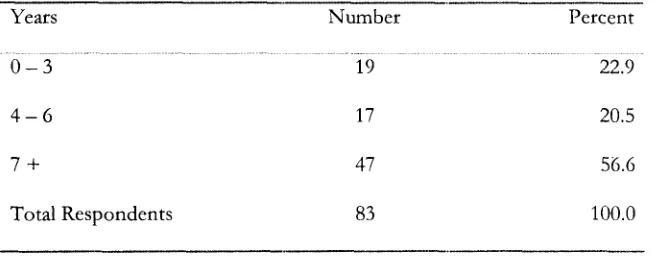
and seven and more years. Forty-seven respondents (56.6%) had been in the field of planned
giving for three or less years. Seventeen respondents (20.5%) had been in the field of planned
giving for between four and six years. There was a notable majority of 64 respondents (77 .1%)
who had been in the field for four or more years. Responses are shown in Table 4.1.
Table 4.1
Years Respondents Had Been in the Field of Planned Giving
Years Number Percent
0-3 19 22.9
4-6 17 20.5
7+ 47 56.6
Total Respondents 83 100.0
Description of Organizations
Respondents were asked to indicate what type of organization they work for. Nine
categories were given as possible answers. The categories were: arts, education, environmental,
health, human services, religious, law firm, financial services company, consulting firm,
community foundation, and other. For the purpose of this analysis, health and human services
organizations were grouped into one category as were law firms and financial services
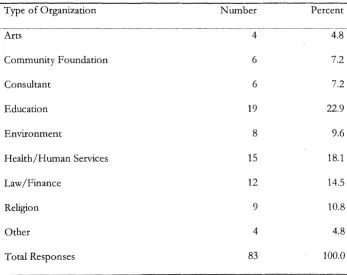
companies. Respondents to the survey represent a wide variety of types of organizations. Of the
83 respondents, 19 worked for educational organizations (22.9% of total responses), with health
and human services organizations having the second greatest number, 15 respondents, or 18.1%
Table 4.2
Type of Organization for which Respondents Currently Work
Type of Organization Number Percent
---··---~-,
Arts 4 4.8
Community Foundation 6 7.2
Consultant 6 7.2
Education 19 22.9
Environment 8 9.6
Health/Human Services 15 18.1
Law /Finance 12 14.5
Religion 9 10.8
Other 4 4.8
Total Responses 83 100.0
The approximate amount of the organization's annual budget was also requested in the
survey. Respondents were given seven categories as possible answers for the annual budget of
their organization. The categories were: under $100,000; $100,000 to $500,000; $500,001 to
$1,000,000; $1,000,001 to $500,000,000; $500,000,001 to $10,000,000; $10,000,001 to
$25,000,000; and above $25,000,000. Responses ranged from less than $1 million per year to
over $10 million. For the purpose of this analysis, the answers were grouped into three
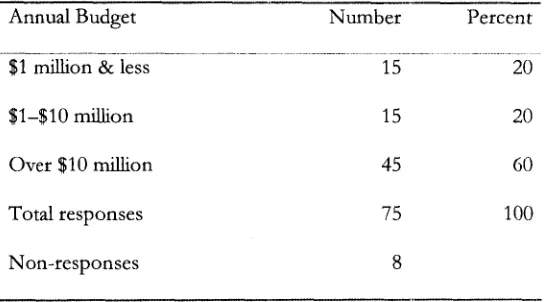
categories: $1 million and less, $1 million to $10 million, Over $10 million. According to the
question, 45 (54.2%) responded that their annual budget was $10 million or more. Responses
are shown in Table 4.3.
Table 4.3
Annual Budget of Respondents' Organizations
Annual Budget Number Percent
----~~--~----,·----~·---$1 million & less 15 20
$1-$10 million 15 20
Over $10 million 45 60
Total responses 75 100
Non-responses 8
In an effort to understand whether certain budget categories were composed of a
majority of certain types of organizations, the answers to the budget and type of organization
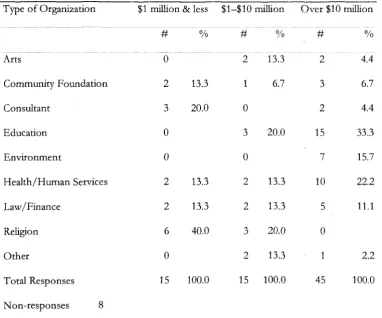
questions are shown in Tables 4.4 and 4.5. The type of organization with the highest budget was
the environmental organizations. All respondents from environmental organizations reported
budgets of $10 million or more. This was followed by educational organizations. Fifteen (83.3%)
of respondents from educational organizations reported budgets of $10 million or more. The
type of organization with the lowest annual budgets was religious organizations. Six (66.7%)
Table 4.4
Annual Budget of Organization Sorted By Type of Organization
Type & Budget Amount
$1 million and less
$1-$10 million
Over $10 million
Total responses
COMMUNITY FOUNDATION
$1 million and less
$1-$10 million
Over $10 million
Total responses
CONSULTANT
$1 million and less
$1-$10 million
Over $10 million
Total responses
Non-responses 1
EDUCATION
$1 million and less
Type & Budget Amount Number Percent
--~-·-~---··· --·--·----~- __ ~{£OUI!_~_e_~)_
Over $10 million 15 83.3
Total responses 18 100.0
Non-responses 1
ENVIRONMENT
$1 million and less 0
$1-$10 million 0
Over $10 million 7 100.0
Total responses 7 100.0
Non-responses
HEALTH/HUMAN SERVICES
$1 million and less 2 14.3
$1-$10 million 2 14.3
Over $10 million 10 71.4
Total responses 14 100.0
Non-responses 1
LAW/FINANCE
$1 million and less 2 22.2
$1-$10 million 2 22.2
Over $10 million 5 55.6
Total responses 9 100.0
Type & Budget Amount
RELIGION
$1 million and less
$1-$10 million
Over $10 million
Total responses
OTHER
$1 million and less
$1-$10 million
Over $10 million
Total responses
TOTAL RESPONSES
NON-RESPONSES 8
Number Percent
1
6 66.7
3 33.3
0
9 100.0
0
2 66.7
1 33.3
3 100.0
Table 4.5
T~e of Organization Sorted b~ Annual Budget
Type of Organization $1 million & less $1-$10 million Over $10 million
#
% # % # %Arts 0 2 13.3 2 4.4
Community Foundation 2 13.3 1 6.7 3 6.7
Consultant 3 20.0 0 2 4.4
Education 0 3 20.0 15 33.3
Environment 0 0 7 15.7
Health/Human Services 2 13.3 2 13.3 10 22.2
Law /Finance 2 13.3 2 13.3 5 11.1
Religion 6 40.0 3 20.0 0
Other 0 2 13.3 1 2.2
Total Responses 15 100.0 15 100.0 45 100.0
Non-responses 8
Research Question 1
The primary research question of this study explored how Bay Area planned giving
professionals rated certain marketing techniques. Respondents were given 12 marketing
techniques and were asked to rate them on a scale of one to seven in terms of their
effectiveness in raising planned gifts. For the purpose of this analysis, the answers were grouped
into three categories: techniques given a rating from one to two, from three to four, and five
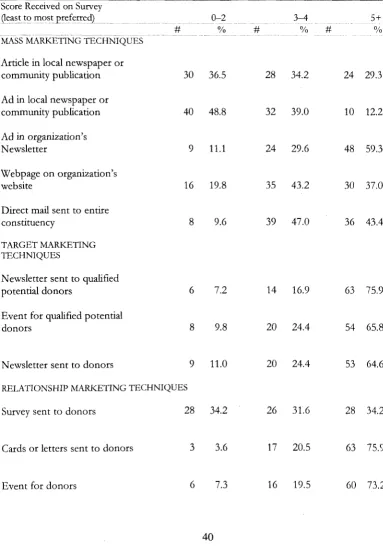
Overall, relationship marketing techniques, those requiring the most personal interaction
rated the highest. Over 97% of respondents rated visits with donors with a score of five or
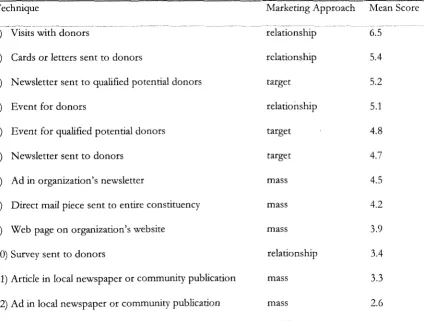
higher. This technique had the highest mean score of 6.5. Personalized cards and letters for
donors rated a score of five or higher from nearly 76% and had the second highest mean score
of 5.4. Events for donors scored a five or higher from more than 72%. Respondents, however,
did not favor spending an organization's resources on conducting a survey of planned giving
donors. This technique received a score of one or two from more than 33% of respondents.
The target marketing technique of mailing newsletters to qualified potential donors
received a score of five or higher from nearly 76% of respondents. An event for qualified
potential donors received a score of five or higher from more than 65%.
Overall, mass marketing techniques received the lower ratings. Mailing newsletters to the
entire constituency received a score of five or higher from more than 63%. Planned giving
advertisements in an organization's newsletter scored five or higher from more than 57%.
Direct mail sent to the entire constituency of an organization scored three or four from about
45% of respondents. A planned giving Web page on an organization's Web site only received a
score of three or four from 42% of respondents. An article in a local newspaper or other
publication received a score of one or two from about 36% of respondents and had a mean
score of 3.3. An advertisement in the same type of publication received a score of one or two
from more than 48% and had the lowest mean score of 2.6.
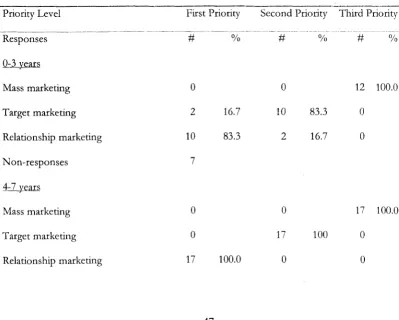
Respondents were also asked to rank three marketing approaches (mass marketing,
target marketing, and relationship marketing) in order of importance in raising planned gifts.
approach of the three. The same percentage gave target marketing second place. All of the
respondents found mass marketing to be the least important of the three.
The final question of the survey asked respondents to select one area they would like
their organization to focus on in the next year. The choices were raising awareness of potential
donors about the planned giving program (mass marketing approach), increasing organizational
research on potential planned giving donors (target marketing approach), and building loyalty
and retention of current planned giving donors (relationship marketing approach). When the
question of marketing approach was phrased in this way, the results were different from those
on the previous question. More than 66% of respondents selected the mass marketing approach
of raising awareness of potential donors about the planned giving program.
Table 4.6 shows respondents' ratings. Table 4.7 shows the marketing techniques ranked
in order of mean scores received. Table 4.8 shows respondents' ranking of three marketing
approaches in order of importance to raising planned gifts. Table 4.9 shows respondents' choice
for the area upon which they would like their organization to focus in the next year.
Research Question 2
The second research question explored whether Bay Area planned giving professionals
of differing amounts of experience in the field rated certain marketing techniques differently
from the ways their peers did. As stated earlier, 47 respondents (more than 56%) had been in
the field of planned giving for seven or more years and 64 (more than 77%) had been in the
field for four or more years.
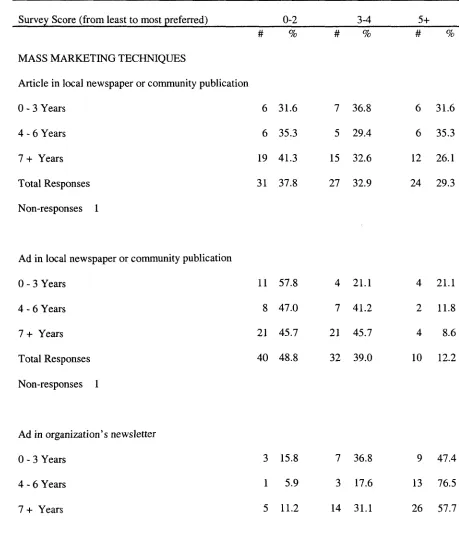
There was a notable difference in the responses of planned giving professionals with
seven or more years of experience as compared to respondents with three or less years of
of marketing techniques. For example, 21.1% of those with experience of three or less years
rated an advertisement in a local newspaper (mass marketing) at five or higher whereas only
8.5% of those with seven or more years gave the technique a rating of five or higher. Nine
professionals with three or less years of experience (47.4%) rated a planned giving Web page on
an organization's Web site (mass marketing) a score or five or higher. Only 14 (29.8%)
professionals with seven or more years of experience agreed.
The more junior professionals also gave higher scores to sending a survey to planned
giving donors and having an event for donors (both relationship marketing techniques) than
their more experienced colleagues. More than 47% with three years or less of experience, but
only 25.5% of those with seven years or more, gave sending a survey to planned giving donors a
score of five or higher. Sixteen (84.2%) of the less experienced professionals rated an event for
donors with a score of five or higher, compared with only thirty (63.8%) of the more
experienced professionals.
Respondents with more years of experience favored a newsletter being sent to qualified
potential donors (target marketing); more than 80% of those with seven plus years experience
rated it at score of five or higher. A similar score was given by only 57.8% of professionals with
three or less years of experience. The only other marketing technique to which more than 65%
of the more experienced professionals gave a rating of five or higher was visits with donors
(relationship marketing). This technique scored a five or higher from 100% of these
professionals. Their more junior colleagues also favored this technique, though not
unanimously. Seventeen (89.4%) of those with three or less years of experience gave visits with
donors a score of five or higher. Table 4.10 shows how the differing levels of professional
Table 4.6
Marketing TechniQues Rated b~ Respondents
Score Received on Survey
Oeast to most preferred) 0-2 3-4 5+
# % # % # %
MASS MARI<ETING TECHNIQUES
Article in local newspaper or
community publication 30 36.5 28 34.2 24 29.3
Ad in local newspaper or
community publication 40 48.8 32 39.0 10 12.2
Ad in organization's
Newsletter 9 11.1 24 29.6 48 59.3
Webpage on organization's
website 16 19.8 35 43.2 30 37.0
Direct mail sent to entire
constituency 8 9.6 39 47.0 36 43.4
TARGET MARI<ETING TECHNIQUES
Newsletter sent to qualified
potential donors 6 7.2 14 16.9 63 75.9
Event for qualified potential
donors 8 9.8 20 24.4 54 65.8
Newsletter sent to donors 9 11.0 20 24.4 53 64.6
RELATIONSHIP MARKETING TECHNIQUES
Survey sent to donors 28 34.2 26 31.6 28 34.2
Cards or letters sent to donors 3 3.6 17 20.5 63 75.9
Visits with donors 1 12.0 1 12.0 81 97.6
Non-responses 10
Table 4.7
Marketing Techniques Ranked in Order of Respondents' Ratings
Technique Marketing Approach Mean Score
1) Visits with donors relationship 6.5
2) Cards or letters sent to donors relationship 5.4
3) Newsletter sent to qualified potential donors target 5.2
4) Event for donors relationship 5.1
5) Event for qualified potential donors target 4.8
6) Newsletter sent to donors target 4.7
7) Ad in organization's newsletter mass 4.5
8) Direct mail piece sent to entire constituency mass 4.2
9) Web page on organization's website mass 3.9
10) Survey sent to donors relationship 3.4
11) Article in local newspaper or community publication mass 3.3