ARTIFICIAL NEURAL NETWORK MODEL FOR PRECISE ESTIMATION OF
1, *
Rajesh Kumar,
2Sunil Pathania,
1
School of Physics and Materials Science, Shoolini University, Bajhol, Solan (HP) 173 212, India
2
School of Electrical and Computer Science Engineering, Shoolini University, Bajhol, Solan (HP) 173 212, India
3School of Mechanical Engineering, Department of Thermal and Energy, VIT University,
4
Department of Environmental Science, Dr Y S Parma
ARTICLE INFO ABSTRACT
A new model based on artificial neural network has been developed to estimate monthly average global solar radiation for different Indian locations. Two layers feed forward network sigmoid trained with Levenberg
have been used to give solar radiation as an output. The
measured global solar radiation data of eighteen Indian locations spread over different Indian climatic zones for which measured data was available. The regression coefficient was found to be 0.95967 with me square error of 0.204. The mean percentage error, root mean square error and mean bias error between estimated and measured global solar radiation of eighteen locations have been found to be in the range of 4.16 to 4.82 , 0.02 to 0.26 and
to find the monthly global solar radiation of any location throughout India by putting eleven input geographical parameters of the desired location.
Research Highlights:
Development of an radiation
Graphical user interface development for the developed artificial neural network model
Graphical representation of best validation performance
Comparison of measur
Regression coefficient representation
Copyright © 2016, Rajesh Kumar et al. This is an open access article distributed under the Creative Commons Att
use, distribution, and reproduction in any medium, provided the original work is properly cited.
INTRODUCTION
It is believed that artificial neural network offers an alternative method for the estimation of global solar radiation, models based on artificial neural network are better as compared to regression models (Kumar, Aggarwal and Sharma
Artificial neural networks have been used in various fields of aerospace, defense, automotive, mathematics, en
medicine, economics, meteorology, psychology, neurologyetc. Artificial neural networks had also been successfully applied for solar radiation estimation with greater accuracy.
many different types of artificial neural network models, b
*Corresponding author: Rajesh Kumar,
School of Physics and Materials Science, Shoolini University, Bajhol, Solan (HP) 173 212, India.
ISSN: 0975-833X
Article History:
Received 18th February, 2016
Received in revised form 24th March, 2016
Accepted 17th April, 2016
Published online 20th May,2016
Key words:
Artificial neural network, Graphical user interface, Solar radiation.
Citation: Rajesh Kumar, Sunil Pathania, Ankit Gupta, Raja Sekhar, Y. and Aggarwal, R.K.
Estimation of Global Solar Radiation”, International Journal of Current Research
RESEARCH ARTICLE
ARTIFICIAL NEURAL NETWORK MODEL FOR PRECISE ESTIMATION OF
GLOBAL SOLAR RADIATION
Sunil Pathania,
3Ankit Gupta,
3Raja Sekhar, Y. and
Materials Science, Shoolini University, Bajhol, Solan (HP) 173 212, India
Computer Science Engineering, Shoolini University, Bajhol, Solan (HP) 173 212, India
School of Mechanical Engineering, Department of Thermal and Energy, VIT University,
Vellore-632014, Tamil Nadu, India
Department of Environmental Science, Dr Y S Parmar University of Horticulture
Nauni (Solan), 173230, India
ABSTRACT
A new model based on artificial neural network has been developed to estimate monthly average global radiation for different Indian locations. Two layers feed forward network sigmoid trained with Levenberg-Marquardt back propagation algorithm with eleven input terminals and ten hidden layer neurons have been used to give solar radiation as an output. The model was trained, validated and tested by using measured global solar radiation data of eighteen Indian locations spread over different Indian climatic zones for which measured data was available. The regression coefficient was found to be 0.95967 with me square error of 0.204. The mean percentage error, root mean square error and mean bias error between estimated and measured global solar radiation of eighteen locations have been found to be in the range of 4.16 to 4.82 , 0.02 to 0.26 and -0.30 to 0.08 respectively. A graphical user interface has also been developed to find the monthly global solar radiation of any location throughout India by putting eleven input geographical parameters of the desired location.
Research Highlights:
Development of an artificial neural network model for the estimation of monthly average global solar radiation
Graphical user interface development for the developed artificial neural network model Graphical representation of best validation performance
Comparison of measured and estimated solar radiation data Regression coefficient representation
is an open access article distributed under the Creative Commons Attribution License, which use, distribution, and reproduction in any medium, provided the original work is properly cited.
It is believed that artificial neural network offers an alternative global solar radiation, models based on artificial neural network are better as compared to Aggarwal and Sharma, 2015). Artificial neural networks have been used in various fields of aerospace, defense, automotive, mathematics, engineering, medicine, economics, meteorology, psychology, neurologyetc. Artificial neural networks had also been successfully applied for solar radiation estimation with greater accuracy. There are many different types of artificial neural network models, but
School of Physics and Materials Science, Shoolini University,
they can be classified into three main categories; feed
feedback and auto-associative methods. Feed forward neural networks are the simplest type of artificial neural network and are used commonly in predicting uncertain outcomes. result of artificial neural network depends upon number of hidden layer neurons. Getting
neurons is a matter of trial and error. Hidden layers number can be one or more than one, depending on the problem examined. The network consists of an
with one neuron corresponding to each input parameter, a hidden layer or layers of neurons and an output layer of one neuron for each output. A neuron, also called processing element, is the basic unit of a neural network and perfor summation and activation functions to determine the output of that neuron. Knowledge is usually stored as a set of connection
International Journal of Current Research
Vol. 8, Issue, 05, pp.31119-31124, May, 2016
INTERNATIONAL
Rajesh Kumar, Sunil Pathania, Ankit Gupta, Raja Sekhar, Y. and Aggarwal, R.K., 2016. “Artificial Neural Network Model for Precise International Journal of Current Research, 8, (05), 31119-31124.
ARTIFICIAL NEURAL NETWORK MODEL FOR PRECISE ESTIMATION OF
and
4Aggarwal, R.K.
Materials Science, Shoolini University, Bajhol, Solan (HP) 173 212, India
Computer Science Engineering, Shoolini University, Bajhol, Solan (HP) 173 212, India
School of Mechanical Engineering, Department of Thermal and Energy, VIT University,
r University of Horticulture and Forestry,
A new model based on artificial neural network has been developed to estimate monthly average global radiation for different Indian locations. Two layers feed forward network sigmoid trained with Marquardt back propagation algorithm with eleven input terminals and ten hidden layer neurons model was trained, validated and tested by using measured global solar radiation data of eighteen Indian locations spread over different Indian climatic zones for which measured data was available. The regression coefficient was found to be 0.95967 with mean square error of 0.204. The mean percentage error, root mean square error and mean bias error between estimated and measured global solar radiation of eighteen locations have been found to be in the range of
-respectively. A graphical user interface has also been developed to find the monthly global solar radiation of any location throughout India by putting eleven input
artificial neural network model for the estimation of monthly average global solar
Graphical user interface development for the developed artificial neural network model
ribution License, which permits unrestricted
they can be classified into three main categories; feed-forward, associative methods. Feed forward neural networks are the simplest type of artificial neural network and are used commonly in predicting uncertain outcomes. The tificial neural network depends upon number of hidden layer neurons. Getting the right number of hidden neurons is a matter of trial and error. Hidden layers number can be one or more than one, depending on the problem examined. The network consists of an input layer of neurons, with one neuron corresponding to each input parameter, a hidden layer or layers of neurons and an output layer of one neuron for each output. A neuron, also called processing element, is the basic unit of a neural network and performs summation and activation functions to determine the output of that neuron. Knowledge is usually stored as a set of connection
INTERNATIONAL JOURNAL OF CURRENT RESEARCH
weights. A training set is a group of matched input and output patterns used for training the network, usually by suitable adaptation of the synaptic weights. The outputs are the dependent variables that the network produces for the corresponding input.
Various artificial neural network based models to estimate solar radiation
The various models to estimate solar radiation using artificial neural network are presented in this section. An artificial neural network model to estimate global solar radiation using eight input data (location, month, mean pressure, mean temperature, mean vapor pressure, mean relative humidity, mean wind speed and mean duration of sunshine) with an accuracy of 93 % and mean absolute percentage error of 7.3 has been developed (Alawi and Hinai, 1998). Data from 41 stations in Saudi Arabia out of which 31 stations were used to train a neural network and the data for the other 10 stations were used for testing the network (Mohandes, Rehman, and Halawani, 1998). The input values to the network were latitude, longitude, altitude and sunshine duration. The input data that were used in the approach had influenced mostly the availability and intensity of solar radiation, namely, the month, day of the month, Julian day, season, mean ambient temperature and mean relative humidity (Kalogirou, Michaelides, and Tymvios, 2002). The estimation of monthly mean daily and hourly values of solar global radiation was determined by using artificial neural network based models. Solar radiation data from 13 stations spread over India were used for training and testing the artificial neural network (Reddy and Ranjan, 2003). Three years meteorological data (2000–2002) from 17 stations spread over Turkey out of which 11 stations were used for training and six stations for testing (Sozen, Arcaklioglu and Ozalp, 2004). The cities thus selected gave a general idea about solar radiation in Turkey. Meteorological and geographical data (latitude, longitude, altitude, month, mean sunshine duration, and mean temperature) were used in the input layer of the network. They also developed a new formula, based on meteorological and geographical data to determine the solar-energy potential in Turkey using artificial neural networks. Scaled conjugate gradient and Levenberg–Marquardt (LM) learning algorithms and a logistic sigmoid transfer function were used in the network. Meteorological data for four years (2000–2003) from 18 cities spread over Turkey were used as training data of the neural network, Meteorological and geographical data (latitude, longitude, altitude, month, mean sunshine duration, and mean temperature) were used in the input layer of the network. Solar radiation was the output parameter as has been depicted (Sozen, Arcaklioglu, Ozalpand Kanit, 2005). Artificial neural networks to develop prediction models for daily global solar radiation using measured sunshine duration for 40 cities covering nine major thermal climatic zones and sub-zones in China were used (Lam, Wan and Yang, 2008). Coefficients of determination (R2) for all the 40 cities and nine climatic zones/sub-zones are 0.82 or higher, indicating reasonably strong correlation between daily solar radiation and the corresponding sunshine hours. The measured air temperature and relative humidity values between 1998 and 2002 for Abha city in Saudi Arabia for the estimation of global
solar radiation using artificial neural network method (Rehman and Mohandes, 2008). The measured data between 1998 and 2001 were used for training the neural network while the remaining 240 days’ data used as testing data. This model can be used for estimating global solar radiation for locations where only temperature and humidity data are available. The climatological and meteorological parameters were considered with monthly average data of six years (1995-2000) in six nominal cities in Iran to estimate solar global radiation with high accuracy about 94 % as has been depicted (Azadeh, Maghsoudi and Sohrabkhani, 2009). The global irradiation HG,
diffuse irradiation HD, air temperature T and relative humidity
Hu data from 1998 to 2002 at the National Renewable Energy
Laboratory (NREL) website has been used to develop six ANN-models to estimate daily global solar radiation by using different combination as inputs (Benghanem, Mellitand Alamri, 2009). The model using sunshine duration and air temperature as inputs, gave accurate results with correlation coefficient of 97.65%. Standard multilayered, feed-forward, back-propagation neural networks with different architecture were designed using neural toolbox for MATLAB. Geographical and meteorological data of 195 cities in Nigeria for period of 10 years (1983–1993) from the NASA geo-satellite database were used for the training and testing the network. Meteorological and geographical data (latitude, longitude, altitude, month, mean sunshine duration, mean temperature, and relative humidity) were used as inputs to the network, while the solar radiation intensity was used as the output of the network. The monthly mean solar radiation potential in northern and southern regions ranged from 7.01– 5.62 to 5.43–3.54 respectively. A graphical user interface (GUI) was developed for the application of the model (Fadare, 2009).
different locations with diverse climatic conditions were used as input parameters. Out of 565 available data, 530 were used for training and the rest were used for testing the artificial neural network. A 3-layer and 4-layer feed forward neural networks were developed and the performance of the developed models was evaluated. The 4-layer feed forward neural network gave accurate results and the average value of the mean absolute percentage error was found to be 5.47%. Two models (ANN-1, ANN-2) for the estimation of solar radiation in Turkey were developed (Yildiz, Şahin, Şenkal, Pestemalci and Emrahoğlu, 2013). The ANN-1 model used latitude, longitude, altitude; month and meteorological land surface temperature as inputs whereas in ANN-2 model utilizes latitude, longitude, altitude, month and satellite land surface temperature used as inputs. The R2 for ANN-1, ANN-2 are 80.41%, 82.37% respectively for testing station showing better estimation of ANN-2 model than ANN-1 model. The estimates of artificial neural network model exhibit excellent compatibility with observations with overall root mean square error and mean biased error for the global radiation as 5.19 and 0.194 respectively were analyzed (Kaushika, Tomar and Kaushik, 2014). The model offers promise of being useable for the prediction of direct, diffuse and global components of solar radiation at an arbitrary location. The review presented above has revealed that different meteorological and geographical parameters have been used by different authors using artificial neural network for estimating global solar radiation. However, the most suitable input variables for the estimation of solar radiation have scope to improve the prediction accuracy which needs to be determined. The objective of this study is to determine the most suitable independent (input) variables for estimating the monthly global solar radiation for different locations by using artificial neural network. A feed-forward back-propagation neural network was used in this study with eleven input variables.
MATERIALS AND METHODS
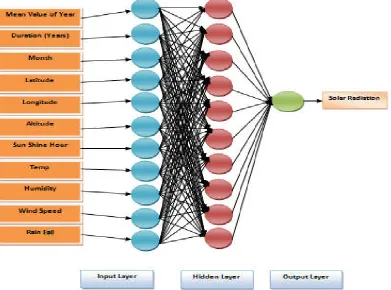
[image:3.595.106.498.475.765.2]Neural fitting tool (nftool) of neural network of MATLAB Version 7.11.0.584 (R2010b) with 32-bit (win 32) has been used to develop an artificial neural network model for the estimation of global solar radiation. A two layer feed forward network with sigmoid hidden layer neurons and linear output neurons can fit multi dimensional mapping problems arbitrarily well, given consistent data and enough neurons in its hidden layer. The network has been trained with Levenberg-Marquardt back propagation algorithm. Result of artificial neural network depends upon a number of hidden layer neurons. Selection of optimum number of hidden layer neurons is required for the optimum results. For the selection of hidden layer of neurons one method is the use of optimize algorithm technique and hit and trial method is the second one. In the existing analysis hit and trial method has been used. For making better, quicker and more practical predictions artificial neural networks are well suited as compared to traditional methods. The neural network model was used with 10 hidden neurons. If the network does not perform well after training, then one can return to the previous step and can change the number of hidden neurons. Here, it gave best results with 10 neurons. The architecture of the used neural network has been depicted in Figure 1. The first input parameter (mean value of the year) is showing the mean of all the years for which the data for particular location has been taken in to consideration. Second parameter is showing the total number of years for the respective location. Third parameter shows the particular month under consideration. Fourth, fifth and sixth input parameters viz: latitude, longitude and altitude are depicting the geographical features of the respective locations. Whereas the remaining five input parameters viz: sun shine hour, temperature, humidity, wind speed and rain fall are the meteorological parameters.
All the input parameters feed their respective values to the input layer which processes that data towards hidden layer. All the functioning (training, validation and testing) of developed neural network takes place in the hidden layer of the network. The estimated solar radiation value for the respective location gets reflected at output layer. The measured data (1962-1978) of eleven parameters (mean value of year, duration, month, latitude, longitude, altitude, sun shine hours, temperature, humidity, wind speed and rain fall) given by Mani and Rangarajan for eighteen locations (Ahmedabad, Bangalore, Bhavnagar, Mumbai, Kolkatta, Goa, Jodhpur, Kadaikanal, Chennai, Mangalore, Nagpur, Nandi Hills, New Delhi, Poona, Port Blair, Shillong, Thiruvanathapuram and Vishakhapatnam) have been taken to train, validate and test the developed model (Mani and Rangarajan, 1980). In order to train the developed artificial neural network model for the estimation of global solar radiation 70 % of the measured data has been used while 15 % data has been used for the purpose of validation and the remaining 15 % data has been used for the testing purpose. A graphical user interface for solar radiation estimation with MATLAB programming has been framed and developed software has been checked for valid results. All the data has been linked with the developed graphical user interface to give the output for the desired inputs. The developed graphical user interface can be used to estimate global solar radiation at any location in India.
RESULTS AND DISCUSSION
[image:4.595.310.558.49.203.2]The monthly global solar radiation for eighteen Indian locations has been estimated by developing an artificial neural network model. Figure 2 gave neural network training performance of solar radiation for all the eighteen locations. It showed three graphs viz: training, testing and validation. Blue curve showed training, green curve showed validation, red curve showed testing and dotted lines showed best performance. Epochs, which shows that how many times training has occurred have been taken along x-axis whereas mean square error has been taken along y-axis.
Figure 2. Neural network training performance of solar radiation for all the eighteen locations
Graph indicates that the epoch/iteration at which the validation performance reached a minimum is at epoch fifteen and the training continued for 6 more epochs before the training stopped. This figure does not indicate any major problems with the training. The validation and test curves are very similar. If the test curve had increased significantly before the validation curve increased, then it is possible that some over fitting might have occurred. The mean squared error have become small by increasing the number of epoch. The network gets trained up to twenty one epochs to give mean square error value equal to 0.204. The next step in validating the network was to create a regression plot, which showed them relationship between the outputs of the network and the targets. The regression coefficient R is an indicator of the relationship between the outputs and targets. Figure 3 showed that the regression coefficient between the outputs and targets is a measure of how well the variation in the outputs is explained by the targets. During data training the slope (m) and intercept (b) were found to be 0.92, 0.42 respectively with regression coefficient of 0.98293 indicating that training is perfect. In case of data validation, regression coefficient was 0.92393 with 0.89 as slope and 0.62 as intercept.
Figure 3. Neural network training regression of solar radiation for all the eighteen locations
[image:4.595.130.474.517.780.2]Table 1. Estimation of monthly globalsolar radiation for eighteen Indian locations using artificial neural network model
S No Station/Month Lat (0N) Long (0E) Alt (m) Jan Feb Mar Apr May Jun Jul Aug Sep Oct Nov Dec MPE RMSE MBE
1 Ahmedabad 23.07 72.63 55 4.95 6.01 6.43 7.22 7.53 6.86 4.66 4.59 5.31 5.7 5.1 4.69 -0.13 0.04 0.00 2 Bangalore 12.97 77.58 921 6.02 5.99 6.71 6.63 6.39 5.3 4.79 5.01 4.72 5.18 4.58 4.16 -0.56 0.11 0.01 3 Bhavnagar 21.75 72.18 5 5.15 5.75 6.84 8.14 7.84 5.73 4.65 4.63 5.21 6.16 5.41 4.77 -1.47 0.10 0.09 4 Mumbai 19.12 72.85 14 5.45 5.74 6.09 6.49 6.71 5.01 4.17 3.77 4.75 5.77 5.17 4.76 1.12 0.09 -0.08 5 Kolkatta 22.65 88.45 6 4.57 4.73 5.39 6.38 6.43 4.44 4.28 4.25 4.17 3.99 4.23 4.06 4.33 0.11 -0.21
6 Goa 15.48 73.82 55 6.0 6.23 6.49 6.86 6.79 4.54 3.84 4.42 4.99 5.82 5.56 5.28 1.85 0.05 -0.09
7 Jodhpur 26.30 73.02 224 4.83 5.84 6.38 7.26 7.39 7.22 5.87 5.75 6.13 5.79 5.0 4.36 -0.61 0.02 0.03 8 Kodaikanal 10.23 77.47 2339 6.16 6.55 6.76 6.31 5.95 5.17 4.77 4.71 4.65 4.31 4.69 5.44 0.46 0.02 -0.03
9 Chennai 13 80.18 16 5.5 6.11 6.48 6.85 6.65 5.78 5.31 5.54 5.53 4.86 4.43 4.36 0.41 0.03 -0.04
10 Mangalore 12.91 74.88 102 6.1 6.28 6.24 6.33 6.09 3.93 3.63 3.88 4.44 5.19 5.89 5.26 -4.16 0.17 0.19 11 Nagpur 21.10 79.50 310 5.0 5.69 6.23 6.85 6.88 5.76 4.58 5.06 5.13 5.46 5.02 4.72 -2.26 0.08 0.09 12 Nandi Hills 13.37 77.68 1479 6.35 6.37 7.37 7.2 6.37 5.06 4.79 4.79 4.66 4.92 3.66 4.21 4.82 0.26 -0.30 13 New Delhi 28.58 77.20 216 4.26 5.26 5.77 6.99 7.09 6.58 5.62 5.12 5.54 5.22 4.49 4.19 -1.54 0.05 0.05 14 Poona 18.53 73.85 559 5.36 6.21 7.12 7.13 7.02 5.81 4.45 4.69 5.23 5.39 5.24 5.11 0.12 0.03 -0.01 15 Port Blair 11.67 92.72 79 5.05 5.51 5.89 5.91 3.99 3.84 3.75 3.58 3.74 4.12 4.38 4.47 -1.86 0.04 0.06 16 Shillong 22.57 91.88 1600 4.92 5.21 5.33 5.55 4.96 4.29 4.21 4.5 4.05 4.1 4.09 3.99 -2.39 0.10 0.08 17 Thiruvananthpuram 8.48 76.95 64 6.0 6.18 6.22 5.77 5.49 5.11 5.28 5.53 5.51 5.21 5.04 5.02 1.75 0.06 -0.11 18 Vishakhapatnam 17.72 83.23 3 5.33 5.9 6.04 6.18 6.57 5.11 4.49 5.0 5.36 5.37 5.31 4.9 1.56 0.05 -0.1
Remaining data with regression coefficient of 0.88787 was used for the testing purpose with 0.74 as slope and 1.13 was the intercept. The overall graph revealed that the slope and intercept were found to be 0.96, 0.22 respectively with regression coefficient of 0.95967. Figure 4 showed the graphical comparison of estimated solar radiation with the measured data of eighteen locations and found that it matches largely with the measured data curve. Blue curve is showing measured data given by Mani Anna while red curve is showing the estimated data by newly developed artificial neural network model. Two hundred sixteen values of eleven parameters for eighteen locations for twelve months have been taken along x-axis and solar radiation values along y-axis. The graphical user interface has also been developed by linking the developed neural network with the MATLAB programming as has been shown in Figure 5. Entries in green rectangle are showing the input terminals and output has been shown by blue colored rectangle. The depicted values are for the August month of the year 1999 with relevant values of other input parameters. From Table 1 the mean percentage error, root mean square error and mean bias error between estimated global solar radiation from artificial neural network model and measured values of eighteen Indian locations have been found to vary from -4.16 to 4.82, 0.02 to 0.26 and - 0.30 to 0.08 respectively. This indicated the accuracy of newly developed artificial neural network.
Conclusion
A new artificial neural network model was developed for the estimation of global solar radiation for Indian locations with greater accuracy and can be used for estimating global solar radiation for any location in India.The network gets trained up to twenty one epochs to give mean square error value equal to 0.204. During data training the slope (m) and intercept (b) were found to be 0.92, 0.42 respectively with R value of 0.98293 indicating that training is perfect (Figure 4). In case of data validation R value was 0.92393 with 0.89 as slope and 0.62 as intercept. Remaining data with R of 0.88787 was used for the testing purpose with 0.74 as slope and 1.13 was the intercept. The overall graph revealed that the slope and intercept were found to be 0.96, 0.22 respectively with regression coefficient of 0.95967. A graphical user interface of the developed model has been developed and verified by putting input values of the eleven variables for any location. The monthly average global solar radiation for all the eighteen locations using newly developed artificial neural network model has also been estimated. The mean percentage error, root mean square error and mean bias error between values obtained from artificial neural network model and measured values of eighteen locations have been found to vary from -4.16 to 4.82 , 0.02 to 0.26 and - 0.30 to 0.08 respectively. This indicated that the newly developed model can be used to estimate global solar radiation with greater accuracy.
REFERENCES
Alawi, S.M., H.A. Hinai, 1998. An ANN-Based Approach for Predicting Global Radiation in Locations with No Direct Measurement Instrumentation, Renewable Energy, 14 (1– 4):199–204.
Azadeh, A., A. Maghsoudi, and S. Sohrabkhani 2009. An integrated artificialneural networks approach for predicting global radiation, Energy Conversion and Management, 50: 1497–1505.
Benghanem, M., A. Mellit, and S.N. Alamri, 2009. ANN-based modeling and estimation of daily global solar radiation data: A case study, Energy Conversion and Management, 50(7):1644-1655.
Emad, A.A., and M. El-Nouby Adam, 2013. Estimate of global solar radiation by using artificial neural network in Qena, Upper Egypt, Journal of Carbon Energy Technologies, 1(2). Fadare, D.A, 2009. Modelling of solar energy potential in Nigeria
using an artificial neural network model, Applied Energy, 86(9):1410–1422.
Kalogirou, S.A., S. Michaelides, and F. Tymvios, 2002. Prediction of Maximum Solar Radiation Using Artificial Neural Networks. Proceedings of the World Renewable Energy Congress VII on CD-ROM, Cologne, Germany.
Kaushika, N.D., R.K. Tomar, and S.C. Kaushik, 2014. Artificial neural network model based on interrelationship of direct, diffuse and global solar radiation, Solar Energy, 103:327-342. Khatib, T., A. Mohamed, K. Sopian, and M. Mahmoud, 2012.
Solar energy prediction for Malaysia using artificial neural networks, International Journal of Photoenergy, 2012:1–16. Kumar, R., R. K. Aggarwal and J. D. Sharma, 2015. Comparison
of regression Andartificial neural network models for estimation of global solar radiations, Renewable and
Sustainable Energy Reviews, 52: 1294-1299.
Lam, J.C., K.K.W. Wan, and L. Yang, 2008. Solar radiation modeling using ANNs for different climates in China, Energy
Conversion and Management, 49:1080–1090.
Maitha, H., Al-Shamisi, H.A. Ali, and H.A.N. Hajase, 2013. Artificial neural network for predicting global solar radiation in Al Ain City-UAE, International Journal of Green Energy, 10(5):443-456.
Mani, A., and S. Rangarajan, 1980. Solar radiation over India.Allied Publishers New Delhi.
Mohandes, M., S. Rehman, and T.O. Halawani, 1998. Estimation of global solarradiation using artificial neural networks,Renewable Energy,14(1–4):179–184.
Reddy, K.S., and M. Ranjan, 2003. Solar resource estimation using artificial neural networks and comparison with other correlation models, Energy Conversion and
Management,44(15):2519–2530.
Rehman, S., and M. Mohandes, 2008. Artificial neural network estimation of global solar radiation using air temperature and relative humidity, Energy Policy, 36(2):571-576.
Sivamadhavi, V., and R.S. Selvary 2013. Prediction of monthly mean daily global solar radiation using artificial neural network, Journal of Earth System Sciences,121(6):1501-1510. Sozen, A., E. Arcaklioglu, and M. Ozalp, 2004. Estimation of
solar potential in Turkey by artificial neural networks using meteorological and geographical data, Energy Conversion and
Management,45 (18–19):3033–3052.
Sozen, A., E. Arcaklioglu, M. Ozalp, and E.G. Kanit, 2005. Solar energy potential in Turkey, Applied Energy, 80(4):367–381. Yildiz, B.Y., M. Şahin, O. Şenkal, V. Pestemalci, and N.A.
Emrahoğlu, 2013. Comparison of two solar radiation models using artificial neural networks and Remote sensing in Turkey,
Energy Sources-Part A, 35:209–17.