The Mesoscopic Constitutive Equations for
Polymeric Fluids and Some Examples
of Viscometric Flows
*
Gregory Pyshnograi, Hyder Nadom Aziz Al Joda, Ivan Pyshnograi Department of Mathematics, Altai State Technical University, Barnaul, Russia
Email: [email protected]
Received November 6,2011; revised December 5, 2011; accepted December 17, 2011
ABSTRACT
Constitutive equations for melts and concentrated solutions of linear polymers are derived as consequences of dynamics of a separate macromolecule. The model is investigated for viscometric flows. It was shown that the model gives a good description of non-linear effects of simple shear polymer flows: viscosity anomalies, first and second normal stresses, non-steady shear stresses.
Keywords: Rheology; Linear Polymer Melts and Solutions; Constitutive Equation; Mesoscopic Approach
1. Introduction
Describing viscoelastic behavior of the polymer system, one should distinguish the case of highly concentrated (c
> 10%) solutions and melts of long polymers—strongly entangled systems (M 10Me), where M is the length (in any units) of a macromolecule and Me is the length of a part of macromolecule between the adjacent entan-glements [1-3], and the case of melts of shorter polymers and half-dilute polymer solutions (c ~ 1% - 10%)—
weakly entangled systems (M 10Me) [4]. The conven-ient characteristic of a system of entangled linear mac-romolecules (solutions and melts of polymers) appears to be π2 2
12 2
e
M Mc
, which, for strongly entangled systems, is inversely proportional to number of entan-glements for one macromolecule—M Me. Here is the polymer density. The quantity can be easily with estimated the value Ge of real component of dynamic modulus G
on the typical plateau, according to the formula for weakly and strongly entangled systems, cor-respondingly1 2, 1
p p
G G .
In this paper we consider the case of weakly entangled systems and formulate a rheological equation of state (RES) that establishes a relationship between the stress tensor, kinetic characteristics, and internal dynamic pa-rameters. At present, a large number of such equations of various complexity is known for polymeric liquids, but,
despite various approaches both phenomenological [5-7] and microstructural [1,2,8-11] ones, the problem how to include specific features of a polymer system into the form of constitutive equations has no complete solution. This is due to both complexity of these systems, which are formed by tangled macromolecules, and mathemati-cal difficulties [11]. The information about the micro-structure and micro dynamics of the material ought to be incorporated into the present theory of linear and nonlin-ear relaxation phenomena in polymer systems. An ad-vantage of the micro structural approach is a possibility of studying the relationship between the micro character-istics of a polymer system (concentration and molecular weight of the polymer) and macroscopically observed quantities (viscosity, shear and normal stresses, etc.). In this connection using microstructural concepts it’s feasi-ble to formulate a sequence of RES that takes into ac-count new molecular effects in each stage. At [4,9,12] obtained and studied a simple rheological model which can be chosen as an initial approximation in formulating such a sequence of RES. In this work, RES [4] is ex-tended to the case of allowance for the additional correc-tions caused by intrinsic viscosity and the delayed inter-action of a macromolecule with its environment. Realiza-tion of this approach involves consequent soluRealiza-tion of two problems: formulation of the equations of dynamics for a macromolecule and transition from the formulated equa-tions to RES. The resulting equaequa-tions can be recom-mended as the first approximation in constructing a se-quence of RES. Comparison of the approach with others, Graessley [1,3] and Doi-Edwards [8] approaches, one
can find in [9,12].
2. Dynamics of a Macromolecule in Flow
The mesoscopic approach to the description of the dy-namics of polymer systems is based on the equations of the macromolecule dynamics which cannot be formu-lated without additional assumptions, namely:
1) A monomolecular approximation of the system. It means that, instead of the entire set of interacting mac-romolecules in the volume we consider are non-inter-acting separate macromolecule, moving in the effective medium formed by the solvent and the other macro-molecules.
2) The coarse-grained approximation of a macro-molecule. It means that, irrespective of the chemical na-ture of the polymer, the slow motions of the chosen macromolecule can be described as motions of N centers
of friction (beads) connected by elastic entropy forces (springs) in a chain. These assumptions lead to the fol-lowing equations of the macromolecules dynamics [9] in normal modes:
i j
d
d
2
i ij
i i
m t
T T
i
i
, (1)
where i
and i
are the i-th components of the
normal coordinates and velocity, is the mass of a m
bead. Here is the friction coefficient of a bead in a monomer fluid, ij is the velocity-gradient tensor, which is conveniently expressed below as the sum of symmetric ij and anti-symmetric ij parts, and the bracketed expression is the difference between the parti-cle velocity at a given point of space and the velocity of undisturbed flow at this point. The force i
describes the interaction of the polymer chain with the environ-ment via the solvent, while the force Ti
is an intrinsic
resistance force, i
is a random force, and 2T is the coefficient of elasticity.
Expression (1) is the basis for the description of the dynamics for different polymer systems [12]. The defini-tion of the extra forces i
and Ti
allows one to
specify the polymer system. Different models of these forces correspond to different physical cases. For dilute polymer solutions, in which polymer macromolecules can be considered non-interacting, the extra forces are considered to be equal to zero [9]. In concentrated poly-mer systems, the macromolecules cannot be considered as not interacting. So, one has to take into account the reaction of the environment and the strengthening of the friction coefficient. The first factor is due to the delayed character of interaction of the macromolecule with its environment, and the second is due to the fact that the
chosen bead undergoes resistance not only from the monomer solvent, but also from other macromolecules. Furthermore, one should take into account that, in the flow with nonzero velocity gradients, a macromolecular coil changes its form, and the medium, formed by the coils becomes anisotropic. This mobility anisotropy of beads is called induced and is determined by the shape and orientation of macromolecular coils [4,9,12]. Ac-cording to all these factors the equation for the force of hydrodynamic entrainment follows:
0 d
d i ij j ij j ij j jn n
p t
B
i
(2)
Here is the relaxation time of the environment, 0
ij
is the dimensionless tensor friction coefficient of a bead, B is the strengthening measure of the friction coefficient , and p is a parameter. The bracketed expression on the left side of (2) is a substantial deriva-tive of the vector quantity i
[9].The presence of this derivative allows one to meet the principle of material objectivity in Equation (2) [6,9]. Numerical parameter p entering into the definition of the substantial deriva-tive can take different values. For p = 0, the substantial derivative becomes the Jaumann derivative which has a simpler form while for p = 1 and –1, it becomes the upper and lower convective derivatives, respectively. The specific value of p corresponding to one of the above-mentioned derivatives in (2) is determined below.
If macromolecules form a tangled system besides the force of hydrodynamic entrainment, one should take into account the intrinsic viscous force Ti
, the meaning of
which is elucidated by Pokrovskii et al. [12]. The
spe-cific requirement imposed on the force Ti
is that this
force is vanishing when a macromolecular coil is rotating as a unit. All this allows one to write the equation for this force in similar to (2) manner in the form
0 d
d i ij j ij j ij j jn n
T T p T T
t E
i
, (3)
where: 0 ij
is the dimensionless tensor friction coeffi- cient and E is the strengthening measure of the friction coefficient for the intrinsic viscous force Ti
.
Intrin-sic viscous force Ti
(since
i
) has relaxation charac-ter and depends on the anisotropic properties of the en-vironment.
We assume that the anisotropy of mobility in consid-ered polymer system is characterized by the second-order symmetric tensor aik. Then, for coefficients
0 ij
and 0
ij we write [9]
1 0
1 0
3 ,
3
3 .
3 jj
ik ik ik ik jj ik
jj
ik ik ik ik jj ik
a
a a
a
a a
(4)
Thus, (1-4) is the system of equations of dynamics of a macromolecule. The random force i
t
entering into (1) is the Gaussian random process with a zero average. Its correlation tensor satisfies the corresponding fluctua-tion-dissipation relation [9,10].
3. Stress Tensor and Rheological Equation of
State
Equations (1)-(4) give a microscopic picture of a poly-mer system flow based on discrete variables. Transition to the continuous case, i.e., to the description of polymer-sys-
tem flows in terms of continuum mechanics, requires introduction of macroscopic variables—density
x t,and momentum density
x t, . These variables areintroduced in the standard manner [9,11]:
, ,
, .
x t m x r
x t m u x r
(5)Here r and u are vectors of position and velocity of the bead with number , x is the co-ordinate
vec-tor of the chosen point in space, and t is time. Sum is taken over all beads in a unit volume, and averaging is performed over the ensemble of all possible realizations of the random force i
t .Differentiating (5) due to time yields an equation of mass conservation, and transformation to generalized coordinates using (1) yields an equation for momentum density. In the latter case, we have an expression for the stress tensor of a polymer system in terms of statistical characteristics of the system (1-4) solutions:
0
1 1
3
3 2
ik ik
ik ik ik ki
p
nT x u u
, (6) where p0 is pressure, n is the number of macromole-cules in a volume unit, T is the temperature in energy units,
and xik 2 i k 3
and
3ik i k u T T are internal thermodynamic parameters with equilibrium values
1 3
ik ik
x , uik 0 (7) In the inertia-free case (m = 0), one can formulate (see
Appendix) the relaxation equations for the dimensionless correlation moments xik and uik in the following form
1 1 1
3 3
2
ik ij jn nk kn jn ni
ik ik jk kj kj ji
R D
x x c x c
Dt
x b x b
B
, (8)
1 1
2 1
2 3
ik kj ij ij jn kn R ij jk ik R
ij ij jk ij jn n
D
u p u c u c u u
Dt B
x f B x d
, (9)
where: d
d
ik ik ij jk kj ij
D
x x x
Dt t x
is the Jaumann
derivative of the tensor quantity xik
and E B is the
measure of intrinsic viscosity, 4 2 T
R
is a set of the Rouse relaxation times. In Equations (8)-(9) symbols bik,cik,fik ,dik
are used.
1
0 0
0
0 0
; 2
; 2
,
ik R ik ik ik
ik R ij ij jk
ik ij kj ik ij kj
b B
c p b
B
f b d c
(10)
Thermodynamic variables xik
entering into (6)
char-acterize the inertial properties of a macromolecular coil and, hence, can be used to determine anisotropy tensor
ik
a in (4). Following [9], we write
26 3 π
ik ik ik
a x
.Therefore it becomes possible to establish the physical meaning of the microanisotropy parameters entering into (4). These parameters take into account dimensions
,
and shape
,
of a macromolecular coil in the equations for macromolecule dynamics.The Equations (6), (8), and (9) define a nonlinear, ani-sotropic, viscoelastic fluid. The behavior of system (6), (8), and (9) is determined by the six dimensionless pa-rameters ( 2B, , , , , and ) and two dimensional parameters (B and nT). Parameter
characterizing the ratio of the relaxation time of the environment to the maximum relaxation time B
was estimated in [9], where it was shown that 1
for sufficiently long polymer chains. As to parameter , here two cases can be distinguished: 1 [13,14-16] and 1 [5], which are discussed below. As in [13], it is convenient to consider simpler forms of equations (8) and (9) by using the smallness of the parameters and . We consider in more detail the case 1, which corresponds to the dynamics of polymer solutions at a concentration about of 1%.
to and , we note that Equations (6) and (8) do not change, and Equation (9) takes the form
1 0
1
0 0 0
1 1
2 1
2 .
3
ik ij jk kj ji
ij jk ik
R
R
ij ij jn nk ij jk kn
D
u u p u
Dt u u B x B
x
(11)
In the zero-th approximation for and , variable
0
ik
u and Equations (6) and (8) take the form
0
1 3
3
ik p ik nT xik ik
, (12)d d
1 ( ) 1
3
3 1 1 .
3 3
2
ik ij jk kj ji
jj
ik ik
R
ij ij jk kj kj ji
R
x x x
t
a x B
x a x a
B
The parameters of this system are B, , and .
Note that when N = 1, system (12) is the system of equations for a dumbbell model
0 0 0 0 0 3 1 d d 2 3 3ik ik ik
ik ij jk kj ji ik
ik ij jk
p a
I
a a a a
t a a
, (13)
where 0nT0 and 0 are the initial shear viscosity and the relaxation time, and Iajj. The system (13)
under the assumption of isotropic relaxation ( = 0), is followed by the well-known structural phenomenological Vinogradov-Pokrovskii model [13,14-17].
The model (13) is simple and gives high accuracy in describing steady nonlinear effects, though it is only the zero-order approximation model, which does not permit one to predict all features of polymer flow. In case, one needs more details, one can consider the contributions of parameters and which take into account the re-laxation character of the environment and the intrinsic viscosity in the equations for macromolecule dynamics.
4. Linear Effects of the Rheological Model
To obtain an expression for the dynamic shear modulus that corresponds to system (6), (8), and (9), we find a solution to this system in a linear approximation with respect to the velocity gradients. In this case, anisotropy
tensor aik is equal to zero, and the terms ik can be omitted. Then (8) and (9) are written as
d 1
d 3 2
R
ik ik ik ij jk kj ji
x x p B x x
t ,
d 1 2
d 3
B
B R
ik ik ik ik ij jk
B
ij jk kj ji
u u x B x
t pu u
where 2
1
RB
; B 2
2
The latter equations can be written as
0 1 3 2 exp d 2 ik ik Rij jk kj ji
t s x
p B
x x s
s(14)
0 1 2 3 exp d Rik ij jk kj ji ik ik ij jk
t s B
u x x x B x
s s
Solving the first equation of (14) by the method of successive approximations with first-order approxima-tion due to the velocity gradients, we obtain
0 2 1 exp d 3 3 Rik ik ik
p B
x t s s s
.Substitution of this expression into the second equa-tion in (14) yields
0 0 0 2( ) exp d
3 2
( ) exp
3
exp d d .
R B
ik ik
R ik B
u B t s s
p B
t s s s
s s s
s
~ exp i t 12
In the simple oscillating shear flow and the last two expressions together with (6) define the complex shear modulus G
i 12
,t 12
,t
2 2 1 1 2 . 1 R B BB R B
B B
i p B
G
nT i
p B i
i
(15)Next, it is convenient to distinguish the real and imagi- nary parts in G
: G
G
iG
.
lim
2 2 1
p
R R
R
G G
p B B
nT
B
. (16)This series converges only for p = 0. Thus, the
Jau-mann derivative in the equations of dynamics of a mac-romolecule (2) and (3) corresponds to cases a) and b).
The definitions of the relaxation times , R
, and
are given through parameters and , estimates of which are given in [4,9], where it was shown that, for sufficiently long chains, one can always assume 1. As to intrinsic viscosity parameter , here two alterna-tive cases 1 and 1 are distinguished.
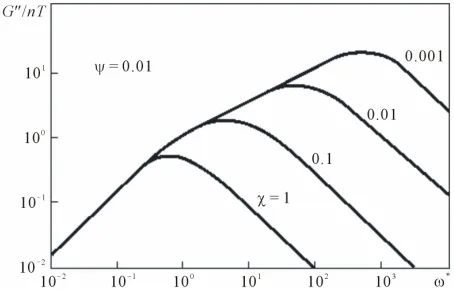
The curves of G
* and G
* versus the di-mensionless frequency B calculated by (18) are given in Figures 1-4, from which one can see that the values of G
* and G
* are mainly determined by parameter , and the impact of parameter (for1
) is insignificant. The existence of characteristic plateau is determined by relaxation time . In the case, when = 0, that corresponds to dilute solutions, irre-spective of the type of convective derivative, a plateau on
G *
isabsent. For 1, which corresponds to the dynamics of melts and strongly concentrated solutions [4], from (16) we have
π212
1p
G nT . The calcu-lation results show that, for 1, the modulus on the plateau ~ 1 2
p
G .
Therefore, the non-dependence of Gp on the mo-lecular weight of a polymer means M2. Using the estimate for c M2 1 obtained in [11], from the last relation one can obtain
3 0 p
G c M .
The value of the initial shear viscosity 0, which can be expressed from (16) as
[image:5.595.311.538.84.230.2]Figure 1. The contribution of parameter to the dimen-sionless frequency dependence of real component of dy-namic modulus G
. [image:5.595.310.537.485.633.2]Figure 2. The contribution of parameter to the dimen-sionless frequency dependence of imaginary component of dynamic modulus G
. [image:5.595.58.287.540.688.2]Figure 3. The contribution of parameter (internal vis-cosity) to the dimensionless frequency dependence of real component of dynamic modulus G
.Figure 4. The contribution of parameter (internal vis-cosity) to the dimensionless frequency dependence of imag-inary component of dynamic modulus G
.
20 0
π
lim
6
G
nT B
. (17)
we turn to the data of Menezes and Graessley [16,17], where G
and G
were measured for solutions of polybutadiene with different molecular weights at the same concentration of c = 0.0676 g/cm. The abovefor-mulae allow us to find the following estimates of the parameters of the rheological model (6), (8), and (9) were obtained: = 0.077; 0.025; 0.011 and 0.005, B = 0.21; 2.35; 16.27 and 147 sec, and = 840.4; 480.2; 321.5 and 206.7 Pa for molecular weights
, respectively. In all cases,
nT
3 10 5 5; 5.17 5
2 10 10 ; 8.1
M 10 ; 3.4 5
= 0.025. The comparison of the results is given in Figures 5 and 6, from which one can see sat-isfactory agreement between the theoretical and experi-mental curves of G
and G
for < 10 [image:6.595.59.288.380.498.2]sec–1. The values of as a function of M are given on Figure 7 showing good agreement with (17).
Figure 7 presents parameter dependence molecu-lar weight corresponding 1 2
p
G .
5. Non Linear Effects in the Simple Shear
Flow
[image:6.595.58.289.565.683.2]The system of constitutive Equations (6), (8), and (9) should be checked for correspondence to polymer fluid
Figure 5. Real component of dynamic modulus G
for polybutadiene solutions of various molecular weights (points) [16,17], compared with the predictions of Equation (15) (solid lines).Figure 6. Imaginary component of dynamic modulus G
for polybutadiene solutions of various molecular weights (points) [16,17], compared with the predictions of Equation (15) (solid lines).Figure 7. Parameterdependence on molecular weight.
flows. Diverse flows leads to difficult mathematical problems and, naturally, the check of the RES should be start with the simplest cases. One type of flows that are often realized in viscometers of various design is simple shear. In this case, the velocity-gradient tensor contains only one nonzero component , which varies with time due to a well-known law. In steady flow, the gradi-ent of velocity is constant, and rheological behavior of the polymer system is conveniently characterized by the following viscometric functions: shear viscosity
12 t
and first 1 and second normal stresses differences, which are given by
N N2
12 12,N1 11 22,N2 22 33
(18)
The dependence 12
t is often given in the form
12 t E t
or 12
t E
t
. Here is the shear velocity and E t
is the unit function of Heavis-ide. In the first case, system (6), (8), and (9) describes the establishment of stresses from the state of rest, and the corresponding viscometric functions (18) are denoted by
,t and
,t 1N . In the second case, this system describes stress relaxation after shear deformation, and functions are denoted by
,t and N1
,t and are generally functions of the velocity gradient and time. The following relations are apparently valid
lim
, , 1 lim 1 , .t t N t N t
(19)Solving (8) for case of a simple shear flow with shear velocity 12 with third-order accuracy with respect to
12
, for viscometric functions we obtain
4 11 22
1 2
12
4 22 33
2 2
12
4 2
12
0 1
12
π
45
π
90
4π 2
1 .
105 5 9
nT
nT
B
2
,
Thus, the parameters and are responsible for the nonlinear properties of system (12). For simple shear,
appears even in the second order with respect to the velocity gradients, and appears only in the third.
from the condition of the best agreement between the theoretical curves and the experimental data. The value of 2 was not measured in [16,17].
Let us consider nonlinear unsteady effects. The results of the calculation of the establishment of stresses for a
N At low shear velocities, the second difference of
nor-mal stresses N2 is given by the formula
2 2 1
15 1 2 2π
N
N
, (20)
obtained in [6]. Thus the model describes a non-zero second normal stress difference. The calculations show that, for 1
10
, formula (20) remains valid for .
B
To compare RES (6), (8), and (9) with experiments, we use the data of Menezes and Graessley [16,17], who studied shear flows of polybutadiene solutions with various molecular weights. It is convenient to use their results, because their data on linear viscoelastictity have already been compared with (6), (8), and (9) in Section 4.
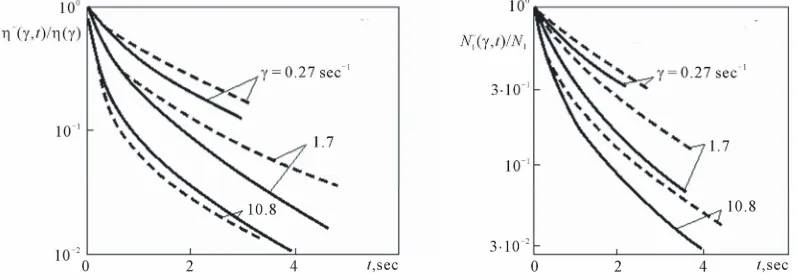
[image:7.595.310.537.158.324.2]The results of the calculation for the viscometric func-tions (18) and the corresponding experimental values are given in Figures 8, 9 and 10. In the calculations, we used the following induced anisotropy parameters: = 0.1, = 0.25, =0, and = 0.1. They were chosen
[image:7.595.107.498.387.524.2]Figure 8. Experimental (solid lines) and theoretical (points) plots of the steady shear viscosity coefficient and the first difference of normal stresses vs. the shear velocity for vari-ous values of the molecular weight.
Figure 9. The comparison of experimental (solid lines) and theoretical (dashed lines) dependences of an establishment of sta-tionary values of the shear viscosity coefficient and the first difference of normal stresses at various shear velocities.
[image:7.595.101.500.569.709.2]specimen with are given in Figure 9, which shows that Equations (2), (4), and (5) describes (the non-monotonic attainment of
5
3.5 10
M
,t
and
1 , N t
,t at high shear velocities. It is also found that and at small
t.
t N1
,t 2
,t t The data for and1
,N t are given in Figure 10, which show that (18), (8) and (19) confirm the presence of two characteristic times for stress relaxa-tion after intense shear deformarelaxa-tion. The anisotropy pa-rameter values are the same as in Figures 8 and 9.
6. Conclusion
Thus, the proposed microstructural approach to the de-scription of the dynamics of polymer fluids does not contradict the available experimental data on the linear and non linear viscoelasticity of linear polymer solutions and melts. The obtained rheological equation of state is applicable for the description of steady and unsteady effects in both linear and nonlinear regions of strain rates and more complex flow regimes of linear polymer solu-tions and melts. The model can serve as a basis for the description of nonlinear effects in polymeric systems.
7. Acknowledgements
All authors thanks professor Vladimir Pokrovskii for the useful discussion.
REFERENCES
[1] W. W. Graessley, “The Constraint Release Concept in Polymer Rheology,” Advances in Polymer Science, Vol.
47, 1982, pp. 68-117.
[2] H. Watanabe, “Viscoelasticity and Dynamics of Entagled Polymers,” Progress in Polymer Science, Vol. 24, No. 9,
1999, pp. 1253-1403.
doi:10.1016/S0079-6700(99)00029-5
[3] W. W. Graessley, “Polymeric Liquids & Networks: Dy-namics and Rheology,” Garland Science, London, 2008. [4] V. N. Pokrovskii, “The Mesoscopic Theory of Polymer
Dynamics,” 2nd Edition, Springer, Berlin, 2010. doi:10.1007/978-90-481-2231-8
[5] J. D. Ferry, “Viscoelastic Properties of Polymars,” 3rd Edition, Wiley and Sons, London, 1980.
[6] A. Yu. Grosberg and A. R. Khokhlov, “Statistical Physics of Macromolecules,” Springer, Berlin, 1994.
[7] G. V. Pyshnograi, V. N. Pokrovskii, Yu. G. Yanovskii, Yu. N. Karnet and I. F. Obrazcov, “Equation of State for Nonlinear Viscoelastic (Polymer) Continua in Zero-App- roximations by Molecular Theory Parameters and Secu- entals for Shearing and Elongational Flows,” Doklady Russian Akademy Nauk, Vol. 335, No. 9, 1994, pp. 612-
615 (in Russian).
[8] M. Doi and S. F. Edwards, “The Theory of Polymer Dy-namics,” Oxford University Press, Oxford, 1986. [9] H. Ch. Ottinger, “Thermodynamically Admissible
Repta-tion Models with Anisotropic Tube Cross SecRepta-tions and Convective Constraint Release,” Journal of Non-New- tonian Fluid Mechanics, Vol. 89, No. 1-2, 2000, pp. 165- 185. doi:10.1016/S0377-0257(99)00025-7
[10] G. Astarita and G. Marucci, “Principles of Non-New- tonian Fluid Mechanics,” McGraw-Hill Inc., New York, 1974.
[11] A. I. Leonov, “A Brief Introduction to the Rheology of Polymeric Fluids,” Coxmoor Publishing Company, Ox-ford, 2008.
[12] A. Gusev, G. Afonin, I. Tretjakov and G. Pyshnogray, “The Mesoscopic Constitutive Equation for Polymeric Fluids and Some Examples of Flows,” In: N. P. Jennifer and M. L. Tyler, Eds., Viscoelasticity: Theories, Types and Models, Nova Publisher, New York, 2011, pp. 186-202.
[13] V. N. Pokrovskii, Yu. A. Altukhov and G. V. Pyshnograi, “On the Difference between Weakly and Strongly Entan-gled Linear Polymer,” Journal of Non-Newtonian Fluid Mechanics, Vol. 121, No. 2-3, 2004, pp. 73-86.
doi:10.1016/j.jnnfm.2004.05.001
[14] Y. G. Yanovsky, V. N. Pokrovskii, Y. A. Altukhov and G. V. Pyshnograi, “Properties of Constitutive Equations for Undilute Linear Polymers Based on the Molecular The-ory,” International Journal of Polymeric Materials, Vol. 36, No. 1-2, 1997, pp. 75-117.
[15] A. S. Gusev, G. V. Pyshnograi and V. N. Pokrovskii, “Constitutive Equations for Weakly Entangled Linear Polymers,” Journal of Non-Newtonian Fluid Mechanics,
Vol. 163, No. 1-3, 2009, pp. 17-28.
[16] Yu. A. Altukhov, G. V. Pyshnograi and I. G. Pyshnograi, “Slipping Phenomenon in Polymeric Fluids Flow be-tween Parallel Planes,” World Journal of Mechanics, 2011, Vol. 1, No. 6, pp. 294-298.
doi:10.1016/S0377-0257(97)00116-X
[17] W. W. Graessley, “Polymeric Liquids & Networks: Dy-namics and Rheology,” Garland Science, London, 2008.
Appendix: Derivation of Relaxation
Equations
We introduce relaxation equations for the dimensionless moments xik
and
ik
u. In the inertia-free case (m = 0),
Equations (1)-(4) can be written as
(A1) Here
d ( ) 4 di t i ij p ij j i
T t 1
is a new random process which is correlated [9],
4
2R
T
is a set of the Rouse
relaxa-tion times, and E B is the measure of intrinsic viscosity.
Using (8), we obtain a closed system of equations for the moments i k and i k :
d
d i k i k k i
t
, (A2)
0 0
0
2 1
2 2
R
kj kj kj i j jn i n
R
i k ij ij jn i n i k
i k B p B
The moment i k
which is unknown in (A2), can be found from the fluctuation-dissipation theorem. Besides there is another method. The equilibrium values of the moments i k
and i k
were deter-mined previously by Pokrovskii [6]:
0
1 2
i k ik
, 0 0 i k
(A3)
These values should be obtained from (A2) at zero velocity gradients, and the moments i k and
i k
enter into (A2) in a linear manner. Hence, taking into account the desired moment i k , in (A2) we should replace the moments i k
and i k
that do not have the velocity-gradient tensor as a cofactor by i k
-0
i k
and i k
-0
i k
,
re-spectively.
Going over to the dimensionless moments xik
in (9),
we have
1 1 1
3 3
2
ik ij jn nk kn jn ni
ik ik jk kj kj ji
R D
x x c x c
Dt
x b x b
B
, (A4)
where 1 0 0 0 ; 2 ; 2 d d
ik R ik ik ik
ik R ij ij jk
ik ik ij jk kj ij
b B
c p b
B D
x x x x
Dt t
is the Jaumann derivative of the tensor quantity xik
.
Multiplying (A1) by i
and averaging the resulting expression, we write the following equation for uik
:
0 d d 3 3ik kj ij kj ij i k ik
ij i j jn i n
u u p u T u
t T B T
. (A5)
We find the moment i Tk
entering into (A5) by multiplying (A1) by Tk
and performing averaging.
Using (A3), we finally obtain
0 0
1 1 2 1 2 3 , .
ik kj ij ij jn kn R ij jk ik R
ij ij jk ij jn n
ik ij kj ik ij kj D
u p u c u c u u
Dt B
x f B x d
f b d c
(A6)
Since the expression for the stress tensor (6) is written in symmetric form, it is more convenient to use the vari-able yik
uik uki
2 instead of
ik
u. The equation for this variable can be obtained from (9) using the symme-try of tensors cik
and
ik
b and assuming the permuta-bility of tensors uik
with ik
, cik
,and
ik
b. Assuming
the existence functional relationship between xik
,
ik u and ik and also by virtue of the fact that cik
and
ik b are expressed in terms of xik
, this assumption is not a
significant constraint. Then, instead of (9), one obtains
1 2 1 1 4 1 2 2 3 1 2 . 2 3ik ij jn kn kj jn ni
ij jk kj ji ik
R
R
ij ij jk ij jn nk
R
kj kj ji kj jn ni
D
y c y c y
Dt
b y b y y
B
x f B x d
x f B x d
![Figure 5. Real component of dynamic modulus polybutadiene solutions of various molecular weights (points) [16,17], compared with the predictions of Equation (15) (solid lines)](https://thumb-us.123doks.com/thumbv2/123dok_us/9261221.415740/6.595.58.289.565.683/component-polybutadiene-solutions-molecular-weights-compared-predictions-equation.webp)