Hyperspectral Image Denoising via Minimizing the Partial
Sum of Singular Values and Superpixel Segmentation
Yang Liua, Caifeng Shanb, Quanxue Gaoa, Xinbo Gaoa, Jungong Hanc, Rongmei Cuia
aState Key Laboratory of Integrated Services Networks, Xidian University, Xi’an, China.
bthe Medical Image Analysis, Philips Research, High Tech Campus 34, Eindhoven 5656AE, NL.
cthe School of Computing and Communications at Lancaster University, Lancaster, UK.
Abstract
Hyperspectral images (HSIs) are often corrupted by noise during the acquisition
pro-cess, thus degrading the HSI’s discriminative capability significantly. Therefore, HSI
denoising becomes an essential preprocess step before application. This paper
propos-es a new HSI denoising approach connecting Partial Sum of Singular Valupropos-es (PSSV)
and superpixel segmentation named as SS-PSSV, which can remove the noise
effec-tively. Based on the fact that there is a correlation between different bands of the same
signal, it is easy to know the property of low rank. To this end, PSSV is utilized, and
in order to better tap the low-rank attribute of samples, we introduce the superpixel
segmentation method, which allows samples of the same type to be grouped in the
same sub-block as much as possible. Extensive experiments display that the proposed
algorithm outperforms the state-of-the-art.
Keywords: PSSV,superpixel segmentation,hyperspectral images,
denoising
1. Introduction
In the recent years, hyperspectral images (HSIs) become more and more
popu-lar, which are being used in a wide range of fields, such as agriculture [1], terrain
classification [2], geological analysis [3], and military surveillance [4, 5]. However,
hyperspectral images often suffer from noises in the process of data acquisition, due to
5
important processing setup and significantly affects on the performance of subsequent
applications.
Recently, many HSIs’ denoising approaches have been proposed such as [6, 7, 8, 9].
As known, low-rank approximation as a powerful method is becoming more and more
10
popular in image analysis field, computer vision and web search [10, 11], or in the
denoising problem of exploring and searching low-dimensional structure from
high-dimensional data in the past years. The aim of low-rank matrix approximation-based
image recovery method is to remove the sparse noise due to the prior knowledge that
some components from the clean image are regarded as low-rank. With aid of the
15
difference between signal and noise, noise can be removed efficiently in the wavelet
domain. And meanwhile, low-rank matrix approximation methods, such as Principal
Component Analysis (PCA) [12] and matrix factorization [13, 14] are widely used to
find the best approximation of an underlying low-rank structure of data.
In the conventional PCA [12], the goodness-of-fit of data is evaluated byL2-norm,
20
which is very sensitive to outliers. To address this problem and to recover the
low-rank matrix while rejecting outliers, Robust PCA [11] improves PCA by not usingL2
-norm, so a rank minimization has been proposed and gained much interests in computer
vision [15, 16, 17]. Early works in RPCA tried to reduce the effects of outliers by
random sampling [18] or robust M-estimator [19, 20] to identify outliers or penalize
25
data with large errors. However, these methods share some limitations: either they are
sensitive to the choice of parameters, or they are not scalable enough in running time.
To further improve the above algorithms, PSSV [11] incorporated a prior information
about the target rank, which minimizes the partial sum of singular values to encourage
the target rank constraint. In view of its great advance, PSSV [11] is also exploited for
30
hyperspectral image denoising in this paper.
Motivated by the fact that PSSV [11] is successful in dynamic object, we want to
test whether it is suitable for hyperspectral images. Therefore, PSSV [11] is introduced
into our model, and we notice a fact that there is a high correlation between different
modalities from the same signal although the small difference exists, thus implying a
35
low rank property should be an appropriate prior knowledge. In order to make further
help group the same type of samples into the same sub-block as much as possible.
This paper is organized as follows: Section 2 overviews the related work and
Sec-tion 3 presents the process of hyperspectral denoising, followed by the experiments in
40
Section 4. In addition, Section 5 concludes this paper and discusses future work.
2. Related Works
In the past years, many methods have been adopted to reduce noise in HSI band
by band or pixel or pixel [21]. However, these denoising results are not satisfactory,
because the relationship between the spatial and spectral bands is not premeditated
45
simultaneously, that is to say, only the noise in spatial or spectral region is removed.
Low rank representation (LRR) has been used in HSI analysis [22]. Lu et al [23]
introduced LRR to remove stripe noise in HSI based on correlation among
differ-ent bands, and a graph regularization is considered for the local geometrical
struc-ture. Zhang [24] proposed a HSI denoising method based on low rank matrix
recov-ery(LRMR), i.e.
min
A,E ∥A∥∗+λ∥E∥1s.t.∥O−A−E∥F ≤δ (1)
whereOis the input, and aim of the model is to recover clean matrix A from O.
In [24], LRMR achieves perfect performance while the uncorrupted HSIs comply with
the low rank assumption. However, LRMR only considers that the rank is low, but does
not limit the extent of the low rank.
50
PSSV [25] extends the extent of the low rank, and the rank is accurate to a specific
number. As in [25], PSSV is proven to be effective in dynamic object. In this paper,
we will introduce PSSV into hyperspectral field, and latter experiment results show
its effectiveness. Furthermore, we also introduce the superpixel segmentation into our
model, which further improves the denoising effect.
55
3. Hyperspectral Image Denoising
3.1. superpixel segmentation
A superpixel is actually a cluster of pixels having the same type, so it can transform
Figure 1: super pixel segmentation process.
In this paper, superpixel segmentation based on entropy rate is utilized and the
60
objective function is,
max −∑
i
ui
∑
j
pi,j(A)log(pi,j(A)) +λ(−
∑
i
pzA(i)log(pzA(i))−NA) (2)
whereλis to balance the weight between the two terms,NAis the number of connected
components andu(u1, u2, ...ui, ...)satisfys a smooth distribution and wherepzA(i) =
|Si|
|V|, i= 1,2, ..., NA. Here,Siis the i-th super pixel block,V represents a collection
of all pixels, and||indicates the number of pixels in the image block. Besides, in which
pi,j(A) =
ωi,j
ωi if i̸=j, and ei,j∈A
0 if i̸=j, and ei,j∈/ A
1−
∑
j:ei,j∈Aωi,j
ωi if i=j
(3)
whereei,jis an edge that connects the i-th and j-th pixels, andAis the set of edges.
Here,ωi,j = exp(− d(v1,v2)2
2σ2 ), and wherev1, v2are adjacent i-th pixel and j-th pixel,
d(v1, v2)dispalys the distance between adjacent i-th pixel and j-th pixel,σis a
param-eter set by person andωi,jis the similarity between i-th pixel and j-th pixel.
65
In this objective function, the first item ensures pixels with high similarity are
grouped into the same superpixel and the second item favors clusters with same size.
Therefore, this objective function can ensure to get both compact, homogeneous, and
balanced clusters. And the rough process is shown in Figure 1.
3.2. PSSV model
70
For each divided sub-block, it mainly contains the same type of samples, and there
adopt the PSSV [25] model to explore low rank attribute in this paper and it is the
updated version of RPCA [10]. As we know, the RPCA model was first proposed by
Ma et al. [10] and the objective is to recover clean matrixA. The formulation of this
model is the following:
min
A,Erank(A) +λ∥E∥0 s.t. O=A+E (4)
whereλis the regularization parameter. As can be seen, it is a nonconvex optimization
problem, and there is no effective solution. Generally, the problem is usually converted
into a tractable optimation problem by substituting thel0-norm for thel1-norm and the
rank for the nuclear norm, so the following optimization problem is acquired:
min
A,E∥A∥∗+λ∥E∥1 s.t.O=A+E (5)
where∥•∥∗ is the nuclear norm(i.e., the sum of the singular values). Regarding the
solution for Eq. (5), various algorithms have been proposed, where Alternating
Direc-tion Method of Multiplier (ADMM) has shown to be quite effective. Apart from the
standard nuclear norm relaxation, there also exist some works that study variants of
nuclear norm to improve the performance of rank minimization. Among them, instead
75
of minimizing nuclear norm, PSSV [25] considers to minimize partial sum of singular
values. And it can be proven effective in dynamic object, but it is rarely used in the
field of hyperspectral, therefore, we decide to adopt it on hyperspectral images. And
the latter part of experiments also confirms its hyperspectral validity, in the following,
and PSSV will be introduced briefly.
80
At first, the idea of PSSV [25] is as:
arg min
A,E|rank(A)−N|+λ∥E∥0 s.t.O=A+E (6)
The aim of PSSV [25] is to recover a low-rank matrixAwith closing to the rank N
and a sparse matrixE. Unfortunately, the Eq. (6) is a NP-hard problem, so in order to
deal with the case, the idea of [10] is utilized to relax it with an alternative tractable
As a result, the first term of Eq. (6) is replaced with∥A∥p=N i.e.
|rank(A)−N| ≈ |∥A∥∗− ∥PN(A)∥∗|
=
min(∑n,m)
i=1
σi(A)− N
∑
i=1
σi(A)
=
min(∑n,m)
i=N+1
σi(A) =∥A∥p=N
(7)
As mentioned above, the objective function of PSSV is gained in the following:
arg min
A,E∥A∥P=N +λ∥E∥1 s.t. O=A+E (8)
In addition, the solution to this problem will be discussed in the following.
Compared with standard nuclear norm, the advantage of PSSV is that it does not
minimize the variance distribution of data with the help of target rank.
3.3. Optimization
For Eq. (8), it can be solved by ADMM proposed by Lin et al. [26]. With the help
of this method, the objective function can be evolved into the following form:
Lu(A,E,Z) =∥A∥p=N+λ∥E∥1+⟨Z,O−A−E⟩+2µ∥O−A−E∥2F (9)
whereZ∈Rm×n is the Lagrange multiplier, and µis a positive scalar. According
85
to [26], Eq. (9) can be optimized by updating variable in turn while fixing the other
variables invariant, so the problem above can be divided into two subproblems.
3.3.1. SolvingA∗
From the Eq. (9), we can obtain that
A∗= arg min
A Lµk(A,Ek,Zk)
= arg min
A µk
−1∥A∥
p=N +
1
2A−
(
O−Ek+µk−1Zk)
2
F
(10)
For Eq. (10), the Partial Singular Value Thresholding (PSVT) operator [25]PN,τ[•]
can solve the problem. As in [25], we can obtain:
Ak+1=PN,µ−1
k (O−Ek+µ −1
where
PN,τ[Y] =UY(DY1+Sτ[DY2])VYT =Y1+UY2Sτ[DY2]VTY2, (12)
and whereDY1=diag(σ1, . . . , σN,0. . .0),DY2=diag(0, . . . ,0, σN+1, . . . , σl),
Sτ[x] =sign(x)max(|x| −τ,0)is the soft-thresholding operator [27, 28]. In
addi-90
tion, PSVT [29] enforces the target rank constraint through projection and it implicitly
encourages the resulting matrix to meet the target rank.
3.3.2. SolvingE∗
From the Eq. (9), we can obtain that
E∗= arg min
E
Lµk(Ak+1,E,Zk)
= arg min
E
λµ−k1∥E∥1+1
2E−(O−Ak+1+µ
−1
k Zk)
2
F
(13)
As in [28], Eq. (13) can be solved as:
Ek+1=Sλµ−k1(O−Ak+1+µ−k1Zk) (14)
whereSτ[x] =sign(x) max(|x| −τ,0)is the soft-thresholding operator [27, 28].
Finally, the whole solution process is summarized in the following:
95
Algorithm 1Optimization
Input:O∈Rm×n, λ >0,the constraint rankN.
InitializeA0=E0=0, Zas suggested in [26],µ0>0, ρ >1andk= 0.
while do while do
1.Ak+1=PN,µ−k1(O−Ek+µ−k1Zk).
2.Ek+1=Sλµ−1
k
(O−Ak+1+µ−k1Zk).
end while
1.Zk+1 =Zk+µk(O−Ak+1−Ek+1).
2.µk+1=ρµk.
3.k=k+ 1.
end while
4. Experiments
To verify the effectiveness of our method, we carry out experiments on three
hy-perspectral data sets and make a comparison among the proposed algorithm with four
algorithms including LRMR [24], robust Principal Component Analysis [10], robust
Principal Component Analysis on Graphs [30], SS-LRR [31] and PSSV [25].
100
Among these contrast methods, LRMR [24] mainly adopts the low rank matrix
recovery model and regards clean samples as low-rank, robust Principal Component
Analysis [10] is an improvement for the PCA, and it adopts a rank minimization
in-stead ofL2-norm, robust Principal Component Analysis on Graphs [30] incorporates
spectral graph regularization into the Robust PCA framework, SS-LRR [31] combines
105
superpixel segmentation and low-rank representation to denoise hyperspectral image
and PSSV [25] is the update version of RPCA, minimizing partial sum of singular
values, and it is firstly used in dynamic images, rarely in hyperspectral images. As
we know, the several methods are state-of-the-art algorithms, so in order to verify the
effectiveness of proposed method, we try to compare the proposed method with them.
110
In this paper, peak signal-to-noise ratio (PSNR) and structure similarity (SSIM)
indices are used to give a quantitative assessment of the denoised results. For an HSI,
we compute the value of two indices for images on different bands, and the mean
value of these bands are calculated and denoted asM ean P SN RorM ean SSIM.
Generally speaking, higher PSNR and higher SSIM values lead to a better denoised
115
result. The definitions of two indices are as follows:
P SN Ri= 10∗log10
M N
M
∑
x=1
N
∑
y=1
[ˆui(x, y)−ui(x, y)]
2 (15)
M ean P SN R= 1
B
B
∑
i=1
P SN Ri (16)
SSIMi =
(2uuiuuˆi+C1)(2σuiuuˆi+C2) (uui
2+u
ˆ
ui
2+C
1)(σui
2+σ
ˆ
ui
2+C
2)
(17)
M ean SSIM = 1
B
B
∑
i=1
whereuianduˆirepresent theith band of the reference image and restored image,
respectively.uuianduuˆiare the average values of imageuiandˆui, whileσuiandσuˆi
are variances. AndMandNare the height and width in the spatial region, respectively.
Moreover,Bis the number of bands in spectrum region.
120
4.1. Experiment results on AVIRIS Indian Pines
In this section, the AVIRIS Indian Pines [32] are used in our experiment. The
hyper-spectral image was collected by the AVIRIS sensor over the Indian Pines region,
North-west Indiana, USA, in 1992. The scene was acquired over a mixed agricultural/forest
area, with a size of145×145×224. The bands in the wavelength range from 0.2 to
125
2.5um, nominal spectral resolution of 10nm. Furthermore, this image has a spatial
res-olution of 20mper pixel and 16-bit radiometric resolution. It includes 16 ground-truth
classes, most of which are different types of crops (e.g., corns, soybeans, and so on).
For the preconditioning of the data, the gray values of each band of the HSI are
normal-ized between [0, 1]. In the experiment, we randomly adds10%,20%,30%,40%,45% 130
salt and pepper noise to all bands. At first, in order to find the best rank, we measure
the relationship between the average peak signal-to-noise ratio and the target rank,
dis-played in Figure 2. From the figure, we can easily obtain that N=2 is the best target
rank in this data set. Similarly, we do the same operation on the ROSIS Pavia
Univer-sity Scene and Botswanna data set and besides, we obtain N=3 is the best target rank
135
in the two scenes, respectively.
1 1.5 2 2.5 3 3.5 4 4.5 5
N
54 55 56 57 58 59 60 61 62 63 64
[image:9.612.180.436.507.647.2]Mean PSNR
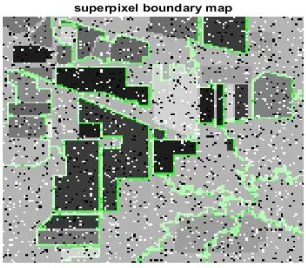
In order to see an intuitive superpixel concept, we show the segmentation results
on Indian Pines, shown in Figure 3. From this figure, it is not hard to see that the same
type of sample is assigned to the same sub-block and samples around the border can be
effectively separated. In this way, this will help us to get a better denoising result, and
140
[image:10.612.230.383.227.361.2]latter experiments also verify this view.
Figure 3: superpixel boundary map on Indian Pines.
Table 1 displays the results of mean PSNR with different methods under
differ-ent ratio of noise. It can be seen clearly that, the mean PSNR of SS-PSSV is higher
than others under10%,20%,40%,45%noise and PSSV achieves the best result
un-der30%noise, which indicates that PSSV and SS-PSSV outperform the other
meth-145
ods and are more effective in the respect of the denoising. Meanwhile, in Table 2,
the results of mean SSIM of different methods with different ratio of noise are
dis-played. From this table, we can see that SS-PSSV can obtain better performance under
20%,30%,40%,45%noise and PSSV achieves the best result under10%noise, which
suggests that SS-PSSV and PSSV are perfect and more effective in denoising. In
ad-150
dition, from Table 2, we easily get the conclusion that SS-PSSV has a more obvious
advantage over others when noise ratio is bigger, that is to say, with the increase of
noise, SS-PSSV’s denoising effect is more obvious. Under10%noise, PSSV obtains
the best performance, which indicates PSSV model is very effective in hyperspectral
field, and when superpixel is added into PSSV, SS-PSSV can get a bigger improvement,
155
process-ing. As we know, LRMR, RPCA, RPCAG and SS-LRR consider the clean sample as
a low rank ingredient, and adopt the nuclear function to portray it. Notice that nuclear
function minimizes the rank, but it does not fully utilize a prior target rank information
about samples.
[image:11.612.151.460.222.326.2]160
Table 1: Mean PSNR values of the restoration results with different restoration methods on Indian Pines
Mean PSNR 10% 20% 30% 40% 45%
LRMR 41.1566 37.2959 34.6609 32.3473 31.2417
RPCA 42.4305 37.4339 31.5867 26.5500 24.4990
RPCAG 54.6674 47.7350 41.2280 34.5390 31.0893
SS-LRR 45.5827 42.2679 38.1975 36.1948 34.0037
PSSV 47.0909 45.1279 44.1626 41.2269 37.4463
SS-PSSV 55.5324 50.3469 43.2180 41.3611 37.9947
Table 2: Mean SSIM values of the restoration results with different restoration methods on Indian Pines
Mean SSIM 10% 20% 30% 40% 45%
LRMR 0.9770 0.9498 0.9172 0.8766 0.8494
RPCA 0.9946 0.9849 0.9362 0.8223 0.7537
RPCAG 0.9955 0.9934 0.9918 0.9719 0.9479
SS-LRR 0.9949 0.9933 0.9885 0.9727 0.9359
PSSV 0.9964 0.9935 0.9919 0.9834 0.9601
[image:11.612.173.437.369.474.2]Figure 4: Restoration results using different methods on Indian Pines: (a) Original band 1, (b) noisy band
with ratio of40%salt and pepper noise, (c) LRMR, (d) RPCA, (e) RPCAG, (f) SS-LRR, (g) PSSV, (h)
SS-PSSV.
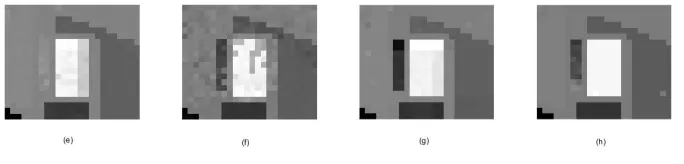
Figure 5: A partial enlargement of the red box in Figure 4 with (e) RPCAG, (f) SS-LRR, (g) PSSV, (h)
[image:12.612.140.482.396.478.2](a)
50 100 150 200
DN -0.1 -0.05 0 0.05 0.1 (b)
50 100 150 200
DN -0.1 -0.05 0 0.05 0.1 (c)
50 100 150 200
DN -0.1 -0.05 0 0.05 0.1 (d)
50 100 150 200
DN -0.1 -0.05 0 0.05 0.1 (e)
50 100 150 200
DN -0.1 -0.05 0 0.05 0.1 (f)
50 100 150 200
DN -0.1 -0.05 0 0.05 0.1 (g)
50 100 150 200
[image:13.612.165.521.127.331.2]DN -0.1 -0.05 0 0.05 0.1
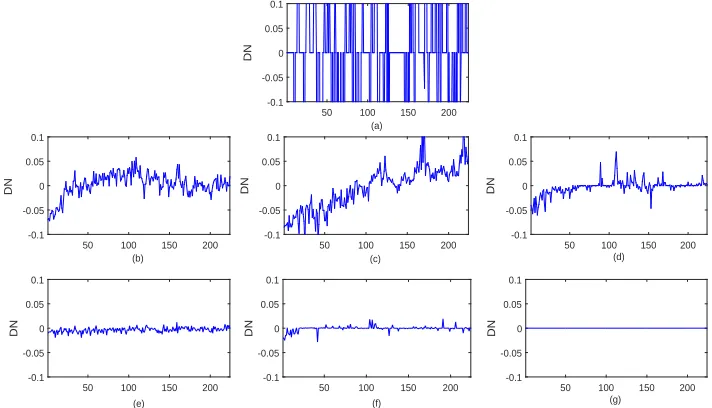
Figure 6: Difference between the noise-free spectrum and the restoration results of pixel (60,75) with ratio
of40%salt and pepper noise on Indian Pines: (a) noisy, (b) LRMR, (c) RPCA, (d) RPCAG, (e) SS-LRR, (f)
PSSV, (g) SS-PSSV.
In the following, we will show some denoised images, and Figure 4 displays the
restoration performance under40%salt and pepper noise for first band. The picture (a)
is clean image, and picture (b) is with40%salt and pepper noise. The pictures (c) to
(h) exhibit the restoration results with different methods, respectively. From the Figure
4, we can find LRMR, RPCA do not remove the noise wholly, and although RPCAG
165
remove the most noise, there is a picture overlapping problem as you see while the
restoration from SS-LRR have a fact of information loss, which can be observed easily
especially in red rectangle box. But with PSSV and SS-PSSV, the noise is basically
removed effectively while retaining most of the picture information at the same time.
In order to be able to see a clearer denoising effect, we make a partial enlargement
170
of the denoised image in Figure 5 with methods including RPCAG, SS-LRR, PSSV,
SS-PSSV. From this figure, we see clearly that (e) and (f) still exist much noise. And
is part of the residual. From (h), we can easily get that SS-PSSV achieves the best
denoising performance, which shows that the combination of superpixel segmentation
175
and PSSV makes sense.
Furthermore, the difference between the noise-free spectrum and the restoration
results in the spectral signatures at (60,75) under40%salt and pepper noise are shown
in Figure 6. From the Figure 6, we can easily see the difference is bigger in all bands
from (b),(c),(d),(e), while SS-PSSV is consistent with the original information, which
180
suggests that SS-PSSV has an advantage over others. Because SS-PSSV first adopt the
superpixel segmentation to make the same class pixel into an superpixel, and so it can
be handled as a whole.
Furthermore, in order to avoid accidental effects, we exhibit the horizonal and
ver-tical profiles of band 50 at pixel (20,30), respectively, where horizonal profiles is a
185
vector on band 50 with the second coordinate being 30 in spatial domain, and vertical
profiles is also a vector on band 50 with the first coordinate being 20 in spatial domain.
In (c) and (d) of Figure 7, we easily see that LRMR and RPCA perform poorly. And
although compared with the two model, performances of RPCAG and SS-LRR are
bet-ter, and still we can see there exist thrill in column numbers from 30 to 140 especially
190
in (f), and this phenomenon can also be found in Figure 8. In Figure 8, performances of
LRMR, RPCA, SS-LRR are bad in most row number, and compared with the models
mentioned, RPCAG performs better. However, there is a slight jitter in (e) in row
num-bers from 20 to 80. Of course, PSSV also has some glitches while SS-PSSV perform
well in almost all bands.
195
Finally, in order to get more perspective and more comprehensive comparison
a-mong several methods, PSNR values with different approaches on each band are
dis-played in Figure 9, which is under45%salt and pepper noise. From this figure, we can
see that SS-PSSV and PSSV are more high than others in most bands although there is
several rapid decline. Because we firstly adopt the superpixel segmentation, and then
200
make full use of target rank to remove noise for each superpixel. Furthermore, SSIM
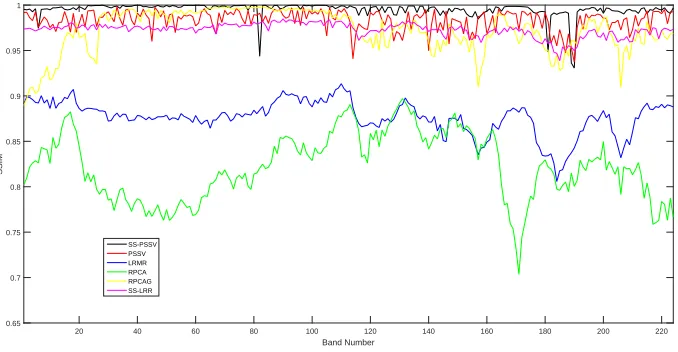
values on every band are displayed in Figure 10. The larger SSIM value is, the
bet-ter denoising quality is. From the figure, we can easily see that PSSV and SS-PSSV
Column Number
20 60 100 140
DN value 0 0.2 0.4 0.6 0.8 1 Column Number
20 60 100 140
DN value 0 0.2 0.4 0.6 0.8 1 Column Number
20 60 100 140
DN value 0 0.2 0.4 0.6 0.8 1 Column Number
20 60 100 140
DN value 0 0.2 0.4 0.6 0.8 1 Column Number
20 60 100 140
DN value 0 0.2 0.4 0.6 0.8 1 Column Number
20 60 100 140
DN value 0 0.2 0.4 0.6 0.8 1 Column Number
20 60 100 140
DN value 0 0.2 0.4 0.6 0.8 1 Column Number
20 60 100 140
DN value 0 0.2 0.4 0.6 0.8 1
(a) (b) (c) (d)
(h) (g)
[image:15.612.137.470.137.327.2](f) (e)
Figure 7: Horizontal profiles of band 50 at pixel (20,30) before and after restoration on Indian Pines: (a)
Original, (b) noisy, (c) LRMR, (d) RPCA, (e) RPCAG, (f) SS-LRR, (g) PSSV, (h) SS-PSSV.
Row Number
20 60 100 140
DN value 0 0.2 0.4 0.6 0.8 1 Row Number
20 60 100 140
DN value 0 0.2 0.4 0.6 0.8 1 Row Number
20 60 100 140
DN value 0 0.2 0.4 0.6 0.8 1 Row Number
20 60 100 140
DN value 0 0.2 0.4 0.6 0.8 1 Row Number
20 60 100 140
DN value 0 0.2 0.4 0.6 0.8 1 Row Number
20 60 100 140
DN value 0 0.2 0.4 0.6 0.8 1 Row Number
20 60 100 140
DN value 0 0.2 0.4 0.6 0.8 1 Row Number
20 60 100 140
DN value 0 0.2 0.4 0.6 0.8 1
(a) (b) (c) (d)
(e) (f) (g) (h)
Figure 8: Vertical profiles of band 50 at pixel (20,30) before and after restoration on Indian Pines: (a)
[image:15.612.137.480.418.608.2]Band Number
20 40 60 80 100 120 140 160 180 200 220
PSNR
0 5 10 15 20 25 30 35 40 45 50
[image:16.612.139.478.123.301.2]SS-PSSV PSSV LRMR RPCA RPCAG SS-LRR
Figure 9: PSNR values of each band of the45%noise experimental results with the different restoration
methods on Indian Pines
Band Number
20 40 60 80 100 120 140 160 180 200 220
SSIM
0.65 0.7 0.75 0.8 0.85 0.9 0.95 1
SS-PSSV PSSV LRMR RPCA RPCAG SS-LRR
Figure 10: SSIM values of each band of the40%noise experimental results with the different restoration
methods on Indian Pines
In summary, AVIRIS Indian Pines contains a variety of crops and the edge between
205
crops is a curve, not a regular straight line. So if we utilize conventional rectangular
block, not using superpixel segmentation, we will not be able to deal well with
sam-ples that are around the edge. For example, PSSV segment images with conventional
[image:16.612.139.478.360.536.2]advantage over PSSV in most experimental results. So in this paper, we use superpixel
210
segmentation skillfully, in this way, we can make same class of pixels into superpixel
as much as possibly. Finally, we adopt PSSV to every superpixel block which can make
full use of prior knowledge about target rank.
4.2. Experiment results on the ROSIS Pavia University Scene
In this subject, the ROSIS Pavia University scene is adopted to test the performance
215
of the proposed method. The data were collected by using the Reflective Optics System
Imaging Spectrometer sensor on the urban area of the University of Pavia, Italy [33].
This image has a size of 610*340 in pixels with a spatial resolution of 1.3mper pixel.
It altogether includes 115 spectral bands ranging from 0.43 to 0.86umin spectrum.
After discarding 12 noisy and water absorption bands, 103 bands are retained in our
220
experiment. The ground truth is classified into 9 mutually exclusive classes including
Trees, Metal sheets and so on. For the preconditioning of the data, the gray values of
each band of the HSI is normalized between [0, 1]. In experiments, we randomly adds
[image:17.612.140.474.415.586.2]10%,20%,30%,40%,45%salt and pepper noise to all bands.
Figure 11: Restoration results using different methods on Pavia University: (a) Original band 101, (b) noisy
band with ratio of40%salt and pepper noise, (c) LRMR, (d) RPCA, (e) RPCAG, (f) SS-LRR, (g) PSSV, (h)
(a) (b) (c) (d)
[image:18.612.181.470.138.310.2](e) (f) (g) (h)
Figure 12: A partial enlargement of the red box in Figure 11.
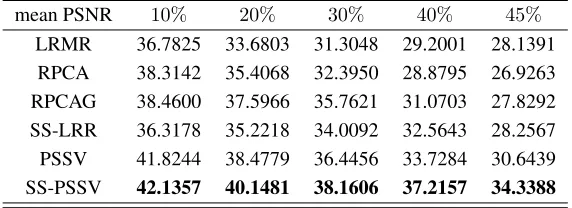
Table 3: mean PSNR values of the restoration results with different restoration methods on Pavia University
mean PSNR 10% 20% 30% 40% 45%
LRMR 36.7825 33.6803 31.3048 29.2001 28.1391
RPCA 38.3142 35.4068 32.3950 28.8795 26.9263
RPCAG 38.4600 37.5966 35.7621 31.0703 27.8292
SS-LRR 36.3178 35.2218 34.0092 32.5643 28.2567
PSSV 41.8244 38.4779 36.4456 33.7284 30.6439
SS-PSSV 42.1357 40.1481 38.1606 37.2157 34.3388
To measure the performance, mean PSNR and mean SSIM among 103 bands are
225
calculated. So Table 3 and Table 4 display the results of mean PSNR and mean SSIM
in ROSIS Pavia University Scene. From the table, it can be seen clearly that,
SS-PSSV achieves the best performance and SS-PSSV get second best result. So superpixel
[image:18.612.163.449.402.506.2]Table 4: mean SSIM values of the restoration results with different restoration methods on Pavia University
mean SSIM 10% 20% 30% 40% 45%
LRMR 0.9366 0.8875 0.8323 0.7651 0.7239
RPCA 0.9725 0.9533 0.9055 0.8004 0.7183
RPCAG 0.9762 0.9617 0.9527 0.8621 0.8028
SS-LRR 0.9628 0.9537 0.9427 0.9228 0.8213
PSSV 0.9764 0.9617 0.9483 0.9111 0.8361
SS-PSSV 0.9781 0.9738 0.9668 0.9628 0.9502
In order to make a intuitive comparison, we displays restoration image on band 101
230
under40%salt and pepper noise in Figure 11. ROSIS Pavia University Scene contains
tree and so on, so if effective methods are not utilized to segment image, it will be hard
to get a good denoising result. It is obvious that traditional segmentation methods can
not effectively divide the complex image, so in this paper, we decide to adopt superpixel
segmentation, because it can handle border information well. Picture (a) is an original
235
image, and (b) shows noisy image with40% salt and pepper noise. The pictures of
(c) to (h) display restoration results with different models, respectively. From Figure
11, we can see that in the restorations with LRMR and RPCA, there has still noise
not been removed. Similarly, denoised image of RPCAG also performs poorly and
recovered image is blurred, so edge information is not preserved completely which can
240
be observed easily in red rectangle box. Simultaneously, the image of the denoising
with SS-LRR also has the phenomenon that edge information is incomplete. Only in
PSSV and SS-PSSV, the recovered image has ability to preserve edge of image and
effective removal of noise. In order to see more clearly, we have partially enlarged the
images, as shown in Figure 12.
245
In order to further explore the characteristics of hyperspectral image, we draw the
difference between the noise-free spectrum and the restoration at (300,120) under40%
salt and pepper noise. From Figure 13, we can see the difference from SS-PSSV is
Band Number
20 40 60 80 100
DN
-1 0 1
Band Number
20 40 60 80 100
DN
-1 0 1
Band Number
20 40 60 80 100
DN
-1 0 1
Band Number
20 40 60 80 100
DN
-1 0 1
Band Number
20 40 60 80 100
DN
-1 0 1
Band Number
20 40 60 80 100
DN
-1 0 1
Band Number
20 40 60 80 100
DN
-1 0 1
(a)
(b) (c) (d)
[image:20.612.142.477.141.351.2](e) (f) (g)
Figure 13: Difference between the noise-free spectrum and the restoration results of pixel (300,120) with
ratio of40%salt and pepper noise on Pavia University: (a) noisy, (b) LRMR, (c) RPCA, (d) RPCAG, (e)
SS-LRR, (f) PSSV, (g) SS-PSSV.
To further test PSSV and SS-PSSV, we calculate horizonal and vertical profiles of
250
band 96 at pixel (100,100), respectively. From Figure 14, we easily see that there is a
serious glitch on the curve in contrast models, especially more obvious in pictures (c),
(d) and (e), and this fact suggests noise is not completely removed. However, there is
no such problem in the curve of picture (g) and (h). In addition, the longitudinal curve
in Figure 15 also verifies that our argument is correct. In Figure 15, there is a more
255
serious glitch on the curve on contrast approaches and still there is no such problem in
the curve of PSSV and SS-PSSV, that is to say, the results with PSSV and SS-PSSV are
more similar to the original in most bands, which undoubtedly validates the fact that
superpixel segmentation and PSSV provide a new perspective of image processing.
For a more comprehensive result, the PSNR and SSIM values on all bands of
260
restoration with different approaches are displayed in Figure 16 and Figure 17,
always above the curves of the other methods in almost all bands and Figure 17 exists
the same solution as Figure 16, which indicates the effectiveness of superpixel
segmen-tation for removing the noise and PSSV is also beneficial to denoise in hyperspectral
265
images.
Column Number 100 200 300
DN 0 0.2 0.4 0.6 0.8 1 Column Number 100 200 300
DN 0 0.2 0.4 0.6 0.8 1 Column Number 100 200 300
DN 0 0.2 0.4 0.6 0.8 1 Column Number 100 200 300
DN 0 0.2 0.4 0.6 0.8 1 Column Number 100 200 300
DN 0 0.2 0.4 0.6 0.8 1 Column Number 100 200 300
DN 0 0.2 0.4 0.6 0.8 1 Column Number 100 200 300
DN 0 0.2 0.4 0.6 0.8 1
100 200 300
DN 0 0.2 0.4 0.6 0.8 1 (a) (d)
(e) (f) (h)
(b) (c)
(g)
[image:21.612.133.471.191.361.2]Column Number
Figure 14: Horizontal profiles of band 96 at pixel (100,100) before and after restoration on Pavia University:
(a) Original, (b) noisy, (c) LRMR, (d) RPCA, (e) RPCAG, (f) SS-LRR, (g) PSSV, (h) SS-PSSV.
Row Number 200 400 600
DN 0 0.2 0.4 0.6 0.8 1 Row Number 200 400 600
DN 0 0.2 0.4 0.6 0.8 1 Row Number 200 400 600
DN 0 0.2 0.4 0.6 0.8 1 Row Number 200 400 600
DN 0 0.2 0.4 0.6 0.8 1 Row Number 200 400 600
DN 0 0.2 0.4 0.6 0.8 1 Row Number 200 400 600
DN 0 0.2 0.4 0.6 0.8 1 Row Number 200 400 600
DN 0 0.2 0.4 0.6 0.8 1 Row Number 200 400 600
DN 0 0.2 0.4 0.6 0.8 1
(a) (b) (c) (d)
(h) (g)
(f) (e)
Figure 15: Vertical profiles of band 96 at pixel (100,100) before and after restoration on Pavia University:
[image:21.612.142.475.443.603.2]Table 5: mean PSNR values of the restoration results with different restoration methods on Pavia University
mean PSNR 10% 20% 30% 40% 45%
LRMR 36.2991 33.8515 31.9306 30.1682 29.2828
RPCA 37.3870 36.1057 33.7716 30.0776 27.9129
RPCAG 37.9592 37.5454 34.5579 30.9087 28.9145
SS-LRR 36.2243 35.5279 34.7330 33.6713 29.7033
PSSV 38.8750 38.1106 37.0402 34.7442 32.0922
[image:22.612.137.478.284.572.2]SS-PSSV 38.2876 38.2372 35.7312 34.2281 33.7147
Table 6: mean SSIM values of the restoration results with different restoration methods on Pavia University
mean SSIM 10% 20% 30% 40% 45%
LRMR 0.9465 0.9134 0.8786 0.8357 0.8096
RPCA 0.9677 0.9606 0.9385 0.8739 0.8231
RPCAG 0.9675 0.9638 0.9539 0.9273 0.8937
SS-LRR 0.9606 0.9554 0.9486 0.9347 0.8829
PSSV 0.9676 0.9644 0.9574 0.9348 0.8940
SS-PSSV 0.9681 0.9697 0.9622 0.9434 0.9400
Band Number
10 20 30 40 50 60 70 80 90 100
PSNR
0 5 10 15 20 25 30 35 40 45 50 55
SS-PSSV PSSV LRMR RPCA RPCAG SS-LRR
Figure 16: PSNR values of each band of the10%noise experimental results with the different restoration
Band Number
10 20 30 40 50 60 70 80 90 100
SSIM
0.8 0.82 0.84 0.86 0.88 0.9 0.92 0.94 0.96 0.98 1
[image:23.612.139.478.122.300.2]SS-PSSV PSSV LRMR RPCA RPCAG SS-LRR
Figure 17: SSIM values of each band of the10%noise experimental results with the different restoration
methods on Pavia University
4.3. Experiment results on the Botswanna data set
(a) (b) (c) (d) (e) (f) (g) (h)
(a) (b) (c) (d) (e) (f) (g) (h)
Figure 18: Restoration results using different methods on BOT: (a) Original band 100, (b) noisy band with
[image:23.612.183.456.392.557.2](a) (b) (c) (d) (e) (f) (g) (h)
Figure 19: A partial enlargement of the red box in Figure 18.
20 40 60 80 100 120 140
Band Number
-0.2 0 0.2
DN
20 40 60 80 100 120 140
Band Number
-0.2 0 0.2
DN
20 40 60 80 100 120 140
Band Number
-0.2 0 0.2
DN
20 40 60 80 100 120 140
Band Number
-0.2 0 0.2
DN
20 40 60 80 100 120 140
Band Number
-0.2 0 0.2
DN
20 40 60 80 100 120 140
Band Number
-0.2 0 0.2
DN
20 40 60 80 100 120 140
Band Number
-0.2 0 0.2
DN
(a)
(b) (c) (d)
(e) (f) (g)
Figure 20: Difference between the noise-free spectrum and the restoration results of pixel (60,75) with ratio
of40%salt and pepper noise on BOT: (a) noisy, (b) LRMR, (c) RPCA, (d) RPCAG, (e) SS-LRR, (f) PSSV,
[image:24.612.136.468.336.553.2]Column Number
50 100 150 200 250
DN value 0 0.2 0.4 0.6 0.8 1 Column Number
50 100 150 200 250
DN value 0 0.2 0.4 0.6 0.8 1 Column Number
50 100 150 200 250
DN value 0 0.2 0.4 0.6 0.8 1 Column Number
50 100 150 200 250
DN value 0 0.2 0.4 0.6 0.8 1 Column Number
50 100 150 200 250
DN value 0 0.2 0.4 0.6 0.8 1 Column Number
50 100 150 200 250
DN value 0 0.2 0.4 0.6 0.8 1 Column Number
50 100 150 200 250
DN value 0 0.2 0.4 0.6 0.8 1 Column Number
50 100 150 200 250
DN value 0 0.2 0.4 0.6 0.8 1
(a) (b) (c) (d)
[image:25.612.139.482.123.270.2](e) (f) (g) (h)
Figure 21: Horizontal profiles of band 122 at pixel (100,80) before and after restoration on BOT: (a) Original,
(b) noisy, (c) LRMR, (d) RPCA, (e) RPCAG, (f) SS-LRR, (g) PSSV, (h) SS-PSSV.
Row Number
200 600 1000 1400
DN value 0 0.2 0.4 0.6 0.8 1 Row Number
200 600 1000 1400
DN value 0 0.2 0.4 0.6 0.8 1 Row Number
200 600 1000 1400
DN value 0 0.2 0.4 0.6 0.8 1 Row Number
200 600 1000 1400
DN value 0 0.2 0.4 0.6 0.8 1 Row Number
200 600 1000 1400
DN value 0 0.2 0.4 0.6 0.8 1 Row Number
200 600 1000 1400
DN value 0 0.2 0.4 0.6 0.8 1 Row Number
200 600 1000 1400
DN value 0 0.2 0.4 0.6 0.8 1 Row Number
200 600 1000 1400
DN value 0 0.2 0.4 0.6 0.8 1
(a) (b) (c) (d)
(e) (f) (g) (h)
Figure 22: Vertical profiles of band 122 at pixel (100,80)before and after restoration on BOT: (a) Original,
(b) noisy, (c) LRMR, (d) RPCA, (e) RPCAG, (f) SS-LRR, (g) PSSV, (h) SS-PSSV.
In our experiment, the Botswanna data set [34] is adopted, and the hyperspectral
image was acquired across Okavango Delta, Botswana(BOT). The hyperspectral data
includes two major ecosystem components defined by absence or presence of flooding,
270
namely: upland and wetland. The data set was collected in 2001 and has a size of
1476*256 with a spatial resolution of 30m in pixels, and there are altogether 1580
[image:25.612.143.486.348.497.2]a hyperspectral resolution of 10nm. After discarding some noisy and water absorption
bands, 145 bands are retained for our experiment, and the ground truth is classified into
275
9 mutually exclusive classes including Water, Primary Floodplain, Riparian and so on.
Band Number
20 40 60 80 100 120 140
PSNR
0 5 10 15 20 25 30 35 40 45
[image:26.612.122.480.139.332.2]SS-PSSV PSSV LRMR RPCA RPCAG SS-LRR
Figure 23: PSNR values of each band of the45%noise experimental results with the different restoration
methods on BOT.
Band Number
20 40 60 80 100 120 140
SSIM
0.4 0.5 0.6 0.7 0.8 0.9 1
SS-PSSV PSSV LRMR RPCA RPCAG SS-LRR
Figure 24: SSIM values of each band of the45%noise experimental results with the different restoration
methods on BOT.
We first calculate mean PSNR and mean SSIM, which are displayed on Table 5 and
Table 6 respectively, and two tables show the performance with several methods under
different ratio of noise. From Table 5, we can see that under20%,45% noise,
SS-PSSV achieves the best performance, and under10%,30%,40%noise, PSSV achieves
280
[image:26.612.139.478.390.535.2]In Figure 18, we display recovery images on band 100 with30%salt and pepper noise
with different models. The picture (a) displays original image on band 100, and picture
(b) shows noisy graphic with ratio of30%salt and pepper noise. Pictures (c) to (h)
exhibit the restorations with different methods, respectively. From these comparisons,
285
we can see that SS-PSSV can recover a more vivid image, which can be observed easily
in red rectangle box. And an enlarged image of the red box will be shown in Figure 19.
In order to have a deeper and comprehensive understanding on spectral
signa-tures, we observe the difference between the noise-free spectrum and the restoration
at (60,75) under40%salt and pepper noise. From Figure 20, we can clearly see that
290
SS-PSSV has an big advantage over others. In order to have a more in-depth
explo-ration of botswanna data set, we records the horizontal profiles and the vertical profiles
of band 122 at pixel (100,80), and the curves are displayed in Figure 21 and Figure
22, respectively. From Figure 21, we can see that contrast methods do not handle with
noise well at column numbers between 240 and 250, while PSSV and SS-PSSV do it.
295
The same situation appear in Figure 22, because LRMR, RPCA, RPCAG, SS-LRR can
not remove noise well around row number 600, while PSSV and SS-PSSV can do.
Finally, in order to make a full understanding on all bands, PSNR and SSIM values
of restorations with different approaches on each band are displayed in Figure 23 and
Figure 24, respectively. It can be clearly seen that PSNR and SSIM values with PSSV
300
and SS-PSSV are higher than others in most bands, which indicates the effectiveness
of superpixel segmentation and PSSV for removing noise. In summary, superpixel
segmentation allows the same type of samples are divided into the same sub-block as
possible, then PSSV takes full advantage of the priori knowledge of the target rank.
When we combine the two effectively, one should get better denoising effect in theory.
305
5. Conclusions
In this work, we combine superpixel segmentation and PSSV, named as SS-PSSV.
The superpixel segmentation can obtain homogeneous regions, which can make full use
of both hyperspectral and spatial information of HSIs and PSSV makes full use of the
prior knowledge on each homogenous region, which can help remove noise effectively.
Experiments on three HSI data sets have been conducted to demonstrate that PSSV and
SS-PSSV outperforms other comparing methods in the field of hyperspectral denoising.
6. References
[1] H. Saari, A. Akuj?rvi, C. Holmlund, H. Ojanen, J. Kaivosoja, A. Nissinen,
O. Niemel?inen, Visible, very near ir and short wave ir hyperspectral drone
imag-315
ing system for agriculture and natural water applications, ISPRS - International
Archives of the Photogrammetry, Remote Sensing and Spatial Information
Sci-ences XLII-3/W3 (2017) 165–170.
[2] C. Winkens, V. Kobelt, D. Paulus, Robust features for snapshot hyperspectral
terrain-classification, in: International Conference on Computer Analysis of
Im-320
ages and Patterns, 2017, pp. 16–27.
[3] Y. Sun, Y. Zhao, K. Qin, F. Tian, P. Liu, New identification of sericite subclass
minerals using airborne hyperspectral data in the xitan region of gansu province
and its significance in gold ore prospecting, Acta Geologica Sinica 92 (1) (2018)
426–427.
325
[4] N. Ma, Y. Peng, S. Wang, P. Leong, An unsupervised deep hyperspectral anomaly
detector., Sensors 18 (3) (2018) 693.
[5] A. V. Vo, L. Truong-Hong, D. F. Laefer, D. Tiede, S. DOleire-Oltmanns, A.
Baral-di, M. Shimoni, G. Moser, D. Tuia, Processing of extremely high resolution lidar
and rgb data: Outcome of the 2015 ieee grss data fusion contestłpart b: 3-d
con-330
test, IEEE Journal of Selected Topics in Applied Earth Observations and Remote
Sensing 9 (12) (2017) 5560–5575.
[6] G. Chen, S.-E. Qian, Denoising of hyperspectral imagery using principal
com-ponent analysis and wavelet shrinkage, IEEE Transactions on Geoscience and
remote sensing 49 (3) (2011) 973–980.
[7] Q. Yuan, L. Zhang, H. Shen, Hyperspectral image denoising employing a
spectral–spatial adaptive total variation model, IEEE Transactions on Geoscience
and Remote Sensing 50 (10) (2012) 3660–3677.
[8] H. Othman, S.-E. Qian, Noise reduction of hyperspectral imagery using hybrid
spatial-spectral derivative-domain wavelet shrinkage, IEEE Transactions on
Geo-340
science and Remote Sensing 44 (2) (2006) 397–408.
[9] S.-L. Chen, X.-Y. Hu, S.-L. Peng, Hyperspectral imagery denoising using a
spatial-spectral domain mixing prior, Journal of computer science and
technol-ogy 27 (4) (2012) 851–861.
[10] E. J. Cand`es, X. Li, Y. Ma, J. Wright, Robust principal component analysis?,
345
Journal of the ACM (JACM) 58 (3) (2011) 11.
[11] E. Candes, B. Recht, Exact matrix completion via convex optimization,
Commu-nications of the ACM 55 (6) (2012) 111–119.
[12] I. Jolliffe, Principal component analysis, Wiley Online Library, 2002.
[13] R. Cabral, F. De la Torre, J. P. Costeira, A. Bernardino, Unifying nuclear
nor-350
m and bilinear factorization approaches for low-rank matrix decomposition, in:
Proceedings of the IEEE International Conference on Computer Vision, 2013,
pp. 2488–2495.
[14] Y. Shen, Z. Wen, Y. Zhang, Augmented lagrangian alternating direction method
for matrix separation based on low-rank factorization, Optimization Methods and
355
Software 29 (2) (2014) 239–263.
[15] H. Ji, C. Liu, Z. Shen, Y. Xu, Robust video denoising using low rank matrix
completion, in: Computer Vision and Pattern Recognition (CVPR), 2010 IEEE
Conference on, IEEE, 2010, pp. 1791–1798.
[16] C. A. Bishop, J. G. Liu, P. J. Mason, Hyperspectral remote sensing for mineral
360
exploration in pulang, yunnan province, china, International Journal of Remote
[17] L. Wu, A. Ganesh, B. Shi, Y. Matsushita, Y. Wang, Y. Ma, Robust photometric
stereo via low-rank matrix completion and recovery, Computer Vision–ACCV
2010 (2011) 703–717.
365
[18] B. Fischler, Martin A, R. C, Random sample consensus: a paradigm for model
fitting with applications to image analysis and automated cartography,
Commu-nications of the ACM 24 (6) (1981) 381–395.
[19] Y.-Q. Zhao, P. Gong, Q. Pan, Object detection by spectropolarimeteric imagery
fusion, IEEE Transactions on Geoscience and Remote Sensing 46 (10) (2008)
370
3337–3345.
[20] F. De La Torre, M. J. Black, A framework for robust subspace learning,
Interna-tional Journal of Computer Vision 54 (1) (2003) 117–142.
[21] Y. Q. Zhao, J. Yang, Hyperspectral image denoising via sparse representation
and low-rank constraint, IEEE Transactions on Geoscience and Remote Sensing
375
53 (1) (2015) 296–308.
[22] H. Huang, A. G. Christodoulou, W. Sun, Super-resolution hyperspectral imaging
with unknown blurring by low-rank and group-sparse modeling, in: IEEE
Inter-national Conference on Image Processing, 2014, pp. 2155–2159.
[23] X. Lu, Y. Wang, Y. Yuan, Graph-regularized low-rank representation for
destrip-380
ing of hyperspectral images, IEEE Transactions on Geoscience and Remote
Sens-ing 51 (7) (2013) 4009–4018.
[24] H. Zhang, W. He, L. Zhang, H. Shen, Q. Yuan, Hyperspectral image restoration
using low-rank matrix recovery, IEEE Transactions on Geoscience and Remote
Sensing 52 (8) (2014) 4729–4743.
385
[25] T.-H. Oh, Y.-W. Tai, J.-C. Bazin, H. Kim, I. S. Kweon, Partial sum minimization
of singular values in robust pca: Algorithm and applications, IEEE transactions
[26] Z. Lin, M. Chen, Y. Ma, The augmented lagrange multiplier method for exact
recovery of corrupted low-rank matrices, arXiv preprint arXiv:1009.5055.
390
[27] D. L. Donoho, I. M. Johnstone, Adapting to unknown smoothness via wavelet
shrinkage, Journal of the american statistical association 90 (432) (1995) 1200–
1224.
[28] E. T. Hale, W. Yin, Y. Zhang, Fixed-point continuation for L1-minimization:
Methodology and convergence, SIAM Journal on Optimization 19 (3) (2008)
395
1107–1130.
[29] E. M. de S´a, Exposed faces and duality for symmetric and unitarily invariant
norms, Linear Algebra and its Applications 197 (1994) 429–450.
[30] N. Shahid, V. Kalofolias, X. Bresson, M. Bronstein, P. Vandergheynst, Robust
principal component analysis on graphs, in: Proceedings of the IEEE
Internation-400
al Conference on Computer Vision, 2015, pp. 2812–2820.
[31] J. Ma, C. Li, Y. Ma, Z. Wang, Hyperspectral image denoising based on low-rank
representation and superpixel segmentation, in: Image Processing (ICIP), 2016
IEEE International Conference on, IEEE, 2016, pp. 3086–3090.
[32] D. Landgrebe, Aviris nw indianas indian pines 1992 data set, 1992.
405
[33] A. Plaza, J. A. Benediktsson, J. W. Boardman, J. Brazile, L. Bruzzone, G.
Camps-Valls, J. Chanussot, M. Fauvel, P. Gamba, A. Gualtieri, et al., Recent advances in
techniques for hyperspectral image processing, Remote sensing of environment
113 (2009) S110–S122.
[34] A. L. Neuenschwander, Remote sensing of vegetation dynamics in response to
410
flooding and fire in the Okavango Delta, Botswana, The University of Texas at