COLLABORATION AMONG NURSES AND PHYSICIANS AND ITS RELATION TO PATIENT
*,1
Sanaa M. Safaan,
¹Department of Nursing Administration, Faculty of Nursing
2Department of Clinical
3
Department of Public Health and Community
ARTICLE INFO ABSTRACT
Deficiencies in collaboration
provision of healthcare and on patient outcomes. Collaborative practice has been shown to benefit civilian health care facilities by decreasing costs and increased patient, family, nurse, and
satisfaction.
This study aimed to
determine its relation to patient's satisfaction.
Design: Setting: Subjects:
study, the third group was patients available at the time of the study.
Tool: three tools were used
Questionnaire about nursing care .Tool III: Patient Satisfaction Question
Results:
satisfac
satisfaction increases.
Conclu
nurses and physicians
Recommendations:
our differences a
Copyright © 2015 Sanaa M. Safaan et al. This is an open access article distributed under the Creative Commons Att use, distribution, and reproduction in any medium, provided the original work is properly cited.
INTRODUCTION
Today's health care delivery system challenges all of us to provide care that is patient centered, efficient, effective, safe, timely, and easily accessible (Karima et al.
physician collaboration was defined as actions related to sharing information about patients, participating in decision making concerning patient care, and providing comprehensive care to patients from a patient-centered perspective
constructs of Nurse–physician collaboration: sharing of patient information, joint participation in the cure/care
making process, and degree of cooperation
Collaboration between nurses and physicians is a complex interaction process between different professional groups. As long as a patient’s progress proceeds as expected, understandings are shared between the disciplines, and hard and fast boundaries between the groups are not often drawn, collaboration proceeds fluidly. Because the discipli medicine and nursing have different histories,
*Corresponding Author:Sanaa M. Safaan
Department of Nursing Administration, Menoufia University, Egypt
ISSN: 0975-833X
Article History:
Received 20th December, 2014
Received in revised form 18th January, 2015
Accepted 23rd February, 2015
Published online 17th March,2015
Key words:
Nurse-physician collaboration, Patients Satisfaction.
RESEARCH ARTICLE
COLLABORATION AMONG NURSES AND PHYSICIANS AND ITS RELATION TO PATIENT
SATISFACTION
2
Enas A. Elkhouly, and
3Reda Abdel Latif Ibrahem
Department of Nursing Administration, Faculty of Nursing
Department of Clinical Oncology and Nuclear Medicine
Department of Public Health and Community Medicine Faculty of Medicine, Menoufia University, Egypt
ABSTRACT
Deficiencies in collaboration between healthcare professionals have a negative relation to the provision of healthcare and on patient outcomes. Collaborative practice has been shown to benefit civilian health care facilities by decreasing costs and increased patient, family, nurse, and
satisfaction.
This study aimed to investigate the levels of the collaboration between physicians and nurses and determine its relation to patient's satisfaction.
Design: Thisstudy demonstrated a descriptive cross-sectional design.
Setting: the study was carried out in Clinical Oncology Hospital, Menofiya University,
Subjects: Three groups of subjects included all staff nurses and physicians available at the time o study, the third group was patients available at the time of the study.
three tools were used; tool 1:Nurse–Physician Collaboration Scale. Tool II: Patient Satisfaction Questionnaire about nursing care .Tool III: Patient Satisfaction Question
Results: Indicated that 94% of patients showed of high satisfaction about doctor, 66% showed high satisfaction for nurses' practice. When collaboration between doctors and
satisfaction increases.
Conclusion: This study concluded that there was a positive relation to between collaboration among nurses and physiciansand patient satisfaction.
Recommendations: As nurse and physicians, it is essential that we should understand and tolerate our differences and foster our mutual interest in caring for patient better than ever
is an open access article distributed under the Creative Commons Attribution License, which use, distribution, and reproduction in any medium, provided the original work is properly cited.
delivery system challenges all of us to provide care that is patient centered, efficient, effective, safe,
et al., 2011). Nurse–
physician collaboration was defined as actions related to sharing information about patients, participating in decision-making concerning patient care, and providing comprehensive
centered perspective. Three physician collaboration: sharing of patient information, joint participation in the cure/care decision-making process, and degree of cooperation (Ushiro 2009 . Collaboration between nurses and physicians is a complex
ifferent professional groups. As long as a patient’s progress proceeds as expected, understandings are shared between the disciplines, and hard and fast boundaries between the groups are not often drawn, collaboration proceeds fluidly. Because the disciplines of medicine and nursing have different histories,
Department of Nursing Administration, Menoufia University, Egypt.
political agendas, and forms of education that forge professional identities, values, and skills, these differences can be highlighted under conditions of stress. At these times, boundaries tend to be drawn regarding who owns what kinds of knowledge and who is responsible for specific kinds of work. Breakdown in collaboration reveals whose knowledge is privileged and the ways in which professional identities are brought to the fore and reinforced
Liaschenko 2007) .Collaboration is vital
benefit of patients, but also for the satisfaction of health care providers. Collaboration between physicians and nurses is rewarding when responsibility for patient well
Professionalism is strengthened when all members ta
for group successes. Unfortunately the contribution of nursing towards the bottom line is often not easy to identify. Physicians have often been viewed as the primary generators of income for hospitals. However, nurses are also substantial revenu producers. The invisibility of nursing may occur because differences in income and gender have historically impacted the balance of power between nurses and physicians 1992)
International Journal of Current Research
Vol. 7, Issue, 03, pp.13299-13305, March, 2015
INTERNATIONAL
COLLABORATION AMONG NURSES AND PHYSICIANS AND ITS RELATION TO PATIENT
Reda Abdel Latif Ibrahem
Department of Nursing Administration, Faculty of Nursing
Menoufia University, Egypt
between healthcare professionals have a negative relation to the provision of healthcare and on patient outcomes. Collaborative practice has been shown to benefit civilian health care facilities by decreasing costs and increased patient, family, nurse, and physician
investigate the levels of the collaboration between physicians and nurses and
sectional design.
the study was carried out in Clinical Oncology Hospital, Menofiya University, Egypt. Three groups of subjects included all staff nurses and physicians available at the time of the study, the third group was patients available at the time of the study.
Physician Collaboration Scale. Tool II: Patient Satisfaction Questionnaire about nursing care .Tool III: Patient Satisfaction Questionnaire about Doctors.
Indicated that 94% of patients showed of high satisfaction about doctor, 66% showed high between doctors and nurses increase, the patients’
This study concluded that there was a positive relation to between collaboration among
As nurse and physicians, it is essential that we should understand and tolerate ng for patient better than ever.
ribution License, which permits unrestricted
agendas, and forms of education that forge professional identities, values, and skills, these differences can be highlighted under conditions of stress. At these times, boundaries tend to be drawn regarding who owns what kinds of onsible for specific kinds of work. Breakdown in collaboration reveals whose knowledge is privileged and the ways in which professional identities are brought to the fore and reinforced (Jane Stein-Parbury and Joan Collaboration is vital not only for the benefit of patients, but also for the satisfaction of health care providers. Collaboration between physicians and nurses is rewarding when responsibility for patient well-being is shared. Professionalism is strengthened when all members take credit for group successes. Unfortunately the contribution of nursing towards the bottom line is often not easy to identify. Physicians have often been viewed as the primary generators of income for hospitals. However, nurses are also substantial revenue producers. The invisibility of nursing may occur because differences in income and gender have historically impacted the balance of power between nurses and physicians (Fagin
patient satisfaction is an important indicator in evaluating the quality of the patient care in the outpatient department. In the context of total quality, serving the customers/patients does not simply mean satisfying them. It implies satisfying their needs in conformance to their requirements, and the specifications have to be stated explicitly by customers to be satisfied (John Paul et al., 2008) . Patient knowledge involves understanding a particular human being’s experience of disease and response to treatment. Nursing work emphasizes patient knowledge, whereas medical work emphasizes case knowledge. Patient knowledge is unique to the recipient of care and isn't accessible or meaningful outside an embodied experience.
Access to patient knowledge requires sensitivity to the complexity and idiosyncrasies of the recipients of care in the recipients’ particular context. Patient knowledge requires and provides proximity to recipients of care over time, allowing nurses to make comparisons and thus interpret responses (3). Patient satisfaction is used increasingly as a quality indicator by health service. Patient satisfaction with care received is an essential criterion by which patients assess quality of medical care received. Satisfaction is broadly defined as the human experience of being filled and enriched by an experience
.Additionally, The outcome of any disease is influenced decisions to seek care, timely arrival appropriate diagnostic and treatment services and the receipt of adequate care from service providers (Kumari et al., 2009). Communication between patient and provider of healthcare is a vital factor for patient satisfaction (Qureshi et al., 2005). Satisfactions based on the overall hospitalization experience which is extended in time, and may involve cognitive as well as psychological process, along with situational and cultural actors. Factors influencing patient satisfaction with nursing care include the technical professional area, the impact of higher education and the trusting relationship (Keerthi Mohanan et al., 2010)
Significance of the study
Traditionally, physicians generally have not demonstrated collaboration in their work with nurses; nurses, on the other hand, have more often sought a collaborative relationship. But the rapidly changing, increasingly complex and constraining world of health care requires those doctors, nurses, and the institutions. Determining the perception of the level of collaborative practice and assessment of patient satisfaction is vital and necessary in modern health care due to rising costs and the need for resourcefulness and efficiency in processes of health care delivery, will provide valuable information on the current status of collaboration between nurses and physicians. These baseline data will enable future research to measure the progress of implementation of collaborative practice in the health care system.
Aim of the study
This study aimed to investigate the levels of the collaboration between physicians and nurses and determine its relation to patient’s satisfaction at Menofiya University.
The following research questions were developed to conduct this study:
What is the level of the collaboration between physicians and nurses?
What is the level of the patients’ satisfaction about physicians and nurses?
Is there an impact of this collaboration on patients’ satisfaction?
Theoretical Framework
The theoretical framework for measurement is Fishbein's Theory of Reasoned Action (TRA) (Ajzen & Fishbein, 1980). TRA makes three general assumptions. First, man is a rational being and makes "systematic use of the information available to them. Second, "most behaviors of social relevance are under volitional control and thus predictable from intentions" and third, intentions are the direct precursors of behavior. Ajzen and Fishbein (1980)assert that people weigh the implications of their actions before deciding whether or not to engage in a specific activity or behavior. Thus, if the intent to behave in a collaborative manner is high it can be inferred that the state of collaborative practice is high.
Subject and Methods
Design: a descriptive cross-sectional design.
Study variables
Dependent variable (patient Satisfaction)
Independent variable (Nurse–Physician Collaboration).
Setting: The study was carried out in Clinical Oncology Hospital, Menoufia University, Egypt.
Subjects: Three groups of subjects included in this study to achieve its aim. They were all staff nurses (n= 25) and all physicians available at the time of the study who were working in inpatient unit of Clinical Oncology Hospital (n= 23). The third group consist of convenient sample of patient available at the time of the study in patient unit (n=84). Patients were included in the survey if they satisfied the following inclusion criteria: (1) adults, aged 18 years and above; (2) conscious, coherent, and oriented to time, person and place; (3) admitted to the wards for at least three days and ready for discharge; and (4) willing to give informed consent
Tools
In order to fulfill the aim of the study, the following tools were used. Which it consists of two parts: First part: Personal data for nurses and physicians it includes gender, specialty, age and years of experience, while for patients it includes gender, age and duration time in the hospital. Second part: consist of three tools:
Tool 1: Nurse–Physician Collaboration Scale
In order to fulfill the aim of the study, the following tools were used. Which it consists of two parts:
Personal data of patient. It includes gender, age and duration time in the hospital
Second part: consist of three tools
Tool 1: Nurse–Physician Collaboration Scale (NPCS)
NPCS is based on the work of (Simon et al., 1977; Innami
et al., 2002) and (Miyagawa 2004) that are used to solve
problems or in decision-making, because information is closely linked to problem-solving and decision-making with regard to patient care. Innami (2002) and Miyagawa(2004). suggested that there are three basic elements in the information management process: shared information, decision-making /consensus building and action. Thus, the concept of collaboration assumes the following three constructs: sharing of patient information (9 items), joint participation in the decision-making process (12 items), and cooperativeness (6 items). Participants were to answer between 1 meaning disagree, 2 meaning neutral & 3 meaning agree. The total score ranged from. 70-100% scores, higher scores will imply more positive the respondent's attitude toward physician-nurse collaboration and vice versa
Tool II: Patient Satisfaction Questionnaire about nursing
care
This questionnaire was developed by Risser, 1975 and Ventura, 1982. PSNC to determine what patient expectations and perceptions they had for nursing care that affect heir satisfaction., It was consist of three dimension : (1) the nurse as a caring person(5items), (2) the nurse as an information provide (5items) and (3) the nurse as a competent and skilled healthcare provider(4items) , and overall Evaluation of Care (4items) . This questionnaire consisted of 19 questions using a 3-point scale. Participants were to answer between 1meaning disagree, 2 meaning neutral, and 3 meaning agree. The total score ranged from 20 to 45 low satisfying experiences. From 46 to 70moderate satisfying experience & from 71 to 100 a highly satisfying experience
Tool II1: Patient Satisfaction Questionnaire about Doctors
Questionnaire was developed by Royal College of General Practitioners (2008)to provide useful feedback to doctors by providing a measure of the patients’ opinion of the doctor’s relationship and empathy during a consultation, It was consist of 11(items). This questionnaire using a 3-point scale. Participants were to answer between 1meaning disagree, 2 meaning neutral, and 3 meaning agree. The total score ranged from 20 to 45 low satisfying experiences. From 46 to 70moderate satisfying experience & from 71 to 100 a highly satisfying experience
MATERIAL AND METHODS
An official letter clarifying the purpose of the study was obtained from the the hospital to conduct the study and collect the necessary data.
Tool was translated into Arabic for (nurses) and was tested for its content validity by five faculty members.
The tools were tested for reliability by test-retest technique.
A pilot study was conducted on five nurses and five physicians (whom are not included in the study) to test the reliability of the tool
Changes were made for few statements who were interviewed twice at an interval of one week period and data was analyzed and compared.
Consent was obtained from the participants. The researcher explained to students the objectives of the study orally, informed confidentiality and anonymity being assured.
The collection of data was started at February 2013 and ended on 30 May 2013, covered three months.
Statistical analysis
Data entry and analysis were done by using statistical package for the social sciences (SPSS Version 11.0). Data were presented using descriptive statistics in the form of frequencies &percentages. Person correlation was used for assessment of the inter-relationships among quantitative variables.
RESULTS
[image:3.595.313.553.474.609.2]Table (1): Displays distribution of the Studied Sample According to demographic data. As indicated in the table the greatest number of doctors (56.6) & nurses (40%) were in the age group more than above 30 years old, while (73.9) of doctors were male group otherwise nurses were Female group., finally (40%) of nurses have less than 10 years of experience, while (39.1) of doctors has 10 ranged from 10 – 20 years of experience
Table 1. Distribution of the Studied Sample (Doctors + nurses) According to demographic data. no=48
Demographic items Doctor
N = 23
Nurses N = 25
No % No %
Age groups < 20 20 – 30 > 30
3 7 13
13.0 30.4 56.6
8 7 10
32.0 28.0 40.0 Sex
Male Female
17 6
73.9 26.1
7 18
28.0 72.0 Duration of work
< 10 10 – 20 > 20
7 9 7
30.4 39.1 30.4
10 7 8
[image:3.595.342.525.639.762.2]40.0 28.0 32.0
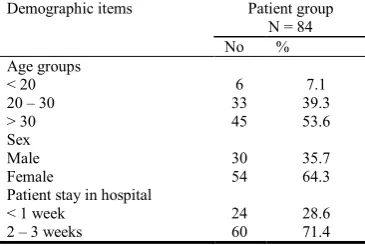
Table 2. Distribution of the Studied Patients According demographic data. No=84
Demographic items Patient group
N = 84
No %
Age groups < 20 20 – 30 > 30
6 33 45
7.1 39.3 53.6 Sex
Male Female
30 54
35.7 64.3 Patient stay in hospital
< 1 week 2 – 3 weeks
24 60
28.6 71.4
Table (2): Displays distribution of the Studied Sample According to demographic data. As indicated in the table the greatest number of Patients (53.6%) were in the age group above 30 years old & (64.35%) were Female group., while Patient stay in hospital the greatest number have 2 – 3 weeks
Table (3): Illustrates Comparison between the studied groups as regards three collaboration constructs between Nurse– Physician Collaboration: Joint participation in the cure/care decision-making process, Sharing of patient information, and Cooperativeness. As indicated in the table that the highest percentage of doctors and nurses agree that there were a high degree’ of correspondence for collaboration constructs and the is no statistical significantly difference between them, And noted from the table that physicians, as a group, were found to be more in the cure/care decision-making process and patient information than Nurses. Otherwise Nurses, as a group, were found to be cooperative than physicians.
Table (4) Illustrates level of Patients satisfaction about doctor. As indicated in the table that 79 (94.0%) of patients were more satisfied about doctor especially in explaining things clearly (fully answering your questions, explaining clearly, giving you adequate information ; not being vague) and 91.0% making you feel at ease (being friendly and warm towards you, treating you with respect). and also As indicated in the table that 10 (11.9%) of patients were not satisfied about doctor especially in how would you rate your consultation with this doctor today.
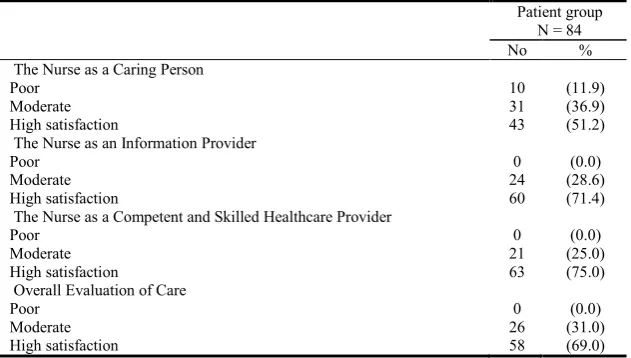
Table (5) Shows distribution of the Studied Sample (Patients) according to their level of satisfaction about Nurses. As indicated in the table that Patients were more satisfied about the nurse as an information provider (71%) and the nurse as a competent and skilled healthcare provider(75%) than the nurse as a caring person (51% ) and overall evaluation of care (69%). Overall Evaluation of nursing Care Patients (69%) were more satisfied.
[image:4.595.330.536.241.348.2]Table (6) Displays Over all Patient Satisfaction about doctors and nurses. As showed in the table that Patient Satisfaction about doctors takes the higher percentage (94.0%) than Satisfaction about nurses (66.7%).
Table 6. Over all Patient Satisfaction about doctors and nurses No=48
Doctors and nurses No=48 Patient group
N = 84
No %
Patient Satisfaction for doctor Poor
Moderate High satisfaction
2 4 79
(2.4) (4.8) (94.0) Patient Satisfaction for nurses
Poor Moderate High satisfaction
0 28 56
[image:4.595.96.492.410.554.2]0.0 33.3 66.7
Table 3. Comparison between the studied groups as regarding to the collaboration constructs between Nurse–Physician. No=48
items Doctor
N = 23
Nurse N = 25
X2 P value
No % No %
Joint participation in the cure/care decision-making process Agree
Neutral Disagree
17 5 1
73.9 21.7 4.3
20 4 1
80.0 16.0
4.0 0.27 0.87
Sharing of patient information Agree
Neutral Disagree
17 5 1
73.9 21.7 4.3
19 6 0
76.0 24.0
0.0 1.12 0.57
Cooperativeness Agree Neutral Disagree
17 5 1
75,4 21.7 2.9
17 7 0
68.7 31..3
[image:4.595.139.455.578.757.2]0.0 3.04 0.14
Table 5. Frequency Distribution of the Studied Sample (Patients) according to their level of satisfaction about Nurses. No=84
Patient group N = 84
No %
The Nurse as a Caring Person Poor
Moderate High satisfaction
10 31 43
(11.9) (36.9) (51.2) The Nurse as an Information Provider
Poor Moderate High satisfaction
0 24 60
(0.0) (28.6) (71.4) The Nurse as a Competent and Skilled Healthcare Provider
Poor Moderate High satisfaction
0 21 63
(0.0) (25.0) (75.0) Overall Evaluation of Care
Poor Moderate High satisfaction
0 26 58
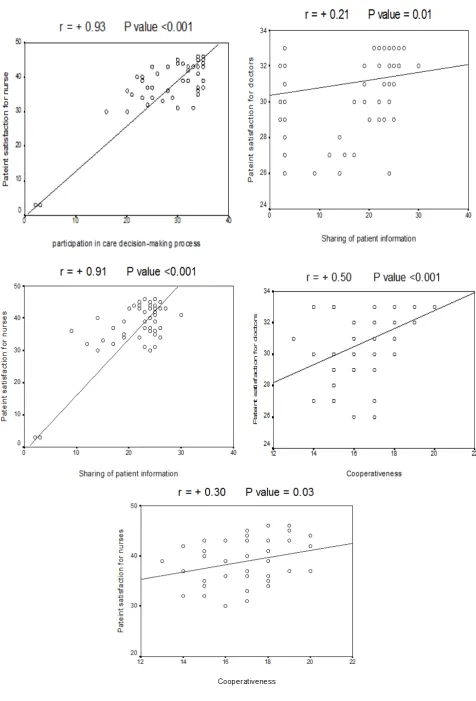
Table 7. Correlation to between three collaboration constructs and Patient Satisfaction for nurses & doctors
DISCUSSION
Healthcare systems have become so complex that a division of labor among specialists in various fields has become indispensable. Interdisciplinary collaborative team care is required because only so much can be achieved by a single individual or group of professionals, as well as because the diverse needs of patients must be met 24 hours/day in a limited time. Collaboration is a common strategy to achieve desired quality outcomes in an effective and efficient manner in a complex array of health services. Provision of healthcare within an increasing diversity of disciplines where one health professional can no longer meet all patient needs. The present study has revealed that the greatest number of doctors (56.6%) & nurses (40%) were in the age group more than above 30 years old, while (73.9) of doctors were male group otherwise nurses were Female group., finally(40%) of nurses have less than 10 years of experience , while(39.1) of doctors has 10 ranged from 10 – 20 years of experience. And also the greatest number of Patients (53.6) were in the age group above 30 years old & (64.3) were Female group, while Patient stay in hospital the greatest number have 2 – 3 weeks
Regarding collaboration constructs between Nurse–Physician Collaboration : Joint participation in the cure/care decision-making process, Sharing of patient information ,and Cooperativeness., the present study has revealed that there were the highest percentage of doctors and nurses agree that there were a high degree’ of correspondence for collaboration constructs with no statistical difference between them ,this result consistent with (Ushiro, 2009) who has stated that general matched each of the three constructs showed that 50% of the physicians responded that there was either a‘fair degree’ or a ‘high degree’ of correspondence for ‘sharing of patient information’ category, and 80% of the physician responded that there was either a ‘fair degree’ or a ‘high degree’ of correspondence for the ‘joint participation in the cure/care decision-making process’ and ‘cooperativeness' categories. More ever the present study has revealed that nurses, as a group, were found to be cooperative than physicians,this result consistent with (Ergün and Yildirim 2011) who has stated that nurses were found to be significantly more assertive and more cooperative than physicians. Regarding Patients satisfaction about doctor the present study has revealed that there were 79(94.0%) of patients were more satisfied about doctor especially in explaining things clearly (fully answering your questions, explaining clearly, giving you adequate information;not being vague) and 91.0% making you feel at ease (being friendly and warm towards you, treating you with respect). and also As indicated in the table that 10(11.9%) of patients were not satisfied about doctor especially in how would you rate your consultation with this doctor today. this result consistent with (Morgan, 2003) who has stated that Interaction in the consultation and the information and explanations provided by doctors has been shown to reflect their assumptions of the interests of different patient. For example, there is some evidence that doctors volunteer more explanations to some groups of patients, including more educated patients and male patients, even when the explanation is not explicitly requested by the patient. Some patients can therefore be doubly disadvantaged; because of both their
passive communication styles and the doctor’s (mis-) perceptions of their informational needs and desires the most common complaints about doctors by patients and the public relate to communication, and particularly that doctors do not listen, will not give information and show a lack of concern or lack of respect for the patient.
As a result, large numbers of patients leave the consultation without asking questions about things that are troubling them or do not receive what they regard as a satisfactory response. Regarding level of satisfaction about Nurses , the present study has revealed that Patients were more satisfied about the nurse as an information provider (71%) and the nurse as a competent and skilled healthcare provider (75%) than the nurse as a caring person(51% )and overall evaluation of care (69%). This result consistent with Maria et al.,2009 who has stated that patient’s relationship with a nurse characterized by understanding, respect, trust, honesty, cooperation personal attention, patience and humor was most often related to a high level of satisfaction., and also (Mohanan et al., 2010) Patient satisfaction with selected nursing care dimensions showed that the subjects were highly satisfied with skill and competence of the nurses (80%). The present study has revealed that overall evaluation of nursing care of patients (69%) were more satisfied. This result was congruent with (Mohanan et al.,2010) who has stated that overall evaluation of care more than half (56%) of the subjects in the current study reported overall satisfaction with hospital services as very good where as 48%rated overall nursing care received by them as very good. Generally Patient Satisfaction about doctors take the higher percentage (94.0%) than Satisfaction about nurses (66.7%). This result wasn't agree withLucie (2005) who has stated that Patients reported higher satisfaction with interactions by nurse practitioners and physician assistants than by interactions with Physicians Finally Correlation to between three collaboration constructs between nurses, doctors and Patient Satisfaction. The present study has revealed that there were a positive Correlation to between collaboration and Patient Satisfaction. This result was congruent with Susan (1997) who has stated that collaborative practice has been shown to improve the satisfaction of patients/families, nurses, and physicians, produce significant cost savings, and improved the quality of care in civilian health care organizations
Conclusion
This study concluded that the highest percentage of doctors and nurses had a high degree’ of correspondence for collaboration constructs but not significance. The majority of the sample (Ninty four percent) of patients showed of high satisfaction about doctor and (Sixty six percent)of patients showed high satisfaction for nurses' practice . Finally there was also positive correlation to between three collaboration constructs between nurses, doctors and Patient Satisfaction.
Recommendations
The following recommendations are suggested:
Initiating and developing mutually respectful inter-professional relationships between nurses and physicians. This can be done through inter professional education in their curriculum to increase understanding of complementary roles of nurses and physician
Involving both nurses and physicians in the recruiting efforts of an organization could help improve the understanding of the needs and values of each group Encourage programs that promote interaction between medical and nursing staff help these future professionals understand each other's roles and responsibility.
The hospital should develop a client feedback system to help them maintain quality service appropriate to the needs of the clients
Additional research is needed in this field involvig different patient populations and including inpatient care.
REFERENCES
Ajzen, I. and Fishbein M. 1980. Understanding attitudes and predicting social behavior. Englewood Cliffs, NJ: Prentice-Hall Inc. In Susan G. Polk 1997. Nurse-Physician Perceptions of Collaborative Practice in Air Force Medical Treatment Facilities. master's thesis. University of Missouri-Kansas City School'ofgraduate
Ergün, Y. and Yildirim, A. 2011. Attitude toward Physician - Nurse–collaboration in intensive care unit. Marmara University, Health Science Faculty, Department of Nursing Management & HealthManagement. 26 Mart 2011 Copenhag-Denmark
Fagin, C. 1992. Collaboration between nurses and physicians: No longer a choice. Academic Medicine, 67(5), 295-303 IN Karima A. EL Sayed1 and Wafaa F. Sleem2 2011 . Innami I. 2002. Excellent Decision Making. Thuoubunko,
Tokyo (in Japanese).In Ushiro R. 2009 Nurse–Physician Collaboration Scale: development and psychometric testing. Journal of Advanced Nursing 65(7), 1497–1508 doi: 10.1111/j.1365-2648.2009.05011.x
Jane Stein-Parbury and Joan Liaschenko 2007. Understanding Collaboration Between Nurses and Physicians as Knowledge at Work. Am J Crit Care 2007. 16:470-477 ,American Association of Critical-Care Nurses Published online http://www.ajcconline.org ,Personal use only John Paul T. Cuevas 2008. patient satisfaction of the health
care services provided by the zamboanga city medical center out patient department. Master thesis in public health presented to the faculty of the graduate school ATENEO DE ZAMBOANGA university
Karima A. EL Sayed1 and Wafaa F. Sleem2 2011. Nurse – physician collaboration: A comparative study of the attitudes of nurses and physicians at Mansoura University Hospital. Department of Nursing Administration, Tanta and Mansoura University – Life Science Journal, 2011; 8(2):140-146 [ ISSN:1097-8135).
http://www.lifesciencesite.com
Keerthi Mohanan, Sukhpal Kaur, Karobi Das, Ashish Bhalla 2010. Journal of Mental Health and Human Behavior, 2010, JMHHB2010; 15(1) : 54-58
Kumari, R. Idris, M. Z., Bhushan, V. Khanna, A. Agarwal, M., Singh, S. K., 2009. Study on patients satisfactionin the government allopathic health faci li ties. Lucknow district, India.; 34, 42, Ind J Comm Med Lucie J. Agosta 2005. patient satisfaction with nurse
practitioner delivered
Maria Vanessa C. Villarruz-Sulit1, Antonio L. Dans1, and Mark Anthony U. Javelosa 2009. Measuring Satisfaction with Nursing Care of Patients Admitted in the Medical Wards of the Philippine General Hospital, University of the Philippines Manila, Quezon City, ACTA MEDICA PHILIPPINA, Vol. 43 N0. 4 2009
Miyagawa K. 2004 Management Information System, 3rd edn. Thuoukeizaisha, Tokyo. (in Japanese). Ushiro R. 2009. Nurse–Physician Collaboration Scale: development and psychometrictesting. Journal of Advanced Nursing 65(7), 1497–1508 doi: 10.1111/j.1365-2648.2009.05011.x Mohanan Keerthi, Kaur Sukhpal, Das Karobi, Bhalla Ashish
2010. patient satisfaction regarding nursing care at emergency outpatient department in a tertiary care hospital. Journal of Mental Health And Human Behavior. JMHHB 2010; 15(1) 54-58
Morgan, M. 2003. The Doctor–Patient Relationship. Scholar articles, journal of sociology as applied to medicine ,49-65. Patient satisfaction regarding nursing care at Emergency. Outpatient Department in a Tertiary care Hospital primary health care services. Doctor degree of Philosophy. Faculty of the Louisiana State University and Agricultural and Mechanical College.
Qureshi, W, Khan, N. A. and Naik, A. A. et al. 2005. A case study on patient satisfaction in SMHS hospital Srinagar. JK- Practitioner. 2005;12 :154-155.
Risser NL. 1975. Development of an instrument to measure satisfaction with nurses and nursing care in primary care settings. Nurs Res. 1975; 24(1):45-52
Royal College of General Practitioners 2008. PSQS Preliminary System Qualification Statement (Eurofighter Typhoon). Submit New Definition. Copyright 1988-2008 AcronymFinder.com,
Simon, H. A. 1977. The New Science of Management Decision, rev., ed., Prentice-Hall, Englewood Cliffs, NJ. In Ushiro R. 2009 Nurse–Physician Collaboration Scale: development and psychometric testing. Journal of Advanced Nursing 65(7), 1497–1508doi: 10.1111/j.1365-2648.2009.05011.x
Susan Gayle Polk, 1997. Nurse-physician perceptions of collaborative practice in air force medical treatment facilities, master of science in nursing university of missouri-kansas city,
Ushiro, R. 2009. Nurse–Physician Collaboration Scale: development and psy-chometric testing. Journal of Advanced Nursing 65(7), 1497–1508 doi: 10.1111/j.1365-2648.2009.05011.x.
Ventura, M. R., Fox, R. N, Corley, M. C. and Mercurio, S. M. 1982. A patient satisfaction measure as a criterion to evaluate primary nursing. Nurs Res. 1982;31(4):226-230