© 2019, IRJET | Impact Factor value: 7.211 | ISO 9001:2008 Certified Journal | Page 1037
Experimental Study on Durability of Concrete using Normal and
Magnetized water
SRINIDHI P
1, NAVANEETHAN K S
21
PG Student, Structural Engineering, Kongu Engineering College, Perundurai, Erode, India
2
Assistant Professor, Department of Civil Engineering, Kongu Engineering College, Perundurai, Erode, India
---***---Abstract -
The most consequential challenge for theconcrete construction is to improve the strength and durability of the concrete. The huge amount of salt and mineral content is present in water. It leads to affect the durability of concrete structure and also life spans of structure are reduced. In the last 2 decades, a new technology called magnetic water technology has been used in the concrete industry. In this technology, by passing water through a magnetic field, some of its physical properties tend to change and as a result of such changes, the number of molecules in the water cluster is breakdown into small, which causes a decrease in the surface tension of water, with an improvement in the workability and strength of concrete for some extent were found. The magnetic treatment affects the nature of hydrogen bonds between water molecules which increases the pH and softens the water. Due to the smaller size of molecules, the water layer surrounding the cement is thinner than normal water molecules, here these water molecules influence the water absorption with lower percentage. This work involves with investigation of properties of concrete with comparatively with normal water and magnetic water into concrete for the hydration. Durability properties of concrete were examined with laboratory tests. The material test results show the considerable improvement in making the cement paste with magnetic water. Thus study involves in experimenting the durability properties thought magnetic water with appropriate durability tests. The reduction of the amount of salt and mineral content in water will improve resistance to corrosion rate excessively and also improve the durability, compressive strength of concrete structure. Therefore, less water demand which has positive effect of hardened concrete properties also it enhances the workability of concrete with greater slum without addition of admixtures.
Key words — Cluster size, Corrosion rate, Durability, Hydration, Magnetizes water, Slump value, Workability.
1. INTRODUCTION
Concrete is most widely using material for construction. Production of cement causes lot of environmental pollution has been noticed one of major problems and quality of water plays a vital role in presentation of concrete. Impurities of water may hinder with setting of cement and it may affect the strength and durability of concrete. This chemical constituent actively participated in chemical reaction and affects the setting, hardening, durability and strength development of
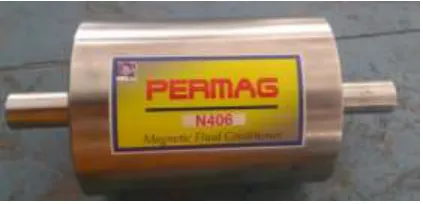
concrete. For this alternative solution magnetized water is placed. Magnetized water doesn’t mean water has acquired magnetic strength but that it has been subjected to a magnetic field which is found to change certain properties of water is shown in fig1. The mechanism of action the magnetic field are divided in three major groups- colloidal, ionic, water hypotheses. Here am choosing ionic group as magnetic field. Hence here PERMAG (N406) is used for the production of magnetic water.
The structure of water is aligned in one direction after magnetization, and the molecule sizes change after the bond angle changes from 1050 to 1030. It leads to a higher viscosity
was performed due to the broken hydrogen bonds after magnetization and also the water layer surrounding the cement is thinner than normal water molecules. Therefore less water demand which has positive effect of hardened concrete properties. The usage of magnetic water while mixing concrete will increase durability, compressive strength and also there will be higher workability for the same water cement ratio.
Fig-1: Effect of magnetic field on water molecules
Many researchers proved that the scaling property and corrosion phenomenon in magnetic water is greatly reduced if the water is passed through an intense magnetic flux which in turn changes the physical structure of water molecule and softens the hard water. This softening intensity is based on the magnitude of flux induced [16].
To achieve higher intensity and magnetization, water is made to recirculate by designing a setup with motor and auto transformer.
1.1 OBJECTIVES
© 2019, IRJET | Impact Factor value: 7.211 | ISO 9001:2008 Certified Journal | Page 1038
To examine the effects of magnetic water on properties of concrete.
To study the durability property of concrete using magnetic water.
2. Preparation of Magnetized Water
2.1 Magnetic device
Magnetic fields are produced by the motion of charged particles. For example, electrons flowing in a wire will produce a magnetic field surrounding the wire [12]. The magnetic fields generated by moving electrons.
Permanent magnets don’t use apply of electrical current. Instead, the magnetic field of a permanent magnet results from the mutual alignment of the very small magnetic fields produced by each of the atoms in the magnet. These atomic-level magnetic fields result principally from the spin and orbital movements of electrons [21].
Fig-2: Permag N406
2.2 Description of the Setup
The recirculating set up consists of a motor (0.5 HP) which performs the action of lifting water from the container and then make the water to flow through the magnetic flux which is fixed around the tube as shown in fig 4.5.This process of lifting water from the container and allowing it to flow through the magnetic flux is repeated for certain period of time. So the effect of flux induction will be more in water so that the harness in water reduces more. It is also illustrated in literature that the flow velocity should be around 0.6-1.0 m/s, so the instrument named auto-transformer is used in the setup to reduce and maintain the flow velocity within the range specified [21].
Fig-3: Preparation of Magnetized Water
3. Properties of Materials
The materials involved in this project are as follows with the respective test results,
1. Water (Normal & Magnetized water)
2. Cement
3. Coarse & Fine aggregate
[image:2.595.297.571.256.467.2]3.1 Physical Properties of Water
Table 1: Physical Properties of Water.
S.No Parameters(mg/lit) NW MW value as per Permissible code IS 3025
1. pH value 6.68 7.87 9
2. Hardness 533 325
500 3. Permanent harness 425 365
4. Total & dissolved solids 700&500 500&400 1500
5. Sulphate content 800 690 1500
6. Chloride content 338 192 1500 to 2000
3.2 Physical Properties of Cement
Table 2: Physical Properties of Cement.
S.No Parameters NW MW
Permissible value as per
code IS 12269-1987
1. Specific gravity 3.10 3.15
2. Standard consistency 29% 31% -
3. Initial setting time Mins 30 Mins 40 Min 30 Mins
[image:2.595.50.262.352.454.2]© 2019, IRJET | Impact Factor value: 7.211 | ISO 9001:2008 Certified Journal | Page 1039 3.3 Physical Properties of Fine Aggregate
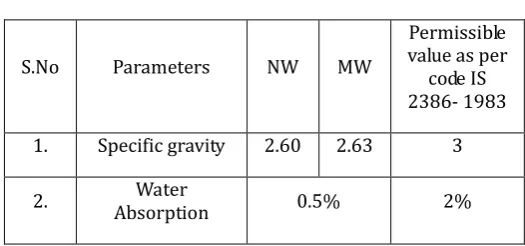
Table 3: Physical Properties of Fine Aggregate.
S.No Parameters NW MW
Permissible value as per
code IS 2386- 1983
1. Specific gravity 2.60 2.63 3
2. Absorption Water 0.5% 2%
3.4 Physical Properties of Coarse Aggregate
Table 4: Physical Properties of Coarse Aggregate.
S.No Parameters NW MW
Permissible value as per code IS 2386-
1983
1. Specific gravity 2.70 2.78 2.5 to 3%
2. Absorption Water 1.2% 0.2 to 2%
4. EXPEERIMENTAL INVERSTIGATIONS
4.1 Slump Cone Test
Slump test is a measurement of concrete workability. Table shows that an increase between 20% was achieved in slump when magnetic water is used. It is explained by the very fact that an additional same lattice of recent formations of hydrous cement minerals is developed once mixed with Magnetic Water.Plasticity levels depend on the quality of cement paste used and because magnetic treatment influences paste qualities, the level of concrete's plasticity change, when using Magnetic Water for kneading of cement [22].
Table 5: Slump Cone Test.
S.No Type of water Slump value (mm)
Slump
type Workability Degree of
1 Normal water 65 slump True Medium
2 Magnetized water 75 slump True Medium
4.2 Compressive Strength Test
The cube specimens are tested for compressive strength at 28 days. f = P/A N/mm2 the results of the
compressive strength tests on concrete cubes are shown in Table.
Table 6: Compressive Strength Test.
Type of Concrete
Compressive strength in
Mpa stresses in Average N/mm2 Spc 1 Spc 2 Spc 3
NWC 27.30 27.80 28.50 27.53
MWC 37.38 37.77 38.35 37.83
Inference: From the table, compressive strength of specimens using magnetized water is slightly greater than compressive strength of cubes using normal water, it’s by 37.41 % increase.
4.3 Durability Properties
In order to obtain the durability of magnetized water concrete the following tests have been conducted and test results were discussed.
Acid attack on concrete
Sulphate attack on concrete
Chloride attack on concrete
Rapid Chloride Penetration Test
Water absorption test
SEM & EADX analysis of concrete
4.3.1 Acid attack on concrete
The sulphuric acid solution was prepared by adding 3% sulphuric acid 1N (by volume of water) to 20 liters of distilled water. The concrete cubes were then immersed in 3% sulphuric acid solution for a period of 90 days. The observations were then made after 90days from the date of immersion in sulphuric acid solution. After taking out from immersion and drying, the surfaces of the cubes were cleaned and they were kept in room temperature for a period of 24 hours, the compressive strength and loss of weight were calculated.
© 2019, IRJET | Impact Factor value: 7.211 | ISO 9001:2008 Certified Journal | Page 1040
Fig-4: Compressive Strength Loss After Acid Attack
4.3.2 Chloride attack on Concrete
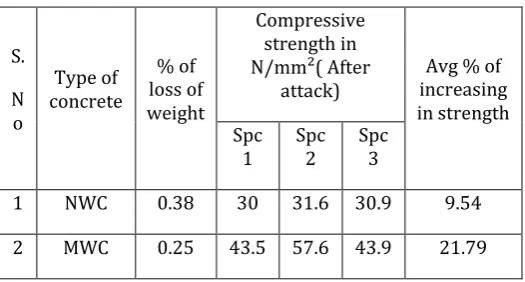
The NaCl solution was prepared by adding 3% sodium chloride salt (by volume of water) to 30 liters of distilled water. In this experimental study on the concrete cubes were immersed in 3% sodium chloride (1N NaCl) solution for a period of 90 days. The observations were then made after 90days from the date of immersion in sodium chloride solution. After taking out from immersion and drying, the surfaces of the cubes were cleaned and they were kept in room temperature for a period of 24 hours.
Table 7: Chloride Attack on Concrete.
Inference: From the table, the average percentage of increasing compressive strength of magnetized water concrete is 21.79 are greater than normal water concrete of 9.54.
4.3.3 Sulphate Attack on Concrete
Sulphate attack test was carried out by using the concrete cubes of sizes 150 mm × 150 mm ×150 mm. the concrete cubes were dried in normal room temperature after 28 days of curing and the weight (W1) of cubes was noted. The sodium sulphate solution was prepared by adding 3% of MgSo4 (by volume of the water) to 30 liters of distilled water.
In this experimental study, the concrete cubes were immersed in magnesium sulphate solution for a period of 90 days. The observations were then made after a period of 90
days from the date of immersion in magnesium sulphate solution. A characteristic whitish appearance was the indication of sulphate attack. After taking out from immersion and drying, the surfaces of the cubes were cleaned and they were kept in room temperature for a period of 24 hours.
Fig-5: Compressive Strength Loss After Sulphate Attack
Inference: Above table are shows the decreasing weight of specimens using magnetized water concrete are slightly greater about 0.75% than normal water concrete of 3.52%. The decreasing compressive strength of specimen using magnetized water concrete is decreased about 0.75% than normal water concrete of 2.7%.
4.3.4 Rapid chloride penetration test
The rapid chloride penetration test (RCPT) was performed as per ASTM C 1202 to determine the electrical conductance of normal water concrete and magnetized water concrete at an age of 28 days curing and to provide a rapid indication of its resistance to the penetration of chloride ions.
In this method consisted of monitoring the amount of electrical current passed through 51mm thick slices of 102mm nominal diameter of cylindrical specimens for duration of six hours. The rapid chloride penetration test apparatus consisted of two reservoirs. The specimen was fixed between two reservoirs. The specimen was fixed between two reservoirs using an epoxy bonding agent to make the test set up leak proof. One reservoir (connected to the positive terminal of the direct current source) was filled with 0.3 N sodium hydroxide solutions and the other reservoir (connected to the negative terminal of the direct current source) with 3% sodium chloride solution. A DC of 60V was applied and maintained across the specimen by using two stainless steel electrodes (meshes) and the current across the specimen was recorded at 30 minutes interval for duration of six hours.
S.
N o
Type of concrete
% of loss of weight
Compressive strength in N/mm²( After
attack)
Avg % of increasing in strength Spc
1 Spc 2 Spc 3
1 NWC 0.38 30 31.6 30.9 9.54
[image:4.595.320.547.180.300.2] [image:4.595.31.294.432.573.2]© 2019, IRJET | Impact Factor value: 7.211 | ISO 9001:2008 Certified Journal | Page 1041
Table 8: RCPT Test
S.no concrete Type of
% increase of weight
after RCPT test
RCPT values in coulombs
Chloride ion penetrability
1 NWC 1.07 3013.90 Moderate
2 MWC 0.72 1782.66 Low
Inference: From the table, the rate of chloride ion penetration of magnetized water concrete is very lower than normal water concrete.
Fig-6: RCPT Test
4.3.5 Water absorption test on concrete
[image:5.595.334.531.250.404.2] [image:5.595.42.280.291.413.2]Water absorption is one of the important parameters, which affects the durability of the structure due to the corrosion of steel reinforcement. The test specimens of 150mm x 150mm x 150mm cubes were dried at a temperature of 105°c for a period of 72 hours with the help of an oven. The dried specimens were cooled at the room temperature and the corresponding dry weight was noted. The dried specimens were immersed in water for a period of 24 hours. After 24 hours the weight of the concrete cubes was taken.
Table 9: Water Absorption of Concrete.
S.No concrete Type of
% of water
absorption at 28 days Avg % of water absorption Spc 1 Spc 2 Spc 3
1 NWC 2.69 2.84 2.11 2.546
2 MWC 1.77 1.33 1.23 1.44
Inference: From the test results, it has been absorbed that the capillary rise of water is stopped after the third day of immersion. Good concrete according to BS 1881-Part 5 has absorption values of less than 3%.The percentage of water
absorbed of magnetized water concrete was lower when compared normal water concrete.
4.3.6 SEM & EADX analysis on concrete
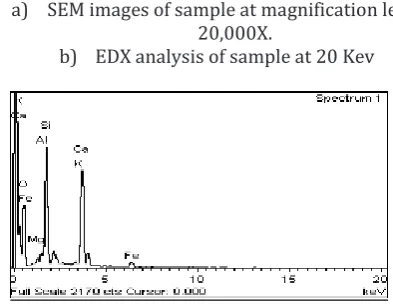
Scanning Electron Microscope (SEM) analysis can be used to visualize the presence of calcite crystals precipitated on concrete specimens. The broken pieces of cube specimens obtained from compressive strength test and the precipitates in the cracks of concrete specimens, used for quantification of crack healing test were collected and subjected to SEM and EDX analysis.
a) SEM images of sample at magnification level
20,000X.
b) EDX analysis of sample at 20 Kev
Fig -7: a) SEM& b) EADX analysis of sample
Table 10 Percentage of concentration values driven from EDX analysis
S.no Element X-ray line Compound % Formula
1 K –k 19 Na2O
2 Mg – k 13 MgO
3 Si – k 14 SiO2
4 Ca- k 20 CaO
5 Fe – k 26 Fe
6 O – k 8 O2
[image:5.595.312.558.462.775.2] [image:5.595.39.286.600.706.2]© 2019, IRJET | Impact Factor value: 7.211 | ISO 9001:2008 Certified Journal | Page 1042
Inference: The SEM image of magnetized water concrete sample presents large amounts of white blackly crystals with the fine granular crystals on the surface, shown in figure 6.10. The EDS analysis identifies the existence of sodium, silicon, calcium and sulfur. According to the EDS results, it is supposed that these white blackly crystals are gypsum and mirabilite, and the fine granular crystals are thenardite, and the bar-like particles are ettringite. There are large quantities of needle-like crystals, as well as some white crystals with the fine granular particles on the surface. According to the EDS analysis, these needle-like crystals are ettringite, and the white crystals are gypsum and mirabilite, and the fine granular particles are thenardite.
5. CONCLUSIONS
The following conclusions were drawn within the limitation of experimental investigations. From the research study carried out, it was compared that the concrete with normal and magnetized water has shown improvements in the strength and durability characteristics of concrete.
As the recirculation time is increases, when the pH value of magnetized water also increases from 6.68 to 7.87 about 1 hour.
The workability of concrete is increases than normal water, when the slump value of magnetized water is 75mm with water/cement ratio 0.30.
The average compressive strength of specimens using magnetized water is 37.41 % slightly greater than compressive strength of cubes using normal water.
The performance of acid attack, the average decreasing percentage of compressive strength using magnetized water concrete is 0.75 slightly lower than normal water concrete of 6.48.
For durability properties to compare the concrete with magnetized water concrete are shows better results than normal water concrete.
The recirculation period is increases, and then the salt and mineral content are reduced. In this technology, greatly achieve the durability and strength of concrete without adding any chemicals. And it is one of the cost-effective and eco-friendly technologies.
6.
REFERENCES
[1] Arunkarthik G (April 2017),"Experimental Study on Flexural Behaviour of Reinforced Concrete Beam Using Magnetic Water", International Journal of Civil Engineering and Technology, Vol. 08, No. 04, pp: 518–525.
[2] D. Kornack and P. Rakic, “Cell Proliferation without Neurogenesis in Adult Primate Neo cortex,” Science, vol. 294, Dec. 2001, pp. 2127-2130, doi:10.1126/science.1065467.
[3] Harsha Rand Sruthi D.K(April 2017),"An Experimental Study on the Use of Magnetized Water in Concrete with M Sand as Fine Aggregate", International organization of Scientific Research, Vol. 08, No. 06, pp:26–32.
[4] IS 10262-2009, Indian Standard recommended guidelines for concrete mix design, Bureau of Indian Standards.
[5] IS 516-1956, Indian Standard method of tests for strength of concrete, edition (1991-2007), Bureau of Indian Standards.
[6] IS: 2386 (Part V) -1963, Indian Standard method of test for aggregates for concrete Bureau of Indian Standards.
[7] IS 383-1970, Indian Standard method of test for strength of concrete, Bureau of Indian Standards.
[8] IS 12269-2013, Indian Standard for ordinary Portland cements 53 grade-specifications, Bureau of Indian Standards. [9] IS 7320-1974, Indian Standard method of test for slump cone test, Bureau of Indian Standards.
[10] IS 456-2000,Indian Standard code for practice for plain and reinforcement concrete, Bureau of Indian Standards. [11] Manjupriya T and Malathy R (March 2016)"Experimental investigation on strength and shrinkage properties of concrete mixed with magnetically treated water", Journal of Structural Engineering and Management, Vol. 03, No. 02.
[12] Malathy R, Karupasamy N and Baranidharan S (2017),"Effect of Magnetic Water on Mixing and Curing of M25 Grade Concrete", International Journal of Chem Tech Research CODEN Journal of Structural Engineering and Management, Vol. 10, No. 11, pp:131-139.
[13] Masoud R, Reza T, Omid S and Yahya S(2014), "Evaluation of magnetic field on water hardness and some characteristics of concrete", International Research Journal of Applied and Basic Sciences, Vol. 08, No. 11, pp:1886-1890. [14] Joyson albino A , Navaneethan K S(Oct 2017), “Experimental Inverstigation on Strain Hardening Polymer Composite”, International research Journal of Engineering and Technology, Volume 05, Issue 01.
[15] M. Young, The Technical Writer’s Handbook. Mill Valley, CA: University Science, 1989.
[16] Nan Su Wu Y.H and Mar C.Y (2003) “Effect of Magnetic Field Treated Water on Mortar and Concrete Containing Fly Ash”, Cement and Concrete Composites, Volume 25, Issue 7,Pages (681-688).
© 2019, IRJET | Impact Factor value: 7.211 | ISO 9001:2008 Certified Journal | Page 1043 [18] Samkit D, Bafna, Nutan J and Pathak (Oct 2017),
“Experimental Inverstigation to enhance compressive strength of concrete blended with plastic waste using magnetized water”, International Journal of Engineering and Technology, Volume 04, Issue 10.
[19] Siddharth P and Nutan J.P (January 2017), “Experimental investigation of properties of concrete cast in magnetic water”, International Journal of Science Technology & Engineering, Vol. 07, pp:01-04.
[20] Siva, B Vishali and G Sudarsana (December 2014), “Use of magnetic water for mixing and curing of concrete”, International Journal of Advanced Engineering Research and Studies, pp: 93-95.
[21] Srinidhi.P, Navaneethan K S, Deeran ampikapathi G, Anandha kumar S (April 2019) “comparative study on concrete materials using normal & magnetized water”.
[22] Srinidhi.P, Gokulapriya K, Pathiban P (April 2019) “Experimental Study on Strength Enhancement of Concrete by using Magnetic Water and Coconut Fiber”.
[23] Shetty M.S "Concrete Technology".
[24] Taghried, M Rabab, M, Abeer A, Mohammed E and Najla M (2017),"Effect of Magnetized Water on Workability and Compressive Strength of concrete", International Conference on Analytical Models and New Concepts in Concrete and Masonry Structures, pp:494-500.
[25] Venkat R A(2015),"Optimizing of fly ash content in different grades of magnetic water concrete", International Journal of Engineering Science and Computing, Vol. 04, No -13.