ISSN Online: 2153-120X ISSN Print: 2153-1196
DOI: 10.4236/jmp.2018.98102 Jul. 24, 2018 1633 Journal of Modern Physics
Periodic System of Atoms in Biquaternionic
Representation
Lyudmila Alexeyeva
Institute of Mathematics and Mathematical Modeling, Almaty, Kazakhstan
Abstract
Private monochromatic solutions of the free-field equation of elec-tro-gravimagnetic charges and currents are constructed in the differential al-gebra of biquaternions, which describe elementary particles as standing elec-tro-gravimagnetic waves. The two classes of solutions of this biquaternionic wave equation have been investigated, generated by scalar potentials (pulsars) and vectorial potentials (spinors). Their asymptotic properties are considered, on the base of which they are classified into heavy (boson) and light (lepton) elementary particles. The biquaternion representation of the hydrogen atom is given. The periodic system of elements is produced, which is built on the principle of the musical structure of a simple gamma.
Keywords
Biquaternion, Elementary Particle, Frequency, Standing EGM-Wave, Pulsar, Spinor, Boson, Lepton, Atom, Hydrogen, Periodic System, Musical Scale
1. Introduction
In [1] [2] [3], the author developed a biquaternion model of the electro- gravimagnetic field (EGM-field) and electro-gravimagnetic interactions. Its basis is made up of biquaternion representations of the generalized Maxwell and Dirac equations. The biquaternion representation of the Maxwell equations expresses the biquaternion of the mass-charge density and the EGM-current through the bigradient of the EGM-field tension. The biquaternionic represen- tation of Dirac equations determines the transformation of the density of mass charges and currents under the influence of external EGM-fields. In particular, in the absence of external fields, it is the biquaternionic wave (biwave) equation for the free field of mass-charges and currents, which is a field analogue of first Newton’s law (inertia law).
How to cite this paper: Alexeyeva, L. (2018) Periodic System of Atoms in Biqua-ternionic Representation. Journal of Mod-ern Physics, 9, 1633-1644.
https://doi.org/10.4236/jmp.2018.98102 Received: June 6, 2018
Accepted: July 21, 2018 Published: July 24, 2018 Copyright © 2018 by author and Scientific Research Publishing Inc. This work is licensed under the Creative Commons Attribution International License (CC BY 4.0).
http://creativecommons.org/licenses/by/4.0/
DOI: 10.4236/jmp.2018.98102 1634 Journal of Modern Physics
Here we construct particular monochromatic solutions of this equation that describe elementary particles as standing EGM-waves. They can be divided into two class, generated by scalar potentials (pulsars) and vector ones (spinors). Their asymptotic properties are investigated, on the basis of which they are classified into heavy (bosons) and light (leptons) elementary particles. It is shown that bosons are spherical harmonic pulsars whose mass-charge density is determined by their frequency of oscillations. This allows us to build periodic systems of elementary particles based on the classical harmonic musical scale.
In particular, the biquaternion representation of the hydrogen atom is given and the periodic system is produced, which is built on the principle of the musical structure of a simple harmonic scale.
2. Inertia Law for Monochromatic Fields of
Charges-Currents
The equation for the free field of charge-currents has the form of a homogeneous biwave equation [1][2]:
( ) (
τ,x τ i)
(
iρ τ( )
,x J( )
τ,x)
0−
∇ Θ ∂ − ∇ + = (1)
Here, Θ
( )
τ,x is the biquaternion of the charge-current, the secular part of whichρ τ
( )
,x describes the density of the electric and gravimagnetic charge (EGM-charge or mass-charge), and the vector J( )
τ
,x is the density of the electric and gravimagnetic current (EGM-current), more exactly:1 E i H,
ρ ρ ρ
ε µ
= −
,
E H
J= µj −i εj
where
ρ
E( ) ( )
x t j x t, , E , are the electric charge and electric current densities,( )
, ,( )
,H x t j x tH
ρ
are the gravimagnetic charge density and current density;,
ε µ
are the constants of electric conductivity and magnetic permeability ofvacuum, c=1 εµ is speed of light, i is imaginary unit.
The action of the biquaternion differential operators ∇− and ∇+ (mutual
bigradients) is determined, according to the quaternion multiplication rule (see Appendix), by the formula
( ) (
)
(
( )
( )
)
(
) {
}
F , , ,
div grad rot
x i f x F x
f i F i f F i F
τ
τ τ
τ τ τ
±
∇ = ∂ ± ∇ +
= ∂ + ± + ∂ ±
The biquaternion of the energy-momentum of the F-field is given by
( )
τ
,x W( )
τ
,x iP( )
τ
,x 0.5F F ,*Σ = +
where F* is the conjugate biquaternion
( )
( )
*
F f
τ
,x F−τ
, .xHere the bar over the symbol means complex conjugation.
DOI: 10.4236/jmp.2018.98102 1635 Journal of Modern Physics
vector is constructed in the biquaternionic representation of the electromagnetic field (in detail about the differential algebra of biquaternions with an application in electrodynamics, see [4]).
The scalar part of the Equation (1) is the law of conservation of the EGM-charge:
divJ 0,
τρ
∂ + =
and the vectorial part describes the relationship between charges and currents in the absence of external EGM-fields:
rot grad 0.
J i J
τ ρ
∂ − + =
For monochromatic fields of frequency ω , the biquaternion of the charge-current can be represented in the form
( )
τ,x(
x, expω)
(
iωτ)
, ω 0.Θ Θ > (2)
In this case, from the Equation (2) we obtain the equation for biquaternions of complex amplitudes ( biamplitudes) Θ
(
x,ω)
:(
ω− ∇)
(
i xρ( )
+J x( )
)
=0. As(
ω
+ ∇) (
ω
− ∇ =) (
ω
− ∇) (
ω
+ ∇ =)
ω
2+ ∆,it follows that the biamplitudes satisfy the Helmholtz equation
2 0
ω
∆Θ + Θ =
and monochromatic solutions have the form:
( )
( )(
)
0(
)
3(
)
1
, exp , j , ,
j j
x i x x e
τ
ωτ ω
ψ
ω
ψ
ω
=
Θ = + ∇ +
∑
(3)
where the potentials ψj are arbitrary solutions of the homogeneous Helmholtz
equation
2 0,
ψ ω ψ
∆ + =
which have the form of a surface integral
(
,)
(
, e)
i x( ), d( )
j x j ξ S
ξ ω
ψ ω ϕ ξ ω − ξ
=
=
∫
(4)for any function φj that is integrable on a sphere of radius ω.
3. Biquaternions of Harmonic Elementary Particles
We consider particular solutions of the Helmholtz equation [5][6]
(
,)
( ) ( )
m ,nm x jn r Yn
ψ
ω
=ω
ϑ φ
(5)where jn
( )
ωr are spherical Bessel functions of order n=0,1,2,; Ynm(
ϑ φ
,)
-spherical harmonics of order
(
n m m,)
, =0,1,2,( )
,(
cos exp)
( )
m m
n n
Y
ϑ φ
=Pϑ
imφ
( )
...m n
DOI: 10.4236/jmp.2018.98102 1636 Journal of Modern Physics
coordinates.
It is natural to take these solutions for the construction of elementary particles, which can be called harmonic. Among them we select the ones generated by the scalar potential, which we call pulsars:
(
) (
)
(
)
(
)
(
)
0 , ,
, grad ,
nm nm
nm nm
x x
x x
ω
ω
ψ
ω
ωψ
ω
ψ
ω
Θ = + ∇
= +
(6)
and particles, generated by a vector potential, we call spinors:
(
) (
)
(
)
(
)
(
)
{
(
)
(
(
)
)
}
, ,
div , , rot ,
j
nm nm j
nm j nm j nm j
x x e
x e x e x e
ω ω ψ ω
ψ ω ωψ ω ψ ω
Θ = + ∇
= − + +
(7)
The latter are polarized in the direction of the coordinate axes, respectively, to the index j=1,2,3.
4. Biquaternions of Monochromatic Structures. Crystals
Using structural biquaternions of arbitrary form K
( )
x , on their basis, by the operation of biquaternion convolution(
)
( ) (
) (
)
(
)
{
3}
{
3(
)
}
1 , , 1
, K
j j jlm j l m
j j l m
x x i J k K
i k J K i K J k J K e
ω ρ
ρ = ρ =ε
Θ ∗ = + ∗ +
= ∗ −
∑
∗ + ∗ + ∗ +∑
∗ (8)where εjlm is the Levi-Civita pseudo-tensor, it is possible to construct a variety
of monochromatic fields of charge-currents:
(
)
3(
)
( )
0
, j , K
nm j
j
xω xω x
=
Θ =
∑
Θ ∗ (9)In (8) there are functional convolutions, which for integrable functions have the integral form:
( ) ( )
x k x R3( ) (
y k x y y y y)
d d d1 2 3ρ ∗ =
∫
ρ −Component convolutions for vectors are written similarly. By virtue of the differentiation property of convolution, the convolutions (9) are also solutions of the equations (1).
Formulas (9) allow us to construct various crystal lattices from harmonic elementary particles, if we take lattices as the structural biquaternion the different shifts of the δ-function, and other generalized functions.
We give here a simple example of an inhomogeneous rectangular lattice with variable step
(
h h hl, ,m n)
and weight almn:( )
(
1) (
2) (
3)
0 0 0
K L M N lmn
l m n
l m n
x a δ x h δ x h δ x h
= = =
=
∑ ∑ ∑
− − −It corresponds, for example, to such a crystalline ω-pulsar
(
)
0(
)
1 2 3
0 0 0
, L M N lmn , , ,
l m n
l m n
xω a θ x lh x mh x nh ω
= = =
Θ =
∑ ∑ ∑
− − −DOI: 10.4236/jmp.2018.98102 1637 Journal of Modern Physics
more details, see [2]). And their frequency superpositions are generally immeasu- rable.
5. Elementary Spherical Harmonic Pulsars and Their
Properties
Among the solutions of the Helmholtz Equations (7), only one is spherically symmetric [5]. It is
(
)
( )
00 x, j0 r sinrr
ω
ψ ω ω
ω
= = (10)
Here 2 2 2
1 2 3
r= x = x +x +x , j0
( )
ωr are spherical Bessel functions. The biamplitude of the corresponding pulsar is(
) (
)
(
)
0
00
2
, ,
sin gradsin sin cos sin ,
x x
x x
r r r r r e e x r
r r r r r
ω ω ψ ω
ω ω ω ω ω
ω
ω ω ω
Θ = + ∇
= + = = + − =
(11)
Whence follows
0 0 1
1 1 sin cos sin r x ei
i J r r r e
r
ωτ
ω
ρ ω ω
ω − + = + − 0 0 2
sin e ,i cos sin e i
x
i r J r r e
r r r
ωτ ωτ
ω ω ω
ρ ω − = − = − 0 0 2
sin r , J cos r sin r
r r r
ω ω ω
ρ
ω
⇒ = = −
We denote by
( )
cos sinz 1( )
.j z z z j z
z
= − = −
Calculating the biquaternion of its energy-momentum
(
)
( )
( )
(
)
(
( )
)
( )
(
)
( )
{
( )
( )
[
]
}
*0 0 0 0 0
2
2 2 2
2
, 0.5 e e
0.5 sin sin
0.5 sin sin
sin , ,
i i
x x
x
x x x
x W iP
r r j r e r j r e
r r j r r j r e
r j r e j r e e
ωτ ωτ
ω
ω ω ω ω
ω ω ω ω
ω ω ω
−
−
−
Ξ = + = Θ Θ
+ − = + + − − we get
( )
(
)
0 0.5 2 sin2 2 , 0.
W = r− ωr j+ ωr P≡ (12)
It follows from (11)-(12) that the density of the mass-charge decreases as r−1
by increasing r, and the oscillation energy decays even more rapidly, as r−2.
It is interesting to investigate the asymptotic of these quantities as 0,
r→ ω=const. Since
( ) ( ) ( )
( )
( )
( )
2 1
2 3 2
sin cos
1 1 ~ 0,
2 6 3
r
j r r j r r
r
r r r
r r
ω
ω ω ω ω
ω
ω ω ω
ω
= = −
= − − + + − →
DOI: 10.4236/jmp.2018.98102 1638 Journal of Modern Physics
from (11) and (13) we obtain: by r→0
( )
0 o r ~ ,
ρ = +ω ω ω
2 2 3 3
0 2 2 2
2
0.5 6 0.5 6 ~2 ,
3
r r r r
J r r
r r
ω ω ω ω ω ω ω
ω
+ −
≈ − ≈ +
(
2 4 2)
2~ 0.5 9 ~ 0.5 .
W ω +ω r ω
Let us now list these properties.
The properties of spherical pulsars. In spherical harmonic pulsars at the center at x=0, the mass-charge density is equal to its oscillation frequency ω; the density of the EGM-current is zero; the energy density is equal to 0.5ω2; and
the Poynting vector equal to zero everywhere.
Proceeding from these properties of mass-charge density, spherical harmonic pulsars are heavy elementary particles—bosons.
Non-spherical harmonic pulsars (6) for n>0 have zero density at x=0, because [5]
( ) (
2 1 !!)
(
1( )
)
0.n
n z
j z o z z
n
= + →
+
They are light elementary particles—leptons.
6. Elementary Spherical Harmonic Spinors and Their
Properties
Consider a spinor polarized in direction X1:
( )
(
)
0 0 0 0
1 x t, i
ρ
1 J1 1 x, e ,ω
iωτΘ = + = Θ
whose biamplitude is
(
) (
)
( )
( )
(
)
( )
(
( )
)
(
)
0
1 0 1
0 1 0 1 0 1
1 2
1 2 3 2 2 3
,
div rot
cos sin
,
sin cos sin , , , , j
j
x j r e
j r e j r e j r e
r r
r
r r
x
re r r r e r e r
r r r x
ω ω ω
ω ω ω ω
ω ω
ω
ω ω ω
ω
Θ = + ∇
= − + +
= − −
+ + − − =
(14)
Whence follows
( )
0 1 1 ix j rr2 ,ρ
= −ω
( )(
)
(
)
0 1
1 1sin ,3 2 ,2 3 ;
J =r e− ωr j r r e r e+ ω −
( )
2( )
(
22 32)
0 1 2
1 2 4
, , sin x x
r j r J r j r
r r r
ω
ρ = ω = + ω +
We calculate the biquaternion of the energy-momentum and its asymptotic:
(
)
0 0 0
1 x,
ω
W1 iP1,DOI: 10.4236/jmp.2018.98102 1639 Journal of Modern Physics
( )
( )
(
)
( )
(
)
( )
(
)
2 2 2 2 2 30 1 2 2
1 2 4
2 2 2
2
1 2 3
2
2 4
2 2 2
, sin 2 sin sin . x x r r
W j r j r
r
r r
x x x
r j r
r r
r r j r
ω ω ω
ω ω ω ω − + = + + + + = + = + 0 1 0. P ≡
We construct their asymptotic for r→0 with allowance (13):
2 2 3 3
0 1 2
1 2 1
1
~ 1 1 0,
2 6 3
x r r x
r r
ω
ω
ρ
ω
ω
− − + = → ( ) ( )
2 4(
2 2)
2 3 2 4 ~ ~ , 9 x x r r J r rω
ω
ω
ω
+ + →( )
(
( )
)
( )
( )
( )
2 3 32 2 2
2 2 4 2
2 6 8 1 2 ~ 1 6 2
1 1 2 4 1 1 1 ~ 0.5 .
3 3 36
2 r r r r W r r r r
r r r
r
ω ω
ω ω
ω ω ω
ω ω ω ω
− − + + = − + + − +
Following (14), we easily obtain a biquaternion representation of the spherical spinor polarized along the vector e e, =1:
(
) (
)
( )
( )
(
)
( )
(
( )
)
0
0
0 0 0
0 0
,
div rot
e
e e
x j r e
j r e j r e j r e
i J
ω ω ω
ω ω ω ω
ρ
Θ = + ∇
= − + +
= +
where
( )
(
( )
)
0 x , 0 1 sin
e e j r J r er e r j r jkl j k lx x e
ρ
= −ω
= −ω
+ω ε
with the same asymptotic properties.
So we have the following properties of the constructed spinors.
Properties of harmonic spherical spinors. For spherical harmonic spinors at the center (for x=0), the mass-charge density is zero, the norm of the density
of the EGM-current vector is ω, the energy density is ω2 2, the Poynting
vector is equal to zero.
Thus, spherical harmonic spinors in terms of the density of the EGM-charge belong to light elementary particles—leptons.
7. Biquaternion Model of the Hydrogen Atom
DOI: 10.4236/jmp.2018.98102 1640 Journal of Modern Physics
The simplest atom is hydrogen (H). The simplest harmonic elementary particle is the above described spherical pulsar. I think they can be identified, namely:
The hydrogen atom is a spherical harmonic pulsar with fixed oscillation frequency ωH0. It has the following biquaternionic representation
( )
0 00 0
0 1
0
sin
H , sin cos H ei H .
H H x
H r
x r r r e
r
ω τ
ω
τ ω ω
ω
−
= + −
(16)
The asymptotic properties of its density at the center of an atom are related to the frequency of the oscillations:
( )
( )
( )
0 0 0 0
2 2
2
, ~ , , ~ , ~ 0.5 , 0.
3
H x H JH x r WH x r
ρ τ ω τ ω ω → (17)
The nodes of this standing wave with respect to the mass density ρH0 are spheres whose radius is determined by a simple trigonometric equation
0
0 π
sin H k 0 k , 1,2,
H k
r r k
ω
ω
= ⇒ = =
To determine the nodes of this standing wave from the energy density WH0, it
is necessary to find the zeros of the more complicated equation:
0 0 0 0
2 2 sin 2 sin2 0
H kr H kr H kr H kr
ω +ω ω − ω = (18)
where 0 k k H z
r =ω , zk are the roots of the transcendental equation:
( )
2 sin 2 sin2 0f z =z +z z− z=
However, this equation has no real roots.
Using the representation of complex charges and currents through electric and gravimagnetic charges and currents (1), we obtain for the hydrogen atom the following expressions for its electric and gravimagnetic charges, electric and gravimagnetic currents:
( )
( )
0 0 0 0 0 0, cos sin ,
, sin sin
H E H H H H H H w x
t x w t
r c
w x
t x w t
r c ε ρ µ ρ = − =
( )
( )
0 0 0 0 0 0 0 0 0 0 1, cos cos sin
1
, sin cos sin
H H
E
H H x
H
H H
H
H H x
H
w x c w x
J t x w t e
c w r c
r
w x c w x
J t x w t e
c w r c
r µ ε = − = − −
Accordingly, in the initial space-time, the biquaternion of hydrogen has the form:
( )
0(
)
(
)
(
0)
0 0
0
0
sin e
H , H sin cos .
iw t
H
H H x
H
c w r c
t x w r c w r c e
r w r
DOI: 10.4236/jmp.2018.98102 1641 Journal of Modern Physics
Here ex=x x , vibration frequency of a hydrogen atom wH0 =cωH0.
Accordingly (17), by r→0
( )
( )
(
)
( )
(
0)
0 0 0 0 0
2 2
2
, ~ , , ~ , ~ .
3 2
H
H H H H H
cw
x cw J x cw r W x
ρ
τ
τ
Note that the energy density contains the square of the speed of light. Since the mass-charge density is determined by the oscillation frequency, the last formula correlates with the known Einstein’s formula for the total energy of a body with a fixed mass.
8. Biquaternion Representation of Atoms. Simple Gamma
So, in the biquaternionic representation, the hydrogen atom is a spherical harmonic standing wave with a fixed frequency in the field of EGM charge- currents.
Since the main characteristic of the hydrogen atom is the oscillation frequency, which determines its mass, on its basis it is possible to construct a periodic system for atoms of substances according to the principle of the musical scale. As the frequency of vibrations increases, the mass of the atom increases.
The musical scale is a system of octaves with frequency doubling for each subsequent octave:
0,2 0,4 0,8 0,16 0,
H H H H H
ω ω ω ω ω
The ratio of vibration frequencies for atoms inside the n-octave:
0 0
1
2n , ,2n
H H
ω ω
−
like the ratio of tone frequencies within the musical scale. Number of tones in the musical scale depends on the type of musical system.
There are many musical structures, which are largely related to the national peculiarities of the musical perception of the peoples who created them. Here in
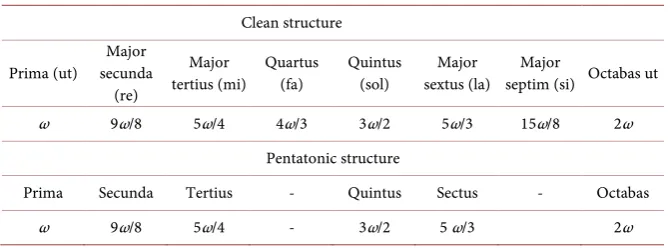
Table 1 two musical systems are given ( simple gamma, [7]), which can be taken as a basis, in which the ratio frequency of tones is a rational number. For such tones (notes), there is the total period of oscillations, which is determined by the least common multiple for the period their harmonies, which makes it possible to harmoniously sound the accords from different notes. For each of them, in nature, there are substances that possess the described above properties. Which of them corresponds to Mendeleyev’s periodic table? It should be the subject of a special study for specialists in area of physical chemistry, spectral properties of substances.
DOI: 10.4236/jmp.2018.98102 1642 Journal of Modern Physics Table 1. Simple gamma.
Clean structure
Prima (ut) secunda Major (re)
Major
tertius (mi) Quartus (fa) Quintus (sol) sextus (la) Major septim (si) Octabas ut Major ω 9ω/8 5ω/4 4ω/3 3ω/2 5ω/3 15ω/8 2ω
Pentatonic structure
Prima Secunda Tertius - Quintus Sectus - Octabas
ω 9ω/8 5ω/4 - 3ω/2 5 ω/3 2ω
Proceeding from this, the atoms can be called musical elementary particles with the appropriate names. The hydrogen atom is the note ut of the first natural octave. Correspondingly, the biquaternion of the k-th atom in the n-th octave has the form
( )
(
)
, 1 sin
Atomn k , eiw tnk sin nk cos nk nk .
x nk
c w r c
w w
t x r r e
r c c w r
= − + −
Here the frequency of oscillations of the atom
0
2n ,
nk k H
w = γ w
where γk is the k-th coefficient in the table of the corresponding musical scale.
For it, all the above formulas for a spherical harmonic pulsar are correct by the frequency of oscillations corresponding to it.
9. Conclusions
How many such natural octaves exist? Obviously, no less than the number of rows in the periodic system of Mendeleyev.
Let us note that the twelve-tempered musical scale, now accepted in classical music, with twelve notes inside the octave, can not be taken, since the ratio of frequencies of consecutive tones in it is a number irrational 122 and the
general period of oscillation for any set of tones in the octave does not exist. Complete harmonious sound in this system can not be achieved. This is well known to the orchestral musicians of strings and wind instruments, the sound of which is determined by the above described musical arrangements. As is known, with disproportionate oscillation frequencies, beats occur.
Such periodic systems can be constructed for elementary harmonic leptons (spinors and asymmetric pulsars), whose addition to atoms with the same vibration frequency apparently creates isotopes of these atoms. Moreover, the addition of the spinors is connected with the magnetization of matter. It is possible to construct many different isotopes with the same asymptotic density of the EGM charge. Which of them exist in nature is also a matter of special experimental research.
DOI: 10.4236/jmp.2018.98102 1643 Journal of Modern Physics
of external fields, charges and currents are transformed. Their transformation is described by the generalized Dirac equation (see [3]). In particular, under the influence of stationary EGM-fields, the oscillation spectrum shifts, which should be taken into account in the experimental substantiation of the model, are considered here.
At present, the most widespread and canonized representations of light and heavy elementary particles and atoms are constructed on the basis of solutions of the equations of quantum field theory. The bibliography in this direction is half a century old and very extensive. Here we use the names for heavy and light particles adopted in this theory. However, the represented biquaternion model is completely different, deterministic, based on the determination of the real physical characteristics of elementary particles and atoms, rather than probabilistic ones.
References
[1] Alexeyeva, L.A. (2009) Journal of Physical Mathematics, 1, Article ID: S090604. [2] Alexeyeva, L.A. (2016) Journal of Modern Physics, 7, 435-444.
https://doi.org/10.4236/jmp.2016.75045
[3] Alexeyeva, L.A. (2016) Journal of Modern Physics, 7, 1351-1358.
https://doi.org/10.4236/jmp.2016.711121
[4] Alexeyeva, L.A. (2012) Clifford Analysis, Clifford Algebras and their Applications, 7, 19-39.
[5] Abramowitz, M. and Stegun, I., Eds. (1964) Handbook on Mathematical Functions. National Buro of Standards, Applied Mathematical Series, 55.
[6] Vladimirov, V.S. (1978) Generalized Functions in Mathematical Physics. Nauka, Moscow.
DOI: 10.4236/jmp.2018.98102 1644 Journal of Modern Physics
Appendix
To use biquaternions algebra we give here some definitions.
We consider on Minkowski space =
{
( )
τ,x}
the functional space of biquaternions in hamiltonian form:( )
={
F f=( )
τ,x +F( )
τ,x}
f is a complex function, 3 1 j j j
F=
∑
=F e —a three-dimensional complex vector-function; x=
∑
3j=1x ej j, e0=1, e e e1, ,2 3 are basic elements.We assume f
( ) ( )
τ, ,x Fj τ,x are locally integrable and differentiable on or, in general case, they are generalized functions.
Summation and quaternionic multiplication are defined as
(
f F)
(
b B) (
f b) (
F B)
,αF+βB=α + +β + α + β + α +β
(
f F) (
b B)
fb F B(
,)
fB bF[
F B, ,]
= + + − + + +
F B
where
(
F B,)
=F B F Bj j, ,[
]
=jkl j k le F B are usual scalar and vector productionsin R3 (here over repeated indexes there are summation from 1 to 3,
jkl
is Levi-Civita symbol).
The norm and pseudonorm of Bq. are denoted
(
)
2 2 2 2 2 2
F = f + F , F = f − F , f = ff, F = F F, .
We’ll use convolution of biquaternions:
(
j j)
j j j j jkl j k l.f b F B f B e b F e e F B
∗ = ∗ − ∗ + ∗ + ∗ + ∗
F B
For regular components a convolution has the form:
(
,) ( )
, d d d d ,1 2 3f b∗ =
∫
f τ−t x y b t y t y y y−
to take a convolution for singular generalized function and conditions of convolution existence see [6].
Mutual bigradients ∇ ∇+, − are the differential operators
(
)
(
)
(
,)
[
,]
div grad rot
i b B b i B i b B i B
b i B i b B i B
τ τ τ
τ τ
±
∇ = ∂ ± ∇ + ∂ ∇ ± ∇ ± ∂ ± ∇
∂ ± ± ∂ ±
B