http://www.scirp.org/journal/msa ISSN Online: 2153-1188
ISSN Print: 2153-117X
Analysis of Deformation in a High Entropy Alloy
Using an Internal State Variable Model
Aaron Stein
1, Paul S. Follansbee
21Swanson School of Engineering, University of Pittsburgh, Pittsburgh, PA, USA
2Boyer School of Natural Sciences, Mathematics, and Computing, Saint Vincent College, Latrobe, PA, USA
Abstract
Deformation in the model high entropy alloy CoCrFeMnNi is assessed using an internal state variable constitutive model. A remarkable property of these alloys is the extraordinarily high strain hardening rates they experience in the plastic region of the stress strain curve. Published stress-strain measurements over a range of temperatures are analyzed. Dislocation obstacle interactions and the observed high rate of strain hardening are characterized in terms of state variables and their evolution. A model that combines a short-range ob-stacle and a long-range obob-stacle is shown to match experimental measure-ments over a wide range of temperatures and grain sizes. The long-range ob-stacle is thought to represent interactions of dislocations with regions of in-complete mixing or partial segregation. Dynamic strain aging also is observed at higher temperatures. Comparisons with measurements in austenitic stain-less steel show some common trends.
Keywords
High Entropy Alloys, Constitutive Modeling, Strain-Hardening, Deformation, Dynamic Strain Aging
1. Introduction
In recent years there has been increased interest in the materials engineering community in a class of metals known as High-Entropic Alloys. These metallic alloys contain five or more primary elements, approximately equimolar in con-centration. The term high-entropy alloy refers to the high entropies of mixing present in the material. These alloys often concurrently possess high strength and good ductility [1], properties which are typically inversely related. For this result to manifest, the alloy’s solid solution phase should consist of a simple crystal structure with abundant slip systems. Qualities such as these are valuable
How to cite this paper: Stein, A. and Fol-lansbee, P.S. (2017) Analysis of Deforma-tion in a High Entropy Alloy Using an In-ternal State Variable Model. Materials Sciences and Applications, 8, 484-492.
https://doi.org/10.4236/msa.2017.86033
Received: May 17, 2017 Accepted: June 18, 2017 Published: June 21, 2017
Copyright © 2017 by authors and Scientific Research Publishing Inc. This work is licensed under the Creative Commons Attribution International License (CC BY 4.0).
for structural materials, making these materials of considerable interest.
The objective of the work presented herein is to analyze the temperature de-pendent stress-strain behavior in a model high-entropy system. An internal-state variable constitutive model is applied and possible internal state variables identi-fied and related to observations of deformation microstructures using electron microscopy analysis provided that accompanies published mechanical property measurements [2] [3]. Finally, the analyzed hardening behavior is compared to that observed in other metallic systems.
Several scientific papers have been published with regards to a specific alloy, CoCrFeMnNi. This report will focus upon a specific high-entropy system CoCr FeMnNi studied by Otto et al. [2] and CoCrFeNi (referred to as HEA 1) studied by Licavoli et al. [3]. For these two alloys, the comprising chemistry is nearly equiatomic, i.e., 20% for each element in CoCrFeMnNi and 25% in CoCrFeNi. The high mixing entropies of each alloy allow for the overcoming of enthalpies of formation of compounds, resulting in a single-phase with a high microstruc-tural stability, even at elevated temperatures [4]. The HEA 1 material contained 0.52% Mn from a previous melt in the same crucible, as well as trace nonmetal elements, allowing for the formation of manganese sulfides, oxides, nitrides, and carbides which manifest as secondary-phase solution particles (evidence of which is provided in theory and electron microscopy) [3]. Limited chemical analysis and processing details were reported for the CoCrFeMnNi system stu-died by Otto et al. [2] and Laplanche et al. [4]. It is assumed that these second-ary-phase solution particles are either non-present, or their effects are negligible. Additionally, it is important to note that the structure of all systems within the scope of the research presented herein manifests as a face-centered cubic (FCC) crystal structure.
Stress strain data is provided for these systems at differing grain sizes and temperatures. In each system, these curves and the yield stress tests were run according to ASTM 1876-01 at a strain rate of 10−3 s−1 for the Otto et al.
mea-surements [2] and 8 × 10⁻⁴ s−1 for the Licavoli et al. measurements [3]. For the
Otto et al. data set, tensile stress strain curves over the temperature range of 77 K to 1073 K were reported. For the Licavoli et al. data set, tensile tests over the temperature range of 296 K to 1073 K were reported. Data was presented in en-gineering stress versus strain converted to true stress versus strain for the mod-eling herein.
2. Yield Stress Dependence
The model begins with an analysis of the dependence of the yield stress of the materials with temperature, strain rate (although strain rates were held con-stant), and grain size. The model calculations require knowledge of the strain- rate, burgers vector (b), and the temperature dependent shear modulus. For this material 3 1
10 s
ε
= − − , b = 0.255 nm, and μ0 (the shear modulus at absolute zero)
(
)
1(
)
2(
)
1 2
0 0 0
ˆ
ˆ ˆ
, , ,
a
s T s T sε T ε
σ σ σ σ
σ ε ε ε
µ= µ + µ + µ + µ (1)
where σa is an athermal stress derived from the strengthening contribution of
grain boundaries, and σˆ1 and σˆ2 are internal state variables characterizing
distinguishable contributions to strength (e.g., due to solute element additions),
ˆε
σ is the internal state variable characterizing interactions of mobile
disloca-tions with stored dislocadisloca-tions,
µ
is the temperature dependent shear modulus, 0µ is the shear modulus at 0 K, and s1 and s2 are functions (defined from zero to
unity) that describe the temperature and strain rate dependence of the internal variable strength contributions [5]. The functions s1, s2, and sε are defined as [5]
(
)
2 2 3 8 1 1 3 0,1 10 s, 1 kT ln
s T b g ε ε µ − = −
(2)
(
)
2 2 3 8 1 2 3 0,2 10 s, 1 kT ln
s T b g ε ε µ − = −
(3)
(
)
3 2 1 8 1 3 0, 10 s, 1 kT ln
s T b g ε ε ε ε µ − = −
(4)
where k is the Boltzmann constant and g0,j is the normalized activation energy
for the specified interaction.
The model for this system was selected by varying the g0,j and
σ µ
ˆ
j 0 valuesuntil parameters were found which enabled the best fit with the experimental yield stress measurements at every grain size and test temperature. For the Otto
et al. material, the heat treatment rendered a fully recrystallized microstructure
[2]; thus σ µˆε 0 is assumed to be zero in the starting condition. For the HEA
system, however, the authors noted evidence of pworking or incomplete re-crystallization [3]. Furthermore, it was observed in this system that the impurity strength contribution s1 is non-present, or is overwhelmed by the impurity
strength contribution s2, and thus s1 assumes a value of zero. The values selected
for these systems are presented in Table 1. Figure 1 shows the fit of the model to the yield stress measurements in the 4.4 μm grain (FG) material.
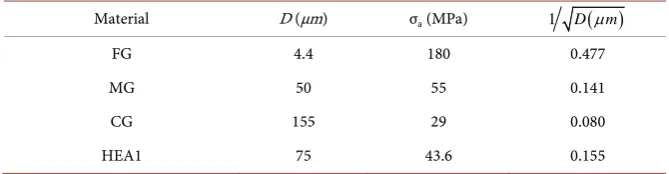
The CG/MG/FG (Coarse Grain/Medium Grain/Fine Grain) systems are the systems defined in Otto et al. [2], with grain sizes listed in Table 2. With regards to the model parameters, the g0,1 and σ µˆ1 0 quantities represent short range
deformation interactions, similar to obstacle populations observed in many pure metals and alloys [5]. These parameters characterize mobile dislocation interac-tions with short range obstacles, such as point defects and smaller clusters of second solution particles. The g0,2 and σ µˆ2 0 quantities represent long range
deformation interactions. Due to unavailability of complete chemistry profiles, exact cause of these interactions cannot be identified. However, it is speculated that these high go values could be produced by interactions of mobile
Figure 1.Yield stress measurements in the FG material compared with the model predictions.
Table 1.Model constants for the two alloy systems.
Material go,1 σ µˆ1 0 go,2 σ µˆ2 0 go,ε σ µˆε 0
CG/MG/FG 0.16 0.0045 3.0 0.0016 1.6 0
HEA 1 0.4 0 4.0 0.0078 1.6 0.001
Table 2.Variation of the athermal stress with grain size.
Material D (μm) σa (MPa) 1 D
( )
µmFG 4.4 180 0.477
MG 50 55 0.141
CG 155 29 0.080
HEA1 75 43.6 0.155
The athermal stress contribution σa is expected to vary with grain size
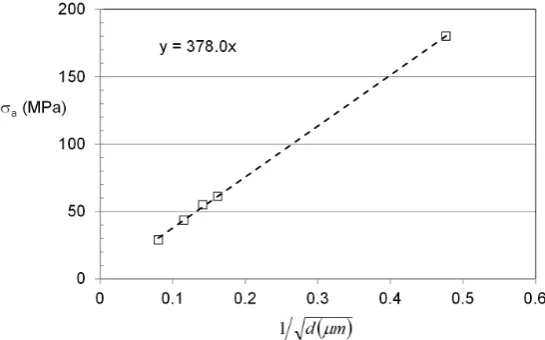
ac-cording to a Hall-Petch relationship. Table 2 lists the athermal stress values de-duced for each material and Figure 2 shows the variation of athermal stress with inverse square-root of the grain size. From this plot the slope gives the “k” factor in the Hall-Petch equation as 378 MPa μm1/2. Recall that for these analyses the
model parameters in Table 1 are held constant. Only the athermal stress was va-ried; this gives high confidence in the applicability of the Hall-Petch correlation.
3. Evolution Kinetics
Strain hardening—also referred to as structure evolution—is added to the model by introducing the current rate of change of σˆε with strain:
(
)
ˆ ˆ
d
1 ˆ
d II s ,T
κ
ε ε
ε
σ θ σ
ε σ ε
= −
(5)
where θII is the stage two hardening rate of a single crystal,
κ
is a constant(selected as κ = 2), and
σ ε
ˆεs(
,T)
is the temperature and strain-rate depen-0.020 0.030 0.040 0.050 0.060 0.070 0.080
0.00 0.20 0.40 0.60 Model
4.4 micron
( )
2 1
180
−
T MPa
µ σ
( )
3 2 1 8
3
10
ln
−
ε
µ
s b
[image:4.595.205.540.392.479.2]Figure 2.Variation of the athermal stress with grain size. The dashed line is the Hall Petch equation.
dence saturation threshold stress [5]. The first step in the application of Equation (5) is to isolate σˆε from the other stress terms. Equation (1) is rewritten [6]
( )
offset0 1 2
1 2
0 0
ˆ ˆ ˆ
ˆ a
s s
s ε ε
ε
σ ε
σ
σ
µ
σ
σ
σ
µ
µ
µ
− −
= − −
(6)
where σoffset is a small offset stress introduced to align the data, account for
ex-perimental scatter, and begin the σˆε values at zero. In writing Equation (6) it is
assumed that structure evolution does not alter any of the terms on the right hand side of this equation–except of course σ(ε) [6]. With σˆε versus ε for each
test condition (material, grain size, and temperature), Equation (5) is applied using numerical integration. The constants θII and σˆεs are selected such that
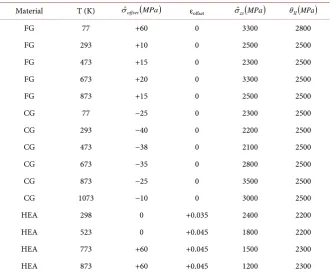
the model matches the experimental data. The fit for the model is shown in Fig-ure 3 for FG materials at 473 K and 673 K. In these figures the solid line displays the experimental data and the dashed line displays the predictions using Equa-tion (5). Table 3 lists the model parameters for each of the test conditions. Note that a strain offset is introduced for the HEA specimens, likely arising from the evidence of incomplete recrystallization reported by Licavoli et al.[3]. However, a strain offset is neither needed nor justified for the FG and CG data sets.
As shown in Table 3 the saturation threshold stress indicates a slight temper-ature dependence. The tempertemper-ature and strain rate dependence of the saturation threshold stress has been describing using a dynamic recovery model:
0 3
0 0
ˆ ˆ
ln s ln s ln
s s
kT b g
ε ε
ε ε
ε
σ σ
ε µ
= +
(7)
where σˆεs0 is the value of σˆεs at 0 K, and εεs0 and gεs0 are constants [5].
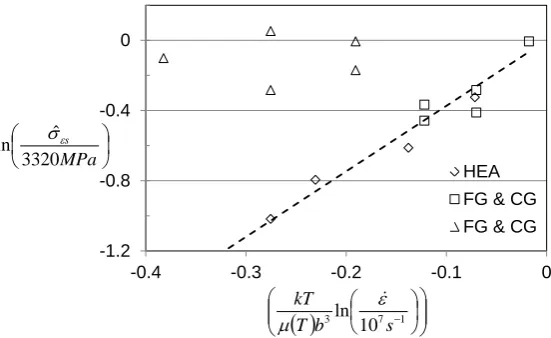
Figure 4 shows the variation of the saturation threshold stress normalized by the value estimated at 0 K versus the combination of temperature and strain rate suggested by Equation (7).
Figure 3. Fit of Equation (5) dashed curves to the deduced values of σˆε versus strain
curve for the measurements in FG material at 473 K and 573 K. The solid curves are from the application of Equation (6).
Table 3.Evolution equation model parameters.
Material T (K) σˆoffset(MPa) εoffset σˆεs
(
MPa)
θII(
MPa)
FG 77 +60 0 3300 2800
FG 293 +10 0 2500 2500
FG 473 +15 0 2300 2500
FG 673 +20 0 3300 2500
FG 873 +15 0 2500 2500
CG 77 −25 0 2300 2500
CG 293 −40 0 2200 2500
CG 473 −38 0 2100 2500
CG 673 −35 0 2800 2500
CG 873 −25 0 3500 2500
CG 1073 −10 0 3000 2500
HEA 298 0 +0.035 2400 2200
HEA 523 0 +0.045 1800 2200
HEA 773 +60 +0.045 1500 2300
HEA 873 +60 +0.045 1200 2300
both the HEA 1 and FG and CG materials) fall along the line represented by Eq-uation (7), but other data points (open triangles) fall well off this line. The line in this figure is characterized by σˆεs0 =3320 MPa , 0
7 1
1 10 s s
ε
ε
= × − , and0 0.267
s
gε = .
Deviations from the linear model depicted in Figure 4 have been attributed to the presence of dynamic strain aging (DSA). DSA occurs in a temperature re-gime when solute mobility is sufficient to enable solutes to travel to dislocation sites, thus promoting additional restriction to the motion of dislocations, which results in hardening beyond that predicted by Equation (7). This is often ac-companied by serrated yielding. Indeed serrated yielding was observed in HEA experiment conducted at 773 K [3].
Strain
0 200 400 600 800
0 0.1 0.2 0.3 0.4 0.5
FG 673K
Strain
0 200 400 600 800
0 0.1 0.2 0.3 0.4 0.5
[image:6.595.208.540.277.550.2]Figure 4.Fit of Equation (7) (dashed curves) to the deduced values ofσˆεs. Several of the data points fall along the dashed line. The open triangles that fall well above the line suggest the contribution of dynamic strain aging at the higher temperatures.
A Potential Inconsistency
The observation of DSA both in the stress strain curve [3] and in the observed deviations from Equation (7) in Figure 3 introduce a potential inconsistency in the kinetic analysis represented by the model parameters in Table 1 as applied to Equation (1). It is assumed that DSA involves transport of either interstitial atoms or substitutional atoms to the dislocation core. The higher concentration of these “defects” would lead to a higher stress that would have to be overcome to enable dislocation motion. Follansbee showed that for carbon in iron [5],
1
0
ˆ c
C
σ
µ
∝ (8)where Cc is the carbon concentration. The correlation expressed by Equation (8),
which is common for solution hardening, shows that a possible source of the in-creased strength is the increase in the solute concentration in the vicinity of the dislocation core.
Two defect populations have been postulated for this high entropy alloy sys-tem. One is a short range obstacle (characterized by g0,1 = 0.16 for the FG and
CG materials). It seems highly unlikely that the long range obstacle population could contribute to DSA; rather it must be the short range obstacle population. However, at a temperature of 673 K, which is a temperature where the FG ma-terial exhibits DSA, Equation (2) predicts an s1 value of 0. The implication of this
is that this obstacle population is ineffective at this high a temperature because the added stress would be s1σˆ1 which would be zero if s1 = 0. It is interesting in
Table 1 that in the HEA alloy, g0,1 = 0.4. At 773 K, where Licavoli et al. observed
serrated yielding, Equation (2) predicts s1 = 0.069. It must be that the g0,1 value
for the FG and CG materials in Table 1 is too low, but this is required to represent the lowest temperature measurements (77 K) in these alloys. Another possibility is that a third obstacle population with a g0 value in the range noted
-1.2 -0.8 -0.4 0
-0.4 -0.3 -0.2 -0.1 0
HEA
FG & CG
FG & CG
( )
−1 7 3
10 ln
s b
T
kT ε
µ
MPa
s 3320
for the HEA materials must be added to Equation (1).
4. Discussion and Conclusions
The behavior observed in the systems presented herein has been noted as similar to other highly entropic FCC metals, e.g. austenitic stainless steel. Application of the model approach used in this report has been studied in the stainless steel systems and described by Follansbee [6]. The values found for the high entropy alloys described in this report are: σˆεs0=3320 MPa, 0
7 1
1 10 s s
ε
ε
= × − , and0 0.267
s
gε = . The values reported by Follansbee in the stainless steel are:
0
ˆεs 2600 MPa
σ = , 0 7 1
1 10 s s
ε
ε
= × − , and0 0.258
s
gε = [6]. The similarly
be-tween these values indicates resemblance bebe-tween the two systems.
Deformation kinetics is controlled by interactions of dislocations with grain boundaries and short range obstacles (g0,1 = 0.16 in CG/MG/FG and g0,1 = 0.4 in
HEA 1). However, the suggestion of a long range obstacle population (g0,2 = 3.0
in CG/MG/FG and g0,2 = 4.0 in HEA 1) is new and suggests interactions of
dis-locations with clusters of solute atoms, perhaps resulting from incomplete mix-ing or a tendency to reduce energy with segregation. It would take quantitative microscopy to identify these clusters. This may offer a glance to the source of deviations in model parameters—particularly σ µˆ2 0—between the systems.
Dynamic strain aging is observed at the higher test temperatures in these high entropy alloys. Evidence for this is seen in the high rate of structure evolution that deviates from model behavior expressed by Equation (7). With a low value of g0,1 for the short-range obstacle system, an inconsistency arises in that this
ob-stacle population is not predicted to be effective at the temperature where DSA is observed. With a two-obstacle model (actually three-obstacle if the stored dislo-cation density obstacle population is included) one is unable to select model pa-rameters (see Table 2) that match the experimental results for the FG, MD, and CG materials and that has a g0,1 value in the range of 0.4 required to render the
obstacle effective at the temperature where DSA is observed. Either a third ob-stacle population must be added, or the lowest temperature measurements (77 K) in the Otto et al.[2] experiments omitted from the analysis. The rationale for the latter would be that testing at cryogenic temperatures introduces a different deformation mechanism. While deformation twinning is observed at these tem-peratures [2] twinning is usually accompanied by a lower rather than a higher yield stress [5]. Another possibility is that the simple model envisioned for DSA and summarized using Equation (8) is an oversimplification. Consistent trends across different material systems when application of the state variable model when DSA is active gives yet another test of the generality of the model formul-ism. Identification of the inconsistency described here is thus an important con-clusion.
Acknowledgements
References
[1] Zhang, Y., Zuo, T.T., Tang, Z., Gao, M.C., Dahmen, K.A., Liaw, P.K. and Lu, Z.P. (2014) Microstructures and Properties of High-Entropy Alloys. Progress in Mate-rials Science, 61, 1-93. https://doi.org/10.1016/j.pmatsci.2013.10.001
[2] Otto, F., Dlouhý, A., Somsen, Ch., Bei, H., Eggeler, G. and George, E.P. (2013) The Influences of Temperature and Microstructure on the Tensile Properties of a CoCrFeMnNi High-Entropy Alloy. Acta Materialia,61, 5743-5755.
https://doi.org/10.1016/j.actamat.2013.06.018
[3] Licavoli, J.J., Gao, M.C., Sears, J.S., Jablonski, P.D. and Hawk, J.A. (2015) Micro-structure and Mechanical Behavior of High-Entropy Alloys. Journal of Materials Engineering and Performance, 24, 3685-3698.
https://doi.org/10.1007/s11665-015-1679-7
[4] Laplanche, G., Gadaud, P., Horst, O., Otto, F., Eggeler, G. and George, E.P. (2015) Temperature Dependencies of the Elastic Moduli and Thermal Expansion Coeffi-cient of an Equiatomic, Single-Phase CoCrFeMnNi High-Entropy Alloy. Journal of Alloys and Compounds, 623, 348-353. https://doi.org/10.1016/j.jallcom.2014.11.061 [5] Follansbee, P.S. (2014) Fundamentals of Strength—Principles, Experiment, and
Ap-plications of an Internal State Variable Constitutive Formulation. The Minerals, Metals, and Materials Society, John Wiley & Sons, Hoboken, NJ.
https://doi.org/10.1002/9781118808412
[6] Follansbee, P.S. (2015) Structure Evolution in Austenitic Stainless Steels. Materials Sciences and Applications,6,457-463. https://doi.org/10.4236/msa.2015.66049
Submit or recommend next manuscript to SCIRP and we will provide best service for you:
Accepting pre-submission inquiries through Email, Facebook, LinkedIn, Twitter, etc. A wide selection of journals (inclusive of 9 subjects, more than 200 journals)
Providing 24-hour high-quality service User-friendly online submission system Fair and swift peer-review system
Efficient typesetting and proofreading procedure
Display of the result of downloads and visits, as well as the number of cited articles Maximum dissemination of your research work
Submit your manuscript at: http://papersubmission.scirp.org/