Effects of hypoxic training on physiological exercise
intensity and recognition of exercise intensity in young men
Sohee Shin1, Shinichi Demura2, Bateer Shi1, Tsuneo Watanabe1, Tamotsu Yabumoto1, Toshio Matsuoka1
1Department of Sports Medicine and Sports Science, Gifu University Graduate School of Medicine, Gifu, Japan 2Kanazawa University Graduate School of Natural Science & Technology, Kanazawa, Japan
Email: [email protected]
Received10 January 2013; revised 13 February 2013; accepted 28 February 2013
ABSTRACT
This study aimed to examine the effects of hypoxic training on physiological exercise intensity and rec-ognition of exercise intensity in young men. The par-ticipants included 9 healthy young males (23.2 ± 6.5 years old, 176.2 ± 6.7 cm, 74.3 ± 16.4 kg). VO2 was
measured during running with subjective exercise intensities of “somewhat hard” for 3 min and “fairly light” for 3 min. After the measurements, the par-ticipants answered the question “what percentage of your maximal effort was performed during both run-ning exercises.” The exercise intensity recognition for the “fairly light” and “somewhat hard” intensities and the physiological exercise intensity measured by relative VO2 (%) and relative heart rate (HR, %)
were then evaluated. The hypoxic training was per-formed 3 times a week for 4 weeks in a normobaric hypoxic chamber (oxygen concentration, 15.4% and altitude, 2500 m). The participants ran at an exercise intensity of 60% VO2max for 40 min after a 5 min
warm-up and then performed a 5 min cool-down. After training, they sat on a chair in the same room for 30 min. VO2max and HRmax changed significantly
after the training. At “fairly light” intensity, the physiological measures were significantly higher than recognition of exercise intensity, with relative VO2 (%)
increasing after training. In conclusion, hypoxia training causes an increase in VO2max and
physiologi-cal exercise intensity during running at a “fairly light” intensity.
Keywords:Hypoxic Training; Relative O2; Relative HR;
Recognition of Exercise Intensity
1. INTRODUCTION
Habitually performing aerobic exercises aimed at im-proving cardiovascular fitness is widely recommended
[1]. It is desirable to use an index based on physiological parameters for determining aerobic exercise load [1]. However, more cases can help to determine exercise in-tensity using subjective measures (i.e., self-selected
in-tensity) rather than physiological indices. However, fac-tors such as physique, exercise ability, exercise experi-ence, and the environment may affect self-selected inten-sity. In short, even if each person was instructed to run with the same exercise intensity, the intensity selected may differ because of the above factors.
Okura et al. [2] reported that people who did not
exer-cise chose significantly higher relative exerexer-cise intensity as their favorite intensity than those who did exercise, with their feeling of comfort after exercise being signifi-cantly lower. Hayashi et al. [1] also reported that
exer-cise characteristics which participants had experienced in the past caused differences in cognition ability to deter-mine the intensity imposed on their body during exercise. As a consequence this affected self-selected intensity. As stated above, although the effects of exercise habit and experience on cognition of exercise intensity have been examined, there is limited information on the effects of environmental factors. Participants may recognize higher exercise intensity by hypoxia even if the intensity is lower than with normoxia because hypoxia itself affects the body in a manner similar to a large load in low oxy-gen environment.
Hypoxia has been used as a method in altitude training for competitive sports [3,4]. The partial pressure of oxy-gen in the atmosphere is decreased at high attitudes or in a low-pressure chamber. Consequently, the decline in SpO2 in human blood causes a lack of oxygen supply to
body tissues. Hypoxia training is a method that aims to improve O2 transport ability, cardiovascular fitness, and
competitive performances by using anoxia to stimulate the body (i.e., environmental stimulation) [5]. HR and
VO2 levels in hypoxic training are greater than or equal
Numerous studies have been performed on the rela-tionships between hypoxia training and aerobic exercise ability or competitive performances [6-8]. However, the effects of hypoxia training on recognition of exercise intensity and physiological exercise intensity during sub-maximal exercise have not been investigated extensively.
Therefore, the purpose of this study was to examine the effects of hypoxic training on physiological exercise intensity and recognition of exercise intensity in young men.
2. METHODS
2.1. Participants
The participants included 9 healthy young males (age, 23.2 ± 6.5 years old; height, 176.2 ± 6.7 cm; weight, 74.3 ± 16.4 kg). As a result of a hearing survey, 3 of the 9 subjects carried out club activities regularly, but did not have the habit of jogging. The purpose and procedure of the study were explained in detail and informed consent was obtained from all the participants. The study was approved by the Ethics Committee on Human Experi-mentation of Faculty of Education, Kanazawa University (No. 19-19).
2.2. Running at Each Rate of Perceived Exertion (RPE) and Measurement of VO2 and VO2max
The above measurements were conducted before and after training in a normoxia laboratory at Gifu University Sports Medicine and Sports Science. VO2 and VO2max
were measured by a pulmonary exercise test monitoring system (Vmax, Nihon Cohden, Tokyo, Japan) using the
following steps.
Procedure of VO2 and VO2max measurements
be-fore and after training:
STEP 1: Measurement of heart rate and blood
pres-sure at rest.
STEP 2: Warm-up (stretch and walk on the treadmill
for 5 min each) (please see Section 2.2.1);
STEP 3: Run on the treadmill at “fairly light”
inten-sity for 3 min with measurement of HR and VO2 (please
see Section 2.2.2);
STEP 4: Run on the treadmill at “somewhat hard”
in-tensity for 3 min with measurement of HR and VO2
(please see Section 2.2.2);
STEP 5: Run on the treadmill until exhausted with
measurement of HRmax and VO2max (please see Section
2.2.4);
STEP 6: Survey on recognition of exercise intensity
(please see Section 2.2.3);
2.2.1. Preparation for Measurement
Resting HR and blood pressure of the participants were
measured before the warm-up. For the warm-up, the par-ticipants stretched for 5 min and then walked at 4 km/h on the treadmill for 5 min. During this time, a mask that fitted the face was regulated and checked to ensure that air was not leaking from it during walking.
2.2.2. Run on the Treadmill at Subjective Exercise Intensity with Measurements of HR and VO2
Hayashi et al. (2003) reported that participants could
recognize intensity more accurately during exercise at moderate or high intensities than at low intensity. In this regard, the running exercise was performed in the order of low intensity (fairly light) and moderate (somewhat hard) in this study. Participants ran on the treadmill at a subjective “fairly light” intensity for 3 min and after a 5 min walk at a subjective “somewhat hard” intensity for 3 min. They voluntarily adjusted their speed using the speed adjustment button. The speed was not displayed during running. Speed was adjusted for the first minute of each exercise intensity.
2.2.3. Recognition of Exercise Intensity
After the measurements the participants answered the question “what percentage of maximal effort was the exercise (running) performed during ‘fairly light’ and ‘somewhat hard’ exercise intensities”.
Questions on exercise intensity recognition:
1) What percentage of maximal intensity was used to perform “somewhat hard” exercise?
2) What percentage of maximal intensity was used to perform “fairly light” exercise?
2.2.4. Measurement of VO2max
VO2max was measured using the modified Astrand
proto-col [9]. Participants ran at 70% HR for 3 min. The angle of the gradient was then increased by 2% every 2 min until exhaustion. Using this protocol and a constant speed carries a slight risk of falling while running, but VO2max can be measured accurately within a short time.
VO2 was recorded continuously using a “breath-by-
breath” method, simultaneously with measurement of HR. In addition, RPE (ratings of perceived exertion) during VO2max measurement was recorded every 2 min
by a research investigator.
2.2.5. Parameters
The following parameters were used to examine differ-ences between physiological exercise intensity (%) and recognition of exercise intensity during runs at “fairly light” and “somewhat hard” intensity.
1) Physiological parameters a) VO2max (ml/kg/min).
b) HR (BPM; beats per minute).
differences between recognition of exercise intensity and physiological exercise intensities (relative HR, relative VO2) ANOVA included before and after training as
Fac-tor 1 and exercise intensity recognition and physiological exercise intensity as Factor 2. Tukey’s HSD method was used for multiple comparison of significant variables. A probability level of p < 0.05 was considered statistically significant. The effect of size was calculated to assess the size of the mean differences.
hard” exercise intensity.
d) HR when running at “fairly light” and “somewhat hard” exercise intensity.
The means of VO2 and HR in the final min of the three
min run were used in the analyses. 2) Physiological exercise intensity
Physiological exercise intensities were calculated us-ing the followus-ing equations:
a) Relative VO %2
VO VO2 2max
100.b) Relative
rest max at restHR %
HR HR HR HR 100.
3. RESULTS
Table 1 shows the mean differences in VO2max and
HRmax before and after training. Significant differences
were found for both parameters, with VO2max being
greater after training and HRmax being higher before
training (ES = 1.26 and 0.39, respectively). 3) Recognition of exercise intensity.
Parameters on recognition of exercise intensity in-cluded subjective recognition of “fairly light” and “some-what hard” intensities (Note: see Section 2.3. Exercise
intensity recognition). before and after training during the subjective intensity Table 2 shows the mean differences in VO2 and HR runs (“fairly light” and “somewhat hard”). VO2 was
greater after training than before training at both exercise intensities.
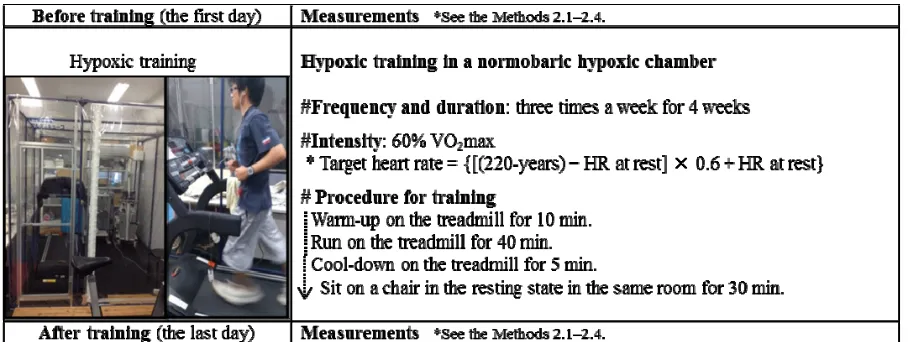
2.3. Hypoxic Training (Figure 1)
Participants performed hypoxic training in a normobaric hypoxic chamber set at an altitude of 2500 meters (oxy-gen level 15.4%). The participants ran at an exercise in-tensity of 60% VO2 for 40 min after a 5 min warm-up
and then performed a 5 min cool-down. After training, they sat on a chair and rested in the same room for 30 min. The hypoxic training was performed 3 times a week for 4 weeks. Training in this study used the same tread-mill run for measuring changes in VO2max.
Table 3 shows the mean differences between
recogni-tion of exercise intensity and relative VO2. Significant
main effects [exercise intensity recognition and relative VO2 (F1) and before and after training (F2)] were only
found during fairly light intensity exercise. Multiple com-parison showed that the difference between recognition of exercise intensity (%) and relative VO2 was larger
after training and that relative VO2 was larger than
[image:3.595.72.526.546.717.2]rec-ognition of exercise intensity.
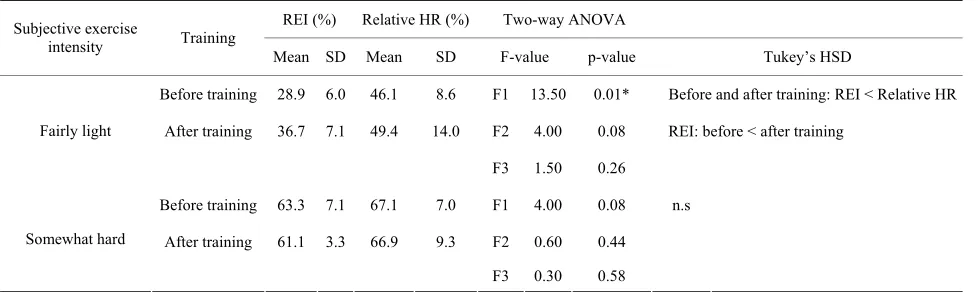
Table 4 shows the mean differences between
recogni-tion of exercise intensity and relative HR. A significant difference was found between the main effect of exercise intensity recognition and relative HR (F1) only during “fairly light” intensity exercise. Multiple comparison showed that relative HR was larger than recognition of exercise intensity.
2.4. Statistical Analyses
Paired t-tests were used to assess the mean differences between before- and after-training values for VO2max,
HRmax, and VO2 and HR during the subjective intensity
runs (“fairly light” and “somewhat hard”). A repeated- measures two-way ANOVA was used to assess mean
Table 1. Mean differences in VO2max and HRmax before and after training (n = 9).
Before training After training Paired t-test
Parameters Mean SD Mean SD t-value p-value ES
VO2max
(ml/kg/min) 51.2 9.2 62.6 8.8 4.3 0.00* 1.26
HR (BPM) 193.6 13.5 188.9 10.6 2.0 0.04 0.39
[image:4.595.56.538.217.329.2]*p < 0.05/2; ES: effect size.
Table 2. Mean differences in VO2 and HR during subjective intensity runs before and after training (n = 9).
Before training After training Paired t-test
Parameters
Subjective exercise intensity
Mean SD Mean SD t-value p-value ES
Fairly light 25.6 5.4 33.6 4.3 3.4 0.01* 1.64
VO2 (ml/kg/min)
Somewhat hard 33.4 6.8 40.0 5.1 2.4 0.02* 1.09
Fairly light 132.3 16.4 133.9 18.7 0.6 0.28 0.09
HR (BPM)
Somewhat hard 156.3 17.0 152.4 17.8 1.2 0.13 0.22
*p < 0.05; ES: effect size.
Table 3. Mean differences between recognition of exercise intensity and relative VO2 (n = 9).
REI (%) Relative VO2 (%) Two-way ANOVA
Subjective exercise
intensity Training
Mean SD Mean SD F-value p-value Tukey’s HSD
Before training 28.9 6.0 49.9 3.3 F1 174.53 0.00* Before and after training: REI < Relative VO
2
After training 36.7 7.1 54.2 5.7 F2 6.33 0.03* REI, Relative VO
2: before < after training
Fairly light
F3 1.37 0.27
Before training 63.3 7.1 65.0 3.6 F1 1.49 0.26 n.s
After training 61.1 3.3 64.4 7.4 F2 0.42 0.53
Somewhat hard
F3 0.49 0.50
*p < 0.05; REI: recognition of exercise intensity; ES: effect size; relative VO
2 = {VO2/VO2max} × 100; F1: REI × relative VO2; F2: Before and after training; F3:
interaction.
Table 4. Mean differences between recognition of exercise intensity and relative HR (n = 9).
REI (%) Relative HR (%) Two-way ANOVA
Subjective exercise
intensity Training Mean SD Mean SD F-value p-value Tukey’s HSD
Before training 28.9 6.0 46.1 8.6 F1 13.50 0.01* Before and after training: REI < Relative HR
After training 36.7 7.1 49.4 14.0 F2 4.00 0.08 REI: before < after training
Fairly light
F3 1.50 0.26
Before training 63.3 7.1 67.1 7.0 F1 4.00 0.08 n.s
After training 61.1 3.3 66.9 9.3 F2 0.60 0.44
Somewhat hard
F3 0.30 0.58
*p < 0.05; REI: recognition of exercise intensity; ES: effect size; relative HR: {(HR − HR
at rest)/(HRmax− HRat rest)} × 100; F1: REI × relative HR; F2: Before
[image:4.595.55.543.370.517.2] [image:4.595.57.546.567.713.2]4. DISCUSSION
This study examined the effects of hypoxic training on physiological exercise intensity and recognition of exer-cise intensity in young men.
VO2max increased after hypoxic training for 4 weeks.
Haga and Ohno [10] classified endurance capacity into maximal ability such as VO2max and submaximal ability
as LT and emphasized that it is necessary to perform training to enhance both VO2max and LT level to improve
whole cardiovascular fitness. They also reported that high exercise intensity is important for improving VO2max
[10]. The current study used 60% VO2max as the exercise
intensity for hypoxic training. VO2max increased
mark-edly after training (ES = 1.0) despite this being per-formed at moderate intensity. VO2 during subjective
ex-ercise intensity also increased after training.
VO2max at high altitude decreases exponentially by
ap-proximately 10% with every rise of 1000 m [11]. This decrease is attributed to decreased oxygen supply to tis-sues that involves a decrease in CaO2 and SpO2 [12].
Hypoxic training by maintaining hypoxia for a given period of time is therefore expected to result in a stimu-latory effect in addition to improving the cardiorespira-tory response at rest [13]. The ability to transport oxygen to tissues shifts from an acute adaptation to a chronic adaptation when during hypoxic training continually for a certain period [14]. This represents altitude acclimation [14], which may contribute to an increase in VO2max and
a decrease in HR with increased cardiac output (i.e., an
increase in cardiovascular fitness).
On the other hand, recognition of exercise intensity was lower for “fairly light” intensity exercise than for physiological exercise intensity (relative HR, relative VO2) both before and after training. In short, this infers
that participants ran with higher intensity than during subjective exercise intensity. In addition, relative VO2
was also higher after training than before training. As the increase in VO2 relative to increased VO2max was high
(“fairly light” intensity VO2 before-training of 49.9% for
VO2max 51.2 ml/kg/min vs after-training of 54.2% for
VO2max 62.6 ml/kg/min indicates that the participants
considered physiological exercise intensity was “fairly light” after training compared with before training even if they exercised at high intensity.
Imakawa [14] and Kacin et al., [15] reported that if
people performed endurance training at high attitude with the same intensity as that at sea level, the hypoxic stimulation to tissues at high altitude may be increased because of the relative exercise intensity being increased compared with that at sea level. In our study, the partici-pants felt comfortable running at pace in normoxic con-ditions because of the effect of hypoxic training, which may have influenced the physiological exercise intensity
of “fairly light” intensity. Asano and Kobayashi [16] also reported that RPE in a 3 min run test conducted before and after a short period of hypoxic training (altitude: 2400 m) tended to decrease after training even during a run at the same speed under normoxic conditions.
Training in this study was performed in a normobaric hypoxic chamber instead of at high attitude, although it is inferred that the participants ran comfortably even if the exercise intensity was higher after training than be-fore training.
However, there was no difference between recognition of exercise intensity and physiological exercise intensity. In short, “somewhat hard” intensity was approximately 65% (61.1% - 67.1%) of HR and VO2max and was similar
to physiological exercise intensity and recognition of exercise intensity. Robertson et al. [17] and Hayashi et al.
[18] reported that people recognized fatigue in breathing and metabolism with emphasis on physical fatigue aware-ness at 70% VO2max. This was similar to the “somewhat
hard” exercise intensity used in this study (approximately 65%). When subjective exercise intensity is greater than moderate intensity, recognition of exercise intensity which people perceive subjectively agrees roughly with the intensity of physiological exercise. However, it is inferred that if it is low, the difference between both sides becomes larger and physiological exercise intensity is higher than recognition of exercise intensity. This study had not control group, and the sample size were small. Hence, further study is needed to examine the ef-fects of hypoxic training on physiological exercise inten-sity and recognition of exercise inteninten-sity from compari-sons with normoxic group.
5. CONCLUSION
After hypoxic training, both VO2max and VO2 increased
during runs at “fairly light” and “somewhat hard” inten-sities. Physiological exercise intensity during running at “fairly light” intensity was higher than subjective recog-nition of exercise intensity. At “fairly light” intensity, physiological exercise intensity was increased after hy-poxic training. Physiological exercise intensity and rec-ognition of exercise intensity during a run at “somewhat hard” intensity are similar. In conclusion, hypoxia train-ing causes an increase in VO2max and physiological
exer-cise intensity during a run at “fairly light” intensity.
REFERENCES
[1] Hayashi, Y., Okura, T., Nakagaichi, M. and Tanaka, K. (2003) The influence of moderate- and high-intensity ex-ercise on perception of exex-ercise intensity and physiologi-cal variables during self-selected aerobic exercise. Japa-neseSocietyofPhysicalEducation, 48, 299-312.
Effect of exercise habit on the cardiorespiratory and psy- chological responses to self-prescribed intensities. Japa- neseSocietyofPhysicalEducation, 45, 201-212.
[3] Bailey, D.M. and Davies, B. (1997) Physiological impli-cations of altitude training for endurance performance at sea level: A review. British Journal of Sports Medicine,
31, 183-190. doi:10.1136/bjsm.31.3.183
[4] Roels, B., Bentley, D.J., Coste, O., Mercier, J. and Millet, G.P. (2007) Effects of intermittent hypoxic training on cycling performance in well-trained athletes. European Journal of Applied Physiology, 101, 359-368.
doi:10.1007/s00421-007-0506-8
[5] Ookura, M., Yoshida, R., Yamamoto, I. and Fujiwara, T. (2006) Research on application of low oxygen environ-ment to therapeutic exercise: Trials in normal air pressure and low oxygen room. TheJournalofJapanAcademyof HealthSciences, 8, 227-233.
[6] Millet, G.P., Roels, B., Schmitt, L., Woorons, X. and Richalet, J.P. (2010) Combining hypoxic methods for peak performance. Sports Medicine, 40, 1-25.
doi:10.2165/11317920-000000000-00000
[7] Wilber, R.L, Stray-Gundersen, J. and Levine, B.D. (2007) Effect of hypoxic “dose” on physiological responses and sea-level performance. Medicine and Science in Sports and Exercise, 39, 1590-1599.
doi:10.1249/mss.0b013e3180de49bd
[8] Saunders, P.U., Pyne, D.B. and Gore, C.J. (2009) Endur-ance training at altitude. High Altitude Medicine & Biol-ogy, 10, 135-148. doi:10.1089/ham.2008.1092
[9] Pollock, M.L, Wilmore, J.H. and Fox, S.M. (1984) Exer-cise in health and disease: Evaluation and prescription for prevention and rehabilitation. W. B. Saunders, Co., Phil- adelphia.
[10] Haga, S. and Ohno, H. (2003) Training physiology. Kyo-rin, Tokyo.
[11] Asano, K. (1999) Trends and practice of high-altitude training. Physiological significance of high-altitude train- ing and recent trends. The Journal of Clinical Sports Medicine, 16, 505-516.
[12] Bert, P. (1943) Barometric pressure: Researches in ex-perimental physiology. College Book Co., Columbus.
doi:10.5962/bhl.title.6434
[13] Bailey, D.M. and Davies, B. (1997) Physiological impli-cations of altitude training for endurance performance at sea level: A review. British Journal of Sports Medicine,
31, 183-190. doi:10.1136/bjsm.31.3.183
[14] Imakawa, S. (2008) Molecular biology on high altitude hypoxic training. IgakunoAyumi, 225, 1287-1292.
[15] Kacin, A., Golja, P. and Eiken, O., Tipton, M.J. and Mek-javic, I.B. (2007) The influence of acute and 23 days of intermittent hypoxic exposures on the exercise-induced forehead sweating response. European Journal of Applied Physiology, 99, 557-566. doi:10.1007/s00421-006-0364-9
[16] Asano, K. and Kobayashi, K. (2004) Science of altitude training. Kyorin, Tokyo.
[17] Robertson, R.J., Gillespie, R.L., McCarthy, J. and Rose, K.D. (1979) Differentiated perceptions of exertion: Part II. Relationship to local and central physiological responses.
Perceptual & Motor Skills, 49, 691-697. doi:10.2466/pms.1979.49.3.691
[18] Hayashi, Y., Suzuki, K., Numao, S. and Tanaka, K. (2007) Interrelation between serial changes in physiological fac-tors and perceived exertion during self-selected aerobic exercise. Japanese Society of Physical Education, 52,