Original citation:
Muñoz, Pablo, Cacciotti, Gabriella and Cohen, Boyd. (2017) The double-edged sword of purpose-driven behavior in sustainable venturing. Journal of Business Venturing . Permanent WRAP URL:
http://wrap.warwick.ac.uk/97857 Copyright and reuse:
The Warwick Research Archive Portal (WRAP) makes this work by researchers of the University of Warwick available open access under the following conditions. Copyright © and all moral rights to the version of the paper presented here belong to the individual author(s) and/or other copyright owners. To the extent reasonable and practicable the material made available in WRAP has been checked for eligibility before being made available.
Copies of full items can be used for personal research or study, educational, or not-for-profit purposes without prior permission or charge. Provided that the authors, title and full
bibliographic details are credited, a hyperlink and/or URL is given for the original metadata page and the content is not changed in any way.
Publisher’s statement:
© 2017. This manuscript version is made available under the CC-BY-NC-ND 4.0 license http://creativecommons.org/licenses/by-nc-nd/4.0/
A note on versions:
The version presented here may differ from the published version or, version of record, if you wish to cite this item you are advised to consult the publisher’s version. Please see the ‘permanent WRAP URL’ above for details on accessing the published version and note that access may require a subscription.
THE DOUBLE-EDGED SWORD OF PURPOSE-DRIVEN BEHAVIOR IN SUSTAINABLE VENTURING
Abstract
This paper examines the relationship between purpose and purposeful organizing and how such arrangements influence the entrepreneurial journey as sustainable ventures move from idea to markets. We leverage an iterative multi-stage process-tracing design to understand the mechanisms whereby 14 different B Corp certified organizations embed purpose before, during and after the certification process. Our analyses reveal three types of venture paths for purpose-driven entrepreneurs, which are shaped by distinct imprinting sequences with three critical sensitive windows playing a pivotal role: the definition of scope of purpose, timing of purpose formalization through B Corp Certification and shifts in the source of feedback. Different imprinters occurring within the critical sensitive windows shape particular imprinting sequences triggering situations of both productive and counterproductive path development. Our results challenge the assumed linear relationship between purpose and purposeful organizing and more specifically the belief that seeking (purposeful) B Corp certification at firm foundation is necessarily productive for society and for the ventures themselves regardless of when the certification is achieved.
Executive summary
In recent years, we have witnessed a growing interest in purposeful organizations where a purpose
beyond profit maximization represents the remit and scope of the business activity. However, to
date, little attention has been paid to the timing of, and the process by which, entrepreneurs
embrace purpose into their organizations. Instead, purpose has been widely assumed to be binary
and static over time (Estrin et al. 2016; Stevens et al. 2015). However, it has been argued that
purpose may go well beyond the reason for which a venture is created and may be decoupled with
the formation of purposeful organizations. Given the salience of purpose and the many critical
(and so far, unknown) events connecting it to purposeful organizing, our work focuses on how the
former becomes embedded through a process of imprinting, shaping the latter.
Consequently, in this study we address three interrelated research questions: does purpose
always lead to purposeful organizing? Does purpose always precede purposeful organizing? And
is the relationship between purpose and purposeful organizing linear or iterative?
To address these questions, we conducted an inductive two-stage process-tracing research of
14 certified B Corp entrepreneurs from Latin America. This method allowed us to delineate the
processes by which entrepreneurs embedded purpose into their organizations, resulting in the
identification of three venturing paths comprising unique imprinting sequences and three critical
sensitive windows for purposeful organizing: the definition of scope of purpose, timing of purpose
formalization through B Corp Certification and shifts in the source of feedback. We show how
these have a long-term and distinct effects on the entrepreneurial process of B Corps. Previously
it had been assumed that from a societal perspective, it may be useful to require, perhaps through
regulation, that all new enterprises imprint purpose at firm foundation. For example, McMullen
a hybrid organization?” It turns out, the answer to this question is not so definitive as many have
thought. In fact, premature imprinting of purpose, before a business model has been validated with
the market, can be detrimental to the organization, reducing the potential success of the venture
and the societal benefit the firm could have otherwise achieved. Our study, therefore contributes
to prosocial theorizing by disentangling purpose from purposeful organizing and reveals how
specific organizing choices influence the evolution of purpose over time, which rectifies the
prevailing assumption that purpose is stable and given before organizing begins. In so doing, we
discovered a substantial variation in how the relationship between purpose and purposeful
organizing works, opening an unexplored area of inquiry, which is now necessary to facilitate the
1 Introduction
For more than a decade, entrepreneurship scholars have explored alternative orientations and
motivations for entrepreneurs beyond profit maximization. Sub fields have emerged such as social
entrepreneurship (Dees 1998), sustainable entrepreneurship (Cohen and Winn 2007),
community-based entrepreneurship (Peredo and Chrisman 2006) and civic entrepreneurship (Cohen and
Muñoz 2015) among others. While the aforementioned streams of research have sought to
distinguish each sub field of “do-good” or pro-social entrepreneurship (Shepherd 2015), others
have sought to provide a unifying framework –going from divergence to convergence- for
exploring beyond profit entrepreneurship. Across these subfields several studies (e.g. Hollensbe
et al. 2014; Cohen and Muñoz 2015; Doherty et al. 2014; Battilana et al. 2015) seem to suggest
that the journey to redefine what entrepreneurs can be or can do for society begins with the creation
of purposeful organizations – where purpose represents the remit and scope of business activity.
Although sustainable entrepreneurship literature is already familiar with the relevance of
values and purpose that motivate venture formation (e.g. Parrish 2010; Muñoz and Dimov 2015),
it has paid relatively little attention to understanding how entrepreneurs elaborate and integrate
their sense of purpose into the forming business over time. First, so far most of this literature has
treated purpose as a binary and static construct (Estrin et al. 2016; Stevens et al. 2015). This
implicit assumption suggests that entrepreneurs choose to be driven primarily by either purpose or
profit, presumably at founding, and that choice stays stable throughout the process of venture
development (Dacin et al. 2011; Mair and Marti 2006). For example, literature on hybrid
organizing has mainly focused on the tensions between such pre-determined purpose and
commercial logics, without questioning the actual emergence of purpose and its stability
when purpose precedes the founding of the business, evidence suggests that subsequent organizing
choices may trigger repeated revisions or substantial deviations from its original form or purpose
(Battilana and Dorado 2010)
In consequence, a focus on purpose may go well beyond the reason for which a venture is
created or exists and requires the appropriate selection of behaviors and practices in building the
character of an organization that serves the common good (e.g. Daly et al. 1994). In other words,
the pursuit of “beyond profit” entrepreneurship cannot be simply encapsulated in the declared
values of a business but has to be enacted through the process of organizing. Moreover, purpose
may also be emergent so that different kinds of (purposeful) organizing may yield unanticipated
destinations (e.g. Mair et al. 2012). In some cases, the way the venture organizes around purpose
may not even reflect its members’ principal interest or values (Mair et al. 2016).
New categories of purposeful organizations, such as B Corps, suggest that purpose matters.
However, in light of this discussion, purpose by itself it may simply not warrant the development
of purposeful organizations, which suggests that the concepts of purpose and purposeful
organizing may exist decoupled from each other, calling for a serious rethinking and revision of
the implicit assumption underlying this relationship. Accordingly, this paper aims to more
precisely delineate the nature of this relationship. By disentangling purpose from purposeful
organizing, we are able to address three interrelated research questions: does purpose always lead
to purposeful organizing? Does purpose always precede purposeful organizing? And is the
relationship between purpose and purposeful organizing linear or recursive? In doing so, we seek
to challenge the theoretical assumption that purpose is always pre-determined and works as the
main imprinter of future organizing (Mathias et al. 2015). In answering these questions, Certified
us to further examine the pre-determination of purpose. B Corps represent a new form of prosocial
enterprising that requires to incorporate the purpose of serving the common good into the legal
fabric of the business (Branzei et al., 2016). While the nature of these organizations suggests that
purpose by itself is central to the development of (truly) sustainable ventures, it also proves that it
is not sufficient, in the sense that purpose needs to be formalized and constantly updated to legally
meet the financial, social, and environmental standards that guarantee the pursuit of beyond-profit
enterprising. Thus, by exploring our research questions in the context of B Corps we can more
carefully understand the linkages and causal relationships between purpose and purposeful
organizing.
To address our research questions, we engaged in an inductive two-stage process-tracing
research of 14 certified B Corp entrepreneurs from Latin America. We depart from traditional
cross-case pattern-finding strategies towards a mechanistic conception of causality, where, by
combining life story research (McAdams 2008), graphic elicitation (Bagnoli 2009) and process
tracing methodology (Beach and Pedersen 2013), we are able to examine how purpose and
purposeful organizing are related to each other and evolve over time as part of several B Corp
entrepreneurial journeys. This approach allows us to move away from the definition of purpose as
pre-startup event, and move towards an examination of purpose as a sequence of ‘stops along the
train” of purposeful organizing.
Through our iterative analyses, we identify salient critical events occurring within particular
sensitive periods in the life of the venture, which seem to have a long-term and distinct effects on
the entrepreneurial process. In consequence, our inductive work led us to focus on how purpose
becomes embedded through a process of imprinting (Marquis and Tilcsik 2013; Boeker 1989)
sustainable venturing paths, which are shaped by distinct imprinting sequences with three key
sensitive periods playing a pivotal role: definition of scope of purpose, timing of B Corp
Certification or purpose formalization and shifts in the source of feedback. Our results suggest that
what occurs within the three periods, through alternative imprinting instances (e.g. getting B Corp
certified early or late in the venturing process), is what actually changes the way purposeful
organizing happens. Different imprints trigger unique individual and venture level responses that
either open or confirm the journey, creating fluctuations in commitment to purpose over time,
which can either be beneficial or detrimental to the venture´s evolution. In this way, we show that
purpose and purposeful organizing are decoupled and their relationship (e.g. whether or not
purpose lead to purposeful organizing) depends on the presence of intermediating imprints
occurring precisely during these sensitive periods.
We make three primary contributions. First, we disentangle purpose from purposeful
organizing, showing that indeed purpose-based venturing fluctuates over time depending on how
the organization is imprinted during three sensitive windows. Different imprinting sequences and
imprinting timing demonstrate that purpose, depending on how and when is integrated and
formalized, can either be beneficial or detrimental to the venture evolution. Since purpose can
unfold differently over time, our results also challenge the underlying assumption of purpose being
static and binary. By uncovering three distinct imprinting sequences and sensitive windows for
purposeful organizing, our research reveals how specific organizing choices influence the
evolution of purpose over time, which rectifies the prevailing assumption that purpose is given
before organizing begins. This is done by showing links between imprints within and across
venturing paths, demonstrating causality, and the role of order and timing of imprinting events,
organizing. Second, we contribute to imprinting theory in sustainable venturing and
entrepreneurship more broadly. Our findings show what lies beyond the net impact of salient
imprinting sources, highlighting the role of imprinting timing and imprinting sequences in venture
development, as well as what sensitive periods are and how can these enable sequences of key
imprinters, some of those turning points and points of no return, confirming or (re)opening the
venture paths. Finally, given their unique “purpose-centric” organizational forms and legal
commitments, our research uncover how B Corps can constitute a new testing ground for a new
generation of theories on purposeful organizing. Unlike traditional non-binding certifications (e.g.
Fairtrade or Rain Forest Alliance), B Corp certification demands companies to formalize purpose
in a way that may affect the relationship between individual sense of purpose, the emergence of
pro-sociality in enterprising activities and the actual organization of and around purpose.
2 Theoretical grounding
2.1 Purpose and purposeful organizing
The creation of purposeful organizations is the way forward to cure the dysfunctional effects of
profit maximizing behavior for society (Hollensbe et al. 2014). Therefore, understanding purpose
and how it operates in the development of purposeful organizations is fundamental for developing
businesses that are intrinsically beneficial for society (e.g. Daly et al. 1994). Purpose in business
is defined as the tendency to derive meanings from the venturing process and to possess a sense of
intentionality and goal directedness that (presumably) guides (positive) behaviors (Hollensbe et al.
2014). As the venture develops, purpose can be turned enabling frameworks leading purposeful
Notwithstanding this attempt to circumscribe purpose to the activation of values, the
development of purpose into purposeful organizations remain a subjective experience. Because of
the prevailing notion of deriving meanings in its definition (see Hollensbe et al. 2014: 1228),
purpose emerges from the entrepreneur’s experience of the context within which her or his life is
embedded (McAdams 2001). Thus, the nature of this experience has to be found in the
entrepreneurs’ interactions with themselves, the others and the world around them (Debats et al.
1995). These interactions shape the sense of purpose, which directs the entrepreneur towards the
development of a venture for the accomplishment of the common good. This suggests that purpose
operates as a personalized intention to doing good, and a commitment to it depends on the
entrepreneurs’ motivation to redesign the connection between business and society. This, while
positive in principle, is highly ambiguous and susceptive to the entrepreneur’s view of the world,
which counterintuitively may end up “intensifying and perpetuating social tensions, conflicts and
acrimony rather than [create] harmony and prosperity” (Zahra et al. 2009:529).
In response to this challenge, new forms of purposeful organizing have emerged that reduce
arbitrary purpose-based venturing by allowing the formalization of purpose in the legal fabric of
the venture. The purpose to transcend financial value to include environmental or social value
(Margolis and Walsh 2003) is not only at the core of their existence, but is also a legal requirement.
B Corp certification is particularly relevant here, as it intends to create a framework for
entrepreneurs to transform their purpose into purposeful ventures that effectively materialize their
intentions. Although existing literature has already discussed reasons for engaging in this new form
of prosocial venturing (e.g. McMullen and Warnick 2016), we know very little about the
the ultimate materialization of such intentions. Given the lack of adequate explanation, we have
been left to assume that this relationship is simply linear and works as intended.
We identify two intertwined shortcomings. Research and practice alike have treated purpose
as, first, a binary construct and, second, a stable feature of the entrepreneur guiding his or her
behavior and the subsequent development of the firm. Under this logic, founders can decisively
choose to be driven by either purpose or profit, leading them to characterize themselves as either
“purpose-based” or “traditional” entrepreneur. This presumably occurs distinctively at the
founding stage imprinting the journey in a way that, whatever they chose, it will remain stable
throughout the venturing process. This means that the inevitable consequence of purpose is a
purposeful organization, evermore so if such purpose is stamped into the legal structure of the
firm, as in the case of Certified B Corporations. However, when viewed through a process lens
(McMullen and Dimov 2013), purpose actually operates through a number of discrete events that
collectively explain the history of the entrepreneur and the efforts to turn purpose into some form
of purposeful organization. As dependent on distinct events, the latter suggests that the
arrangement, order and timing of critical events will engrave the journey differently, producing
alternative forms purposeful (or eventually purposeless) organizing.
Therefore, we can speculate that purposeful organizing will depend not only on purpose, but
also on a greater articulation of these events. This makes purpose emergent and its effect become
contingent upon past and future event, making its destination unforeseeable. As such, purposeful
organizing may no longer be possible to attribute solely to a set of values declared at the genesis
of the process. Addressing these shortcomings requires taking a closer look at the purpose-based
process of venture emergence, and its relationship with purposeful organizing, which requires a
purpose varies over time and influences the direction and pace in the creation (or not) of purposeful
organizations.
2.2 Imprinting in purposeful organizing
Imprinting theory (Stinchcombe 1965) offers a robust basis for observing and analyzing the effect
of discrete events along the relationship between purpose and purposeful organizing. Imprinting
is the “process whereby, during a brief period of susceptibility, a focal entity develops
characteristics that reflect prominent features of the environment, and these characteristics
continue to persist despite significant environmental changes in subsequent periods” (Marquis and
Tilcsik 2013:199). In organizational contexts, this definition identifies three fundamental
components: 1) the existence of sensitive periods in discrete windows of time where the
organization is more susceptible to being imprinted from external influences; 2) the
disproportionate impact of imprinting caused by exposure of the firm to an external influence in a
highly sensitive period; and 3) the tendency for imprinted characteristics resulting from 1 and 2 to
persist over time. Imprinting is, therefore, an evolutionary process which develops amongst the
source of imprints (i.e. imprinters) and the target of the imprinter (i.e. imprinted) through a series
of three successive elements: genesis (the initial imprint), metamorphosis (the persistence,
transformation or decline of the imprint) and manifestations (the influence of the imprint on the
imprinted over time).
In entrepreneurship research, imprinting theory has been utilized to explain the long-term and
enduring effect that the early actions of key actors (e.g. founders or investors) or salient events
(e.g. investment allocation) have on the future shaping of the venture (e.g. Burton and Beckman
understanding of the role of imprinting has revolved around the founder of the enterprise, who has
proven to be a key imprinter shaping the firm even through successive generations (Pieper et al.
2015). For example, Fauchart and Gruber (2011) show that social or political values, which make
up the social identity of some entrepreneurs, imprint the firm differentially from profit-driven
entrepreneurs in ways that significantly alter the firm´s actions and performance. These formative
sources of imprinting, shaped by the salience of the founder’s a priori experiences and values,
impact entrepreneurial decision-making and persist over time (Mathias et al. 2015).
Building on these ideas, one can argue that the entrepreneur’s sense of purpose, which
encapsulates the values of the business, will necessarily impact the future purposeful organizing
of the venture. Although the relationship between purpose and purposeful organizing resonates
within the basic tenets of imprinting theory, there is no evidence that the assumed linear and
persistent effect of purpose on purposeful organizing actually exist. In light of recent evidence
suggesting unintended endings of good intentions, we have reasons to suspect that some imprinting
events can create deviance from rather than reinforcement of values, which may dilute the intended
purpose over time. While imprinting is clear on the cumulative role of imprints over time, it does
not tackle the tensions derived from the varying potency and directionality of imprints in general
and entrepreneurship in particular. Moreover, new imprints resulting from early responses can
overwrite profound ones, such the effect of the founders’ personal values. This means that despite
its prominence, the centrality of the founder’s values and identity cannot be taken for granted. In
consequence, we argue that the narrow emphasis on the founder’s characteristics and early events
is limiting our understanding of the nature and actual effects of imprinting.
Imprinting has so far focused on sources, process, recipient and consequences of imprinting,
remained as black boxes (Marquis and Tilcsik 2013; Simsek et al. 2015).Sensitive periods may
appear again later in the process, opening up new windows during the enterprise journey to the
influence of both internal and external imprinters. The venture can indeed be “resensitized” to
ongoing or new contextual and component influences (Marquis and Tilcsik 2013). These may
include team changes, discontinuities in products, market changes, career shifts and periods of
poor performance or crisis (Simsek et al. 2015), which have been surprisingly overlooked in our
efforts to understand the transformation of purpose into purposeful organizing. Our study focuses
on these elements in an effort to clarify and explain the relationship between purpose and
purposeful organizing.
3 Methodology
3.1 Research approach
In understanding the relationship between purpose and purposeful organizing, our research draws
on an inductive multi-stage process-tracing design (Collier 2011). We adopted this strategy for
two main reasons. First, our examination of the stories whereby individual sense of purpose
evolves into purposeful organizing demands a detailed examination of events and circumstances
occurring over a certain period of time. This inductive process-based approach using multiple
sources of evidence enables us to capture and uncover entrepreneurial (life) stories and areas of
experience difficult to grasp through traditional case-based research. Second, drawing on unique
data, process-tracing analysis allows us to understand the causal mechanisms whereby purpose can
(or cannot) lead to purposeful organizing, as well as the key events (e.g. B Corp certification)
influencing this process and the causal forces connecting both ends (Beach and Pedersen 2013;
outcome across our already bounded context of cases (Beach and Pedersen 2013). In the following
sections, we provide a description of our research context, strategy for sample selection, data
collection and data analysis.
3.2 Research context
Our context of interest is B Corporations (B Corps). These are for-profit companies that meet a set
of standards of social and environmental performance, accountability, and transparency, certified
by the NGO B Labs. Practices are evaluated through the B Impact Assessment, which is a
self-administered test that provides a judgment and comprehensive rating on how significant a
company’s current impact is1. After meeting those standards and in order to protect the purpose
driving action, prospective B Corps are required to amend their governing documents, or adopt
benefit corporation status where available, so the legal requirements for certification are also met.
Our interest stems from the fact that they represent a new form of prosocial enterprising, sharing
a purpose-based organizational model (Appendix A), which materializes when the entrepreneurs
integrate purpose into the legal fabric of their own venture (Branzei et al., 2016). Such commitment
offers “legal protection to directors and officers to consider the interests of all stakeholders, not
just shareholders, when making decisions”2, ensuring that the intended purpose can better survive
new management, new investors, or even new ownership. This goes far beyond signaling a
personalized intention to doing good, as it guarantees the pursuit of a venture that accommodates
multiple, even conflicting, criteria within a single entity (McMullen and Warnick 2016). Because
of its legal power, B Corp certification represent an important event able to interfere with the
integration of purpose into the business practices of these ventures, which is central to our
3.3 Sample selection
Taking our context of interest as an area of homogeneity, our sample selection draws on a
purposive sampling strategy and is guided by two key criteria: context and venture diversity, and
maturity in the venturing process. Consequently, we selected 14 certified B Corps from Argentina,
Colombia and Chile, operating across Latin America (Table 1), which have been required to amend
the governing documents and legal structure3. All of the firms have been certified for more than
two years, and have already gone through a recertification process. This is a diverse group of firms,
representing 14 different industries, and are in pursuit of a variety of purposes and ambitions. Five
of the B Corps have been active for four years or less and an equal amount for more than seven
years, with a median of six years of activity for the entire sample. Since purpose is deeply
connected to individual values and value orientation in the context of social and environmental
concerns is gender-sensitive (Stern et al. 1993), our sample is purposively gender-balanced
comprising six female entrepreneurs and eight male entrepreneurs.
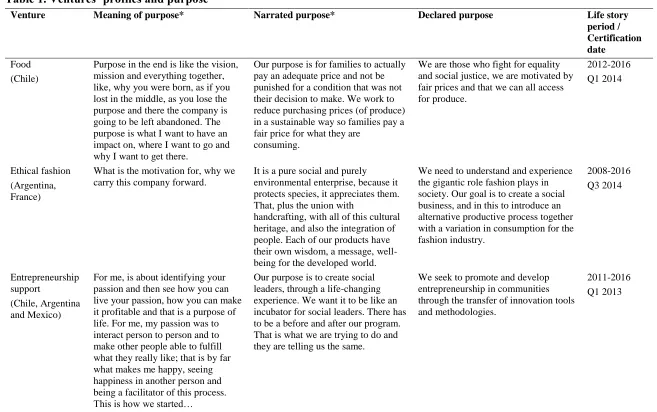
--- Insert Table 1 about here ---
3.4 Data collection
Process-tracing focuses on the unfolding of events or situations over time (Collier 2011).
Consequently, we selected appropriate data collection methods that allowed us to capture “key
steps in the process”, through which a personalized sense of purpose unfolds as part of a
sustainable venture. Hence, to collect the descriptive components of this process, we used two
elicitation methods (Bagnoli 2009). In the following we provide a detailed description of each
method and its application.
Life story interviews (Atkinson 2001) are a type of semi-structured interview about the story
of the participant. These are used to elicit autobiographical recollections including time-bounded
actions, contexts, feelings and key events in the life of the participant (McAdams 2001).We began
the interviews asking the participants to provide an overall plot outline of their journey as
entrepreneur (normally starting one year prior to foundation of the venture until the day of the
interview) and his/her particular connection to purpose, as it were divided into chapters. Once the
chapters were established in the timeline (see below), the researcher started with open questions
such as: “Tell me about your business”, “How did everything start?” “What was the main
motivation for starting this business?” “What opportunity do you think triggered this business
idea?” “What did you want to achieve?”. Founding team, places, key events and particularly how
these are related to purpose were also explored during the interview, since stories have characters,
time-bounded actions and scenes. The interview protocol included questions such as: “What does
purpose mean to you?” “What is the purpose of your business?” “At which stage did purpose
become a priority?” “How has this purpose been embedded in your business?”. Given the interest
of our study in understanding the relationship between purpose and purposeful organizing, we
explicitly inquired about the process of getting certified as a B Corp, reasons for doing so, its
meanings, and perceived impacts.
To enhance entrepreneurs’ reflexivity, we included two complementary graphic elicitation
techniques: relational maps and timelines (Bagnoli 2009). These two visual methods involve
drawing and producing diagrams which facilitate a more comprehensive and time-bounded
representation of more profound layers of experience, normally absent in verbal accounts. For both
timelines and relational maps, we used the collaborative sketching platform Scribblar, where both
the researcher and the interviewee had access to visualize and edit the sketches at any time during
the interview.
Relational maps are used in studies of social care and human relationships to examine how
people see themselves in relation to other important people or things in their lives (Bagnoli 2009).
Because entrepreneurs also shape their sense of purpose through interactions with others and the
world around them (Debats et al. 1995), we used this technique to gain deeper understanding of
how central or peripheral the internalized sense of purpose and manifestations of purposeful
organizing are to the entrepreneur and his or her business throughout the venture development
process. In our study, map drawing started with three concentric circles where the entrepreneur is
requested to situate him or herself in relation to the venture and the purpose under pursuit. Other
people, objects and notions are placed in order of importance within the set of concentric circles,
with the intimate relationships being in the inner circles, and least important fading towards the
edges. As such, relational maps were integral to the interview as they were not only a source of
evidence but also an enabling tool for moving the verbal interaction between the researcher and
participant one step further to explore other areas of experience.
Timelines, as a graphic elicitation method, enable a deep reflection on the temporal
dimensions of the entrepreneurial journey as well as elicit biographical data about time. Inspired
by recent studies in social care and nursing research (Bagnoli 2009), this method allowed us to
gather the most important turning points and biographical events from the entrepreneurs’
perspective. Timelines were developed collaboratively throughout the interview. After agreeing
the day of the interview), we asked the participants to start recording the key events along the two
axes of the timeline, as they emerged during the conversation; i.e. temporal (horizontal) and
purpose intensity (vertical), and also to make clear whether the event related to an internalization
of purpose (using black color) or a perception of impact resulting from the practice of purpose
(using grey color). While the temporal axe allows mapping of the process through which a sense
of purpose unfolds into purposeful organizing, the intensity axe is used to identify the relevance
of events in their connection to purpose. The identification of key events was triggered by
discussing past, present and future challenges, and whether those challenges were positive or
negative, and related to feelings or external circumstances, which were also registered in the
timeline.
Life story interviewing tangled with graphic elicitation is an inherently iterative data
collection process. For example, the drawing of relational maps was repeated several times during
the interviews, as participants kept reflecting on the different stages of their entrepreneurial
journey and populating the timeline with key events. Similarly, when doubts about specific dates
and events emerged through the interview the interviewer stopped the session to corroborate their
occurrence through external informants (e.g. business partners, suppliers and B Labs staff who
were either interviewed or called for consultation) and relevant documentation (e.g. media articles
announcing awards, invoices to customers, Twitter and Facebook posts and crowdfunding
campaigns). In this sense, real-time editing in Scribblar proved central to our inquiry because both
timelines and maps were expected to change (and indeed changed) during the interview, as the
participant retrieves and reconfirms evidence and amends dates and key events in the timeline or
rearranges the elements according to their level of importance within the relational map, in line
dates and the intensity moderated based on a final comparison of key events, we asked the
participants to connect the events with lines to identify links between relevant events based on
their own experience.
The main data collection effort spanned over 11 months, between April 2015 and March 2016.
This process was anteceded by two key activities, which were central to understanding the role of
B Corps in Latin America and their functioning and main challenges: The B Corp Regional
Strategy Meeting that took place in Chile in January 2014 and a 2-day Regional Challenges
Meeting organized by the first author with representatives from 22 Latin American B Corps in
August 20144.
The interviews with B Corp entrepreneurs in 2015-2016 lasted between two and three hours.
Building the life story and recollecting dates, context, feelings, characters, actions and events took
us on average 60 minutes. The remaining interview time was used to organize and make sense of
the key elements of the life story in the timeline and relational map. This two-step procedure was
key to minimizing retrospective and memory biases. Verbal accounts were recorded and
transcribed and visual data digitalized and later standardized and prepared for coding. Following
our initial life story interviews, we conducted several short follow-up interviews over the course
of one year with the founders and key informants, until early 2017. The aim was threefold: to be
able to triangulate data and corroborate the stories in different points in time after the initial life
story account; record new key and critical events; and complete missing pieces of evidence needed
for the causal inferences and process tracing tests. In addition, to minimize self-reporting and
retrospective biases, we triangulated our interview data with archival data (e.g. internal reports),
publicly-available data (e.g. media articles and crowdfunding profiles) and secondary sources
4 Data analysis
Our data analysis draws on process-tracing (PT) techniques (Collier 2011) and is divided into three
iterative stages, including two inductive analyses (descriptive and causal inferences) and one
logical consistency test of early process-based findings. PT data analysis requires a departure from
the traditional within-case / cross-case pattern-finding approach, which simply focuses on
emerging commonalities across cases and causal inferences based on what is common and/or
different between them. Therefore, our analyses elaborate on a mechanistic conception of
causality, focusing on uncovering the causal forces moving towards the outcome (Collier et al.
2010). This entails elaborating on the theoretical process(es) whereby sequences of causes lead to
alternative outcomes and more the transmission of causal forces from causally interlinked events
to outcomes. As such, our analyses look at how several outcomes are imprinted by events that
result from actors’ actions, interactions and various contextual factors (Bengtsson and Ruonavaara
2016).
4.1 Stage 1 descriptive inferences
The first stage focuses on sorting and coding life story and autobiographical evidence, comprising
both visual and verbal data. This part of the analysis focuses first on recognizing empirical
regularities that are part of a temporal sequence of events to then derive and elaborate on
descriptive inferences in relation to how purpose is experienced by the entrepreneur and the
temporal sequence of events through which purpose is integrated into purposeful organizing. This
is divided into three analytical activities: pattern-finding across relational maps, coding of
4.1.1 Pattern-finding across relational maps
Initially, we focused on examining patterns across relational maps. This allowed us to infer the
scope, nature and relative importance of purpose to the entrepreneur, which was considered as the
main input for the elaboration of timelines. Through our examination, we recognized three types
of ventures paths and one inner mutation, which we label broad purpose (group 1), narrow purpose
(group 2) and circular purpose (group 3), inferred from the most central declared purpose at the
inception stage. We also observe a mutation of purpose in group 2 from narrow in early stages of
the process to broad in late stages, which becomes more prominent in a subset of cases we label
group 2b. This marks a significant turning point in the life of purpose group 2, which splits halfway
through, leading to two alternative outcomes. Figure 1 shows four relational maps as an illustration
of the three different types (and one mutation) of purpose relationships emerging from the data.
The results from the relational maps were considered as the main input for the development and
interpretation of timelines, which we explain in detail below.
--- Insert Figure 1 about here ---
4.1.2 Coding of timelines
Following, in a first attempt to uncover causal mechanism, we combined life stories narratives and
timelines to detect relevant pieces of information that helped us understand the relationships
between purpose and purposeful organizing. This is done by coding the critical events identified
by the interviewee (and confirmed through triangulation), which in their view marked the story of
their ventures.
Since process tracing is an “analytic tool for drawing descriptive and causal inferences from
our coding procedure of life stories and timelines differs from the traditional content-based coding.
Although codes were developed inductively, the specific terms were not meant to be representative
words that summarize the meaning of a particular piece of text, but rather abstractions of key
events. While labeling and coding was done by the research team, it was the interviewee who
defined the nature, intensity and meaning of the event in her or his life. In enhancing the validity
of this coding, two researchers evaluated the life story narratives and timelines collectively, based
on previous agreement on how each key event should be recognized and treated in the timeliness.
Disagreements were resolved through discussion.
Drawing on comparative process tracing methods (Bengtsson and Ruonavaara 2016) and the
notion of path dependency (Mahoney 2000), our coding of life stories and timelines focuses on
those key events where the paths (depicted in the timelines) are imprinted, with two potential
outcomes: path opening or path confirmation, which in PT language constitute critical junctures
and focal points respectively. While the former type of imprinter are transitional situations in
which actors have the possibility to make choices that would open up a new path, the latter
demonstrate, manifest, and consolidate the path dependence of a direction taken before.
Interestingly, actors may not realize at a critical juncture that they are actually making history.
This is central to our examination of imprinting, since at times, purpose-related decisions may
have more far-reaching consequences for purposeful organizing than what the decision-makers
themselves realized (Bengtsson and Ruonavaara 2016). While key events were defined by the
interviewee while completing the exercise, the role of the research team was to evaluate the
timelines and maps collectively to detect critical junctures, focal points and empirical regularities
across life stories and derive descriptive inferences. As a result, we identified 21 codes representing
--- Insert Figure 2 ---
In Figure 2, the horizontal axe shows the normalized life story period, which ranges from nine
years in the case of Newspaper to four years in the case of Food and Crowdfunding, as well as the
perceived degree of internalization (black lines) and impact (grey lines) of the stated purpose.
Internalization represents how vivid or intense the stated purpose was felt and experienced by the
entrepreneur and his or her team. In the case of Food, for example, the significantly broad
internalized purpose derived from a life-changing experience of two of the founders who lived for
several months in one of the most deprived areas of the country, doing social service. The desire
to eliminate the punishment to poverty imprinted their journey and stuck with them unchanged
over a long period of time, despite several rejections from market actors, financial struggles and
relatively poor performance. The impact of the stated purpose, on the other hand, shows whether,
and the extent to which, the entrepreneur’s ambitions were delivering results, either inside or
outside the venture. In the case of crowdfunding, for example, the first key external imprinting
event, recognized as highly impactful and linked to purpose, was the first big contract which
involved securing equity-based investment for another B Corp. In most cases, obtaining the B Corp
certification is recognized by the entrepreneurs as a highly impactful internal event.
4.1.3 Pattern-finding of interlocking events
In examining sequences of codes across timelines we identified patterns in the relationships
between interlocking events showing empirical regularities across cases. Sequences of several
critical events were shared by cases, which most notably were also aligned with the original
grouping of ventures resulting from the analysis of relational maps based on scope of purpose. In
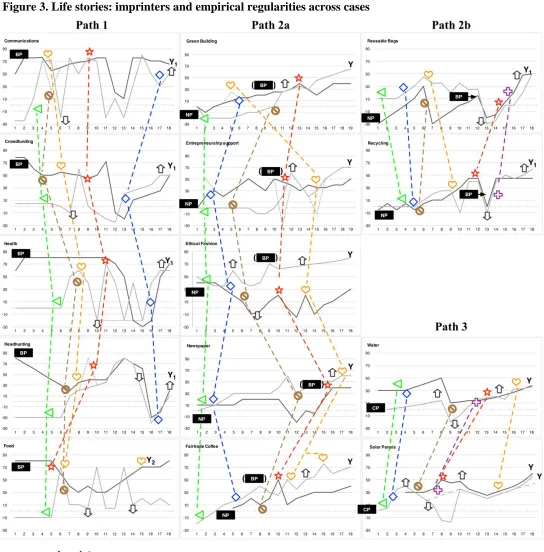
These relationships can be seen in Figure 3, where cases sharing broad, narrow and circular
purposes (black boxes) are connected to eight types of critical events (marked with symbols)
appearing in distinct sequences (shown as vertical dotted lines). These distinct sets of events,
imprinted the venture during sensitive stages by either confirming or changing the paths, yielding
three distinct purpose-based venturing paths and uncovering three unique purpose-purposeful
organizing relationships.
--- Insert Figure 3 ---
As seen in Figure 3, purpose group 1, characterized by broad purpose (BP), is aligned with a
distinct sequence of seven critical events and two alternative outcomes shared by four cases, which
we label Path 1. We also noticed that purpose group 2, comprising six cases sharing a narrow
purpose (NP), is aligned with two unique sequences of events yielding Path 2a and Path 2b, with
seven and eight critical events respectively, one outcome for Path 2a andtwo alternative outcomes
for Path 2b. The latter follows a similar logic as the outcomes of Path 1. Uniquely in Paths 2a and
2b, the definition of (narrow) purpose is not the main trigger of the venturing process, it rather
follows from the business idea (green triangle). Finally, the group 3 sharing circular purpose (CP)
is aligned with a distinct sequence of eight critical events and one common outcome shared by two
cases, which we label Path 3.
4.2 Stage 2 Causal inferences
“The principle difficulty in your case lay in the fact of there being too much evidence. What was vital was overlaid and hidden by what was irrelevant. Of all the facts which were presented to us we had to pick just those which we deemed to be essential, and then piece them together in their order, so as to reconstruct this very remarkable chain of events.” – Sherlock Holmes in the The
Uncovering such a remarkable chain of events, as Sherlock Holmes emphasizes, requires moving
from description to causality, where the descriptive inferences from life stories are transformed
into prospective causal mechanisms, and each part of the mechanism is presented as a statement
of regularity (George and Bennett 2005). In order to do so, we engaged in a recursive process to
give causal structure to the empirical regularities by means of theorizing on the causal mechanisms
underlying the relationship between purpose and purposeful organizing.
Drawing on the tenants of PT methods, in this second stage, verbal and visual data are turned
into evidence, at the time descriptive inferences and empirical regularities are turned into
structured statements of regularities or causal mechanisms, which is central to process-based
theorizing. In structuring our causal inferences, we focused on causal process observation (CPO),
which is the main unit of analysis in PT studies, understood as an insight, extant knowledge or
piece of data that provides information about the mechanism, process or context and enables causal
inference (Collier et al. 2010). In PT, observations are not strong or weak evidence per se. Evidence
is always a combination of observations and other factors, such as timing or previous knowledge
of the phenomenon, which has proven central for uncovering the role of timing of B Corp
certification in our study, revealed below. This means that observations can become evidence
depending on what other observations have been made in previous steps of the process or in other
parallel processes and what other contextual information is available (Befani and Mayne 2014). In
this sense, PT evidence is bounded as the same observation made in different contexts can have
4.2.1 Towards a theorized system of purposeful organizing
In uncovering the causal mechanism underlying our process of interest, we use the X->Y centric
PT theory building variant, where we theorize the X->Y process in the form of a number of
interlocked components that are all necessary for the causal mechanism to exist (Befani and Mayne
2014). In PT theory building, the conceptualization of causal mechanisms and their parts draws on
two analytical conceptions of path dependency, which is methodologically and theoretically
central to imprinting theory: points of no return and historical narrative (Milanov and Fernhaber
2009). In moving from descriptive to causal inferences, our analysis does not pay particular
attention to the uncovering of regular associations, as the mechanisms can be infrequent. The focus
of causality here is on the dynamic and interactive influence of causes on outcomes and in
particular how causal forces are conveyed through the series of interlocking events (Beach and
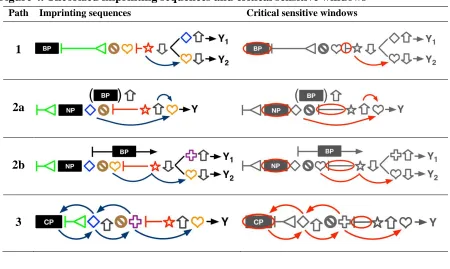
Pedersen 2013). The inferred causal mechanisms and identified imprinters (in brackets) for the
three paths are presented in Table 2. Since the causal mechanisms consist of sequences of events
that are the product of actors’ actions and interactions, the table conceptualizing the inferred causal
mechanisms and their parts highlight both actors (underlined) and activities (in italics).
--- Insert Table 2 about here ----
4.3 Stage 3 Iterative logical tests
Inductive process-based theory building is normally completed once the individual causal
relationships are inferred from the data. However, this says little about whether the inferred chain
of events is actually causally interlinked, the strength of each causal relationship, and whether and
how each event and chain of events are necessary and/or sufficient for the outcome to occur
(George and Bennett 2005; Mahoney 2012). Therefore, the aim for this stage is to deductively
2. This is assessed by using necessity and sufficiency tests regarding the interlocking events
moving causal forces from purpose to purposeful organizing, i.e. from the origin of the venture
and formalization to its final disposition as either a small business or a venture at the brink of
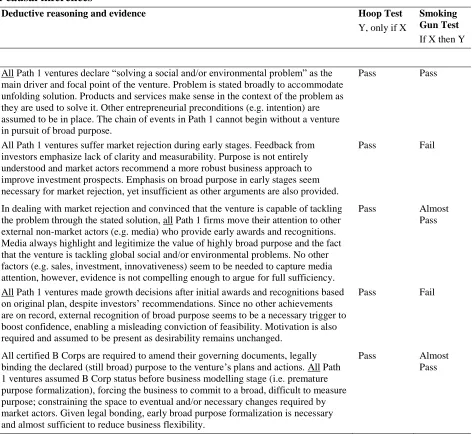
failure. We do so by means of three logical tests: hoop test, smoking gun test (Van Evera 1997),
and trivial necessity and tautological sufficiency (Mahoney 2004).
Hoop tests permit assessing the extent of necessity within a given causal relationship. Passing
a hoop test increases the confidence on and the subjective probability that a CPO is correct
(Mahoney 2012) and that the specific causal relationship being tested exists, as it disproves other
alternative causes. Smoking gun tests permit assessing the extent of sufficiency within a given
causal relationship, i.e. that the condition X is sufficient but not necessary for Y. Based on the
notions of unobserved events and causal proximity, we adhere to the principle of quasi sufficiency,
because despite the weight of evidence, we cannot establish for certain that the observed event was
alone and proximate enough to be sufficient for the subsequent event. In order to minimize the
skepticism towards arguments of necessity and sufficiency in the social sciences, we conducted
complementarily logical tests for trivial necessity and tautological sufficiency. While the former
refers to those causes in which the cause is present in all cases of the universe of analysis
irrespective of the value on the dependent variable (e.g. humans are necessary for
entrepreneurship), the latter refers to causes embedded in outcomes with no clear definitional
distinction or temporal separation between the two (Mahoney 2004) (e.g. entrepreneurship is
sufficient for new venture creation). In Appendix B we provide further details of our logical
consistency tests.
Table 3 presents the inferred relationship (XY) reported in Table 2, the theorized causal
exercise, causal inferences are treated as expectations or hypothesized causal mechanisms that
have been derived inductively and requiring strength testing against evidence. Mirroring the
conceptualization of causal mechanisms (Table 2), process expectations are broken down into a
feasible number of parts.
--- Insert Table 3 about here ---
Despite their post-hoc nature, in our analyses we used these tests recursively. While testing the
logical consistency and strength of our inductive reasoning, we were able to refine the inferred
causal mechanisms and also discover patterns of salience of three sensitive periods across the three
paths given the almost sufficient relationships between events observed within those periods,
namely: definition of scope of purpose, timing of B Corp certification -as unique formalization of
purpose- and changes in source of feedback. These are considered as critical sensitive windows
that explain variance in the relationship between purpose and purpose organizing.
In refining the process model and strengthening the logical consistency of our theorizing, we
increased our level of confidence on that 1. the inferred causal mechanisms (three path types)
actually occurred as theorized; 2. the three paths begin with distinct initial conditions; 3. all the
events within the paths are causally interlocked and necessary for the next one to occur; 4. causes
are not present in all cases in the universe of analysis, 5. there are no embedded causes, 6. the three
critical sensitive windows (i.e. scope, timing and source of feedback) are actually central, given
the quasi sufficient relationships between the events observed within them, the irreversible effect
of those events shaping both the following events and the continuation of the path; and 7. the three
5 Research Findings
5.1 Imprinting sequences from purpose to purposeful organizing
Our analyses reveal three remarkable paths explaining distinct relationships between purpose and
purposeful organizing. Path 1 is characterized by a broad problem-based purpose (black square
located in the upper part of the timelines, along the black line) and low perceived impact in early
stages. We consider broad purpose to be an all-encompassing ambition of achieving a social and/or
environmental impact without having tangible indicators and objectives clearly identified, for
example “reduce punishment to poverty” (Food) or “contribute so that people, businesses and
communities can live in harmony” (Communications), which can be evidenced in both the
description of purpose (Table 1) and the relational maps (Figure 1). Idea stage is relatively long
and purpose is recognized and rewarded by non-market actors (e.g. media) before the business
idea or business model are refined, although market actors (e.g. investors, clients) reject the nascent
venture several times.
[Purpose] So, we wanted to tackle an important social problem, because I graduated with the desire to change the world (Health)
[Recognition] Having a traditional investor, at the beginning, it can cost us a lot… versus having 57 small investors who are fans of our business, they all have stickers in their cars, they follow us on Facebook and retweet everything we post… you do not need to discuss the purpose and focus of this business every minute (Food).
Path 1 ventures also receive B Corp certification early in the process before having a business
model and clear value proposition, which leads to new instances of recognition and media
attention, increasing the sense of external recognition and feasibility, despite the evident low
performance.
[Early certification] Basically, we got certified because one of my partners knew someone at B Labs… we said oh cool…this is sort of what we are dreaming of doing. We needed that sort of external legitimacy for the first meetings (Headhunting).
Based on apparent success due to external validation, venture decisions are oriented towards
growth and expansion. Purpose formalization occurs once the venture achieves certified B Corp
status. For Path 1 ventures, purpose formalization through B Corp certification seems premature
because the business model has not been fully developed and validated by market actors. Due to
the apparent sense of external recognition and feasibility, purpose cannot be narrowed down and
the business model corrected, despite market (negative) feedback.
Broad-purpose low-performing Path 1 ventures inevitably face financial problems leading to
team and purpose conflicts and, in all observed cases, organizational crisis. We identified two
divergent outcomes; on the one hand (Y1 in Table 2) internal changes trigger a new orientation
where the entrepreneurial team regains control of the venture (if and when) by focusing on specific
tasks, business planning and realistic forecasting, and more importantly by narrowing down the
scope of the venture’s purpose. In an alternative, still open-ended outcome (Y2 in Table 2), purpose
is not called into question, low performance continues and risk of failure increases as the
entrepreneur maintains biased behavior and assumed perception of success.
[Reorientation and control] 2014 was the worst, it hit the team, hit the confidence, hit the friends, hit the dirt, then I left. We loved each other and we were the best, when I came back there were three people who did not look at each other, they did not talk to each other, with broken trust…We decided to focus on search and selection, that changed our model. Clients did not understand what we were doing. We did not attend the B Corps festival, and focused on gaining maturity in the market, positioning and opportunities (Headhunting)
[Purpose is sustained] When there are moments of uncertainty I believe that the purpose can even be questioned; in our case, it did not change, thank God. (Food)
and we have time to learn how to grow. We are now in 280 shops and we are going for 3,000 shops (Food)
Path 2 is characterized by absence of purpose and unintended impact in early stages (black square
located in the lower part of the timelines, along the black line). Idea stage is short in comparison
to Path 1, and the venturing process is triggered by a business idea that may or may not respond to
social or environmental problems. In Path 2 ventures, narrow purpose is built into the business as
the sustainable practices implemented start paying off. We consider narrow purpose to be a
specific ambition of achieving a concrete social and/or environmental impact on a particular group
of people with tangible indicators and objectives clearly identified, for example “improve our labor
practices” or “optimize the projects of our clients towards a better environmental impact”, as
declared by Recycled Bags and Green Building respectively. Market actors recognize and value
the business idea and practices, but unlike Path 1, the venture is rewarded on business merits only.
Path 2 adapts to comply with market demands if necessary, formalizing their business model by
implementing sustainable business practices.
[Idea development] We started as a merchandise business, well I wanted to brew my own beer but that did not work, entrepreneurship was my thing so merchandise it is. Small margins, so we needed to change, the (2008) crisis changed the market and that was the opportunity… the day that Lehman Brothers collapsed in September, we were in China and my other partner, resigning from her old job, and that was the beginning of the world of reusable bags (2b)
[Rewarded on business merits] We went from 9,000 to 30,000 bags of certified coffee beans in 3 years, which has enabled us to do great work with the farmers…we are convinced of the (relevance of) the certification processes (i.e. Fairtrade), the impacts that we have achieved through the certifications, in the farming communities, through the purchase of certified coffee, through a higher income. A certified coffee today represents an additional 35% in income for the farmer compared to non-certified coffee (Fairtrade Coffee)
then the crisis in Europe, purchasing decisions changed and we moved part of it to USA, with e-commerce, marketing, many things (Ethical Fashion).
[Response to markets] Alongside financing and cash flows, etc. consolidating our internal process is now central to us, this means consolidating our team… how many new people do we need, which partners, allies do we need… internal consolidation is the key to continue creating value (Fairtrade Coffee)
Path 2 ventures apply for and receive B Corp certification comparatively later in the process,
mostly to reflect the interaction between business practices and sustainability aspirations, and to
make sense of the narrow purpose already delivering positive impacts.
[Late certification] B Certification was about simplifying the narrative, our purpose. Instead of explaining what we do as a firm every time, we just say we are a B Corp (Entrepreneurship). Somehow, we are a company with social and environmental impact. B Corps was our place, we were very happy, it was the same as when we joined the Ethical Fashion Show. So, it's like, support for your model, what you are doing, it's like strengthening your wings too, being part of the Ethical Fashion Show, being part of the Fashion Forum, being part of the B Corps. It is a way of empowering those people who are doing business like you (Fashion).
[Late certification] Two years ago we decided to get B certified, we are B by nature, everything we were doing was very B, so we connected very easily with the certification. We did not have to make a big effort to become a B (Coffee).
As the venture gains maturity, narrow purpose is expanded to cover a wider range of sustainability
challenges, yet unlike Path 1, market as well as non-market actors are perceived to be reliable
sources of feedback. Confidence is then built into the business as the entrepreneur focuses on both
gaining maturity and purpose expansion. Returns increase as the venture leverages external
recognition while evolving the business model in response to demands.
[Purpose expansion] We started exporting organic food products… while we were growing, we detected massive inequalities in the industry’s purchasing model where the farmers are left behind. Then we developed a new purchasing model (“co-responsibility”), to empower coffee producers (Coffee).
At this stage, purpose broadening triggers a major critical juncture. While Path 2a ventures
consider the increasingly broad purpose to be relevant only if it serves the objectives of the
business, Path 2b ventures begin to deviate and believe that the increasingly broad purpose is
relevant by itself. In the former, the pursued impact remains under control bounded by the scope
of the venture (shown in brackets in Figure 3), whereas in the latter the pursued impact grows
broader surpassing the scope of the firm (shown as a forward-facing arrow in Figure 3).
P2a [path continuation] We have also used the B Corp networks for new business partners and growing in Latin America (Entrepreneurship).
P2b [path deviation] Then it is like when you are about to lower your arms, suddenly there is good news about (the company), it is like an adrenaline injection that gets you back convinced that we will get there (Recycling).
As a result, B Corp certification begins to play a dual role. In Path 2a, it sits along other practices
and standards, whereas in Path 2b the certification becomes the main source of external recognition
capturing the attention of media and other non-market actors. Path 2 ventures also diverge in the
final outcome after that critical juncture. The 2b variant enters into a similar spiral and biased
behavior as Path 1 (Part 5 onwards in Table 2), with similar dual endings. Path 2a ventures, in
contrast, retain an increasingly ambitious, yet still narrow purpose, which remains bounded by the
scope of the business, creating and delivering value as the ventures consolidate their business
model and enter a formal planning stage.
P2b [Recognition] With regard to awards, I always saw it as a way of posing you in front of potential clients, in a much better way, when you arrive with a medal, so to speak, it is because your idea is not so crazy, if it has been awarded it is because you really are seeing something … First two years, all good (as a business) … then the prizes, more than anything, are a “pat to the soul” that tell you that you are doing things well, though the company is not taking off as one wants, or your target has not taken off as you want it to take off (Recycling).
P2a [Business-bounded purpose] Our company is facing new challenges every year, first we needed to consolidate a good client portfolio, and we already have a good portfolio of clients; then the suppliers, we have built a very good base of suppliers that are very close to us and very committed; we now have the challenge of balance the operation from the financial point of view, in order to continue to grow and evolve…coffee is expensive, we are growing and there will always be cash flow challenges (Coffee).
Path 3 is characterized by a change initiative and an unintended emergence of a social movement
in early stages. Purpose and the business idea are not immediately visible, and the business model
only surfaces as a vehicle for change. While interpreting that ‘wanting to change something’ is
indeed purposeful, Path 3 founders perceive it differently, based on their own definition of purpose
(Table 1). Based on interviews, Path 3 founders seek to change the status quo, while purpose, as
defined by scholars and B Corps, came much later in the process. The aim of Path 3 ventures is to
challenge the way other social enterprises and B Corps for that matter operate. In this sense, the
business functions as a “challenging” artefact, where purpose is circular or recursive as it seems
to serve the purpose of the case for change.
[Purpose as change initiative] Solidarity, we say "hey, we all have to move in this direction" and hopefully we have been a small grain of sand for the movement, and that the entrepreneurs, those who are starting, they have to start with this…You know, this did not start by identifying a business opportunity, it is the other way around, it started because we wanted something to happen, force a change, and we were willing to put resources in it (Water).
External actors react to anecdotal information (e.g. first LLC in the country to donate 100% of its
profit), but both market and non-market actors do not engage further as motives and mechanisms
are not clearly understood. The business model and product portfolio are changed several times to
remain in line and serve the change initiative. The latter grows to become the purpose of the
venture, which is legitimized through B Corp Certification.