warwick.ac.uk/lib-publications
Original citation:
Amel, Hoda, Raath, Neill D., Williams, Geraint J., Cozien-Cazuc, S., Ravaioli, M., Currie, S.,
Bools, A., Hawrylak, M., Goodman, E. and Hughes, D. J. (2017) Introducing a novel
manufacturing process for automotive structural/semi structural composite components.
Procedia CIRP, 66 . pp. 143-146.
Permanent WRAP URL:
http://wrap.warwick.ac.uk/98495
Copyright and reuse:
The Warwick Research Archive Portal (WRAP) makes this work of researchers of the
University of Warwick available open access under the following conditions.
This article is made available under the Attribution-NonCommercial-NoDerivatives 4.0 (CC
BY-NC-ND 4.0) license and may be reused according to the conditions of the license. For
more details see:
http://creativecommons.org/licenses/by-nc-nd/4.0/
A note on versions:
The version presented in WRAP is the published version, or, version of record, and may be
cited as it appears here.
Procedia CIRP 66 ( 2017 ) 143 – 146
2212-8271 © 2017 Published by Elsevier B.V. This is an open access article under the CC BY-NC-ND license (http://creativecommons.org/licenses/by-nc-nd/4.0/).
Peer-review under responsibility of the scientific committee of the 1st Cirp Conference on Composite Materials Parts Manufacturing doi: 10.1016/j.procir.2017.03.364
ScienceDirect
1st Cirp Conference on Composite Materials Parts Manufacturing, cirp-ccmpm2017
Introducing a novel manufacturing process for automotive structural/semi
structural composite components
H.
Amel
a*, N.D. Raath
a, G. Williams
a, S. Cozien-Cazuc
b, M. Ravaioli
b, S. Currie
c, A. Bools
d,
M.Hawrylak
d, E. Goodman
e, D.J. Hughes
aaWMG, University of Warwick, Coventry, UK bFar-UK, Unit 29, Wilford Ind Est, Nottingham, UK
cTMETC, University of Warwick, Coventry, UK dExpert Tooling, Banner Park, Wickmans Drive, Coventry, UK eNational Composites Centre, Bristol & Bath Science Park, Bristol, UK
* Corresponding author. Tel.: +44-247-652-8873; E-mail address: [email protected]
Abstract
Potential uses of composite materials are currently being investigated by the automotive industry to reduce vehicle weight and CO2 emissions. Existing composite production processes are however, low volume and high cost. The aim of the present study was to develop a novel end-to-end production process to produce a light weight, cost effective polymer composite with reduced TAKT time and potential for structural applications. Components were produced from discontinuous random fibres mixed with an epoxy resin system. Static and dynamic mechanical testing as well as durability tests are in progress to evaluate the performance of these materials. Initial results were compared to Sheet Moulding Compound (SMC) as the benchmark composite material.
© 2017 The Authors. Published by Elsevier B.V.
Peer-review under responsibility of the scientific committee of the 1st Cirp Conference on Composite Materials Parts Manufacturing.
Keywords: Composite materials; epoxy; thermoset; discontinuous fibre
1.Introduction
In order to meet strict emission reduction targets and to enable electro mobility, it is essential to reduce the structural weight of future automobiles [1]. Fiber reinforced polymer composites are of more interest to the automotive industry due to their lightweight, reduced tooling cost, resistance to corrosion and their higher specific energy absorption in comparison to their metal alternatives [2]. One of the important obstacles in using polymer matrix composites as automotive body parts is their potential loss of mechanical integrity when exposed to elevated temperatures of the e-coat process. During this process, paint particles are suspended within a liquid medium with a charge upon them. Under a high voltage DC current, the paint particles migrate to the part being painted and are deposited onto the surface, forming an even continuous
film. This process continues until the desired thickness is reached, at which point the film insulates the part and the process is complete, leaving a corrosion resistant and durable paint film [3]. The typical temperature for e-coating of metal components is 200°C. While different approaches, such as assembling the composite parts to the BIW after the aggressive e-coat process or lowering the temperature of the e-coat process , have been suggested and used to eliminate this issue [4], none of these approaches are suitable for a high volume production process.
The High Volume Lightweight Technologies for Vehicle Structures (HiLiTe) project was established to develop a novel production process for manufacturing high-volume composite parts for the automotive industry. The project’s aim was to achieve a 30% weight reduction on the structural steel case study component while meeting all performance and safety
© 2017 Published by Elsevier B.V. This is an open access article under the CC BY-NC-ND license (http://creativecommons.org/licenses/by-nc-nd/4.0/).
144 H. Amel et al. / Procedia CIRP 66 ( 2017 ) 143 – 146
specifications of the steel benchmark. Cost reduction of 40% was to be achieved from traditional composite materials and processing considering SMC material as the benchmark. An important requirement for this project was the ability of the composite components to withstand the high temperature paint line production step of approximately 200°C, considering that the matrix may exhibit a loss of mechanical integrity at this elevated temperature. Additionally, the project aimed to reduce TAKT time in manufacturing this light-weight, cost-effective polymer composite structure.
2.Method and Materials
First stage of the project was to select an automotive component as the demonstrator part. A component decision matrix was defined with bulkhead, panel reinforcement and bonnet inner as targeted application candidates. All candidates were inner components which do not require high quality finish, to ensure a reduced process time. These components were each scored based on the identified desirable attributes such as weight, crash safety, repeatability, tolerance sensitivity and potential adverse life time effects and bonnet inner was selected as the appropriate component to focus on during the term of the project.
An important parameter in selecting the composite matrix material was its ability to withstand the elevated temperature of the e-coat line. This parameter was identified as one of the processing boundaries and the research performed on various
polymers showed epoxy resin as a suitable material with the potential of withstanding the e-coat line temperature.
To reduce production cost of the component, discontinuous random carbon fiber was considered as reinforcement and a continuous mixing process was used to mix the fiber-epoxy system before its deposition on to the press. The component was molded into a net-shape. Net-shape molding of the material reduces the de-flashing operations to a minimum if not totally removing it, and therefore assists with eliminating the need for post processing as well as reducing material waste.
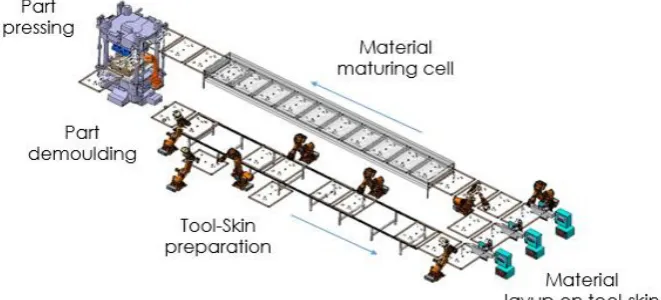
[image:3.595.135.466.373.523.2]To aid with reducing the process TAKT time and eliminate stand still periods during molding, tool skins were introduced and used in molding of the component. The use of tool-skins allows for easy transfer of the material in the manufacturing cell and simultaneous operation of the press and the material mixing and charging robots, to ensure that each step of manufacturing is kept under 2 minutes. This is in addition to the fact that the material itself allows for cure cycles between 90 and 120 seconds. A schematic of the manufacturing cell simulation is shown in Figure 1. The composite charge is deposited onto the tool skin while the next charge is being prepared and the charges in front are going through the maturing oven and pressing. In such a way, in a mass production line, the through-put of the production cell is improved without the need for several complete tools. The overall cell utilization is also improved as the robots can be working while the part is being pressed, instead of standing idle when a single tool is being used.
Fig. 1. Schematic of the HiLiTe manufacturing cell
Tool skins were produced through an Incremental Sheet Forming (ISF) [5] technique, which uses a round tipped tool attached to a computer numerical control (CNC) robot to incrementally indent a metallic sheet. The advantage of such a technique is that no press die is required, as in traditional sheet metal forming, thus lowering costs. Figure 2 shows a demonstrator tool skin and the component molded from HiLiTe material.
[image:3.595.308.513.563.641.2]The HiLiTe resin system consists of 4 parts. Araldite LY1556 is used as the baseline resin system, Aradur®1571 as the hardener, Accelerator 1573 and a maturing agent. Throughout the project, different maturing agents with different mixing ratios and maturing times were produced and tested to enable selecting the optimum process. Maturing agents and the mixing ratios are confidential and cannot be reported in this paper.
To study the mechanical properties of the component, plaques were produced from the same material using the same production method with a shear edge tool. 10 Tensile and 10 compression samples were cut from the plaques based on the sample dimensions in ISO standards for testing of carbon reinforced polymer matrix composites. Samples were tested using a 250KN Instron machine and standard fixtures and results were used in design and analysis of the final component.
Life cycle analysis (LCA) was performed to quantify the environmental impact of the component. The LCA explores the energy associated with different raw material processing routes, production techniques and recycling options. Consideration of all these options allows for a more in-depth understanding of the effects of utilizing different materials for the same component.
All stages of the component life including raw material extraction, processing, part production and usage (apart form disposal/recycling) were modelled in the GaBi software to analyze the potential global warming of each stage of the
component’s life. A traditional steel component was used as a
benchmark and comparisons were made with the HiLiTe material component.
3.Results and Discussion
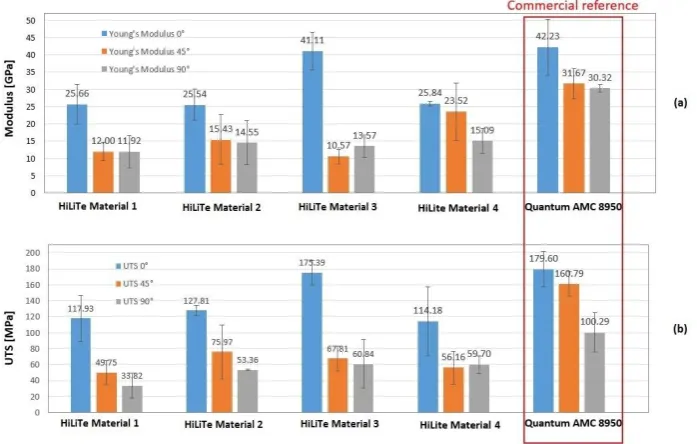
Figure 3 presents the tensile results from testing of the initial HiLiTe material matrix combination with different maturing agents and maturing times as shown in Table 1. It is important to note that the baseline resin system, hardener and accelerator materials are the same for all of the samples. All samples have the same volume fraction of carbon fiber, which is also the same as the benchmark SMC material.
Table 1- Material specifications for tensile testing samples Sample Maturing
Agent
Maturing Time
Maturing Temperature HiLiTe 1 A 14 days ambient HiLiTe 2 B 2 minutes 160˚C HiLiTe 3 B 2 minutes 160˚C HiLiTe 4 B 1.5 minutes 160˚C
From the presented modulus and UTS values, it is safe to assume that mechanical properties close to that of SMC are attainable with the HiLiTe material and processing method.
Fig. 3. a) Modulus and b)UTS results of different matrix combinations of HiLiTe material and the benchmark SMC material in 0, 45 and 90 degrees directions.
The problem with the current material is the directionality of the properties, which is visible in the SMC samples as well but is more noticeable in the HiLiTe samples. This can be partially attributed to directional flow of the carbon fibers.
[image:4.595.125.474.358.580.2]146 H. Amel et al. / Procedia CIRP 66 ( 2017 ) 143 – 146
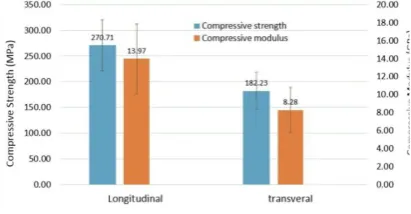
[image:5.595.76.282.181.288.2]Another issue with the presented results is the large deviation of modulus and UTS values in the same direction and same material system. This is also considered as a mixing system problem and is expected to be resolved upon using the alternative mixing system. Directionality can also be observed in compressive properties of the plaques in Figure 4, where compressive modulus and strength are considerably higher for samples cut in longitudinal direction than the samples cut in transverse direction.
Fig 4. Compressive results for HiLiTe Material 2 samples
The LCA impact calculations were determined using the
[image:5.595.76.277.506.638.2]“ILCD recommendations” methodology. Figure 5 compares the parameters common to both steel and composite models. It is clear that the main difference between the two models comes from the use phase, where the lighter composite component causes a significantly reduced GWP100 impact than the heavier steel version. It should be noted that there is a difference of 12.5 kg CO2 eq between the average total steel GWP100 and the average total composite GWP100. Although the difference in the total GWP100 values for composite and steel components does not seem large enough to justify the conversion to composite, it is important to note that this difference comes from replacing only one component. The authors believe that by replacing more steel components with composite components in a vehicle, this gain will become more noticeable and valuable.
Fig. 5. GWP100 comparison of steel and composite parts.
4.Conclusion
Ongoing research on developing a novel end-to-end production process to produce a polymer composite automotive structure with reduced TAKT time was presented. HiLiTe project concludes in May 2017 and will produce demonstrator components for the final process validation. In order to improve production cell utilization and efficiency, tool skins produced through ISF will be used in manufacturing of the demonstrator parts. Material boundaries based on the potential e-coat line temperature were established and tensile properties of a few example material trials were presented and discussed. An alternative mixing method is under investigation to achieve a material with more robust mechanical properties. The environmental impact of the part production and usage was quantified through LCA and compared with a traditional steel component used as reference. Data for end of life/recycling phase of the component is to be produced and reported in upcoming publications. More testing in regards to flexural properties and energy absorption of the material under low speed impact is in progress, the results of which and the verified finite element model of the component will be presented in further publications.
References
[1] F. Groh, E. Kappel, C. Huhne, and W. Brymerski,
“EXPERIMENTAL INVESTIGATION OF PROCESS
INDUCED DEFORMATIONS OF AUTOMOTIVE COMPOSITES WITH FOCUS ON FAST CURING EPOXY
RESINS,” in 20th International Conference on Composite Materials, 2015.
[2] K. Friedrich and A. A. Almajid, “Manufacturing aspects of advanced polymer composites for automotive applications,” Appl. Compos. Mater., vol. 20, no. 2, pp. 107–128, 2013. [3] M. A. Omar, The automotive body manufacturing systems and
processes. John Wiley and Sons, 2011.
[4] R. Chaudhari, M. Reif, O. Geiger, F. Henning, A. Diehl, and A.
Terenzi, “E-Coat Sustainable Long-Fiber Thermoplastic
Composites For Structural Automotive Applications,” Automot. Compos. Conf. Exhib., no. Il, pp. 1–15, 2008.