warwick.ac.uk/lib-publications
Original citation:
Fang, Yuting, Noel, Adam, Yang, Nan, Eckford, Andrew W. and Kennedy, Rodney A. (2018)
Maximum likelihood detection for cooperative molecular communication. In: 2018 IEEE
International Conference on Communications (ICC), Kansas City, MO, USA, 20-24 May 2018
Permanent WRAP URL:
http://wrap.warwick.ac.uk/101171
Copyright and reuse:
The Warwick Research Archive Portal (WRAP) makes this work by researchers of the
University of Warwick available open access under the following conditions. Copyright ©
and all moral rights to the version of the paper presented here belong to the individual
author(s) and/or other copyright owners. To the extent reasonable and practicable the
material made available in WRAP has been checked for eligibility before being made
available.
Copies of full items can be used for personal research or study, educational, or not-for-profit
purposes without prior permission or charge. Provided that the authors, title and full
bibliographic details are credited, a hyperlink and/or URL is given for the original metadata
page and the content is not changed in any way.
Publisher’s statement:
“© 2018 IEEE. Personal use of this material is permitted. Permission from IEEE must be
obtained for all other uses, in any current or future media, including reprinting /republishing
this material for advertising or promotional purposes, creating new collective works, for
resale or redistribution to servers or lists, or reuse of any copyrighted component of this
work in other works.”
A note on versions:
The version presented here may differ from the published version or, version of record, if
you wish to cite this item you are advised to consult the publisher’s version. Please see the
‘permanent WRAP URL’ above for details on accessing the published version and note that
access may require a subscription.
Maximum Likelihood Detection for Cooperative
Molecular Communication
Yuting Fang
†, Adam Noel
‡, Nan Yang
†, Andrew W. Eckford
], and Rodney A. Kennedy
††Research School of Engineering, Australian National University, Canberra, ACT, Australia
‡School of Electrical Engineering and Computer Science, University of Ottawa, Ottawa, ON, Canada
]Department of Electrical Engineering and Computer Science, York University, Toronto, ON, Canada
Abstract—In this paper, symbol-by-symbol maximum likeli-hood (ML) detection is proposed for a cooperative diffusion-based molecular communication (MC) system. In this system, an fusion center (FC) chooses the transmitter’s symbol that is more likely, given the likelihood of the observations from multiple receivers (RXs). We propose three different ML detection variants accord-ing to different constraints on the information available to the FC, which enable us to demonstrate trade-offs in their performance versus the information available. The system error probability for one variant is derived in closed form. Numerical and simulation results show that the ML detection variants provide lower bounds on the error performance of the simpler cooperative variants and demonstrate that majority rule detection has performance comparable to ML detection when the reporting is noisy.
I. INTRODUCTION
Molecular communication (MC) has been heralded as one of the most promising paradigms to implement communication in bio-inspired nanonetworks, due to the potential benefits of bio-compatibility and low energy consumption; see [1]. In MC, the information transmission between devices is realized through the exchange of molecules; see [2]. The simplest molecular propagation mechanism is free diffusion, where the information-carrying molecules can propagate from a trans-mitter (TX) to a receiver (RX) via Brownian motion. One of the primary challenges posed by diffusion-based MC is that its reliability rapidly decreases when the TX-RX distance increases. A naturally-inspired approach, which makes use of the envisioned collaboration between nanomachines, is allowing for multiple RXs to share information for cooperative detection. Often, cells or organisms share the same information to achieve a specific task, e.g., calcium signaling; see [3].
The majority of the existing MC studies have focused on the modeling of a single-RX MC system. Recent studies, e.g., [4]–[6], have expanded the single-RX MC system to the multi-RX MC system. However, these studies have not explored the potential of active cooperation among multiple RXs in determining the TX’s intended symbol sequence in a multi-RX MC system. To address this gap, our contributions in [7]–[9] analyzed the error performance of a cooperative diffusion-based MC system where an fusion center (FC) device combines the binary decisions of distributed RXs to improve the detection of a TX’s symbols.
In other fields of communications, e.g., wireless communi-cations, the maximum likelihood (ML) detector is commonly used to optimize detection performance; see [10, Ch, 5]. In the
MC domain, the ML sequence detector has been considered for optimality in several studies. For example, [11], [12] considered variations to modify the Viterbi algorithm and reduce the computational complexity of optimal detection. However, the high complexity of sequence detection is a significant barrier to implementation in the MC domain, even when applying simplified ML algorithms.
We note that the (suboptimal) symbol-by-symbol ML de-tector requires less computational complexity, compared to the ML sequence detector. Motivated by this, [13], [14] considered symbol-by-symbol ML detection for MC, but focused on a sin-gle RX only. Recently, [15], [16] considered cooperative ML detection for MC. However, [15], [16] considered detection of an event, rather than modulated information from a TX.
In this paper, we present symbol-by-symbol ML detection for the cooperative diffusion-based MC system, i.e., the FC chooses the TX symbol that was more likely, given the (joint) likelihood of its observations from all the individual RXs. The significance of this paper is that our results provide lower bounds on the error performance of the simpler cooperative variants in [7]–[9]. We demonstrate the good performance of these simpler cooperative variants (which are more likely to be realizable in biological environment) relative to symbol-by-symbol ML variants, particularly when we impose reasonable constraints on the knowledge available at the FC.
In our system, the transmission of each information symbol from the TX to the FC via the RXs is completed in two phases. In the first phase, the TX sends a symbol to all RXs. In the second phase, the RXs send their detected information to the FC. We consider relatively simple RXs and keep the relatively high complexity associated with ML detection at the FC1. In this work we consider the transmission of a sequence of binary symbols and the resultant intersymbol interference (ISI) in the design and analysis of the cooperative MC system. For convenience, we refer to the FC-estimated previous symbols as local history and the perfect knowledge of the previous symbols as genie-aided history. In our design, the FC chooses the current symbol using the FC’s local history. To the best knowledge of the authors, our work is the first to apply symbol-by-symbol ML detection to a cooperative MC system with multiple communication phases.
1This consideration is because that the FC could have a direct interface
TX
RX1
RX3
FC
A 0
A1 A
1 A0
RX2 A0
A1
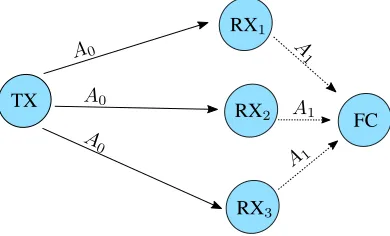
Fig. 1. An example of a cooperative MC system withK = 3, where the transmission from the TX to the RXs is represented by solid arrows and the transmission from the RXs to the FC is represented by dashed arrows.
We consider two different reporting scenarios according to the FC’s knowledge of the observations at the RXs, namely, perfect reporting and noisy reporting. The error performance in perfect reporting provides a lower bound on that in noisy reporting. Also, the perfect reporting scenario is appropriate for non-diffusive reporting channels such as neurons; see [17]. In perfect reporting, based on different levels of the knowledge of the observations at the RXs, we propose two ML detection variants, namely, 1) full knowledge ML detection (F-ML) and 2) limited knowledge ML detection (L-ML). In noisy reporting, we consider one detection variant between the RXs and the FC, namely, decode-and-forward (DF) with a single type of molecule and ML detection at the FC (SD-ML).
Our contributions are summarized as follows. We use the genie-aided history to derive the system error probability of L-ML in closed form; that of F-ML and SD-ML will be considered in future work. Using simulation and numerical re-sults, we demonstrate the FC’s effectiveness in obtaining local history for all ML detection variants. We corroborate the ac-curacy of our analytical results. Also, our results reveal trade-offs among the performance, the knowledge of previously-transmitted symbols, and computational complexity.
II. SYSTEMMODEL ANDPRELIMINARIES
A. System Model
We consider a cooperative MC system in a three-dimensional space based on [7]–[9], which consists of one TX, a “cluster” of K RXs, and one device acting as an FC. An example of the cooperative MC system is illustrated in Fig. 1. For reliable reporting, we generally assume that the FC is close to the cluster of RXs. For tractability, we assume that the system has a symmetric topology, such that the distances between the TX and the RXs are identical and the distances between the RXs and the FC are also identical. We also assume that all RXs and the FC are passive spherical observers such that molecules can diffuse through them without reacting. Accordingly, we denote VRXk andrRXk
as the volume and the radius of thekth RX, RXk, respectively,
where k ∈ {1,2, . . . , K}. We also denote rFC as the radius of the FC. We use the terms “sample” and “observation” interchangeably to refer to the number of molecules observed
by a RX or the FC at some timet. We assume that the time between samples is sufficiently small and the distance between RXs is sufficiently large for all individual observations to be independent of each other.
In this paper, the transmission interval time from the TX to the RXs is denoted byttrans and the report interval time from the RXs to the FC is denoted by treport. Thus, the symbol interval time from the TX to the FC is given by T =ttrans+
treport. We emphasize that the symbol interval time T is the same in the perfect and the noisy reporting scenarios.
In the following, we present the timing schedule of the TX, the RXs, and the FC. At the beginning of the jth symbol interval, i.e., (j −1)T, the TX transmits WTX[j]. The TX transmits WTX[j] to the RXs over the diffusive channel via typeA0molecules which diffuse independently. The TX uses
ON/OFF keying to convey information, i.e., the TX releases
S0 molecules of type A0 to convey information symbol “1” with probability Pr(WTX[j] = 1) = P1, where Pr(·) denotes probability, but no molecules to convey information symbol “0”. The TX then keeps silent until the start of the(j+ 1)th symbol interval. We denoteLas the number of symbols trans-mitted by the TX. We define2 Wl
TX={WTX[1], . . . , WTX[l]}as anl-length subsequence of the symbols transmitted by the TX, wherel≤L.
Each RXk observes typeA0 molecules over the TX−RXk
link and takes MRX samples in each symbol interval at the same times. The time of the mth sample by each RX in the
jth symbol interval is given bytRX(j, m) = (j−1)T+m∆tRX, where∆tRX is the time step between two successive samples by each RX, m∈ {1,2, . . . , MRX}, andMRX∆tRX < ttrans. For SD-ML, at the time(j−1)T+ttrans, each RX transmits type
A1 molecules via a diffusion-based channel to the FC. The time of them˜th sample by the FC in thejth symbol interval is given bytFC(j,m˜) = (j−1)T+ttrans+ ˜m∆tFC, where∆tFC is the time step between two successive samples by the FC andm˜ ∈ {1,2, . . . , MFC}.
B. Preliminaries
In this subsection, we establish some fundamental prelimi-nary results based on [11]. These results are needed to evaluate the likelihoods in the ML detection variants in Section III.
1) TX − RXk Link: We first evaluate the probability
P(TX,RXk)
ob (t)of observing a given type A0 molecule, emitted
from the TX att= 0, insideVRXkat timet. Given independent
molecule behavior and assuming that the RXs are sufficiently far from the TX, we use [11, Eq. (13)] to write
P(TX,RXk)
ob (t) =
VRXk
(4πD0t)3/2exp
− d 2
TX 4D0t
, (1)
where D0 is the diffusion coefficient of type A0 molecules in ms2 and dTX is the distance between the TX and RXk in
m. We denote SRXk
ob (t)as the number of molecules observed within VRXk at time t due to the emission of molecules from
the TX’s current and previous symbols. We label the value
2Throughout this paper, W is a single information symbol andW is a
[image:3.612.76.271.59.177.2]of the realization of SRXk
ob (tRX(j, m))as s RXk
j,m.S
RXk
ob (t) can be accurately approximated by a Poisson random variable (RV) with the mean given by
¯
SRXk
ob (t) =
bt T+1c X
i=1
S0WTX[i]P
(TX,RXk)
ob (t−(i−1)T). (2)
The sum ofMRXsamples by RXkin thejth symbol interval,
SRXk
ob [j] =
PMRX
m=1S
RXk
ob (tRX(j, m)), is also a Poisson RV whose mean is given by S¯RXk
ob [j] =
PMRX
m=1S¯
RXk
ob (tRX(j, m)). We label the value of the realization ofSRXk
ob [j] ass RXk
j .
2) RXk−FCLink: The RXs detect with an energy detector,
i.e., RXk compares sRXjk with aconstantdecision threshold at
RXk,ξRXk, that is independent of W
j−1
TX . We denote WˆRXk[j]
as RXk’s binary decision on the jth transmitted symbol. We
define WˆlRX k =
n ˆ
WRXk[1], . . . ,
ˆ
WRXk[l] o
as an l-length
subse-quence of the binary decisions at RXk. We denoteP
(RXk ,FC)
ob (t) as the probability of observing a given A1 molecule, emitted
from the center of RXk att= 0, insideVFC at timet. Due to the relatively close proximity between the RXs and the FC, we find that (1) cannot be used to evaluate P(RXk ,FC)
ob (t). Thus, we resort to [18, Eq. (27)] to evaluate P(RXk ,FC)
ob (t)as
P(RXk ,FC) ob (t) =
1
2[erf (τ1) + erf (τ2)]
− √
D1t dFCk
√ π
exp −τ2 1
−exp −τ2 2
, (3)
where τ1 =
rFC+dFCk
2√D1t , τ2 =
rFC−dFCk
2√D1t , D1 is the diffusion
coefficient of typeA1molecules in ms2, anddFCkis the distance between RXk and the FC in m.
III. ML DETECTIONDESIGN ANDANALYSIS
In this section, we presentsymbol-by-symbolML detection design for the cooperative MC system. We denote WˆFC[j] as the FC’s decision on the jth symbol transmitted by the TX. We define WˆlFC = nWˆFC[1], . . . ,WˆFC[l]
o
as an l-length subsequence of the FC’s decisions on the symbols transmitted by the TX. We note that ML detection in the jth symbol interval requires the knowledge of ISI due to the previously-transmitted symbols by the TX (and by all the RXs for noisy reporting with SD-ML). For practicality, the FC relies on local history to choose the current symbol, but for tractability we use the genie-aided history when deriving the system error probability. We denote WˆFCk[j] as the FC’s estimated binary decision of RXk on the jth transmitted symbol. We define
ˆ
WlFC
k = n
ˆ
WFCk[1], . . . ,WˆFCk[l]
o
as the FC’s estimate of the first l binary decisions by RXk. Forgivenlocal history at the
FC, we formulate the general decision rule of ML detection on the jth symbol transmitted by the TX as
ˆ
WFC[j] =argmax
WTX[j]
Lhj|WˆjFC−1i (4)
or
ˆ
WFC[j] =argmax
WTX[j]
Lhj|Wˆj−1 FC ,Wˆ
j−1
FCk
i
. (5)
Eq. (4) applies to F-ML and L-ML. Eq. (5) applies to SD-ML. For the sake of simplicity, we defineL[j],Lhj|WˆjFC−1i for F-ML and L-ML and L[j] , Lhj|WˆFCj−1,WˆjFC−1
k i
for SD-ML. In the remainder of this section, we present the detailed communication process and L[j] for F-ML, L-ML, and SD-ML. We denoteQFC[j]as the error probability of the cooperative MC system in the jth symbol interval for a TX sequence WjTX−1. We derive QFC[j] for L-ML to provide an analytical lower bound on the achievable error performance of the system in either the perfect or the noisy reporting scenario. By averagingQFC[j]over all symbol intervals and all possible realizations ofWjTX−1, the average error probability of the cooperative MC system,QFC, can be obtained.
A. Perfect Reporting
In the perfect reporting scenario, we assume that the FC has perfect knowledge of the observations at all RXs. Thus, we only consider one-phase transmission of each information symbol from the TX to the RXs.
1) ML detection: Here, we present F-ML and L-ML. F-ML: The FC separately assesses the likelihood of every sample by each RX and chooses the symbol WˆFC[j] that is more likely, given the joint likelihood of KMRX individual observations at all RXs in the jth symbol interval. Since all individual observations are independent,L[j] is given by
L[j] =
K Y k=1 MRX Y m=1
PrSRXk
ob (tRX(j, m)) =s RXk
j,m|WTX[j],Wˆ
j−1
FC
.
(6)
L-ML: The FC adds each RX’sMRXobservations in thejth symbol interval, i.e., the FC applies an equal weight to every observation at each RX. The FC chooses the symbol WˆFC[j] that is more likely, given the joint likelihood of K sums of
sRXk
j in thejth symbol interval. Recalling our assumption that
theK RXs are independent, L[j]is given by
L[j] =
K
Y
k=1
Pr
SRXk
ob [j] =s RXk
j |WTX[j],Wˆ
j−1
FC
. (7)
It can be shown that (6) and (7) can be evaluated by the conditional probability mass function (PMF) of the Poisson RVs SRXk
ob (t) and S RXk
ob [j]. The conditional mean of S RXk ob (t) givenWˆjFC−1in (6) is obtained by replacingWTX[i]withWˆFC[i] in (2), wherei∈ {1, . . . , j−1}.
2) Error Probability: We now deriveQFC[j]for L-ML using
genie-aided history. To this end, we first defineλn,k[j] as the
expected ISI at RXk in the jth symbol interval due to the
previous TX symbolsWjTX−1, i.e.,
λn,k[j] = j−1 X
i=1
S0WTX[i]
MRX
X
m=1
P(TX,RXk)
ob ((j−i)T +m∆tRX).
We defineλs,k[j]as the number of molecules at RXk in the
jth interval due to the current TX symbol WTX[j] = 1, i.e.,
λs,k[j] =S0
MRX
X
m=1
P(TX,RXk)
ob (m∆tRX). (9)
When WjTX−16=0, we have λn,k[j]>0. When WjTX−1=0, we haveλn,k[j] = 0. Since we assume (via symmetry) that the
RXs have independent and identically distributed observations, we have λn,k[j] =λn[j] and λs,k[j] = λs[j]. For the sake of brevity, for L-ML, we define L
j|WTX[j] = 1,W
j−1
TX
, L1
and L
j|WTX[j] = 0,W
j−1
TX
,L0. Applying the conditional PMF of the Poisson RV SRXk
ob [j] to (7), we write L1 andL0 as
L1=
K
Y
k=1
(λs[j] +λn[j])
sRXk j
sRXk
j !
exp (−(λs[j] +λn[j])) (10)
and
L0=
K
Y
k=1
(λn[j])s RXk j
sRXk
j !
exp (−λn[j]), (11)
respectively. Based on (10) and (11), we rewrite the general decision rule of L-ML in (4) as the lower-complexity decision rule in the following theorem.
Theorem 1: Whenλn[j]>0, the decision rule of L-ML is to compare sRX
j with anadaptive thresholdξadFC[j], i.e.,
ˆ
WFC[j] =
(
1, ifsRX
j ≥ξFCad[j], 0, sRX
j < ξadFC[j],
(12)
wheresRX
j =
PK
k=1s
RXk
j andξFCad[j] =
Kλs[j]
ln((λs[j]+λn[j]) λn[j] )
. When
λn[j] = 0, the decision rule of L-ML is to compare sRXj with
0 and it is obtained by replacing≥,<, and ξad
FC[j]with>,=, and0 in (12), respectively.
Proof: Applying (10) and (11) to (4), we write the decision rule of L-ML as
(λs[j] +λn[j])
sRX
j
exp (K(λs[j] +λn[j]))
ˆ
WFC[j]=1
R
ˆ
WFC[j]=0
(λn[j])
sRX
j
exp (Kλn[j])
, (13)
Whenλn[j]>0, we can further write (13) as
λ
s[j] +λn[j]
λn[j]
sRXj WˆFC[j]=1
R
ˆ
WFC[j]=0
exp (Kλs[j]). (14)
We rearrange (14) and then obtain (12). If λn[j] = 0 and
sRX
j = 0, then we can write (13) as
exp (−Kλs[j])<1, (15)
where the decision at the FC is alwaysWˆFC[j] = 0. Ifλn[j] = 0 andsRX
j >0, then we can write (13) as
(λs[j])
sRX
j exp (−Kλ
s[j])>0, (16)
where the decision at the FC is always WˆFC[j] = 1. This completes the proof.
Based on Theorem 1, whenWjTX−16=0, we evaluateQFC[j] for L-ML as
QFC[j] = (1−P1)Pr SobRX[j]≥ξ ad
FC[j]|WTX[j] = 0,W
j−1
TX
+P1Pr SRX
ob[j]< ξadFC[j]|WTX[j] = 1,W
j−1
TX
, (17)
where SRX ob[j] =
PK
k=1S
RXk
ob [j]. When W
j−1
TX =0, we obtain
QFC[j]for L-ML by replacing≥,<, andξ ad
FC[j]with>,=, and 0 in (17), respectively.
B. Noisy Reporting
In the noisy reporting scenario, the transmission of each information symbol from the TX to the FC via the RXs is completed in two phases. The first phase of noisy reporting is analogous to the one-phase transmission of perfect reporting. For the second phase, we consider SD-ML between the RXs and the FC over a diffusive channel.
SD-ML: Each RXk transmits type A1 molecules to report
ˆ
WRXk[j]to the FC. Similar to the TX, each RX uses ON/OFF
keying to report its decision to the FC and the RX releasesS1
molecules of typeA1to convey information symbol “1”. The FC receives typeA1molecules over allKRXk−FC links and
takes MFC samples of type A1 molecules in every reporting interval. The FC adds MFC observations for all RXk −FC
links in the jth symbol interval3. We denote SFC,D
ob [j] as the total number of A1 molecules observed at the FC in the jth
symbol interval, due to both current and previous emissions of molecules by all RXs. Since the TX and RXk use the same
modulation method and the TX−RXk and RXk−FC links
are both diffusive,SFC,D
ob [j]can be accurately approximated by a Poisson RV. We denote S¯FC,D
ob [j] as the mean of S FC,D ob [j]. We label the value of the realization of SFC,D
ob [j] as s FC
j. The
FC chooses the symbol WˆFC[j] that is more likely, given the likelihood of sFC
j in the jth interval. To present L[j]for
SD-ML, we first define WˆRX
j ={WˆRX1[j]. . .WˆRXK[j]} as the set
of decisions at all RXs in the jth symbol interval. We then define a setRwhich includes all possible realizations ofWˆRX
j
and the cardinality of setRis2K. We derive L[j]as
L[j] = X
ˆ WRX
j ∈R
PrWˆRX
j |WTX[j],Wˆ
j−1
FC
×PrSFC,D ob [j] =s
FC
j|Wˆ
RX
j ,Wˆ j−1
FC1 , . . .
ˆ
WjFC−1
K
, (18)
where we clarify that we need to consider every realization of WˆRX
j and the corresponding probability to lead to sFCj.
However, in (18), it is hard for the FC to obtain WˆjFC−1 k
when all RXs transmit type A1 molecules to the FC in
SD-ML. Fortunately, due to the symmetric topology, WˆjFC−1 k is
not precisely required for calculating the conditional PMF of SFC,D
ob [j] in (18); only the number of RXs that transmitted symbol “1” in each previous symbol interval is needed. We first defineZ as the set where the elements are the possible number of RXs that transmit symbol “1” in the each symbol
3To decrease the computational complexity at the FC, the FC assesses the
interval, i.e., Z={0,1, . . . , K}. We denote Zˆ[j] as the FC’s estimate of the number of RXs that transmit symbol “1” in the
jth symbol interval. We define Zˆl =nZˆ[1], . . . ,Zˆ[l]o as the FC’s estimate of the number of RXs transmitting the symbol “1” in the firstlsymbol intervals. Hence, for the evaluation of the likelihood in all future intervals, i.e.,L[j+ 1], . . . ,L[L], the FC also choosesZˆ[j]in thejth interval from the setZthat is most likely, given the likelihood of sFC
j in the jth interval.
ˆ
Z[j]is obtained by
ˆ
Z[j] =argmax
Z
PrSFC,D ob [j] =s
FC
j|Z∈ Z,Zˆ j−1
. (19)
Also, since the cooperative MC system has a symmetric topology, the RXs have independent andidenticallydistributed observations. This leads to PrWˆRXk[j] = 1|WTX[j],Wˆ
j−1
FC
=
PrWˆRX[j] = 1|WTX[j],Wˆ
j−1
FC
, Θj. Using Zˆ j−1
and the notation Θj, we rewrite (18) as
L[j] =
K
X
Z=0
K
Z
ΘjZ(1−Θj) K−Z
×PrSFC,D ob [j] =s
FC
j|Z∈ Z,Zˆ j−1
, (20)
which can be evaluated by applying the conditional cumulative distribution function (CDF) of the Poisson RVSRXk
ob [j]and the conditional PMF of the Poisson RVSFC,D
ob [j]. Finally, we derive the conditional mean of SFC,D
ob [j] given Z andZˆ
j−1
. We first writeS¯FC,D
ob [j] as
¯
SFC,D
ob [j] =S1
j−1 X
i=1
K
X
k=1
ˆ
WFCk[i]
×
MFC
X
˜
m=1
P(RXk ,FC)
ob ((j−i)T+ ˜m∆tFC)
+S1
K
X
k=1
ˆ
WRXk[j]
MFC
X
˜
m=1
P(RXk ,FC)
ob ( ˜m∆tFC), (21)
Since our topology is symmetric, we then rewrite (21) as
¯
SFC,D
ob [j] =S1
j−1 X
i=1
ˆ
Z[i]
MFC
X
˜
m=1
P(RXk ,FC)
ob ((j−i)T+ ˜m∆tFC)
+S1Z
MFC
X
˜
m=1
P(RXk ,FC)
ob ( ˜m∆tFC). (22)
IV. NUMERICALRESULTS ANDSIMULATIONS
In this section, we present numerical and simulation results to examine the error performance of ML detection for the cooperative MC system. We simulate using a particle-based method considered in [19], where the precise locations of all individual molecules are known. Since we model the RXs and the FC as passive observers, in our simulation all molecules persist indefinitely once they are released. Unless otherwise stated, we consider the environmental parameters in Table I. Since we consider a symmetric topology, we assume the same decision threshold at all RXs such that ξRXk=ξRX,∀k.
TABLE I
ENVIRONMENTALPARAMETERS
Parameter Symbol Value
Radius of RXs rRXk 0.2µm
Radius of FC rFC 0.2µm
Time step at RXs ∆tRX 50µs
Time step at FC ∆tFC 30µs
Number of samples by RXs MRX 5
Number of samples by FC MFC 10
Transmission time interval ttrans 0.5ms
Report time interval treport 0.3ms
Bit interval time T 0.8ms
Diffusion coefficient D0=D1 5×10⁻⁹m2/s
Length of symbol sequence L 20
Probability of binary 1 P1 0.5
Number of cooperative RXs K 4
TABLE II DEVICES’ LOCATION
Devices X-axis [µm] Y-axis [µm] Z-axis [µm]
TX 0 0 0
RX1 2 0.6 0
RX2 2 −0.6 0
RX3 2 −0.3 0.5196
RX4 2 −0.3 −0.519
FC 2 0 0
In the following, we assume that the TX releasesS0= 5000 molecules for symbol “1” and for SD-ML, each RX releases
S1= 500molecules to report a decision of “1”. We consider a system that consists of at most four RXs. The specific locations of the TX, RXs, and FC are listed in Table II. Furthermore, the simulated error probabilities are averaged over independent transmissions of 5 ×10⁴ randomly generated TX symbol
sequences.
In order to provide insights in terms of the trade-offs among the error performance, the knowledge of previous symbols, and computational complexity, we compare the error performance of the proposed ML detection for a cooperative MC system with that of the following alternatives:
1) The majority rule which we considered in [7] and shows the best error performance among all hard fusion rules. In the majority rule, the behavior of each RX is similar to that in SD-ML, but each RX reports its decision to the FC using a unique type of molecule and the FC combines the received decisions at all RXs and declares a decision of “1” on the TX’s symbol when it receives at least dK/2edecisions of “1”.
2) A simple soft fusion variant. In [7] we proposed this variant to provide a simple lower bound on the error performance of the cooperative system with hard fusion rules. In this variant, the FC adds all RXs’ KMRX samples in the jth symbol interval, and then makes a decision WˆFC[j] by comparing this sum sRXj with a
constantthresholdξFC, that is independent ofW
j−1
Number of Samples by RXs 10-2
10-1
O
pt
im
a
l A
ve
ra
ge
G
loba
l E
rror P
roba
bi
li
ty
Majority Rule
L-ML
F-ML Soft Fusion
1 2 3 4 5 6
Analysis Simulation
Simulation, Local History Simulation, Genie-aided History
Fig. 2. Optimal Average global error probabilityQ∗FC of different variants
versus the number of samples by RXsMRXin the perfect reporting scenario.
For these two variants, we consider the same parameters as for the ML detection variants listed in Table I and described above. This ensures that our comparisons are fair.
In the following figures, we clarify that the value ofQ∗FC is the minimum QFC by numerically optimizing the correspond-ing constant decision thresholds of SD-ML, the majority rule, and the simple soft fusion variant. In the following figures, for each ML detection variant, we plot the error probability using the local history and genie-aided history. In the following figures, we observe that for all ML detection variants, the error performance using local history has a very small degradation from that using the genie-aided history. This demonstrates the effectiveness of our proposed method to for the FC to estimate the symbols previously transmitted by the TX (and by all the RXs for SD-ML). We also observe that the simulations precisely match the analytical results, thereby validating our analytical results, especially the analytical error performance of L-ML using genie-aided history.
In Fig. 2, we consider the perfect reporting scenario. We plot the optimal average global error probability versus the number of samples by RXs for F-ML, L-ML, the majority rule, and the soft fusion variant. In this figure, the report time interval is fixed at ttrans = 0.5ms as in Table I and the time step at the RXs for eachMRXis∆tRX=ttrans/2MRX. We first observe that F-ML and L-ML achieve a significant error performance improvement over the majority rule and the soft fusion variant. This demonstrates the advantage of ML detection for the cooperative MC system, even though the ML detection is applied on a symbol-by-symbol basis. Second, we observe that for the majority rule, the error performance gain for the soft fusion variant is minimal relative to that achieved with ML detection. This observation is not surprising since the decision rule of L-ML is comparing the sum sRX
j with the adaptive
threshold ξad
FC[j], while the soft fusion variant compares this sum with the constant threshold ξFC. Third, we observe that F-ML outperforms L-ML. This is because that the likelihood of every sample by each RX is considered separately in
F-Detection Threshold at RXs 10-1
A
ve
ra
ge
G
loba
l E
rror P
roba
bi
li
ty Majority Rule
SD-ML
Simulation
Simulation, Local History Simulation, Genie-aided History Analysis
[image:7.612.318.556.53.225.2]0 5 10 15
Fig. 3. Average global error probabilityQFCof different variants versus the
decision threshold at RXs,ξRX in the noisy reporting scenario.
0.04 0.08 0.12 0.16 0.20
O
pt
im
a
l A
ve
ra
ge
G
loba
l E
rror P
roba
bi
li
ty
Analysis
Simulation, Genie-aided Simulation, Local History Simulation
Majority Rule SD-ML
L-ML
Number of Samples by FC
2 3 4 5 6 7 8 9 10
Fig. 4. Optimal Average global error probabilityQ∗FC of different variants
versus the number of samples by FCMFCin the noisy reporting scenario. We
emphasize thatQFCis independent ofMFCfor L-ML.
ML which entails higher computational complexity compared to L-ML, whereas only the sum of all samples by each RX are considered in L-ML. Finally, we see that the system error performance improves asMRX increases.
In Fig. 3, we consider the noisy reporting scenario. We plot average global error probability versus the decision threshold at RXs for SD-ML and the majority rule. In this figure, we consider ξFC = 4 for the majority rule, since ξFC is this value when the thresholds at the RXs and the FC are jointly optimized. This ensures the fairness of our comparison. We observe that ML outperforms the majority rule, i.e., SD-ML provides lower bounds on the error probability for the majority rule. We also observe that the majority rule only suf-fers a small34% error performance degradation compared to SD-ML using local history at their corresponding optimal RX detection thresholds. This demonstrates the good performance of the majority rule, relative to the SD-ML variant.
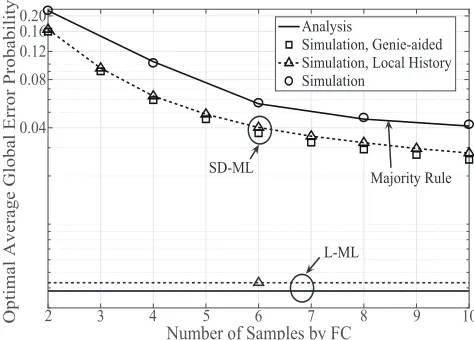
[image:7.612.56.291.57.226.2] [image:7.612.318.555.273.443.2]probabil-ity versus the number of samples by the FC for SD-ML and the majority rule in the noisy reporting scenario and L-ML in the perfect reporting scenario. We first observe that SD-ML outperforms the majority rule. Second, we observe that the majority rule achieves a slightly worse error performance compared to SD-ML. For example, when MFC = 6, the majority rule only suffers a slight 30% error performance degradation compared to SD-ML using local history. This observation is consistent with our observations in Fig. 3 and it again demonstrates the good performance of the majority rule, relative to the SD-ML variant. We note that in the majority rule, each RX releases a unique type of molecule, but the FC requires relatively low complexity. However, in SD-ML, all RXs release a single type of molecule, but the FC requires relatively high complexity. Thus, SD-ML is more suitable for an environment with high complexity at the FC and a limited number of molecule types, whereas the majority rule is more suitable for an environment with sufficient types of molecules but limited computational capability at the FC. Importantly, we observe that L-ML has a significant improvement over SD-ML and the majority rule, i.e., L-ML provides a lower bound on the achievable error performance of the system in either the perfect or the noisy reporting scenario. Finally, we see that the system error performance improves asMFC increases.
V. CONCLUSIONS
In this paper, we presented for the first time symbol-by-symbol ML detection for the cooperative diffusion-based MC system with multiple communication phases. This approach enables us to determine lower bounds on the error performance of the simpler cooperative variants. We presented three ML detection variants with different constraints on the knowledge available at the FC, i.e., F-ML, L-ML, and SD-ML. We derived a closed-form expression for the system error probability for L-ML and corroborated the accuracy of this expression using simulation results. We demonstrated the good performance of the majority rule relative to SD-ML, e.g., the majority rule suffers a 34% error performance degradation compared to SD-ML in Fig. 3. Our results revealed the trade-off between the system error performance and the knowledge available at the FC. In our future work, we will investigate ML detection variants with other constraints on the knowledge available at the FC, e.g., amplify-and-forward relaying at the RXs.
REFERENCES
[1] W. Guoet al., “Molecular communications: Channel model and physical layer techniques,” IEEE Trans. Wireless Commun., vol. 23, no. 4, pp. 120–127, Aug. 2016.
[2] T. Nakano, A. W. Eckford, and T. Haraguchi,Molecular Communica-tion. Cambridge, UK: Cambridge University Press, 2013.
[3] T. Nakano and J. Q. Liu, “Design and analysis of molecular relay channels: An information theoretic approach,”IEEE Trans. Nanobiosci., vol. 9, no. 3, pp. 213–221, Sep. 2010.
[4] A. Einolghozati, M. Sardari, and F. Fekri, “Networks of bacteria colonies: A new framework for reliable molecular communication networking,”Nano Commun. Networks, vol. 7, pp. 17 – 26, 2016. [5] B. H. Kooet al., “Molecular mimo: From theory to prototype,”IEEE
J. Sel. Areas Commun., vol. 34, no. 3, pp. 600–614, Mar. 2016. [6] T. Furubayashi, T. Nakano, A. Eckford, and T. Yomo, “Reliable
end-to-end molecular communication with packet replication and retransmis-sion,” inProc. IEEE GLOBECOM, Dec. 2015, pp. 1–6.
[7] Y. Fang, A. Noel, N. Yang, A. W. Eckford, and R. A. Kennedy, “Distributed cooperative detection for multi-receiver molecular commu-nication,” inProc. IEEE GLOBECOM, Dec. 2016, pp. 1–7.
[8] ——, “Convex optimization of distributed cooperative detection in multi-receiver molecular communication,” submitted to IEEE Trans. Mol. Bio. Multi-Scale Commun., 2016. [Online]. Available: arXiv:1611.05590
[9] Y. Fang, A. Noel, Y. Wang, and N. Yang, “Simplified cooperative detection for multi-receiver molecular communication,” inProc. IEEE ITW, Nov. 2017, pp. 1–5.
[10] J. G. Proakis,Digital Communication, 4th ed. New York: McGraw-Hill, 2000.
[11] A. Noel, K. C. Cheung, and R. Schober, “Optimal receiver design for diffusive molecular communication with flow and additive noise,”IEEE Trans. Nanobiosci., vol. 13, no. 3, pp. 350–362, Sept. 2014.
[12] L. S. Meng, P. C. Yeh, K. C. Chen, and I. F. Akyildiz, “On receiver design for diffusion-based molecular communication,” IEEE Trans. Signal Process., vol. 62, no. 22, pp. 6032–6044, Nov. 2014.
[13] M. U. Mahfuz, D. Makrakis, and H. T. Mouftah, “A comprehensive analysis of strength-based optimum signal detection in concentration-encoded molecular communication with spike transmission,” IEEE Trans. Nanobiosci., vol. 14, no. 1, pp. 67–83, Jan. 2015.
[14] A. Singhal, R. K. Mallik, and B. Lall, “Performance analysis of amplitude modulation schemes for diffusion-based molecular communi-cation,”IEEE Trans. Wireless Commun., vol. 14, no. 10, pp. 5681–5691, Oct. 2015.
[15] T. C. Mai, M. Egan, T. Q. Duong, and M. D. Renzo, “Event detection in molecular communication networks with anomalous diffusion,”IEEE Commun. Lett., vol. 21, no. 6, pp. 1249–1252, June 2017.
[16] R. Mosayebi et al., “Cooperative abnormality detection via diffusive molecular communications.” [Online]. Available: arXiv:1703.10084 [17] J. Suzuki, D. H. Phan, and H. Budiman, “A nonparametric stochastic
op-timizer for TDMA-based neuronal signaling,”IEEE Trans. Nanobiosci., vol. 13, no. 3, pp. 244–254, Sept. 2014.
[18] A. Noel, K. C. Cheung, and R. Schober, “Using dimensional analysis to assess scalability and accuracy in molecular communication,” inProc. IEEE ICC, June 2013, pp. 818–823.