© 2019, IRJET | Impact Factor value: 7.211 | ISO 9001:2008 Certified Journal
| Page 7610
DESIGN AND IMPLEMENTATION OF INTEGRATED SMART HOME
SYSTEM (ISHS)
V.Leorandal
1, M.Bharath
2, K.Hemanth
3, K.Anand Prabhu
4, Dr.S.Dhanalakshmi
51-4 student, Dept. of EEE, Velammal College of Engineering and Technology, Tamilnadu, India.
5
Associate professor, Dept. of EEE, Velammal College of Engineering and Technology, Tamilnadu, India.
---***---Abstract -
This report proposes a style of integrated homeautomation system using Robotdyn Mega 2560 PRO Mini based on Internet of Things (IoT). Now days, many home automation devices are present that replace the existing appliances and are feasible only with the smart appliances which may not be beneficial. This project is intended to monitor the surrounding and control the existing appliances with user friendly interface. The consumer can integrate up to 32 devices. It helps in monitoring the environment of the home and provides maximum security and unparalleled user convenience. One time password or one time pin (OTP) is valid for only one login session for the authorised guest user. OTP provides high security than static passwords. A thin-film-transistor liquid-crystal display (TFT LCD) replaces from conventional switches to low voltage switch system which isolates human from high voltages and also provides user friendly interface. This system also interconnects the energy meter to incorporate energy saving activities by the residents. The system also has features such as automatic gas booking and trash management system.
Key Words: Android application (App) controlled
devices, Home automation system, Internet of Things (IoT), Smart home system, Integrated home system.
1. INTRODUCTION
As the world travels towards modern systems, the comfort and security of home automation plays vital role in recent days. Many smart devices have been developed to provide control and monitor the environment of home. Most of them are expensive and need a hub to control them. Recent developments include Amazon Alexa, Wink Hub, and Philips Hue. They act as a hub to control and monitor only the smart devices. The paper proposes the design of integrated smart home system which performs tasks automatically and end users experience great convenience. It provides better control functions of gadgets remotely by using android application. This system monitors the power consumption, helping to prevent exorbitant electricity bills. We’re living in the golden age of technology development, you need not want to replace the older ones instead you can integrate them with the new technology with increased energy efficiency and improved functionality.
2. LITERATURE SURVEY
© 2019, IRJET | Impact Factor value: 7.211 | ISO 9001:2008 Certified Journal
| Page 7611
system does not provide constant speed when more than 4interrupt devices are integrated instead the speed gets reduced as well as system gets crashes. Existing systems provide security management, trash management, monitoring system and metering system separately and not integrated. Any system that needs to be integrated is designed for that particular hub. Hub such as Philips Hue, Amazon Alexa and Wink Hub can integrate the smart devices designed on the basis of them. It does not able to control the appliances which does not support Wi-Fi control. The existing system fails to operate when internet shutdown occurs and requires many terminals and switches that a far from each devices to control.
4. PROPOSED SYSTEM
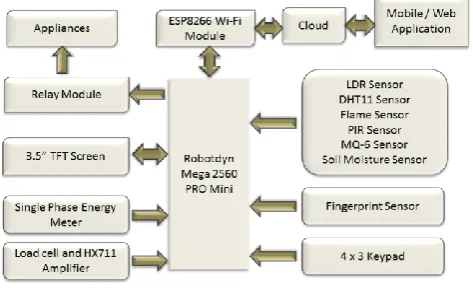
The Integrated Smart Home System (ISHS) mainly focus on controlling and monitoring the appliances that is connected to the system. The system can be controlled both via android application as well as touch screen present in the house. The touch screen control provides isolation from high voltage controlling operations. Some devices such as safety lockers can be controlled only from android application ensuring high security to the house. It also provides high secured door locking system by using biometric system. The system can be used by residents as well as the persons authorised by the residents. The authorised persons can enter into the house by using OTP generated from the security system that is acknowledged by the residents of the house. The system is designed by Proteus Professional and Arduino IDE. The android application provides user friendly interface for the remote operations. The TFT Screen helps when the server can’t be reached. The security cameras will provide visual image through the android application for the residents. The proposed system consists of subsystems that communicate with one another by using MQTT cloud server.
Fig -1: Block Diagram of Integrated Smart Home System
4.1 MQ-6 Sensor
The MQ-6 sensor has high sensitivity to LPG, isobutene and propane, used as a gas leakage detection system in ISHS. When the leakage is detected the electricity will be cut-off immediately to avoid more damage to the home. The output of the sensor is manipulated by the microcontroller and the data is sent to cloud for further processing such as alerting residents of the house.
Fig -2: MQ-6 Sensor
4.2 DHT11 Sensor
[image:2.595.320.557.117.261.2] [image:2.595.360.512.431.547.2]© 2019, IRJET | Impact Factor value: 7.211 | ISO 9001:2008 Certified Journal
| Page 7612
Fig -3: DHT11 Sensor4.3 Flame Sensor
The flame sensor can detect flame with wavelengths
ranging from 760 nm to 1100 nm. This is used to
trigger the fire alarm and sprinkler system. The degree
of heat is computed from the sensor and is
manipulated by the microcontroller, data is sent to the
MQTT broker which alerts the residents and fire
station about the degree of heat so that necessary tools
can be brought.
Fig -4: Flame Sensor
4.4 Soil Moisture Sensor
The soil moisture sensor measurement ranges from 5% moisture to fully saturated soil. It helps to water the plants. The value of the soil moisture sensor is used to water the crops based on their amount they consume so that water wastage can be reduced. It also helps to prevent the wilting and dying of plant in summer heat.
Fig -5: Soil Moisture Sensor
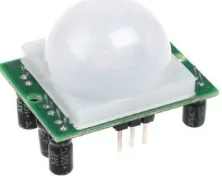
4.5 PIR Sensor
The Passive Infrared sensor helps to sense motion, used to detect whether a human has entered or left out of the sensor range and turns on/off the lights and fans in the particular room. The PIR sensor helps in saving the electricity by turning off the relay system of the room. The PIR sensor is a dual element sensor with low noise and high sensitivity. It has a delay time adjustable switch so that the light can be turned on for a particular time after when we go out of the room.
Fig -6: PIR Sensor
4.6 LDR Sensor
The Light Dependent Resistor is used in automatic lighting control. The cell resistance of LDR 4009 will be in range of few ohms to few kilo ohms. The LDR sensor value is taken by the controller and the PWM signal is generated by the controller is used to adjust the intensity of light. The change in resistance value of the LDR sensor implies the value of intensity of light is suitable.
[image:3.595.384.495.402.496.2] [image:3.595.366.503.644.736.2]© 2019, IRJET | Impact Factor value: 7.211 | ISO 9001:2008 Certified Journal
| Page 7613
can be viewed in the android application.
Fig -8: Fingerprint Sensor
4.8
4X3 KEYPAD
The keypad used to enter the one time password
(OTP) generated by the Mega 2560 PRO mini. This is
used by the guest to enter into the house with prior
permission by the residents of the home. The OTP
entry adds high security to the house since the code
can be used only one time to enter into the house.
Fig -9: 4x3 Keypad
4.9
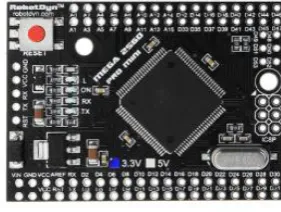
Robotdyn Mega 2560 PRO
The heart of the system is the microcontroller, used
to get the data and process it. The processed data is
sent to the MQTT cloud. The board has compact size
38x52mm and has 54 digital I/O pins and 16 analog
I/O pins. The Mega Pro MINI CH340G / ATmega2560
board is based on the ATmega2560 microcontroller
and the USB-UART adapter CH340.
4.10
Nodemcu
[image:4.595.362.503.104.210.2]The data from the MQTT cloud can be obtained and
manipulated with the help of Nodemcu, which has
ESP8266 Wi-Fi module with it. The Nodemcu also
sends the sensor values to the MQTT cloud. It is an
open source IoT platform, includes firmware which is
based on the ESP-12 module. NodeMCU has ESP-12
based serial Wi-Fi integrated on board to provide GPIO,
PWM, ADC, I2C and 1-WIRE resources easily.
Fig -11: Nodemcu
4.11
3.5” TFT Screen
[image:4.595.104.220.251.347.2] [image:4.595.327.536.375.504.2]© 2019, IRJET | Impact Factor value: 7.211 | ISO 9001:2008 Certified Journal
| Page 7614
Fig -12: 3.5” TFT Screen4.12
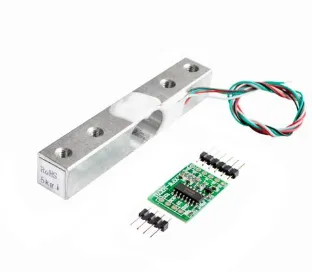
Load Cell AND HX 711 ADC
[image:5.595.83.239.442.578.2]The 24 high precision A/D converter chip HX711
helps in converting the analogue value from the load
cell into digital value. This is used to know the exact
weight of the gas cylinder hence the booking can be
done in advance. This is also used to determine the
amount of waste that is produced in the home so that
the waste can be reduced by the residents. The
pollutants such as plastics are disposed by paying
amount to the government and bio degradable waste
can be used as a raw material for fertilizer production
hence the government will pay for the bio degradable
waste.
Fig -13: Load Cell AND HX 711 ADC
4.13
Single Phase Energy Meter
The pulse of the single phase energy meter can be
used to determine the load consumption by the
connected devices of the home, which can be used to
save the electricity. The call signal from the energy
meter can be used to calculate the units consumed by
the user. The data is directly sent to the Electricity
board and also is displayed in mobile application for
consumers to save the electricity.
Fig -14: Single Phase Energy Meter
5. RESULTS AND DISCUSSION
The ISHS hardware is designed and developed by using
Proteus Professional and Arduino IDE. The web server
used is 000webhostapp and the database used is
phpMyAdmin. The integrated smart home system has
three systems. They are
i) Monitoring system
ii) Metering system
iii) Management system
5.1
Monitoring system
[image:5.595.330.552.573.776.2]The monitoring system includes Robodyn Mega
2560 pro mini and various sensors interfaced with it.
The sensors such as DHT 11 temperature and humidity
sensor,MQ-6 sensor, soil moisture sensor, flame sensor,
PIR sensor and LDR sensor is used for monitoring the
environment of the home. The TFT screen is used to
provide user friendly interface. The appliances can be
controlled using TFT screen also.
© 2019, IRJET | Impact Factor value: 7.211 | ISO 9001:2008 Certified Journal
| Page 7615
Fig -16: Metering System5.2
Management system
[image:6.595.64.260.214.395.2]The management system includes trash
management, security management and gas cylinder
management systems. The trash management includes
10 kg Load cell and HX711 module. The amount of
wastage produced is calculated and viewed in the
mobile application. The gas cylinder management
system includes 20 kg Load cell and HX711 module
which is used to obtain the weight of the gas cylinder
so that automatic booking can be done. The security
system has R307 Fingerprint sensor and 4x3 keypad
which provides high secured authentication for both
residents as well as authorized persons by the
residents of the house.
Fig -17: Management System
5.4
Mobile Application
Mobile app was created using Ionic framework
which is a native script uses angular 2. Ionic
framework is an open source UI toolkit for building
high performance mobile application using web
technologies (HTML, CSS and TS). Ionic framework
mainly focuses on UI interaction for that it uses
Angular 2.It also have large library which support
many features. The main advantage of Ionic is its cross
platform feature. Ionic app can be built as both native
ios and android app with single codebase. It is the main
reason for choosing ionic to build app in our project.
[image:6.595.311.557.499.656.2]© 2019, IRJET | Impact Factor value: 7.211 | ISO 9001:2008 Certified Journal
| Page 7616
5.4
Web Application
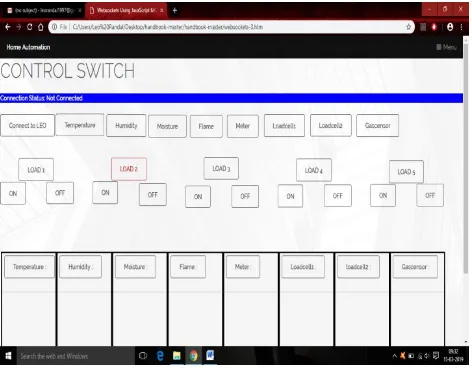
[image:7.595.330.535.89.272.2] [image:7.595.44.280.343.527.2]Web app was created using JavaScript which is an
native script uses Paho MQTT. It is hosted using GIT
repositories. Github is an open source software
developing platform, which accepts languages like
HTML, CSS and JS. Web app communicate to micro
controllers through a communication protocol called
MQTT. MQTT broker pays a way through which data
can be sent and received across Web app and micro
controller. In order to increase the security of the Web
app, Sign in and Sign up page is included so only
authorized user can login. During login, if the user
credentials are valid then the user would be able to
move to the controlling page. On every further request
made to the backend server the token is send along the
request URL. If the token is valid then corresponding
response is send to the Web application.
Fig -19: Web application (ISHS)
6. CONCLUSION
The proposed work is an integrated smart home
system (ISHS), which is mainly focus on existing
systems that can be integrated to become a smart
system. ISHS is used to monitor our appliances both
through mobile application and web server doesn’t
matter how long the distance may be. This helps us to
manage our electricity bills, makes gas booking on its
own, and helps us keep track of the amount of plastics
used. It also helps in safeguarding our home from
unknown persons. The processor used can maintain
the constant speed even when much number of devices
is connected to it. The maximum numbers of devices
that can be connected to a single system are 32.
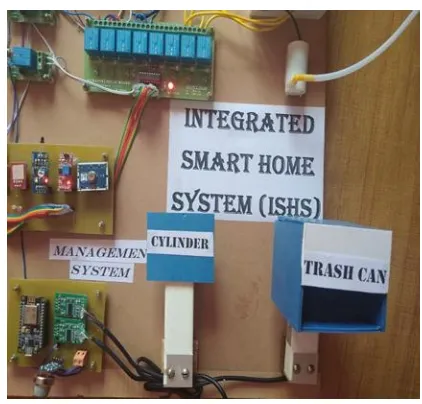
Fig -19: Integrated Smart Home System (ISHS)
ACKNOWLEDGEMENT
We express our deep sense of gratitude to our respected guide, Associate Prof.Dr.S.Dhanalakshmi for encouraging us to complete our project successfully. We are also grateful to our HOD Dr.A.Shanmugalatha for permitting us to utilize all the necessary facilities of the institution. We also thank EDII Ahmedabad for providing necessary fund to complete our project.
REFERENCES
[1] Y. Liu, "Study on Smart Home System Based on Internet of Things Technology," in Informatics and Management Science IV. vol. 207, W. Du, Ed., ed: Springer London, 2013, pp. 73-81.
[2] A.Z. Alkar and U. Buhur, "An Internet based wireless home automation system for multifunctional devices," Consumer Electronics, IEEE Transactions on, vol.51, 2005, pp.1169-1174.
[3] C. Chiu-Chiao, H. Ching Yuan, W. Shiau-Chin, and L. Cheng-Min, "Bluetooth-Based Android Interactive Applications for Smart Living," in Innovations in Bio-inspired Computing and Applications (IBICA), 2011 Second International Conference on, 2011, pp. 309-312. [4] R. Shahriyar, E. Hoque, S. Sohan, I. Naim, M. M. Akbar, and M. K. Khan, "Remote controlling of home appliances using mobile telephony," International Journal of Smart Home, vol. 2, pp. 37-54, 2008.
[5] A. ElShafee and K. A. Hamed, "Design and Implementation of a WiFi Based Home Automation System," World Academy of Science, Engineering and Technology, pp. 2177-2180, 2012.
[6] B. Park, "Mobile IP-Based Architecture for Smart Homes," International Journal of Smart Home, vol. 6, pp. 29-36, 2012 [6] A. Kamilaris, V. Trifa, and A. Pitsillides, "HomeWeb: An application framework for Web-based smart homes," in Telecommunications (ICT), 2011 18th International Conference on, 2011, pp. 134-139. [7] R. Piyare and M. Tazil, "Bluetooth Based Home