© 2019, IRJET | Impact Factor value: 7.211 | ISO 9001:2008 Certified Journal | Page 4442
Healthy Beat
H Harshitha R Shetty
1, Karthik P N
2, Namratha N Jogi
3, Sneda Wynall D’souza
41,2,3,4
Shree Devi Institute of Technology, Department of Information Science Engineering, Mangalore,
Karnataka, India
---***---Abstract -
One of the important fields of ArtificialIntelligenceis Computer Vision. Computer Vision is the science of computers and software systems that can recognize and understand images and scenes. Computer Vision is also composed of various aspects such as image recognition, object detection, image generation, image super-resolution and more. Object detection is probably the most profound aspect of computer vision due the number practical use cases. Object detection refers to the capability of computer and software systems to locate objects in an image/scene and identify each object. Object detection has been widely used for face detection, vehicle detection, pedestrian counting, web images, security systems and driverless cars. The project “Supermarket Visual Product identification using artificial intelligence” is aimed to help the blinds to pick up the product from supermarket rack where the products are arranged. This project consists of a camera and sensor integrated hardware device which would help the blind people.
Key Words
:
Ultrasonic
, Raspberry Pi3, Wireless Radio.1. INTRODUCTION
The World Health Organization (WHO) reported that there are 285 million visually-impaired people worldwide. Among these individuals, there are 45 million who are totally blind. There have been several systems designed to support visually-impaired people and to improve the quality of their lives. Unfortunately, most of these systems are limited in their capabilities. In terms of daily living activities, blind people are quite the same with sighted people. They go to school or work, get dressed, prepare breakfast, go shopping, do sports etc. However, it does not mean that they do not encounter a great number of problems. Some everyday tasks that sighted people take for granted can become difficult and challenging for them. For instance, detecting the product is difficult and biggest challenges for blind people. Because of this, they will bring a sighted friend or family member to help in buying the products at the supermarket. In this project we are planning to build a wearable and portable “Supermarket product identification assistive devices for visually-impaired people” in order to show the progress in assistive Technology for This Group of People.
One of the important fields of Artificial Intelligenceis Computer Vision. Computer Vision is the science of computers and software systems that can recognize and understand images and scenes. Computer Vision is also composed of various aspects such as image
recognition, object detection, image generation, image super-resolution and more. Object detection is probably the most profound aspect of computer vision due the number practical use cases. Object detection refers to the capability of computer and software systems to locate objects in an image/scene and identify each object. Object detection has been widely used for face detection, vehicle detection, pedestrian counting, web images, security systems and driverless cars.
The project “My Vision” is aimed to help the blinds to pick up the product from supermarket rack where the products are arranged. This project consists of a camera and sensor integrated hardware device which would help the blind people.
2. LITERATURE SURVEY
Smart Guiding Glasses for Visually Impaired People in Indoor Environment
To overcome the travelling difficulty for the visually impaired group, this paper presents a novel ETA (Electronic Travel Aids)-smart guiding device in the shape of a pair of eyeglasses for giving these people guidance efficiently and safely. Different from existing works, a novel multi-sensor fusion based obstacle avoiding algorithm is proposed, which utilizes both the depth sensor and ultrasonic sensor to solve the problems of detecting small obstacles, and transparent obstacles, e.g. the French door. For totally blind people, three kinds of auditory cues were developed to inform the direction where they can go ahead. Whereas for weak sighted people, visual enhancement which leverages the AR (Augment Reality) technique and integrates the traversable direction is adopted. The prototype consisting of a pair of display glasses and several low-cost sensors is developed, and its efficiency and accuracy were tested by a number of users. The experimental results show that the smart guiding glasses can effectively improve the user’s travelling experience in complicated indoor environment. Thus it serves as a consumer device for helping the visually impaired people to travel safely.
Blind Assistant Navigation System
© 2019, IRJET | Impact Factor value: 7.211 | ISO 9001:2008 Certified Journal | Page 4443
the first level localization. It also incorporates additionalcomponents to provide more refined location and orientation information. Optimal path planning is done by a server that communicates wirelessly with the portable mobile unit that can be pushed by the blind person. The blind person issues commands and receives direction responses using audio signals.
Ultrasonic Stick for Blind
Today technology is improving daily in different aspects in order to provide flexible and safe movement for the people. Currently the most widespread and used mean by the visually impaired people are the white stick, however it has limitations. With the latest technology, it is possible to extend the support give to people with visual impairment during their mobility; this paper proposes an economical ultrasonic stick for visually challenged people, so as to gain a personal independence and free from the external help. A portable user friendly device is developed that can identify the obstacles in the path using ultrasonic sensors and Camera. Ultrasonic sensors can scan three different directions (at 180 degree ). Camera can be used as an alternative tool in the places that surrounds with the low signal coverage, a microcontroller, buzzer and vibrating motor. The buzzer and vibration motor is activated when any obstacle is detected. GPS system provides the information regarding to his current location. SMS system is used by the blind to send SMS message to the saved numbers in the microcontroller in case of emergency
Voice Navigation Stick for Bind
God gifted sense to human being which is an important aspect in our life is vision. We are able to see the beauty of nature, things which happen in day-to-day life with the help of our eyes. But there are some people who lack this ability of visualizing these things. They face many difficulties to move on with their daily life. The problem gets worse when they move to an unfamiliar location. Visually impaired people face many challenges when moving in unfamiliar public places. Only few of the navigation systems for visually impaired people can provide dynamic interactions. None of these systems work perfectly for outdoors. Propose navigation device for the visually impaired focus on travelling from one location to another. This focuses on designing a device for visually impaired people that help them in travelling independently comfortable to use. The device is linked with a GPS to identify the location of the blind person. Moreover, it provides voice alert to avoid obstacles based on ultrasonic sensors. An emergency button is also added to the system. The whole device is designed to be small and is used in conjunction with the stick.
3. HARDWARE COMPONENTS
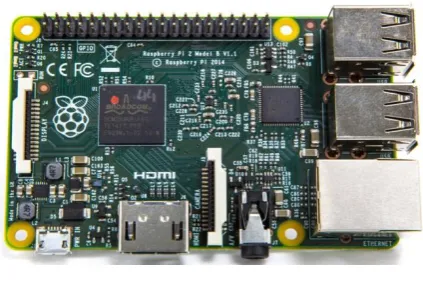
[image:2.595.327.539.141.282.2]Raspberry Pi3 model B
Fig. 1 Raspberry Pi3 Model B
The Raspberry Pi is a credit card-sized single-board computer.Developed in the UK by the Raspberry Pi Foundation with the Intention of promoting the teaching of basic computer science in schools.The Raspberry Pi hardware has several versions that divides feature variations in memory capacity and peripheral-device support.
Raspberry pi model B contain a Broadcom system on a chip (SoC), which includes an ARM compatible central processing unit (CPU) and an on-chip graphics processing unit (GPU, a VideoCore IV). CPU speed ranges from 700 MHz to 1.2 GHz for the Pi 3 and on board memory range from 256 MB to 1 GB RAM. Secure Digital (SD) cards are used to store the operating system and program memory in either the SDHC or MicroSDHC sizes. In this model has four USB slots, HDMI and composite video output, and a 3.5 mm phone jack for audio. Lower level output is provided by a number of GPIO pins which support common protocols like I²C. Processor
The Broadcom BCM2835 SoC used in the first generation Raspberry Pi is somewhat equivalent to the chip used in first generation smart phones (its CPU is an older ARMv6 architecture), which includes a 700 MHz ARM1176JZF-S processor, Video Core IV graphics processing unit (GPU), and RAM. It has a level 1 (L1) cache of 16 KB and a level 2 (L2) caches of 128 KB. The level 2 cache is used primarily by the GPU. The SoC is stacked underneath the RAM chip, so only its edge is visible. The Raspberry Pi 2 uses a Broadcom BCM2836 SoC with a 900 MHz 32-bit quad-core ARM Cortex-A7 processor (as do many current smart phones), with 256 KB shared L2 cache.
Performance
© 2019, IRJET | Impact Factor value: 7.211 | ISO 9001:2008 Certified Journal | Page 4444
could be up to 14 times faster than a Raspberry Pi 1 ModelB+. While operating at 700 MHz by default, the first generation Raspberry Pi provided a real-world performance roughly equivalent to 0.041 GFLOPS. On the CPU level the performance is similar to a 300 MHz Pentium II of 1997–99. The GPU provides 1 Gpixel/s or 1.5 Gtexel/s of graphics processing or 24 GFLOPS of general purpose computing performance.
RAM
The Raspberry Pi 2 and the Raspberry Pi 3 have 1 GB of RAM. For the new Model B with 512 MB RAM initially there were new standard memory split files released( arm256_start.elf, arm384_start.elf, arm496_start.elf) for 256 MB, 384 MB and 496 MB CPU RAM (and 256 MB, 128 MB and 16 MB video RAM).
Networking
On the Model B and B+ the Ethernet port is provided by a built-in USB Ethernet adapter using the SMSC LAN9514 chip. The Raspberry Pi 3 and Pi Zero W (wireless) are equipped with 2.4 GHz Wi-Fi 802.11n (150 Mbit/s) and Bluetooth 4.1 (24 Mbit/s) based on Broadcom BCM43438 FullMAC chip with no official support for monitor mode but implemented through unofficial firmware patching and the Pi 3 also has a 10/100 Ethernet port.
Peripherals
The Raspberry Pi may be operated with any generic USB computer keyboard and mouse. It may also be used with USB storage, USB to MIDI converters, and virtually any other device/component with USB capabilities. Other peripherals can be attached through the various pins and connectors on the surface of the Raspberry Pi.
Real time clock
None of the current Raspberry Pi models have a built-in real-time clock, so they are unable to keep track of the real-time of day independently. As a workaround, a program running on the Pi can retrieve the time from a network time server or from user input at boot time, thus knowing the time while powered on. To provide consistency of time for the file system, the Pi does automatically save the time it has on shutdown, and re-installs that time at boot. A real-time hardware clock with battery backup, such as the DS1307, which is fully binary coded, may be added (often via the I²C interface.
Power supply
The board takes fixed 5 V input, (with the 1.2 V core voltage generated directly from the input using the internal switch-mode supply on the BCM2835 die). This permits adoption of the micro USB form factor, which, in turn, prevents the user from inadvertently plugging in out-of-range power inputs;
that would be dangerous, since the 5 V would go straight to HDMI and output USB ports, even though the problem should be mitigated by some protections applied to the input power: The board provides a polarity protection diode, a voltage clamp, and a self-resetting semiconductor fuse.
[image:3.595.350.517.182.308.2]Wireless Radio
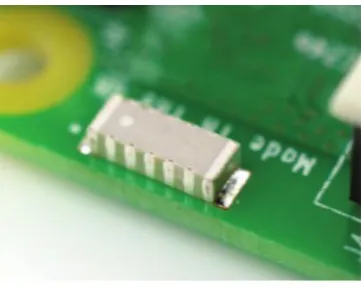
Fig. 2 Wireless Radio module
This part is very small in size. Its markings can only be properly seen through a microscope or magnifying glass, the Broadcom BCM43438 chip provides 2.4GHz 802.11n wireless LAN, Bluetooth Low Energy, and Bluetooth 4.1 Classic radio support. Cleverly built directly onto the board to keep costs down, rather than the more common fully qualified module approach, its only unused feature is a disconnected FM radio receiver
Antenna
Fig. 3 Antenna
[image:3.595.343.524.462.606.2]© 2019, IRJET | Impact Factor value: 7.211 | ISO 9001:2008 Certified Journal | Page 4445
SoC (system on chip)Fig. 4 Soc module
Built specifically for the new Pi 3, the Broadcom BCM2837 system-on-chip (SoC) includes four high-performance ARM Cortex-A53 processing cores running at 1.2GHz with 32kB Level 1 and 512kB Level 2 cache memory, a VideoCore IV graphics processor, and is linked to a 1GB LPDDR2 memory module on the rear of the board.
[image:4.595.70.263.368.542.2]GPIO
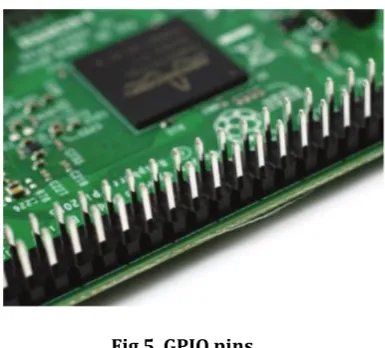
Fig 5 GPIO pins
The Raspberry Pi 3 features the same 40-pin general-purpose input-output (GPIO) header as all the pin is going back to the Model B+ and Model A+. Any existing GPIO hardware will work without modification; the only change is a switch to which UART is exposed on the GPIO’s pins, but that is handled internally by the operating system.
Camera Module
Fig. 6 Camera module v2
The Raspberry Pi Camera Module v2 replaced the original Camera Module in April 2016. The v2 Camera Module has a Sony IMX219 8-megapixel sensor (compared to the 5-megapixel Omni Vision OV5647 sensor of the original camera).The Camera Module can be used to take high-definition video, as well as stills photographs. It’s easy to use for beginners, but has plenty to offer advanced users if you’re looking to expand your knowledge. There are lots of examples online of people using it for time-lapse, slow-motion, and other video cleverness. You can also use the libraries we bundle with the camera to create effects.
Ultrasonic sensor
An ultrasonic sensor is an instrument that measures the distance to an object using ultrasonic sound waves. An ultrasonic sensor uses a transducer to send and receive ultrasonic pulses that relay back information about an object's proximity.
4. SOFTWARE DESCRIPTION
Software Requirements
Python (v2.7)
Python is widely used a high-level programming language for general-purpose programming. It has a design philosophy which emphasizes code readability and a syntax which allows programmers to express concepts in fewer lines of code than possible in languages such as C++ or Java. The language provides constructs intended to enable writing clear programs on both a small and large scale.
Python features a dynamic type system and automatic memory management and supports multiple programming paradigms, including object-oriented, imperative, functional programming, and procedural styles. It has a large and comprehensive standard library.
Raspbian OS
Raspbian is a free operating system based on Debi an optimized for the Raspberry Pi hardware. It comes with over 35,000 packages, pre-compiled software bundled in a nice format for easy installation. Features of Raspbian include:
Created specially for RPi hardware. Supports hard float ABI.
Desktop LXDE
Easy to use, install and customize
Win32 Disk Imager
© 2019, IRJET | Impact Factor value: 7.211 | ISO 9001:2008 Certified Journal | Page 4446
1. Download rasbrian stretch OS and unzip thecontents.
2. Plug in the USB thumb drive or SD or micro SD card to your computer. It should be detected and appear as a drive in Windows.
3. Open Win32 Disk Imager, choose the .img or image file you want to write as Image File(raspbian stretch OS) and choose the USB or SD drive as Device and press Write.
4. The write may take a while. Once it is done, remove the USB thumb drive or SD card and insert it into raspberry pi.
Xming X Server
Xming is the leading X Window System Server for Microsoft Windows. It is fully featured, lean, fast, simple to install and because it is standalone native Windows, easily made portable (not needing a machine-specific installation or access to the Windows registry).
Xming is totally secure when used with SSH and optionally includes an enhanced Plink SSH client and a portable PuTTY replacement package. Xming installers include executable code, and libraries, only built by Colin Harrison (Project Xming's chief developer).
PuTTY is Project Xming's preferred and integrated X terminal emulator for Microsoft Windows: superseding any requirement for a cumbersome POSIX API compatibility layer and simulated directory mount points.
Xming is cross-compiled on Linux for Microsoft Windows, using MinGW-w64, mostly from canonical X.Org source code with my patches applied. It is kept current and secure with frequent from X.Org, XCB, XKB, FreeType, PthreadsWin32, Mesa, PuTTY and Freedesktop Bugzilla.
PuTTY
PuTTY is a free and open-source terminal emulator, serial console and network file transfer application. It supports several network protocols, including SCP, SSH, Telnet, rlogin, and raw socket connection. It can also connect to a serial port. The name "PuTTY" has no official meaning.
After setting up your Raspberry Pi you probably don’t want to use your keyboard and mouse. That’s where a remote connection helps: You can have remote access to your Raspberry Pi through SSH from every other computer which is in the same network as your Pi.
Then you will see a user interface like this where you enter the host “raspberrypi“
If the connection didn’t work, you can look up the internal IP address of your Raspberry Pi in your
router. It should be similar to 192.168.0.xxx, but the last digits may vary.
Select Connection > SSH > X11 and check “Enable X11 forwarding”. Optimally you save the settings. If you now login (first category: Session) X11 is enabled and you can open GUI programs, too. After establishing the connection by clicking “Open”
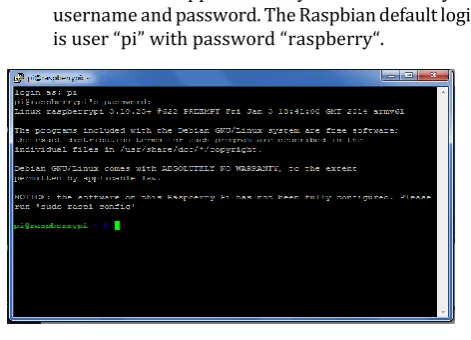
[image:5.595.318.554.187.357.2]a new window appears. Here you should insert your username and password. The Raspbian default login is user “pi” with password “raspberry“.
Fig. 7 Raspberry pi login
Pi Camera module interface
Raspberry Pi Board has CSI (Camera Serial Interface) interface to which we can attach PiCamera module directly. This Pi Camera module can attach to the Raspberry Pi’s CSI port using 15-pin ribbon cable. Connect Pi Camera to CSI interface of Raspberry Pi.
For enabling camera in Raspberry Pi, open raspberry pi configuration using following command
sudo raspi_config
Then select Interfacing optionsin which select camera option to enable its functionality.
Reboot Raspberry Pi.
Now we can access camera on Raspberry Pi. Now we can capture images and videos using Pi Camera on Raspberry Pi.
Autologin and Auto run
This is a technique for running a program when the Pi boots. The technique where the Pi automatically logins as the Pi user and immediately executes a Python script.
The first step is to enable the Pi to login automatically without requiring any user intervention. This step is optional.
© 2019, IRJET | Impact Factor value: 7.211 | ISO 9001:2008 Certified Journal | Page 4447
Select “Boot Options” then “Desktop/CLI” then “ConsoleAutologin”
Now we need to tell the operating system to run the script for the Pi user. In the command prompt or in a terminal window type:
sudo nano /etc/profile
Scroll to the bottom and add the following line : sudo python /home/pi/myscript.py
Where “/home/pi/myscript.py” is the path to your script. Type “Ctrl+X” to exit, then “Y” to save followed by “Enter” twice.
Flite TTS Engine
Speech synthesis is the artificial production of human voice. A computer system used for this task is called a speech synthesizer. Anyone can use this synthesizer in software or hardware products. The main aim of text-to-speech (TTS) system is to convert normal language text into speech. Synthesized speech can be produced by concatenating pieces of recorded speech that are stored in a database. TTS Systems differ in size of the stored speech units.
Flite offers text to speech synthesis in a small and efficient binary. It is designed for embedded systems like PDAs as well large server installation which must serve synthesis to many ports. Flite is part of the suite of free speech synthesis tools.
This algorithm bresaks a word such that there are minimum number of breaks in the word. The algorithm dynamically looks for polysyllable units making up the word, and cross checks the database for unit’s availability, and then breaks the word accordingly. If the polysyllable units are not there, then the algorithm naturally picks up smaller units. For example, for breaking a word .satara. Algorithm looks for unit ./satara/. In database, if not found it looks for unit combinations such as. /sata/, /ra/., ./sa/, /tara/. Etc... And at the end it falls back on phone sequence. /s/, /a/, /t/, /a/, /r/, /a/.. In the next approach, the syllabification algorithm breaks a word into monosyllables without checking for its availability in the database. In this case syllabification is done based on standard linguistic rules. If a unit is not found in database it can be substituted by a nearest unit or by silence. Although, syllable based synthesis does not require significant prosodic modification, the prosodic modification that needs to be performed in the context of syllable is significantly different from that of conventional based synthesis.
Linux command to install Flite - sudo apt-get install flite
Application
1. Blinds can easily identify the product which is kept in the supermarket rack.
2. No need of bringing sighted friend or family member to help in buying the products at the supermarket.
3. Easy to use only English language understanding required.
4. Voice messages through headphone. 5. Real-time product identification.
6. Small portable device which can be carried easily. 7. More than 95% accuracy (accuracy depends on
training dataset).
5. CONCLUSION
The project “My Vision” aims at helping the blind deal with the daily challenges that they are been facing more easily and to help them become more self-sufficient. It will help them to pick up the products from supermarket rack where the products are arranged.
6. REFERENCES
1. Smart Guiding Glasses for Visually Impaired People in Indoor Environment Jinqiang Bai, Shiguo Lian, Member, IEEE, Zhaoxiang Liu, Kai Wang, Dijun Liu
2. Development of Glasses for Guiding Visually Impaired Using Ultrasonic Sensor and Microcontroller Wawan Setiawan, Rasim, and Jajang Kusnendar.