Manuscript version: Author’s Accepted Manuscript
The version presented in WRAP is the author’s accepted manuscript and may differ from the published version or Version of Record.
Persistent WRAP URL:
http://wrap.warwick.ac.uk/114396
How to cite:
Please refer to published version for the most recent bibliographic citation information. If a published version is known of, the repository item page linked to above, will contain details on accessing it.
Copyright and reuse:
The Warwick Research Archive Portal (WRAP) makes this work by researchers of the University of Warwick available open access under the following conditions.
© 2017 Elsevier. Licensed under the Creative Commons Attribution-NonCommercial-NoDerivatives 4.0 International http://creativecommons.org/licenses/by-nc-nd/4.0/.
Publisher’s statement:
Please refer to the repository item page, publisher’s statement section, for further information.
Accepted Manuscript
Title: Effects of concurrent ball milling and octenyl
succinylation on structure and physicochemical properties of starch
Author: Nannan Li Meng Niu Binjia Zhang Siming Zhao Shanbai Xiong Fengwei Xie
PII: S0144-8617(16)31007-4
DOI: http://dx.doi.org/doi:10.1016/j.carbpol.2016.08.063
Reference: CARP 11488
To appear in:
Received date: 7-6-2016 Revised date: 29-7-2016 Accepted date: 19-8-2016
Please cite this article as: Li, Nannan., Niu, Meng., Zhang, Binjia., Zhao, Siming., Xiong, Shanbai., & Xie, Fengwei., Effects of concurrent ball milling and octenyl succinylation on structure and physicochemical properties of starch.Carbohydrate Polymershttp://dx.doi.org/10.1016/j.carbpol.2016.08.063
Effects of concurrent ball milling and octenyl succinylation on
structure and physicochemical properties of starch
Nannan Li1, Meng Niu1,3, Binjia Zhang1*, Siming Zhao1** , Shanbai Xiong1, Fengwei Xie2***
1Key Laboratory of Environment Correlative Dietology (Ministry of Education), College of Food
Science and Technology, Huazhong Agricultural University, Wuhan, Hubei 430070, China
2School of Chemical Engineering, The University of Queensland, Brisbane, Qld 4072, Australia 3Guangdong Province Key Laboratory for Green Processing of Natural Products and Product Safety,
South China University of Technology, Guangzhou, Guangdong 510640, China
*Corresponding author. Email address: [email protected] (B. Zhang) **Corresponding author. Email address: [email protected] (S. Zhao)
Highlights
Ball milling-octenyl succinylation (BM/OSA) influenced starch structure/properties
BM/OSA caused structural disruption to starch granule and crystallites
BM/OSA changed the starch rheological behavior from pseudo-plastic to Newtonian
BM/OSA enhanced starch paste stability during shear, heating and cooling
BM/OSA reduced paste viscosity and rigidity regardless of substitution degree
Abstract
This work concerns the effects of concurrent ball milling (BM) and octenyl succinic anhydride (OSA) modification on the starch microstructure and physicochemical properties (swelling, emulsifying, and rheological). Unlike normal OSA-modified starches, the BM/OSA-modified starch displayed new features such as reduced viscosity and rigidity but increased paste stability during shearing, heating and cooling, regardless of the substitution degree. More interestingly, while the physicochemical properties could be regulated by simply altering the BM treatment time, BM/OSA was more efficient and effective at modulating starch properties during the initial period (approx. 10 h), as seen by the rapid evolutions in starch structural disruption and OSA esterification. Thus, the BM/OSA modification can serve as a viable and cost-effective approach for producing octenyl succinate starches where low viscosity (at relatively high concentrations) and high paste stability are desired.
Keywords: starch; ball milling; octenyl succinylation; physicochemical properties
Chemical compounds studied in this article
Starch (PubChem CID: 24836924); Sodium hydroxide (PubChem CID: 14798); Water (PubChem CID: 962); Hydrochloric acid (PubChem CID: 313); octenyl succinic anhydride (PubChem CID: 5362721)
1. Introduction
2012; Zhang et al., 2015). Starch contains two glucan biopolymers, i.e. amylose, mostly a linear 1,4-α-D-glucan with several long branches, and amylopectin, a 1,4-α-D-glucan with a large number of
1,6-α linkages at the branch points (Jiang, Gao, Li & Zhang, 2011; Liu, Halley & Gilbert, 2010). Despite its great potentials, the application of native starch is often hindered by its undesirable features resulting from the supramolecular and molecular structures, including poor solubility, weak heat and shear resistance, uncontrolled paste consistency, high tendency to retrogradation, and low paste freeze-thaw stability (Lawal, 2009). For improving these physicochemical properties, chemical, physical and enzymatic modifications have been used to modulate the starch structural characteristics relating to the granule, crystallites and molecular chains (Bemiller, 1997; Copeland, Blazek, Salman & Tang, 2009; Zhang, Chen, Li, Li & Zhang, 2015).
Among different modification methods for starch, the esterification with octenyl succinic anhydride (OSA) endows starch with amphiphilicity, which is instrumental to stabilizing water-in-oil and oil-in-water emulsions for foods, cosmetics and pharmaceutics (Sweedman, Tizzotti, Schäfer & Gilbert, 2013). The resultant octenyl succinate starches have better emulsion performance, freeze-thaw stability, and filming properties, which have widened industrial applications (Bhosale & Singhal, 2007; Sweedman, Tizzotti, Schäfer & Gilbert, 2013). Currently, octenyl succinylation is commonly realized by using specific reactions in an aqueous or organic medium under alkaline conditions (Xu et al., 2012), in which case a high reaction efficiency could be achieved. However, the generation of chemical wastes during OSA modification using solution chemistry could lead to the pollution to the environment. As “green processing” becomes increasingly important in food and non-food industries, there has been intense interest in the design and application of innovative technologies for the production of octenyl succinate starches.
treatment with OSA modification could result in products with varied molecular chain characteristics and thermal behaviors. Moreover, the additional BM treatment could induce starch structural changes (e.g., molecular degradation) that are different to those by only OSA modification. However, it has been unclear of how the BM/OSA modification modulates the key physicochemical properties of starch such as rheological behaviors especially from a structural point of view. The lack of this understanding prevents us from exploring the underlying structure-properties mechanism and rationally designing BM/OSA-modified starches with desired properties for specific applications.
In this work, waxy rice starch was used as a raw material for preparing BM/OSA-modified starches. We used planetary BM as it is more efficient than other conventional BM techniques. This work explored the effects of BM/OSA modification on the starch structures (granule morphology and polymorph) and physicochemical properties (swelling power, solubility, freeze-thaw stability, emulsification and rheological behaviors). Based on that, we established the structure-property relationship and discussed the underlying mechanism.
2. Materials and methods
2.1 Materials
Waxy rice was purchased from Dong Po Oil Group (Huanggang, China), and its chemical composition was determined as 90.45±0.62% total starch with <5% amylose content, 7.83±0.26% moisture content and 0.15±0.00% crude protein, according to AACC standard methods (Quinton & Kennedy, 2002). High-purity octenyl succinic anhydride (OSA) (99.9%) was acquired from Dixie Chemicals (No. 7757-96-2, Houston, USA). All other chemicals used were of analytical grade.
2.2 Preparation of octenyl succinate starches
Approximately 2 kg (dry basis) of waxy rice was saturated into 6 kg of 0.4% NaOH solution for 24 h, followed by wet-milling and filtration. The remained slurry was washed with 0.4% NaOH solution (ca. 6 kg) for four times. Then the resulting slurry was adjusted to pH 7.0 using 0.6 M HCl solution and washed using distilled water for five times. The slurry was centrifuged at 4000 g for 10 min. The precipitate was dried at 40 °C for 12 h, and the pristine waxy rice starch was obtained.
In the following discussion, codes typically as “S-BM/OSA-3” are used, where “S” denotes the starch, “BM3” indicates the time (3 h) of BM treatment, and “OSA” shows the OSA modification. “S-BM-3” is the sample treated by BM with NaOH solution (ca. 0.9% of starch weight) but without OSA. “S-BM-0” represents the pristine waxy rice starch; “S-BM/OSA-0” indicates the starch sample obtained by directly washing the mixture of starch-NaOH-OSA using ethanol solution before the BM treatment.
2.3 Degree of substitution (DS)
The DS for octenyl succinylation, i.e., the average number of hydroxyl groups of each glucose unit substituted by OSA, was determined for the starch samples using a previously-reported method (Bhosale & Singhal, 2006; Li, Zhang, Chen, Xie, Li & Li, 2012). All results were reported as the averages of three replicates.
2.4 Scanning electron microscopy (SEM)
The granule morphology was observed using a JSM-6390 scanning electron microscope (NTC, Japan), operated at 5 kV. All the samples were coated with a gold thin film before the observations.
2.5 X-ray diffraction (XRD)
The starch samples were placed in the sample holder of a JDX-10P3A X-ray diffractometer (Tokyo, Japan) equipped with the Cu Kα X-ray source having a wavelength of 0.1542 nm. XRD patterns were recorded for an angular range (2θ) of 4–40°, with a step size of 0.02° and a step rate of 1 s per step. The radiation parameters were set at 30 kV and 20 mA. The degree (Xc) of crystallinity
was calculated with the method of Lopez-Rubio, Flanagan, Gilbert and Gidley (2008). The PeakFit software (Version 4.12, Systat Software, Inc., San Jose, CA, USA) was used for the deconvolution of the peaks, and the following equation was used for the calculation:
t n
i ci
c
A A X
1 (1)
where Aci is the area under each crystalline peak with index i, and At is the total area (both the
2.6 Physicochemical properties
2.6.1 Swelling power (SP) and solubility (S)
The SP and S values for the starch samples were determined using a previous method (Zhang, Chen, Zhao & Li, 2013) with proper modifications. Specifically, ca. 0.8 g (termed m0) of the starch
sample was dispersed in 40 mL of deionized water and incubated at 70 °C for 30 min. Then, the dispersion was cooled to room temperature and centrifuged at 15000 g for 30 min. The precipitate was weighed to obtain the weight (m1) of swollen starch. The supernatant was decanted and dried in
an oven at 105 °C until a constant weight (m2) was obtained. SP and S of the starch samples were
calculated using the following equations.
SP (g/g dry starch) = m1/(m0-m2) (2)
S (g/100g dry starch) = (m2/m0) × 100 (3)
For each sample, at least triplicate measurements were undertaken.
2.6.2 Freeze-thaw stability (FTS)
The starch sample (ca. 5.0 g, dry basis) was transferred into a tube containing 100 mL of deionized water, which was heated in boiling water for 20 min. The resultant gelatinized starch was cooled and divided into four equal parts in weight (m0), which were kept at −18 °C for 24 h and then
thawed at room temperature. Each thawed starch sample was centrifuged at 4000 g for 20 min, and the supernatant water was weighed (m1). The FTS value was acquired using Eq.(4).
FTS (%) = (1 − m1/m0) × 100 (4)
These procedures were repeated for four times to obtain FTS1, FTS2, FTS3 and FTS4. Each data was
based on triplicate measurements.
2.6.3 Emulsifying activity (EA) and emulsion stability (ES)
solution. The absorbance (A0) at 500 nm was determined immediately and then again after 10 min
(A1) using a 722 spectrophotometer (Shanghai Precision Scientific Instrument Co., Ltd. Beijing,
China). The values of EA and ES were calculated as follows:
EA (m2/g) = 2 × 2.303 × A
0 × N/C × φ × 10000 (5)
ES (%) = A0/A1 × 100 (6)
where N the starch dilution ratio, C the starch concentration (g/mL), and φ the oil volume fraction of the emulsion (equal to 0.25). All the measurements were performed in triplicate.
2.6.4 Surface tension (ST)
The ST values of the starch samples were measured using a DCAT21 surface tensiometer (Datephysics, Germany). Specifically, ca. 1 g of the starch was added to 10 mL of deionized water and fully heated in boiling water. All the data were based on triplicate measurements.
2.6.5 Rheological properties
The flow properties were measured using an AR-1500ex stress-controlled rheometer (TA Instruments, USA). Each starch sample was dispersed in the desired amount of deionized water to obtain a starch suspension of 10% concentration, which was heated in a boiling water bath for 20 min until the starch was fully gelatinized. The resulting starch paste was cooled to 25 °C. The measurement was performed at 25 °C from 0.1 to 1000 S−1 and then from 1000 to 0.1 S−1. Flow parameters recorded include: Aup-down, the area between the shear stress curve with the shear rate
rising (up) and that with the shear rate reducing (down); K, consistency coefficient; m, flow index. According to a previous report (Wang, Chen, Li, Xie, Liu & Yu, 2011) with proper modifications, a DMA AR500 rheometer (TA, USA) equipped with a parallel plate (4 cm in diameter) with a 1 mm gap was used to determine the dynamic rheological properties of starch samples at 20% concentration. Silicone oil was used to seal the outer gap to avoid moisture evaporation during the measurements. 0.5% strain (within the linear viscoelastic region) and 1 Hz frequency were used. The starch samples were heated from 20 to 100 °C and then cooled to 20 °C at a rate of ca. 4 K/min. Storage modulus G′ as a function of time/temperature was recorded. Other
dynamic rheological parameters recorded include: Tp, temperature at the beginning of the storage
cooling; G'final, storage modulus at the end of cooling; ΔG'bd (G'peak − G'sc), breakdown storage
modulus; ΔG'sb (G'final − G'sc), setback storage modulus.
All results reported are the averages of three replicates.
3. Results and discussion
3.1 Degree of substitution (DS)
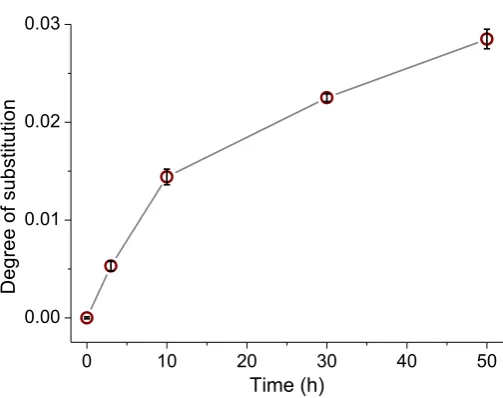
Fig. 1 records the DS profilefor the starch subjected to the BM/OSA modification for different times. With longer BM treatment, DS gradually increased from ca. 0 to 0.0285, suggesting a progressively-enhanced reaction between starch and OSA. In particular, a faster increase in DS was displayed during the initial 10 h than during 10–50 h, indicating that BM induced structural changes that facilitated the octenyl succinylation of the starch happened mainly during the first 10 h. In the following sections, the changes in structural features were discussed with physicochemical properties.
3.2 Granule morphology
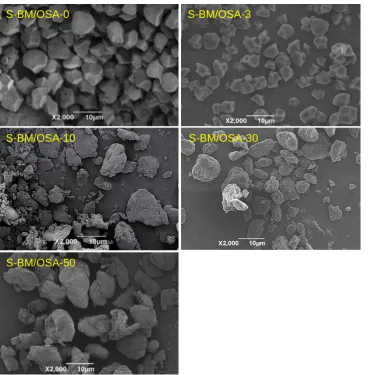
The SEM images of the starch after the BM/OSA modification for different times are shown in
Fig. 2. The non-ball-milled starch (S-BM/OSA-0) granules were pentagonal or angular-shaped with a relatively compact and smooth surface. For the starch subjected to 3 h BM/OSA modification, there was a negligible change in the morphology. Nevertheless, the sample after 10 h BM/OSA treatment predominantly consisted of broken granules with a fragmented surface, which was presumably caused by the mechanical effect of BM (Tan, Zhang, Chen, Li, Li & Xie, 2015). With an even longer time (10 to 50 h) of treatment, no apparent further variation of the granule morphology was observed. The predominant change within the first 10 h might suggest the existence of a “grinding equilibration” for the starch.
3.3 Crystalline structure
Fig. 3 shows the XRD patterns and the degree of crystallinity (Xc) for the unmodified and
agreement with the DS profile and the granule morphology change, the XRD results here confirmed the existence of a “grinding equilibration”.
It can be seen that the BM treatment resulted in a faster reduction in crystallinity for the starch without OSA (S-BM-3) than for the starch with OSA (S-BM/OSA-3). This difference was reasonable as the additional OSA in the system could assist in the dissipation of the mechanical energy exerted by BM.
3.4 Physicochemical characteristics
3.4.1 Swelling power (SP), solubility (S), and freeze-thaw stability (FTS)
Table 1 summarizes the physicochemical parameters of SP, S and FTS for the starch samples after the BM/OSA modification for different times. Apparently, the increased time of BM treatment led to gradually increased SP, S and FTS, which means the BM/OSA modification endowed the starch with increased granule disruption and low-temperature gel stability. This changing trend was especially evident during the initial time range (< 10 h).
3.4.2 Emulsifying activity (EA), emulsion stability (ES) and surface tension (ST)
Table 1 also shows the emulsifying characteristics (EA, ES and ST) of the starch samples with the BM/OSA modification for different times. When octenyl succinate starch is used in an oil-water emulsion, the hydrophobic alkenyl chains stretch into the oil phase and the hydrophilic sodium carboxylate groups into the water phase. This allows the formation of an interfacial film at the oil-water interface. Hence, as the BM/OSA modification time rose, there were more octenyl succinic groups (higher DS), which gradually enhanced the EA and ES but reduced the ST in the oil-water emulsion.
3.4.3 Flow properties
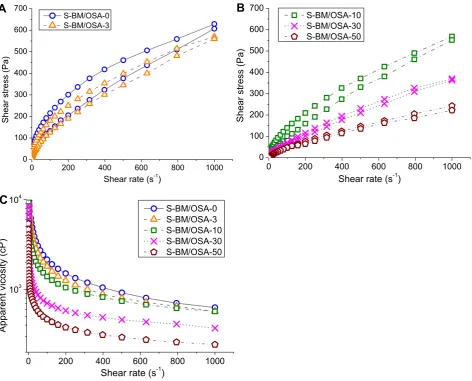
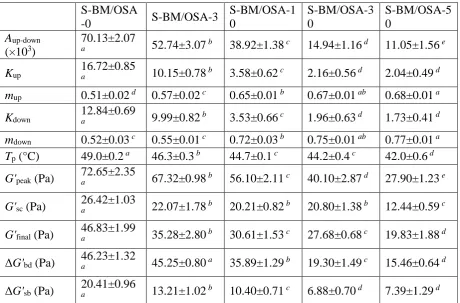
The rheological profiles of the BM/OSA modified starch samples for different times are shown in Fig. 4. It can be seen that all the samples displayed a shear thinning behavior as non-Newtonian fluids. The increased BM/OSA treatment time made the parabolic arc of the rheological curve less prominent, suggesting the modification made the starch become more like a Newtonian fluid. Moreover, the thixotropic parameter (Aup-down), i.e., the area between the shear stress curve with the
A power lawequation τ = K·γm was used to fit the flow curves, with the consistency coefficient K
and the flow index m summarized in Table 2. Both mup and mdown of the starch paste were less than 1
but increased with a longer BM/OSA treatment time, indicating a gradual change from a non-Newtonian fluid to a Newtonian one. Also, the BM/OSA modification caused decreases in the paste viscosity and K (see Fig. 4C). Moreover, both K and m experienced the most drastically change within the first 10 h, followed by moderate changes with even longer time (10–50 h). This change pattern was similar to those for the DS, structures and other physicochemical properties.
3.4.4 Dynamic rheological properties
Fig. 5 and Table 2 present the dynamic rheological results during the heating and cooling processes of the BM/OSA-modified starch samples. During heating, the granules swelled, and starch molecules leached out from the granules into the water medium, leading to the formation of a molecular network and an increase in the paste rigidity (as reflected by storage modulus, Gꞌ). At a
certain temperature, Gꞌ reached a maximum (Gꞌpeak). Then during cooling, the shear stress during
rheological measurement could result in the breaking of the starch paste network, as reflected by decreasing Gꞌ. With the reduction in temperature, Gꞌ could reach the lowest value and then increase
until at the end of testing.
The BM/OSA modification could reduce overall Gꞌ during the whole heating-cooling cycle. Also,
it can be particularly noticed that the modification time decreased the temperature at the beginning of the storage modulus increase (Tp). This was attributed to the BM/OSA modification induced
reduction in the resistance of starch granules to swelling and rupture in an aqueous medium (Li, Shu, Zhang & Shen, 2011; Zhang, Chen, Li, Li & Zhang, 2015). Furthermore, compared with the pristine starch, the BM/OSA-modified starches had reduced modulus breakdown (ΔGꞌbd) and setback (ΔGꞌsb).
These reduced values suggest the modified starch had greater paste stability and a less tendency to retrogradation (starch molecules rearrangements).
Like for other results, it can be seen that the modification-induced changes in the dynamic rheological parameters mainly occurred within the first 10 h.
3.5 Structure-property relationship discussion
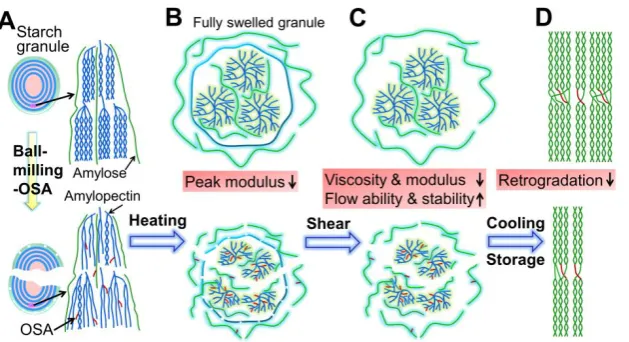
Fig. 6 is a schematic of the structure-property relationship for the BM/OSA-modified starch. During the BM/OSA modification, predominantly BM disrupted starch granules and crystallites, i.e., decreased Xc and the crystallite perfection (cf. Fig. 2 and 3). The structural disruptions promoted the
time-induced increase in DS (cf. Fig. 1). During heating, the disruptions of granules and crystallites also facilitated the diffusion of water molecules into the granules; and the sodium carboxylate groups increased the amphipathicity of starch molecules. Hence, while SP, S, EA and ES were increased, Tp
and ST could be reduced (cf.Table 1).
Although the reduced starch orders and the increased sodium carboxylate groups contributed to the swelling of starch granules, the BM/OSA-modified starch did not show an increase in the maximum system rigidity (G'peak) (cf. Table 2, and Fig. 6 A and B). In fact, the modified starch paste
contained swollen broken granules and granule fragments, which had a delicate surface and thus weaker resistance to shear. These swollen species showed a reduced swelling degree, i.e., a smaller size after fully swelling, as indicated by the reduced G'peak (Fig. 6B).
The changes in starch molecular chains affected the water-bolding capacity and therefore played a role in altering G'peak. Normally, conventionally-OSA-modified starch with a proper DS has a
greater ability to hold water than does the pristine starch, which increases the system rigidity and viscosity of the starch gel or paste. However, in present work, BM/OSA induced not only the OSA modification but also starch molecular degradation (Zhang, Zhao & Xiong, 2013). The reduced molecular size enhanced the solubility of starch molecules but decreased their ability to retain water molecules (Fig.6B). Thus, the BM/OSA-modified starch showed a weaker ability to form huge colloid-like starch molecular fractions. Accordingly, an overall reduction in paste rigidity including
G'peak occurred during heating. In addition, G'peak underwent a more prominent reduction than did Gꞌsc,
leading to a smaller ΔGꞌbd for the BM/OSA modifed starch (cf. Table 2), i.e., enhanced paste stability
at high temperatures.
Under the shear condition, the swollen granules and granule fragments were gradually ruptured, and then the colloids, constituted by starch molecules and water molecules, were the main agents that determined the rigidity and viscosity of starch-water system (Fig. 6 B and C). Thus, the weakened water-retaining capacity of the BM/OSA modified starch also increased its paste flow abilities (increased m) by reducing the viscosity (reduced K) (cf. Fig. 4C and Table 2).
The BM/OSA modification has been demonstrated capable of regulating the starch physicochemical properties. Nonetheless, the changes in the structural features (granule morphology and crystallites), DS and physicochemical properties all indicated that there was a modification equilibration at ca. 10 h. Most of the changes occurred within the first 10 h, and the further BM/OSA treatment would only cause moderate alterations to the starch structure and properties.
4. Conclusions
From a structural perspective, this work provides insights into how concurrent BM/OSA modification regulates the physicochemical properties of starch. BM/OSA caused both the structural disruptions in the granules (granule breakage and amorphization) and the reaction of the OSA molecules with starch hydroxyls (indicated by the increased DS). These two aspects of changes eventually endowed the starch with not only the enhanced swelling power, solubility, freeze-thaw stability, emulsifying properties, and paste flowability and stability, but also reduced paste consistency and viscosity, thermal resistance, and paste overall storage modulus (i.e., elasticity or rigidity). It is noteworthy that this BM/OSA-modified starch was much different from conventionally-OSA-modified starches. Irrespective of DS, the present BM/OSA-modified starch showed relatively low viscosity and rigidity as well as enhanced paste stability under shear and various temperatures. Moreover, while the features of the BM/OSA-modified starch could be modulated by simply controlling the BM/OSA treatment time, the changes of starch structural features, the chemical reaction, and the variation in the physicochemical properties, mostly occurred during the initial period (< 10 h). Thus, this work provides us with a clearer understanding of the starch physicochemical properties as regulated by the BM/OSA modification. The BM/OSA-modified starch can be used as an emulsifier or a fat replacer that has a relatively low viscosity at high concentrations for various food and non-food products.
Acknowledgments
References
Bemiller, J. N. (1997). Starch modification: challenges and prospects. Starch‐Stärke, 49(4), 127-131. Bhosale, R., & Singhal, R. (2006). Process optimization for the synthesis of octenyl succinyl derivative of waxy corn and amaranth starches. Carbohydrate Polymers, 66(4), 521-527.
Bhosale, R., & Singhal, R. (2007). Effect of octenylsuccinylation on physicochemical and functional properties of waxy maize and amaranth starches. Carbohydrate Polymers, 68(3), 447-456.
Chen, M., Yin, T., Chen, Y., Xiong, S., & Zhao, S. (2014). Preparation and characterization of octenyl succinic anhydride modified waxy rice starch by dry media milling. Starch‐Stärke,
66(11-12), 985-991.
Copeland, L., Blazek, J., Salman, H., & Tang, M. C. (2009). Form and functionality of starch. Food
Hydrocolloids, 23(6), 1527-1534.
Fuentes-Zaragoza, E., Sánchez-Zapata, E., Sendra, E., Sayas, E., Navarro, C., Fernández-López, J., & Pérez-Alvarez, J. A. (2011). Resistant starch as prebiotic: A review. Starch-Starke, 63(7), 406-415. Huang, Z.-Q., Xie, X.-l., Chen, Y., Lu, J.-p., & Tong, Z.-F. (2008). Ball-milling treatment effect on physicochemical properties and features for cassava and maize starches. Comptes Rendus Chimie, 11(1), 73-79.
Jiang, Q. Q., Gao, W. Y., Li, X., & Zhang, J. Z. (2011). Characteristics of native and enzymatically hydrolyzed Zea mays L., Fritillaria ussuriensis Maxim. and Dioscorea opposita Thunb. starches.
Food Hydrocolloids, 25(3), 521-528.
Kim, Y., Suzuki, T., Hagiwara, T., Yamaji, I., & Takai, R. (2001). Enthalpy relaxation and glass to rubber transition of amorphous potato starch formed by ball-milling. Carbohydrate Polymers, 46(1), 1-6.
Lawal, O. S. (2009). Starch hydroxyalkylation: Physicochemical properties and enzymatic digestibility of native and hydroxypropylated finger millet (Eleusine coracana) starch. Food
Hydrocolloids, 23(2), 415-425.
Li, W. H., Shu, C., Zhang, P. L., & Shen, Q. (2011). Properties of Starch Separated From Ten Mung Bean Varieties and Seeds Processing Characteristics. Food and Bioprocess Technology, 4(5), 814-821.
Li, X., Zhang, P., Chen, L., Xie, F., Li, L., & Li, B. (2012). Structure and colon-targeted releasing property of resistant octenyl succinate starch. Food Research International, 47(2), 246-252.
Liu, W. C., Halley, P. J., & Gilbert, R. G. (2010). Mechanism of Degradation of Starch, a Highly Branched Polymer, during Extrusion. Macromolecules, 43(6), 2855-2864.
Lopez-Rubio, A., Flanagan, B. M., Gilbert, E. P., & Gidley, M. J. (2008). A novel approach for calculating starch crystallinity and its correlation with double helix content: A combined XRD and NMR study. Biopolymers, 89(9), 761-768.
Pu, H., Chen, L., Li, X., Xie, F., Yu, L., & Li, L. (2011). An oral colon-targeting controlled release system based on resistant starch acetate: synthetization, characterization, and preparation of film-coating pellets. Journal of Agricultural and Food Chemistry, 59(10), 5738-5745.
Situ, W., Li, X., Liu, J., & Chen, L. (2015). Preparation and Characterization of Glycoprotein-Resistant Starch Complex As a Coating Material for Oral Bioadhesive Microparticles for Colon-Targeted Polypeptide Delivery. Journal of Agricultural and Food Chemistry, 63(16), 4138-4147.
Sweedman, M. C., Tizzotti, M. J., Schäfer, C., & Gilbert, R. G. (2013). Structure and physicochemical properties of octenyl succinic anhydride modified starches: A review. Carbohydrate
Polymers, 92(1), 905-920.
Tan, X., Zhang, B., Chen, L., Li, X., Li, L., & Xie, F. (2015). Effect of planetary ball-milling on multi-scale structures and pasting properties of waxy and high-amylose cornstarches. Innovative
Food Science & Emerging Technologies, 30, 198-207.
Wang, J., Su, L., & Wang, S. (2010). Physicochemical properties of octenyl succinic anhydride‐ modified potato starch with different degrees of substitution. Journal of the Science of Food and
Agriculture, 90(3), 424-429.
Wang, X., Chen, L., Li, X., Xie, F., Liu, H., & Yu, L. (2011). Thermal and rheological properties of breadfruit starch. Journal of Food Science, 76(1), E55-E61.
Xie, F., Halley, P. J., & Avérous, L. (2012). Rheology to understand and optimize processibility, structures and properties of starch polymeric materials. Progress in Polymer Science, 37(4), 595-623. Xu, J., Zhou, C.-w., Wang, R.-z., Yang, L., Du, S.-s., Wang, F.-p., Ruan, H., & He, G.-q. (2012). Lipase-coupling esterification of starch with octenyl succinic anhydride. Carbohydrate Polymers, 87(3), 2137-2144.
Zhang, B., Chen, L., Li, X., Li, L., & Zhang, H. (2015). Understanding the multi-scale structure and functional properties of starch modulated by glow-plasma: A structure-functionality relationship.
Food Hydrocolloids, 50, 228-236.
Zhang, B. J., Chen, L., Zhao, Y., & Li, X. X. (2013). Structure and enzymatic resistivity of debranched high temperature-pressure treated high-amylose corn starch. Journal of Cereal Science, 57(3), 348-355.
[image:17.595.56.308.252.451.2]Zhang, Z., Zhao, S., & Xiong, S. (2013). Molecular properties of octenyl succinic esters of mechanically activated Indica rice starch. Starch-Starke, 65(5-6), 453-460.
Fig. 1 Degree of substitution for the BM/OSA-modified starch as a function of time.
0 10 20 30 40 50
0.00 0.01 0.02 0.03
D
e
g
re
e
o
f
su
b
sti
tu
tio
n
Fig. 2 SEM micrographs of the starch granules subjected to the BM/OSA modification for 0, 3, 10, 30 or 50 h.
S-BM/OSA-10
S-BM/OSA-0 S-BM/OSA-3
S-BM/OSA-30
Fig. 3 XRD patterns of the starch subjected to the BM/OSA modification for 0, 3, 10, 30 or 50 h.
Fig. 4 Flow curves (A and B) and apparent viscosity curves (C) of the starch subjected to the BM/OSA modification for 0, 3, 10, 30 or 50 h.
10 20 30 40
0.00% 0.00% 0.00% 0.00% 2.76% 4.12% 7.96% 10.79% 18.76% 18.18% R e la tiv e in te n sit y ( a .u .) S-BM-0 S-BM/OSA-0
2 (°)
S-BM-3 S-BM/OSA-3 S-BM-10 S-BM/OSA-10 S-BM-30 S-BM/OSA-30 S-BM-50 S-BM/OSA-50 Xc
0 200 400 600 800 1000 0 100 200 300 400 500 600 700 S hear s tres s (P a)
Shear rate (s-1 )
S-BM/OSA-0 S-BM/OSA-3
A
0 200 400 600 800 1000
0 100 200 300 400 500 600 700 S h e a r s tr e ss ( P a )
Shear rate (s-1
) S-BM/OSA-10
S-BM/OSA-30 S-BM/OSA-50
B
0 200 400 600 800 1000
103 104
Shear rate (s-1)
[image:19.595.57.530.334.715.2]Fig. 5 Changes in storage modulus (G') with cooking and cooling for the starch subjected to the BM/OSA modification for 0, 3, 10, 30 or 50 h.
Fig.6 Schematic of the structure-property relationships for the BM/OSA-modified starch.
0 5 10 15 20 25 30 35
10 20 30 40 50 60 70 80 90
T
e
m
p
e
ra
tu
re
(°
C
)
G
' (
P
a
)
Time (min) S-BM/OSA-0 S-BM/OSA-3 S-BM/OSA-10 S-BM/OSA-30 S-BM/OSA-50
[image:20.595.61.308.69.245.2] [image:20.595.56.371.333.504.2]Table 1 Physicochemical parameters of the starch samples treated by the BM/OSA modification for 0, 3, 10, 30 or 50 hA
S-BM/OSA-0 S-BM/OSA-3 S-BM/OSA-10 S-BM/OSA-30 S-BM/OSA-50
SP
(g/100g) 10.72±0.15 e 12.10±1.02 d 18.04±0.38 c 20.03±0.70 b 22.34±0.59 a
S (%) 12.89±1.37 e 16.99±1.19 d 24.27±0.76 c 30.83±0.66 b 32.63±0.59 a
FTS1(%) 52.87±0.31 e 55.30±0.22 d 59.00±0.25 c 63.59±0.13 b 70.99±0.23 a
FTS2(%) 48.34±0.21 e 53.78±0.24 d 61.98±0.16 c 64.58±0.30 b 77.41±0.27 a
FTS3(%) 65.06±0.16 e 68.79±0.23 d 76.59±0.12 c 81.28±0.11 b 83.42±0.14 a
FTS4(%) 88.19±0.25 d 88.50±0.13 d 92.60±0.14 c 93.28±0.15 b 95.54±0.21 a
EA (m2/g) -- 1.86±0.12 d 2.52±0.19 c 4.06±0.11 b 4.97±0.10 a
ES (%) -- 50.53±5.56 d 171.25±5.12 c 289.50±18.57 b 351.53±16.72 a
ST (mN/m) -- 10.40±0.11 a 8.40±0.12 b 7.40±0.20 c 6.30±0.24 d
A SP,swelling power; S, solubility; FTS, freeze-thaw stability; EA,emulsifying activity; ES, emulsion
Table 2 Rheological parameters of the starch treated by the BM/OSA modification for 0, 3, 10, 30 or 50 h A
S-BM/OSA
-0 S-BM/OSA-3
S-BM/OSA-1 0
S-BM/OSA-3 0
S-BM/OSA-5 0
Aup-down
(×103)
70.13±2.07
a 52.74±3.07 b 38.92±1.38 c 14.94±1.16 d 11.05±1.56 e
Kup 16.72±0.85a 10.15±0.78 b 3.58±0.62 c 2.16±0.56 d 2.04±0.49 d
mup 0.51±0.02 d 0.57±0.02 c 0.65±0.01 b 0.67±0.01 ab 0.68±0.01 a
Kdown 12.84±0.69a 9.99±0.82 b 3.53±0.66 c 1.96±0.63 d 1.73±0.41 d
mdown 0.52±0.03 c 0.55±0.01 c 0.72±0.03 b 0.75±0.01 ab 0.77±0.01 a
Tp (°C) 49.0±0.2 a 46.3±0.3 b 44.7±0.1 c 44.2±0.4 c 42.0±0.6 d
G'peak (Pa) 72.65±2.35a 67.32±0.98 b 56.10±2.11 c 40.10±2.87 d 27.90±1.23 e
G'sc (Pa) 26.42±1.03a 22.07±1.78 b 20.21±0.82 b 20.80±1.38 b 12.44±0.59 c
G'final (Pa) 46.83±1.99a 35.28±2.80 b 30.61±1.53 c 27.68±0.68 c 19.83±1.88 d
ΔG'bd (Pa) 46.23±1.32a 45.25±0.80 a 35.89±1.29 b 19.30±1.49 c 15.46±0.64 d
ΔG'sb (Pa) 20.41±0.96a 13.21±1.02 b 10.40±0.71 c 6.88±0.70 d 7.39±1.29 d A Flow parameters during the increase (up) or decrease (down) in shear rate: A
up-down, thixotropic
behavior, i.e., the area between the shear stress curve with the shear rate rising (up) and that with the shear rate reducing (down); K, consistency coefficient; m, flow index; dynamic rheological parameters: Tp, temperature at the beginning of the storage modulus increase; G'peak, maximum (peak)
storage modulus; G'sc, storage modulus at the start of cooling; G'final, storage modulus at the end of
cooling; ΔG'bd (G'peak − G'sc), breakdown storage modulus; ΔG'sb (G'final − G'sc), setback storage