200,000
dropout-free passes of this
tape on one of our single capstan digital tape
transports impressed everybody.
Now we've passed
552,176
We'll be glad to put this tape on the air for you if you'd like to talk about the reliability of the Ampex
tape transport family.
-In this continuing series of tests we record 32 data blocks of 10241BM l's at 800 cpi. Then we read and re-read these blocks cyclically. In our most recent test we reached 552,176 passes without generation
of any permanent errors.
How we make a tape transport this reliable is partly secret, partly hard work, but mainly our patented single capsta;1 electronic servo control drive system * . Because it has only 1/ 5th as many parts as other drive systems, you have far fewer mechanical problems. (MTBF is 2000 hours; at least one billion start/ stop operations.) The tape
is in sliding contact with only the read/ write head and tape cleaner, so dropout errors are virtually eliminated.
In sum, our tape transports are at least as reliable as your computer. And if you have multiple systems, you can benefit from our design commonality; each of our tape transports is interface inter-changeable with all the others. They cover the en-tire range of data transfer rates and speeds. There is much more you should know. Write Ampex Cor-poration, 401 Broadway, Redwood City, Calif. 94063. This is the TM-U, big brother of the TM-7 above - members of the Ampex family of slnglei---_ _ _ _ _ _ _ _ ---.
::::~aN::~:.:8~:~4s:::t:.·2st.m
I
AM PEX
I CIRCLE 1 ON READER CARD,.
..ONLY HONEYWELL OFFERS
lr©~©G93~©~~~ [B5G93~~@ @~
O/©
©@~~Mlr~G93ooo
••• AND THEY'RE BEING DELIVERED,
lr@@£
W~
I/C construction . . . 16-bit word . . . 960 nanosecond speeds . . . strong software support -unprecedented computer capability in a low cost compact. And these are only some of the features that put 3C's two new Il-COMP machines in to-morrow's computer class today.
THE' DDP-516, at $25,000, is the· most advanced I/C 16-bit computer now available. Both hardware and software are already operational. Hardware includes high-speed multiply and divide (optional), a 4096-word memory (expandable to 32K), 960 nsec cycle time. The command repertoire includes 72 instructions with such capabilities as byte manipu-lation,' skip-branch. conditioning, and extensive memory reference and control.
250 field proven programs are available with every DDP-516 ... including ASA FORTRAN IV compiler, selectable one- or two-pass· assembler with a unique DESECTORIZING loader that lets you ig-nore memory restrictions. DDP-516 delivery: as few as 90-days.
THE DDP-416, at $16,900, was engineered for a price/performance ratio that.can't be beat by any
other on-line real-time computer. Hardware fea-tures include a 4096-word memory (expandable to 16K), 960 nsec cycle tJme, 1.92 Ilsecs add, with indirect addressing.
A 30-command repertoire, priority interrupt and power failure protection are standard. Both the DDP-516 and the DDP-416 may be mounted in standard 19" racks. Best of all, if you decide to get the more powerful DDP-516 in the future, you CCin continue to use your DDP-416 programs be-cause of direct compatibility. DDP-416 delivery: second quarter of 1967.
Write today for information on both Il-COMP computers. You can't go wrong with either one. Honeywell, Com-puter Control Division, Old Connecticut Path, Fram-ingham, Massachusetts.
~
COMPUTER CONTROL
Your decentralized company
2
Your decentralized company with a Univac
Total Management Information System ..
Your total organization is tied together by a total
communications system that continuously receives,
up-dates and relays management information.
Centralized control of decentralized operations
becomes a reality. And distance, as a factor
in management, becomes irrelevant.
There are two distinct Univac Total Management
Information Systems designed for complex, large-scale
business and scientific applications. The Univac® 1108
and the Univac 494 Real-Time Systems.
For information about them, get in touch with
UNIVAC
4
A little
B T
of LOGIC
for COMPUTERS
'Maintenance Service by RCA For Computer Peripheral Equipment
Reduce downtime and service ~eadaches-with a planned service program from RCA's specialists on communications, control, and data processing equipment maintenance. Select the leading serv-ice; it even can help you close the sale!
• Nationwide facilities • Skilled technical manpower • Complete parts inventory • Lower over-all costs
Contractual plans for the account of the manu-facturer and large user. Emergency and per-call serv)ce, too. Write or phone for details.
RCA SERVICE COMPANY
A Division of Radio Corporation of America , Industrial Center, Camden, N. J. 08101
Phone (609) 963-8000
(8®
The Most Trusted Nanle In Electronics CIRCLE 6 ON READER CARDNEW
PROGRAMMER CARD
PUNCH
SAVES
TIME'
WRIGHT PUNCH MODEL 2600 • Precision desk-top model simple to use. • lets you make computer corrections
on the spot.
• Handles 80-column-and-shorter cards.) • Does not duplicate or print. • Only $159 for accurate recording.
SEND NOW FOR COMPLETE DETAILS
w~
DATA PROCESSING ACCESSORIES170 GOLD STAR BOULEVARD. WORCESTER. MASS. 01606
A division of Barry Wright Corporation @
CIRCLE 7 ON READER CARD
march
1967
volume 13 number 3
Publisher
Editor
DATFlMATJGD~ ••
GARDNER F. LANDON ROBERT B. FOREST
Managing Editor & Arl Director
Associate Editors
CLEVE MARIE BOUTEll EDWARD K. YASAKI WILLIAM J. ROLPH HEIDE H. THORSTENSON WENDY R. REID ANGELINE PANTAGES CHARLES WHITE HOWARD BROMBERG ROBERT V. HEAD PHIL HIRSCH
Assistant Editors
Eastern Editor European Editor Contributing Editors
Washington Reporter Editorial Adviser Technical Consultant Production Manager
Director of Circulation Circulation Fulfillment
Eastern Distrid Manager.
ROBERT L. PATRICK LOWELL AMDAHL MARILEE PITMAN FRANK DeCARLO ALGENE TRAINA
JAMES M. MORRIS WARREN A. TIBBETTS 35 Mason Street', Greenwich, Conn. 06830 (203) 661-5400
New England Disfrid Manager
& Vice President
WARREN A. TIBBETTS 112 West Haven Rd., Manchester, N.H., [603) NAtional 5-9498
Midwest Disfrict Manager JOHN BRENNAN
205 West Wacker Drive, Chicago, III. 60606 [312) Financial 6-1026 Western Disfrid Manager HAMILTON S. STYRON & Vice President 1830 W. Olympic Blvd., Los Angeles, CaL, 90006
"':JItU
(213) 385-0474
EDITORIAL OFFICES
1 8 3"0 W EST 0 L Y M PIC B L V 0 •
LOS ANGELES, CALIF. 90006
Circulation audited by
Business Publications Audit American Business Press, Inc. Member,
DATAMATION is published monthly on or about the tenth day of every month by F. D. Thompson Publications, Inc., Frank D. Thompson, Chairman; Gardner F. Landon, Pres-ident; Gilbert Thayer, Senior Vice President. Executive, Circulation and Advertising offices, 35 Mason Street, Greenwich, Conn. 06830 (203) 661-5400. Editorial offices, 1830 W. Olympic Blvd., Los Angeles, California 90006. Published at Chicago, III. ' DATAMATION is circulated without charge by name and title to certain qualified individuals who are .employed by companies involved with automatic information han-dling equipment. Available to others by subscription at the rate of $15.00 annually; single issues (when available) $1.50. Reduced rate for qualified' students. Foreign sub-scriptions are on a paid basis only at a rate of $25.00 annually. No subscription agency is authorized by us to solicit or take orders for subscriptions. Controlled circulation paid at Columbus, O. and Chicago, III. Form 3579 to be sent to F. D. Thompson Publications, Inc., 205 W. Wacker Dr.; Chicago, III. 60606. Copyright 1967, F. D. Thompson Publications, Inc. Microfilm copies of DATAMATION may be obtained from University, Microfilms, Inc., 313 No. First St., Ann Arbor, Michigan. Printed by Beslow ASSOCiates, Inc.
This issue 70,561 copies
t '
Strangest library in the world.
1700 requests a day, and not a book in sight.
In fact it rarely has a visitor. And the only sound in the reading room is from IBM computers duplicating pro-grams to serve IBM customers. Located 28 miles north-east of New York City, this country library is a computer-age phenomenon. Its bookshelves are loaded with pro-grams on tapes, cards and disks ... propro-grams developed by I BM and its customers.
The library began operations nine years ago when it started acquiring programs for distribution. Since then, computer technology has move-d so swiftly that thou-sands of programs-complete with
documentation-have been added. Now it takes the power of an IBM SYSTEM/360 to maintain, update and distribute the programs currently in the library. And it requires four trucks each day just to ship them out.
It even takes special equipment to handle the volume. Like a newly developed tape duplicator to process as much as 4 billion characters of information daily ... the equivalent of 7000 books. And miniature tape reels to speed automatically updated program information to IBM customers.
Strange little library. None other quite like it. It's there when you need it. .. Iike all IBM services.
What's the matter? Is your computer
too busy to talk to you?
It's probably nothing personal. Like many other firms, you might very well have outgrown the computer you started with. If you started with NCR, your solution is relatively inexpensive. A-system expansion ... or maybe' a faster processor, will give your system the breathing
room to chat with you all you like.
That's the beauty of the315 family. You don't have any problem with obsolescence. No matter how small you start in the 315 family, you can move right up with· out recompiling or reprogramming.
You have an advanced operating system with auto-matic run·to·run control assuring the right file name
and date version, and including dating flag options for any program in the system.
You can move up to the newest RMC (Rod Memory C,omputer), with a choice of 20 to 160K character mem-ories. Even Multiprogramming, if you have a lot of con-versation on your mind.
You can get your information to the 315 or RMC from the widest range of input devices available ... all from NCR. So if you are in the market for a computer that's fast, powerful and flexible ... and doesn't have a fancy price tag to start, call NCR. Let's get a conversation started.
THE N~TIONAL CASH REGISTER COMPANY, DAYTON, OHIO 45409 ®
march
1967
volume 13 number 3
automatic
information
processing
for business
industry &science
®
22 AUTOMATION IN STATE AND LOCAL GOVERNMENTS,
by
Dennis
G.
Price.
An overview of problems and progresses in the use of computers, and recommendations for cooperative effort among federal, state and local governments.25 DETROIT'S DATA BANKS,
by
Harold Black
andEdward Shaw.
Development and uses of two computer-stored files, holding physical and social data on the city.
~8 ALAM'EDA COUNTY'S "PEOPLE INFORMATION SYSTEM,"
by
Gordon Milliman.
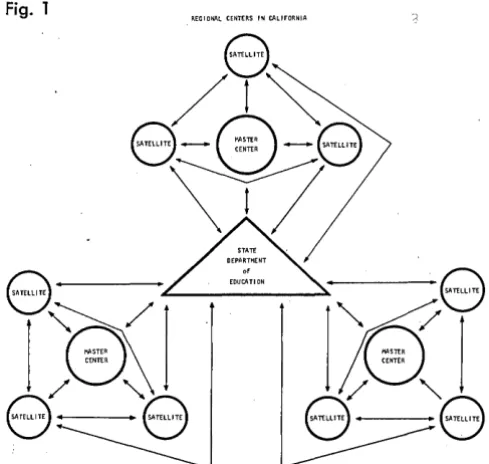
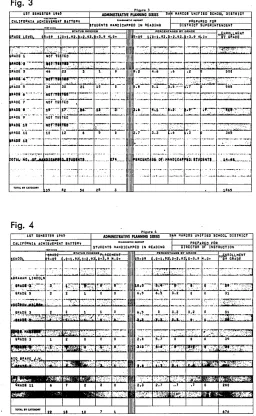
A description of the big northern California county's· information system and how it fits into other existing and proposed state sys-tems.32 THE CALIFORNIA EDUCATIONAL INFORMATION SYSTEM,
by
Alvin Grossman.
A general description of the evolving California informa-tion system for centralizing data processing at regional centers.39 FLUIDIC COMPUTERS,
by
Maior John A. Humphries, Jr.
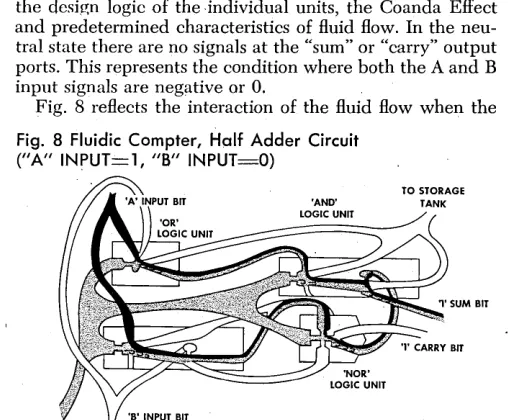
A primer on fluidic logic elements, how they work and how they're put together to form a half-adder, and the place of fluidic computers in the scheme of things.45 THE COBOL CONCLUSION,
by
Howard
Bromberg._ The author, who has been immersed in the COBOL experiment since its beginning, out-lines the history of the program and describes the organization of the proposed ASA COBOL Standard.50 MULTIPROGRAMMING SOFTWARE, HARDWARE FROM HON-EYWELL. New products for the series 200 family include an extended Mod
2 operating system, audio response system and disc files.
59 THE UNPREDICTABLE COMPUTER,
by
Fred Gruenberger.
In-creasing numbers of large inter-related systems and the trend toward time-sharing mean big mistakes.63 COMPUTERS AND COMMUNICATIONS SYMPOSIUM,
by
Irving
Cohen.
IEEE-sponsored, one-day workshop gave the communications and dp communities an opportunity to discuss common problems and possible solu-tions.107 EDP HOROSCOPE,
by
T.
D. C.Kuch.
Whenever you were born, some- _ thing alarming will happen to you today.datamation departments
9 Calendar 95 New Products
13 Letters to the Editor 109 New Literature
17 Look Ahead 131 Books
21 The Editor's Readout 135 People
73 News Briefs 143 Datamart
87 Washington Report 144 Index to Advertisers
Our optical
reader can do
anything
your
keypunch
operators do.
(W
~ll,
almost.)
It can't make time on company time. Or use the office for intimate tete-a-tetes. Or be a social butterfly. But it can read. And gobble data at the rate of 2400 typewritten characters a second. And compute while it reads. And reduce errors from a keypunch operator's one in a thousand to an efficient one in a hundred
thousand.
Our machine reads upper and lower case characters in intermixed, standard type fonts.
It handles intermixed sizes and weights of paper, including carbon-backed sheets.
An ordinary computer program tells our reader what to do ... to add, subtract, edit, check, or verify as it reads. Lets you forget format restrictions, leading and trailing zeros, skipped fields, and fixed record lengths. And our reader won't obsolete any of your present hardware because it speaks the same output language as your computer.
Our Electronic Retina Computing Reader can replace all-or almost all-of your key-punch operators. At least that's what it is doing for American Airlines.
If you have a volume input application, it can do the same for you. Tell us your problem and we'll tell you how. .
RECOGNITION EQUIPMENT
Incorporated
U.S. Headquarters: Dallas, T~xas 214-637-2210 Offices in prinCipal U.S, cities and Frankfurt, London. Milan, Paris and Stockholm
CIRCLE 10 ON READER CARD
CATAMATICJN
(."
-I
~
calendar
April 4-7
April 4-7
April 6-7
April 8
April 10
Users Conference
Users Conference
Systems Conference
Conference: Manag.ement Scientists
Paper deadline: IEEE Computer Conf.
April 12-14 Users conference
April 12-14 Conference: Electronic Information Handling
April 17 JUG Workshop
April 17-28 Course: Advances in Digital Systems Design. $300.
April 18-20 Spring Joint Computer Conference
April 24-26 Conference: Machine Records
April 27-28 Conference: Tools of Management
April 27-28 Conference on Management
April 28 Seminar: Computer in local Government Accounting & Management
May 7-10 Conference on Data Processing
Bellevue Stratford Hotel
Philadelphia, Pa.
Fontainebleu Hotel Miami, Fla.
Americana Hotel New York, N.Y.
American Univ. Washington, D.C.
San Francisco Hilton San Francisco, Calif.
Un.iv. of Pittsburgh Pittsburgh, Pa.
SJCC Headquarters Atlantic City, N.J.
Univ. of California los Angeles, Calif.
Chalfonte-Haddon Hall
Honeywell H-800 Users
Univac Users & Scientific Exchange
Systems & Proce-dures Assn.
Society for Ad-vancement of Management
Prof. S. S. Yau Dept. of Electri-car Engineering Tech. Institute Northwestern U .. Evanston, III.
VIM.-6 Control Data 6000 Users
U. of Pittsburgh, ACM SIGIR, O. N. R., Good-year Aerospace, W. Mich. U.
Joint User Group of the ACM
Atlantic City, N.J. AFIPS
Sheraton Western Skies
Albuquerque, N.M. U. of New Mexico
Hotel Muehlebach Kansas City, Mo.
Radisson Hotel Minneapolis, Minn.
McGregor Center Wayne State Univ. Detroit, Mich.
Americana Hotel New York, N.Y.
Systems & Proce-dures Assn.
DPMA
Governmental Accountants & Analysts Assn.
American Bankers' Assn.
HOW A CHESHIRE
MAKES
IZIPI
EASY·
Cheshire applies form as labels or imprints and ZIP-sorts
Converting to ZIP codes? Use your EDP
sys-tem plus a Cheshire. Write for brochure.
408 Washington Blvd. Mundelein, Illinois 60060
Reports show how each of these firms use data processing equipmenttoaddress continuous forms-then use Cheshire equipment to apply these forms as labels or address imprints to mailing pieces.
Studies cover mail operations of manu-facturers, sales organizations; service companies, printers and publishers . .In-clude quantities mailed, man~hour re-quirements, speeds of operation and time/labor savings over previous systems.
These studies may show how to reduce your mail room costs. Write today. No obligation!
CHESHIRE
1INC.
She must be trained.
She makes mistakes.
She quits.
Install our new Datafinder
on her IBM card punch
( or verifier). She will train
herself in
1/3
the usual time,
make 70%
less errors,
and if she quits, you'll
only miss her smile.
---Datafinder solves the card punch people problem. It puts the operator under total, automatic instruction. Any job becomes simple and easy.
D
With Datafinder, the newest operator can punch complex documents faster than old-timers on standard machines. Card punch opera-tions remain consistently" accurate and efficient, no matter who comes and whoI
,goes.D
If you have card punch peoplePlease send complete information on Datafinder and how it can improve my card punch operations.
N a m e
T i t l e
-Firm _ _ _ _ _ _ _ _ _ _ _ _ _ _ _ _ _ _
P h o n e
-1 problems-high turnover, overstaffing, Street I
1 inexperience-send in our coupon. We'll 1
: send you all the facts on Datafinder. City State Zip I
I
: TAB
PRODUCTS CO" Machine Division, P.O. Box 1119, Menlo Park, California940~~
: I-Captain Paul M. Wolff, USN, knows the world's weather
... as well as he knows the back of his hand.
Captain Wolff is the officer in charge of
the USN Fleet Numerical Weather Facility
in Monterey, California.
The facility gathers weather conditions
from over 4,000 observation stations all,
over the world. Makes about six
, billion computations on them.
Translates these results into
charts and maps. And relays'
the resulting contour charts
to several hundred operating
Navy units the FNWF services.
The brains behind this
opera-tion: five Bryant Auto-Lift Memory Systems
and a commercial EDP system.
Why Bryant? The Navy reports: reliability,
low cost per bit and dependable
interfac-ing capability. A pretty good ratinterfac-ing in
any branch of the service. So
if
you've
got a memory problem forget
it. Just remember Bryant and
drop us a line at 850 Ladd Rd.,
Walled Lake, Michigan
48088. We'll make a Bryant
believer out of you, too.
BRYANT
COMPUTER PRODUCTS
""'XLa
~~
EX.CELL.O CORPORATION
CIRCLE 13 ON READER CARD
~
letters
recruiters & snatchers
Sir:
In reading your mention of the situa-tion regarding GE's search for a loss-trimming formula (Jan., p. 17), I noted with a great deal of repulsion the manner in which you referred to "body snatchers and other recruiting vultures invading Phoenix."
If you were referring to tJ:1e many major computer manufacturers and users throughout the U.S. that either sent representatives to perform a re-cruiting function for them, or even ap-peared on the scene in Phoenix via their own personnel recruiters, it ap-pears 1:0 me and many of my client companies that you described them rather shoddily and without too much regard for their reputations.
Furthermore, many of these so-called "body snatchers and invading vultures" are, and have been, listed in your advertising index: month after month, year after year.
Reporting on the, news is one mat-ter;. but being impudent, indiscreet and sarcastic about the people and organizations that support your effort in printing DATAMATION is another. A three-year-old child can tear some-thing down, but it takes education, training and performance to build something.
I've always felt that DATAMATION did a professional job and that this
faux-pas is probably the result of a
psuedo-professional attempting to over-colloquialize.
FRANK DANIELE
President
La Salle Associates, Inc. Philadelphia, Pennsylvania
We don't like to think of ourselves as "psuedo. professionals," but your assumption that we were attempting to be colloquial is correct. Your other assumption, that we were referring merely to personnel agencies and their resentatives, is incorrect. We talked to rep-resentatives of software firms and other orga-nizations as well as to some professional
recruiters, and were referring to all of them.
DATAMATION has respected and continues to. respect professional recruiting org_anizations such as yours. But there are pr'actices in recruiting by agencies and non-agencies which have led to the extensive use of such terms as "body snatchers." As we see it, such terms attack the bad practices, not the recruiting profession itself.
ring in the old
Sir:
Ascher Opler ("Fourth Generation Software," Jan., p. 22), predicts that microprogramming will become a ma-jor factor in future computers. He points out that preparing micropro-grams is considerably different from writing programs as it involves a much more detailed knowledge of the func-tion of circuits and registers, and in-dicates that there is a limited supply of microprogrammers.
This must have a familiar ring to plenty of old-timers like ourselves who entered the computing game before the availability of stored program computers, and did our calculations by wiring "microprograms" on 604 and CPC boards. We even had float-ing point arithmetic, as well as square root, log and exponential functions available. We gratefully thought the kind of intricate logic design we went through in those days to fit the. avail-able relays, diodes and registers while decreasing running time was gone forever, but now it appears that modern microprogramming involves the same kind of skill. Even with computers, history can repeat.
DONALD W. PEACE MAN HENRY H. RACHFORD, JR.
Houston, Texas
automation & unemployment
Sir:
Thank goodness someone finally stood up for our side. The article on eco-nomic growth and unemployment
(December) did a fine job of
present-Put some sparkle into your copies. Tell your forms printer you want Port Huron Carbon Paper in all your carbon interleaved forms.
Port Huron One-Time
Carbon-designed particularly for snap-outs -continuous forms-machine or hand written.
Port Huron Car/Bond
Paper-ideal for up to fifteen clear copies from one EDP print out.
Port Huron Opti/Scan
Carbon-formulated for optical scanning systems programmed to read the document carbon copy.
Ask your supplier for information or write direct for samples to run on
your equipment.
POI HURON PAPER COMPANY
new products from
Dynalectron's Dala
Sciences Division
=
c:::a
c....
-CIRCLE 15 ON READER CARD
14
letters
ing. the positive aspects of automation. . For years we have accepted the label of job destroyers with a quiet
mea. culpa. Now the statistics have
turned on the automation critic as employment reaches new highs and unemployment recedes to where even' a campaigning congressman can't use it.
Your articles were timely, pointed and in the public interest; let's hope others catch the spirit and continue the discussion. A problem as serious as unemployment deserves to be ex-amined from all sides and we who have such intimate knowledge should never stop presenting our side.
J. K. SWEARINGEN
Past International President
Data Processing Management Assn. San Jose,. California
credit's due
Sir:
In my article, "A Machine Aided Drafting System," (Jan., p. 49), I neglected to mention that the manu-facturer of our coordinate digitizing equipment was the Benson-Lehner Corporation. This equipment is a very important part of MADS, and the omission was nothing but an over-sight on my part.
HARVEY N. LERMAN
Daytona Beach, Florida
more PL/I
Sir:
Mr. Dorn, in his letter (Jan., p. 12), suggests two or three inaccurate facts which should not remain unchallenged since he purports to _ represent an in-fhiential, if sometimes paranoid, pro-gramming group.
The. first error that he makes is the infinitive he uses to describe X 3's efforts regarding ASCII. In terms of both its operating rules and its mem-bership, it would be difficult for X 3 to "foist" anything on the data pro-cessing. community. By definition, the membership of the X 3 represents the data processing community and not a narrow segment of techni-cians who act as high priests -to the machines.
The second alleged fact is the phrase that "the ASCII set is not par--ticularly useful for programming." This is an unsupportable statement unless Mr. Dorn means the ASCII set is not
p~rticularly useful for programming PL/I, which may be true, but rests solely on the basis that the designers of PL/I chose to ignore the existence of ASCII which was approved in its initial form in January, 1963, after long and-arduous public debate .. This date is somewhat before the three-year pe-riod cited by Mr. Dorn for PL/I's germination, and the argument smacks of extremely sharp hindsight.
Finally, there is a paradox in Mr. Dorn's eloquent diatribe in that at-tacking X 3 on the one hand, he then castigates Dr. Burkhardt by citing X 3.4.2;C as the focal point for public participation. I would hope that three years hence we will not hear the cry that this organization, a proper sub-set of X 3, will be charged with foist-ing PL/I on the data processfoist-ing community.
In ,short, I feel an extreme lack of sympathy for those whose technical competence is as sharp as a razor, and about as broad, who would have the dp community conform to a set of arbitrary and rigid parameters estab-lished fo"r the benefit of the program-mer rather than the user.
VICO E. HENRIQUES
Washington, D.C.
fourth-generation clarification
Sir:
Thank you for the undeserved im-portance you attach to my views on hardware technology, a subject in which I have no special competence .. Let me state these views explicitly, rather than as checkmarks which can be ambiguous and erroneous.
I do not believe fourth-generation
computers will be cyrogenic. I believe fourth-generation technology, what-ever it is, will not appear before 1971.
I doubt if any commercial computers will be cyrogenic before 1975, if ever.
Should cyrogenic computers appear, they will indeed "warrant a fourth-generation billing," as your question asked. Many other developments would also warrant such billing. FREDERICK P. BROOKS, JR.
Clwpel Hill, North Carolina
Datamation welcomes. your
correspondence concerning articles or items appearing in' this magazine. letters should be double spaced . . . and the briefer the better. We re-serve the right to edit letters submitted to us.
First cost of digital computer tape?
Forget itl
The
rea·1 cost is the price-per-pass.
And on that basis; U.S. Tape with exclusive Duramil 7 may well be the lowest priced tape on the market today!
Duramil 7 makes possible the manufacture of computer tape with superior abrasion resistance and oxide adhesion ... excellent scratch resistance. Coupled with 8
+
8 Total Surface Testing* - a forward step in truly error-free tape certification - U.S. Tape with Duramil 7 records and main-tains your data pass after pass after pass after pass. More passes, you'll find, than any other tape you can buy;Give us a call to arrange your own evaluation program .
.. Write for free booklet: "The facts about testing magnetic tape for digital computers."
u.s.
MAGNETIC TAPE COMPANY
At JPl,
an
EMR
computer
makes practice perfect
At JPL, only perfection is acceptable when a space craft is launched
toward deep space. That's why an EMR
ADVANCE6050 computer system
is now aiding JPL in perfecting techniques, procedures and personnel
for the Mariner '67 flight as well as other future interplanetary
and lunar probes.
The flight data normally received at JPL's Space Flight Operations from
ground stations around the world is simulated by JPL personnel on the
EMR Computer. By repeating the actual data conditions over and over,
all data stream segments of a regular space probe are checked and
re-checked. In addition, this real-time simulation perfects the mission
control programs as well as training of Space Flight Operations
personnel. After months of simulations, actual missions
become extensions of practice.
EMR's Computer Division offers down-to-earth solutions to ali kinds
of out-of-this-world scientific problems.
Yours could be one.
COMPUTER DIVISION
8001 Bloomington Freeway, Minneapolis, Minnesota 65420
'p
-J •
16 ,d.
W.
I.look*ahead
$100-200 MILLION
FOR FADAC REPLACEMENT
The Army is looking for a replacement for its FADAC
(Field Artillery Digital Automatic Computer), which
is still in production at Magnavox (see Feb. '64,
p. 61).
By the time this is in print, the Automatic
Data Field Systems Command will have awarded
contracts to two or three mainframe manufacturers.
'And later this year, one of these will get what's
estimated to be a $100-200 million contract for the
TACFlRE (Tactical Fire Direction) system, hardware
&:
software.
With the big contract (100 megabucks is the
current order'backlog of Burroughs), the Army
envisions a family of computers.
It starts with the
TACFlRE processor (maybe 1-2 usec cycle time), data
link, displays, other"peripherals plus software. But
the computer must also be easily reconfigured for use
in other Army tactical data systems.
Current schedule is for delivery of the prototype
in April '69.
Delivery of the new processors will
free FADAC's for use at the battery level, down from
the battalion level where they're now being used.
SHARE ATTENDEES PLAY
BUTTON! BUTTON . -
••
-Over 1800 hard-working, fun- and button-loving SHARE
members invaded fun-loving, topless San Francisco
last month, with no winner declared.
Earlier
announcements on the ndecommitmentn of TSS (see Feb.
Look Ahead) triggered buttons reading nTSS/360 Keep
the Faith, Baby,n nDeconceived,n and npromises,
Promises. n Some TSS pioneers will move boldly ahead
on their own, while others will watch.
PL/I came in
for its usual criticism, summed up by one observer
as nI expected PL/I to be bad and it wasn't, so I'm
disappointed,n or, nWe're faced with an insurmountable
opportunity.n According to one critic: npL/I isn't
dead; it's being tortured by OS."
The absence of
PL/I for the 1800 or the 360/44 makes some users
wonder at the extent of IBM's commitment.
They feel
that the language might be at the crossroads; they
remember the bath some users took when IBM decommitted
Commercial Translator not too many years ago.
Not noteworthy for any signs of a revolution or
even an uprising, the meeting was marked by more than
casual interest in ASP (the direct-coupled 360),
especially on the part of '67 users.
And there was
renewed talk of progress being made in talks with
GUIDE concerning a possible merger of the two
influential IBM user groups.
GE GETS BIG ORDE!h
THINKS SMALL,
•
18
incremental plotter
operates directly
from computers,
encoders, commutators
or any signal of 3
volts or
more ...
and
IS
•
priced at
$2850, including
Z-fold paper, 0.005"
or 0.01" resolution,
AC/DC
operation
and 18,000 increments
•
speed
per min.
Or, ask about the new Omnigraphic™ Style
x-v
recorders.houston
DIVINIGRAPHIC
corporationa subsidiary o{ houston instrument corporation
4950 Terminal Ave. / Bellaire, Texas 77401 (113) 667 7403/ cable HOINCO I TWX (113) 511 2063
CIRCLE 18 ON READER CARD
DATAMATION
\',
Moving?
If you're going to have a new business address, please fill out the form at the right now and return it to us. We'll make sure that DATAMA-TION keeps up with you. To save time, we need your old address, just as it's printed on the mailing label, (or the whole label is better yet) as well as your new address.
Name_
Title_
Com pan
Address_
City_
NEW A
Name_
Title_
Compan
Address_
City_
What is
\..~: iiiiiiiiiiiiiiiiiiiiiiiii~~
__ iiiiiiiiiiiiiiiiii;;;T'/ _~
~~S~
an inti
DA
This 62-1 of techn essing. I-tronics, I This glol
¢OO
as a reft'
~ familiaridefine
as a con responsii Please uyour terms,
-please
DJ
35 Me Whatever your work in
in-Please
formation processing, you'll communicate better with the
help of this authoritative Name_
glossary. Addrel
City_ \..
, I
look ahead
UNIVERSITY COMPUTING
HAS TERMINAL,.
IS TRAVELING
LARGER THAN ! BREADBOX,
SMALLER THAN !.MOD 20
INFORMATION FOR
: INFORMATION PROCESSING?
Systems marketing.
He now reports to Harrison Van
Aken, head of the Information System Division's
overseas activity.
Meanwhile, it appears that GE has won a 10-plus
megabuck order from Weyerhaeuser.
The order, which
includes dual 635's, 415's and 115's plus beaucoup
remotes, will be used to implement the Pacific
Northwest lumber company's nationwide network for an
ambitious management information system.
.Fast-moving University Computing Co. is branching out
into equipment manufacturing, beefing up its leasing
operation ••• is hot on the acquisition trail.
To be announced soon is the Cope .45 -- "fastest
terminal in the west" -- a combination computer, card
reader/printer, keyboard and modem which will offer
overlapped two-way transmission over four voice-grade
lines, simultaneous read/write.
The company claims .
the unit will
of~erfive times the speed and
throughput of a 1004, reduce line costs
50%~Invented
by UCC's Leroy Towell, the Cope
(Communications-. Oriented Processing Equipment) (Communications-.45 will be offered to
UCC's on-line service center customers and other
interested parties for around $2-2500/month.
UCC's subsidiary Computer Leasing Co. is now
being run by Bob Holland, ex-CEIR president, who will
serve out of Wash. D.C. as chairman and chief
executive officer. Art Phinney has been promoted to
senior vp, and Lee Meadows, formerly with Union
Carbide, joins as a vp.
The company is seeking two
more vp's to help it grow to $25 million worth of
equipment leased by the end of the year.
The firm'
leased $5 million worth of gear, mostly non-IBM, in
the last five months.
Holland has turned over to CEIR refugee John
Ankney his consulting operation, Holland Associates,
which has set up Associated Ventures, Inc., an
investment firm.
UCC is also conducting merger talks with Dallas'
Scientific Control Corp., and Benson-Lehner, a
division of United Gas which is, in turn, controlled
by Pennzoil.
SCC and B-L would make an attractive
matching of computer-peripheral product lines, give
SCC a much-needed marketing and service organization.
The UCC money wouldn't hurt.
Following their tradition of getting the most mileage
possible from machines in production, IBM is beginning
to push the 1130 as a business machine. The relatively
fast binary processor, first aimed just at the
scientific market, can be had for a price well below
the 360/20.
To make it suitable for business
applications, IBM supplies Ideal, a program that
provides double-precision integers and thus allows
decimal use.
The company is also making use of Type 3
and 4 application programs -- those that are'
distributed but not maintained by IBM.
A commercial
subroutine to handle card and printer functions for
business purposes is available, as are a set of
commercial additions to Fortran.
In addition,
Bonner
&
Moore Associates, Houston-based software
firm, is finishing up MISSIL, a management information
system for, small machines,including the 1130.
~The industry may yet develop some statistics about
itself. AFIPS societies and the DPMA have developed
/
editor's
read~ut
BAUDS
vs.
BITS
One of those rare semi-formal confrontations between the computer and com-munications industries took place in J anuaryat an IEEE-sponsored one-day symposium reported on elsewhere in this issue.
It was an important event, because it is b~coming increasingly apparent that the destinies of the two industries are inextricably intertwined. It's clear that as time-sharing becomes more of a commercial reality, as load-sharing and central-ized edp continue their brisk advances, as data bases and management informa-tion systems and the amorphous computer "utility" take shape, communicainforma-tions will play an increasingly vital role in information processing. Western Union's Robert Francisco estimates that the number of private 4kc data circuits will in-crease lOO-fold by 1975, while voice-grade circuits will less than double in the same period.
Despite such evidence, the dialogue between the two industries' specialists charged with the task of talking to each other sounds more like cold war parley than peace talk. Every other phrase is "But you don't understand our problem."
Computer folks charge that the phone companies are super sluggish, timidly dedicated to voice transmission, have neurotic compulsions about "foreign
attach-lIl~nts,'" have no setup to permit experimental services. They. feel that technical jargon is used to cover bureaucratic reasons for failing to meet the communica-tions requirements of computing.
The communications firms, however, look at their tremendous capital invest-ment in current facilities, note that they are dedicated to the on-demand concept, which means they have to provide a uniform service even in the face of rolle:t:-coaster demands with spotty geographic representation.;
As J.C.R. Licklider sees it, it's a conflict between an industry dedicated to devoting 10 years to developing facilities which will be run for 10 years . . . and an industry which is changing too fast to stabilize. The computer industry wants many consoles and communications lines while the communications industry wonders if there is enough communicable data to warrant the investment.
As Dick Mills of Project MAC sees it, the computer industry must "establish a body to act as a knowledgeable mouthpiece to pull together and cleanse the technical communications requirements of the industry and to transmit them to the communications people in a rational, unemotional, helpful way." He's head of an ad hoc ACM committee which is trying to do just that.
The ACM and Mills & crew are to be congratulated for trying to help the information proc·essing community offer a single face to the giant communica-tions industry. But the industry's communicacommunica-tions pro,blems exceed the bounds of the ACM and of time-sharing, the most persistent and strident voice in'the attempt to accelerate computer communications developments.
The phone companies undoubtedly share a great deal of the blame for the current cold war. We hate to let them off the hook. But we feel that until that loose collection of special-interest groups we euphemistically call the information processing industry begins to talk to each other and work together-to act like
AUTOMATION
an overview
IN STATE
, I&
LOCAL
GOVERNMENTS
by' DENNIS G. PRICE
D
One index of the growth of a particular field is the amount of literature which discusses the field. If this is the case, then one would gather that not very much has been done in auto-mating state and local, government systems! The number of books on the subject could easily be counted on one hand, and the number of articles on the subject is probably less than one hundred. It is partly to remedy this defect that the articles in this issue of DATAMATION are intended. Everyone is aware that the federal government is "big business." Fewer people realize that direct expenditures of state and local governments are now approaching the $100-billion mark ($98 billion in 1964-65) l-close to the expenditures of the federal government ($119 billion in 1964-65). But while the federal government in 1965-66 spent about $350 million in equivalent annual rental2for 2,600 computers, state and local governments are spending only about $60 million in equivalent annual rental for about 630 computers. Other costs (for punch card equipment, personnel, etc.) are roughly in the same proportion. Thus while the federal government's total expenditures are only about 20% greater than those of state and local governments, in the adp area they are over five times greater.
The most obvious reason for this discrepancy is the size of federal applications compared with those at the state level and more particularly with those at the local level. The problem of size is one of those discussed below.
problems facing state, local governments
We have already indicated that state and local govern-ment is "big business." It is also a growth business. And this growth poses state and local government's biggest problem. Whatever one's view on the role of government in the economy, one cannot help but agree that for the foreseeable future the government's role is going to be-come increasingly more important. The dramatic increase in our urban population has intensified the problems of crime, unemployment, pollution control, welfare, poverty, housing, transportation, etc. It is an' almost endless chain. These problems are interrelated, and solutions to them must be found through coordinated and well-integrated programs (facile phrase!). Unfortunately the vested inter-ests of the various state and local government agencies which have dealt with these problems are separate entities in the past, have served as effective barriers to greater cooperative action.
With this growth in activities, it is not surprising to find that in most state and local governments, the com-puter has been used only to mechanize basic record-keeping functions, noted above. Crime control is one
ex-ISource: Governmental Finances in 1964·65, U.S. Bureau of the Census. 2Equivalent annual rental converts the cost of purchase~ equipment to rental.
22
ception to this, and several government jurisdictions have developed or are developing sophisticated applications in this area-see, for example, Gordon Milliman's article in this issue.
Tremendous sums .of money are now being expended by the three levels of government in coping with these problems in our "Great Society." Unfortunately, for the most part, the money is being expended in an unco-ordinated manner. Certainly there are very few sophis-ticated information systems concerned with the impact of programs in the area of crime, welfare, poverty, etc. at the three levels of government.
If we were to examine the various "vertical programs" (which link the federal, state and local governments in particular functional areas),' we will note they have grown up in a piecemeal fashion, and the federal agency has established its own reporting requirements with the cor-responding state and local government agencies. This in turn has meant that much information sent to the federal government is collected with little regard for its possible llse at the state and local level.
impact of federal government
To obtain some idea of the impact of the federal government's program at the state and local level, one need only reRect on the fact that in 1966-67 the federal government is spending about $15 billion in grants-in-aid. (The Health, Education & Welfare Department accounts for $7 billion of this total.) Of course, "he who 'pays the
Mr. Price is director, State Com .. puter Systems Development in
the Div. of the Budget for New I
York State, which includes re-sponsibility for development of the state's dp activities. He is -also a representative of the Council of State Governments
on the X3 committee of the
U.S.A. Standards Institute.
Pre-viously, he was a senior
con-sultant in the Management Services Div. of Touche, Ross, Bailey and Smart. He holds a
BS in economics from London
U., and an MS from Carnegie Tech.
/
piper calls the tune," and part of the tune is to render information. Vast amounts of information are now Rowing upward from local and state governments to the federal government in the areas of education, health, poverty, crime, Medicare, etc. In addition, new federal agencies are being developed which will also require information. For example, the Office of Regional Economic Develop-ment is studying how to assemble data on federal, state and local public investments. This is a nationwide program and the information will be collected on a county by county basis.
While the impact of these programs is severe at the state level, at the local level the impact can be near cata-strophic. The reasons for this are brought out very clearly in a publication called "Modernizing Local Governments."3 Specifically there are 80,000 separate local governments in the country today, most of which are too small to do an effective job in many areas with which they are concerned. They overlap one another-municipalities withiq. counties, independent school districts and special districts within these. Because they are small, they are also usually poor, which means in turn that they ,cannot afford adequate administrative organizations to implement their programs and take advantage of modern technology. This is very evident in the area of data processing. In addition, at the local level the "spoils system" is still much in evidence, which means that important jobs are often filled by amateurs. To a lesser degree, these statements are also true of the smaller states.
'Vhen the federal government imposes its information demands, related to new programs, on this local govern-ment structure, the results are often chaotic.
response of state and local governments
We have already noted the piecemeal development of so-called "vertical programs." It is evident that the speed with which these projects have been put into operation has allowed too little time for considering the need for "standardizing information requirements. In response to the need to develop the necessary information, the usual re-sponse of state and local governments has been to request new information. This has had the following effects:
• Duplication of information: Even though the agency charged with obtaining the information may be aware that another agency has that information, it doesn't bother to obtain it from this source, because it may not be quickly available (the usual bureaucratic red tape), or it may not be in the actual format or frequency that is required by the new agency.
• Increasing requirements at the source of information: the new agency goes immediately to the source of infor-mation and requests this source to cooperate. Even though the source may be .providing the same or very "similar information to another agency, it has very little choice other than to provide what is requested. This is very burdensome to the prime sources of information-the taxpayer, private industry, or other governmental organi-zations.
• Increasing difficulty in relating information concerning a given entity such as a taxpayer, or a parcel of land: Once the original source has given what may be the same information to two or more agencies, it becomes pro-gressively more difficult for these agencies to relate in-formation concerning the same entity. Once the infor-mation is received, manipulated, digested, and generally played around with, it is usually unrecognizable, and almost certainly irreconcilable.
3Published July, 1966 by t~e Committee for Economic Development, New York.
• Increasing cost of information: Since the same infor-mation may be generated several times from the same source and processed by several agencies, obviously the cost of the information is much higher than need be. Perhaps more important, the information is now stored in an incompatible format, so that the cost of reconciliation ( even if possible) is very high.
data elements and codes
This lack of integration of data requirement raises an-other topic, which has become very much in vogue in the last year or so, and that is the need for the standardi-zation of data elements and their codes. It seems that very often there is an inverse correlation between the amount of talk about a subject and the amount of action on that same subject, and in this area the inverse cor-relation is very high! This lack' of compatibility among data elements is probably the greatest barrier to the Row
of information among the three levels of government. Although the problems posed by this lack of standardi-zation have 'existed and have been discussed for many years, with any systems change problems become high-lighted. Since the impact of the computer brings about a dramatic systems change, the problems in this case are highlighted to a greater degree.
One of the problems which immediately arises if and when compatibility of information is obtained, is the inva-sion of privacy. Clearly as it becomes possible to relate information (i.e., make it compatible) from many sources concerning an individual, the issue of invasion of privacy will become even more important. Representative Corneli-us Gallagher (D., New Jersey) conducted hearings re-cently on the proposal for a computerized National Data Center to centralize government statistics. This proposal is being studied by the Bureau of the Budget. And as is sometimes the case with Congressional hearings, a good deal of smoke was generated by persons who were per-haps not as close to the subject as they should have been, so that the emotional aspects of the problem tended to be stressed the most. However, it is a familiar theme that as one problem-data compatibility-is solved, another prob-lem-invasion of privacy-arises., "
There are two other problems which impede progress. The first concerns the nature of government itself in re-spect to the civil servant. Because in most government organizations the civil servant has permanent status, he is usually less than enthusiastic about the promise of better things. The "recumbent incumbent" is a major problem in installing new systems in government. Resistance to change is at a premium in many government installations because, while there is little incentive on the part of the individual to make changes (which after all always mean headaches and hard work), mistakes can be costly to him. In many cases the "good old days" are still with us.
The other problem is concerned with the edp area itself. Changes are implemented at the detail level by systems analysts and programmers. I often think that today in many government installations we have third-generation equipment with second-"generation software and first-generation personnel. Not only are many dp personnel be-hind times, but very often they are intrigued with the equipment itself and hence suffer from "microsecond miasma." (With the faster third-generation equipment, they suffer from "nanosecond inertia.")
From what has been said above, it is obvious that there is a tremendous amount of work to be done in solving the information processing problems of state and local governments.
possible steps to solutions
AUTOMATION . . .
from these governments. The Council of State Govern-ments has a Committee on Information Systems (former-ly the Committee on Automation, Technology and Data Processing) which was formed in 1965. Its role is to act as a catalyst in encouraging the development of modern information systems in state governments. To this end it has conducted several projects, such as the mailing of an annual questionnaire to all state governments concerning the status of their equipment installations, applications, personnel and organization for edp. It is also negotiating a standard lease contract for all vendors of computing equipment, similar to the General Services Administra-tion approach.
In May 1966, the Committee on Information Systems requested each state to establish a state-local advisory council to take "an active leadership role in working with representatives· of its political subdivisions to identify joint state-local programs and, where there is a joint interest, assure that the interests of local governments are accom-modated when planning for data processing systems."
Today only a handful of state governments have es-tablished such councils on a. formal basis, althpugp several states do have active plans for developing much closer ties with their local governments. California has developed long-range plans for a "statewide federated information system" whiCh will develop loc<:il government data process-ing capabilities in various regional or functional areas, and these will be tied in electronically to state computer systems. New York state, Illinois, Wisconsin and the Com-monwealth of Puerto Rico have similar plans.
vertical proiects
Clearly the development of these federated informa-tion systems should be tied in with the development of the "vertical programs" referred to above, and thus bring the federal government into the act. What is therefore needed is a tripartite development, with teams of analysts and administrators from the three levels of government re-sponsible for developing design criteria in each functional area (such as crime, health, education, etc.). These teams should define in each functional area the information that Hows among the governments: this would involv~ the standardization of data elements and their codes, the con-tents of files, etc. Unless this is done, and done soon, the proliferation of incompatible information will become worse, thus making the eventual task (which is inevitable) even more difficult.
At the state level, more and more states are developing positive programs of central control for the developm~nt
of information systems. In New York state, for example, the Division of the Budget has developed control and guidance along several lines to assist departments in all aspects of computer acquisition and use: for instance, in the areas of information studies, issuance of specifications, realistic evaluation procedures, monitoring of installations, developmerit 6f a central computer, etc. Similar qevelop-ments have taken place in California, Hawaii, Michigan, Ohio, Texas" Wisconsin, and the Commonwealth of Puerto Rico.
In New York state, we have recently developed a state-wide master plan for information systems development which includes a data element inventory for all important master files (mechanized or not) in the state. This inven-tory is being circulated to potential users and we shall soon be implementing a much more effective interagency use of information, with the accompanying data standardi-zation whic? this entails. Although the plan also
encom-24
passes the development of new computer applications for . the next five years in state departments, we believe that the analysis of the "micro" level of the data elements and files is essential to any further sophistication of our data processing system.
the supply of personnel
Presently the situation concerning personnel is deplor-able, not only. in government but in industry too. The state governments should take the initiative in encour-aging (with moneyl) the development of data process-ing curricula in their state universities; in the private universities, and even in high schools. This will increase the long-term supply of high quality personnel for the total market. In addition, . stv.te governments and large local governments could establish training schools or in·sti-tutes to increas3 their own "Captive" supply, the resulting pool of trainees to be assigned to computer installations. These in-government schools could help in training per-sonnel in departments which are converting to a, first compllter when it is usually important to utilize de-partmental personnel because of· their knowledge of operations.
Of course, it is no use increasing the total supply if it cannot be attracted to government service. With very few exceptions government salaries are not competitive with private industry, so that governments act as a training ground for industry; as soon as a man is compe-tent, he is seduced by attractive offers from industry. In most governments, too, the salary· gap widens as the experience increases, so that the best programmers, analysts and managers may leave.
But apart from salaries, governments have to overcome their poor image with outsiders. This image is of a dull, pedestrian operation, staffed by dull, pedestrian people in dull, pedestrian offices. Furthermore, while a private firm can recruit a prospect in one or two weeks after the initial interview, most governments take months: to sched-ule exams, give exams, grade exams, allow appeals, and produce eligible lists.
software packages
With the development of infOlmation systems in local governments, there should be the possibility for developing common software packages in certain areas. This will not be an easy task since the individual idiosyncrasies of local governments will be brought to the surface. To stan-dardize systems will be a great problem,· but one which must be overcome if we are to develop integrated state-local systems. Within the next five years there will un-doubtedly be considerable progress by the more advanced states in developing networks for information systems with local governments. There we shall· see regional computers performing all the work of large local govern-ments, or groups of smaller local governments; the sys-tems described in this issue of DATAMATION for Alameda county and Detroit are good examples. We shall also undoubtedly see regional computers which perform the work for local governments in one functional area only. This seems to be a trend today in the education area where regional centers are processing the work of sev-eral school districts-:-for example, in California and New York.
summary
The prime source of the information problems of state and local governments is the rapid expansion of their own so-cial programs, together with the massive impact of federal . programs.
Major steps to solution for the state and local govern-ments include the development of vertical programs in