Manuscript version: Author’s Accepted Manuscript
The version presented in WRAP is the author’s accepted manuscript and may differ from the published version or Version of Record.
Persistent WRAP URL:
http://wrap.warwick.ac.uk/106294
How to cite:
Please refer to published version for the most recent bibliographic citation information. If a published version is known of, the repository item page linked to above, will contain details on accessing it.
Copyright and reuse:
The Warwick Research Archive Portal (WRAP) makes this work by researchers of the University of Warwick available open access under the following conditions.
Copyright © and all moral rights to the version of the paper presented here belong to the individual author(s) and/or other copyright owners. To the extent reasonable and
practicable the material made available in WRAP has been checked for eligibility before being made available.
Copies of full items can be used for personal research or study, educational, or not-for-profit purposes without prior permission or charge. Provided that the authors, title and full
bibliographic details are credited, a hyperlink and/or URL is given for the original metadata page and the content is not changed in any way.
Publisher’s statement:
Please refer to the repository item page, publisher’s statement section, for further information.
Developing a logic model to guide evaluation of impact for learning disability projects:
the case of the Positive Behavioural Support (PBS) Academy
DOI 10.1108/TLDR-10-2017-0038
Suzi J. Scott, Louise D. Denne and Richard P. Hastings
Suzi J. Scott was PBS Intern at Challenging Behaviour Foundation, Chatham, UK. Louise D.
Denne is Senior Research Fellow and Richard P. Hastings is Deputy Director, Professor, and
Cerebra Chair of Family Research, both at CEDAR, University of Warwick, Coventry, UK.
Suzi J. Scott can be contacted at: [email protected]
Acknowledgements
The authors acknowledge the Warwick Economic and Social Research Council (ESRC)
Impact Acceleration Account for funding this study [grant number ES/M500434/1], members
of the PBS Academy, the Challenging Behaviour Foundation (CBF) for their dedicated
support and the University of Warwick’s Centre for Educational Development, Appraisal and
Abstract
Purpose – Measuring “impact” is an important aspect of the dissemination of
evidence-based practice and relevant to all disciplines. However, it has only recently become
a focus of enquiry and is not commonly directlyresearched within the learning disabilities
field. The present paper describes the process of developing a logic model for the UK
Positive Behavioural Support (PBS) Academy as part of an evaluation and impact study of its
work to date.
Design/methodology/approach – Logic models are a visual representation of the
relationship between a project’s resources, activities and outputs and identified outcomes, in
relation to key stakeholder groups. This representation allows for key impact measures to be
identified and can be a useful tool for evaluation purposes.We used the process outlined by
McLaughlin and Jordan (1998) to develop a bespoke logic model for the PBS Academy.
Findings – The model was particularly helpful in making clear the distinction
between output and impact, identifying impact criteria differentiated by stakeholder group
and across time-scales, and highlighting areas of activity that are needed to increase the
impact of the work of the PBS Academy in the longer-term.
Originality/value – Inthe absence of any generalised impact evaluation frameworks
in the learning disabilities field we suggest that logic models may provide a useful framework
for evaluating the impact of policy, practice, and research interventions.
Keywords – Evaluation, Learning disabilities, Logic model, PBS Academy, Positive
Behavioural Support (PBS)
Background
Achieving impact is a desired outcome in any dissemination of evidence-based
practice. That may seem obvious, but evaluating research impact is only relatively recently
becoming a focus of enquiry. In the learning disabilities field, assessing impact is
complicated because the delivery of policies and interventions are across health, education
and social care sectors, include multiple stakeholder groups and community settings, and are
across the lifespan.
The Research Excellence Framework (REF), which assesses the quality of research in
UK higher education institutions, introduced impact as a measure of research quality for the
first time in 2014, defining it as “an effect on, change or benefit to the economy, society,
culture, public policy or services, health, the environment or quality of life, beyond
academia” (Research Excellence Framework, 2011, p. 48). In their review of 2014 REF
submissions, Chowdhury et al. (2016) found that the approaches taken to evaluate, measure
and report impact, varied both across and within disciplines. Their findings suggest that
standardised measures of impact may not be possible because different disciplines are likely
to have different impact criteria, but that within disciplines certain themes are likely to be
common. For “Clinical Medicine”, for example, quality of life, life expectancy, improved
knowledge transfer, productivity of services and safety were commonly included in the
impact criteria. No common processes for measuring impact were identified, and the authors
conclude that in the absence of a generalised impact evaluation framework, research impact
evaluation continues to be a challenge within academia.
Outside of academia, methods of evaluation are better established e.g. health
(Donabedian, 1966), business (Porter, 1989) and public services (Gash et al., 2008). Given
field, we argue that it would be helpful to turn to “Logic Models” to guide questions of
evaluation of policy, practice, and research interventions. Logic models are often used to
evaluate the effectiveness of organisations, programmes and projects. They are a “visual
representation of a theory of action or programme logic guiding the design and
implementation of a programme or policy and can be used as a tool for building a relevant
evaluation design” (Shakman and Rodriguez, 2015, p. 3). The logic model describes the
relationship between a project’s resources, activities and outputs (particularly in relation to
key stakeholders) and identifies short, medium and longer-term outcomes. Constructing a
visual representation of these relationships facilitates the identification of critical impact
measures. The model can also be used to communicate a shared understanding and
expectations of a programme (McLaughlin and Jordan, 1998).
McLaughlin and Jordan (1998) outline a five-stage process of constructing a logic
model. Stage one involves collecting relevant information. It is critical that this information
comes from several sources including a review of documentation relating to a project as well
as surveys and interviews with key stakeholders. This is an iterative, and therefore dynamic
process that is conducted throughout the evaluation. In stage two, the need for, and context of
the project is clearly outlined, the underlying assumption being that all activities are based on
an understanding of the problem that the project seeks to address. This includes
differentiating between the problems faced by different stakeholders. Stage three defines the
elements of the logic model including categorising information collected into resources or
inputs, activities, outputs, key stakeholder groups, short, medium and long-term outcomes
and external factors. This information is used in stage four, to construct a visual
representation of the links between each of the elements. This may be presented in different
ways. The key is to make clear how activities relate to identified outcomes and their potential
becomes a working document, regularly updated, continues to be relevant, and can be used to
identify and mitigate against risks, and as a planning tool for future activity to increase
potential impact.
Although the use of impact evaluation frameworks within the learning disabilities
field is limited, logic models have been used or referred to previously in research. La Valle
(2016) used a logic model as one step in an evaluation of the Paving the Way project, the aim
of which was to facilitate access to early intervention to improve the quality of life and
outcomes experienced by children with learning disabilities who display behaviours that
challenge. However, the process of developing the logic model was not described. Van Loon
et al. (2013) acknowledged that logic models are a useful way of evaluating impact and drew
upon aspects of the thinking behind logic models in a proposed model for selecting,
developing, and implementing evidence-based outcomes in relation to quality of life.
Similarly, Schalock et al. (2010) distinguished between logic models that provide a
description of how specific programme components relate to a programme’s desired results,
and an operational model that may be used to identify desired outcomes, such as the quality
of life construct.
As far as we are aware there are no studies which describe the process of developing a
logic model in relation to the learning disabilities field. Using a logic model for both
measuring and increasing impact could be advantageous within our field; the framework
facilitates identification of areas where activities may have been less effective (such as
dissemination to certain stakeholders), provides a means of helping achieve a shared
understanding of programme objectives and allows researchers, services or project managers
identify activities needed to improve impact.
In the present paper, we describe the process of the development of a logic model
Positive Behavioural Support (PBS) Academy. The PBS Academy is a collective of
organisations and individuals in the UK working together to promote PBS as a framework for
people with learning disabilities who are at risk of behaviour that challenges. The potential
impact of its activities is already becoming apparent. The final report of the post
Winterbourne consultation published in February 2016 (ACEVO, 2016, p. 6) acknowledges
PBS as the recommended framework for working with people with learning disabilities at
risk of behaviour that challenges; and states that “the nearest we have got to a Standard is the
PBS Coalition’s1 Competency Based Framework currently hosted on the PBS Academy’s
website”.
Logic model development process
Collecting relevant information (stage one)
The PBS Academy evaluation and impact study began in October 2016. Stage one,
largely desk research, involved reading relevant literature and social media outputs to identify
PBS Academy activities including resources produced, citations of PBS Academy activities,
publications or resources in policy and practice documents, and the identification of key
stakeholder groups. Analyses of the PBS Academy website (www.pbsacademy.org.uk) and
Twitter feed; the Paving the Way website (www.pavingtheway.works) which hosts copies of
PBS Academy resources, and detailed conversations with those involved PBS Academy were
also conducted. An internet survey gathered stakeholder views and experiences of the
activities of the PBS Academy. For a more detailed description of the survey findings see
Scott et al. (2018).
Clarifying the need (stage two)
People with learning disabilities sometimes develop behaviours that challenge others
(Hastings et al., 2013). The prevalence rate for severe challenging behaviour in people with a
learning disability is estimated to be 4.6 per 10,000 (Lowe et al., 2007) of the general
population – approximately 24,000 individuals in England (a figure that more than doubles if
less severe but still significant challenging behaviour is included), or approximately 18 per
cent of all adults with learning disability known to services (Bowring et al., 2017). PBS is
currently considered best practice in the support of this population, and PBS and/or its
components are recommended in several UK policy documents and professional guidelines
(Denne et al., 2015). The evidence base includes systematic and meta-analytic reviews of
single-case and small group designs, a smaller number of randomised trials, and a UK
randomised control trial of the outcomes from a PBS service (see summary in Gore et al.,
2013).
The overall aim of PBS is to improve the quality of a person’s life and that of the
people around them. The PBS Academy seeks to support this through promoting and
increasing the use of PBS as a framework for supporting individuals with learning disabilities
across the lifespan and by raising standards in the delivery of PBS. The context for the
activities of the PBS Academy is partly the UK Government’s Transforming Care
programme (NHS England et al., 2015). This seeks to improve services for people with
learning disabilities and/or autism, who display behaviour that challenges, through
system-wide change, enabling more people to live in the community, with the right support, close to
home. The Transforming Care National Plan: Building the right support (NHS England et al.,
2015) references PBS, as do 38 of the 39 regional Transforming Care Plans that were
publicly available in August 2017. However, PBS is not yet universally understood or
sector. This has led to practice of variable quality (Denne et al., 2015). It is difficult to find
estimates for the workforce required to support this population. Data from the National
Minimum Data Set for Social Care (Skills for Care, 2016) estimate the learning disability
workforce in social care to be 121,000. This is approximately 8 per cent of the total adult
social care workforce. However, these figures do not include health care or education, do not
reflect the demand created by high turnover rates (25.4 per cent in adult social care, Skills for
Care, 2015) or the fact that much care is provided by family and other unpaid carers.
Designing and putting in place a sustainable workforce development plan for this population
is a huge challenge particularly when coupled with the government’s target of building
capacity in local services and bringing people with learning disabilities back into their
communities.
Within this context, the PBS Academy aims to raise standards in the delivery of PBS,
to develop the capacity of local communities to support people with learning disabilities, and
to ensure a system of support that produces and recognises competent staff in the effective
delivery of PBS across different settings (Denne et al., 2013)2
Defining the elements of the logic model (stage three)
Clarifying outputs
Explicitly stating what the organisation, project or programme does is key in a logic
model. The PBS Academy has completed four distinct phases of activities as well as
lobbying/influencing policy-makers.
In phase one, four articles were published in the International Journal of Positive
Behavioural Support (IJPBS) special edition (2013). The aim was to increase understanding
2 See detailed supplementary information available from first author ‘Table 1 – A list of the objectives identified
of PBS and to discuss current issues related to the delivery of PBS (Hastings et al., 2013;
Gore et al., 2013; Denne et al., 2013; Allen et al., 2013).
Phase two focussed on issues relating to workforce development and training
including the development of a PBS Competence Framework (Positive Behavioural Support
(PBS) Coalition UK, 2015) and a proposed model of four major inter-related phases to
workforce development specific to PBS (Denne et al., 2015).
Phase three focussed on the development of resources that map on to the PBS
Competence Framework, produced in collaboration with, and tailored for specific stakeholder
groups and contexts – people with learning disabilities, family carers, service providers,
commissioners and support workers. These resources are intended to be a means of
embedding the PBS Competence Framework into practice. In addition, there is a resource to
check the quality of PBS provision. These are available on the PBS Academy website
(www.pbsacademy.org.uk).
Phase four was the development of PBS standards for services and training providers:
The PBS Academy has also been involved in non-phase specific activities contributing to
national programmes including Transforming Care and workforce development initiatives,
and to policies, guidance and reviews published by third parties. (e.g. NHS England et al.,
2015).3
Clarifying inputs and process
Inputs involve everything that has gone into the project’s activities, including time
and funding. This information is used to assess the effectiveness of processes and resources
used to achieve outputs (value for money/available resources). Projects completed by the
PBS Academy have generally followed a similar process of holding small, focussed
3 See detailed supplementary information available from first author ‘Figure 1 – A summary of third-party
production workshops (involving experts and members from key stakeholder groups), core
writing and final peer review. Funding from third-party sources covered the costs of
workshops, project management time and a project writer, with many individuals providing
their time free of charge. This process allowed for resources to be produced quickly, cost
efficiently, to a high standard and, crucially, with involvement of key stakeholders.
Clarifying outcomes
Outcomes are the desired effects of a programme over the short, medium and long
term.4 Unlike activities, inputs and processes (described above) which are factual, outcomes
are anticipated and agreed upon by a process of detailed consultation with stakeholders. PBS
Academy outcomes were set partly by current context (e.g. the Transforming Care goal of
decreased numbers of people with learning disabilities in assessment and treatment units),
partly in relation to a perceived need (e.g. professional recognition and career structure for
staff working within a PBS framework) and in part by the PBS implementation research
agenda (e.g. all people with learning disabilities having access to PBS and being able to
benefit from high-quality evidence-based support).
Outcomes are especially important for evaluation purposes as they define areas to
measure including: process (measuring programme activities, e.g. citations of PBS Academy
in publications, resources, policy and practice documents); impact (measuring the
programme’s immediate effects, e.g. stakeholder satisfaction measures); and outcome
(concerned with the long-term programme effects, e.g. quality of life improvements for
people with a learning disability whose behaviour challenges, their families and those who
support them). Adopting a logic model approach to measuring impact means that the REF
definition of impact maps most closely onto “outcome measures”.
4 See detailed supplementary information available from first author ‘Table 2 – The PBS Academy outcomes’
Clarifying stakeholders
The PBS Academy is trying to effect change for specific groups of people including,
but not restricted to, people with learning disabilities, their families, professionals,
commissioners and policy-makers. Placing those who may benefit from activities in the
middle of a logic model, helps focus attention on the value of differentiating stakeholder
needs, potential benefits and the activities required to meet these. It is important to note that
not all stakeholder benefits will be achieved in the short or medium term and may require
long-term input and influencing (not solely by the PBS Academy).5
Clarifying external factors
For any project, there will inevitably be factors within the wider context outside of the
project’s control that will influence or affect the outcomes. As external factors may facilitate
or limit the outcomes set out by a project, it is important to identify key ones to be able to
consider their potential influence on achieving outcomes.
The Transforming Care Programme, part of the context of the PBS Academy’s work,
is being conducted against a backdrop of factors such as government cuts to services and
budgets, a proposed shift of provision of care from health to social services with care
delivered within local communities (despite a lack of professional recognition, regulation and
a career infrastructure in the social services sector), a NHS infrastructure which has
competing priorities, and the putative impact of Brexit on the care sector (workforce supply).
Constructing and verifying the logic model (stages 4 and 5)
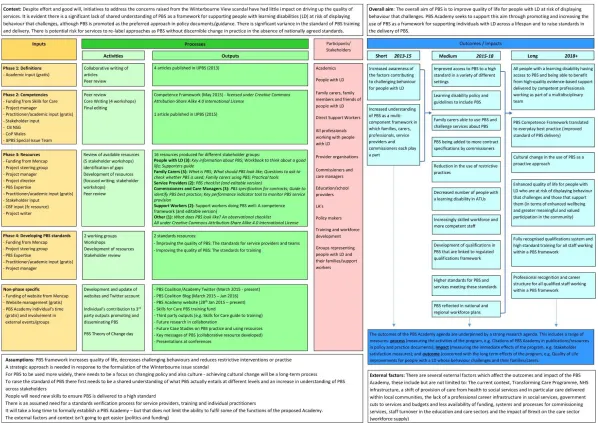
A logic model diagram based upon the elements outlined above was constructed and
shared with the PBS Academy to achieve consensus (Figure 1). The development of a logic
5 See detailed supplementary information available from first author ‘Table 3 – A summary of the stakeholder
model is an iterative process. It becomes a working document, accounting for inevitable
changes in elements of the model (e.g. context changes, progress towards outcomes, new
outputs), which are used to measure impact and inform a more strategic approach to
co-ordinating/planning and prioritising future activities (ensuring activities are logical steps to
meet outcomes within the context, aims, external factors, assumptions).
Discussion
Assessing impact according to a REF definition (longer term effects outside of
academia) is complicated in the learning disabilities field. Interventions and policy are
relevant across the lifespan; they are delivered within health, education and social care
settings and involve multiple stakeholder groups, including family and other unpaid carers.
Developing a logic model for the PBS Academy to guide evaluation of “impact” and inform
its strategic agenda illustrates the value that this approach may have for other learning
disability projects.
Identification of impact measures
The process has clarified the distinction between outputs (the “things” that are
produced) and outcomes (resulting change) and has facilitated the identification of outcome
measures (differentiated by stakeholder group and across time scales) and the collection of
relevant data. These data are being used to shape the strategic agenda of the PBS Academy.
Identifying gaps and process issues
The logic model has identified areas where activities have been less effective, such as
the development of resources for certain stakeholder groups (e.g. allied health professionals)
focussed attention on the need to engage more effectively with a clearly identified set of
stakeholders involved in affecting cultural change, and the recognition that whilst certain
activities require collaboration and co-production across sectors (anything that requires
system change); others are more effectively achieved by small, focussed working groups (the
development of resources for specific purposes).
Setting the strategic agenda
It has helped make clear that for PBS to be adopted more widely, there needs to be
greater strategic focus on changing policy and culture at national, regional and individual
provider levels than there has been to date. Achieving cultural change will be a long-term
process. The priorities going forward are to develop a shared understanding of, and
commitment to, PBS across all stakeholders (people with learning disabilities, family and
carers, commissioners, provider organisations, direct support workers, training providers,
government inspection teams, other health and social care professions and third sector
organisations), a workforce development and training strategy across all levels of service
provision, and the establishment of an external and independent process by which standards
for PBS training and delivery can be validated.
Communication of a shared understanding
The logic model has provided a means of communicating the rationale of the PBS
Academy goals and activities to a wider audience including those that it seeks to influence
and in so doing helped to identify the very significant role that others need to play in the
dissemination of PBS and the PBS Academy’s work.
“Impact” from the perspective of the PBS Academy will be achieved when outputs go
beyond a set of recommendations and into a set of tangible activities that bring about the
creation of an infrastructure that facilitates workforce development around PBS in the
learning disability sector. This includes (for example) the steps necessary to establish a
verification system of standards of PBS practice; the establishment of a career path for
support workers as PBS practitioners; and building local capacity for the delivery of front line
services. There is also a need to measure the longer term effects which have not been
explored in depth within this paper. Ways to measure longer term impact might include
longitudinal quality of life studies for people with a learning disability whose behaviour
challenges and their families/carers; stakeholder-specific self-efficacy/confidence measures
(direct care workers, commissioners of services, families and carers, people with learning
disabilities, provider organisations) and stakeholder satisfaction measures (e.g. of the quality
of provided services and supports).
Developing a logic model has provided a useful framework for the PBS Academy
evaluation and impact study. There is an increased focus on the importance of evaluating
impact and a lack of a generalised framework for evaluating impact in the learning
disabilities field. We suggest that using logic models to guide evaluation of impact for
References
Allen, D., McGill, P., Hastings, R.P., Toogood, S., Baker, P., Gore, N.J. and Hughes, J.C.
(2013), “Implementing positive behavioural support: changing social and
organisational contexts”, International Journal of Positive Behaviour Support, Vol.3
No.2, pp.32-41.
AVECO (2016), “Time for change: The challenge ahead”, available at:
https://www.acevo.org.uk/sites/default/files/ACEVO_report_TCA_final_web.pdf
(accessed 13 June 2017).
Bowring, D.L., Totsika, V., Hastings, R.P., Toogood, S. and McMahon, M. (2017),
“Prevalence of Psychotropic Medication Use and Association With Challenging
Behaviour in Adults With an Intellectual Disability. A Total Population Study”,
Journal of Intellectual Disability Research, Vol.61 No.6, pp.604-617.
Chowdhury, G., Koya, K. and Philipson, P. (2016), “Measuring the impact of research:
lessons from the UK’s Research Excellence Framework 2014”, PloS one, Vol.11
No.6, pp. 1-15.
Denne, L.D., Jones, E., Lowe, K., Jackson Brown, F. and Hughes, J.C. (2015), “Putting
positive behavioural support into practice: the challenges of workforce training and
development”, International Journal of Positive Behavioural Support, Vol.5 No.2,
pp.43-54.
Denne, L.D., Noone, S.J., Gore, N.J., Toogood, S., Hughes, J.C., Hastings, R.P., Allen, D.,
Baker, P. and McGill, P. (2013), “Developing a core competencies framework for
positive behavioural support: issues and recommendations”, International Journal of
Donabedian, A. (1966), “Evaluating the quality of medical care”, Milbank Memorial Fund
Quarterly, Vol.44 No.3, pp.166-206.
Gash, T., Hallsworth, M., Ismail, S. and Paun, A. (2008), “Performance Art: Enabling better
management of public services” Institute for Government, London.
Gore, N.J., McGill, P., Toogood, S., Allen, D., Hughes, J.C., Baker, P., Hastings, R.P.,
Noone, S.J. and Denne, L.D. (2013), “Definition and scope for positive behavioural
support”, International Journal of Positive Behaviour Support, Vol.3 No.2, pp.14-23.
Hastings, R.P., Allen, D., Baker, P., Gore, N.J., Hughes, J.C., McGill, P., Noone, S.J. and
Toogood, S. (2013), “A conceptual framework for understanding why challenging
behaviours occur in people with developmental disabilities”, International Journal of
Positive Behaviour Support, Vol.3 No.2, pp.5-13.
La Valle, I. (2016), “Final evaluation of the Paving the Way project: Early intervention for
children with learning disabilities whose behaviour challenges”, available at:
http://pavingtheway.works/download/early-intervention-project-final-evaluation/
(accessed 30 August 2017).
Lowe, K., Allen, D., Jones, E., Brophy, S., Moore, K. and James, W. (2007), “Challenging
behaviours: prevalence and topographies”, Journal of Intellectual Disabilities, Vol.51
No.8, pp.625-636.
McLaughlin, J.A. and Jordan, G.B. (1998), “Logic models: a tool for telling your program’s
performance story”, Evaluation and Program Planning, Vol.22 No.1, pp.65-72.
NHS England, Local Government Association and Association of Directors of Adult Social
Services. (2015), “Building the Right Support: A National Plan to Develop
Community Services and Close Inpatient Facilities for People with a Learning
with a Mental Health Condition”, available at:
https://www.england.nhs.uk/wp-content/uploads/2015/10/ld-nat-imp-plan-oct15.pdf (accessed 30 October 2017).
Porter, M.E. (1979), “How competitive forces shape strategy”, Harvard Business Review,
Vol.57 No.2, pp.137-145.
Positive Behavioural Support (PBS) Coalition UK. (2015), “Positive Behavioural Support
(PBS): A Competence Framework”, available at:
http://pbsacademy.org.uk/pbs-competence-framework/ (accessed 10 November 2016).
Research Excellence Framework (2011), “Assessment framework and guidance on
submissions”, available at: www.ref.ac.uk/2014/pubs/2011-02/ (accessed 22 June
2018).
Schalock, R.L., Keith, K.D., Verdugo, M.Á. and Gómez, L.E. (2010), “Quality of life model
development and use in the field of intellectual disability”, in Kober, R. (Ed.),
Enhancing the Quality of Life of People with Intellectual Disabilities, Springer,
Dordrecht, pp. 17-32.
Scott, S.J., Denne, L.D. and Hastings, R.P. (2018), “Assessing the impact of the UK Positive
Behavioural Support (PBS) Academy: an internet survey”, International Journal of
Positive Behavioural Support, Vol. 8 No. 1.
Shakman, K. and Rodriguez, S.M. (2015), “Logic model for program design, implementation
and evaluation: Workshop toolkit”, available at:
http://files.eric.ed.gov/fulltext/ED556231.pdf (accessed 10 March 2017).
Skills for Care. (2016), “The adult social care workforce supporting people with learning
disabilities and/or autism. Data from the National Minimum Data Set for Social
Care”, available at:
http://www.skillsforcare.org.uk/Documents/Topics/Learning-
Skills for Care. (2015), “The state of the adult social care sector and workforce report in
England, 2014”, available at:
http://www.skillsforcare.org.uk/Document-
library/NMDS-SC,-workforce-intelligence-and-innovation/NMDS-SC/State-of-2014-ENGLAND-WEB-FINAL.pdf (accessed 03 September 2017).
Van Loon, J.H., Bonham, G.S., Peterson, D.D., Schalock, R.L., Claes, C. and Decramer, A.E.
(2013), “The use of evidence-based outcomes in systems and organizations providing
services and supports to persons with intellectual disability”, Evaluation and Program