Active Dual Supervision: Reducing the Cost
of Annotating Examples and Features
Prem Melville
IBM T.J. Watson Research Center Yorktown Heights, NY 10598
Vikas Sindhwani
IBM T.J. Watson Research Center Yorktown Heights, NY 10598
Abstract
When faced with the task of building machine learning or NLP models, it is often worthwhile to turn to active learning to obtain human an-notations at minimal costs. Traditional active learning schemes query a human for labels of intelligently chosen examples. However, hu-man effort can also be expended in collecting alternative forms of annotations. For example, one may attempt to learn a text classifier by labeling class-indicating words, instead of, or in addition to, documents. Learning from two different kinds of supervision brings a new, unexplored dimension to the problem of ac-tive learning. In this paper, we demonstrate the value of such active dual supervision in the context of sentiment analysis. We show how interleaving queries for both documents and words significantly reduces human effort – more than what is possible through tradi-tional one-dimensional active learning, or by passive combinations of supervisory inputs.
1 Introduction
As a canonical running example for the theme of this paper, consider the problem of sentiment
anal-ysis (Pang and Lee, 2008). Given a piece of text as
input, the desired output is a polarity score that indi-cates whether this text expresses a positive or nega-tive opinion towards a topic of interest. From a ma-chine learning viewpoint, this problem may be posed as a typical binary text classification task. Senti-ment, however, is often conveyed with subtle lin-guistic mechanisms such as sarcasm, negation and the use of highly domain-specific and contextual
cues. This brings a multi-disciplinary flavor to the problem, drawing interest from both Natural Lan-guage Processing and Machine Learning communi-ties.
Many methodologies proposed in these disci-plines share a common limitation that their perfor-mance is bounded by the amount and quality of la-beled data. However, they differ conceptually in the type of human effort they require. On one hand, supervised machine learning techniques re-quire human effort in acquiring labeled examples, which requires reading documents and annotating them with their aggregate sentiment. On the other hand, dictionary-based NLP systems require human effort in collecting labeled features: for example, in the domain of movie reviews, words that evoke positive sentiment (e.g., “mesmerizing”, “thrilling” etc) may be labeled positive, while words that evoke negative sentiment (e.g., “boring”,“disappointing”) may be labeled negative. This kind of annotation requires a human to condense prior linguistic expe-rience with a word into a sentiment label that reflects the net emotion that the word evokes.
We refer to the general setting of learning from both labels on examples and features as dual
super-vision. This setting arises more broadly in tasks
where in addition to labeled documents, it is fre-quently possible to provide domain knowledge in the form of words, or phrases (Zaidan and Eisner, 2008) or even more sophisticated linguistic features, that associate strongly with a class. Recent work (Druck et al., 2008; Sindhwani and Melville, 2008) has demonstrated that the presence of word supervision can greatly reduce the number of labeled documents
required to build high quality text classifiers. In general, these two sources of supervision are not mutually redundant, and have different annota-tion costs, human response quality, and degrees of utility towards learning a dual supervision model. This leads naturally to the problem of active dual
supervision, or, how to optimally query a human
or-acle to simultaneously collect document and feature annotations, with the objective of building the high-est quality model with the lowhigh-est cost. Much of the machine learning literature on active learning has focused on one-sided example-only annotation for classification problems. Less attention has been de-voted to simultaneously acquiring alternative forms of supervisory domain knowledge, such as the kind routinely encountered in NLP. Our contribution may be viewed as a step in this direction.
2 Dual supervision
Most work in supervised learning has focused on learning from examples, each represented by a set of feature values and a class label. In dual super-vision we consider an additional aspect, by way of labels of features, which convey prior knowledge on associations of features to particular classes. Since we deal only with text classification in this paper, all features represent term-frequencies of words, and as such we use feature and word interchangeably.
The active learning schemes we explore in this pa-per are broadly applicable to any learner that can support dual supervision, but here we focus on ac-tive learning for the Pooling Multinomials classi-fier (Melville et al., 2009) described below. In con-current related work, we propose active dual su-pervision schemes for a class of graph-based and kernel-based dual supervision methods (Sindhwani et al., 2009).
2.1 Pooling Multinomials
The Pooling Multinomials classifier was introduced by Melville et al. (2009) as an approach to incorpo-rate prior lexical knowledge into supervised learn-ing for better sentiment detection. In the context of sentiment analysis, lexical knowledge is available in terms of the prior sentiment-polarity of words. From a dual supervision point of view, this knowledge can be seen as labeled features, since the lexicon
effec-tively provides associations of a set of words with the positive or negative class.
Pooling Multinomials classifies unlabeled exam-ples just as in multinomial Na¨ıve Bayes classifica-tion (McCallum and Nigam, 1998), by predicting the class with the maximum likelihood, given by
argmaxcjP(cj)QiP(wi|cj); where P(cj) is the prior probability of class cj, and P(wi|cj) is the
probability of wordwi appearing in a document of
classcj. In the absence of background knowledge about the class distribution, we estimate the class priorsP(cj)solely from the training data. However,
unlike regular Na¨ıve Bayes, the conditional prob-abilities P(wi|cj) are computed using both the
la-beled examples and the lala-beled features.
Pooling distributions is a general approach for combining information from multiple sources or ex-perts; where experts are typically represented in terms of probability distributions (Clemen and Win-kler, 1999). Here, we only consider the special case of combining multinomial distributions from two sources – namely, the labeled examples and labeled features. The multinomial parameters of such mod-els can be easily combined using the linear
opin-ion pool (Clemen and Winkler, 1999), in which
the aggregate probability is given by P(wi|cj) = αPe(wi|cj) + (1−α)Pf(wi|cj); where Pe(wi|cj)
andPf(wi|cj)represent the probability assigned by
using the example labels and feature labels respec-tively, andαis the weight for combining these dis-tributions. The weight indicates a level of confi-dence in each source of information, and Melville et al. (2009) explore ways of automatically selecting this weight. However, in order to not confound our results with the choice of weight-selection mecha-nism, here we make the simplifying assumption that the two experts based on instance and feature labels are equally valuable, and as such setαto0.5.
attempt to select the parameters Pf(wi|cj) of the
multinomial distributions that would generate such documents. The exact values of these condition-als are presented below. Their derivation is not di-rectly pertinent to the subject of this paper, but can be found in (Melville et al., 2009).
Given:
V– the vocabulary, i.e., set of words in our domain
P – set of words labeled as positive
N – set of words labeled as negative
U – set of unknown words, i.e.V −(N ∪ P)
m– size of vocabulary, i.e.|V|
p– number of positive words, i.e. |P|
n– number of negative words, i.e.|N |
All words in the vocabulary can be divided into three categories – words with a positive label, nega-tive label, and unknown label. We refer to the prob-ability of any positive term appearing in a positive document simply asPf(w+|+). Similarly, we refer to the probability of any negative term appearing in a negative document asPf(w−|−); and the
probabil-ity of an unknown word in a positive or negative con-text asPf(wu|+)andPf(wu|−) respectively. The
generative model for labeled features can then be de-fined by:
Pf(w+|+) =Pf(w−|−) = p+1n
Pf(w+|−) =Pf(w−|+) = p+1n ×1r
Pf(wu|+) =
n(1−1/r)
(p+n)(m−p−n)
Pf(wu|−) =
p(1−1/r)
(p+n)(m−p−n)
where, the polarity level, r, is a measure of how much more likely it is for a positive term to occur in a positive document compared to a negative term. The value ofr is set to100in our experiments, as done in (Melville et al., 2009).
2.2 Learning from example vs. feature labels
Dual supervision makes it possible to learn from la-beled examples and lala-beled features simultaneously; and, as in most supervised learning tasks, one would expect more labeled data of either form to lead to more accurate models. In this section we explore the
influence of increased number of instance labels and feature labels independently, and also in tandem.
For these, and all subsequent experiments, we use 10-fold cross-validation on the publicly avail-able data of movie reviews provided by Pang et al. (2002). This data consists of 1000 positive and 1000 negative reviews from the Internet Movie Database; where positive labels were assigned to re-views that had a rating above 3.5 stars and negative labels were assigned to ratings of 2 stars and below. We use a bag-of-words representation of reviews, where each review is represented by the term fre-quencies of the 5000 most frequent words across all reviews, excluding stop-words.
In order to study the effect of increasing number of labels we need to simulate a human oracle label-ing data. In the case of examples this is straight-forward, since all examples in the Movies dataset have labels. However, in the case of features, we do not have a gold-standard set of feature labels. So in order to simulate human responses to queries for feature labels, we construct a feature oracle in the following manner. The information gain of words with respect to the known true class labels in the dataset is computed using binary feature represen-tations. Next, out of the 5000 total words, the top 1000 as ranked by information gain are assigned a label. This label is the class in which the word ap-pears more frequently. The oracle returns a “dont know” response for the remaining words. Thus, this oracle simulates a human domain expert who is able to recognize and label the most relevant task-specific words, and also reject a word that falls below the rel-evance threshold. For instance, in sentiment classi-fication, we would expect a “don’t know” response for non-polar words.
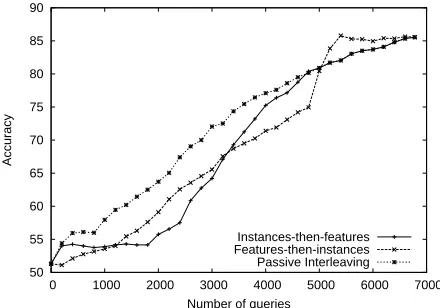
We ran experiments beginning with a classifier provided with labels for 10 randomly selected in-stances and 10 randomly selected features. We then compare three schemes - Instances-then-features, Features-then-instances, and Passive Interleaving. As the name suggests, Instances-then-features, is provided labels for randomly selected instances until all instances have been labeled, and then switches to labeling features. Similarly, Features-then-instances acquires labels for randomly selected features first and then switches to getting instance labels. In
be-tween issuing queries for randomly chosen instance and feature labels. In particular, at each step we choose to query for an instance with probability 0.36, otherwise we query for a feature label. The
instance-query rate of0.36is selected based on the ratio of available instances (1800) to available fea-tures (5000). The results of these learning curves are presented in Fig. 1. Note that the x-axis in the figure corresponds to the number of queries issued. As dis-cussed earlier, in the case of features, the oracle may respond to a query with a class label or may issue a “don’t know” response, indicating that no label is available. As such, the number of feature-queries on the x-axis does not correspond to the number of actual known feature labels. We would expect that on average 1 in 5 feature-label queries prompts a response from the feature oracle that results in a known feature label being provided.
At the end of the learning curves, each method has labels for all available instances and features; and as such, the last points of all three curves are identical. The results show that fixing the number of labeled features, and increasing the number of la-beled instances steadily improves classification ac-curacy. This is what one would expect from tra-ditional supervised learning curves. More interest-ingly, the results also indicate that we can fix the number of instances, and improve accuracy by la-beling more features. Finally, results on Passive In-terleaving show that, though both feature labels and example labels are beneficial by themselves, dual su-pervision which exploits the interaction of examples and features does in fact benefit from acquiring both types of labels concurrently.
For all results above, we are selecting instances and/or features to be labeled uniformly at random. Based on previous work in active learning one would expect that we can select instances to be labeled more efficiently, by having the learner decide which instances it is most likely to benefit from. The results in this section suggests that actively selecting fea-tures to be labeled may also be beneficial. Further-more, the Passive Interleaving results suggest that an ideal active dual supervision scheme would actively select both instances and features for labeling. We begin by exploring active learning for feature labels in the next section, and then consider the simultane-ous selection of instances and features in Sec. 4.
50 55 60 65 70 75 80 85 90
0 1000 2000 3000 4000 5000 6000 7000
Accuracy
Number of queries
[image:4.612.316.536.62.216.2]Instances-then-features Features-then-instances Passive Interleaving
Figure 1: Comparing the effect of instance and feature label acquisition in dual supervision.
3 Acquiring feature labels
Traditional active learning has primarily focused on selecting unlabeled instances to be labeled. The dual-supervision setting now provides us with an ad-ditional dimension to active learning, where labels may also be acquired for features. In this section we look at the novel task of active learning applied only to feature-label acquisition. In Section 4 we study the more general task of active dual supervi-sion, where both instance and feature labels may be acquired concurrently.
3.1 Feature uncertainty vs. certainty
A very common approach to active learning for in-stances is Uncertainty Sampling (Lewis and Catlett, 1994). In this approach we acquire labels for in-stances that the current model is most uncertain about. Uncertainty Sampling is founded on the heuristic that uncertain instances are close to the cur-rent classification boundary, and acquiring the cor-rect labels for them are likely to help refine the loca-tion of this boundary. Despite its simplicity, Uncer-tainty Sampling is usually quite effective in practice; which raises the question of whether one can apply the same principle to feature-label acquisition. In this case, we want to select unlabeled features that the current model is most uncertain about.
lin-ear classifier as in (Sindhwani and Melville, 2008), we could use the magnitude of the weights on the features as a measure of uncertainty – where lower weights indicate less certainty. Since Pooling Multi-nomials builds a multinomial Na¨ıve Bayes model, we can directly use the model’s conditional proba-bilities of each word (feature) given a class.
For ease of exposition we refer to the two classes in binary classification as postive (+) and negative (-), without loss of generality. Given the probabili-ties of wordfbelonging to the positive and negative class, P(f|+) and P(f|−), we can determine the
uncertainty of a feature using the absolute value of the log-odds ratio, i.e.,
abs
logP(f|+)
P(f|−)
(1)
The smaller this value, the more uncertain the model is about the feature’s class association. In every it-eration of active learning we can select the features with the lowest certainty scores. We refer to this ap-proach as Feature Uncertainty.
Though Uncertainty Sampling for features seems like an appealing notion, it may not lead to better models. If a classifier is uncertain about a feature, it may have insufficient information about this fea-ture and may indeed benefit from learning its la-bel. However, it is also quite likely that a feature has a low certainty score because it does not carry much discriminative information about the classes. In the context of sentiment detection, one would ex-pect that neutral/non-polar words will appear to be uncertain words. For example, words such as “the” which are unlikely to help in discriminating between classes, are also likely to be considered the most un-certain. As we shortly report, on the movies dataset, Feature Uncertainty ends up wasting queries on such words ending up with performance inferior to ran-dom feature queries. What works significantly bet-ter is an albet-ternative strategy which acquires labels for features in the descending order of the score in Eq 1. We refer to this approach as Feature Certainty.
3.2 Expected feature utility
The intuition underlying the feature certainty heuris-tic is that it serves to confirm or correct the orienta-tion of model probabilities on different words during
the active learning process. One can argue that fea-ture certainty is also suboptimal in that queries may be wasted simply confirming confident predictions, which is of limited utility to the model. An alterna-tive to using a certainty-based heuristic, is to directly estimate the expected value of acquiring each fea-ture label. Such Expected Utility (Estimated Risk Minimization) approaches have been applied suc-cessfully to traditional active learning (Roy and Mc-Callum, 2001), and to active feature-value acquisi-tion (Melville et al., 2005). In this secacquisi-tion we de-scribe how this Expected Utility framework can be adapted for feature-label acquisition.
At every step of active learning for features, the next best feature to label is one that will result in the highest improvement in classifier performance. Since the true label of the unlabeled features are unknown prior to acquisition, it is necessary to es-timate the potential impact of every feature query for all possible outcomes.1 Hence, the decision-theoretic optimal policy is to ask for feature labels which, once incorporated into the data, will result in the highest increase in classification performance in
expectation.
Iffj is the label of thej-th feature, andqj is the
query for this feature’s label, then the Expected Util-ity of a feature queryqj can be computed as:
EU(qj) = K
X
k=1
P(fj =ck)U(fj =ck) (2)
WhereP(fj =ck)is the probability thatfj will be labeled with class ck, and U(fj = ck) is the
util-ity to the model of knowing that fj has the label ck. In practice, the true values of these two
quan-tities are unknown, and the main challenge of any Expected Utility approach is to accurately estimate these quantities from the data currently available.
A direct way to estimate the utility of a feature la-bel to classification, is to measure classification ac-curacy on the training set of a model built using this feature label. However, small changes in the model that may result from a acquiring a single additional feature label may not be reflected by a change in ac-curacy. As such, we use a more fine-grained mea-sure of classifier performance, Log Gain, which is
1
computed as follows. For a model induced from a training set T, let Pˆ(ck|xi) be the probability
es-timated by the model that instance xi belongs to
class ck; and I is an indicator function such that
I(ck, xi) = 1 if ck is the correct class for xi and
I(ck, xi) = 0, otherwise. Log Gain is then defined
as:
LG(xi) =− K
X
k=1
I(ck) ˆP(ck|xi) (3)
Then the utility of a classifier,U, can be measured by summing the Log Gain for all instances in the training set T. A lower value of Log Gain indi-cates a better classifier performance. For a deeper discussion of this measure see (Saar-Tsechansky et al., 2008).
In Eq. 2, apart from the measure of utility, we also do not know the true probability distribution of labels for the feature under consideration. This too can be estimated from the training data, by see-ing how frequently the word appears in documents of each class. In a multinomial Na¨ıve Bayes model we already collect these statistics in order to deter-mine the conditional probability of a class given a word, i.e. P(fj|ck). We can use these probabilities
to get an estimate of the feature label distribution, ˆ
P(fj =ck) = PKP(fj|ck) k=1P(fj|ck).
Given the estimated values of the feature-label distribution and the utility of a particular feature query outcome, we can now estimate the Expected Utility of each unknown feature, and select the fea-tures with the highest Expected Utility to modeling. Though theoretically appealing, this approach is quite computationally intensive if applied to evalu-ate all unknown features. In the worst case it re-quires building and evaluating models for each pos-sible outcome of each unlabeled feature query. If you have m features and K classes, this approach requires trainingO(mK) classifiers. However, the complexity of the approach can be significantly al-leviated by only applying Expected Utility evalua-tion to a sub-sample of all unlabeled features. Given the large number of features with no true class la-bels, selecting a sample of available features uni-formly at random may be sub-optimal. Instead we select a sample of features based on Feature Cer-tainty. In particular we select the top 100 unknown
features that the current model is most certain about, and identify the features in this pool with the highest Expected Utility. We refer to this approach as
Ex-pected Feature Utility. We use Feature Certainty to
sub-sample the available feature queries, since this approach is more likely to select features for which the label is known by the Oracle.
3.3 Active learning with feature labels
We ran experiments comparing the three different active learning approaches described above. In these, and all subsequent experiments, we begin with a model trained on 10 labeled features and 100 labeled instances, which were randomly selected. From our prior efforts of manually labeling such data, we find this to be a reasonable initial setting.
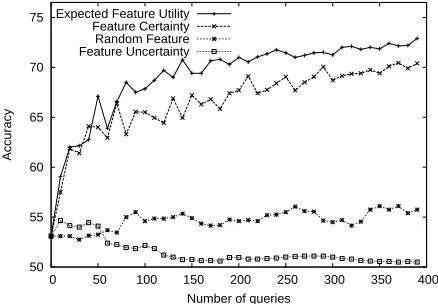
The experiments in this section focus only on the selection of features to be labeled. So, in each itera-tion of active learning we select the next 10 feature-label queries, based on Feature Uncertainty, Feature Certainty, or Expected Feature Utility. As a baseline, we also compare to the performance of a model that selects features uniformly at random. Our results are presented in Fig. 2.
50 55 60 65 70 75
0 50 100 150 200 250 300 350 400
Accuracy
Number of queries Expected Feature Utility
[image:6.612.316.535.407.559.2]Feature Certainty Random Feature Feature Uncertainty
Figure 2: Comparing different active learning approaches for acquiring feature labels.
of Feature Certainty does remarkably well. This may be because polarized words are better for learn-ing, but it is also likely that querying for such words increases the likelihood of selecting one whose label is known to the oracle.
The results on Expected Feature Utility show that estimating the expected impact of potential labels for features does in fact perform much better than feature certainty. The results confirm that despite our crude estimations in Eq. 2, Expected Feature Utility is an effective approach to active learning of feature labels. Furthermore, we demonstrate that by applying the approach to only a small sub-sample of certain features, we are able to make this method computationally feasible to use in practice. In-creasing the size of the sample of candidate feature queries is likely to improve performance, at the cost of increased time in selecting queries.
4 Active dual supervision
In the previous section we demonstrated that ac-tively selecting informative features to be labeled is significantly better than random selection. In this section, we look at the complementary task of se-lecting instances to be labeled, and combined active learning for both forms of supervision.
Selecting unlabeled examples for learning has been a well-studied problem, and we use Uncer-tainty Sampling (Lewis and Catlett, 1994), which has been shown to be a computationally efficient and effective approach in the literature. In particular we select unlabeled examples to be labeled in order of decreasing uncertainty, where uncertainty is mea-sured in terms of the margin, as done in (Melville and Mooney, 2004). The margin on an unlabeled ex-ample is defined as the absolute difference between the class probabilities predicted by the classifier for the given example, i.e.,|P(+|x)−P(−|x)|. We re-fer to the selection of instances based on this uncer-tainty as Instance Unceruncer-tainty, in order to distinguish it from Feature Uncertainty.
We ran experiments as before, comparing selec-tion of instances using Instance Uncertainty and se-lection of features using Expected Feature Utility. In addition, we also combine these to methods by interleaving feature and instance selection. In par-ticular, we first order instances in decreasing order
of uncertainty, and features in terms of decreasing Expected Feature Utility. We then probabilistically select instances or features from the top of these lists, where, as before, the probability of selecting an instance is0.36. Recall that this probability
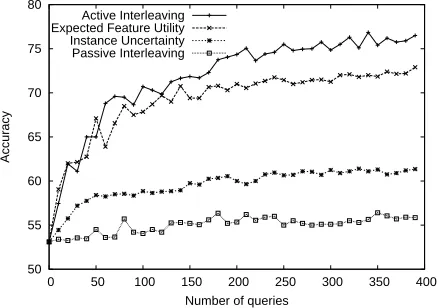
cor-responds to the ratio of available instances (1800) and features (5000). We refer to this approach as Ac-tive Interleaving, in contrast to Passive Interleaving, which we also present as a baseline. Recall that Pas-sive Interleaving corresponds to probabilistically in-terleaving queries for randomly chosen, not actively chosen, examples and features. Our results are pre-sented in Fig. 3.
We observe that, Instance Uncertainty performs better than Passive Interleaving, which in turn is bet-ter than random selection of only instances or fea-tures – as seen in Fig. 1. However, effectively se-lecting features labels, via Expected Feature Util-ity, does even better than actively selecting only in-stances. Finally, selecting instance and features si-multaneously via Active Interleaving performs bet-ter than active learning of features or instances sep-arately. Active Interleaving is indeed very effective, reaching an accuracy of77%with only 500 queries, while Passive Interleaving requires more than 4000 queries to reach the same performance – as evi-denced by Fig. 1
50 55 60 65 70 75 80
0 50 100 150 200 250 300 350 400
Accuracy
Number of queries Active Interleaving
[image:7.612.317.536.442.596.2]Expected Feature Utility Instance Uncertainty Passive Interleaving
Figure 3: Comparing Active Interleaving to alternative label acquisition strategies.
5 Related work
work, to the best of our knowledge. Most prior work has focused on pooled-based active learning, where examples from an unlabeled pool are selected for la-beling (Cohn et al., 1994; Tong and Koller, 2000). In contrast, active feature-value acquisition (Melville et al., 2005) and budgeted learning (Lizotte et al., 2003) focus on estimating the value of acquiring missing features, but do not deal with the task of learning from feature labels. In contrast, Raghavan and Allan (2007) and Raghavan et al. (2006) study the problem of tandem learning where they combine uncertainty sampling for instances along with co-occurence based interactive feature selection. God-bole et al. (2004) propose notions of feature uncer-tainty and incorporate the acquired feature labels, into learning by creating one-term mini-documents. Learning from labeled examples and features via dual supervision, is itself a new area of research. Sindhwani et al. (2008) use a kernel-based frame-work to build dual supervision into co-clustering models. Sindhwani and Melville (2008) apply sim-ilar ideas for graph-based sentiment analysis. There have also been previous attempts at using only fea-ture supervision, mostly along with unlabeled doc-uments. Much of this work (Schapire et al., 2002; Wu and Srihari, 2004; Liu et al., 2004; Dayanik et al., 2006) has focused on using labeled features to generate pseudo-labeled examples that are then used with well-known models. In contrast, Druck et al. (2008) constrain the outputs of a multinomial logistic regression model to match certain reference distributions associated with labeled features.
6 Perspectives and future work
Though Active Interleaving is a very effective ap-proach to active dual supervision, there is still a lot of room for improvement. Firstly, Active Interleav-ing relies on Uncertainty SamplInterleav-ing for the selection of instances. Though Uncertainty Sampling has the advantage of being fast and effective, there exist ap-proaches that lead to better models with fewer ex-amples – usually at the cost of computation time. One such method, estimating error reduction (Roy and McCallum, 2001), is a direct analog of Ex-pected Feature Utility applied to instance selection. One would expect that an improvement in instance selection, should directly improve any method that
combines instance and feature label selection. Sec-ondly, Active Interleaving uses the simple approach of probabilistically choosing to select an instance or feature for each subsequent query. However, a more intelligent active scheme should be able to assess if an instance or feature would be more beneficial at each step. Furthermore, we do not currently con-sider the cost of acquiring labels. Presumably la-beling a feature versus lala-beling an instance could incur very different costs – which could be mone-tary costs or time taken for each annotation. Fortu-nately, the Expected Utility method is very flexible, and allows us to address all these issues within a sin-gle framework. We can specifically estimate the ex-pected utility of different forms of annotation, per unit cost. For instance, Provost et al. (2007) use such an approach to estimate the utility of acquir-ing class labels and feature values (not labels) per unit cost, within one unified framework. A similar method can be applied for a holistic approach to ac-tive dual supervision, where the Expected Utility of an instance or feature label queryq, can be computed asEU(q) = PKk=1P(q=ck)U(qω=qck); whereωqis
cost of the queryq, and utilityU can be computed as in Eq. 3. By evaluating instances and features on the same scale, and by measuring utility per unit cost of acquisition, such a framework should enable us to handle the trade-off between the costs and benefits of the different types of acquisitions. The primary challenge in the success of this approach is to
accu-rately and efficiently estimate the different quantities
in the equation above, using only the training data currently available. These are directions for future exploration.
7 Conclusions
References
R. T. Clemen and R. L. Winkler. 1999. Combining prob-ability distributions from experts in risk analysis. Risk
Analysis, 19:187–203.
D. Cohn, L. Atlas, and R. Ladner. 1994. Improving gen-eralization with active learning. Machine Learning, 15(2):201–221.
Aynur Dayanik, David D. Lewis, David Madigan, Vladimir Menkov, and Alexander Genkin. 2006. Con-structing informative prior distributions from domain knowledge in text classification. In SIGIR.
G. Druck, G. Mann, and A. McCallum. 2008. Learn-ing from labeled features usLearn-ing generalized expecta-tion criteria. In SIGIR.
S. Godbole, A. Harpale, S. Sarawagi, and S. Chakrabarti. 2004. Document classification through interactive su-pervision of document and term labels. In PKDD. David D. Lewis and Jason Catlett. 1994.
Heteroge-neous uncertainty sampling for supervised learning. In
Proc. of 11th Intl. Conf. on Machine Learning (ICML-94), pages 148–156, San Francisco, CA, July. Morgan
Kaufmann.
Bing Liu, Xiaoli Li, Wee Sun Lee, and Philip Yu. 2004. Text classification by labeling words. In AAAI. Dan Lizotte, Omid Madani, and Russell Greiner. 2003.
Budgeted learning of naive-Bayes classifiers. In UAI. Andrew McCallum and Kamal Nigam. 1998. A
com-parison of event models for naive Bayes text classifi-cation. In AAAI Workshop on Text Categorization. Prem Melville and Raymond J. Mooney. 2004. Diverse
ensembles for active learning. In Proc. of 21st Intl.
Conf. on Machine Learning (ICML-2004), pages 584–
591, Banff, Canada, July.
Prem Melville, Maytal Saar-Tsechansky, Foster Provost, and Raymond Mooney. 2005. An expected utility ap-proach to active feature-value acquisition. In ICDM. Prem Melville, Wojciech Gryc, and Richard Lawrence.
2009. Sentiment analysis of blogs by combining lexi-cal knowledge with text classification. In KDD. Bo Pang and Lilian Lee. 2008. Opinion mining and
sen-timent analysis. Foundations and Trends in
Informa-tion Retrieval: Vol. 2: No 1, pp 1-135.
Bo Pang, Lillian Lee, and Shivakumar Vaithyanathan. 2002. Thumbs up? sentiment classification using ma-chine learning techniques. In EMNLP.
Foster Provost, Prem Melville, and Maytal Saar-Tsechansky. 2007. Data acquisition and cost-effective predictive modeling: Targeting offers for electronic commerce. In ICEC ’07: Proceedings of the ninth
in-ternational conference on Electronic commerce.
Hema Raghavan, Omid Madani, and Rosie Jones. 2006. Active learning with feedback on features and in-stances. J. Mach. Learn. Res., 7:1655–1686.
H. Raghavan, O. Madani, and R. Jones. 2007. An inter-active algorithm for asking and incorporating feature feedback into support vector machines. In SIGIR. Nicholas Roy and Andrew McCallum. 2001. Toward
optimal active learning through sampling estimation of error reduction. In ICML.
Maytal Saar-Tsechansky, Prem Melville, and Foster Provost. 2008. Active feature-value acquisition. In
Management Science.
Robert E. Schapire, Marie Rochery, Mazin G. Rahim, and Narendra Gupta. 2002. Incorporating prior knowl-edge into boosting. In ICML.
Vikas Sindhwani and Prem Melville. 2008. Document-word co-regularization for semi-supervised sentiment analysis. In ICDM.
Vikas Sindhwani, Jianying Hu, and Alexandra Mo-jsilovic. 2008. Regularized co-clustering with dual supervision. In NIPS.
Vikas Sindhwani, Prem Melville, and Richard Lawrence. 2009. Uncertainty sampling and transductive experi-mental design for active dual supervision. In ICML. Simon Tong and Daphne Koller. 2000. Support
vec-tor machine active learning with applications to text classification. In Proc. of 17th Intl. Conf. on Machine
Learning (ICML-2000).
Xiaoyun Wu and Rohini Srihari. 2004. Incorporating prior knowledge with weighted margin support vector machines. In KDD.