Priorities in Process Algebras
Rance Cleaveland Matthew Hennessy Computer Science Department
Univemity of Suasur
Falmer, Brighton
BN1 9QH,
ENGLANDAbstract
An operational semantics for a n algebraic theory of concur- rency is developed that incorporates a notion of priority into the definition of the execution of actions. An equivalence based on strong observational equivalence is defined and shown t o be a congruence, and a complete axiomatization is given for finite terms. Several examples highlight the novelty and usefulness of our approach.
1
Introduction
Much has been written in recent years about the semantic ba- sis for communicating processes and reactive systems.
[
12,9,15] Intuitively, these are systems which evolve by interacting, or communicating, with their environment. Systems may perform a variety of actions, some of which may interact with the en- vironmentin
a particular way; communication is modeled in terms of such interactions.Most semantic theories for these systems are operational. Processes are interpreted using labeled transition ayatem, which are triples of the form ( P , + , A c t ) , where
P
is the set of processes, Act is the set of actions, and -+ is a relation on P x Act x P defining the behaviour of processes. The state- ment “ p2
q” means that process p may evolve t o process q by performing action a. This form of operational semantics has given rise t o a variety of behavioural equivalences on processes [12,9,6] and has proven t o be a convenient way of defining pro- cess behaviour when actions are all of equal importance. How- ever, the approach has a well recognized flaw when one tries t o assign more importance t o some actions than others. Obvious examples of actions which require special treatment include interrupts in hardware systems and time outs in communica- tions protocols. In addition, certain programming language constructs, such as the ‘delay” commands in OCCAM[lo]
and ADA 1161 and the disabling construct in LOTOS [4], em-body the notion of priority between actions. No satisfactory semantic theory exists for these constructs and for actions with priority in general.
In this paper we wish t o develop such a theory.
To
do so we introduce the notion of priority on actions and m o d i the use of labeled transition systems t o develop an operational seman- tia reflecting these priorities. We then develop and axiomatize a new behavioural equivalence analogous t o the strong obser- vational equivalence of [12]. We believe that this new semantic theory provides a sound basis for the language constructs and actions mentioned previously.The paper is organbed as follows. In section 2 we give an example highlighting the problem with existing theories and introduce the idea of prioritized actions. Section 3 defines the language we use and gives our new operational semantics. The language is based on CCS, but our method for giving opera- tional semantics can equally well be applied t o other languages such as
LOTOS
[4] and Statecharts [7]. In section 4 we define a new behavioural equivalence based on strong observational equivalence, and in section 5 we discuss proof techniques and give a complete axiomatbation for finite terms and a proof rule for recursively defined terms. Section 6 gives some examples emphasbing the novelty of our approach, and the final section discusses our conclusions and future plans. The proofs of most theorems are ,omitted; the interested reader is referred to 151.2
Prioritized Actions
UP
[image:2.614.86.537.88.189.2]down
Figure 1: A two-process system.
definition of the system would be as follows.
SYS
e
(CIINT)\iINT
+=
shut-down.z.nilC
+
up.Cl +i.nilCn+l e
up.Cn+o+
down.Cn+
;.nilHowever, in the standard operational semantics based on la- beled transition systems the following is a valid possible se- quence of actions for SYS.
up up shut-down up up
...
Although the action shut-down is performed C,, may choose t o ignore indefinitely the offer of communication from INT along channel i; the operational semantics merely states that actions up and i are always possible for C,,. Because of this defect in the operational semantics, the resulting behavioural theo- ries (12,9,3,6] give an inadequate account of this system. This semantic shortcoming is not confined to CCS; any language whose operational semantics are given in terms of traditionally defined labeled transition systems will not be able to describe this system correctly.
Intuitively, the desired behaviour of
SYS
can be captured if we associate priorities t o actions. By assigning a higher priority toi than t o up or
down we can ensure that whenSYS
reaches the state (Clz.nd)\i, the internal synchronization on port i must take place next, since it has a higher priority than any of the other possible actions. This is the basis of our approach; we modify the usual operational semantics t o take account of priorities and use it to develop what we feel is an adequate semantic theory of such processes.3
The
Language
The syntax of our language is essentially that of pure CCS, although later in the paper we introduce additional operators.
For simplicity we assume a two-level hierarchy of priorities; a n action is either prioritized or unprioritized. (We should point out that there is no theoretical difficulty is extending our results t o sets of actions with a range of discrete priorities.) To model communication we adopt the usual structure of actions used in
CCS.
Let A be a set of action labels, and let A =Auhu{r}.
Additianally, each a E A has a prioritized version,,-
a. Let
A be the set of prioritized actions. Then
Act = A UA
is our set of actions.In the remainder of the paper, let a, b E A ,
b
EA
anda,/3 E Act, with X E Act-
{r,d.
The terms of our language are defined as follows.t ..-
..-
nilI
a.tI
tltI
t+
tI
t\AI
t [ R ]I
xI
fiz(z.t)RI
it should be noted, is a relabeling, a mapping from Act to Act preserving r , c a n d - a n d such that R(a) E A and R ( d EA.
(Note that we do not require that
R ( 4
=R(a).)
We adopt the usual definitions for free and bound variables, open and closed terms, and guarded recursion. In what follows, p, q and r range over closed terms, which we shall often call processes.The operational semantics of this language is given in two stages. The firat stage ignores priorities and is called the a
priori operational semantics; the relations are defined by structural induction on terms in figure 2. This definition takes no account of the special properties we wish to assign to pri- oritized actions. The second stage defines the relations
-%,
representing the actions which are actually possible. These relations are defined by:1. X p S q t h e n p A q ;
2. i f p J q a n d f o r n o q ' , b d o e s p > q ' t h e n p - % q .
Intuitively, prioritized actions are unconstrained, while unpri- oritized actions can only happen if no unprioritized actions are possible. Thus -O defines an operational semantics reflecting our intuitions about prioritized actions. Formally, we have de-
U Q.9 + a
a
4
a' =+t J t ' =+
a
J
a' =+t J e =+
a ~ a ' , t Z e
*
a ~ s ' , t % =+
s J a ' , a # / 3
=+
a
J
a' =+t J t' =+
s + t J a ' a + t J e
sit
J
a'lt slt4
slt'slt
A
s'le sit s'lt'a\a a'\B
[image:3.615.79.528.95.240.2]fiz(2.t) 4 t'[fi(z.t)/z] a[R]
%'
s'[R]Figure 2: The a priori semantics.
fined a labeled transition system ( P , -D, Act), where P is the with a 'hole"). In the previous example, the context
[]\b
dis- set of closed terms. tinguishes a.p+b.q and b.q. Relation-,
does contain a largest congruence,-,",
where p-,"
q if and only if C[p]-,
C[q] for all contexts C. However, there are disadvantages to this type of definition. It does not give rise to the elegant proof techniques A variety of behavioural equivalences have been defined on normally associated with bisimulation equivalences, and it the basis of labeled transition systems. One such equivalence, dependent on the h g u i s t i c constructs allowed in the language, strong observational equivalence, can be defined in t e r m of re- which may not coincide with all programming envi"-ents lations on processes called bisimulations [14]. Given the labeled that appear in practice.transition system (P,
+,
Act) a bisimulationR
c
p xP
is a Given that we desire an equivalence that is a congruence and symmetric relation satisfying: that can also be defined in terms of bisimulations, we define another operational semantics based on a new arrow,-.
For convenience, let us say that p is patient if p 5 q for no q. Then M is defined by the following two clauses.4
The Behavioural Equivalence
(p, q ) E R and p
J
p' implies q5
q' for some q' where (p',q') ER.
Strong observational equivalence,
-,
is defined as the largest such bisimulation. It is guaranteed t o exist and to be an equiv- alence relation (141.This definition can be applied to (PI -9, Act) t o obtain a new equivalence,
-,.
Unfortunately,-,
is not an adequate be- havioural equivalence, because it identifies processes that can intuitively be distinguished. For example,1. If p
4
q then p2. If p
q.
q and p is patient then p
A
q.As
before, prioritized actions are not constrained. However, unprioritized actions are pre-empted by I; they can only be performed by patient processes.Let H be the strong equivalence generated by the labeled
=*P
+
b4
-,
h 4 I transition system (PI C, Act). Then we have the following.since the only transition available to a.p+b.q
is
a . p + . q-%
q, Theorem 4.1 i s a congruence W i t h respect to the operatorsand yet of
ccs.
It also turns out that U is a congruence with respect to sev-
since (a.p
+
b.q)\b
may perform an a action while(b.q)\b
may eral other language constructs. Of particular interest are thenot. operations corresponding t o prioritization of an action (writ-
In
CCS
terms,-,
is not a congruence, since terms that are ten pro for a#
7 ) and deprioritization of an action (writtenprovided the newly deprioritized action is also available to p. In particular, properties like
Proving the converse of the previous theorem is somewhat more involved. Intuitively, the difference between -D and M
arises in their treatments of unprioritized actions in the pres- ence of external (e.g. non-3 prioritized actions.. Therefore, if we define a context D[] that deprioritizes all external actions in an appropriate way, then -0 transitions for D [ p ] correspond t o 2--0 transitions for p, and we can relate
-,”
and N . To this end, let p and q be processes, and letDP,,[]
be the context defined as follows. First, let Su(p) and S p ( p ) be the ‘unprior- itized” and ‘prioritized” sorts, respectively, of p . Now define the relabelingL , ,
asp _Q_ q
*
praA
qrahold. Defining these operators precisely is somewhat subtle, since their semantics must be defined first in terms of the a priori semantics even though the actions that p may ultimately perform are not defined until the second stage of the semantic specification. The required additions to the a priori semantics are as follows.
a i f a E A
L , , ( a ) = a ifa E A and S p ( p ) U S p ( q )
e, otherwise
i
1. Prioritization
(a)
If
p f q and p is patient then pro4
q[o.(b) If p 4 q and p is not patient then pro f qru.
(c) If p
5
q and a#
Q then pro5
qra. where c, E A, c h = G, c,#
c p if a#
p,
and5
S p ( p ) ~ S p ( q ) ~ S ~ ( p ) ~ S u ( q ) .
L,,,
essentially maps unpriori- tized actions in p and q whose prioritized versions also exist in p and q t o unique unprioritized actions with no prioritized coun- terparts in the processes. Now define S,,, = S p ( p ) U S p ( q ) , and letDP,,[]
=([l[Lp,q])[Sp,q,
where LS is the obvious gen- eralisation of the deprioritization operator t o sets of actions.- -
2. Deprioritization
(a) If p
4
q and p is patient then p[gf q[g.(b) If p
4
q and p is not patient then p [ g4
41%.(c) If p
J
q and a#
g then p [ g z q[g.R o m these definitions it is easy t o see that [a and [g enjoy the following properties with respect t o M, in addition t o the one mentioned above.
This context uniquely deprioritizes actions in p and q. The definition of
Dp,q[]
gives rise to an equivalence between processes in much the same way that the set of all contexts C[] gives rise to the equivalence-2.
Define p-:
q to hold exactly If proA
qra then either pA
q or pA
q.If p
when DP,,(p)
-,
DP,,(q). Clearly, if p-,”
q then p-,”
q. Several properties of Dp,q[] and-,”
deserve comment, since they will be used in the proof of the next theorem. To begin q and p is patient then plg&
qLg.a
If p l g
A
q [ g then either p q and p is patient or with,if
P patient then for no 3 and does D ~ , q [ P 1 r;this results from the fact that because p is patient, the deprior- itization operator in DP,,[] deprioritiees all prioritized actions In particular, it be noted that if P q;P
P
9, and that may initially perform. Aho, if a E A and D,,,[p] L P V pDp,q[p‘] then p
A
p’, since in this case p must be patient. p>7% q (owing to p not being patient) then p r a m q[a. ThatFinally, if SP(P‘)
C
SP(P),~V(P‘)
G S V ( P ) , ~ P ( ~ ‘ )C
S P ( d l is, an action is prioritized onlyif
it is “visible” with respectto
_.
Similarly, an action is deprioritized only if it remains and Su(q’)C
Su(q), then D,~,,t[p’]-,
D,t,,t[q‘] (and thus visible with respect t o>--Q.
p’-,”
q’) if and only if DP,,[p’]-,
D,,,[q’]. This follows from the fact that bothD , ,
and D,I,,I uniquely deprioritze We now have the following result.Theorem 4.2
is
a congruence with respect to priorit&ation actions in P’ and q’* It be noted that if P -% P’ then and deprioritization.SP
(P’)C
SP
(P) and Su (P’)C
su
(PI.
We are now able to prove the next theorem. In the augmented language
-:
and N turn out to be thesame relation. In one direction the result is straightforward, Theorem 4.4 I f p
-,”
q then P Eas the following theorem demonstrates.
Theorem 4.3 I f p H q then p
-:
q.Proof. Since
-p”C-p”
it suffices t o show that-,”
is a bisim- ulation for(P,
M, Act). Clearly-,”
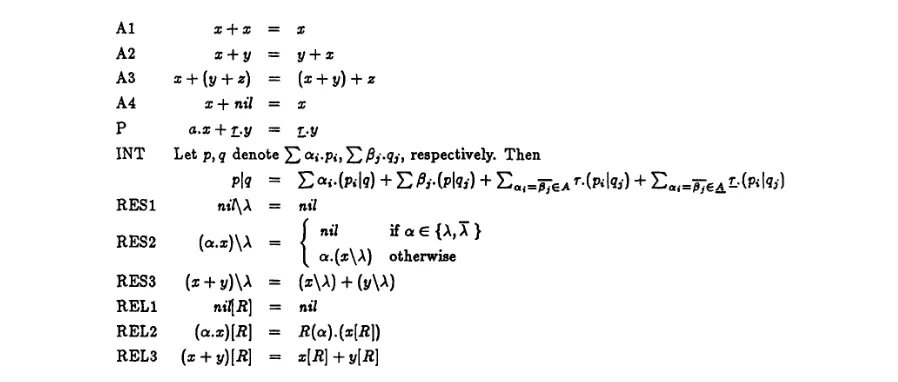
is symmetric. AssumeA 1 x + x = 2
A2 x + y = y + z A3 z + ( y + z ) = ( z + y ) + z A4 x + nil = x
nil
; ~ ~ E { x , X }
a.(z\X) otherwiseRES2 (...)\A =
RES3 ( z + y ) \ X = (%\A) +(y\X) RELl nil(R] = nil
REL2 (a.z)[R] = R(a).(z[R]) REL3 ( z + y ) [ R ] = z[R] + y [ R]
Figure 3: The equational characterisation of N for
CCS.
p
-:
q and pA
p’; we must show that there is a q’ such lation construction algorithms for deciding bisimulation equiv-that q alence [ll] may be adapted to our semantics.
Alternatively, there is a set of equivalence-preserving syn- tactic transformations based on the well-known ones for strong bisimulation equivalence [8]; these are listed in figure 3. The q’ and p‘
-,”
q‘. There are three cases.a =
a
EA and
p is patient. Then DP,t[p] is patient, and DP,,[p] f Dp,q[p’]. From the properties above it follows that DP,t[pl-%
DP,P[p’l, and this\A and [RI remain valid; however, the q‘ such that DP~Q[ql
-%
DP*q[q’l and DP,q[p’l -P DP*qlq’l* presence of 7 introduces the new law p. This is readily seen tothat there
is
a usual laws for+,
Again from the properties mentioned above, p’
-,”
q’, and it is easy t o establish that q&
q’.be satisfied by H because of the preemptive power GE 7. The
interleaving law from [8] also needs a slight modification be-
is
impatient. This case is routine because the cause of the presence of two kinds of synchronization actions, r and L this law appears in figure 3 as INT. Let E denote the set of equations in figure 3, and let p = E q mean that p can bea E A. Then P, and hence D P , q [ ~ ] , Dp,q[q] and q, muet transformed into q by application of the equations in E. The be patient. This implies that D , , [ p ]
4
D,,[p‘], and next theorem says that these equations completely characterizethere is therefope a q‘ such that Dp,q[q]
%
Dp,q[q‘] and the new finite terms* Dp,q(p’] -P Dptt[q‘], meaning that p’-,”
q’. Moreover, asTheorem
5.1 For finite CCS terms p, q, p H q if and only if DP,,,[q]-+
Dp,q[q’], by the above properties it must bethe case that q _(I_ q’.
a E
A
anddeprioritization in Dp,q[] has no effect.
L? ( 4
L? ( 3
LP., ( 4
= B q.
We
now consider proof rules for recursive terms. The de-0 velopment of the standard results is complicated somewhat by
the fact that the basic a priori moves,
3,
are defined by struc- tural induction on (open) terms instead of by the more usual inductive definition. This is necessary because the clauses in the definition of4
for the prioritization and deprioritiration5
Proof Techniques
In this section we briefly sketch the proof techniques we have
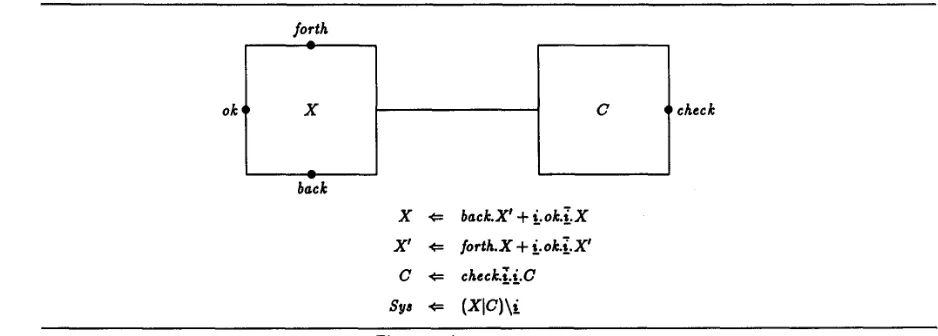
[image:5.623.73.522.99.290.2]forth
o k r i - r ! check
back
X
+=
back.X’+
i.0k.z.XX’ -e forth.X+ i.0k.z.X’
C
.e= check.&C [image:6.618.77.546.93.261.2]SYS -e (XlC)\i
Figure 4 A two-process system.
the more general case certain desirable properties of recursively
defined processes-such as f i ( z . t ) N t[fi(z.t)/z]-do not hold. called ‘unique fixed point induction.” This restriction, however, is a standard one adopted in the lit- Theorem 5.4
If
erature and is indeed a reasonable one. The relevant property of guarded expressions, which we leave to the reader to verify,
The final result we show is a form of induction that is often
then fiz(z.t).
is the following. Assume that z is guarded in t. Then,
6
Examples
t[u/z] 4 r r is t‘[u/z] and tJ
t’. (1)Another useful property, which is trivial to prove, is:
( p
5
r q5
r ) implies p N q . (2)More generally, let
R
be any bisimulation in the a priori se- mantics (P,+,
A c t ) . Then( p , q) E R implies p N q. (3)
This follows easily from the fact that such an R is also a bisim- dation in the actual operational semantics (P, M , A c t ) .
With these results we can derive many of the expected prop erties of the fixed point operator. The first states that f i ( z . t ) is indeed a fixed point of the equation z N t.
In this section we present two examples that illustrate the use-
fulness of our approach. The first example defines a system consisting of two processes: a process
X
that flips back and forth between two states and a process C that checks that the first process is running properly. The implementation of this rystem in our language appeam in figure 4.One desirable property of this system would be that each check action is followed by an ok, an acknowledgement that
X
is running. In pureCCS,
this is not the case; indeed, the (infinite) sequence of actionscheck back forth back forth
...
is possible, owing to the fact that
X
is not required to synchro- nise with C after C performs a check. In our framework, this cannot happen, since i is prioritized. In fact, it is the case thatTheorem 5.2 f i ( z . t ) z t[fiz(z.t)/z]. Sys N Spec,
It is possible to extend N t o open terms in a natural way. Let where spec is defined as a substitution a be a mapping from variables to
P,
and for aterm t let ta represent the obvious (closed) term. Then define
t H U to hold exactly when for all substitutions U , tu N ua.
The next result states that this extended H- behaves properly TO prove this, let SYS’=
(x’Ic)\i.
It suffices to show thatSpec
e
bac k.Spec’
+
c hec k.7. ok..r.Spec Spec’ forthSpec+
check.7.ok.L.Spec’.with respect to
fi
considered as an operator on terms.Theorem 6.S
If
t N U then f i ( 2 . t ) H fi(z.u). Sys’ = Spec’.sys = spec
Sys = [back.(X'IC)
+
i.((ok.z.X)IC)+
check.(Xl~.~.C)]\i by Int=
= back.[(X'IC)\d
+
back.[(X'IC)\d
+
check.[(Xll.i.C)\d by RES3, RES2 and A4check.[[back.(X'lz.i.C)
+
i.(
(ok.z.X)Ig.JC)+
z.(Xli.C)+
E.( (ok.z.X)li.C)]\A by INT [image:7.613.70.501.89.196.2]back.[(X'lC)\d
+
check.[z.((ok.z.X)Ii.C)\d
byP,
RES3, RES2 and A4 =Figure 5: A fragment of the proof that Sys = E Spec.
Using the unique fixed point rule, it is sufficient to show that
Sys = back.Sys
'+
chcck.z. ok.z.Sys Sya' = forth.Sys+
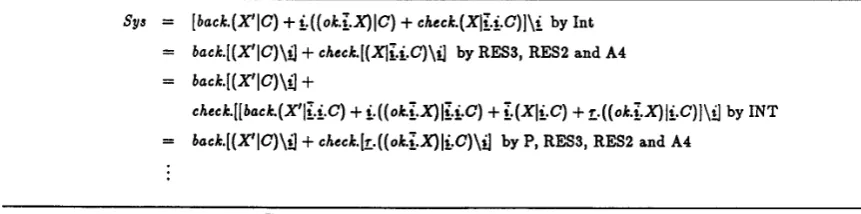
check.z.ok.Z.Sys'.Figure 5 contains a fragment of the proof of (4) using the ax-
ioms of figure 3 as rewrite rules. Readers familiar with similar- style proofs from [14] should have no trouble completing this proof.
The second example uses priorities in a slightly different fashion. Here we present a development of the alternating bit protocol [l] that is correct in pure
CCS
when the medium may lose messages but is incorrect when the medium is reliable. We show how the introduction of priorities resolves this anomaly. We should note that the use of priorities here is only partially successful. The inadequacy of the example is discussed more fully after its presentation, but the problem arises from the fact that only the prioritized internal move can preempt un- prioritized actions.The alternating bit protocol provides a means of ensuring reliable communication over half-duplex lines. In this pro- tocol, the sending and receiving processes alternate between two states in response to the receipt of messages (in the case of the receiving process) and acknowledgements (in the case of the sending process). Senders and receivers may also time
out while waiting for acknowledgements and messages, respec- tively. A full account of the protocol may be found in [l].
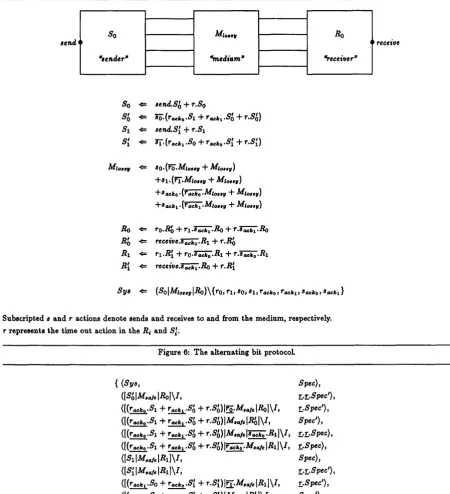
Figure 6 presents the development (in pure
CCS)
of the pro- tocol in the context of a lossy medium. It can be proven correct-
after every send action, the only next possible non-r action is a receiue, and vice versa, and the system does not deadlock (i.e. wind up in a state where no actions are possible).How-
ever, if we replace Mlorry with M,,je, a medium that does not lose messages, the protocol is no longer correct. Consider the definition ofMlafe.
Mraje
+
S0.K-Mra~e+
S1.K.MaajeSince every a-action is followed by an r-action, this medium delivers every message it receives for sending. With MIaje re-
placing Mlorry, however, Sys may deadlock; the state
is reachable via the sequence of actions
send r r r ,
and no actions are possible from chis state. Intuitively, this problem results from the fact that the receiver
&
can elect totime out (by executing its r action) even though a message is available for it t o receive from the medium.
Using prioritized actions, this situation can be prevented. By prioritizing all actions except the r actions in
SA,
Si,
Ro
and RI (the time-out actions), interactions with the medium that are possible are required to happen; the above state is therefore not reachable, and the protocol will behave correctly. In fact, one can prove that Sys H Spec, where Spec is definedas follows.
Spec
+
send.r.r.Spec'+ L.Spec Spec'+=
receive.r.r.Spec+
.r.Spec'Figure 7 presents a tabular representation of a relation whose symmetric closure is a bisimulation containing (Sya, Spec).
It is worth noting here that our implementation of the al- ternating bit protocol uses busy waiting. That is, So,
SI,
Rb
and Ri each offerJend
and receive actions in the context of 1-loops. It is certainly more natural to imagine implementing the protocol without this busy waiting; however, in this case, pri- oritizing all actions except the 7's corresponding to time-outs
Subscripted a and r actions denote sends and receives to and from the medium, respectively.
r represents the time out action in the Ri and Si.
[image:8.619.97.548.90.585.2] [image:8.619.103.551.428.641.2]receive
Figure 6: The alternating bit protocol.
Spec) 8
--
r.r.Spec'), .r.Spec'),
Spec'),
--
r.r.Spec),Spec) I
-
r.Spec) I--
r.r.Spec'),
-
r.Spec') I
Spec') I
--
r.r.Spec),-
r.Spec) }prioritized external (i.e. non-r] actions cannot ovemde non- prioritized actions. Thus, a process can time-out when the versions of SO,
SI
,
It$ andRi
without busy waiting offer asend
or rcceiug even though these actions are prioritised.This phenomenon merits more study; one idea to get around it would be to extend the language with a special type of pri- oritized actions having the preemptive power of E, This would imply that these special actions could not be restricted or de- prioritized, as otherwise
=!
would cease t o be a congruence. Nevertheless, such actions could play a useful role, for example, as the external actions used in specifications. In the example of the alternating bit protocol, if thesend
and receive actions were of this type the ploops representing busy waiting could be eliminated.7
Conclusions
In this paper we have developed an operational semantics for processes having actions that take priority over other ac- tions. Using the semantics as a
basis
we have developed a behavioural equivalence based on strong observational equiva- lence and shown that it is a congruence, and we have presented a complete axiomatization of the equivalence for finite terms and a development of proof rules for recursive proof rules. We have also developed several examples that show the usefulness of our approach.Much research remains to be done in order to show that our approach to priorities is indeed of general interest and a p plicability, We have already indicated that a process algebra with prioritked actions should also contain associated com- binators such as proritization and deprioritization and that certain other characteristics such as "strongly prioritized" ac- tions are desirable. In general, what is a reasonable set of new combinators? We would also like t o develop and axiomathe a weak observational equivalence or testing equivalence based on our semantics; the interaction of prioritization and abstraction from internal details may prove to be difficult. Another related line of research is t o examine the semantics of programming language constructs that incorporate notions of prioritiration, like those mentioned in the introduction.
An alternative approach to priorities in process algebras may be found in 12). There the emphasis is on equational reason- ing; more specifically, the authors examine the consistency of sets of equations obtained by adding to existing equational the- ories additional equations that the authors feel prioritisation
operators should satisfy. Their approach is purely algebraic in the sense that they do not give an operational semantics or behavioural equivalence that u n d e r k their theory.
References
[l] Bartlett, K.A., R.A. Scantlebury and
P.T.
Wilkinson."A
Note on Reliable Full-Duplex Transmission over Half- DuplexLinks." Communications of the ACMl2, n. 5, May 1969, pp. 260-261.[2) Baeten, J.C.M, J.A. Bergstra and J.W. Klop. "Syntaxand Defining Equations for an Interrupt Mechanism in Pro- cess Algebra." Technical Report CS-R8503, Department of Computer Science, Center for Mathematics and Com- puter Science, Amsterdam, February 1985.
[3] Bergstra, J.A., and J.W. Klop. "Process Algebra for Syn- chronous Communication." Information and Control 60, 1984, pp. 109-137.
[4] Brinksma, E. "A Tutorial on LOTOS." Proceedings of IFIP Workshop on Protocol Specification, Testing and
Verifieation
VI
M. Diaa, ed., pp. 73-84. North-Holland, Amsterdam, 1986.[5] Cleaveland, R. and
M.
Hennessy. "Priorities in Process Al- gebras." Technical Report 2/88, Department of Computer Science, University of Sussex, March 1988.[S] DeNicola, R. and M. Hennessy. "Testing Equivalences for Processes." Theoretical Computer Science 24, 1984, pp. 83-113.
(71 Harel, D. "Statecharts: A Visual Formalism for Complex Systems." Science of Computer Programming 8, 1987.
[8] Hennessy, M. and R. Milner. "Algebraic Laws for Nonde- terminism and Concurrency." Journal of the ACM 32, n. 1, January 1985, pp. 137-161.
191 Hoare, C.A.R. Communicating Sequential Processes. Prentice-Hall International, London, 1985.
LO] INMOS Limited. OCCAM Programming Manual. Prentice- Hall International, London, 1984.
1121 Milner, R. A Calculus of Communicating Systems. Lecture Notes in Computer Science 92. Springer-Verlag, Berlin, 1980.
(131 Milner, R. ‘A Complete Inference System for a Class of Regular Behaviours.” Journal of Computer and System Sciences 28, n. 3, June 1984, pp. 439-468.
[
141 Milner, R. “Calculi for Synchrony and Asynchrony.” The- oretical Computer Science 25, n. 3, July 1983, pp. 267-310.1151 Pnueli, A. ‘Linear and Branching Structures in the
S e
mantics and Logics of Reactive Systems.” Lecture Notes in Computer Science 194, pp. 14-32. Springer-Verlag, Berlin, 1985.[la]