Proceedings of SSST-5, Fifth Workshop on Syntax, Semantics and Structure in Statistical Translation, pages 21–30,
Semantic Mapping Using Automatic Word Alignment and Semantic Role
Labeling
Shumin Wu
Department of Computer Science University of Colorado at Boulder
Martha Palmer
Department of Linguistics Univerisity of Colorado at Boulder
Abstract
To facilitate the application of semantics in statistical machine translation, we propose a broad-coverage predicate-argument struc-ture mapping technique using automated re-sources. Our approach utilizes automatic syntactic and semantic parsers to gener-ate Chinese-English predicgener-ate-argument struc-tures. The system produced a many-to-many argument mapping for all PropBank argu-ment types by computing arguargu-ment similarity based on automatic word alignment, achieving 80.5% F-score on numbered argument map-ping and 64.6% F-score on all arguments. By measuring predicate-argument structure sim-ilarity based on the argument mapping, and formulating the predicate-argument structure mapping problem as a linear-assignment prob-lem, the system achieved 84.9% F-score us-ing automatic SRL, only 3.7% F-score lower than using gold standard SRL. The map-ping output covered 49.6% of the annotated Chinese predicates (which contains predicate-adjectives that often have no parallel annota-tions in English) and 80.7% of annotated En-glish predicates, suggesting its potential as a valuable resource for improving word align-ment and reranking MT output.
1 Introduction
As the demand for semantically consistent machine translation rises (Wu and Fung, 2009a), the need for a comprehensive semantic mapping tool has be-come more apparent. With the current architecture of machine translation decoders, few ways of in-corporating semantics in MT output include using
word sense disambiguation to select the correct tar-get translation (Carpuat and Wu, 2007) and reorder-ing/reranking MT output based on semantic con-sistencies (Wu and Fung, 2009b) (Carpuat et al., 2010). While a comprehensive semantic mapping tool can supplement or improve the results of such techniques, there are many other exciting ideas we can explore: with automatic SRL, we can improve coverage (and possibly accuracy) of Chinese seman-tic class generation (Wu et al., 2010) by running the system on a large, unannotated parallel corpus. Us-ing predicate-argument mappUs-ings as constraints, it may be possibly to improve SRL output by perform-ing joint inference of SRL in source and target lan-guages simultaneously, much like what Burkett and Klein (2008) was able to achieve with syntactic pars-ing.
As the foundation of many machine translation decoders (DeNeefe and Knight, 2009), word align-ment has continuously played an important role in machine translation. There have been several at-tempts to improve word alignment, most of which have focused on tree-to-tree alignments of syntac-tic structures (Zhang et al., 2007; Mareˇcek, 2009a). Our hypothesis is that the predicate-argument struc-ture alignments can abstract away from language specific syntactic variation and provide a more ro-bust, semantically coherent alignment across sen-tences.
tated in parallel PropBank-ed corpora, we attempt to map automatically generated predicate-argument structures. For each Chinese and English verb pred-icate pairs within a parallel sentence, we exam-ine the quality of both the predicate and argument alignment (using GIZA++ word alignment output) and devise a many-to-many argument mapping tech-nique. From that, we pose predicate-argument map-ping as a linear assignment problem (optimizing the total similarity of the mapping) and solve it with the Kuhn-Munkres method (Kuhn, 1955). With this approach, we were able to incur only a small predicate-argument F-score degradation over using manual PropBank annotation. The output also pro-vides much more fine-grained argument mapping that can be used for downstream MT applications.
2 Related work
Our basic approach to semantic mapping is similar to the idea of semantic similarity based on triangu-lation between parallel corpora outlined in Resnik (2004) and Madnani et al. (2008a; 2008b), but is implemented here quite differently. It is most sim-ilar in execution to the work of (Mareˇcek, 2009b), which improves word alignment by aligning tec-togrammatical trees in a parallel English/Czech cor-pus. The Czech corpus is first lemmatized because of the rich morphology, and then the word alignment is “symmetrized”. However, this approach does not explicitly make use of the predicate-argument struc-ture to confirm the alignments or to suggest new ones.
Pad´o and Lapata (2005; 2006) used word align-ment and syntax based argualign-ment similarity to project English FrameNet semantic roles to German. The approach relied on annotated semantic roles on the source side only, precluding joint inferenece of the projection using reference or automatic target side semantic roles.
Fung et al. (2007) demonstrated that there is poor semantic parallelism between Chinese-English bilingual sentences. Their technique for im-proving Chinese-English predicate-argument map-ping (ARGChinese,i 7→ ARGEnglish,j) consists of matching predicates with a bilingual lexicon, com-puting cosine-similarity (based on lexical transla-tion) of arguments and tuning on an unannotated
parallel corpus. The system differs from ours in that it only provided one-to-one mapping of num-bered arguments and may not be able to detect predicate mapping with no lexical relations that are nevertheless semantically related. Later, Wu and Fung (2009b) used parallel semantic roles to im-prove MT system outputs. Given the outputs from Moses (Koehn et al., 2007), a machine translation decoder, they reordered the outputs based on the best predicate-argument mapping. The resulting system showed a 0.5 point BLEU score improvement even though the BLEU metric often discounts improve-ment in semantic consistency of MT output.
Choi et al. (2009) (and later Wu et al. (2010)) showed how to enhance Chinese-English verb align-ments by exploring predicate-argument structure alignment using parallel PropBanks. The result-ing system showed improvement over pure GIZA++ alignment. Those two systems differs from ours in that they operated on gold standard parses and semantic roles. The systems also did not pro-vide explicit argument mapping between the aligned predicate-argument structures.
3 Resources
To perform automatic semantic mapping, we need an annotated corpus to evaluate the results. In addi-tion, we also need a word aligner, a syntactic parser, and a semantic role labeler (as well as annotated and unannotated corpora to train each system).
3.1 Corpus
3.2 Word Alignment
We chose GIZA++ (Och and Ney, 2003) as our word alignment tool primarily because of its popularity, though there are other alternatives like Lacoste-Julien et al. (2006).
3.3 Phrase Structure Parsing
We chose the Berkeley Parser (Petrov and Klein, 2007) for phrase structure parsing since it has been tested on both English and Chinese corpora and can be easily retrained.
3.4 Semantic Role Labeling
For semantic role labeling (SRL), we built our own system using a fairly standard approach: SRL is posed as a multi-class classification problem requir-ing the identification of argument candidates for each predicate and their argument types. Typi-cally, argument identification and argument label-ing are performed in two separate stages because of time/resource constraints during training/labeling. For our system, we chose LIBLINEAR (Fan et al., 2008), a library for large linear classification prob-lems, as the classifier. This alleviated the need to separate the identification and labeling stages: argu-ment identification is trained simply by incorporat-ing the “NOT-ARG” label into the training data.
Most the of the features used by the classifier are standard features found in many SRL systems; these include:
Predicate predicate lemma and its POS tag
Voice indicates the voice of the predicate. For En-glish, we used the six heuristics detailed by Igo (2007), which detects both ordinary and reduced passive constructions. For Chinese, we simply detected the presence of passive in-dicator words (those with SB, LB POS tags) amongst the siblings of the predicate.
Phrase type phrase type of the constituent
Subcategorization phrase structure rule expanding the predicate parent
Head word the head word and its POS tag of the constituent
Parent head word whether the head word of the parent is the same as the head word of the con-stituent
Position whether the constituent is before or after the predicate
Path the syntactic tree path from the predicate to the constituent (as well as various path general-ization methods)
First word first word and its POS tag of the con-stituent
Last word last word and its POS tag of the con-stituent
Syntactic frame the siblings of the constituent
Constituent distance the number of potential con-stituents with the same phrase type between the predicate and the constituent
We also created many bigrams (and a few trigrams) of the above features.
By default, LIBLINEAR uses the one-vs-all ap-proach for multi-class classification. This does not always perform well for some easily confusable class labels. Also, as noted by Xue (2004), cer-tain features are strong discriminators for argument identification but not for argument labeling, while the reverse is true for others. Under such condi-tions, mixing arguments and non-arguments within the same class may produce sub-optimal results for a binary classifier. To address these issues, we built a pairwise multi-class classifier (using simple major-ity voting) on top of LIBLINEAR.
The resulting English SRL system, evaluated using the CoNLL 2005 methodology, achieved a 77.3% F-score on the WSJ corpus, comparable to the leading system (Surdeanu and Turmo, 2005) us-ing a sus-ingle parser output. The Chinese SRL system, on the other hand, achieved 74.4% F-score on the triple-gold Xinhua corpus (similar but not directly comparable to Wu et al. (2006) and Xue (2008) because of differences in TreeBank/PropBank revi-sions as well as differences in test set).
4 Predicate-arguments mapping
4.1 Argument mapping
4.1.1 Predicate-dependent argument mapping Theoretically, PropBank numbered arguments are supposed to be consistent across predicates: ARG0
typically denotes the agent of the predicate and
ARG1 the theme. While this consistency may hold true for predicates in the same language, as Fung et al. (2007) noted, this is not a reliable indicator when mapping predicate-arguments between Chinese and English. For example, when comparing the Prop-Bank frames of the English verbarriveand the syn-onymous Chinese verb抵达, we seeARG1(entity in motion) forarrive.01 is equivalent toARG0(agent) of 抵达.01 while ARG4 (end point, destination) is equivalent toARG1(destiny).
4.1.2 Many-to-many argument mapping Just as there are shortcomings in assuming pred-icate independent argument mappings, assuming one-to-one argument mapping may also be overly restrictive. For example, in the following Chinese sentence:
大 通道 建设 搞搞搞活活活了大 西南的 物流 big passage construction invigorated big southwest’s material flow
the predicate搞活(invigorate) has 2 arguments:
• ARG0: 大 通道 建设 (big passage construc-tion)
• ARG1: 大 西南 的物流 (big southwest’s ma-terial flow)
In the parallel English sentence:
Construction of the main passage hasactivatedthe flow of materials in the great southwest activatehas 3 arguments:
• ARG0:construction of the main passage
• ARG1:the flow of materials
• ARGM-LOC:in the great southwest
In these parallel sentences,ARG1of搞活should be mapped to bothARG1andARGM-LOCofactivate.
While the English translation of搞活,invigorate, is not a direct synonym ofactivate, they at least have some distant relationship as indicated by sharing the inherited hypernymmakein the WordNet (Fell-baum, 1998) database. The same cannot be said for all predicate-pairs. For example, in the following parallel sentence fragments:
街上 客流 如如如 潮
on the street peopleflow like the tide
the Chinese predicate-argument structure for 如(like) is:
• ARG0:客流(flow of guests)
• ARG1:潮(tide)
• ARGM-LOC:街上(on the street)
while the English predicate-argument structure for
flowis:
• ARG1:people
• ARGM-LOC:on the street
• ARGM-MNR:like the tide
Semantically, the predicate-argument pairs are equivalent. The argument mapping, however, is more complex:
• 如.ARG0⇐⇒flow.ARG1,flow.V
• 如.V,如.ARG1⇐⇒flow.ARGM-MNR
• 如.ARGM-LOC⇐⇒flow.ARGM-LOC
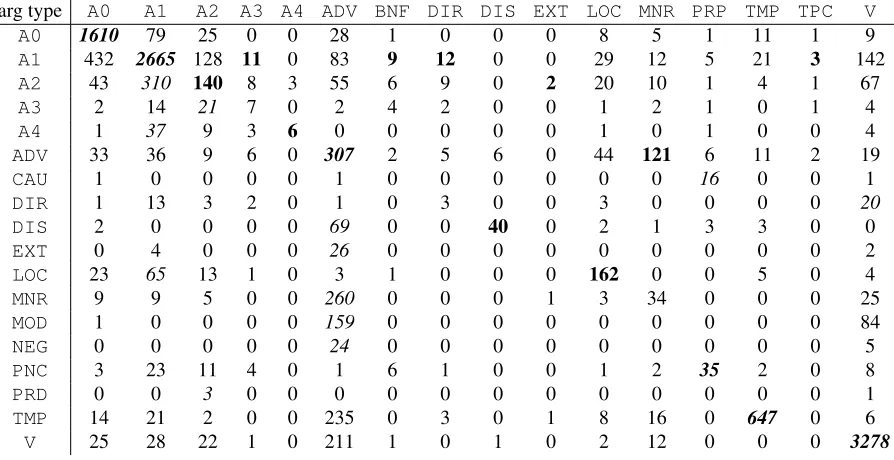
Table 1 details the argument mapping for the triple-gold Xinhua data. The mapping distribution forARG0andARG1is relatively deterministic (and similar to ones found by Fung et al. (2007)). Map-pings involving ARG2-5 and modifier arguments, on the other hand, are much more varied. Typically, when there is a many-to-many argument mapping, it’s constrained to a one-to-two or two-to-one map-ping. Much more rarely is there a case of a two-to-two or even more complex mapping.
4.2 Word alignment based argument mapping
To achieve optimal mappings between parallel predicate-argument structure, we would like to max-imize the number of words in the mapped argument set (over the entire set of arguments) while minimiz-ing the number of unaligned words in the mapped argument set.
arg type A0 A1 A2 A3 A4 ADV BNF DIR DIS EXT LOC MNR PRP TMP TPC V A0 1610 79 25 0 0 28 1 0 0 0 8 5 1 11 1 9 A1 432 2665 128 11 0 83 9 12 0 0 29 12 5 21 3 142 A2 43 310 140 8 3 55 6 9 0 2 20 10 1 4 1 67 A3 2 14 21 7 0 2 4 2 0 0 1 2 1 0 1 4 A4 1 37 9 3 6 0 0 0 0 0 1 0 1 0 0 4 ADV 33 36 9 6 0 307 2 5 6 0 44 121 6 11 2 19 CAU 1 0 0 0 0 1 0 0 0 0 0 0 16 0 0 1 DIR 1 13 3 2 0 1 0 3 0 0 3 0 0 0 0 20 DIS 2 0 0 0 0 69 0 0 40 0 2 1 3 3 0 0 EXT 0 4 0 0 0 26 0 0 0 0 0 0 0 0 0 2 LOC 23 65 13 1 0 3 1 0 0 0 162 0 0 5 0 4 MNR 9 9 5 0 0 260 0 0 0 1 3 34 0 0 0 25 MOD 1 0 0 0 0 159 0 0 0 0 0 0 0 0 0 84 NEG 0 0 0 0 0 24 0 0 0 0 0 0 0 0 0 5 PNC 3 23 11 4 0 1 6 1 0 0 1 2 35 2 0 8 PRD 0 0 3 0 0 0 0 0 0 0 0 0 0 0 0 1 TMP 14 21 2 0 0 235 0 3 0 1 8 16 0 647 0 6 V 25 28 22 1 0 211 1 0 1 0 2 12 0 0 0 3278
Table 1: Chinese argument type (column) to English argument type (row) mapping on triple-gold Xinhua corpus
language sentence. We define precision as the frac-tion of aligned target words in the mapped argument set:
Pc,I =
|(∪i∈Imape(ac,i))∩(∪j∈JWe,j)|
|∪i∈Imape(ac,i)|
(1)
and recall as the fraction of source words in the mapped argument set:
Rc,I = P
i∈I|Wc,i| P
∀i|Wc,i|
(2)
We then chooseAc,I that optimizes the F1-score of
PcandRc:
Ac,I = arg max I
2·Pc,I·Rc,I
Pc,I+Rc,I
=Fc,I (3)
Finally, to constrain both source and target argument set, we optimize:
Ac,I, Ae,J = arg max I,J
2·Fc,I·Fe,J
Fc,I+Fe,J
=FIJ (4)
To measure similarity between a single pair of source, target arguments, we define:
Pij =
|mape(ac,i)∪Wj|
|mape(ac,i)|
, Rij =
|mapc(ae,j)∪Wi|
|mapc(ae,j)| (5)
To generate the set of argument mapping pairs, we simply choose all pairs of ac,i, ae,j ∈ Ac,I, Ae,J whereFij ≥( >0).
Directly optimizing equation 4 requires exhaus-tive search of all argument set combinations between the source and target, which is NP-complete. While the typical number of arguments for each predicate is relatively small, this is nevertheless inefficient. We performed the following greedy-based approx-imation with quadratic complexity:
1. Compute the best (based on F-score of equa-tion 5) pair of source-target argument mappings for each source argument (target argument may be reused)
2. Select the remaining argument pair with the highest F-score
3. Insert the pair inAc,I, Ae,J if it increasesFIJ, else discard
4. repeat until all argument pairs are exhausted
5. repeat 1-4 reversing the source and target direc-tion
6. merge the output of the 2 directions
4.3 One-to-one predicate-argument mapping
To find the best predicate-argument mapping be-tween Chinese and English parallel sentences, we assume each predicate in a Chinese or English sen-tence can only map to one predicate in the target sentence. As noted by Wu et al. (2010), this as-sumption is mostly valid for the Xinhua news cor-pus, though occasionally, a predicate from one sen-tence may align more naturally to two predicates in the target sentence. This typically occurs with verb conjunctions. For example the Chinese phrase “观 光 旅游” (sightseeing and tour) is often translated to the single English verb “travel”. As noted by Xue and Palmer (2009), the Chinese PropBank annotates predicative adjectives, which tend not to have an equivalent in the English PropBank. Additionally, some verbs in one language are nominalized in the other. This results in a good portion of Chinese or English predicates in parallel sentences not having an equivalent in the other language.
With the one-to-one mapping constraint, we op-timize the mapping by maximizing the sum of the F1-scores (as defined by equation 4) of the predi-cates and arguments in the mapping. LetPC andPE denote the sets of predicates in Chinese and English respectively, withG(PC, PE) ={g:PC 7→PE}as the set of possible mappings between the two predi-cate sets, then the optimal mapping is:
g∗= arg max g∈G
X
i,j∈g
FCi,Ej (6)
To turn this into a classic linear assignment problem, we define Cost(PCi, PEj) = 1−FCi,Ej, and (6)
becomes:
g∗= arg min g∈G
X
i,j∈g
Cost(PC,i, PE,j) (7)
(7) can be solved in polynomial time with the Kuhn-Munkresalgorithm (Kuhn (1955)).
5 Experimental setup
5.1 Reference predicate-argument mapping
To generate reference predicate-argument map-pings, we ran the mapping system described in sec-tion 4.2 with a cutoff threshold of FCi,Ej < 0.65
(i.e., alignments with F-score below 0.65 are dis-carded). We reviewed a small random sample of the
output and found it to have both high precision and recall, with only occasional discrepancies caused by possible word alignment errors. If one-to-one argu-ment mapping is imposed, the reference predicate-argument mapping will lose 8.2% of the alignments. For mappings using automatic word alignment, we chose a cutoff threshold ofFCi,Ej <0.15. This can
easily be tuned for higher precision or recall based on application needs.
5.2 Parser, SRL, GIZA++
We trained the Berkeley parser and our SRL sys-tem on Ontonotes 4.0, excluding the triple-gold Xin-hua sections as well as the non-English or Chinese sourced portion of the corpus. GIZA++ was trained on 400K parallel Chinese-English sentences from various sources with the default parameters. For the word mapping functions mape(ac), mapc(ae) in equation 5, instead of taking the word align-ment intersection of the source-target and target-source directions as Pad´o and Lapata (2006), we used the two alignment outputs seperately (using the Chinese-English output when projecting Chinese ar-gument to English words, and vice versa). On av-erage (from the 400K corpus), an English sentence contains 28.5% more tokens than the parallel Chi-nese sentence (even greater at 36.2% for the Xinhua portion). Taking either the intersection or union will significantly affect recall or precision of the align-ment.
6 Results
6.1 Semantic role labeling
signifi-language type P R F1
Chinese
CoNLL 77.9% 71.1% 74.4% oracle 100% 92.6% 96.1% word match 84.8% 74.6% 79.4%
English
[image:7.612.75.295.71.171.2]CoNLL 75.6% 68.4% 71.8% oracle 100% 91.1% 95.2% word match 82.7% 69.4% 75.5%
Table 2: SRL results on triple-gold Xinhua corpus. “arg match” is the standard CoNLL 2005 evaluation metric, “oracle” is the oracle SRL based on automatic parser out-put, and “word match” is scoring based on length of ar-gument overlap with the reference
cantly worse isARG0 (almost 10% F-score lower). This is likely caused by dropped pronouns in Chi-nese sentences (Yang and Xue, 2010), making it harder for both the syntactic and semantic parsers to identify the correct subject.
We also report the SRL result scored at word level instead of at argument level (79.4% F-score for Chi-nese and 75.5% for English). The CoNLL 2005 shared task scoring (Surdeanu and Turmo, 2005) discounts arguments that are not a perfect word span match, even if the system output is semantically close to the reference argument. While this is im-portant in some applications of SRL, for other ap-plications like improving word alignment with SRL, improving recall on approximate arguments may be a better trade-off than having high precision on per-fectly matched arguments. We noticed that while overall improvement in SRL improves both word level and argument level performance, for other-wisely identical systems, we can slightly favor word level performance (up to 1-3% F-score) by includ-ing positive traininclud-ing samples that are not a perfect argument match.
6.2 Predicate-argument mapping
Table 3 details the results of Chinese-English predicate-argument mapping. Using automatic SRL and word alignment, the system achieved an 84.9% F-score, only 3.7% F-score less than using gold stan-dard SRL annotation. When looking at only ar-guments, however, the differences are larger: au-tomatic SRL based output produced an 80.5% F-score for core arguments. While this compares fa-vorably to Fung et al. (2007)’s 72.5% (albeit with
Evaluation gold P R F1 predicate- yes 88.7% 88.5% 88.6%
argument no 84.6% 85.3% 84.9%
A0-5label yes 97.8% 96.2% 97.0% no 87.0% 74.9% 80.5%
A0-5span no 67.9% 57.9% 62.5%
all arg label yes 84.0% 79.3% 81.6% no 70.3% 59.8% 64.6%
all arg span no 61.6% 52.2% 56.5%
Table 3: Predicate-argument mapping results
different sections of the corpus), it’s 16.5% F-score lower than gold SRL based output. When including all arguments, automatic SRL based output achieved 64.6% while the gold SRL based output achieved 81.6%. This indicates that the mapping result for all arguments is limited by errors in word alignment. We also report the results of automatic SRL on both producing the correct argument mappings and word spans (62.5% for core arguments and 56.5% for all arguments). This may be relevant for applications such as joint inference between word alignment and SRL.
We also experimented with discriminative (reweighing) word alignment based on part-of-speech tags of the words to improve the mapping system but were not able to achieve better results. This may be due to the top few POS types account-ing for most of the words in a language, therefore it did not prove to be a strong discriminator.
6.3 Mapping coverage
Table 4 provides predicate and word coverage de-tails of the predicate-argument mapping, another potentially relevant statistic for applications of predicate-argument mapping. High coverage of predicates and words in the mappings may provide more relevant constraints to help reorder MT output or rerank word alignment. We expect labeling En-glish nominalized predicate-arguments will help in-crease both predicate and word coverage in the map-ping output.
[image:7.612.319.536.72.200.2]output type language coverage
triple-gold
predicate Chinese 50.0% predicate English 81.3% word Chinese 66.0% word English 64.2%
automatic
predicate Chinese 49.6% predicate English 80.7% word Chinese 57.4% word English 55.4%
Table 4: Predicate-argument mapping coverage. Predi-cate coverage denotes the number of mapped prediPredi-cates over all predicates in the corpus, word coverage denotes the number of words in the mapped predicate-arguments over all words in the corpus
language PropBank appeared appeared verb framesets in corpus in mapping Chinese 16122 8591 7109
[image:8.612.78.293.72.198.2]English 5473 3689 3121
Table 5: Frameset coverage on the 400K parallel sentence corpus
SRL found 1.6 million Chinese predicate instances and 1.3 million English predicate instances. The mapping system found around 700K predicate-pairs (withFC,E < 0.3). Table 5 shows the number of unique verbs in the corpus and contained in the map-ping results within the Chinese and English Prop-Bank verb framesets. The corpus also included some verbs that do not appear in PropBank framesets.
7 Conclusion and future work
We proposed a broad-coverage predicate-argument mapping system using automatically generated word alignment and semantic role labeling. We also provided a competitive Chinese and English SRL system using a LIBLINEAR classifier and pair-wise multi-class classification approach. By explor-ing predicate-argument structure, the mappexplor-ing sys-tem is able to generate mappings between seman-tically similar predicate-argument structures con-taining non-synonymous predicates, achieving an 84.9% F-score, only 3.7% lower than the F-score of gold-standard SRL based mappings. Utilizing word alignment information, the system was able to provide detailed many-to-many argument
map-pings (occurs in 8.2% of the reference mapmap-pings) for core arguments and modifier arguments, achiev-ing an 80.5% F-score for core arguments and 64.6% F-score for all arguments.
While our experiment with discriminative word alignment based on POS tags did not show improve-ment, there are other word grouping/weighing met-rics like n-gram based clustering, verb classification, term frequency, that may be more appropriate for se-mantic mapping. With the advent of a predicate-argument annotation resource for nominalization, Ontonotes 5, we plan to update our SRL system to produce nominalized predicate-arguments. This would potentially increase the predicate-argument mapping coverage in the corpus as well as increasing the accuracy of mapping (by reducing the number of unmappable predicate-arguments), making the map-ping more useful for downstream applications.
We are also experimenting with a probabilis-tic approach to predicate-argument mapping to im-prove the robustness of mapping against word align-ment errors. Using the output of the current sys-tem on a large corpus, we can establish mod-els forp(prede|predc), p(arge|predc, prede, argc) and refine them through iterations of expectation-maximization. If this approach shows promise, the next step would be to explore integrating the map-ping model directly into GIZA++ for joint inference of word alignment and predicate-argument mapping. Other statistical translation specific applications we would like to explore include extensions of MT out-put reordering (Wu and Fung, 2009b) and rerank-ing usrerank-ing predicate-argument mapprerank-ing, as well as predicate-argument projection onto the target lan-guage as an evaluation metric for MT output.
Acknowledgement
References
David Burkett and Dan Klein. 2008. Two languages are better than one (for syntactic parsing). InProceedings of the Conference on Empirical Methods in Natural Language Processing, EMNLP ’08, pages 877–886, Stroudsburg, PA, USA. Association for Computational Linguistics.
Marine Carpuat and Dekai Wu. 2007. Improving sta-tistical machine translation using word sense disam-biguation. InThe 2007 Joint Conference on Empirical Methods in Natural Language Processing and Compu-tational Natural Language Learning (EMNLP-CoNLL 2007), pages 61–72.
Marine Carpuat, Yuval Marton, and Nizar Habash. 2010. Improving arabic-to-english statistical machine trans-lation by reordering post-verbal subjects for align-ment. In Proceedings of the ACL 2010 Conference Short Papers, ACLShort ’10, pages 178–183.
Jinho D. Choi, Martha Palmer, and Nianwen Xue. 2009. Using parallel propbanks to enhance word-alignments. InProceedings of ACL-IJCNLP workshop on Linguis-tic Annotation (LAW‘09), pages 121–124.
Steve DeNeefe and Kevin Knight. 2009. Synchronous tree adjoining machine translation. InProceedings of the 2009 Conference on Empirical Methods in Natural Language Processing (EMNLP’09), volume 2, pages 727–736.
R.-E. Fan, K.-W. Chang, C.-J. Hsieh, X.-R. Wang, and C.-J. Lin. 2008. Liblinear: A library for large linear classification. Journal of Machine Learning Research, 9:1871–1874.
Christiane Fellbaum. 1998. WordNet: An Electronic Lexical Database. MIT Press.
Pascale Fung, Zhaojun Wu, Yongsheng Yang, and Dekai Wu. 2007. Learning bilingual semantic frames: Shal-low semantic parsing vs. semantic role projection. In 11th Conference on Theoretical and Methodological Issues in Machine Translation, pages 75–84.
Eduard Hovy, Mitchell Marcus, Martha Palmer, Lance Ramshaw, and Ralph Weischedel. 2006. Ontonotes: The 90 In Proceedings of HLT-NAACL 2006, pages 57–60.
Sean Paul Igo. 2007. Identifying reduced passive voice constructions in shallow parsing environments. Mas-ter’s thesis, University of Utah.
Philipp Koehn, Hieu Hoang, Alexandra Birch, Chris Callison-Burch, Marcello Federico, Nicola Bertoldi, Brooke Cowan, Wade Shen, Christine Moran, Richard Zens, Chris Dyer, Ondrej Bojar, Alexandra Con-stantin, and Evan Herbst. 2007. Moses: Open source toolkit for statistical machine translation. In Proceed-ings of the Annual Meeting of the Association for Com-putational Linguistics (ACL’07), demonstration ses-sion, pages 177–180.
Harold W. Kuhn. 1955. The hungarian method for the assignment problem. Naval Research Logistics Quar-terly, 2:83–97.
Simon Lacoste-Julien, Ben Taskar, Dan Klein, and Michael I. Jordan. 2006. Word alignment via quadratic assignment. In Proceedings of the main conference on Human Language Technology Confer-ence of the North American Chapter of the Associa-tion of ComputaAssocia-tional Linguistics, HLT-NAACL ’06, pages 112–119, Stroudsburg, PA, USA. Association for Computational Linguistics.
Nitin Madnani, Philip Resnik, Bonnie Dorr, and Richard Schwartz. 2008a. Applying automatically generated semantic knowledge: A case study in machine trans-lation. In NSF Symposium on Semantic Knowledge Discovery, Organization and Use.
Nitin Madnani, Philip Resnik, Bonnie Dorr, and Richard Schwartz. 2008b. Are multiple reference translations necessary? investigating the value of paraphrased ref-erence translations in parameter optimization. In Pro-ceedings of the 8th Conference of the Association for Machine Translation in the Americas (AMTA’08). David Mareˇcek. 2009a. Improving word alignment
us-ing alignment of deep structures. In Proceedings of the 12th International Conference on Text, Speech and Dialogue, pages 56–63.
David Mareˇcek. 2009b. Using tectogrammatical align-ment in phrase-based machine translation. In Proceed-ings of WDS 2009 Contributed Papers, pages 22—27. Franz Josef Och and Hermann Ney. 2003. A system-atic comparison of various statistical alignment mod-els. Computational Linguistics, 29(1):19–51.
Sebastian Pad´o and Mirella Lapata. 2005. Cross-linguistic projection of role-semantic information. In Proceedings of the conference on Human Language Technology and Empirical Methods in Natural Lan-guage Processing, HLT ’05, pages 859–866, Strouds-burg, PA, USA. Association for Computational Lin-guistics.
Sebastian Pad´o and Mirella Lapata. 2006. Optimal constituent alignment with edge covers for semantic projection. In Proceedings of the 21st International Conference on Computational Linguistics and the 44th annual meeting of the Association for Computational Linguistics, ACL-44, pages 1161–1168, Stroudsburg, PA, USA. Association for Computational Linguistics. Slav Petrov and Dan Klein. 2007. Improved inference
for unlexicalized parsing. InIn HLT-NAACL ’07. Philip Resnik. 2004. Exploiting hidden meanings: Using
Mihai Surdeanu and Jordi Turmo. 2005. Semantic role labeling using complete syntactic analysis. In Pro-ceedings of CoNLL-2005 shared task, pages 221–224. Dekai Wu and Pascale Fung. 2009a. Can semantic role labeling improve smt? In Proceedings of the 13th Annual Conference of the EAMT, pages 218–225, Barcelona, Spain.
Dekai Wu and Pascale Fung. 2009b. Semantic roles for smt: A hybrid two-pass model. InProceedings of the North American Chapter of the Association for Com-putational Linguistics - Human Language Technolo-gies (NAACL-HLT’09), pages 13–16.
Zhaojun Wu, Yongsheng Yang, and Pascale Fung. 2006. C-assert: Chinese shallow semantic parser. http://hlt030.cse.ust.hk/research/ c-assert/.
Shumin Wu, Jinho D. Choi, and Martha Palmer. 2010. Detecting cross-lingual semantic similarity using par-allel propbanks. In Proceedings of the 9th Confer-ence of the Association for Machine Translation in the Americas.
Nianwen Xue and Martha Palmer. 2009. Adding se-mantic roles to the chinese treebank. Nat. Lang. Eng., 15(1):143–172.
Nianwen Xue. 2004. Calibrating features for semantic role labeling. InProceedings of EMNLP 2004, pages 88–94.
Nianwen Xue. 2008. Labeling chinese predicates with semantic roles. Computational Linguistics, 34(2):225–255.
Yaqin Yang and Nianwen Xue. 2010. Chasing the ghost: recovering empty categories in the chinese treebank. In Proceedings of the 23rd International Conference on Computational Linguistics: Posters, COLING ’10, pages 1382–1390, Stroudsburg, PA, USA. Association for Computational Linguistics.