Summarizing Search Results using PLSI
Jun Harashima∗and Sadao Kurohashi Graduate School of Informatics
Kyoto University Yoshida-honmachi, Sakyo-ku,
Kyoto, 606-8501, Japan
{harashima,kuro}@nlp.kuee.kyoto-u.ac.jp
Abstract
In this paper, we investigate generating a set of query-focused summaries from search results. Since there may be many topics related to a given query in the search results, in order to summarize these results, they should first be clas-sified into topics, and then each topic should be summarized individually. In this summarization process, two types of redundancies need to be reduced. First, each topic summary should not contain any redundancy (we refer to this prob-lem as redundancy within a summary). Second, a topic summary should not be similar to any other topic summary (we refer to this problem as redundancy be-tween summaries). In this paper, we focus on the document clustering pro-cess and the reduction of redundancy be-tween summaries in the summarization process. We also propose a method using PLSI to summarize search results. Eval-uation results confirm that our method performs well in classifying search re-sults and reducing the redundancy be-tween summaries.
1 Introduction
Currently, the World Wide Web contains vast amounts of information. To make efficient use of this information, search engines are indispens-able. However, search engines generally return *Research Fellow of the Japan Society for the Promotion of Science (JSPS)
only a long list containing the title and a snip-pet of each of the retrieved documents. While such lists are effective for navigational queries, they are not helpful to users with informational queries. Some systems (e.g., Clusty1) present
keywords related to a given query together with the search results. It is, however, difficult for users to understand the relation between the key-words and the query, as the keykey-words are merely words or phrases out of context. To solve this problem, we address the task of generating a set of query-focused summaries from search results to present information about a given query using natural sentences.
Since there are generally many topics re-lated to a query in the search results, the task of summarizing these results is one of, so to speak, multi-topic multi-document tion. Studies on multi-document summariza-tion typically address summarizing documents related to a single topic (e.g., TAC2). However
we need to address summarizing documents re-lated to multiple topics when considering the summarization of search results.
To summarize documents containing multiple topics, we first need to classify them into top-ics. For example, if a set of documents related to swine flucontains topics such as the outbreaks of swine flu, the measures to treatswine flu, and so on, the documents should be divided into these topics and summarized individually. Note that a method for soft clustering should be employed in this process, as one document may belong to several topics.
In the summarization process, two types of redundancies need to be addressed. First, each topic summary should not contain any redun-dancy. We refer to this problem as redun-dancy within a summary. This problem is well known in the field of multi-document summa-rization (Mani, 2001) and several methods have been proposed to solve it, such as Maximum Marginal Relevance (MMR) (Goldstein et al., 2000) (Mori et al., 2004), using Integer Lin-ear Programming (ILP) (Filatova and Hatzivas-siloglou, 2004) (McDonald, 2007) (Takamura and Okumura, 2009), and so on.
Second, no topic summary should be similar to any of the other topic summaries. We re-fer to this problem as redundancy between sum-maries. For example, to summarize the above-mentioned documents related to swine flu, the summary for outbreaks should contain specific information about outbreaks, whereas the sum-mary for measures should contain specific infor-mation about measures. This problem is char-acteristic of multi-topic multi-document summa-rization. Some methods have been proposed to generate topic summaries from documents (Radev and Fan, 2000) (Haghighi and Vander-wende, 2009), but to the best of our knowledge, the redundancy between summaries has not yet been addressed in any study.
In this paper, we focus on the document clus-tering process and the reduction of redundancy between summaries in the summarization pro-cess. Furthermore, we propose a method using PLSI (Hofmann, 1999) to summarize search re-sults. In the proposed method, we employ PLSI to estimate the membership degree of each doc-ument to each topic, and then classify the search results into topics using this information. In the same way, we employ PLSI to estimate the mem-bership degree of each keyword to each topic, and then extract the important sentences spe-cific to each topic using this information in order to reduce the redundancy between summaries. The evaluation results show that our method per-forms well in classifying search results and suc-cessfully reduces the redundancy between sum-maries.
D D
z
Sz
Sz’
[image:2.595.298.508.107.156.2]W Dz’
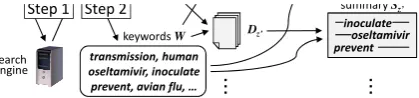
Figure 1: Overview of the proposed method.
2 Proposed Method
2.1 Overview
Figure 1 gives an overview of the proposed method, which comprises the following four steps.
Step 1. Acquisition of Search Results Using a
search engine, obtain the search results for a given query.
Step 2. Keyword Extraction Extract the
key-words related to the query from the search results using the method proposed by Shi-bata et al. (2009).
Step 3. Document Clustering Estimate the
membership degree of each document to each topic using PLSI, and classify the search results into topics.
Step 4. Summarization For each topic,
gener-ate a summary by extracting the important sentences specific to each topic from each document cluster.
In the following subsections, we describe each step in detail.
2.2 Step 1. Acquisition of Search Results First, we obtain the search results for a given query using a search engine. To be more precise, we obtain the topN0documents of the search en-gine results. Next, we remove those documents that should not be included in the summarization, such as link collections, using a simple filtering method. For example, we regard any document that has too many links as a link collection, and remove it.
2.3 Step 2. Keyword Extraction
We extract the keywords related to a query from D using the method proposed by Shibata et al. (2009), which comprises the following four steps.
Step 2-1. Relevant Sentence Extraction For
each document inD, extract the sentences containing the query and the sentences around the query as relevant sentences.
Step 2-2. Keyword Candidate Extraction For
each relevant sentence, extract compound nouns and parenthetic strings as keyword candidates.
Step 2-3. Synonymous Candidate Unification Find the paraphrase pairs and the ortho-graphic variant pairs in the keyword candidates, and merge them.
Step 2-4. Keyword Selection Score each
key-word candidate, rank them, and select the bestMas the keywords related to the query. In this paper, we write W to denote the ex-tracted keywords.
2.4 Step 3. Document Clustering
We classifyDinto topics using PLSI. In PLSI, a document dand a word w are assumed to be conditionally independent given a topic z, and the joint probabilityp(d, w)is calculated as fol-lows.
p(d, w) =∑ z
p(z)p(d|z)p(w|z) (1)
p(z), p(d|z), andp(w|z) are estimated by max-imizing the log-likelihood functionL, which is calculated as
L=∑ d
∑
w
f req(d, w) logp(d, w), (2)
where f req(d, w) represents the frequency of word w in document d. L is maximized using the EM algorithm, in which the E-step and M-step are given below.
E-step
p(z|d, w) = ∑p(z)p(d|z)p(w|z)
z0p(z0)p(d|z0)p(w|z0) (3)
M-step
p(z) = ∑
d∑wf req(d, w)p(z|d, w) ∑
d∑wf req(d, w)
(4)
p(d|z) = ∑
wf req(d, w)p(z|d, w) ∑
d0∑wf req(d0, w)p(z|d0, w) (5)
p(w|z) = ∑
df req(d, w)p(z|d, w) ∑
d∑w0f req(d, w0)p(z|d, w0) (6)
The EM algorithm iterates through these steps until convergence.
First, we give PLSI the number of topics K, the search results D, and the keywords W as input, and estimate p(z), p(d|z), and p(w|z), wherezis a topic related to the query,dis a doc-ument inD, andwis a keyword inW. There is, however, no way of knowing the value ofK; that is, we do not know in advance how many topics related to the query there are in the search results. Hence, we perform PLSI for several values ofK, and select theK that has the minimum Akaike Information Criterion (AIC) (Akaike, 1974), cal-culated as follows.
AIC =−2L+ 2K(N +M) (7)
Furthermore, we selectp(z),p(d|z), andp(w|z) estimated using the selectedK as the result of PLSI.
Next, we calculate the membership degree of each document to each topic. The membership degree of documentdto topicz, denotedp(z|d), is calculated as
p(z|d) = ∑p(d|z)p(z) z0p(d|z0)
. (8)
Finally, for each topic, we collect those docu-ments whose membership degree to the topic is larger than the threshold α. If there is a docu-ment whose membership degree to multiple top-ics is larger than the threshold, we classify the document into each topic.
In this paper,Dz denotes the documents clas-sified into topicz.
2.5 Step 4. Summarization
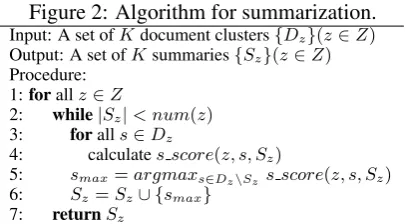
Figure 2: Algorithm for summarization. Input: A set ofKdocument clusters{Dz}(z∈Z)
Output: A set ofKsummaries{Sz}(z∈Z)
Procedure: 1:forallz∈Z
2: while|Sz|< num(z)
3: foralls∈Dz
4: calculates score(z, s, Sz)
5: smax=argmaxs∈Dz\Sz s score(z, s, Sz)
6: Sz=Sz∪ {smax}
7: returnSz
cluster. Figure 2 gives the algorithm for sum-marization. When we generate the summarySz for topicz, we calculate the importance of sen-tencesto topic z, denoted ass score(z, s, Sz), for each sentence inDz(lines 3-4). Then we ex-tract the sentence smax with the maximum im-portance as an important sentence, and include smax in Sz (lines 5-6). When we extract the next important sentence, we recalculate the im-portance s score(z, s, Sz) for each sentence in Dz except the sentence in Sz (lines 3-4). Then we extract the sentencesmaxwith the maximum importance as an important sentence, and add smaxtoSz(lines 5-6). We continue this process until the number of important sentences compos-ing the summary, denoted|Sz|, reaches the num-ber of important sentences extracted for topicz, denotednum(z)(line 2).
s score(z, s, Sz)is calculated as follows:
s score(z, s, Sz)
= ∑
w∈Ws
(
w score(z, w)×c score(w, Sz, s) )
(9)
[image:4.595.76.280.74.186.2]whereWsrepresents the keywords in sentences. w score(z, w)is a function to reduce the re-dundancy between summaries, and represents the importance of keywordwto topicz. We can use the probability ofwgivenz, denotedp(w|z), as thew score(z, w). This approach fails, how-ever, because if there are keywords with a high probability in both topic zand another topicz0, the sentences containing such keywords are ex-tracted as the important sentences in both top-ics, and it follows that the generated summaries will contain redundancy. To solve this problem, we use the membership degree of keyword w
Table 1: Values ofc score(w, Sz, s).
wis wis not
contained inSz contained inSz
wis the subject ofs 2 -2
otherwise 0 1
to topic z, denoted p(z|w), as w score(z, w). We use p(z) and p(w|z) estimated using PLSI in Section 2.4 to calculatep(z|w).
p(z|w) = ∑p(w|z)p(z)
z0p(w|z0) (10)
Keywords with high probability in several topics should have a low membership degree to each topic. Thus, usingp(z|w)as thew score(z, w) prevents extracting sentences containing such keywords as important sentences, and it follows that the similarity between the summaries is re-duced. Furthermore, the keywords which are specific to a topic are supposed to have a high membership degree to that topic. Thus, using p(z|w)asw score(z, w) makes it easier to ex-tract sentences containing such keywords as im-portant sentences, and with the result that each summary is specific to the particular topic.
Finally, using p(z) we determine the number of important sentences extracted for topicz, de-noted asnum(z).
num(z) = {
bI×p(z)c (p(z)≥β)
Imin (p(z)< β) (11)
where I represents the parameter that controls the total number of important sentences ex-tracted for each topic. The higher the probability a topic has, the more important sentences we ex-tract. Note that no matter how lowp(z) is, we extract at leastIminimportant sentences.
3 Experiments
3.1 Overview
To evaluate the proposed method, we recruited 48subjects, mainly IT workers, and asked them to fill in a questionnaire. We prepared a sys-tem implemented according to our method, and asked the subjects to use our system to evaluate the following four aspects of our method.
• Validity of the number of topics
• Precision of document clustering
• Degree of reduction in redundancy between summaries
• Effectiveness of the method for presenting
information through summaries
We allowed the subjects to create arbitrary queries for our system.
3.2 System
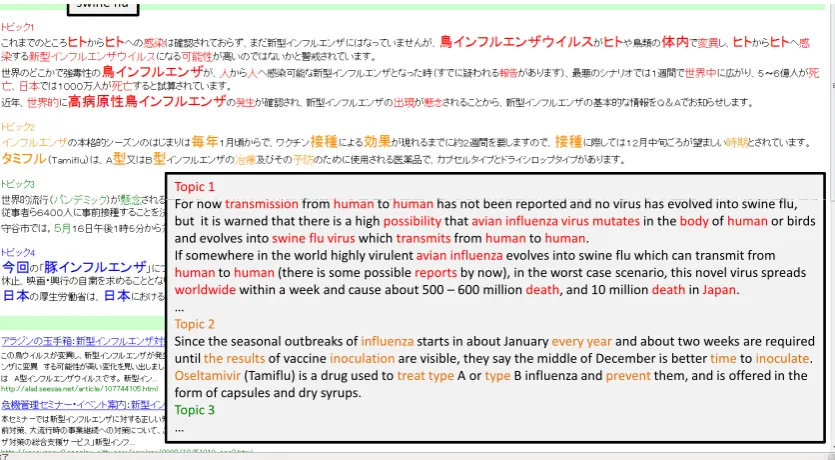
Figure 3 shows the system results for the query swine flu. Our system presents a separate sum-mary for each topic related to a given query. In Fig.3, the colored words in the summaries are keywords specific to each topic. If a user clicks on a keyword, the system presents a list of doc-uments containing that keyword at the bottom of the browser.
The configuration of our system was as fol-lows. In the acquisition process, the system ob-tained the search results for a given query us-ing the search engine TSUBAKI (Shinzato et al.,
2008b). SettingN0 = 1,000, we obtained the top 1,000 documents in the search results for the query. In the keyword extraction process, we set M = 100, and extracted 100 keywords related to the query from the search results. In the document clustering process, we performed PLSI for K = 3,4,5, and selected theK with the minimum AIC. We set the initial value of p(z) = 1/K, and the initial values of p(d|z) andp(w|z)to random values. The EM algorithm continued until the increase inLreached just be-low1to achieve convergence. We setα= 1/K. In the summarization process, we set I = 10, since the number of important sentences able to be presented in a browser is about 10. We set Imin = 2andβ = 0.2, and extracted at least two important sentences, even ifp(z)was very low.
3.3 Validity of the Number of Topics
First, we investigated how well the proposed method determined the number of topics. In our method, the number is determined using AIC. Ideally, we should have manually counted the topics in the search results, and compared this with the number determined using AIC. It was, however, difficult to count the topics, because the search results contained1,000documents. Fur-thermore, it was impossible to count the number of topics for each query given by each subject. Thus, in this investigation, we simply asked the subjects whether they felt the number of topic summaries presented to them was appropriate or not, and investigated our method in terms of us-ability.
!"" # $"" " % &
'
( % )
*
+ ,
-.
[image:6.595.81.499.106.336.2]&
[image:6.595.72.283.416.481.2]Figure 3: System results for the queryswine flu.
Table 2: Validity of the number of topics. options # subjects ( % ) (a) definitely too many 0 ( 0.0) (b) somewhat too many 3 ( 6.3)
(c) acceptable 29 (60.4)
(d) somewhat too few 11 (22.9) (e) definitely too few 5 (10.4)
3.4 Precision of Document Clustering Second, we investigated how precisely the pro-posed method classified the search results into topics. To be more precise, we evaluated the re-liability of the membership degree p(z|d) used in the document clustering process. It is gen-erally difficult to evaluate clustering methods. In our case, we did not have any correct data and could not even create these since, as men-tioned previously, the number of topics is not known. Furthermore, it is not possible to classify by hand search results containing 1,000 docu-ments. Consequently, we did not evaluate our method directly by comparing correct data with the clustering result from our method, but instead
evaluated it indirectly by investigating the relia-bility of the membership degreep(z|d) used in the document clustering process.
The evaluation process was as follows. First, we presented the subjects with a document d, which was estimated by our system to have a high membership degree to a topic z. Strictly speaking, we selected as d, a document with a membership degree of about0.9. Next, we pre-sented two documents to the subjects. One was a document d0 whose membership degree to z was also about0.9, and another was a document d00 whose membership degree to z was about 0.1. Finally, we asked them which document was more similar tod3.
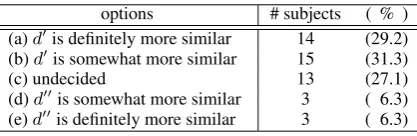
Table 3 gives the results. According to this ta-ble,60.5%of the subjects saidd0was more simi-lar or somewhat more simisimi-lar. On the other hand, only 12.6% of the subjects said d00 was more similar or somewhat more similar. We see from these results that the ability to recognize topics in our system is in agreement to some extent with
3Naturally, we did not tell them that d0 had a similar
Table 3: Precision of the estimationp(z|d). options # subjects ( % ) (a)d0is definitely more similar 14 (29.2)
(b)d0is somewhat more similar 15 (31.3)
(c) undecided 13 (27.1)
(d)d00is somewhat more similar 3 ( 6.3)
(e)d00is definitely more similar 3 ( 6.3)
the subjects’ ability for recognizing topics; that is, our method was able to estimate a reliable membership degreep(z|d). Thus, it seems that our method usingp(z|d)is able to classify search results into topics to some extent.
3.5 Degree of Reduction in Redundancy between Summaries
Third, we investigated how well the proposed method reduced the redundancy between sum-maries. To be more precise, we used three mea-sures as w score(z, w) to generate summaries and investigated which measure generated the least redundant summaries. Generally, meth-ods for reducing redundancy are evaluated using ROUGE (Lin, 2004), BE (Hovy et al., 2005), or Pyramid (Nenkova and Passonneau, 2004). However, the use of these methods require that ideal summaries are created by humans, and this was not possible for the same reason as men-tioned previously. Thus, we did not perform a direct evaluation using the methods such as ROUGE, but instead evaluated how well our method performed in reducing redundancy be-tween summaries using the membership degree p(z|w)asw score(z, w).
The evaluation process was as follows. We used three measures asw score(z, w), and gen-erated three sets of summaries.
Summaries A This set of summaries was
[image:7.595.81.290.91.159.2] [image:7.595.304.514.106.301.2]gen-erated using df idf(w) as w score(z, w), with df idf(w) calculated as ldf(w) × log(100million/gdf(w)), ldf(w) repre-senting the document frequency of keyword w in the search results, and gdf(w) rep-resenting the document frequency of key-word w in the TSUBAKI document col-lection (Shinzato et al., 2008a) comprising about 100 million documents.
Table 4: Comparison of df idf(w), p(w|z) and p(z|w).
options # subjects ( % ) (a) B is definitely less redundant 5 (10.4) (b) B is somewhat less redundant 16 (33.3)
(c) undecided 15 (31.3)
(d) A is somewhat less redundant 6 (12.5) (e) A is definitely less redundant 6 (12.5) options # subjects ( % ) (a) C is definitely less redundant 16 (33.3) (b) C is somewhat less redundant 14 (29.2)
(c) undecided 6 (12.5)
(d) A is somewhat less redundant 8 (16.7) (e) A is definitely less redundant 4 ( 8.3) options # subjects ( % ) (a) C is definitely less redundant 15 (31.3) (b) C is somewhat less redundant 8 (16.7)
(c) undecided 10 (20.8)
(d) B is somewhat less redundant 6 (12.5) (e) B is definitely less redundant 9 (18.8)
Summaries B This set of summaries was
gen-erated usingp(w|z)asw score(z, w).
Summaries C This set of summaries was
gen-erated usingp(z|w)asw score(z, w).
We then presented the subjects with three pairs of summaries, namely a pair from A and B, a pair from A and C, and a pair from B and C, and asked them which summaries in each pair was less redundant4.
The results are given in Tables 4. Firstly, ac-cording to the comparison of A and B and the comparison of A and C, A was more redundant than B and C. The value of df idf(w) to key-word w was the same for all topics. Thus, us-ingdf idf(w)asw score(z, w)made summaries redundant, as each summary tended to contain the same keywords with highdf idf(w). On the other hand, as the value of p(w|z) and p(z|w) were dependent on the topic, the summaries gen-erated using these measures were less redundant. Second, the comparison of B and C shows that 48.0% of the subjects considered C to be less redundant or somewhat less redundant. p(w|z) was a better measure thandf idf(w), but even us-ingp(w|z)generated redundancy between sum-4Naturally, we did not tell them which summaries were
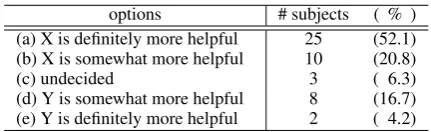
Table 5: Comparison of summaries and keywords. options # subjects ( % ) (a) X is definitely more helpful 25 (52.1) (b) X is somewhat more helpful 10 (20.8)
(c) undecided 3 ( 6.3)
(d) Y is somewhat more helpful 8 (16.7) (e) Y is definitely more helpful 2 ( 4.2)
maries. Because common keywords to a query have high p(w|z) for several topics, sentences containing these keywords were extracted as the important sentences for those topics, and thus the summaries were similar to one another. On the other hand, the keywords’ value for p(z|w) was low, allowing us to extract the important sentences specific to each topic usingp(z|w)as w score(z, w), thereby reducing the redundancy between summaries.
3.6 Effectiveness of the Method for Presenting Information Using Summaries
We also investigated the effectiveness of the method for presenting information through sum-maries. We asked the subjects to compare two different ways of presenting information and to judge which way was more effective in terms of usefulness for collecting information about a query. One of the methods presented the search results with topic summaries generated by our system (method X), and while the another method presented the search results with the key-words included in each topic summary (method Y).
Table 5 gives the results. 72.9%of the sub-jects considered the method using summaries to be more effective or somewhat more effective. From these results, it appears that the method of presenting information through summaries is ef-fective in terms of usefulness for collecting in-formation about a query.
4 Conclusion
In this paper, we focused on the task of gen-erating a set of query-focused summaries from search results. To summarize the search results for a given query, a process of classifying them
into topics related to the query was needed. In the proposed method, we employed PLSI to es-timate the membership degree of each document to each topic, and then classified search results into topics using this metric. The evaluation re-sults showed that our method estimated reliable degrees of membership. Thus, it seems that our method is able to some extent to classify search results into topics.
In the summarization process, redundancy within a summary and redundancy between sum-maries needs to be reduced. In this paper, we fo-cused on the reduction of the latter redundancy. Our method made use of PLSI to estimate the membership degree of each keyword to each topic, and then extracted the important sentences specific to each topic using this metric. The eval-uation results showed that our method was able to reduce the redundancy between summaries us-ing the membership degree.
In future, we will investigate the use of more sophisticated topic models. Although our method detected the topics related to a query us-ing a simple topic model (i.e., PLSI), we be-lieve that more sophisticated topic models such as LDA (Blei et al., 2003) allow us to improve our method.
References
Akaike, Hirotugu. 1974. A new look at the statis-tical model identification. IEEE Transactions on Automation Control, 19(6):716–723.
Blei, David M., Andrew Y. Ng, and Michael I. Jor-dan. 2003. Latent Dirichlet Allocation. Journal of Machine Learning Research, 3:993–1022. Filatova, Elena and Vasileios Hatzivassiloglou. 2004.
A formal model for information selection in multi-sentence text extraction. InProceedings of COL-ING 2004, pages 397–403.
Goldstein, Jade, Vibhu Mittal, Jaime Carbonell, and Mark Kantrowitz. 2000. Multi-document summa-rization by sentence extraction. InProceedings of ANLP/NAACL 2000 Workshop on Automatic Sum-marization, pages 40–48.
Hofmann, Thomas. 1999. Probabilistic latent se-mantic indexing. InProceedings of SIGIR 1999, pages 50–57.
Hovy, Eduard, Chin-Yew Lin, and Liang Zhou. 2005. Evaluating duc 2005 using basic elements. In Pro-ceedings of DUC 2005.
Lin, Chin-Yew. 2004. Rouge: A package for au-tomatic evaluation of summaries. InProceedings of ACL 2004 Workshop on Text Summarization Branches Out, pages 74–81.
Mani, Inderjeet. 2001. Automatic Summarization. John Benjamins Publishing Company.
McDonald, Ryan. 2007. A study of global inference algorithms in multi-document summarization. In
Proceedings of ECIR 2007, pages 557–564.
Mori, Tatsunori, Masanori Nozawa, and
Yoshi-aki Asada. 2004. Multi-answer-focused
multi-document summarization using a question-answering engine. In Proceedings of COLING 2004, pages 439–445.
Nenkova, Ani and Rebecca Passonneau. 2004. Eval-uating content selection in summarization: The pyramid method. InProceedings of NAACL-HLT 2004.
Radev, Dragomir R. and Weiguo Fan. 2000. Auto-matic summarization of search engine hit lists. In
Proceedings of ACL 2000 Workshop on Recent ad-vances in NLP and IR, pages 1361–1374.
Shibata, Tomohide, Yasuo Bamba, Keiji Shinzato, and Sadao Kurohashi. 2009. Web information or-ganization using keyword distillation based clus-tering. In Proceedings of WI 2009, pages 325– 330.
Shinzato, Keiji, Daisuke Kawahara, Chikara Hashimoto, and Sadao Kurohashi. 2008a. A large-scale web data collection as a natural lan-guage processing infrastructure. In Proceedings of LREC 2008, pages 2236–2241.
Shinzato, Keiji, Tomohide Shibata, Daisuke Kawa-hara, Chikara Hashimoto, and Sadao Kurohashi. 2008b. TSUBAKI: An Open Search Engine In-frastructure for Developing New Information Ac-cess Methodology. In Proceedings of IJCNLP 2008, pages 189–196.