ISSN Online: 2162-2442 ISSN Print: 2162-2434
DOI: 10.4236/jmf.2019.93016 Aug. 9, 2019 272 Journal of Mathematical Finance
Application of Linear Programming in
Optimizing Labour Scheduling
Osama Yaseen M. Al-Rawi, Taniya Mukherjee
General Sciences Department, College of Engineering, Gulf University, Sanad, Kingdom of Bahrain
Abstract
Employee or labor scheduling is associated with assigning an appropriate number of workers to the jobs during each day of work. It requires deter-mining when staff members will work and when part-time, full-time workers will be needed to work. It is obvious that the number of employees wanted on duty throughout the week may fluctuate depending on health or family issues of the labor and the employer’s requirement for a particular job; Scheduling forces us to systematically identify and analyze about all the tasks that need to be done on a project, the expected time each task might take, the expected requirement of the workforce for the job in terms of size and quality of em-ployee personnel and the expected labor expenses. As the availabilities of the employees may vary and change from week to week; hence the scheduling becomes more essential for the smooth running of a project or shift. This pa-per focuses on a constructive method for solving Labor Scheduling problem encountered in a construction company, suggesting an estimated labor cost over a week and the requirement of part-time labors in each shift, using linear programming techniques, thus, providing a logical way to organize these tasks and produce a new schedule each week, by the virtue of the changing demand for service while minimizing labor cost and maximizing labor prefe-rences.
Keywords
Optimization, Linear Programming, Staff Scheduling, Complex Scheduling Problem, Business
1. Introduction
Employee scheduling problems are commonly faced in the service industry [1] [2] which include the scheduling of nurses in hospitals [3][4][5][6], scheduling
How to cite this paper: Al-Rawi, O.Y.M. and Mukherjee, T. (2019) Application of Linear Programming in Optimizing Labour Scheduling. Journal of Mathematical Finance, 9, 272-285.
https://doi.org/10.4236/jmf.2019.93016 Received: May 18, 2019
Accepted: August 6, 2019 Published: August 9, 2019 Copyright © 2019 by author(s) and Scientific Research Publishing Inc. This work is licensed under the Creative Commons Attribution International License (CC BY 4.0).
DOI: 10.4236/jmf.2019.93016 273 Journal of Mathematical Finance
of staffs in the hotel, check encoders in banks [7], airline [8][9], and hotel res-ervation personnel, telephone operators, patrol officers, scheduling of waiter or waitresses in the restaurants, scheduling of laborers in the construction company and others. In a construction company, the scheduling process helps the con-tractor to formulate an overview of how the project is going to be laid. Detailed planning of schedule is prepared before execution starts in an area.
In their simplest form, the Scheduling which is a classic operation research problem provides the contractor with structured planning process while they are reviewing the plans and figuring out the sequence for building the project or the assignment of days-off, as in some of the less complex settings for the scheduling of nurses.
In a service organization or in a Construction company the front-line manag-ers or contractors have to perform the important task of cost-effective labour scheduling. Serving the customers need, at a reasonable price requires a proper forecast of labour requirement. At any given time, having an inadequate number of employees or employees lacking the necessary job-skills—can result in subs-tandard customer service; exasperated, overworked employees; and delay in completion of the project and lost sales. On the other hand, having excessive number of employees will increase: 1) the labour cost, 2) will reduce the operat-ing margins, when extra hours are scheduled, or 3) from the employee's point of view will lower their morale and hamper job satisfaction if the working hours of the employees are fewer than they desire because the available work is spread thinly among many employees. Thus, labour or workforce scheduling is the process of balancing customer demand with employee work requests without compromising much on profitability.
2. Literature Review
There has been a lot of research on the various aspects of staff scheduling and rostering [1][10]. Since this area has become increasingly important due to the business becoming more service oriented and cost-conscious in a global envi-ronment. Hence extensive Literature on Personnel scheduling [11] [12] [13], general workforce planning problems [14] and so on. are available. To trace the induction of staff scheduling and rostering we look into Edie's work on traffic delays at toll booths [15]. Since then, the application of scheduling of staff and rostering methods to transportation systems such as airlines [8] [9] [16] [17] [18] and railways [19][20], health care systems [3][4][6], emergency services such as police [21], ambulance and fire brigade, call centers [22][23][24][25], and many other service organizations such as hotels, restaurants and retail stores
[26][27] have increased manifold. This has led the foundation of focused studies and surveys on the scheduling objective models [12][28][29] [30] constraints
DOI: 10.4236/jmf.2019.93016 274 Journal of Mathematical Finance
mathematical models using efficient optimal [5][33] or heuristic algorithms [34] [35][36] has taken place.
In some research, the study was concentrated in the adaptation and applica-tion of convenapplica-tional mathematical programming on workforce planning prob-lem such as linear programming [13], mixed linear programming [3][26][29]
constraint programming [25] [30] [37] [38] mixed integer programming ap-proach [17][20] [27][37] [39][40] [41][42] decomposition method [37][43]
branch and bound techniques[44], dynamic programming [45], goal program-ming [46] approaches in which the weighted coverage and shift satisfaction terms were given importance in the objective function. The constraints enforc-ing strict rules to be observed on shifts were discussed as well [30]. While some focus their study on iterative algorithms [10][47]. The key problems related to staff/employee scheduling in different application area has been analyzed to ob-tain an optimal solution. From the research done in construction companies, it has been found that labor costs contribute for a large proportion of total project costs, i.e. in a way it can be concluded that labor cost is the major direct cost component in most of the companies. Though in construction areas or in indus-trial organizations most of the employee or workforce scheduling deals with full-time workers but now part-time employees [48] [49] are also extensively compensating the labor requirement. Research [32] [50], in this sector, shows that there are three types of problems namely, days off scheduling, shift sche-duling [23][51][52], and tour schedule. Days off scheduling is related to the as-signment of workers work and non-work days over the planning horizon. How-ever, shift scheduling problem deals with determining the actual shifts (start and end times, breaks, etc.) in a planning horizon. And Tour scheduling problems combine features of both days off and shift scheduling. Here, it is to be noted that typically, work shifts are assigned to cover the daily demand for each shift, and each worker’s days off schedule are taken care of. In the research literature of many key papers related to this area, integration of project task scheduling and staff scheduling has been studied and attempts were made to provide solu-tions. The objective in those papers was the determination of the number of staffs required on each day, based on proper scheduling of tasks, which would result in the minimization of the overall cost. Also in some papers research work was reported in the scheduling of engineers to carry out a variety of jobs located at different places where the main objectives were to maximize the amount of work done while minimizing the amount of time that gets wasted while trans-porting workers between locations [53]. Thus, enough researches regarding var-ious aspects of labor or employee scheduling in varvar-ious service sectors have in-itiated the research of my paper.
3. Problem Formulation
DOI: 10.4236/jmf.2019.93016 275 Journal of Mathematical Finance
maximizing the laborer’s preferences and requests without hampering the project schedule and ensuring equal distribution of workload between all the available laborers. In these cases, work constraints or the working hours of the laborers are according to the contracts and the laws of the Ministry of labor.
Constraints commonly occurring with Employee Scheduling Problems can be divided into; hard constraints and soft constraints.
Hard constraints are defined to be those which usually include coverage re-quirements (for example, labour demand per day per shift type per skill catego-ry) while soft constraints are usually, those which involved with time require-ments on personal schedules. Our purpose is to schedule resources to meet the hard constraints while maintaining a high-quality result with respect to soft constraints.
However, the constraints [31][32] commonly applicable to labor scheduling relates to:
1) Requirement of skilled labors in each shift.
2) Consecutive same working shift (minimum/maximum/exact number). 3) Shift type(s) assignments (maximum shift type, requirements for each shift types).
4) Maximum number of consecutive working days. 5) The minimum amount of leisure time between two shifts. 6) Days off (In the Middle East Friday is a day off).
7) A maximum number of hours worked.
8) No consecutive shifts are allowed for a particular labor.
4. Application Area
In a construction company when we are estimating for a particular the job we look for some vital information on the steps of production, an indication of what materials we need, when we need, the current cost of the materials, Whether the labor drivers are time variant or time-invariant, Determine the time interval for tracking the time variant labor drivers, an indication of how long the job will take, and any an unwanted situation which may affect the completion of the job. Tracking such records will give us an indication of how much labors we will need. In case, the work falls behind the permissible time, we may need more workers to complete the job within the assured schedule, as two employees have varying skills or desire to work the same number of hours and possibly avoid larger financial loss from penalization. The manager also needs to abide by gov-ernment regulations, company policies, and contractual obligations. In a typical problem of this type, the scheduler needs to emphasize on appropriate days off to each of a number of employees who work standard shifts with different start times while assuring that the required number of employees are on duty throughout the day and week.
DOI: 10.4236/jmf.2019.93016 276 Journal of Mathematical Finance
international investors have been lined up to enhance the country’s business and lifestyle. In a country like Bahrain, with Major construction projects like Expan-sion of Bahrain International Airport, investment in power and water projects, Gulf rail line development, the construction sector in Bahrain is expected to contribute a huge growth in real GDP. The proper finishing of projects is de-pendent on the scheduling process of laborers. And the goal in many researches was to produce support tools to lessen the need for manual construction of La-bor distribution.
In a construction company, it is to be noted that the available labor is distri-buted into DIRECT LABOUR and INDIRECT LABOUR.
DIRECT LABOUR is related to the skilled labor operating machines and whose absence may affect the working in an operation site. However INDIRECT LABOUR is employees who are not directly related to the operation of ma-chines.
5. Structure of Linear Programming Model
Generally, all LP problems [3][17][29][31][32] have these three properties in common:
1) OBJECTIVE FUNCTION: The objective function of an LPP (Linear Pro-gramming Problem) is a mathematical representation of the objective in terms of a measurable quantity such as profit, cost, revenue, etc.
Optimize (Maximize or Minimize) Z =a x a x a x1 1+ 2 1+ 3 3++an nx . In most of the typical form, we look for maximizing the profit. However, in labor sche-duling problem we look for minimizing Labor Cost.
2) CONSTRAINTS: The restrictions or constraints in an equation limit the degree to which we can pursue our objective.
1 1 2 1 3 3 n n 1
a x a x a x+ + + + a x ≤b
where a a a1, , , ,2 3 an are parameters that contributes to decision variables. 3) DECISION VARIABLES: The various activities within the linear equation are represented by x x x1, , , ,2 3 xn is known as decision variables.
Therefore, LP means to maximize or minimize a quantity (the objective func-tion) subject to limited resources (the constraints). It is desirable to express the objective and constraints in linear programming problems in terms of linear eq-uations or inequalities.
6. Assumptions in a Linear Programming Problem
Certainty
All LP models are based on the assumption that all the model parameters such as availability of resources, profit (or cost) contribution of a unit of decision va-riable and consumption of resources by a unit of decision, the vava-riable are known and constant.
Divisibility (Continuity)
DOI: 10.4236/jmf.2019.93016 277 Journal of Mathematical Finance
generally used to represent the solution values of the decision variables and re-sources. However, in some cases, Integer programming method may be em-ployed depending on the desirability of only integer variables are solutions.
Additivity
The sum of the contributions (Profit or Cost) earned from each of the deci-sion variables and the sum of the resources used by each decideci-sion variable should be equal to the value of the objective function for the assigned values of the decision variables and the accumulated sum of the available resources used, respectively. Thus, it is to be accepted that an objective function is the direct sum of the individual contributions of the different variables.
GENERAL MATHEMATICAL MODEL FOR LPP
Optimize (Maximize or Minimize) Z C X C X= 1 1+ 2 2+ + C Xn n Subject to constraints,
(
)
(
)
(
)
(
)
11 1 12 2 1
21 1 22 2 2
31 1 32 2 3
1 1 2 2
1 2 3 n n n n n n
m m mn n m
c x c x c x c x c x c x c x c x c x
c x c
b b
x c x b b ≤ ≥ + + + + + + + + + + + ≤ ≥ ≤ + ≥ ≤ ≥
and x x1, , ,2 xn >0.
Steps followed for formulating Linear Programming model [3][17][20]
Identifying and defining the decision variable of the given problem. Defining the objective function.
Stating the constraints to which the objective function needs to be optimized (i.e. Maximization or Minimization).
Adding the non-negative constraints.
Non-negative values have a physical interpretation; however negative values of the decision variables lack valid physical interpretation.
7. Results
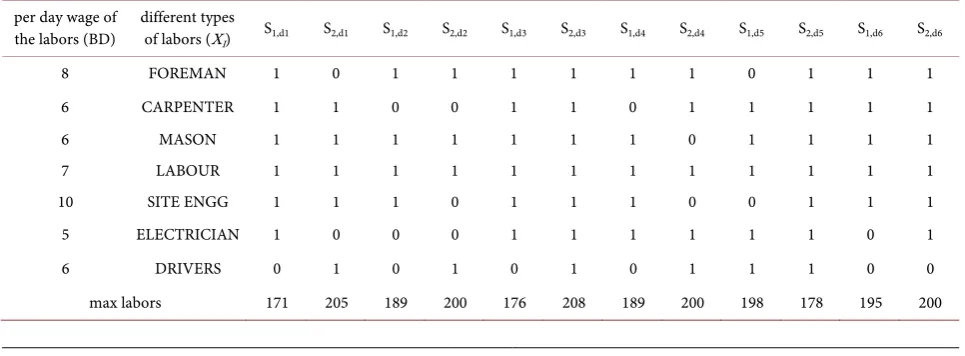
Labor Scheduling aim is to allocate the sufficient number of staffs for each des-ignated task while minimizing Labor cost. Reconstruction of the schedule with available staff is usually simple, however changing the schedule may lead to ad-justments to other Job schedules as well. This is the daily report of the require-ment of different categories of manpower for a particular job to be done on a particular shift in a day in a construction company (1, 0) represents the availa-bility of that particular manpower for a particular shift. 1 for a particular cell represents that the particular category of employee is required for a scheduled job and 0 represents non-requirement of the particular category of employee
DOI: 10.4236/jmf.2019.93016 278 Journal of Mathematical Finance
We now formulate this as a linear programming problem by setting up suita-ble constraints and objective function [3][20][21]. We first Identify and define the decision variable of the problem. Let I be the index for different types of la-bor employed in a project. Where 1≤ ≤I 7. X1 denotes No of Foreman, X2
de-notes No of Carpenter, X3 denotes No of Masons, X4 denotes No of Labors, X5
denotes no of site engineers, X6 denotes no of Electrician and X7 denotes the
number of Drivers.
Let d be the number of days in a scheduling period. Here we have considered 6 days in a period and we assume that the solution schedule is repeated. Where 1≤ ≤d 6. Let each day have 2 shifts denoted by S = {S1, S2} where S1 is the morning shift and S2 is the evening shift [31].
[ ]
, , 0,1I d S
X ∈
for each category of labour I, day d, shift S those section of labor is either work-ing the shift or not.
[image:7.595.57.540.564.742.2]That means we can refer the scheduling by the 3-tuple (I, d, S), as shown in
Table 1.
(
1,1, 1 1)
X S = can be interpreted as that for the shift S1 all the available
FOREMAN are working the shift 1 on day 1.
(
3,2, 2)
0X S = means that no LABOURS are working on shift 2 of day 2.
We Define the objective function Min labor required in a day
, , 1 I d S I N
Z =
∑
= X when d ={
1,2, ,6}
and shift = {S1, S2}Min labor cost in a day
(
)
1 1
6 N
I I
d I C
Y =
∑
=∑
= Xwhere CI is the daily wage of each type of labor depending on their rank in the
office.
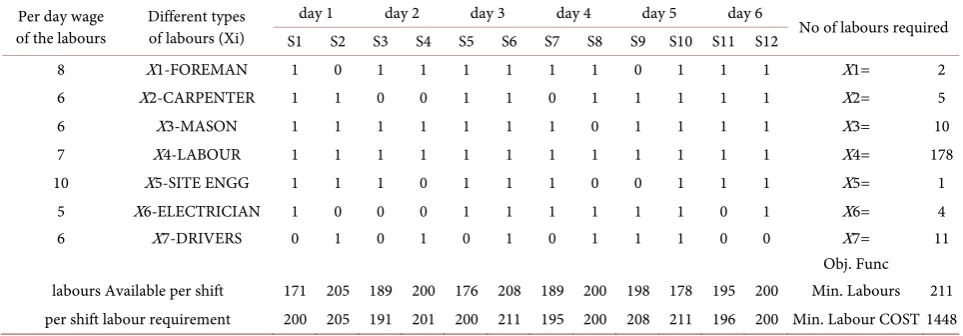
We now state the constraints which will determine the optimization of the objective function. In this case, the objective function is subjected to the follow-ing constraints, as shown in Table 2.
Table 1. Labour availability per shift.
per day wage of
the labors (BD) different types of labors (XI) S1,d1 S2,d1 S1,d2 S2,d2 S1,d3 S2,d3 S1,d4 S2,d4 S1,d5 S2,d5 S1,d6 S2,d6
DOI: 10.4236/jmf.2019.93016 279 Journal of Mathematical Finance
Table 2. Labour availability per shift with minimum labour cost.
Per day wage
of the labours Different types of labours (Xi)
day 1 day 2 day 3 day 4 day 5 day 6
No of labours required S1 S2 S3 S4 S5 S6 S7 S8 S9 S10 S11 S12
8 X1-FOREMAN 1 0 1 1 1 1 1 1 0 1 1 1 X1= 2 6 X2-CARPENTER 1 1 0 0 1 1 0 1 1 1 1 1 X2= 5 6 X3-MASON 1 1 1 1 1 1 1 0 1 1 1 1 X3= 10 7 X4-LABOUR 1 1 1 1 1 1 1 1 1 1 1 1 X4= 178 10 X5-SITE ENGG 1 1 1 0 1 1 1 0 0 1 1 1 X5= 1
5 X6-ELECTRICIAN 1 0 0 0 1 1 1 1 1 1 0 1 X6= 4 6 X7-DRIVERS 0 1 0 1 0 1 0 1 1 1 0 0 X7= 11
Obj. Func labours Available per shift 171 205 189 200 176 208 189 200 198 178 195 200 Min. Labours 211 per shift labour requirement 200 205 191 201 200 211 195 200 208 211 196 200 Min. Labour COST 1448
1 6
, , 1
N
I d S dS d=
∑
I= X ≥K∑
where K is the maximum labor available in each day d in each shift S.
1,1, 1S 2,1, 1S 3,1, 1S 4,1, 1S 5,1, 1S 6,1, 1S 0 171
X +X +X +X +X +X + ≥ (1)
2,1, 2 3,1, 2 4,1, 2 5,1. 2 7,1, 2
0+X S +X S +X S +X S + +0 X S ≥205 (2)
1,2, 1S 0 3,2, 1S 4,2, 1S 5,2, 1S 0 0 189
X + +X +X +X + + ≥ (3)
1,2, 2S 0 3,2, 2S 4,2, 2S 0 0 7,2, 2S 200
X + +X +X + + +X ≥ (4)
1,3, 1S 2,3, 1S 3,3, 1S 4,3, 1S 5,3, 1S 6,3, 1S 0 176
X +X +X +X +X +X + ≥ (5)
1,3, 2S 2,3, 2S 3,3, 2S 4,3, 2S 5,3, 2S 6,3, 2S 7,3, 2S 208
X +X +X +X +X +X +X ≥ (6)
1,4, 1S 0 3,4, 1S 4,4, 1S 5,4, 1S 6,4, 1S 0 189
X + +X +X +X +X + ≥ (7)
1,4, 2S 2,4, 2S 0 4,4, 2S 0 6,4, 2S 7,4, 2S 200
X +X + +X + +X +X ≥ (8)
2,5, 1 3,5, 1 4,5, 1 5,5, 1 6,1, 1
0+X S +X S +X S +X S +X S + ≥0 198 (9)
1,5, 2S 2,5, 2S 3,5, 2S 4,5 2S 5,5, 2S 6,5 2S 7,5, 2S 178
X +X +X +X +X +X +X ≥ (10)
1,6, 1S 2,6, 1S 3,6, 1S 4,6, 1S 5,6, 1S 0 0 195
X +X +X +X +X + + ≥ (11)
1,6, 2S 2,6, 2S 3,6, 2S 4,6, 2S 5,6, 2S 6,6, 2S 0 200
X +X +X +X +X +X + ≥ (12)
0
I
X ≥ for all I (I=1, 2, ,7 ) (13)
integer
I
X = (14)
1 2, 2 5, 3 10, 4 40, 5 1, 6 4, 7 2
X ≥ X ≥ X ≥ X ≥ X ≥ X ≥ X ≥ (15)
DOI: 10.4236/jmf.2019.93016 280 Journal of Mathematical Finance
shift is running short of a certain number of employees and the extra number of employees that need to be hired for the smooth running of the particular shift.
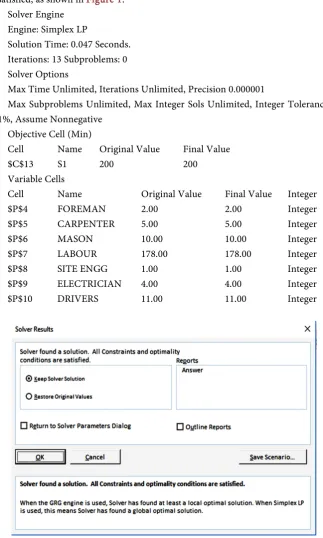
Answer Report:
Worksheet: [lpp solver.xlsx] Sheet 1 Report Created: 01-06-2018 10:40:38
Result: Solver found a solution. All Constraints and optimality conditions are satisfied, as shown in Figure 1.
Solver Engine Engine: Simplex LP
Solution Time: 0.047 Seconds. Iterations: 13 Subproblems: 0 Solver Options
Max Time Unlimited, Iterations Unlimited, Precision 0.000001
Max Subproblems Unlimited, Max Integer Sols Unlimited, Integer Tolerance 1%, Assume Nonnegative
Objective Cell (Min)
Cell Name Original Value Final Value
$C$13 S1 200 200
Variable Cells
Cell Name Original Value Final Value Integer
$P$4 FOREMAN 2.00 2.00 Integer
$P$5 CARPENTER 5.00 5.00 Integer
$P$6 MASON 10.00 10.00 Integer
$P$7 LABOUR 178.00 178.00 Integer
$P$8 SITE ENGG 1.00 1.00 Integer
$P$9 ELECTRICIAN 4.00 4.00 Integer
[image:9.595.209.533.170.709.2]$P$10 DRIVERS 11.00 11.00 Integer
DOI: 10.4236/jmf.2019.93016 281 Journal of Mathematical Finance
Constraints
Cell Name Cell Value Formula Status Slack
$C$13 S1 200 $C$13 ≥ $C$12 Not Binding 29
$D$13 S2 205 $D$13 ≥ $D$12 Binding 0
$E$13 S3 191 $E$13 ≥ $E$12 Not Binding 2 $F$13 S4 201 $F$13 ≥ $F$12 Not Binding 1 $G$13 S5 200 $G$13 ≥ $G$12 Not Binding 24
$H$13 S6 211 $H$13 ≥ $H$12 Not Binding 3
$I$13 S7 195 $I$13 ≥ $I$12 Not Binding 6
$J$13 S8 200 $J$13 ≥ $J$12 Binding 0
$K$13 S9 208 $K$13 ≥ $K$12 Not Binding 10 $L$13 S10 211 $L$13 ≥ $L$12 Not Binding 33
$M$13 S11 196 $M$13 ≥ $M$12 Not Binding 1
$N$13 S12 200 $N$1 ≥ $N$12 Binding 0
$P$10 DRIVERS 11.00 $P$10 ≥ 2 Not Binding 9.00
$P$4 FOREMAN 2.00 $P$4 ≥ 2 Binding 0.00
$P$5 CARPENTER 5.00 $P$5 ≥ 5 Binding 0.00
$P$6 MASON 10.00 $P$6 ≥ 10 Binding 0.00 $P$7 LABOUR 178.00 $P$7 ≥ 40 Not Binding 138.00
$P$8 SITE ENGG 1.00 $P$8 ≥ 1 Binding 0.00
$P$9 ELECTRICIAN 4.00 $P$9 ≥ 4 Binding 0.00
$P$4:$P$10 = Integer
8. Conclusion
As discussed, Staff Scheduling is a complex scheduling problem that often affects the completion of a project in the construction farms all over. In this paper an overview of the planning and staff scheduling problem in a construction com-pany is shown, which shows the minimum requirement of manpower for the proper execution of a job in each shift, the temporary employees that need to be hired from outside in order to meet the shift demands and the particular type of deficit employee that needs to be hired can also be stated, also the extra amount of money paid on temporary hire can be calculated. It is to be noted that the constraints described in this system are in terms of requirement of skilled labour and piece of works. The aim of this problem is to maximize the fairness of the schedule, while respectively all the constraints, thus, aiming at utilizing the time and effort efficiently, balancing the workload to lead more contented and effec-tive outcomes.
Acknowledgements
DOI: 10.4236/jmf.2019.93016 282 Journal of Mathematical Finance
Conflicts of Interest
The authors declare no conflicts of interest regarding the publication of this pa-per.
References
[1] Pinedo, M., Zacharias, C. and Zhu, N. (2015) Scheduling in the Service Industries: An Overview. Journal of Systems Science and Systems Engineering, 24, 1-48. https://doi.org/10.1007/s11518-015-5266-0
[2] Semra Ağralı, Z., Taşkın, C. and Ünal, A.T. (2016) Employee Scheduling in Service Industries with Flexible Employee Availability and Demand. Omega, 66, 159-169. https://doi.org/10.1016/j.omega.2016.03.001
[3] Satheesh Kumar, B., Nagalakshmi, G. and Kumaraguru, S. (2014) A Shift Sequence for Nurse Scheduling Using Linear Programming Problem. IOSR Journal of Nurs-ing and Health Science, 3, 24-28. https://doi.org/10.9790/1959-03612428
[4] De Grano, M.L., Medeiros, D.G. and Eitel, D. (2009) Accommodating Individual Preferences in Nurse Scheduling via Auctions and Optimization. Health Care Management Science, 12, 228-242.https://doi.org/10.1007/s10729-008-9087-2 [5] Moz, M. and Pato, M.V. (2007) A Genetic Algorithm Approach to a Nurse
Reros-tering Problem. Computers and Operations Research, 34, 667-691. https://doi.org/10.1016/j.cor.2005.03.019
[6] Maenhout, B. and Vanhoucke, M. (2013) An Integrated Nurse Staffing and Sche-duling Analysis for Longer-Term Nursing Staff Allocation Problems. Omega, 41, 485-499.https://doi.org/10.1016/j.omega.2012.01.002
[7] Bagatourova, O. and Mallya, S.K. (2004) Coupled Heuristic and Simulation Sche-duling in a Highly Variable Environment. Proceedings of the 2004 Winter Simula-tion Conference, Washington DC, 5-8 December 2004, 1856-1860.
https://doi.org/10.1109/WSC.2004.1371540
[8] Brusco, M., Jacobs, L., Bongiorno, R., Lyons, D. and Tang, B. (1995) Improving Personnel Scheduling at Airline Stations. European Journal of Operational Re-search, 43, 728-905.https://doi.org/10.1287/opre.43.5.741
[9] Chu, S.C.K. (2007) Generating, Scheduling and Rostering of Shift Crew-Duties: Ap-plications at the Hong Kong International Airport. European Journal of Operation-al Research, 177, 1764-1778.https://doi.org/10.1016/j.ejor.2005.10.008
[10] Ernst, A.T., Jiang, H., Krishnamoorthy, M. and Sier, D. (2004) Staff Scheduling and Rostering: A Review of Applications, Methods and Models. European Journal of Operational Research, 153, 3-27.https://doi.org/10.1016/S0377-2217(03)00095-X [11] Van den Bergh, J., Beliën, J., De Bruecker, P., Demeulemeester, E. and De Boeck, L.
(2013) Personnel Scheduling: A Literature Review. European Journal of Operational Research, 226, 367-385.https://doi.org/10.1016/j.ejor.2012.11.029
[12] Brucker, P., Qu, R. and Burke, E. (2011) Personnel Scheduling: Models and Com-plexity. European Journal of Operational Research, 210, 467-473.
https://doi.org/10.1016/j.ejor.2010.11.017
[13] Pawar, U.S. and Hanchate, D.B. (2013) Literature Review on Personnel Scheduling.
International Journal of Computer Engineering and Technology, 5.
DOI: 10.4236/jmf.2019.93016 283 Journal of Mathematical Finance
[15] Dantzig, G.B. (1954) Letter to the Editor: A Comment on Edie’s ‘Traffic Delays at Toll Booths’. Operations Research, 2, 229-361.https://doi.org/10.1287/opre.2.3.339 [16] Casado, S., Laguna, M. and Pacheco, J. (2005) Heuristical Labour Scheduling to
Op-timize Airport Passenger Flows. Journal of the Operational Research Society, 56, 649-658.https://doi.org/10.1057/palgrave.jors.2601859
[17] De Bruecker, P., Van den Bergh, J., Belien, J. and Demeulemeester, E. (2015) A Two-Stage Mixed Integer Programming Approach for Optimizing the Skill Mix and Training Schedules for Aircraft Maintenance. Social Science Research Network. https://doi.org/10.2139/ssrn.2697491
[18] Thiel, M.P. (2008) Team-Oriented Airline Crew Rostering for Cockpit Personnel. In: Hickman, M., Mirchandani, P. and Voß, S., Eds., Computer-Aided Systems in Public Transport. Lecture Notes in Economics and Mathematical Systems, Springer, Berlin, Heidelberg, 600, 91-114. https://doi.org/10.1007/978-3-540-73312-6_6 [19] Hoong, C.L., Zhi, Y. and Aldy, G. (2016) Patrol Scheduling in Urban Rail Network.
Annals of Operations Research, 239, 317-342. https://doi.org/10.1007/s10479-014-1648-9
[20] Pour, S.M., Drake, J.H., Ejlertsen, L.S., Rasmussen, K.M. and Burke, E.K. (2018) A Hybrid Constraint Programming/Mixed Integer Programming Framework for the Preventive Signaling Maintenance Crew Scheduling Problem. European Journal of Operational Research, 269, 341-352.https://doi.org/10.1016/j.ejor.2017.08.033 [21] Kolesar, P.J., Rider, K.L., Crabill, T.B. and Walker, W.E. (1975) A Queuing-Linear
Programming Approach to Scheduling Police Patrol Cars. Operations Research, 23, 1045-1062.
[22] Chanpanit, T. and Udomsakdigool, A. (2015) Workforce Planning for Single Call Center with Service Level Agreement. In: Kachitvichyanukul, V., Sethanan, K. and Golinska-Dawson, P., Eds., Toward Sustainable Operations of Supply Chain and Logistics Systems. EcoProduction (Environmental Issues in Logistics and Manufac-turing), Springer, Cham, 521-533. https://doi.org/10.1007/978-3-319-19006-8_36 [23] Bhulai, S., Koole, G. and Pot, A. (2008) Simple Methods for Shift Scheduling in
Multiskill Call Centers. Manufacturing & Service Operations Management, 10, 337-562.https://doi.org/10.1287/msom.1070.0172
[24] Dietz, D.C. (2011) Practical Scheduling for Call Center Operations. Omega, 39, 550-557.https://doi.org/10.1016/j.omega.2010.12.001
[25] Canon, C. (2007) Personnel Scheduling in the Call Center Industry. 4OR, 5, 89-92. https://doi.org/10.1007/s10288-006-0008-2
[26] Parisio, A. and Jones, C.N. (2015) A Two-Stage Stochastic Programming Approach to Employee Scheduling in Retail Outlets with Uncertain Demand. Omega, 53, 97-103. https://doi.org/10.1016/j.omega.2015.01.003
[27] Henao, C.A., Muñoz, J.C. and Ferrer, J.C. (2015) The Impact of Multi-Skilling on Personnel Scheduling in the Service Sector: A Retail Industry Case. Journal of the Operational Research Society, 66, 1949-1959. https://doi.org/10.1057/jors.2015.9 [28] Thomas, P.I. (2013) Scheduling Algorithm with Optimization of Employee
Satisfac-tion.
[29] Jaumard, B., Semet, F. and Vovor, T. (1998) A Generalized Linear Programming Model for Nurse Scheduling. European Journal of Operational Research, 107, 1-18. https://doi.org/10.1016/S0377-2217(97)00330-5
DOI: 10.4236/jmf.2019.93016 284 Journal of Mathematical Finance
[31] Cheang, B., Li, H., Lim, A. and Rodrigues, B. (2003) Nurse Rostering Problems: A Bibliographic Survey. European Journal of Operational Research, 151, 447-460. https://doi.org/10.1016/S0377-2217(03)00021-3
[32] Van den Bergh, J., Beliën, J., De Bruecker, P., Demeulemeester, E. and De Boeck, L. (2013) Personnel Scheduling: A Literature Review. European Journal of Operational Research, 226, 367-385.https://doi.org/10.1016/j.ejor.2012.11.029
[33] Cai, X. and Li, K. (2000) A Genetic Algorithm for Scheduling Staff of Mixed Skills under Multi-Criteria. European Journal of Operational Research, 125, 359-369. https://doi.org/10.1016/S0377-2217(99)00391-4
[34] Hewitt, M., Chacosky, A., Grasman, S. and Thomas, B. (2015) Integer Programming Techniques for Solving Non-Linear Workforce Planning Models with Learning.
European Journal of Operational Research, 42, 942-950. https://doi.org/10.1016/j.ejor.2014.10.060
[35] Li, G., Jiang, H. and He, T. (2015) A Genetic Algorithm-Based Decomposition Ap-proach to Solve an Integrated Equipment-Workforce-Service Planning Problem.
Omega, 50, 1-17. https://doi.org/10.1016/j.omega.2014.07.003
[36] Aickelin, U. and Dowsland, K.A. (2004) An Indirect Genetic Algorithm for a Nurse-Scheduling Problem. Computers & Operations Research, 31, 761-778. https://doi.org/10.1016/S0305-0548(03)00034-0
[37] Harjunkoski, I. and Grossmann, I.E. (2002) Decomposition Techniques for Multis-tage Scheduling Problems Using Mixed-Integer and Constraint Programming Me-thods. Computers & Chemical Engineering, 26, 1533-1552.
https://doi.org/10.1016/S0098-1354(02)00100-X
[38] Baptiste, P., Le Pape, C. and Nuijten, W. (2003) Constraint-Based Scheduling: Ap-plying Constraint Programming to Scheduling Problems. Journal of Scheduling, 6, 413-414.
[39] Hertz, A., Lahrichi, N. and Widmer, M. (2010) A Flexible MILP Model for Mul-tiple-Shift Workforce Planning under Annualized Hours. European Journal of Op-erational Research, 200, 860-873.https://doi.org/10.1016/j.ejor.2009.01.045
[40] Cuevas, R., Ferrer, J.-C., Klapp, M. and Muñoz, J.-C. (2016) A Mixed Integer Pro-gramming Approach to Multi-Skilled Workforce Scheduling. Journal of Scheduling, 19, 91-106.https://doi.org/10.1007/s10951-015-0450-0
[41] Azmat, C.S., Hurlimann, T. and Widmer, M. (2004) Mixed Integer Programming to Schedule a Single-Shift Workforce under Annualized Hours. Annals of Operations Research, 128, 199-215.https://doi.org/10.1023/B:ANOR.0000019105.54898.a4 [42] Al-Yakoob, S.M. and Sherali, H.D. (2007) Multiple Shift Scheduling of Hierarchical
Workforce with Multiple Work Centers. Informatica, 18, 325-342.
[43] Harjunkoski, I. and Grossmann, I.E. (2001) A Decomposition Approach for the Scheduling of Steel Plant Production. Computers & Chemical Engineering, 25, 1647-1660. https://doi.org/10.1016/S0098-1354(01)00729-3
[44] Abril, F.C. and Alvarez, C.M. (2005) Scheduling Resource-Constrained Projects Using Branch and Bound and Parallel Computing Techniques. International Jour-nal of OperatioJour-nal Research, 1.
[45] Mirmohseni, S.M., Nasseri, S.H. and Khaviari, M.H. (2017) A New Fuzzy Hybrid Dynamic Programming for Scheduling Weighted Jobs on Single Machine. Journal of Applied Research on Industrial Engineering, 4, 97-115.
DOI: 10.4236/jmf.2019.93016 285 Journal of Mathematical Finance https://doi.org/10.1016/S0305-0548(03)00249-1
[47] Novoa, D., Olarte, C., Barrera, D. and González-Neira, E.M. (2016) A GRASP-Based Approach to the Multi Activity Combined Timetabling and Crew Scheduling Prob-lem Considering a Heterogeneous Workforce. International Journal of Industrial Engineering Computations, 7, 597-606.https://doi.org/10.5267/j.ijiec.2016.4.001 [48] Akbari, M., Zandieh, M. and Dorri, B. (2012) Scheduling Part-Time and
Mixed-Skilled Workers to Maximize Employee Satisfaction. The International Journal of Advanced Manufacturing Technology, 64, 1017-1027.
https://doi.org/10.1007/s00170-012-4032-4
[49] Hojati, M. and Patil, A.S. (2011) An Integer Linear Programming-Based Heuristic for Scheduling Heterogeneous, Part-Time Service Employees. European Journal of Operational Research, 209, 37-50.https://doi.org/10.1016/j.ejor.2010.09.004 [50] Baker, K.R. (1976) Workforce Allocation in Cyclical Scheduling Problems: A
Sur-vey. Journal of the Operational Research Society, 27, 155-167. https://doi.org/10.1057/jors.1976.30
[51] Azmat, C.S. and Widmer, M. (2004) A Case Study of Single Shift Planning and Scheduling under Annualized Hours: A Simple Three-Step Approach. European Journal of Operational Research, 153, 148-175.
https://doi.org/10.1016/S0377-2217(03)00105-X
[52] Di Gaspero, L., Gärtner, J., Kortsarz, G., Musliu, N., Schaerf, A. and Slany, W. (2007) The Minimum Shift Design Problem. Annals of Operations Research, 155, 79-105.https://doi.org/10.1007/s10479-007-0221-1
[53] Sadat, Z., Nadoushani, M., Hammad, A.W.A. and Akbarnezhad, A. (2017) Location Optimization of Tower Crane and Allocation of Material Supply Points in a Con-struction Site Considering Operating and Rental Costs. Journal of Construction En-gineering and Management, 143, Article ID: 04016089.