ISSN Online: 2162-1977 ISSN Print: 2162-1969
DOI: 10.4236/ojpc.2019.93007 Jul. 22, 2019 107 Open Journal of Physical Chemistry
Clusters: Viscosity Cause?
V. P. Malyshev, A. M. Makasheva
Chemical and Metallurgical Institute after Name Zh. Abishev, Karaganda, Republic of Kazakhstan
Abstract
The significance of the work is determined by the need to develop a cluster theory of the liquid state of a substance in order to more deeply substantiate the viscosity, which is still expressed by empirical parameters within the framework of ideal ideas about the stratified flow of a liquid. According to the reference data on the dynamic viscosity of the melts for chlorides of the first group of the Periodic System, the approximating dependences in the form of cluster-associate and Frenkel’s models were constructed at various tempera-tures. The first model is based on taking into account the share of particles that cannot overcome the thermal melting barrier and thus serve to form vir-tual clusters and associates while preserving the structural motifs of the solid phase. In the framework of the cluster-associate viscosity model developed by the authors, these formations determine the melt viscosity and serve as flow units to which the energy of fluid motion is applied. The Frenkel’s model al-lows us to estimate the activation energy of fluidity. Calculations show that by comparing this energy with the degree of cluster association obtained in the framework of the cluster-associate model, a fairly close linear correlation is obtained, and the proportionality coefficient has the meaning of the activa-tion energy per cluster. This energy does not go beyond the van der Waals energy of the unsaturated intermolecular bond characteristic of the interac-tion of particles in a liquid. This confirms the earlier established by the au-thors a similar pattern for melts of simple substances, based on the under-standing of fluidity as a consequence of the destruction of cluster associates while preserving the clusters themselves.
Keywords
Dynamic Viscosity, Cluster, Associate, Temperature, Fluidity, Activation Energy
1. Introduction
The prerequisites for this research are the wide use by the authors of the How to cite this paper: Malyshev, V.P.
and Makasheva, A.M. (2019) Clusters: Viscosity Cause? Open Journal of Physical Chemistry, 9, 107-125.
https://doi.org/10.4236/ojpc.2019.93007
Received: May 14, 2019 Accepted: July 19, 2019 Published: July 22, 2019
Copyright © 2019 by author(s) and Scientific Research Publishing Inc. This work is licensed under the Creative Commons Attribution International License (CC BY 4.0).
http://creativecommons.org/licenses/by/4.0/
DOI: 10.4236/ojpc.2019.93007 108 Open Journal of Physical Chemistry Boltzmann’s distribution for expressing various properties of a substance based on taking into account the degree of its randomization, in particular, on plastic-ity, evaporation and grindability. The modern cluster theory of a fluid is based on the discovery of numerous virtual formations that retain the structural motifs of the solid phase using physical methods [1]-[18]. At the same time, only ap-proximate qualitative relationships were found relating to the effect of tempera-ture on the number and form of these formations. The authors of [19] [20] [21]
for the first time substantiated the decisive influence of these formations on the viscosity of a liquid based on the concept of randomized particles put forward by them, subject to the Boltzmann’s distribution and retaining their belonging to the virtual solid phase in a liquid according to the condition that they did not overcome the thermal melting barrier RTm in the entire liquid state range.
The proportion of these particles, called crystal-mobile, depends on the tem-perature according to the law
1 exp m 1 exp m .
crm
RT T
R
RT T
= − − = − −
(1)
The distribution of clusters according to the number of particles within them obeys a probabilistic pattern
(
)
, 1
n crm n crm crm
R = −R P , (2)
according to which the share of n-particle clusters decreases with increasing n and decreasing Pcrm, that is, with increasing temperature. According to the au-thors [19], the viscosity is determined by the content of two- and more partial clusters, and the fluidity is determined by all single-particle clusters in the Pcrm composition and by all single over-barrier particles. Thus, the proportion of par-ticles responsible for the viscosity of the liquid, receives a quantitative expression
(
)
2(
)
2,1
1 crm 1 crm crm 1 exp m .
Rη = −R + −R =P = − −T T (3)
At the same time, the correlation of viscosity with the square of the share of crystal-mobile particles, close to linear, was revealed in [19] using the example of metals of the first group. This opened up the possibility of a transition to a natu-ral expression of the temperature dependence of viscosity using arbitrary refer-ence points Ti, ηi.
The most adequate form of adaptation of the fractional dependence of viscos-ity (3) to the natural one turned out to be the one that was observed primarily on the limits of viscosity change in the full temperature range with a transition to the dimensionless expression of viscosity at the reference point η/η1
(
)
1 1
a
T T
η η= . (4)
de-DOI: 10.4236/ojpc.2019.93007 109 Open Journal of Physical Chemistry pendence is determined by the content of clusters. This led to the expression of the secondary dependence in the same form through the second reference point
(
)
2 2
b
a=a T T . (5)
In general, we obtained a hierarchical cluster-associate viscosity model
(
)
2(2 )1 1
b
a a T T
T T
η η= =
, (6) according to which it became possible not only to describe the experimental data most adequately, but also confidently extrapolate the dependence to the full range of the liquid state, and also to analyze the cluster-associate nature of a flu-id in interrelation with its well-known models based on the internal unity of the structural and probabilistic approaches with the interpretation of viscosity not only as a structure-sensitive, but also chaos-sensitive property.
In this case, the parameters of the model (6) are determined by three reference points:
(
)
(
2 1)
2 1 2 ln ln a T T η η
= , (7)
(
) (
)
(
) (
)
(
)
3 1 1 2
1 3 2 1
2 3 ln ln ln ln ln ln T T T T b T T η η η η
= . (8)
The value of b corresponds to the degree of aggregation of associates, that is, a more detailed hierarchical model of viscosity. As shown by calculations, this in-dicator differs little from one and can be taken constant for each substance. Ap-parently, the aggregation of associates is not as clearly expressed as the formation of clusters and their associates, and cannot be reliably identified given the low ac-curacy of the experimental definitions of viscosity, especially at elevated tempera-tures and a small number of reference points. It is possible that these inaccuracies for the most parts are accumulated and taken into account in the indicator b, which ensures, in general, a very high adaptation of the cluster-associate model to the experimental data [19].
2. Methodical Part
Usually, such an adaptation is achieved by linearizing a complex model with subsequent data processing on the parameters of the direct equation. In this case, such linearization is not mathematically possible with either a single or double logarithmization of the model (6).
DOI: 10.4236/ojpc.2019.93007 110 Open Journal of Physical Chemistry To a greater extent, this circumstance is inherent in the Frenkel-Andrade’s equation 0 3 6 e W kT kTτ η δ ∆
= , (9)
where δ—the distance of one molecule jump to the adjacent monolayer of liquid,
τ0—molecular oscillation period around equilibrium, ∆W—jump activation energy. Here, the pre-exponential fraction can in fact also be referred to the col-lision frequency factor and therefore is usually taken as a constant value, at least for small temperature ranges, as is assumed in the Frenkel’s equation
0e
E RT
η η= . (10) However, the formal analogy of the Frenkel’s equation with the Arrhenius equation
e E RT
k=A − (11)
this ends due to the opposite expression of the exponent of the fraction sign. As shown in [22], only the identity transformation of the Frenkel’s equation by taking inverse values in the left and right sides of the equation
0 1 1 e E RT η η −
= (12)
returns the exponent the original meaning of the probability of overcoming the thermal barrier based on the fundamental Boltzmann’s distribution. In this case, inverse dimensional values, by definition, relate to fluidity, and the value of E—to the activation energy of fluidity, and not viscosity, as it formally follows from the Frenkel’s equation. The itself value of E when processing the linearized Equation (10) remains unchanged.
Thus, the main characteristics of the viscosity of a fluid related to its nature in the Frenkel’s model is the activation energy of fluidity, which can be determined by processing experimental data in a certain temperature range that allows ade-quate linearization in coordinates lnη − 1/T.
In the cluster-associate model (6) it is possible to linearize in the same coor-dinates, assuming a = const and reducing formula (6) to (4). However, the mod-el is unnecessarily simplified, since it is determined through just one reference point and reduces to the type of power functions (у = ха), while the exponential dependencies are indicative of the type (у = ах). Only in its full form does the cluster-associate model acquire the greatest generality and adaptability, becom-ing an exponential-power function (у = хх). In this case, the average value of the degree of association of clusters a can be analytically determined on the basis of formula (5) as the average integral value
(
)
(
)
(
)
1 1
2 2
1
b b b
up l
up l
a T T T
a
b T T
− − −
=
− − , (13)
DOI: 10.4236/ojpc.2019.93007 111 Open Journal of Physical Chemistry This interval can be selected with a full graphical representation of the clus-ter-associate model (6) after its identification by three reference points in the coordinates lnη − 1/T range from melting point Tm to boiling point Tb and processed in areas that allow linearization with the inclusion of all experimental values, and with their division into several segments of direct, as well as in the field of lack of experimental data. In all cases, the corresponding values of the activation energy by the Frenkel’s equation and the average integral values of the degree of cluster association are found in straight-line segments by formula (13).
Since the value of ā characterizes the average number of clusters in an asso-ciate, then by the ratio E a one can determine the activation energy attributa-ble to the cluster and having the sense of breaking the bond between the cluster and the associate, that is, the beginning of its destruction.
This value should be determined on a wide variety of materials in order to identify any regularities in its change or constancy. Previously, in works [19] [20] [21] [22], it was analyzed on contrast data relating to the viscosity of simple substances and complex slag systems, and in all cases the specific activation energy of a viscous flow, E/ā, did not go beyond the energy of the van der Waals forces [23]. Being the weakest and most unsaturated intermolecular bonds, they are overcome in the first place, which makes it possible to argue about the nature of the viscous flow, which consists in breaking the associates without destroying the clusters that retain the binding energy of the particles in a solid state even with their virtual existence [19] [20] [21].
This paper is devoted to continuing the analysis of the relationship of the cluster-associate model with the Frenkel’s viscosity model using the example of the halides of the first group of the Periodic System, for which there are mini-mally sufficient reference data (at least three experimental values).
3. Calculations of Viscosity Using the Cluster-Associate
Model and the Frenkel’s Model
Lithium chloride. According to the directory [24] found the values Tm = 887 K, Tb = 1653 K and three viscosity values used as reference points Т1 = 910 K, η1 = 1.59 mPa·c; Т2 = 980 K, η2 = 1.21 mPa·c; Т3 = 1080 K, η3 = 0.87 mPa·c. Using them, using Equations ((7), (8)), we have identified the viscosity Equations (6) and the degree of cluster association (5):
( )0.4703
3.6853 980
910
1.59 , mPa c
T
T
η=
⋅
(14)
(
)
0.47033.6853 980
а= T . (15)
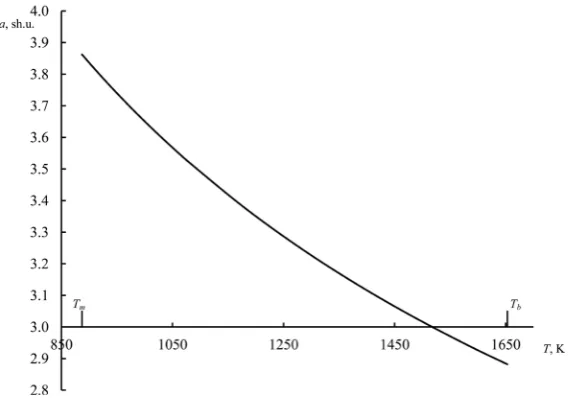
The results of calculations on them with extrapolation to Tm and to Tb are presented in Table 1 and in Figure 1 and Figure 2.
DOI: 10.4236/ojpc.2019.93007 112 Open Journal of Physical Chemistry
Table 1. Reference [24] and calculated by (14) and (15) values of the dynamic viscosity
and the degree of association of clusters of liquid lithium chloride.
Т, K η [24], mPa·c
η(14),
mPa·c а (15) Т, K
η [24], mPa·c
η(14),
mPa·c а (15)
Тт = 887 - 1.755 3.862 1040 - 0.985 3.584
900 - 1.659 3.836 1060 - 0.925 3.552
910 1.59 1.590 3.816 1080 0.87 0.870 3.521
930 - 1.465 3.777 1180 - 0.661 3.377
950 - 1.354 3.740 1280 - 0.525 3.250
970 - 1.255 3.703 1380 - 0.431 3.137
980 1.21 1.210 3.685 1480 - 0.363 3.036
1000 - 1.127 3.650 1580 - 0.313 2.944
1020 - 1.052 3.617 Tb = 1653 - 0.285 2.882
Points—reference data [24], line—by (14).
[image:6.595.205.542.100.460.2]Figure 1. Dependence of dynamic viscosity of liquid lithium chloride on temperature.
Figure 2. Dependence of the degree of association of clusters in lithium chloride on
[image:6.595.232.521.494.693.2]DOI: 10.4236/ojpc.2019.93007 113 Open Journal of Physical Chemistry constructing a cluster-associate viscosity model [19] [20] [21], and this is con-firmed by the actual expression of data on η and a, reflecting both a decrease in the share of clusters and associates with an increase in temperature.
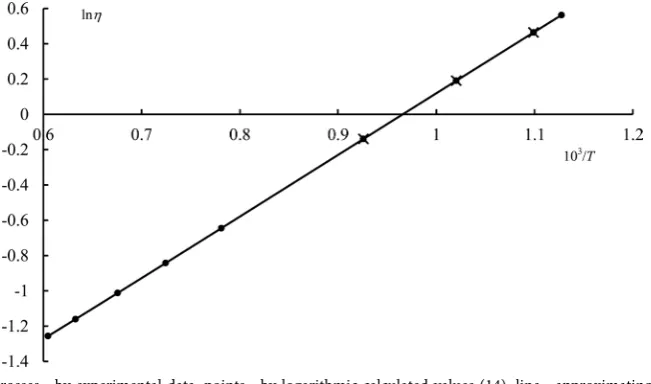
In the lnη − 1/T coordinates, almost straight-line placement of experimental and calculated data is observed over the entire temperature range (Figure 3). According to the parameters of the straight-line approximation of these data, the Fraenkel equation is obtained
29045 2
3.43 10 e RT , mPa c
η= × − ⋅ , (16)
with the value of the activation energy of fluidity 29,045 J/mol.
In the framework of the cluster-associate viscosity model, this value refers to a flow unit – cluster association. According to (13), the average integral value of the degree of association of clusters in the range Tm − Tb is a =3.298, and then
we obtain the ratio E a=8807 J/cluster corresponding to the energy of van
der Waals attraction of molecules.
Direct comparison of cluster-associate (14) and Frenkel (16) models viscosity is presented in Table 2.
[image:7.595.212.538.338.530.2]Crosses—by experimental data, points—by logarithmic calculated values (14), line—approximating straight line.
Figure 3. Logarithmic dependence of the viscosity of LiCl back temperature.
Table 2. Dynamic viscosity of lithium chloride according to cluster-associate Equation
(14) and Frenkel Equation (16).
Т, K ηmPa·c (14), ηmPa·c (16), Т, K mPa·c η(14), ηmPa·c (16), Т, K ηmPa·c (14), mPa·c η(16),
Тт = 887 1.755 1.761 980 1.210 1.212 1180 0.661 0.662
900 1.659 1.663 1000 1.127 1.128 1280 0.525 0.525
910 1.590 1.594 1020 1.052 1.054 1380 0.431 0.431
930 1.465 1.468 1040 0.985 0.986 1480 0.363 0.363
950 1.354 1.356 1060 0.925 0.926 1580 0.313 0.313
[image:7.595.206.541.608.724.2]DOI: 10.4236/ojpc.2019.93007 114 Open Journal of Physical Chemistry It is characterized by the correlation coefficient R = 0.99979 with the signific-ance of the Student coefficient tR=96412 and the degree of determination
D = R2 = 0.99958, which indicates the functional nature of the relationship of these models, due to their physical, probabilistic and structural conformity.
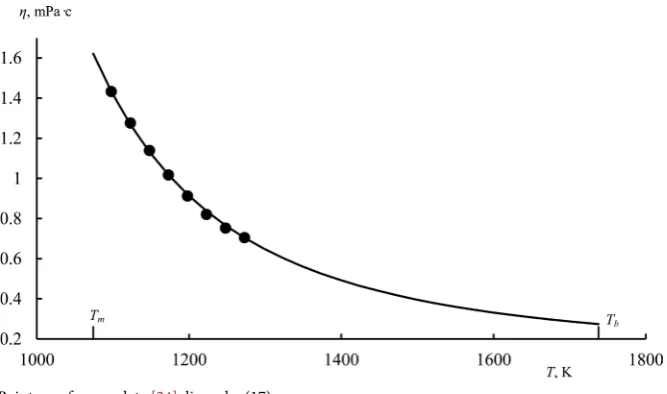
Sodium chloride. According to the directory [24] found the values Tm = 1074 K, Tb = 1738 K. Of the eight viscosity data presented, three reference points were selected: Т1 = 1098 K, η1 = 1.432 mPa·c; Т2 = 1173 K, η2 = 1.017 mPa·c; Т3= 1273 K, η3 = 0.704 mPa·c. From these data, we obtained the calculated dependences for the viscosity and the degree of cluster association
( )0.9261
5.1792 1173
, 1098
1.432 mPa c
Т
Т
η=
⋅ (17)
(
)
0.92615.1792 1173
a= Т . (18)
The results of calculation on them with extrapolation on Tm and up to Tb are given in Table 3 and in Figure 4.
The correlation coefficient was R = 0.999026 at tR =5132 and D = 0.998.
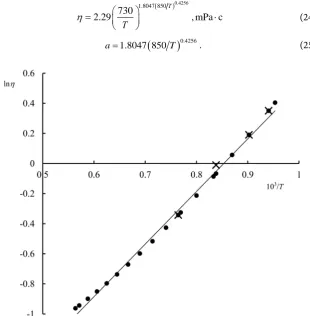
In logarithmic coordinates, these data are presented in Figure 5.
Here, the noticeable curvature of the logarithmic dependence (17) forces us to carry out a linear approximation at two ranges with obtaining two Frenkel equa-tions for the ranges Tm-1273 и 1273-Tb:
49326 3
, mP 6.493 10 e RT a c
η= × − ⋅ (19)
36464 2
, mP 2.175 10 e RT a c
[image:8.595.199.539.477.739.2]η= × − ⋅ (20)
Table 3. Reference [24] and calculated by (17) and (18) values of the dynamic viscosity
and the degree of association of clusters of liquid sodium chloride.
Т, K η [24], mPa·c η(17), mPa·c а (18) Т, K η(17), mPa·c а (18)
Tm = 1074 - 1.621 5.620 1423 0.466 4.331
1098 1.432 1.432 5.506 1448 0.440 4.261
1123 1.275 1.268 5.393 1473 0.419 4.194
1148 1.138 1.132 5.284 1498 0.397 4.130
1173 1.017 1.017 5.179 1523 0.379 4.067
1198 0.912 0.920 5.079 1548 0.362 4.006
1223 0.82 0.837 4.983 1573 0.347 3.947
1248 0.752 0.766 4.890 1598 0.333 3.890
1273 0.704 0.704 4.801 1623 0.320 3.834
1298 - 0.651 4.716 1648 0.309 3.780
1323 - 0.604 4.633 1673 0.298 3.728
1348 - 0.563 4.553 1698 0.288 3.677
1373 - 0.527 4.477 1723 0.279 3.628
DOI: 10.4236/ojpc.2019.93007 115 Open Journal of Physical Chemistry
[image:9.595.208.542.68.265.2]Points—reference data [24], line—by (17).
Figure 4. Dependence of dynamic viscosity of liquid sodium chloride on temperature.
Crosses—by experimental data [24], points—according to calculated from Table 3, straight lines—approximation by the Frenkel equation.
Figure 5. Logarithmic dependence of the viscosity of NaCl on the inverse temperature.
[image:9.595.209.540.300.546.2]DOI: 10.4236/ojpc.2019.93007 116 Open Journal of Physical Chemistry Potassium chloride. Reference [24] contains the values Tm = 1049 K, Tb = 1773 K, as well as information on the four viscosity values, of which they were chosen as reference points Т1 = 1063 K, η1= 1.42 mPa·c; Т2 = 1108 K, η2 = 1.21 mPa·c; Т3 = 1308 K, η3 = 0.71 mPa·c. With their help, found the parameters of a clus-ter-associate model of potassium chloride
( )0.8682
3.860 1108
, 1063
1 2.4 mPa c
Т
Т
η=
⋅ (21)
(
)
0.86823.860 1108
a= Т . (22)
[image:10.595.204.537.293.698.2]The calculation results for them are presented in Table 4 and in Figure 6. According to these data, a regular, with a slowdown, a decrease in the viscosity and degree of association of clusters with an increase in temperature is observed.
Table 4. Reference [24] and calculated by (21) and (22) values of the dynamic viscosity
and the degree of association of clusters of liquid potassium chloride.
Т, K η [24], mPa·c η(21), mPa·c а (22) Т, K η(21), mPa·c а (22)
Tm= 1049 - 1.498 4.048 1400 0.596 3.151
1063 1.42 1.420 4.001 1450 0.550 3.056
1108 1.21 1.210 3.860 1500 0.511 2.967
1150 - 1.058 3.737 1550 0.479 2.884
1193 0.99 0.935 3.620 1600 0.451 2.806
1200 - 0.918 3.602 1650 0.427 2.732
1250 - 0.808 3.476 1700 0.407 2.662
1300 - 0.722 3.360 1750 0.389 2.596
1308 0.71 0.710 3.342 Tb = 1773 0.382 2.566
1350 - 0.653 3.252
[image:10.595.206.539.296.691.2]Points—reference data [24], line—by (21).
DOI: 10.4236/ojpc.2019.93007 117 Open Journal of Physical Chemistry The correlation coefficient with reference values was R = 0.992 at tR = 122 > 2 and D = 0.984.
In logarithmic coordinates, the temperature dependence of the viscosity of potassium chloride is shown in Figure 7.
Here a linear approximation is possible in the whole range of the liquid state of potassium chloride,
28546 2
5.5 10 e RT ,mPa c
η= × − ⋅ (23)
The correlation coefficient with the experimental data was R = 0.973 at tR = 36.3 > 2 and D = 0.947, and with cluster-associate Equation (21) R = 0.9779 at tR = 374 > 2 and D = 0.9889, indicating a fairly close functional relationship.
The average integral value of the degree of cluster association in the full range of the liquid state of potassium chloride is a = 3.187, that in comparison with the activation energy of fluidity Е = 28,546 J/mol gives the ratio Е/a = 8957 J/cluster, newly located within the energy of van der Waals attraction.
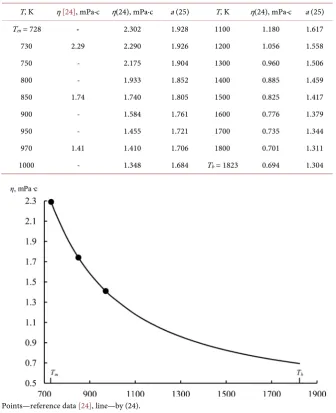
Silver chloride. Reference [24] lists Tm = 728 K, Tb = 1823 K and contains vis-cosity information for three temperatures Т1 = 730 K, η1 = 2.29 mPa·c; Т2 = 850 K, η2 = 1.74 mPa·c; Т3 = 970 K, η3 = 1.41 mPa·c, which were chosen as reference points for building a cluster-associate model
( )0.4256
1.8047 850
730
2.29 , mPa c
T
Т
η=
⋅
(24)
(
)
0.42561.8047 850
a= T . (25)
[image:11.595.221.532.363.680.2]Crosses—by experimental data [24], points—according to calculated from Table 4, straight lines—approximation by the Frenkel equation.
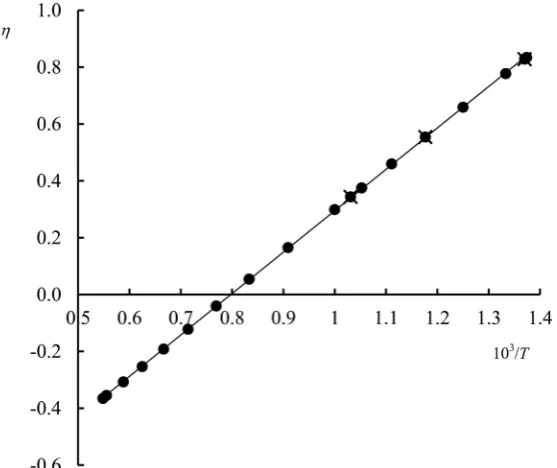
DOI: 10.4236/ojpc.2019.93007 118 Open Journal of Physical Chemistry The calculation results for these equations are given in Table 5 and in Figure 8. They testify to the preservation of the monotonous nature of the loss of both dependencies, and in logarithmic coordinates (Figure 9) there is an almost straightforward placement of reference and calculated data. They obtained the Fraenkel equation for silver chloride
12039 2
, mP 0.317 10 e RT a c
η= × − ⋅ (26)
The correlation coefficient with reference data was R = 0.9995 at tR =9922
and D = 0.999.
Comparison of calculated values for (26) with (24) is characterized by R = 0.999907 at tR=214232 and D = 0.9998, which indicates the functional
[image:12.595.205.542.292.706.2]proximity of cluster-associate and molecular-kinetic viscosity models.
Table 5. Reference [24] and calculated by (24) values of the dynamic viscosity and the
degree of association of clusters (25) of liquid silver chloride.
Т, K η [24], mPa·c η(24), mPa·c а (25) Т, K η(24), mPa·c а (25)
Tm = 728 - 2.302 1.928 1100 1.180 1.617
730 2.29 2.290 1.926 1200 1.056 1.558
750 - 2.175 1.904 1300 0.960 1.506
800 - 1.933 1.852 1400 0.885 1.459
850 1.74 1.740 1.805 1500 0.825 1.417
900 - 1.584 1.761 1600 0.776 1.379
950 - 1.455 1.721 1700 0.735 1.344
970 1.41 1.410 1.706 1800 0.701 1.311
1000 - 1.348 1.684 Tb = 1823 0.694 1.304
Points—reference data [24], line—by (24).
[image:12.595.206.538.292.702.2]DOI: 10.4236/ojpc.2019.93007 119 Open Journal of Physical Chemistry
[image:13.595.238.517.70.304.2]Crosses—by experimental data [24], points—according to calculated from Table 5, straight lines—approximation by the Frenkel equation.
Figure 9. Logarithmic dependence of the viscosity of AgCl on the inverse temperature.
Their mutual complementarity is indicated by the consistency of the activa-tion energy flow of 12,039 J/mol and the average integral degree of cluster asso-ciation a=1.549, giving, at their E a ratio, a value of 7772 J/cluster, which is in the intermolecular energy interval.
Sodium fluoride. According to the reference [24] found the values Tm = 1265 K и Тb = 1973 K, as well as three viscosity values that were used as reference points: Т1 = 1288 K, η1 = 1.85 mPa·c; Т2 = 1383 K, η2 = 1.41 mPa·c; Т3 = 1473 K, η3 = 1.14 mPa·c. They determined the parameters of the cluster-associate model for liquid sodium fluoride
( )0.893
3.816 1383
, mPa c 1288
1.85
T
Т
η=
⋅ (27)
(
)
0.8933.816 1383
a= T . (28)
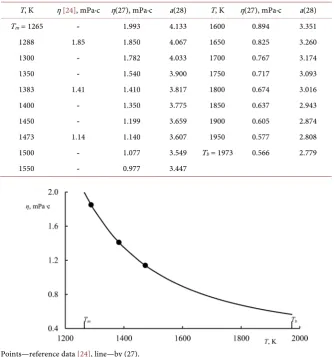
The results of the calculation in the full range of the liquid state are given in
Table 6 and in Figure 10.
A simbatic decrease with a slowing down of the viscosity and the degree of association of clusters in this case in the coordinates lnη − 1/Т leads to a notice-ably curvilinear placement of the data in Table 6.
This forces us to carry out a linear approximation at two ranges, Tm-1500 and 1500-Тb, with obtaining two Frenkel equations (Figure 11)
39909 2
, mP 4.416 10 e RT a c
η= × − ⋅ (29)
32592 2
, mP 7.746 10 e RT a c
DOI: 10.4236/ojpc.2019.93007 120 Open Journal of Physical Chemistry
Table 6. Reference [24] and calculated by (27) and (28) values of the dynamic viscosity
and the degree of association of clusters of liquid sodium fluoride.
Т, K η [24], mPa·c η(27), mPa·c а(28) Т, K η(27), mPa·c а(28)
Tm = 1265 - 1.993 4.133 1600 0.894 3.351
1288 1.85 1.850 4.067 1650 0.825 3.260
1300 - 1.782 4.033 1700 0.767 3.174
1350 - 1.540 3.900 1750 0.717 3.093
1383 1.41 1.410 3.817 1800 0.674 3.016
1400 - 1.350 3.775 1850 0.637 2.943
1450 - 1.199 3.659 1900 0.605 2.874
1473 1.14 1.140 3.607 1950 0.577 2.808
1500 - 1.077 3.549 Тb = 1973 0.566 2.779
1550 - 0.977 3.447
Points—reference data [24], line—by (27).
Figure 10. Dependence of dynamic viscosity of liquid sodium fluoride on temperature.
[image:14.595.206.541.100.458.2]Crosses—by experimental data [24], points—according to cluster-associate model (29), solid straight lines—approximation by the Frenkel model, dashed lines—extrapolation to another temperature range.
[image:14.595.235.518.491.681.2]DOI: 10.4236/ojpc.2019.93007 121 Open Journal of Physical Chemistry From Figure 11 it is noticeable that extrapolation of the Frenkel equation beyond the limits of linearized areas leads to deviations from the clus-ter-associate model (27) that is uniform for the entire range, reaching 11% - 14% at the extrapolation limits. At the same time, within the linearized areas, the correlation coefficient with the cluster-associate model was R = 0.99968 at
6382 2
R
t = and D = 0.99935, pointing to the functional relationship of both models. This relationship is reinforced by their physical interdependence through the ratio E a which for the low temperature range is 39,909/3.825 = 10,433 J/cluster, and for high temperature—32,592/3.131 = 10,409 J/cluster, al-most identical values, a kind of intercluster bonds invariant in associates at the level of van der Waals attraction energy, or rupture during viscous flow.
Potassium iodide. According to it in [24] contains information about Tm = 959 K and Тb = 1593 K, as well as three viscosity values that were chosen as ref-erence points: Т1 = 980 K, η1 = 1.53 mPa·c, Т2 = 1080 K, η2 = 1.19 mPa·c, Т3 = 1160 K, η3 = 1.00 mPa·c. They are used to build a cluster-associate viscosity model KI
( )0.353
2.587 1080
, mPa c 980
1.53
T
T
η=
⋅ (31)
(
)
0.3532.587 1080
a= T . (32)
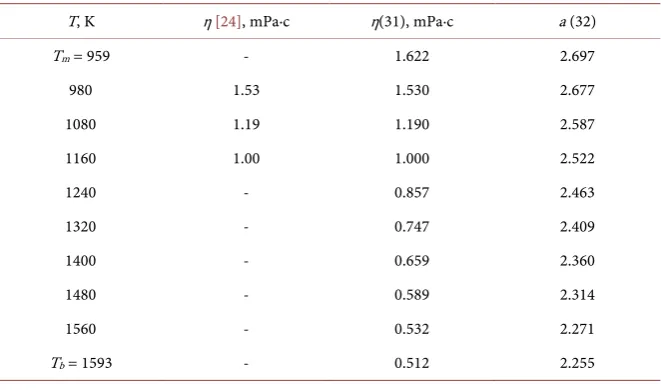
The calculation results for them are shown in Table 7 and in Figure 12. In logarithmic coordinates, these data are presented in Figure 13. Judging from the figure, the calculated and reference data are approximated to a straight line in the full range of the liquid state of potassium iodide, which makes it possible to describe the full range with a single Frenkel equation:
23280 2
, mP 8.892 10 e RT a c
η= × − ⋅ (33)
[image:15.595.208.539.533.728.2]The correlation coefficient of models (31) and (33) was R = 0.99955 at tR=31612
Table 7. Reference [24] and calculated by (31) and (32) values of the dynamic viscosity
and the degree of association of clusters of liquid potassium iodide.
Т, K η [24], mPa·c η(31), mPa·c а (32)
Тm = 959 - 1.622 2.697
980 1.53 1.530 2.677
1080 1.19 1.190 2.587
1160 1.00 1.000 2.522
1240 - 0.857 2.463
1320 - 0.747 2.409
1400 - 0.659 2.360
1480 - 0.589 2.314
1560 - 0.532 2.271
DOI: 10.4236/ojpc.2019.93007 122 Open Journal of Physical Chemistry
[image:16.595.218.534.70.271.2]Points—reference data [24], line—by (31).
Figure 12. Dependence of dynamic viscosity of liquid potassium iodide on temperature.
Crosses—by experimental data [24], points—according to cluster-associate model (31), straight line—approximation by Frenkel model.
Figure 13. Logarithmic dependence of the viscosity of potassium iodide on the inverse
temperature.
and degree of determination D = 0.99911. Ratio E a=23280 2.451 9498=
J/cluster characterizes the energy of the intercluster bond in the associate at the level of the energy of van der Waals attraction.
4. Discussion and Synthesis of Results
[image:16.595.225.523.311.514.2]DOI: 10.4236/ojpc.2019.93007 123 Open Journal of Physical Chemistry
Table 8. Characteristics of cluster-associate (η1) and Frenkel (η2) viscosity models.
Subs-tance Temperature range, K η1 and η2, mPa·c Е, J/mol a, sh.u. E a,
J/cluster
Е (34), J/mol
LiCl Тт− Tb
( )
1 1.59 910
a
T
η =
( )0.4703
98
3.6853 0T
а=
29045 2
2 3.43 10 e
RT
η = × −
29,045 3.298 8807 31,176
NaCl
Тт− 1273
1273 − Tb
( )
1 1.432 1098
a
T
η =
( )0.9261
11
5.1792 73T
а=
49326 3
2 6.493 10 e
RT
η = × −
36464 2
2 2.175 10 e
RT
η = × −
49,326 36,464 5.193 3.94 9499 9255 49,089 37,245
KCl Тт − Tb
( )
1 1.42 1063
a
T
η =
( )0.8682
110
3.860 8
а= T
28546 2
2 5.5 10 e
RT
η = × −
28,546 3.187 8957 30,127
AgCl Тт − Tb
( )
1 2.29 730
a
T
η =
( )0.4256
85
1.8047 0T
а=
12039 2
2 0.317 10 e
RT
η = × −
12,039 1.549 7772 14,643
NaF
Тт − 1500
1500 − Tb
( )
1 1.85 1288
a
T
η =
( )0.893
13 3.816 83T a=
39909 2
2 4.416 10 e
RT
η = × −
32592 2
2 7.746 10 e
RT
η = × − 39,909
32,592 3.825 3.131 10,433 10,409 36,158 29,597
KI Тт− Tb
( )
1 1.53 980
a
T
η =
( )0.353
10 2.587 80T a=
23280 2
2 8.892 10 e
RT
η = × −
23,280 2.451 9498 23,169
The average − − 31,400 3.322 9329 (31,403)
integral degree of cluster association, from 1.549 to 5.193, their ratio remains relatively stable, from 7772 to 10,433 J/cluster, averaging 9329 J/cluster and not going beyond the energy of van der Waals attraction of molecules. This indicates a possible proportional dependence of E on ā, which is traced in Figure 14.
This dependence is constructed from the origin of coordinates, since the ab-sence of clusters in the associate (a=0) is possible only at zero activation
ener-gy of yield within the cluster-associate model. The result is the desired dependency
9453 , J mol
E= a (34)
DOI: 10.4236/ojpc.2019.93007 124 Open Journal of Physical Chemistry
[image:18.595.217.533.73.275.2]Points—the data of Table 8, the line—according to Equation (34).
Figure 14. Dependence of the activation energy of fluidity on the average integral degree
of cluster association.
of the viscosity calculation in coordinates lnη − 1/Т.
Acknowledgements
The work was performed in the framework of the project AP05130844/GF on grant funding from the MES Republic of Kazakhstan.
Funding
The work was carried out as part of the grant project No. AP05130844/GF4 of the Ministry of Education and Science of the Republic of Kazakhstan.
Conflicts of Interest
The authors declare no conflicts of interest regarding the publication of this paper.
References
[1] Melikhov, I.V. (2006) Physico-Chemical Evolution of Solids. BINOM, Knowledge Lab, Moscow, 309 p.
[2] Elansky, G.N. and Elansky, D.G. (2006) Structure and Properties of Metal Melts. MGBMI, Moscow, 228 p.
[3] Baum, B.A. (1979) Metallic Liquids. Nauka, Moscow, 120 p.
[4] Baum, B.A., Tyagunov, G.V., Baryshev, E.E. and Tsepelev, E.S. (2002) Fundamental Studies of the Physics and Chemistry of Metal Melts. IKC Academcniga, Moscow, 469 p.
[5] Gavrilin, I.V. (2000) Melting and Crystallization of Metals and Alloys. VGU, Vla-dimir, 260 p.
DOI: 10.4236/ojpc.2019.93007 125 Open Journal of Physical Chemistry GVUZ DonNTU, Donetsk, 189 p.
[7] Lyakishev, N.P. (2002) Fundamental Studies of the Physicochemistry of Metallic Melts. Academcniga, Moscow, 467 p.
[8] Cherepakhin, A.A., Koltunov, I.I. and Kuznetsov, V.A. (2009) Materials Science. Knorus, Moscow, 235 p.
[9] Maksimov, A. (2014) New Interpretation in Thermodynamics. Academic Publish-ing, Lambert, 76 p.
[10] Simon, A.D. (2015) Physical Chemistry. Krasand, Moscow, 318 p.
[11] Budanov, V.V. and Maksimov, A.I. (2016) Chemical Thermodynamics. Publishing House Lan, Saint Petersburg, 320 p.
[12] Efremov, Yu.S. (2017) Statistical Physics and Thermodynamics: Uch, Allowance. 2nd Edition, Publishing House Yurait, Moscow, 209 p.
[13] Zarubin, D.P. (2017) Physical Chemistry. Infra-M, Moscow, 476 p.
[14] Schmidt, P. and Schafer, R. (2017) Methods in Physical Chemistry. John Willey & Sons Limited, Manchester, 370 p.
[15] Atkins, P.W. and de Paula, J. (2016) Elements of Physical Chemistry. W. H. Free-man and Company, Oxford, 656 p.
[16] Yazachev, T. (2014) Physical Chemistry. Academic Publishing, Lambert, 148 p. [17] Monk Paul, M.S. (2004) Physical Chemistry: Understanding Our Chemical World.
John Wiley & Sons Ltd., Manchester Metropolitan University, Manchester, 619 p. [18] Rogers, D.W. (2013) Concise Physical Chemistry. John Wiley & Sons, Brooklyn, 405
p.
[19] Malyshev, V.P., Makasheva, A.M. and Bekturganov, N.S. (2013) Viscosity, Fluidity and Density of Substances. Aspect of Chaotization. Academic Publishing, Lambert, 340 р.
[20] Malyshev, V.P., Tolymbekov, M.Z., Turdukozhayeva, A.M., Kazhikenova, A.S. and Akuov, A.M. (2010) Melt Flow—Destruction of Cluster Associations. Melts, 6, 43-49.
[21] Malyshev, V.P. and Turdukozhayeva, A.M. (2011) Refinement of the Clus-ter-Associate Model of Melt Viscosity Based on the Influence of Temperature on the Degree of Cluster Association. Melts, 6, 72-79.
[22] Malyshev, V.P. and Makasheva, A.M. (2018) Boltzmann’s Distribution as the Basis for the Universal Expression of the Activation Energy of Viscous Flow, Chemical Reactions and Mechanical Destruction. Non-Ferrous Metals, 10, 6-12.
https://doi.org/10.17580/tsm.2018.10.01
[23] Dickerson, R., Gray, G. and Height, J. (1982) Basic Laws of Chemistry. Vol. 2, Mir, Moscow, 654 p.
![Table 3. Reference [24] and calculated by (17) and (18) values of the dynamic viscosity and the degree of association of clusters of liquid sodium chloride](https://thumb-us.123doks.com/thumbv2/123dok_us/9020553.398630/8.595.199.539.477.739/table-reference-calculated-dynamic-viscosity-association-clusters-chloride.webp)