A STUDY TO EVALUATE THE EFFECTIVENESS OF MULTI COMPONENT INTERVENTION PROGRAM
(MCIP) ON THE LEVEL OF ANXIETY AMONG ADOLESCENTS
1
Dr. Pawan k Sharma
1
Sharma Associate Professor, Deptt of Psychiatric Nursing, PGIMER
2
Professor, School of Health Sciences, IGNOU, New Delhi
ARTICLE INFO ABSTRACT
Background:
force. One of every six person is an adolescent. There are about 1.2 billion adolescents with the age group of 10
that relaxation training has tremendous effect in decreasing anxiety. In present study a combination of Deep Breathing, Progressive Muscle Relaxation and Laughter Therapy was included.
Objectives To assess
To prepare a multi component intervention programme for adolescents with anxiety
To evaluate the effect of multi component intervention programme (MCIP) on anxiety level of Adolescents.
Methods:
used to conduct the study. The study was conducted in two phases. In phase I total enumeration sampling was used to assess the prevalence and level of anxiety among 1447 study subjects using standar
having high to extremely high state anxiety scores were selected and Multi Component Intervention Programme (MCIP) was implemented once in a day for 15 days. Anxiety
assessed with State Trait Anxiety Inventory (STAI) after 15 days.
phase I majority 51.14% study subjects had average state anxiety followed by 20.73% with high state anxiety as measured by STAI. I
was effective in reducing the anxiety of adolescents. Association of anxiety with Gender, Family income and Class was found to be statistically significant among study subjects.
present study confirms the prevalence of anxiety among adolescents and highlights the need for immediate attention towards strategies in reducing the magnitude of the problem. Teachers can play a vital role in early identification of anxious adolescents
psychological functioning thereby improving their self confidence, social integrity and social interaction.
Copyright © 2019, Dr. Pawan k Sharma and Dr. Pity Koul
permits unrestricted use, distribution, and reproduction
INTRODUCTION
“There is no such thing as pure pleasure; some anxiety
always goes with it”
(Anonymous)
Asia is the home of more than half of all adolescents globally. In absolute numbers, South Asia is having more adolescents (around 340 million) than any other region, followed
Asia and the Pacific with around 277 million of adolescents (UNICEF 2016). Child and adolescent psychiatric disorders are not uncommon in the community with prevalence rate of
ISSN: 0975-833X
Article History: Received xxxxxxx Received in revised form xxxxxx
Accepted xxxxx Published online xxxxx
Citation: Dr. Pawan K Sharma and 2Dr. Pity Koul (MCIP) on the level of Anxiety among Adolescents Key Words:
Adolescents; Anxiety,
Multi Component Intervention Program (MCIP).
*Corresponding author:
Article History:
Received 29th March, 2019
Received in revised form 24th April, 2019
Accepted 15th May, 2019 Published online 30th June, 2019
RESEARCH ARTICLE
A STUDY TO EVALUATE THE EFFECTIVENESS OF MULTI COMPONENT INTERVENTION PROGRAM
(MCIP) ON THE LEVEL OF ANXIETY AMONG ADOLESCENTS
Dr. Pawan k Sharma
and
2Dr. Pity Koul
Sharma Associate Professor, Deptt of Psychiatric Nursing, PGIMER-Dr. RML Hospital, New Delhi
Professor, School of Health Sciences, IGNOU, New Delhi
ABSTRACT
Background: Adolescents are the future of the nation, forming a major demographic and economic One of every six person is an adolescent. There are about 1.2 billion adolescents with the age group of 10-19 years, which comprises sixteen percent of world’s popula
that relaxation training has tremendous effect in decreasing anxiety. In present study a combination of Deep Breathing, Progressive Muscle Relaxation and Laughter Therapy was included.
Objectives
o assess and analyze the level of anxiety among adolescents,
To prepare a multi component intervention programme for adolescents with anxiety
o evaluate the effect of multi component intervention programme (MCIP) on anxiety level of Adolescents.
Methods: Descriptive approach with Quasi experimental Pre-test Post
used to conduct the study. The study was conducted in two phases. In phase I total enumeration sampling was used to assess the prevalence and level of anxiety among 1447 study subjects using standardized tool i.e. State Trait Anxiety Inventory (STAI). In phase II, study subjects who were having high to extremely high state anxiety scores were selected and Multi Component Intervention Programme (MCIP) was implemented once in a day for 15 days. Anxiety
assessed with State Trait Anxiety Inventory (STAI) after 15 days.
phase I majority 51.14% study subjects had average state anxiety followed by 20.73% with high state anxiety as measured by STAI. In phase II MCIP was implemented and findings revealed that MCIP was effective in reducing the anxiety of adolescents. Association of anxiety with Gender, Family income and Class was found to be statistically significant among study subjects.
present study confirms the prevalence of anxiety among adolescents and highlights the need for immediate attention towards strategies in reducing the magnitude of the problem. Teachers can play a vital role in early identification of anxious adolescents and helping them in promotion of their psychological functioning thereby improving their self confidence, social integrity and social interaction.
Dr. Pity Koul. This is an open access article distributed under the Creative in any medium, provided the original work is properly cited.
such thing as pure pleasure; some anxiety
ore than half of all adolescents globally. In absolute numbers, South Asia is having more adolescents (around 340 million) than any other region, followed by East ound 277 million of adolescents Child and adolescent psychiatric disorders are not uncommon in the community with prevalence rate of
6.46% and in schools they are much higher i.e. up to 23.33%. The reporting systems of psychiatric disorders in children are found to be inadequate. (Sivagurunathan
Unfortunately the modern youth is in perpetual state of anxiety, unhappiness and is withdrawn because he is not able to achieve a well-balanced placement in his present circumstances and situations.(Joshi D, Dutta I 2014)
asserted that relaxation of muscles would lead to relaxation of the mind, “because an emotional state
presence of complete relaxation of the peripheral parts involved. Briefly, in PMR clients sit in a comfortable chair and the therapist instructs them in contracting and releasing different muscle groups. (Jacobson1987).
International Journal of Current Research Vol. 11, Issue, 06, pp.4970-4975, June, 2019
DOI: https://doi.org/10.24941/ijcr.35766.06.2019
Dr. Pawan K Sharma and 2Dr. Pity Koul, 2018. “A Study to evaluate the effectiveness of Multi Component Intervention Program (MCIP) on the level of Anxiety among Adolescents”, International Journal of Current Research, 11, (06), 4970-4975
A STUDY TO EVALUATE THE EFFECTIVENESS OF MULTI COMPONENT INTERVENTION PROGRAM
(MCIP) ON THE LEVEL OF ANXIETY AMONG ADOLESCENTS
Dr. RML Hospital, New Delhi
Adolescents are the future of the nation, forming a major demographic and economic One of every six person is an adolescent. There are about 1.2 billion adolescents with the age 19 years, which comprises sixteen percent of world’s population. Studies have shown that relaxation training has tremendous effect in decreasing anxiety. In present study a combination of Deep Breathing, Progressive Muscle Relaxation and Laughter Therapy was included.
and analyze the level of anxiety among adolescents,
To prepare a multi component intervention programme for adolescents with anxiety,
o evaluate the effect of multi component intervention programme (MCIP) on anxiety level of
test Post-test Control Group design was used to conduct the study. The study was conducted in two phases. In phase I total enumeration sampling was used to assess the prevalence and level of anxiety among 1447 study subjects using dized tool i.e. State Trait Anxiety Inventory (STAI). In phase II, study subjects who were having high to extremely high state anxiety scores were selected and Multi Component Intervention Programme (MCIP) was implemented once in a day for 15 days. Anxiety in study subjects was re-assessed with State Trait Anxiety Inventory (STAI) after 15 days. Results: Finding revealed that in phase I majority 51.14% study subjects had average state anxiety followed by 20.73% with high state n phase II MCIP was implemented and findings revealed that MCIP was effective in reducing the anxiety of adolescents. Association of anxiety with Gender, Family income and Class was found to be statistically significant among study subjects. Conclusion: The present study confirms the prevalence of anxiety among adolescents and highlights the need for immediate attention towards strategies in reducing the magnitude of the problem. Teachers can play a and helping them in promotion of their psychological functioning thereby improving their self confidence, social integrity and social
Creative Commons Attribution License, which
6.46% and in schools they are much higher i.e. up to 23.33%. The reporting systems of psychiatric disorders in children are found to be inadequate. (Sivagurunathan et al., 2015). Unfortunately the modern youth is in perpetual state of and is withdrawn because he is not able balanced placement in his present circumstances and situations.(Joshi D, Dutta I 2014). Jacobson asserted that relaxation of muscles would lead to relaxation of the mind, “because an emotional state fails to exist in the presence of complete relaxation of the peripheral parts fly, in PMR clients sit in a comfortable chair and the therapist instructs them in contracting and releasing different muscle groups. (Jacobson1987).
INTERNATIONAL JOURNAL OF CURRENT RESEARCH
effectiveness of Multi Component Intervention Program
Bernstein and Borkovec modified Jacobson’s original method in that they do not promote distinguishing between different degrees of tension, but rather instruct patients to either tense or relax a muscle group completely. Many ancient philosophers, such as Aristotle and Plato, and later, Descartes, Hobbes, Locke, Kant and Darwin, as well as modern philosophers such as Bergson, Jankelevich and Alvin Toffler, have considered humour or laughter to be a central phenomenon in the lives of people and society. Studies indicate that there is growing application of humour and laughter interventions with child and adult medical patients, as well as its use in psychotherapy frameworks (Marc, 2011). In addition, relaxation results in an increased useful output, flourishing the internal talents, and an increase in ability of thinking and innovation through empowerment of psychological and mental power and increase of self-confidence. Therefore, practice of Progressive muscle relaxation seems to be essential for students. (Maryam, 2014). Laughter therapy can also be used to create happiness and satisfaction in life among elderly (Deshpande, 2014).Laughter is universally well tolerated and it has very limited side effects. Laughter therapy relaxes the muscles and improves breathing. It raises the pain threshold, increases tolerance and improves psychological well-being. It also increases friendliness and collaboration and facilitates group identity, solidarity and cohesiveness. (Melike, 2015).
Aim of the Study: The major aim of the intervention was to
reduce Anxiety among adolescents and to assess the effectiveness of Multi component Intervention Program (MCIP), among adolescents in selected school at Ludhiana.
MATERIALS AND METHODS
The study has been conducted in Bahadur Chand Munjal Arya Model Senior Secondary School, Model town, Ludhiana, Punjab. A quantitative research approach has been adopted to accomplish the objectives of the present study and was conducted in two phases Phase-I and Phase II. In phase–I Prevalence of anxiety was assessed using Descriptive Exploratory Research Design and In phase II effect of MCIP was assessed using Non Equivalent Pre test-Post test Control Group Design (Quasi Experimental Design) to evaluate the effectiveness of Multi Component Intervention Program (MCIP) on the level of Anxiety among adolescents.
Hypothesis for this study were
H 1:- There is a significant difference in the level of anxiety
among male and female adolescents as measured by STAI at p< 0.05 level.
H01:- There is no significant difference in the level of anxiety
among male and female adolescents as measured by STAI at p< 0.05 level.
H 2:-There is a significant difference in pre intervention and
post intervention anxiety scores of adolescents as measured by STAI at p<0.05 level.
H02:- There is no significant difference in pre intervention and
post intervention anxiety scores of adolescents as measured by STAI at p<0.05 level.
Sample and Sampling Technique: The present study is
carried out in two phases.
In Phase I of the study, sample consisted of 1447 adolescents studying in 9th, 10th, 11th, and 12th class for assessment of anxiety. Total enumeration sampling was used to select the sample for assessment of prevalence of anxiety. In phase II of the study, sample consisted of 344 adolescents selected by Purposive sampling technique who were having high to extremely high level of anxiety out of all adolescents assigned in phase I.
Sample Size Calculation: Sample size was calculated using
power analysis. The required sample size was 323, though the researcher has enrolled all the subjects having high to extremely high level of anxiety.
Tool: STAI (State Trait Anxiety Inventory) was used to assess
prevalence of anxiety among adolescents.
Reliability of the tool: STAI is a standardized tool. The Test-
retest reliability for State test was found to be 0.88 whereas for Trait test it was 0.86 with 0.87 for total test. So the tool was found to be highly reliable.
Description of Multi component Intervention Programme
(MCIP): MCIP was implemented to assess its impact on
anxiety. It consisted of following three components.
Deep Breathing is the practice of voluntary breath control,
consisting of conscious inhalation, retention and exhalation. Deep Breathing or Belly Breathing consists of three phases: inhalation, retention and exhalation.
Progressive Muscle Relaxation: Progressive relaxation
training involves the systematic tensing and releasing of various gross muscle groups throughout the body and learning to attend to the feelings of tension and of relaxation that occur as a consequence of those procedures. The ultimate clinical goal is to increase the client’s ability to identify even mild tension and to efficiently eliminate that tension.
Laughter Therapy: Laughter universally provides observable
physiological advantages and has social functions (Pearce J 2004)9, (Morreall J 2009)10. Laughter therapy is a therapeutic exercise composed of unconditional laughing exercises with yoga breathing techniques. Laughter therapy involves adding laughter exercises to yoga. During a session, laughter is feigned through physical exercises, by providing contact with other members of the group.
Data Collection Procedure: After taking formal permission
On 15th day, after MCIP implementation, the anxiety level of study subjects of both groups was re-assessed using Tool I.
Ethical Consideration: Formal written permission was taken
from the Principal of the school to conduct the study on adolescents to assess anxiety and to assess the effect of MCIP on anxiety among them. Informed written consent was also taken from the selected adolescents and their parents for participation in the study.
RESULTS
Section l deals with distribution of sample characteristics
among study subjects. (Intervention and non-intervention group).
Section 2: It deals with prevalence of anxiety and level of
anxiety among study subjects.
Section 3: This section comprises the effectiveness of MCIP
on study subjects and includes comparisons of pre and post intervention anxiety among study subjects.
Section I
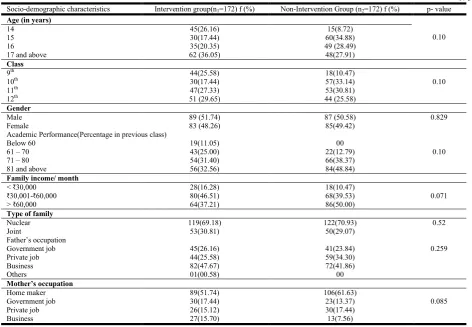
This section deals with distribution of sample characteristics among Intervention and non-intervention group. Table 1 deals with Sample Characteristic as per Intervention and Non-intervention Group. The findings revealed that in Intervention Group, maximum 36.05% of study subjects were in age group of 17 years. In Non-intervention group, majority 34.88% of study subjects were in age group of 15 years. With respect to Class, maximum 29.65% of study subjects in Intervention Group were in 12th class. As per Gender 51.74% of study subjects in Intervention Group were male and remaining 48.26% were female. In Non-Intervention group 50.58% of study subjects were male and remaining 49.42% were female. With regard to Academic Performance in previous class, majority 32.56% of study subjects were in Intervention Group scored 81% and above in their previous class and only 11.05% of study subjects have scored below 60% in their previous class. In Non-Intervention Group maximum 48.84% of study subjects scored 81% and above. According to Family income per month, maximum 46.51% of study subjects in Intervention Group had family income of ₹30,001-₹60,000 whereas in Non-Intervention Group as many as 50% of study subjects had family income of above ₹60,000. With respect to Type of family, in both the group maximum numbers of study subjects were residing in nuclear family ie in Intervention Group 69.81% and in non intervention group 70.93%.
According to Father’s occupation, most of the of study subject’s father 47.67% in Intervention Group had business. As per Mother’s occupation, mothers of majority of study subjects in Intervention Group 51.74% were home maker. The findings revealed that both the groups were comparable with respect to age, class, gender, academic performance (Percentage in previous class), family income/ month, type of family, father’s occupation and mother’s occupation.
Section II
Section II deals with assessment of prevalence and level of anxiety among study subjects. Table 2 depicts the Prevalence and Level of Anxiety among Study subjects.
Findings revealed that majority 51.14% of study subjects (mean 49.6) had average state anxiety (rank 1st) followed by 20.73% with rank 2nd (mean 55.3) high state anxiety, 19.62% with rank 3rd (mean 38.6) low state anxiety and 5.45% with rank 4th (mean 18.2) extremely low state anxiety. Least number of study subjects 3.04% with rank 5th had extremely high state anxiety (mean 62.6). Hence it was inferred that anxiety was prevalent among study subjects.
Section III
This section comprises the results of MCIP on study subjects and includes comparisons of pre and post intervention anxiety among study subjects. Table 3 depicts the Pretest and Post-test State anxiety scores in Intervention and Non-intervention group as per level of Anxiety. Findings revealed that Intervention group majority of the study subjects had high anxiety 84.30% with mean 55.6+2.54 followed by extremely high anxiety 15.69% with mean 63.9+4.22 before intervention. Post intervention scores showed that majority of the study subjects had average anxiety 62.21% with mean 48.6+3.06 followed by high anxiety 20.93% with mean 53.3+3.40 and only10.47% of study subjects had extremely high anxiety with mean 60.7+3.40. In intervention group, the difference in pretest and post test scores was found to be statistically significant at p<0.001. Hence it can be concluded that Multi Component Intervention Plan (MCIP) was effective in decreasing state anxiety of study subjects. In non intervention group also, the difference in pretest and post test scores was found to be statistically significant at p<0.05. It could have been due to extraneous variables which could have affected the level of trait anxiety among adolescents. So later in the analysis, regression analysis was done to limit the effect of extraneous variables. Table 4 depicts the Comparison of Pre and Post Intervention State Anxiety scores among Study subjects in Intervention and Non-Intervention Group. Findings revealed that in intervention group pre intervention mean was 56.9+4.1 whereas post intervention unadjusted and adjusted mean were 50.1+5.9 and 49.5+0.245 respectively. In Non-intervention group pre intervention mean was 55.8+2.67whereas post intervention unadjusted and adjusted mean were 54.4+2.8 and 54.9+0.245 respectively. There was significant difference in pre and post intervention among both the groups, so regression analysis was done and covariates were adjusted. After ANCOVA analysis, a significant difference between post interventions of both the groups was found and hence it can be inferred that intervention was effective in decreasing the anxiety of the study subjects in intervention group.
DISCUSSION
Table 1. Sample Characteristic
N-344 Socio-demographic characteristics Intervention group(n1=172) f (%) Non-Intervention Group (n2=172) f (%) p- value
Age (in years)
0.10
14 45(26.16) 15(8.72)
15 30(17.44) 60(34.88)
16 35(20.35) 49 (28.49)
17 and above 62 (36.05) 48(27.91)
Class
9th 44(25.58) 18(10.47)
0.10
10th 30(17.44) 57(33.14)
11th 47(27.33) 53(30.81)
12th 51 (29.65) 44 (25.58)
Gender
Male 89 (51.74) 87 (50.58) 0.829
Female 83 (48.26) 85(49.42)
Academic Performance(Percentage in previous class)
0.10
Below 60 19(11.05) 00
61 – 70 43(25.00) 22(12.79)
71 – 80 54(31.40) 66(38.37)
81 and above 56(32.56) 84(48.84)
Family income/ month
< ₹30,000 28(16.28) 18(10.47)
0.071
₹30,001-₹60,000 80(46.51) 68(39.53)
> ₹60,000 64(37.21) 86(50.00)
Type of family
Nuclear 119(69.18) 122(70.93) 0.52
Joint 53(30.81) 50(29.07)
Father’s occupation
0.259
Government job 45(26.16) 41(23.84)
Private job 44(25.58) 59(34.30)
Business 82(47.67) 72(41.86)
Others 01(00.58) 00
Mother’s occupation
Home maker 89(51.74) 106(61.63)
0.085
Government job 30(17.44) 23(13.37)
Private job 26(15.12) 30(17.44)
[image:4.595.110.467.437.508.2]Business 27(15.70) 13(7.56)
Table 2. Prevalence and Level of State Anxiety
N=1447
Level of Anxiety State Anxiety Trait Anxiety
n n% Mean Rank n n% Mean Rank
Extremely High 44 3.04 62.6 5 59 4.07 61.9 5
High 300 20.73 55.3 2 85 5.87 55.9 4
Average 740 51.14 49.6 1 394 27.22 46.3 2
Low 284 19.62 38.6 3 818 56.53 34.6 1
Extremely Low 79 5.45 18.2 4 91 6.28 17.1 3
Table 3. Pre-test and Post-Test State Anxiety Scores in Intervention and Non-Intervention Group
N= 344
Level of State Anxiety Pre Intervention n (n%) Mean Post Intervention n (n%) Mean Within the Group p-value
Intervention Group n = 172 n = 172
Extremely High 27 (15.69) 63.9+4.22 18 (10.47) 60.7+ 3.40
0.001
High 145 (84.30) 55.6+2.54 36 (20.93) 53.3+ 3.40
Average 00 -- 107 (62.21) 48.6+ 3.06
Low 00 -- 11 (6.40) 37.6+ 5.20
Extremely Low 00 -- 00
Non-Intervention Group n = 172 n = 172
Extremely High 17 (9.88) 61.5+ 1.77 14 (8.14) 60.2+ 1.62
0.001
High 155(90.12) 55.2+ 1.91 138 (80.23) 54.3+ 1.98
Average 00 -- 20 (11.63) 50.6 +0.94
Low 00 -- 00 --
Extremely Low 00 -- 00 --
Between the Group p-value 0.106 0.001
Table 4. Comparison of Pre and Post Intervention State Anxiety Scores
N=344
Group n Pre and Post Intervention State Anxiety Score
Pre intervention Post intervention
Mean+ SD Unadjusted Mean (SD) Adjusted Mean + SE p-value*
Intervention group 172 56.9+4.1 50.1 +5.9 49.5+0.245 0.001
Non-Intervention Group 172 55.8+2.67 54.4+ 2.8 54.9 +0.245 0.001
Between the group p-value#
0.004 0.001 .001@
[image:4.595.28.550.539.669.2] [image:4.595.29.547.702.771.2]Similarly in consistent with present study findings Sellakumar (2015) after conducting a research on adolescents studying in higher secondary school concluded that here is a significant decrease in the level of anxiety after slow deep breathing exercise. Similarly Ranjita et al. (2014)further reported that Modified Jacobson Progressive Muscle Relaxation Therapy (JPMRT) is effective in reducing anxiety. Poorgholami et al. (2014) also conducted a study to assess the effect of multimodal therapy (relaxation education, regular desensitization, and cognitive behavioural interventions) on anxiety among adolescents. The findings revealed that multimodal therapy had significant effect on decreasing the test anxiety among students as used by the researcher in present study. Similar findings are reported by Kuru et al. (2017) that Laughter therapy improved the quality of life of nursing home residents. Chang et al. (2013) reported that Laughing Qigong Program (LQP) is helpful in decreasing stress of adolescents and it is a non-pharmacological and cost – effective means to help adolescents mitigate stresses in their everyday life. Consistent to this Melike Demir, (2015)reported that not only healthy adolescents but patient suffering from some diseases like cancer can also be benefited by laughter in decreasing their anxiety. Choi W, Park J, Jung H, Yim J, Lee S(2016)17 explored that effects of laughter Therapy Interventions for Smartphone Addicts and reported that stress and anxiety is significantly reduced by the use of laughter therapy intervention. Weaver L. and Darragh, (2016) concluded after their systematic review that the effect of deep breathing in decreasing anxiety has been examined across many studies and spans a wide variety of physical, emotional, and behavioural conditions. Overall, the results from these studies were positive that deep breathing is effective in reducing anxiety and anxiety-related symptoms or behavior (e.g. nervousness, worry, fatigue, sleep disturbance). In consistent with present study findings though not the exact same intervention Shazia Ali, (2010) conducted a case study on effectiveness of relaxation therapy in the reduction of anxiety related symptoms. The researcher has combined deep breath, instant vacation, ideal relaxation and visualization.
The findings revealed drastic decrease in level of anxiety after twelve sessions of relaxation therapy as measured by IPAT Anxiety and IPAT Depression scale. Gholami et al. (2013) conducted a study to assess the impact of two methods of music therapy and relaxation on the aggression in high school students. The relaxation therapy included combination of music, PMR, Breathing exercise and imagery. The findings of the study revealed that combination of PMR, Deep breathing with music was effective in aggression of male students. The present study confirms that state anxiety is prevalent among adolescents. Multi Component Intervention Program (MCIP) was effective in reducing the anxiety among adolescents. Class, Family Income and Gender were found to be having statistically significant impact on level of anxiety among adolescents. The practice of these interventions does not require any equipment or machine or extra expenses except the willingness of the subjects to learn and practice. These strategies will help in reducing the magnitude of the problem. With respect to contributory factors present study revealed that unfulfilment of basic needs, frustration in life, physical abuse, privacy issues, too much competitive activities and parental pressure for good academic performance are most reported factors leading to anxiety among them.
Conclusion
The present study confirms that state anxiety is prevalent among adolescents. Multi Component Intervention Program (MCIP) was effective in reducing the anxiety among adolescents. Class, Family Income and Gender were found to be having statistically significant impact on level of anxiety among adolescents. The practice of these interventions does not require any equipment or machine or extra expenses except the willingness of the subjects to learn and practice. These strategies will help in reducing the magnitude of the problem. With respect to contributory factors present study revealed that unfulfilment of basic needs, frustration in life, physical abuse, privacy issues, too much competitive activities and parental pressure for good academic performance are most reported factors leading to anxiety among them.
Conflict of Interest: No conflict of interest is involved in
above research
REFERENCES
Chang C., Tsai G., Hsieh C. Psychological, immunological and physiological effects of a Laughing Qigong Program (LQP) on adolescents. Complementary Therapies in Medicine. 2013;21(6):660-668.
Choi W., Park J., Jung H., Yim J., Lee S. 2016. The Effects of Laughter Therapy Interventions for Smartphone Addicts. International Journal of Bio-Science and Bio-Technology., 8(4):189-198.
Deshpande A., Verma V. 2014. Effect of Laughter therapy and Life satisfaction in Elderly.
Dhanajay J., Indrajeet D. 2014. Development and Effectiveness of Social Adjustment Scale for Urban Adolescence. International Journal of Innovation and Scientific Research. 2014Apr:1(1);26-35
Gelkopf M. 2011. The Use of Humor in Serious Mental Illness: A Review Evidence Based Complementary Alternate Medicine. 2011:1-8
in high school students. Journal of Jahrom University of Medical Sciences. 11(2):7-12
Hasan S, Ali U. 2010. The Effectiveness of Relaxation Therapy in the Reduction of Anxiety Related Symptoms (A case Study). International Journal of Psychological Studies. 2(2):202-208.
https://data.unicef.org/topic/adolescents/adolescent-demographics
Jacabson E. 1987. Progressive Relaxation. The American Journal of Psychology. 100(3/4): 522-37
Kuru N., Kublay G. 2017. The effect of laughter therapy on the quality of life of nursing home residents. Journal of Clinical Nursing., 26(21-22):3354-3362.
Maryam Z., Maryam S. 2014. The effect of progressive muscle relaxation method on test anxiety in nursing students. Iran J Nurs Midwifery Res., Nov-Dec; 19(6): 607–612.
Melike Demir. 2015. Effects of Laughter Therapy on Anxiety, Stress, Depression and Quality of Life in Cancer Patients. Journal of Cancer, Science and Therapy. 7(9):272-273 Morreall J. 2009. A new theory of laughter. Philosophical
Studies. 42(2):243-254.
Pearce J. 2004. Some Neurological Aspects of Laughter. European Neurology. 52(3):169-171.
Poorgholami F. and Fatehi Y. 2014. An investigation of the impact of the combination of systematic desensitization and study-skills training on the reduction of students' test anxiety. Indian Journal of Fundamental and Applied Life Sciences. 4(S4):2627-2633.
Ranjita L., Sarada N. 2014. Progressive Muscle Relaxation therapy in Anxiety: A Neuro-physiological Study. IOSR Journal of Dental and Medical Sciences. 13(2):25-28. Rasid M Z., Parish S.T. 1998. Effects of two types of
relaxation training on student’s level of anxiety. Spring. 33(129);101-115
Sellakumar G. Kannaiah. 2015. Effect of slow-deep breathing exercise to reduce anxiety among adolescent school students in a selected higher secondary school in Coimbatore, India. Journal of Psychological and Educational Research. 1:54-72
Sivagurunathan, C., Umadevi, R., Rama, R., Gopalakrishnan, S. 2015. Adolescent Health: Present Status and Its Related Programmes in India. Are We in the Right Direction?. Journal of Clinical and Diagnostic Research. Mar, Vol-9(3): LE01-LE06'
Weaver L., Darragh A. 2015. Systematic Review of Yoga Interventions for Anxiety Reduction Among Children and Adolescents. American Journal of Occupational Therapy., 69(6):70.