CAN PIRFENIDONE BE A TREATMENT MODALITY IN ORAL SUB MUCOUS FIBROSIS?
1,*Dr. Shesha Prasad
1,2
Department of Oral Medicine and
3
Consultant Oral medicine and Radiology, Sri Krishna Sevashrama Hospital, Jaynagar 5
ARTICLE INFO ABSTRACT
Oral submucous
oral cavity due to the imbalance in collagen production and breakdown mediated by transforming growth factor beta (TGF
steroids, enzymes, nutritional supplements, antioxidants, interferons, turmeric, ayurveda to various drugs have been tried with weak evidence requiring better documentation of the studies performed with standardized criteria.
antifibrotic agent used extensively in lung, cardiac and liver fibrosis has still not been tried in OSMF. This drug mainly exerts it action blocking the action of TGF
research and numerous clinical trials, evaluating the systemic and topical uses of pirfenidone in OSMF with can give a ray of hope to these patients, helping them achieve a better quality of life.
aims at proposing this drug in the treatm
progressively debilitating disease, significantly improving quality of life.
Copyright © 2018, Shesha Prasad et al. This is an open
use, distribution, and reproduction in any medium, provided
INTRODUCTION
Oral submucous fibrosis (OSMF) is a debilitating potentially malignant condition resulting from the deregulation in the collagen metabolism (Arakeri and Brennan, 2013)
studies have established a dose dependant relation between areca nut and causation of OSMF (Tilakaratne
Auluck et al., 2008). Multiple aetiological factors including capsaicin in chillies, iron, zinc, and deficiencies in essential vitamins (Arakeri and Brennan, 2013; Tilakaratne
immunologic and genetic predisposition (Auluck
have also been considered. Clinically the disease progresses in stages with patients presenting with burning sensation, intolerance to spicy food, vesicles particularly on the palate, ulceration and dryness of the mouth, fibrosis of
mucosa, leading to lips, tongue, and palate rigidity and finally trismus (Arakeri and Brennan, 2013; Auluck
Annually 0.5% of OSMF cases become malignant
der Waal, 2009). Physical therapy, antioxidants, steroids, immunological modulators like interferon gamma, fibrinolytic agents like hyaluronidase, collagenase, ayurvedic treatment with turmeric, green tea and many drugs like pentoxiphylline,
*Corresponding author: Dr. Shesha Prasad, R.
Department of Oral Medicine and Radiology, The Oxford Dental College, Hosur road, Bommanahalli, Bangalore, Karnataka, India
ISSN: 0975-833X
Article History:
Received 17th January, 2018
Received in revised form 21st February, 2018
Accepted 03rd March, 2018
Published online 30th April, 2018
Citation: Dr. Shesha Prasad, R., Dr. Anuradha Pai and Dr. Anisha Yaji
International Journal of Current Research, 10, (04), 67789
Key words:
OSMF, Pirfenidone, Potentially malignant Disorder, Fibrosis.
RESEARCH ARTICLE
CAN PIRFENIDONE BE A TREATMENT MODALITY IN ORAL SUB MUCOUS FIBROSIS?
Dr. Shesha Prasad, R.,
2Dr. Anuradha Pai and
3Dr. Anisha Yaji
and Radiology, The Oxford Dental College, Hosu
Bangalore, Karnataka, India
Oral medicine and Radiology, Sri Krishna Sevashrama Hospital, Jaynagar 5
Karnataka, India
ABSTRACT
Oral submucous fibrosis (OSMF) is a potentially malignant collagen metabolic disorder affecting the oral cavity due to the imbalance in collagen production and breakdown mediated by transforming growth factor beta (TGF-β). Numerous modalities ranging from behavioural
steroids, enzymes, nutritional supplements, antioxidants, interferons, turmeric, ayurveda to various drugs have been tried with weak evidence requiring better documentation of the studies performed with standardized criteria. One drug perfinidone (5-methyl-1
antifibrotic agent used extensively in lung, cardiac and liver fibrosis has still not been tried in OSMF. This drug mainly exerts it action blocking the action of TGF-β. A positive outcome with pro research and numerous clinical trials, evaluating the systemic and topical uses of pirfenidone in OSMF with can give a ray of hope to these patients, helping them achieve a better quality of life.
aims at proposing this drug in the treatment of OSMF which can be beneficial in managing this progressively debilitating disease, significantly improving quality of life.
open access article distributed under the Creative Commons Attribution provided the original work is properly cited.
fibrosis (OSMF) is a debilitating potentially malignant condition resulting from the deregulation in the , 2013). Numerous studies have established a dose dependant relation between Tilakaratne et al., 2006; . Multiple aetiological factors including capsaicin in chillies, iron, zinc, and deficiencies in essential Tilakaratne et al., 2006) Auluck et al., 2008) have also been considered. Clinically the disease progresses in stages with patients presenting with burning sensation, intolerance to spicy food, vesicles particularly on the palate, , fibrosis of the oral mucosa, leading to lips, tongue, and palate rigidity and finally Auluck et al., 2008) Annually 0.5% of OSMF cases become malignant (Isaac van antioxidants, steroids, immunological modulators like interferon gamma, fibrinolytic agents like hyaluronidase, collagenase, ayurvedic treatment with turmeric, green tea and many drugs like pentoxiphylline,
epartment of Oral Medicine and Radiology, The Oxford Dental College, Hosur road, Bommanahalli, Bangalore, Karnataka, India.
buflomedil hydrochloride, nylidrin
OSMF. Surgical line of treatment including extra oral and intraoral flaps, micro vascular flaps, alloplasts like collagen membrane have also been tried in advanced cases
Brennan, 2013). Early intervention with habit
key to successful management in OSMF, as the disease is progressively debilitating. Pirfenidone (5
(1H)-pyridone) is a novel anti fibrotic agent with anti inflammatory properties (Shi et al
Schaefer et al., 2011), currently used in treating idiopathic lung fibrosis (ILF) which is also an inflammatory condition mediated through transforming growth factor beta(TGF Pirfenidone has been used to treat ILF successfully
2011; Cottin, 2013).We hypothesis that Perfinidone can be a novel anti fibrotic agent (Shi
beneficial in treating early stages of OSMF as both the conditions are mediated through TGF
understand the pathogenesis of OSMF in detail
morphological and molecular level to consider antifibrotic drugs like Pirfenidone as a treatment modality. In chronic betel nut addicts, repeated irritation from the coarse fibres of areca nut placed in the oral cavity causes inflammation
by the presence of activated T cells, macrophages. Cytokines like interleukin 6, tumour necrosis factor, interferon α (Rajalalitha and Vali, 2005),connective tissue growth factor
International Journal of Current Research
Vol. 10, Issue, 04, pp.67789-67793, April, 2018
Dr. Shesha Prasad, R., Dr. Anuradha Pai and Dr. Anisha Yaji, 2018. “Can pirfenidone be a treatment modality in oral sub mucous fibrosis? 67789-67793.
CAN PIRFENIDONE BE A TREATMENT MODALITY IN ORAL SUB MUCOUS FIBROSIS?
Dr. Anisha Yaji
, Hosur road, Bommanahalli,
Oral medicine and Radiology, Sri Krishna Sevashrama Hospital, Jaynagar 5
thblock, Bangalore,
fibrosis (OSMF) is a potentially malignant collagen metabolic disorder affecting the oral cavity due to the imbalance in collagen production and breakdown mediated by transforming Numerous modalities ranging from behavioural therapy, physiotherapy, steroids, enzymes, nutritional supplements, antioxidants, interferons, turmeric, ayurveda to various drugs have been tried with weak evidence requiring better documentation of the studies performed 1-phenyl-2-(1H) pyridine) a novel antifibrotic agent used extensively in lung, cardiac and liver fibrosis has still not been tried in OSMF. β. A positive outcome with prolonged research and numerous clinical trials, evaluating the systemic and topical uses of pirfenidone in OSMF with can give a ray of hope to these patients, helping them achieve a better quality of life. This paper ent of OSMF which can be beneficial in managing this progressively debilitating disease, significantly improving quality of life.
ribution License, which permits unrestricted
buflomedil hydrochloride, nylidrin, have been used to manage OSMF. Surgical line of treatment including extra oral and intraoral flaps, micro vascular flaps, alloplasts like collagen membrane have also been tried in advanced cases (Arakeri and . Early intervention with habit cessation is the key to successful management in OSMF, as the disease is progressively debilitating. Pirfenidone
(5-methyl-N-phenyl-2-pyridone) is a novel anti fibrotic agent with anti
et al., 2007; Simone et al., 2007; currently used in treating idiopathic lung fibrosis (ILF) which is also an inflammatory condition mediated through transforming growth factor beta(TGF-β). Pirfenidone has been used to treat ILF successfully (Gan et al., .We hypothesis that Perfinidone can be a Shi et al., 2007) which may be beneficial in treating early stages of OSMF as both the conditions are mediated through TGF-β. We need to pathogenesis of OSMF in detail both, at morphological and molecular level to consider antifibrotic drugs like Pirfenidone as a treatment modality. In chronic betel nut addicts, repeated irritation from the coarse fibres of areca nut placed in the oral cavity causes inflammation characterised by the presence of activated T cells, macrophages. Cytokines like interleukin 6, tumour necrosis factor, interferon α connective tissue growth factor
INTERNATIONAL JOURNAL OF CURRENT RESEARCH
(CTGF) (Ekanayaka and Tilakaratne, 2013) are also synthesized. CTGF is associated with the onset and progression of fibrosis in many human tissues. Arecoline stimulated CTGF synthesis in a dose and time dependent manner in buccal mucosal fibroblasts through reactive oxygen species (ROS), NF–kappaβ pathway has been demonstrated in OSMF (Ekanayaka and Tilakaratne, 2013).The basic fibroblast growth factor (b-FGF) is another factor which interacts synergistically with other growth factors enhancing the extra cellular matrix deposition. This is upregulated in OSMF (Ekanayaka and Tilakaratne, 2013; Bishen et al., 2008). At molecular level, OSMF is associated with two main events namely increased collagen production and decreased degradation of collagen mediated through TGF-β (Rajalalitha and Vali, 2005; Ekanayaka and Tilakaratne, 2013). Procollagen genes are activated with elevation of procollagen proteniases levels involving procollagen C-proteinase (PCP)/bone morphogenetic protein1 (BMP1) and procollagen N-proteinase (PNP). Up-regulation of lysyl oxidase (LOX) activity is also noted leading to increased collagen production (Rajalalitha and Vali, 2005). COL1A2, COL3A1, COL6A1, COL6A3, and COL7A1 are early induced procollagen genes in fibroblasts which have been identified as TGF-β targets leading to transcriptional activation of types I and VII collagen gene expression in turn increasing collagen production (Rajalalitha and Vali, 2005; Ekanayaka and Tilakaratne, 2013). Procollagen precursors PCP/ BMP -1 and PNP are processed into collagen fibrils by procollagen proteases are induced and upregulated by TGF-β (Rajalalitha and Vali, 2005). These events lead to overproduction collagen, that are cross linked by LOX, an essential enzyme for final processing of stable, cross linked collagen fibers that are resistant to proteolysis and degradation. LOX is mediated by increased copper content of areca nut (Rajalalitha and Vali, 2005; Ekanayaka and Tilakaratne, 2013).
Tissue inhibitor of matrix metalloproteinase gene (TIMPs) and plasminogen activator inhibitor (PAI) gene are activated and upregulated in OSMF leading to collagen degradation. MMP1, MMP8 and MMP 13 are matrix metalloproteinases (MMPs) which are collagenases that degrade collagen. TIMPs inhibit the degradation of collagen by these collagenases resulting in increased collagen (Rajalalitha and Vali, 2005). Plasminogen activation system (PAS) an extracellular proteolytic system plays an important role in tissue remodelling. The active plasmin activated by PAS in turn activates pro MMPs which promotes MMPs that degrades collagen. PAS is inhibited by PAI-1 and PAI-2 genes which are activated in OSMF further preventing collagen degradation (Rajalalitha and Vali, 2005; Ekanayaka and Tilakaratne, 2013). In addition to the above mechanisms reactive oxygen species (ROS) induce oxidative stress via lipid peroxidation which contributes to malignant potential of OSMF. Increased lipid peroxidation product melonaldehyde has been demonstrated by Gupta etal in OSMF (Gupta et al., 2004). The above discussion deduces that collagen metabolism is primarily affected in OSMF, resulting primarily from exposure to areca nuts. An abnormal collagen deposition and decreased collagen degradation is noted, leading to an increased deposition of collagen in the oral cavity. (Rajalalitha and Vali, 2005) The integrity and repair of collagen is mediated by many growth factors, cytokines and lymphokines. TGF-β (specifically TGF-β1) has been implicated in oral fibrosis (Rajalalitha and Vali, 2005; Ekanayaka and Tilakaratne, 2013).Pirfenidone has shown to
proliferative properties regulating key fibrotic cytokines and growth factors (Macias Barragan et al., 2010). Its pharmacological actions that can be useful in treating OSMF are enumerated below. Pirfenidone and inflammation, cytokines and growth factors. It also suppresses pro inflammatory cytokines TNF-α (Nakazato et al., 2002) and interleukin-6 which are upregulated in OSMF. T cell activation and proliferation is inhibited by pirfenidone in cell culture (Gan et al., 2011). Additionally CTGF which induces fibrosis via NF-kappaβ pathway is blocked by pirfenidone (Cho and Kopp, 2010). The basic fibroblast growth factor (b-FGF) which interacts synergistically with other growth factors enhancing the extra cellular matrix deposition in OSMF (Ekanayaka and Tilakaratne, 2013; Bishen et al., 2008) is shown to be down regulated in murine bleomycin induced pulmonary fibrosis (Gan et al., 2011).
Pirfenidone in oxidative stress
Pirfenidone is shown to ameliorate oxidative stress scavenging hydroxyl radicals in a dose-dependent manner reducing ROS (Cho and Kopp, 2010).
Perfinidone and collagen metabolism
LOX leads to cross linked collagen which is difficult to degrade. Pirfenidone is an orally active molecule exhibiting a range of biological activities. It was approved in 2011 for treatment of ILF in Europe (Cottin, 2013). Initially it was developed as an anti helminthic and antipyretic agent. It is very soluble in alcohol and chloroform; in aqueous solutions, the maximum concentration is 2%. The pirfenidone molecule is able to move through cell membranes without requiring a receptor. When administered orally, it is easily absorbed in the gastrointestinal tract, reaching most tissues and crossing the blood-brain barrier (Macias Barragan et al., 2010).
Pharmacokinetics of pirfenidone
The drug has a tmax of 0.33 to 1 hour and is rapidly absorbed from oral doses with a mean t1/2 of 2 to 2.5 hours (Shi et al., 2007). it is metabolised in liver (Nakazato et al., 2002). Concomitant food intake reduces the bioavailability of the drug up to 20%. Food intake with the drug is also known to reduce the gastric irritation (Shi et al., 2007; Macias Barragan et al., 2010). The plasma pirfenidone levels fell rapidly, with a mean residence time of 6.3 min, which agrees with the rapid disappearance of the drug. Moderate extra vascular distribution occurred within 5 min with the volume of distribution at steady state (Vdss) being 0.71 ml/g, with the drug reaching the following areas in descending order: kidney, liver, ventricle, lung, spleen, pancreas, testes, GI system, brain, skeletal muscle, adrenal glands and epididymal fat pad (Macias Barragan et al., 2010). In any fibrotic diseases, the amount of collagen deposited in the tissue is controlled by the balance between synthesis and degradation of collagen in ECM by matrix MMPs, which are regulated by TIMPs mediated by TGF-β. This occurs at the transcriptional and translational level. TGF-β is down regulated by pirfenidone (Macias Barragan et al., 2010).
Safety profile of pirfenidone
Most clinical trials describe that pirfenidone is generally well tolerated in doses up to 2400 mg daily (800 mg three times daily). The most common adverse effects include gastrointestinal (nausea, dyspepsia, diarrhea, abdominal discomfort, and vomiting), anorexia, fatigue, sedation, and photosensitivity rash which are dose related (Cottin, 2013; Cho and Kopp, 2010).
Clinical trials using perfinidone
In Animal models (Table1)
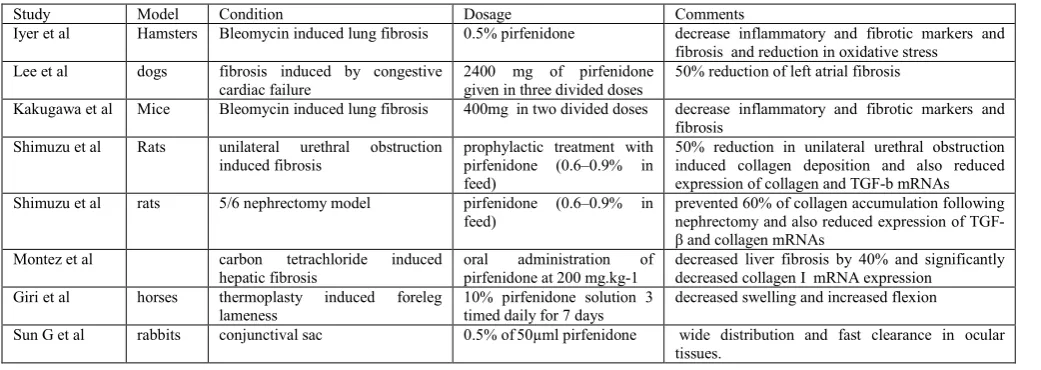
Bleomycin induced lung fibrosis in mice treated with 400mg by Kakugawa et al in two divided doses showed decrease inflammatory and fibrotic markers and fibrosis (Schaefer et al., 2011). In addition to the above findings another study by Iyer
et al showed reduction in oxidative stress in hamsters fed with 0.5% pirfenidone (Schaefer et al., 2011). 2400 mg of pirfenidone given in three divided doses in dogs with congestive cardiac failure for three weeks showed decrease inflammatory and fibrotic markers and fibrosis. 50% reduction of left atrial fibrosis induced by congestive cardiac failure was noted by Lee et al (Schaefer et al., 2011).
The effect of pirfenidone on unilateral urethral obstruction induced fibrosis in rats was studied. In this model, prophylactic treatment with pirfenidone (0.6–0.9% in feed) yielded a 50% reduction in unilateral urethral obstruction induced collagen deposition and also reduced expression of collagen and TGF-b mRNAs. The effect of pirfenidone in the 5/6 nephrectomy model in rats was evaluated. In this study by Shimuzu et al, pirfenidone treatment (0.6–0.9% in feed) prevented 60% of collagen accumulation following nephrectomy and also reduced expression of TGF-β and collagen mRNAs (Schaefer
et al., 2011).
The efficacy of oral administration of pirfenidone at 200 mg.kg-1 in carbon tetrachloride induced hepatic fibrosis decreased liver fibrosis by 40% and significantly decreased collagen I mRNA expression as shown by Montez et al
[image:3.595.41.562.603.788.2](Schaefer et al., 2011; García et al., 2002). The most commonly evaluated marker of fibrosis in the above studies is TGF- β. A total of 11 studies which evaluated expression of TGF- β showed that TGF- β was upregulated in the fibrotic state and that pirfenidone treatment significantly reduced TGF- β expression (Schaefer et al., 2011). A topical application of 10% pirfenidone solution 3 timed daily for 7 days decreased swelling and increased flexion in thermoplasty induced foreleg lameness in horses (Gan et al., 2011). 0.5% of 50µml pirfenidone placed in rabbits conjunctival sac showed wide distribution and fast clearance in ocular tissues. Research using this data is going on to treat glaucoma (Sun et al., 2011).
Table 1. Pirfenidone in animal trials
Study Model Condition Dosage Comments
Iyer et al Hamsters Bleomycin induced lung fibrosis 0.5% pirfenidone decrease inflammatory and fibrotic markers and fibrosis and reduction in oxidative stress
Lee et al dogs fibrosis induced by congestive
cardiac failure
2400 mg of pirfenidone given in three divided doses
50% reduction of left atrial fibrosis
Kakugawa et al Mice Bleomycin induced lung fibrosis 400mg in two divided doses decrease inflammatory and fibrotic markers and fibrosis
Shimuzu et al Rats unilateral urethral obstruction induced fibrosis
prophylactic treatment with pirfenidone (0.6–0.9% in feed)
50% reduction in unilateral urethral obstruction induced collagen deposition and also reduced expression of collagen and TGF-b mRNAs
Shimuzu et al rats 5/6 nephrectomy model pirfenidone (0.6–0.9% in
feed)
prevented 60% of collagen accumulation following nephrectomy and also reduced expression of TGF-β and collagen mRNAs
Montez et al carbon tetrachloride induced
hepatic fibrosis
oral administration of pirfenidone at 200 mg.kg-1
decreased liver fibrosis by 40% and significantly decreased collagen I mRNA expression
Giri et al horses thermoplasty induced foreleg
lameness
10% pirfenidone solution 3 timed daily for 7 days
decreased swelling and increased flexion
Sun G et al rabbits conjunctival sac 0.5% of50µml pirfenidone wide distribution and fast clearance in ocular
Human trials (Table 2)
Clinical trials on pulmonary fibrosis associated with focal segmental glomerulosclerosis, ILF, hypertrophic cardiomyopathy, kidney disease in patients with diabetes, and fibrosis caused by radiation therapy for cancer has been done using pirfenidone (Macias Barragan et al., 2010).
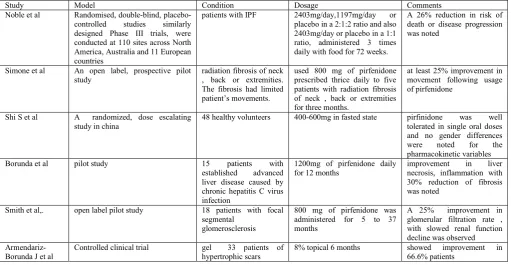
A multicentric, double-blind, placebo-controlled, randomised Phase III clinical trial was conducted in Japan by Azuma et al
to determine the efficacy and safety of pirfenidone in 275 patients with IPF. Patients were randomised to pirfenidone 1800 mg per day, pirfenidone 1200 mg per day or placebo using a 2:1:2 ratios, with 267 patients evaluated for the efficacy of pirfenidone with its dose increased in a stepwise manner over four weeks. Pirfenidone was associated with a 44% reduction in the vital capacity decline compared with placebo (Cottin, 2013). Randomised, double-blind, placebo-controlled studies similarly designed Phase III trials, were conducted at 110 sites across North America, Australia and 11 European countries using pirfenidone /day, 1197mg/day or placebo in a 2:1:2 ratio and also 2403mg/day or placebo in a 1:1 ratio, administered 3 times daily with food for 72 weeks.
A 26% reduction in risk of death or disease progression was noted (Cottin, 2013). An open label, prospective pilot study by Simone et al used 800 mg of pirfenidone prescribed thrice daily to five patients with radiation fibrosis of neck , back or extremities for three months. The fibrosis had limited patient’s movements. The study results showed at least 25% improvement in movement following usage of pirfenidone (Simone et al., 2007). A randomized, dose escalating study in china on 48 healthy volunteers showed that pirfinidone was well tolerated in single oral doses 400-600mg in fasted state (Shi et al., 2007) and no gender differences were noted for the pharmacokinetic variables (Shi et al., 2007), Macias Barragan
et al., 2010). In a pilot study by Borunda et al, 15 patients with established advanced liver disease caused by chronic hepatitis C virus infection were treated for 12 months using
inflammation with 30% reduction of fibrosis was noted (Macias Barragan et al., 2010). In an open label pilot study by Smith et al, 800 mg of pirfenidone was administered for 5 to 37 months in 18 patients with focal segmental glomerosclerosis. A 25% improvement in glomerular filtration rate, with slowed renal function decline was observed (Macias Barragan et al., 2010).
8% topical gel used in 33 patients for 6 months in treating hypertrophic scars showed improvement in 66.6% patients (Macias Barragan et al., 2010).
Conclusion
Clinical trials evaluating the effectiveness of pirfenidone in OSMF has not been done. It is clear that clinical trials involving this drug for fibrosis involving lung, kidney, liver and heart have shown significant improvement in ameliorating the disease intensity. Dose adjustment in OSMF patients in accordance with the clinical staging and minimal effective dosage in decreasing the existing oral fibrosis needs to be assessed. Use of topical preparations in OSMF, as the disease is localised to the oral cavity mostly has to be evaluated. Another parameter that needs to be addressed is the duration of treatment in OSMF. A positive outcome with prolonged research and numerous clinical trials, evaluating the systemic and topical uses of pirfenidone in OSMF with can give a ray of hope to these patients, helping them achieve a better quality of life.
REFERENCES
Arakeri, G. and Brennan, PA. 2013. Oral submucous fibrosis: an overview of the aetiology, pathogenesis, classification, and principles of management. Br J Oral Maxillofac Surg.,
51: 587–93.
[image:4.595.42.554.168.433.2]Auluck, A., Rosin, MP., Zhang, L. and Sumanth, KN. 2008. Oral Submucous Fibrosis, a Clinically Benign but
Table 2. Pirfenidone in human trials
Study Model Condition Dosage Comments
Noble et al Randomised, double-blind, placebo-controlled studies similarly designed Phase III trials, were conducted at 110 sites across North America, Australia and 11 European countries
patients with IPF 2403mg/day,1197mg/day or
placebo in a 2:1:2 ratio and also 2403mg/day or placebo in a 1:1 ratio, administered 3 times daily with food for 72 weeks.
A 26% reduction in risk of death or disease progression was noted
Simone et al An open label, prospective pilot study
radiation fibrosis of neck , back or extremities. The fibrosis had limited patient’s movements.
used 800 mg of pirfenidone prescribed thrice daily to five patients with radiation fibrosis of neck , back or extremities for three months.
at least 25% improvement in movement following usage of pirfenidone
Shi S et al A randomized, dose escalating study in china
48 healthy volunteers 400-600mg in fasted state pirfinidone was well
tolerated in single oral doses and no gender differences
were noted for the
pharmacokinetic variables
Borunda et al pilot study 15 patients with
established advanced liver disease caused by chronic hepatitis C virus infection
1200mg of pirfenidone daily for 12 months
improvement in liver
necrosis, inflammation with 30% reduction of fibrosis was noted
Smith et al,. open label pilot study 18 patients with focal
segmental glomerosclerosis
800 mg of pirfenidone was administered for 5 to 37 months
A 25% improvement in glomerular filtration rate , with slowed renal function decline was observed
Armendariz-Borunda J et al
Controlled clinical trial gel 33 patients of
hypertrophic scars
8% topical 6 months showed improvement in
Potentially Malignant Disease: Report of 3 Cases and Review of the Literature. JCDA., 74:735-40.
Bishen, KA., Radhakrishnan, R. and Satyamoorthy, K. 2008. The role of basic fibroblast growth factor in oral submucous fibrosis pathogenesis. J Oral Pathol Med., 37: 402–11.u
Cho, ME. and Kopp, JB. 2010. Pirfenidone: an anti-fibrotic and cytoprotective agent as therapy sfor progressive kidney disease. Expert Opin Investig Drugs., 19(2): 275–83. Cottin,V. 2013. The role of pirfenidone in the treatment of
idiopathic pulmonary fibrosis. Respiratory Research,
14(1):S5.
Ekanayaka, RP. and Tilakaratne, WM. 2013. Oral Submucous Fibrosis: Review on Mechanisms of Pathogenesis and Malignant Transformation. J Carcinogene Mutagene., S5. Gan, Y., Herzog, EL. and Gomer, RH. 2011. Pirfenidone
treatment of idiopathic pulmonary fibrosis. Therapeutics and Clinical Risk Management, 7; 39–47.
García, L., Hernández, I., Sandoval, A., Salazar, A., Garcia, J.,
et al., 2002. Pirfenidone effectively reverses experimental liver fibrosis. J Hepatol., 2002 ;37(6):797-805.
Gupta, S., Reddy, MVR. and Harinath, BC. 2004. Role of oxidative stress and antioxidants in aetiopathogenesis and management of oral submucous fibrosis. Indian J Clin Biochem.
, 19(1):138-41.
Isaac van der Waal, 2009. Potentially malignant disorders of the oral and oropharyngeal mucosa; terminology, classification and present concepts of management Oral Oncol., 45: 317–23.
Macias Barragan, J., Sandoval Rodriguez, A., Navarro Partida, J. and Armendáriz Borunda, J. 2010. The multifaceted role of pirfenidone and its novel targets. Fibrogenesis Tissue Repair. 3:16.
Nakazato, H., Oku, H., Yamane, S., Tsuruta, Y. and Suzuki, R. 2002. A novel anti-fibrotic agent pirfenidone suppresses tumor necrosis factor-alpha at the translational level. Eur J Pharmacol., 446(1-3):177-85.
Rajalalitha, P. and Vali, S. 2005. Molecular pathogenesis of oral submucous fibrosis –a collagen metabolic disorder. J Oral Pathol Med., 34: 321–8.
Schaefer, CJ., Ruhrmund, DW., Pan, L., Seiwert, SD. and Kossen, K. 2011. Antifibrotic activities of pirfenidone in animal Models. Eur Respir Rev., 20: 120, 85–97.
Shi, S., Wu, J., Chen, H., Chen, H., Wu, J., et al., 2007. Single and Multiple Dose Pharmacokinetics of Pirfenidone, an antifibrotic agent, in healthy Chinese volunteers. J Clin Pharmacol.,47; 1268-76.
Simone, NL., Soule, BP., Gerber, L., Augustine, E., Smith, S.
et al., 2007. Oral Pirfenidone in patients with chronic fibrosis resulting from radiotherapy: a pilot study. Radiat oncol., 2:19.
Sun, G., Lin, X., Zhong, H., Yang, Y. and Qiu, X. 2011. Pharmacokinetics of pirfenidone after topical administration in rabbit eye. Mol Vis., 17: 2191–96. Tilakaratne, WM., Klinikowski, MF., Saku, T., Peters, TJ. and