ISSN Print: 2161-6795
DOI: 10.4236/wjnst.2019.93010 Jul. 16, 2019 140 World Journal of Nuclear Science and Technology
Atom’s Nuclear Structure and the Periodic
Table of the Chemical Elements
Faustino Menegus
V. Europa 15, Bussero, Italy
Abstract
A new method for the identification of the chemical Elements isotopes takes advantage of the isotope Neutron Excess (NE) number. The representation of the natural isotopes in the Z-NE plane reveals a surprising correspondence between atom’s nuclear and electronic structures. Nuclear directs the atom electronic structure in spite of the alternative set of numbers ruling the two main atom’s compartments. These compartments appear better integrated than actually considered. The Mendeleev periodic table is rooted in the atom’s nuclear structure. Two recent studies arrive to identical conclusions.
Keywords
Periodic Table, Atom’s Structure, Nuclear Structure, Electronic Structure
1. Introduction
Atomic nuclei birth takes place in the star interior at temperatures and pressures allowing their nucleosynthesis. Following migration at the star periphery, the reduced temperature and pressure allow nuclei to acquire the necessary elec-trons to become the stabilized atoms constituting the chemical Elements of our world [1]. The heavy central nuclear, r = 10−15 m and close to 100% of the atomic
mass, and the external electronic cortex, r = 10−10 m and close to 100% of the
atomic volume, appear as very distinct and somehow independent atom’s com-partments. Two distinct branches of physics, nuclear and atomic, describe the above compartments notably ruled by two different sets of numbers: 2, 8, 20, 28, 50, 82, 126 the proton-neutron nuclear magic numbers and 2, 10, 18, 36, 54, 86 the noble gases electron numbers, respectively. While the noble gases numbers satisfactory describe the chemical Elements electronic structure and properties, this is not the case for the magic numbers. The nuclear structure is still an open How to cite this paper: Menegus, F.
(2019) Atom’s Nuclear Structure and the Periodic Table of the Chemical Elements. World Journal of Nuclear Science and Technology, 9, 140-145.
https://doi.org/10.4236/wjnst.2019.93010
Received: June 9, 2019 Accepted: July 13, 2019 Published: July 16, 2019
Copyright © 2019 by author(s) and Scientific Research Publishing Inc. This work is licensed under the Creative Commons Attribution International License (CC BY 4.0).
DOI: 10.4236/wjnst.2019.93010 141 World Journal of Nuclear Science and Technology field [1]. So different compartments constitute, nevertheless, stable and defined objects: the atoms of the chemical Elements. We suggest here that subtle influ-ences exist between the nuclear and the electronic structure, the latter, likely dictated by the nuclear one. Besides the strong electrostatic interaction between the nucleus and the electrons, a cross-talk of electromagnetic nature takes place between the atom’s main compartments: the analysis of atom’s electronic spectra allows the retrieval of important nuclear information [2]. Mendeleev maintained that, in addition to the periodic properties, each element has its own personality
[3]. Properties like the diagonal behavior, Li and Be have similarities with Mg and Al respectively, or the knight’s move, whereby Zn resembles Sn, may be of nuclear origin. To provide the ground for the discussion of the above ideas, it was decided to employ the representation of the chemical Elements isotopes by the Neutron Excess number [4] [5]. Such a representation contains the basic elements of both the nuclear and electronic atom’s compartments.
Recently Mao J., guided by the most abundant isotope of each Element, pro-posed the atom’s nuclear structure as the root of the periodic table [6]. Identical conclusions where reached, Bonchev D. [7], using the tools of the Information Theory [8]. An idea of the present work is contained in a poster presentation at the 15th International Conference on Condensed Matter Nuclear Science: Rome
2009 [9].
2. Methods
The Excess Neutron (EN) number of the isotope ZXA of the element X was
cal-culated by the equation: EN = A − 2Z. The mass numbers A were from K. Lod-ders [10]. The results constitute a new method for the representation of the chemical Element’s isotopes in the Z-NE plane.
3. Results
The representation of the chemical Elements isotopes by the Neutron Excess number
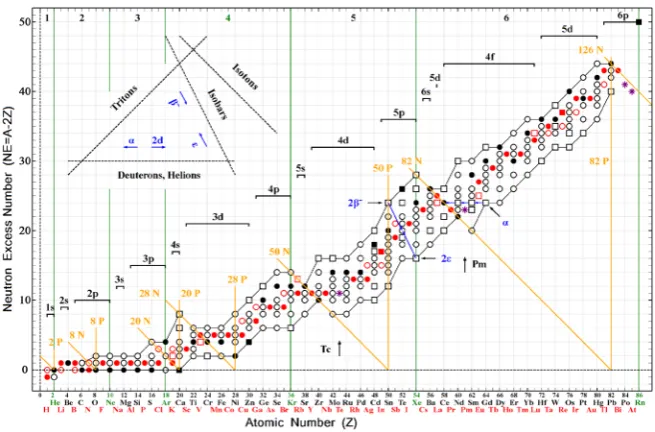
In Figure 1, the electronic structure of the Elements is represented by the principal quantum number, n = 1, 2, 3…., and by the orbital angular momen-tum quanmomen-tum number, the latter, as usual, by the letters s, p, d, f. The natural isotopes of the chemical Elements are represented by the atomic Z number and by their Neutron Excess number (NE). With Z = P = proton number, N = neutron number, A = P + N = mass number, NE = N − P = Neutron Excess number, the relationship A = NE + 2Z holds for each isotope represented in
Figure 1.
DOI: 10.4236/wjnst.2019.93010 142 World Journal of Nuclear Science and Technology Figure 1. Representation of the Elements isotopes by the Neutron Excess number, NE = A − 2Z, in the Z-NE plane and the respective electronic structure. The noble gases limit-ing the periods of the periodic table, indicated at the top of the figure, are green; s, p, d, f, indicate the electron’s angular momentum quantum numbers. Highlighted are the pro-ton-neutron couples of the nuclear magic numbers. Even and odd Element’s symbols are black and red respectively; ( ) ( ) represent stable and radioactive isotopes respec-tively, with the full symbol indicating the most abundant isotope of each Element; ( ) represents the most stable isotope of the artificial Elements. The inset shows basic rela-tionships between the isotopes along with radioactive decay paths.
What matters to be noted here is that, with the progress of the Z number, the nuclear EN addition takes place with pauses, upsurges and reductions that pa-rallel the periodicity of the chemical Elements properties, the latter marked by the noble gas location. In fact following He, Ne, Ar, Kr and Xe there is first a pause, period 2, 3 and 4 or a reduction, period 5 and 6 of the maxima of the NE level addition to the Elements nuclei; see discussion for the anomalous situation at Ca. Most important is the net NE upsurge, coincident with the electron filling of the p orbitals, reaching completeness at the noble gases. The electron filling of the 3 d orbitals takes place with a clear EN addition pause. That pause, still present in the 4 d and in the subsequent f and d orbitals, progressively vanish because of a robust NE addition. The NE addition is required to counteract the nuclear proton-proton repulsion caused by the Z progress [4]. Closure of the Table periods, with maxima of the nuclear NE levels, is a strong indication of a nuclear periodicity, repeating that of the electronic compartments.
DOI: 10.4236/wjnst.2019.93010 143 World Journal of Nuclear Science and Technology element convey the same information contained in the upper border of the β-stability valley, see also [6].
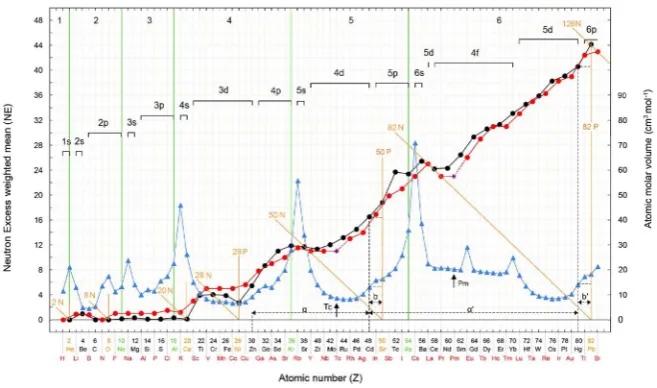
Further support to the idea that the electronic may reflect atom’s nuclear structure comes from Figure 2, representing the weighted means of the Ele-ments NE content. Periods 4, 5 and 6 show again a clear correspondence of the electronic with the nuclear structure: a sharp nuclear NE increase accompanies the electron filling of the p orbitals, reaching maxima at the noble gases. The NE pause after Ar and its reduction after Kr and Xe mark the electron filling of the d and f orbitals. The message of Figure 2 reinforces that of Figure 1 in spite of the notable discrepancy for the light Elements up to Ti. The evolvement of the Ele-ments molar atomic volume [11], with the progress of Z, is anything but a mo-notonous-one, like that of the NE addition to nuclei. The sharp volume increase of the alkaline and alkaline earth metals, coinciding with the s orbitals filling next to the noble gases NE maxima, stresses a nuclear-electronic structure cor-respondence.
It is well known from inorganic chemistry that in addition to the periodical similarities of Zn and Cd with Cd and Hg respectively, Zn and Cd show in addi-tion similarities with Sn and Pb respectively. This last property is known as the Knight’s move relationship [12]: one step down and two steps right in the peri-odic table, as in the game of chess [3]. Figure 2 shows that relationship from the nuclear point of view.
4. Discussion
[image:4.595.209.538.450.644.2]In Figure 1 the 46Ca and the 48Ca isotopes, at variance with the situation in Mg,
DOI: 10.4236/wjnst.2019.93010 144 World Journal of Nuclear Science and Technology Sr and Ba, show an abnormal NE increase corresponding to the electron filling of the s orbitals. This exception may be the result of the paramount influence, on the nuclear structure, of the combined effects of the 20 P and the 28 N magic numbers. The NE drop behind Kr and Xe, followed by its resumption with the progress of Z, is the result of the NE reduction connected to the 50 N and the 82 N respectively.
The lack of NE maxima at Ne and Ar in Figure 2 is the result of the nucleo-synthesis mechanisms: nuclear fusion, fading at Fe, for the light Elements, then replaced by the neutron capture processes [1]. The NE drop, connected with the 50 N and the 82 N isotons, shows up again with the 126 N isoton, accompanied by dramatic consequences: beyond Bi atom’s nuclei become unstable. The NE drop is evidenced by the reduced NE content of the most long-lived isotopes of Po and At. A NE recovery takes place with the most long-lived isotope of Rn, confirming NE maxima for the noble gases. Notably the 126 N isoton does not relate to a noble gas. It relates however with the complete filling of the 4f and 5d orbitals.
At variance with the upper, the lower border of the β-stability valley doesn’t reflect the Element’s electronic structure, because it is differently affected by the 50 and 82 neutron magic numbers (Figure 1). As proposed by J. Mao [6], the most abundant isotope of the Elements reflects the atom electronic structure: a suggestion confirmed by the full symbol isotopes in Figure 1. The weighted means of the Elements NE content (Figure 2) confirm again the nuc-lear-electronic structure correlation.
In Figure 2, the nuclear interpretation of the knight’s move shows that mov-ing two steps at the right of Cd and Hg, Sn and Pb are reached respectively. In both cases the identical nuclear circumstance is found: the shift zeroes the in-fluence of the 50 and 82 neutron magic numbers [4] [5], with the consequent increase of the Elements molar atomic volume [11] and as well as that of the NE level. Changes that may offer a key for the interpretation of the knight’s move, presently still debated [13] and, at the same time, may constitute a validation test for the suggestions of the present work.
5. Conclusion
The representation of the natural isotopes in the Z-NE plane, together with the basic elements of their nuclear and electronic structures, convey the idea that nuclear directs the atom’s electronic structure. In particular, the Element’s elec-tronic structure is reflected in the upper border of the β-stability valley, and in the evolution of the NE number of the most abundant isotope of each Element (Figure 1). This last observation agrees with the findings of J. Mao [6]. Figure 2
DOI: 10.4236/wjnst.2019.93010 145 World Journal of Nuclear Science and Technology
Acknowledgements
The author thanks Maurizio Zanardini for the graphical work.
Conflicts of Interest
The authors declare no conflicts of interest regarding the publication of this pa-per.
References
[1] Shaviv, G. (2012) The Synthesis of the Elements. Astrophysics and Space Science Library. Springer, Heidelberg, New York, Dordrecht, London.
https://doi.org/10.1007/978-3-642-28385-7_12
[2] Palffy, A. (2011) Nuclear Effects in Atomic Transitions.
[3] Scerri, E.R. (2007) The Periodic Table. Oxford University Press, Oxford, New York. [4] Menegus, F. (2016) The Representation of the Chemical Element’s Isotopes by the
Neutron Excess Content. World Journal of Nuclear Science and Technology, 6, 147-152. https://doi.org/10.4236/wjnst.2016.63016
[5] Menegus, F. (2018) A Suggestion Complementing the Magic Numbers Interpreta-tion of the Nuclear Fission Phenomena. World Journal of Nuclear Science and Technology, 8, 11-22. https://doi.org/10.4236/wjnst.2018.81002
[6] Mao, J. (2017) The Periodic Table Possible Coincided with an Unfolded Shape of Atomic Nuclei. Applied Physics Research, 9, 47-57.
https://doi.org/10.5539/apr.v9n6p47
[7] Bonchev, D. (2004) Periodicity of the Chemical Elements and Nuclides: An Infor-mation-Theoretical Analysis.
https://www.researchgate.net/.../236671879_Periodicity_of_the
[8] Brillouin, L. (1956) Science and Information Theory. Academic Press, New York. [9] Menegus, F. (2009) Nuclear and Electronic Structure of Atoms. Proceedings of the
15th International Conference on Condensed Matter Nuclear Science, Rome, 5-9 October 2009, 378-381.
[10] Lodders, K. (2003) Solar System Abundances and Condensation Temperatures of the Elements. The Astrophysical Journal, 591, 1220-1247.
https://doi.org/10.1086/375492
[11] Singam, C.N. (1984) Atomic Volume and Allotrpy of the Elements. Journal of Chemical Education, 61, 137-142. https://doi.org/10.1021/ed061p137
[12] Laing, M. (1999) The Knight’s Move in the Periodic Table. Education in Chemistry, 36, 160-161.
[13] Rayner-Canham, G. and Oldford, M. (2007) The Chemical Knight’s Move Rela-tionship: What Is Its Significance? Foundations of Chemistry, 9, 119-125.