Wild chimpanzees select tool material based on efficiency and knowledge
Journal: Proceedings B
Manuscript ID RSPB-2018-1715.R1
Article Type: Research
Date Submitted by the Author: 17-Sep-2018
Complete List of Authors: Lamon, Noemie; Universite de Neuchatel Institut de Biologie, Comparative Cognition
Neumann, Christof; Universite de Neuchatel Institut de Biologie, Comparative Cognition
Gier, Jennifer; Universite de Neuchatel Institut de Biologie, Comparative Cognition
Zuberbuhler, Klaus; University of St Andrews, School of Psychology Gruber, Thibaud; University of Oxford Mathematical Physical and Life Sciences Division, Zoology; Université de Genève, Swiss Center for Affective Sciences
Subject: Behaviour < BIOLOGY, Cognition < BIOLOGY
Keywords: tool use, efficiency, sponges, subculture, field experiment, Pan troglodytes schweinfurthii
Proceedings B category: Behaviour
Wild chimpanzees select tool material based on efficiency and knowledge
1
2
Noemie Lamon1,2*, Christof Neumann1, Jennifer Gier1, Klaus Zuberbühler1,2,3†, Thibaud
3
Gruber2,4,5†*
4
5
1
Department of Comparative Cognition, University of Neuchâtel, 2000 Neuchâtel,
6
Switzerland
7
2
Budongo Conservation Field Station, Masindi, Uganda;
8
3 School of Psychology and Neuroscience, University of St Andrews, Fife KY16 9JP, UK; 9
4 Swiss Center for Affective Sciences, University of Geneva, 1211 Geneva, Switzerland; 10
5
Department of Zoology, University of Oxford, OX1 3PS, UK
11
12
*: Correspondence to: Thibaud Gruber, [email protected] and Noémie Lamon,
13
14
†: joint senior authors
15
16
Keywords: tool use, efficiency, sponges, field experiment, subculture, Pan troglodytes 17
schweinfurthii 18
Abstract
20
Some animals have basic culture but to date there is not much evidence that cultural traits
21
evolve as part of a cumulative process as seen in humans. This may be due to limits in animal
22
physical cognition, such as an inability to compare the efficiency of a novel behavioural
23
innovation with an already existing tradition. We investigated this possibility with a study on
24
a natural tool innovation in wild chimpanzees, moss-sponging, which recently emerged in
25
some individuals to extract mineral-rich liquids at natural clay-pits. The behaviour probably
26
arose as a variant of leaf-sponging, a tool technique seen in all studied chimpanzee
27
communities. We found that moss-sponges not only absorbed more liquid but were
28
manufactured and used more rapidly than leaf-sponges, suggesting a functional improvement.
29
To investigate whether chimpanzees understood the advantage of moss- over leaf-sponges we
30
experimentally offered small amounts of rainwater in an artificial cavity of a portable log,
31
together with both sponge materials, moss and leaves. We found that established
moss-32
spongers (having used moss at clay-pits) preferred moss to prepare a sponge to access the
33
rainwater, whereas leaf-spongers (never observed using moss) preferred leaves. Survey data
34
finally demonstrated that moss was common in forest areas near clay-pits but nearly absent in
35
other forest areas, suggesting that natural moss-sponging was, at least partly, constrained by
36
ecology, not knowledge. Together, these results suggest that chimpanzees perceive functional
37
improvements in tool quality, a crucial prerequisite for cumulative culture.
38
Introduction
40
Over the last decades, social network analyses and experiments in the wild and captivity have
41
produced evidence that some animal behaviour can spread socially [1-4] giving ground for the
42
notion of animal cultures [5]. Yet, there is still little compelling evidence for evolution of
43
cultural traits within groups or populations of animals. Consequently, animal cultures remain
44
seen as stagnant, population-level portfolios of behaviour, much in contrast to what is seen in
45
humans [6-8].
46
47
While cultural evolution has become a hot topic in science [9], the term is not uniformly
48
defined, especially when applied to animals. According to some definitions, cultural evolution
49
occurs through stochastic, drift-like processes, as seen in changes in the songs of humpback
50
whale and some birds [10, 11]. Other definitions require that cultural evolution entails some
51
sort of functional improvement, similar to natural selection, a process termed ‘Cumulative
52
Cultural Evolution’ (CCE). For instance, Schofield et al. [12, p.114] define CCE as “…a
53
modification […] of a cultural trait (i.e., acquired via social learning) that enhances its
54
complexity, efficiency, security, or convenience”, a definition we use in this article.
55
Importantly, this view of CCE does not mandate incremental changes in the complexity of
56
behavioural traditions, as proposed by other authors [6-8], as this effectively limits the notion
57
of cultural evolution to humans, a perspective we and others ([13, 14]) find unhelpful for
58
evolutionary studies. Cultural evolution, in our view, is equivalent to cultural change, which
59
also broadens the range of relevant research to include, for example, experimental studies of
60
zebra finch song or route learning in pigeons [15, 16].
61
Whatever definition is adopted, the current literature remains weak on examples of cultural
63
change, particularly in wild animals and for tool use, which is astonishing considering the
64
growing interest in animal innovations and traditions [17]. While all current cultural traits
65
must have started off as innovations, most innovations in animals are not copied by others and
66
remain one-off occurrences [e.g. 18]. This is particularly true for chimpanzees (Pan
67
troglodytes), a species well known for its culturally acquired behaviour [19], where only few
68
of numerous behavioural innovations have spread through communities [20, 21].
69
70
This has led to the hypothesis that, compared to humans, animals experience fundamental
71
limitations in the types of social learning required for high-fidelity spread of novel
72
behaviours, which some authors consider a precondition for CCE [6-8]. For example, while
73
there is consensus that chimpanzees are avid social learners, they may achieve this by
74
stimulus enhancement, local enhancement or emulation [22], but not through imitation or
75
teaching [6, 23]. As a result, chimpanzees may not truly understand the behaviours they learn
76
from others but need to re-invent the wheel anew from one generation to the next [6-8]. A
77
similar point has been made for New Caledonian crows (Corvus moneduloides), a species for
78
which there is evidence for local and stimulus enhancement, but not for imitation for
79
behaviour transmission between conspecifics and with humans [24, 25]. Nevertheless, more
80
work is needed in both species to identify the specific social learning mechanisms that
81
contribute to the transmission of tool designs. In addition, others have argued that imitation
82
and teaching are not necessary for CCE to occur, neither in animals nor in humans [26, 27],
83
suggesting that an exclusive focus on social learning mechanisms may prevent a deeper
84
understanding of CCE.
85
Another hypothesis for low levels of cultural evolution in animals is based on limitations in
87
physical cognition [e.g. 28]. Individuals may be unable to recognise that a novel behaviour is
88
more suited for a given task compared to a pre-existing one, and thus fail to experience a
89
motivation to adopt the new behaviour, even if it is more advantageous. Animals, in other
90
words, may simply lack the cognitive ability to understand the functional consequences of
91
physical actions upon the environment, which consequently prevents them from improving
92
previously acquired cultural behaviours [29, 30].
93
94
This view is controversial, however, as chimpanzees and other species in the wild have
95
demonstrated some understanding of the physical properties of their tools (e.g. Western
96
chimpanzees (P.t. verus) [31], capuchin monkeys (Sapajus libidinosus) [32]). For example,
97
most chimpanzees use sticks to fish for termites, but Central chimpanzees (P.t. troglodytes)
98
also manufacture more efficient brush-tipped sticks [33], suggesting that the Central African
99
technique emerged from the unmodified technique. Interestingly, migrating female Western
100
chimpanzees adopt a less efficient nut-cracking technique to conform to the prevalent
101
behaviour of their new social group at the cost of personal efficiency [34]. Among
non-102
primates, New Caledonian crows manufacture probing tools to capture invertebrates in trees
103
from the long-barbed edges of palm-like Pandanus leaves, but designs differ across groups of
104
animals [35]. In particular, hooked stick tools may have evolved from unmodified stick tools,
105
possibly due to CCE [36, 37].
106
107
Causal understanding of tool properties has also been demonstrated in captivity, notably for
108
all great apes [38, 39] and New Caledonian crows [40]. For example, chimpanzees can change
109
from one technique to another if there is a noticeable improvement in efficiency [41, 42]. As
always with captive studies, the concern remains that capacities demonstrated by subjects may
111
be a by-product of conditions absent in natural environments. One solution is to carry out
112
controlled experiments with wild-born animals under laboratory conditions [43], as
113
demonstrated for wild-caught New Caledonian crows that discriminate differences in design
114
features of hooked stick tools in captivity [44].
115
116
In sum, the current literature is unable to provide a clear picture regarding the question of
117
whether culturally acquired behaviour in animals can change in directed ways. While captive
118
studies have demonstrated the ability of animals to improve both individually and socially
119
learned techniques, these findings may be artefacts of captive conditions and, as such, of
120
limited value to understand the cultural repertoires described in the wild. Similarly, while
121
field studies have documented naturally occurring changes in behavioural traditions,
122
sometimes with differences in complexity, we are not aware of any documented transition in a
123
cultural trait changing from a less to a more efficient variant, which would provide strong
124
evidence for CCE in wild cultures.
125
126
An interesting consequence of within-group changes in socially acquired behaviour is the
127
establishment of cultural subgroups, defined here as parts of a group engaging in socially
128
acquired behavioural patterns different from the rest of the group [45]. As has been argued for
129
animal culture in general, a key point is that any eventual cultural subgroup is not the result of
130
shared genetics or shared ecology alone [46]. Socially learned subcultures, in other words, are
131
evidence for diversification within cultures and are important to investigate cultural evolution
132
[47]. Over longer time periods, the behavioural variant that defines the subculture may
continue its cultural sweep, to the effect that it becomes part of the entire group’s culture.
134
Alternatively, it may remain restricted to parts of the group [48].
135
136
In this study, we address the question of CCE in animals by capitalizing on recent
137
observations in the Sonso chimpanzee community (P.t. schweinfurthii) of Budongo Forest,
138
Uganda [21]. In 2011, a behavioural innovation, moss-sponging, naturally spread within a
139
subset of the community [21]. Moss-sponging is an alternative to commonly found
leaf-140
sponging, a behaviour present in all wild chimpanzee communities studied so far. While
leaf-141
sponging is often referred to as a ‘cultural universal’ in chimpanzees [19], its widespread
142
presence may also suggest a genetic basis; studies examining the likelihood of its spontaneous
143
emergence are thus needed [49]. Well before the advent of moss-sponging [50], most
144
members of the Sonso community habitually manufactured leaf-sponges to extract various
145
types of liquids from cavities and rivers. Moss-sponging is most likely a variant of
leaf-146
sponging as both consist of harvesting a handful of leafy vegetation or clumps of moss,
147
respectively, subsequently shaped in the mouth into a sponge approximately the size of a golf
148
ball. The sponges are then dipped into the liquid and reinserted and squeezed in the mouth.
149
Moss-sponging was first seen at one specific location in the community’s home range, a
clay-150
pit, which consisted of two waterholes in clay ground, filled with mineral-rich suspensions
151
[51]. Immediately after its appearance, the new behaviour spread within a week across seven
152
individuals via proximity-based observational learning [21]. In the subsequent three years,
153
moss-sponging propagated further throughout the community, albeit now mainly within the
154
matrilines of cohort members that initially learned the technique [52]. These two studies show
155
that, compared to leaf-sponging, social learning must have contributed strongly to the spread
156
of moss-sponging. In the meantime, moss-sponging was also observed in the Waibira
community of Budongo Forest, which has an overlapping home range with the Sonso
158
community (C. Hobaiter, personal communication).
159
160
The fact that moss-sponging continued to spread through the community, despite the presence
161
of an already existing technique for absorbing liquids (leaf-sponging), led us to hypothesize
162
that the spread may have been caused by a difference in efficiency between the two types of
163
sponge materials. However, one puzzling fact was that, since its emergence, moss-sponging
164
was almost only observed at the site of its original invention, the clay-pit, with only six
165
observations elsewhere in the forest, despite uninterrupted daily focal follows over several
166
years by field assistants and researchers. Leaf-sponging, instead, continued to be observed in
167
a range of contexts and throughout the forest including at the clay-pit.
168
169
A more parsimonious hypothesis may thus have been that moss-sponging was nothing but a
170
context-specific behaviour, triggered by special ecological conditions present at clay-pits, but
171
that chimpanzees did not perceive the more general functional properties of moss as sponge
172
material. Instead, moss-sponging chimpanzees may have simply used moss at the clay-pit in
173
response to ecological (e.g. clay water) or social (e.g. competition) factors encountered at the
174
location, but not because moss-sponging was part of an enriched cultural repertoire.
175
176
To distinguish between these two hypotheses we collected three sets of data. First, we tested
177
whether moss-sponging was indeed more efficient than leaf-sponging, a crucial prerequisite
178
for any argument based on physical cognition. We were interested in two dimensions of
179
efficiency: absorbency (amount of liquid a sponge could contain) and effectiveness (duration
180
of manufacturing and deployment time).
182
Second, to test whether savvy (but not ignorant) individuals preferred
moss-183
sponging over leaf-sponging, we tested subjects with a standardised field experiment. The
184
experiment consisted of giving subjects a choice between both sponge materials, leaves and
185
moss, presented on a portable log with an artificial cavity filled with natural rainwater [53].
186
Not all members of the community had been observed using moss-sponges at the time of the
187
experiment, suggesting some were ‘moss-ignorant’. We thus classified subjects as either
188
‘moss-spongers’ (i.e. individuals who had been observed manufacturing a moss-sponge at the
189
clay-pit but continued to use leaf-sponges in other contexts, including also at the clay-pit) or
190
‘leaf-spongers’ (individuals who had never been observed manufacturing moss-sponges but
191
had manufactured leaf-sponges). If moss-sponges are more efficient than leaf-sponges and if
192
chimpanzees can compare tools in terms of efficiency, we predicted that the proportion of
193
moss choices would be higher amongst known moss-spongers than amongst leaf-spongers.
194
195
Third, we investigated whether the lack of moss-sponging by moss-savvy individuals
196
throughout most of the forest was a by-product of uneven moss distribution as chimpanzees
197
generally manufacture their tools near the location of use. To evaluate the ecological
198
correlates of moss-sponging, we conducted a survey of leaf and moss distribution at known
199
chimpanzee sponging locations throughout the forest, including areas of mixed forest where
200
rainwater filled tree-holes were located and swamps where clay-pits were located.
201
202
203
Material and methods
204
206
Study site and subjects 207
The study was conducted in Budongo Forest Reserve in Western Uganda (1°37’-2°00’N,
208
31°22’-31°46’E) with the Sonso chimpanzee community (P.t. schweinfurthii). The reserve
209
consists mainly of moist semi-deciduous tropical forest, at a mean altitude of 1100m. The
210
Sonso community’s home range approximately 7 km2 and members have been habituated to
211
human presence since the mid-1990s [54]. At the time of the study, the community consisted
212
of 68 individuals.
213
214
Tool features 215
Tool efficiency was assessed in terms of absorbency, defined as the weight of liquid that a
216
leaf-sponge or a moss-sponge could carry, the assumption being that the more water it could
217
absorb, the more efficient it was. ‘Leaf-sponging’ was defined as using a wad of crumpled or
218
folded leaves to absorb and consume liquid; ‘moss-sponging’ as using a clump of moss or
219
mixture of moss and leaves for the same purpose (fig.1). Sponges manufactured by
220
chimpanzees during daily follows and experiments were collected whenever possible and
221
their absorbency measured. Over 153 days of focal follows and experiments between January
222
2013 and February 2015, we collected 96 sponges on 48 separate days from 28 identified and
223
three unidentified individuals. We measured the absorbency for N=62 of them for whom the
224
manufacturer was identified (N=48 leaf-sponges; N=14 moss-sponges), collected during
225
natural sponging at clay-pits, tree holes and rivers (N=44) and during experiments (N=18).
226
Absorbency was determined by dipping the sponge in water and then squeezing it, comparing
227
the weight before and after squeezing with a scale (Factory weighTMPRO-VA1234, precision:
228
0.01g). Each sponge was tested within a few hours after being collected in the forest, ruling
out systematic environmental effects (e.g. [55]). Each sponge was then submerged in a
230
container with rainwater, removed, weighed, squeezed until water stopped dripping, and
231
weighed again. This procedure was repeated 10 times for each sponge, following Biro and
232
colleagues [56]. To account for possible degradation between repeated squeezes, we included
233
measurement number as a covariate in the statistical analyses. While we measured weight of 234
absorbed liquid, for simplicity we refer to absorbency as volume. 235
236
Availability 237
We carried out a survey to assess the availability of sponging material (leaves and moss)
238
around locations where chimpanzees had been observed sponging. The prediction was that
239
swamp areas where clay-pits are located contained more moss than mixed forest areas where
240
natural tree holes are rather located. To this end, in December 2016, we surveyed all locations
241
where chimpanzees had previously been observed sponging from tree holes or clay-pits (28
242
locations, N=8 in swamp areas and N=20 in mixed forest areas). The survey zone was a 5m
243
radius around the water source, up to three meters off the ground. To assess leaf availability,
244
we counted all stems of Acalypha spp. and Lasiodiscus mildraedii, the species most
245
frequently picked by the chimpanzees to manufacture leaf-sponges. We considered a stem as
246
a plant axis that carried at least four leaves. To assess moss availability, we calculated the
247
surface covered by moss in the survey zone. As moss species, we were able to identify
248
Orthostichella welwitschii (mostly hanging from tree branches), Porotrichum elongatum, and
249
Plagiochila spp (a liverwort). We assessed moss coverage by using surfaces of 20cm x 20cm,
250
using a cardboard reference unit. If the whole surface was covered by moss, we attributed a
251
value of 1; if half, 0.5; a quarter, 0.25; otherwise 0.
252
Experiment 254
To investigate what tool ‘leaf-spongers’ and ‘moss-spongers’ would select if given the choice
255
of the two materials in a controlled context, we manufactured a portable log (length:33.5cm;
256
diameter:14cm, fig.SF10) with an artificial cavity drilled in the centre (opening:8.0x8.5cm;
257
depth:8.0cm), filled with 20ml of rainwater. The apparatus was a modified version of a
258
honey-trap apparatus used in previous experiments [53]. To minimize the risk of disease
259
transmission from humans to chimpanzees, we boiled rainwater collected from tin roofs prior
260
to each experiment. We chose rainwater rather than mineral suspensions to remove any
261
potential inherent advantage that moss might have over leaves in absorbing minerals [57]. We
262
positioned the apparatus in the absence of any individuals and supplied tool material at equal
263
distance from the hole (fig.SF10) in the form of two clumps of moss (Orthostichella
264
welwitschii) and two leafy branches of Acalypha spp.
265
266
We aimed to test subjects in isolation to rule out social influence or competitive pressure. We
267
thus targeted specific individuals by anticipating subjects’ travel direction, presenting the
268
apparatus when they were alone (except for mothers with dependent offspring). The choice of
269
subjects was therefore opportunistic and not blind. Since individuals were unconstrained in
270
their daily movement patterns, it was unavoidable that, in some trials (8 of 20), the subject
271
arrived at the apparatus while another individual was already engaging with it. In another
272
case, the subject joined two group members already engaging with the log (Supplementary
273
material). If both materials were still available when the subject arrived, we included its
274
choices in the analysis. If an individual participated several times, we only took the first trial
275
into account. Trials had to be repeated occasionally, with at least 24-hour intermissions, if the
276
subject interacted with the log but did not manufacture a sponge. All trials were filmed by two
experimenters (NL and her field assistant) with Panasonic HC-X909 video cameras to get two
278
different angles of the scene. Data included: the identity of the subject and eventual
279
bystanders; whether the subject had been seen moss-sponging before; and the technique used
280
to retrieve the water from the hole.
281
282
There were two experimental periods (January 2014 and January 2015) corresponding to the
283
annual dry season, when chimpanzees are most likely to search for water in tree holes. 20
284
individuals participated in the experiment, all of which had been observed manufacturing
leaf-285
sponges prior to the experiment: six adult females, five adult males, two subadult females, one
286
subadult male, four juvenile females and two juvenile males. 9 of 20 individuals were
287
classified as ‘moss-spongers’ as they had moss-sponged at least once before the experiment
288
(Table ST1), while the remaining 11 were classified as ‘leaf-spongers’ by default [52].
289
290
The absorbency of the sponges (9 moss-sponges and 9 leaf-sponges) manufactured during the
291
experiment was measured as described above. We additionally evaluated efficiency by
292
extracting manufacturing time (latency between first touching the material and removing the
293
fabricated sponge from the mouth) and deployment time (latency between touching the
294
sponge material, fabricating the sponge, and transferring the liquid-filled sponge into the
295
mouth) from videos recorded during the experiments for N=17 leaf-sponges and N=8
moss-296
sponges. For both measures, the assumption was that the faster a tool could be manufactured
297
and used, the more efficient it was.
298
299
To assess differences in sponge absorbency we fitted a linear mixed model (LMM) with
301
Gaussian error distribution with the lme4 package in R3.4.0 [58, 59]. The response variable
302
was the volume of water a given moss absorbed. Type of material (moss/leaf), context
303
(natural observation/experiment) and sponge weight were entered as fixed effects. In addition,
304
we fitted measurement number as control variable to account for the possibility that
305
absorbency degraded within a sponge over repeated squeezes. Our main interest was the
306
effect of the sponge material. As the degradation effect of repeated squeezes could differ
307
between the two materials or the effects of material differ between the two contexts, we
308
included two 2-way interactions in our model: (1) material and measurement number and (2)
309
material and context. We fitted sponge ID (due to multiple measurements per sponge) nested
310
in manufacturer ID as random intercept. Finally, we fitted material and context as
311
uncorrelated random slopes in manufacturer ID. Model fit was assessed visually (distribution
312
and homogeneity of residuals) and numerically (variance inflation factors), and neither check
313
indicated severe violations of assumptions (Supplementary material). We also fitted a null
314
model with material (our factor of primary interest) removed but random effects structure
315
unchanged. The difference between full and null model was assessed using a likelihood ratio
316
test (LRT) [60].
317
318
To assess differences in manufacturing and deployment time during the experiment, we fitted
319
two LMMs with material (moss/leaf) as fixed effect, sponge manufacturer as random
320
intercept, and material as uncorrelated random slope in manufacturer ID. In the first model,
321
we used manufacturing time as the response variable. In the second model, we used
322
deployment time as the response variable. As with the absorbency models, we removed the
323
major factor of interest (material) of these full models to fit corresponding null models, which
were also tested with LRTs. We also fitted both models as generalized linear mixed models
325
with Poisson error and log-link function.
326
327
We used two tests to assess subjects’ choices during the experiment. First, we ran a proportion
328
test to address the hypothesis that, given their presumed differences in knowledge,
moss-329
spongers were more likely to choose moss than leaf-spongers and that leaf-spongers were
330
more likely to choose leaves than moss-spongers. Because this was a directed hypothesis, we
331
opted to provide a one-tailed p-value here. In addition, if effects were significant, but opposite
332
to what we predicted, we would consider the result as non-significant, i.e., the same
333
interpretation as if accepting the null hypothesis [61].
334
335
Second, we addressed the same question but framed the problem as correlational, i.e., how
336
strongly material choice was correlated with presumed knowledge. For this, we investigated
337
the correlation between the likelihood of individuals to use moss in the experiment (yes=1;
338
no=0) and their presumed knowledge of the moss-sponging technique (yes=1; no=0). This
339
coding allows the calculation of repeatability R (intra-class correlation coefficient) between
340
choice of material during the experiment and presumed knowledge [62, 63]. This metric can
341
be interpreted as the proportion of total variance accounted for by differences between
342
individuals [62]. At its highest (R=1), there is no within-subject variance, i.e., in our case the
343
matching between choices during the experiment and subjects’ knowledge would be perfect.
344
We computed a null distribution of expected R values based on 2000 permuted data sets and
345
assessed statistical significance as the proportion of R values from these permuted data sets 346
that were larger or equal to our observed R value [63].
347
Finally, we compared the frequencies of materials to manufacture sponges between different
349
locations/forest types using a Mann-Whitney U test.
350
351
352
Results
353
354
Absorbency 355
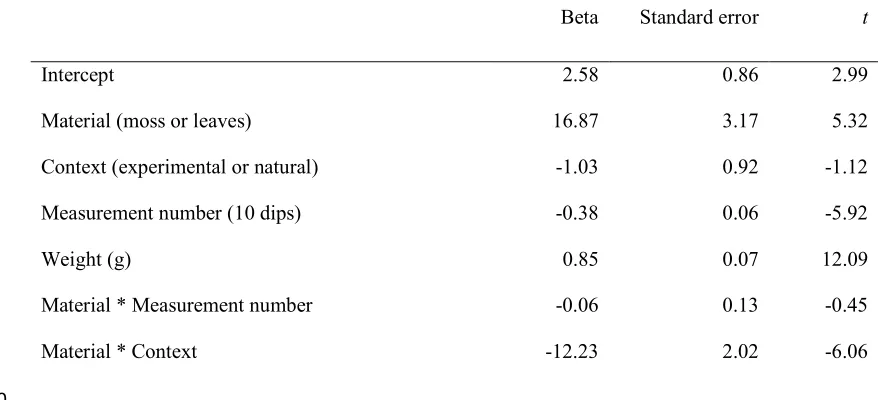
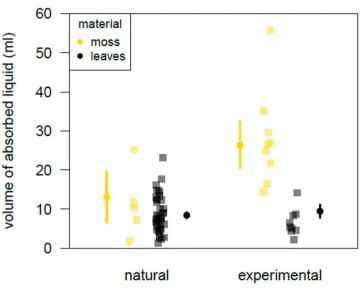
The model assessing the absorbency of moss-sponges manufactured by chimpanzees in both
356
natural and experimental contexts differed significantly from the null model (LMM, LRT:
357
χ23=36.25, p<0.0001). We found that sponges made of moss absorbed significantly more 358
liquid than sponges made of leaves, and this difference was more pronounced for the sponges
359
manufactured in the experimental context (LRT, χ21=28.69, p<0.0001, Table 1, fig.2). Not 360
surprisingly, heavier sponges, independently of the material used to manufacture them,
361
absorbed more liquid than lighter sponges (1g increase in weight corresponded to 0.85ml
362
more liquid absorbed, table 1). In the natural context, moss-sponges absorbed an average of
363
13.1ml; leaf-sponges an average of 8.4ml of liquid (fig.2). In the experimental context,
moss-364
sponges absorbed an average of 26.3ml; leaf-sponges an average of 9.5ml of liquid (fig.2).
365
366
Table 1│ Results of the LMM testing differences in absorbency. Each sponge was
368
measured 10 times.
369
Beta Standard error t
Intercept 2.58 0.86 2.99
Material (moss or leaves) 16.87 3.17 5.32
Context (experimental or natural) -1.03 0.92 -1.12
Measurement number (10 dips) -0.38 0.06 -5.92
Weight (g) 0.85 0.07 12.09
Material * Measurement number -0.06 0.13 -0.45
Material * Context -12.23 2.02 -6.06
370
Manufacturing and deployment time 371
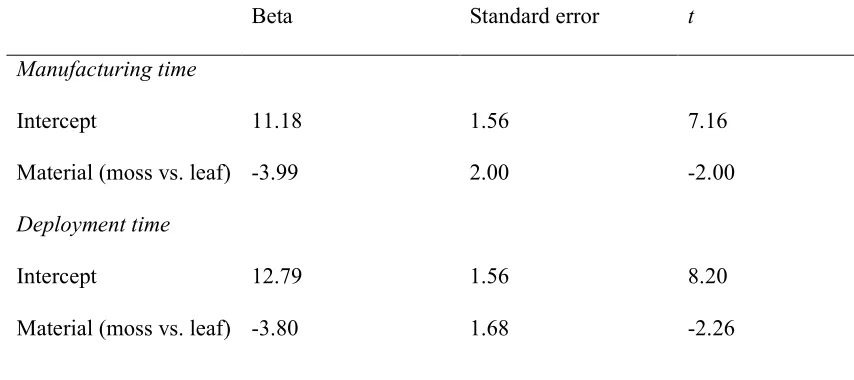
The model comparing manufacturing time only between experimentally manufactured
moss-372
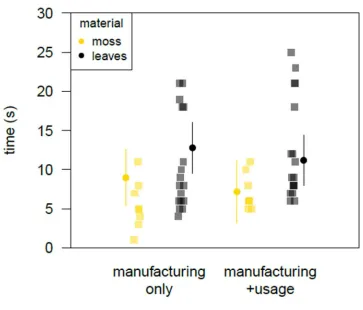
and leaf-sponges was marginally significantly different from the null model (LMM: N=25
373
sponges by 15 individuals, LRT: χ21=3.44, p=0.0635, Table 2, fig.3). Moss-sponges took on 374
average 7.2s to manufacture while leaf-sponges took on average 11.2s.
375
376
The model comparing deployment time (manufacturing plus first use) between experimentally
377
manufactured moss-and leaf-sponges differed significantly from the null model (LRT:
378
χ21=4.46, p=0.0347, Table 2, fig.3). Here, the combined time was on average 9.0s for moss-379
sponges and on average 12.8s for leaf-sponges.
380
381
In both cases, GLMMs with Poisson error structure revealed very similar results (see
382
supplemental materials).
383
Table 2│ Results of the LMMs testing differences in manufacturing and deployment
385
time between moss and leaf-sponges.
386
Beta Standard error t
Manufacturing time
Intercept 11.18 1.56 7.16
Material (moss vs. leaf) -3.99 2.00 -2.00
Deployment time
Intercept 12.79 1.56 8.20
Material (moss vs. leaf) -3.80 1.68 -2.26
Experiment 387
We tested 20 individuals. In line with our predictions, the proportion of individuals that used
388
moss for sponge production was higher amongst known moss- than leaf-spongers (proportion
389
test: χ21=3.23, one-tailed p=0.0361, moss-spongers: 7/9, leaf-spongers: 3/11, Table ST1). 390
391
To assess the correlation between presumed knowledge and choice during the experiment, we
392
calculated the repeatability of the material chosen. The repeatability estimate was R=0.52
393
(p=0.009, range of permuted R: 0.00-0.81, see fig.SF8). These results indicate that individuals
394
were more likely to choose the material in the experiment that corresponded to their presumed
395
knowledge.
396
397
[image:19.612.76.503.117.307.2]Availability 399
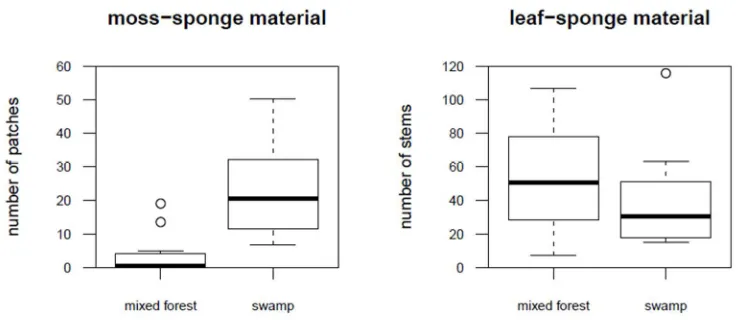
We found that both Acalypha spp. and Lasiodiscus mildraedii were more readily available
400
around tree-hole sponging locations in mixed forest areas (N=20 locations) than in swamp
401
areas (N=8 locations) although this difference was not statistically significant (Wilcoxon test,
402
W=105.5, p=0.2034, fig.4). However, there was significantly less moss material available at
403
known sponging locations in mixed forest than in the swamp areas, where the clay-pits were
404
located (Wilcoxon test, W=5, p<0.001, fig.4).
405
406
407
Discussion
408
409
We tested experimentally whether the spread of moss-sponging, first observed in the Sonso
410
chimpanzees of Budongo Forest in 2011, could be connected to differences in efficiency
411
between this behavioural innovation and the ancestral leaf-sponging variant, and whether this
412
led to the establishment of a new subculture in the community. We report three sets of
413
findings that are directly relevant to this question and to the topic of cultural evolution more
414
generally. In the first set, we found that moss-sponges represented a functional improvement
415
compared to ancestral leaf-sponges. Moss-sponges were both more effective in absorbing
416
rainwater and were fabricated and used more quickly than leaf-sponges. Our results are thus
417
in line with an ongoing discussion on tool efficiency as an indicator of cumulative culture,
418
exemplified by data on New Caledonian crows whose hooked tools are more efficient than
419
non-hooked tools [36, 37] and central African chimpanzees whose brush-tipped termite
420
fishing tools are more efficient than non-brushed tools [33].
421
Our second finding was to show experimentally that chimpanzees who already had experience
423
with moss-sponges preferred moss over leaves as material to fabricate sponges when
424
presented with a novel problem unrelated to the original socio-ecological context of
moss-425
sponging, i.e., independent of location, liquid type and social competition. In contrast,
426
individuals that had never been observed moss-sponging mainly chose leaves, suggesting they
427
did not perceive moss as a suitable sponge material in this novel situation. These results
428
demonstrate that moss-sponging is not tied to a particular ecological condition but generally
429
available to individuals who have learned the novel technique beforehand. Our experimental
430
results are also supported by the natural observations of Sonso individuals using
moss-431
sponges outside the context of the clay-pit, which suggest that moss-sponging is in the process
432
of being applied more widely.
433
434
In a third set of findings, we reported that the most likely reason natural moss-sponging was
435
not seen outside its original clay-pit context was the uneven availability of moss throughout
436
the forest. Survey data showed that the two most common plant species to manufacture
leaf-437
sponges were abundant throughout the forest and present at the 28 locations where
438
chimpanzees had been observed leaf-sponging. In contrast, moss was rare in the forest, except
439
in swamp areas where clay-pits are located, which effectively prevented moss-spongers from
440
executing their behaviour because of a lack of opportunities [64, 65]. Nevertheless,
441
chimpanzees do not transport moss-sponges from moss-rich areas to moss-depleted ones,
442
suggesting that the functional improvements may not be enough to modify chimpanzees’
443
preference entirely.
444
The core evidence for cultural evolution was the result of our field experiment, which
446
essentially suggested the presence of a cultural subgroup in tool use within the Sonso
447
community. Our experiment did not specifically address the role of social learning in sponge
448
manufacturing, as this was done in previous studies [21, 52]. More importantly, the current
449
study suggests that most leaf-spongers did not perceive moss as a potential sponge material
450
[29], suggesting a lack of underlying cultural knowledge.
451
452
Nevertheless, 3 of 11 classified leaf-spongers (Table ST1) chose moss to manufacture a
453
sponge during the experiment, which requires some explanation. For one individual, KH, we
454
cannot exclude that she was socially influenced by observing an individual before her using
455
moss. However, this argument does not apply for other trials, such as when ST, roughly the
456
same age, chose moss, even after having observed an individual before her using a
leaf-457
sponge (Supplementary material). It is also possible that the three new moss-spongers (a)
458
were simply oblivious to the choices offered, (b) recognised the advantages of moss as sponge
459
material in situ, or (c) were curious to try out its properties in the absence of any prior social
460
learning. Generally, however, we find explanations based on ad-hoc trial and error
461
experimenting less plausible because multiple studies with this community have already
462
shown a remarkable resistance to using novel tools in experimental situations [64, 66]. The
463
most likely explanation, in our view, is that these three individuals had acquired
moss-464
sponging behaviour prior to the experiment, but never showed it during observer presence. It
465
would be important to monitor these previously unidentified moss-spongers to check whether
466
moss-sponging remains present. We have observations for one individual, KH, who was
467
subsequently observed moss-sponging at the clay-pit.
468
Also relevant is that two of nine known moss-spongers opted for the traditional leaf-sponging
470
technique in the experiment. This might have been the result of individual differences in
471
conservatism, manufacturing skills, or taste. For example, some individuals may prefer the
472
technique they are more used to, even if they understand differences in efficiency [53].
473
Leaves are the more habitual material to manufacture a sponge, which may have hindered
474
some individuals from seeing the more efficient moss solution [29]. Social conformity may
475
also cause some chimpanzees to opt for a less efficient technique [34]. In sum, while we
476
showed consistency between attributed prior knowledge and choice in the experiment, our
477
results suggest that context and individual differences interact with each other and determine
478
an individual’s choice of tool material, even in controlled situations [66].
479
480
Overall, these results provide, to our knowledge, the first evidence that wild chimpanzees can
481
switch from an older, less efficient variant towards a newer, more efficient, socially learned
482
technique. Whether or not moss-spongers preferentially chose moss because they understood
483
and compared the physical properties of the two materials seems very plausible but can
484
ultimately not be decided by our data. While it is possible that experience with moss led to an
485
understanding that moss is more efficient than leaves, moss-spongers may have simply
486
become more familiar with moss compared to other chimpanzees, such that differences in
487
habits were ultimately responsible for our findings. We do not find this a very strong
488
argument because all individuals, including the moss-spongers, continued to use leaf-sponges
489
regularly outside the context of the clay-pit over the years following the appearance of
moss-490
sponging, predicting that all subjects should have chosen leaves in the experiment.
491
In sum, our findings are consistent with the interpretation that the innovation and social
493
spread of moss-sponging effectively led to the formation of a tool-related cultural subgroup in
494
the Sonso community. This outcome may be based on a cognitive ability to perceive and
495
compare the functional properties and efficacy of tools. Cognitively ‘less demanding’
496
explanations, for example that chimpanzees simply chose the more locally abundant material,
497
were ruled out by our experiment, which controlled for the availability of tool materials. Our
498
data further highlight a potential role of efficiency as a driver of cultural evolution, insofar as
499
more efficient traits are favoured and eventually come to dominate, while less efficient traits
500
are neglected and eventually abandoned. In our case, one reason why moss-sponging did not
501
spread as much as its efficiency suggested might be the mere lack of available resources.
502
There is no doubt ecological factors generally have a strong influence on the emergence and
503
maintenance of cultural behaviour [64]. The Sonso chimpanzees had been observed for over
504
20 years before moss-sponging appeared, with dozens of chimpanzees visiting the swamp
505
forest but no one innovating the behaviour before 2011. One explanation for this is that other
506
nutrient resources, such as Raphia pith, became less abundant due to human activities, forcing
507
chimpanzees to look for alternative sources, such as mineral-rich water found in clay-pits
508
[57]. Moss-sponges then spread socially in a subgroup of the current generation of
509
chimpanzees, who adopted the more efficient form compared to the ancestral trait. It will be
510
interesting to see how new generations of Sonso chimpanzees, regularly exposed to
moss-511
sponging demonstrators, magistrate between the old tradition, leaf-sponging, and the more
512
recent tradition, moss-sponging, in tool-assisted drinking contexts.
513
Data availability
515
All data and code used in this study are available in the supplementary materials.
516
517
Acknowledgements
518
We thank Samuel Adue for his invaluable help in the field, Dr Michelle Price for moss
519
identification and Dr Caroline Asiimwe for her advice regarding experimental design. We
520
thank UNCST and UWA for permission to conduct our research in Budongo Forest Reserve
521
and the Royal Zoological Society of Scotland for supporting BCFS. We thank Andy Whiten
522
for comments on an earlier draft. We thank Alex Thornton, Josh Firth and one anonymous
523
reviewer for their useful comments on an earlier version of the article.
524
References
526
1. Aplin L.M., Farine D.R., Morand-Ferron J., Cockburn A., Thornton A., Sheldon B.C.
527
2015 Experimentally induced innovations lead to persistent culture via conformity in wild
528
birds. Nature 518, 538-541.
529
2. Boogert N.J., Giraldeau L.-A., Lefebvre L. 2008 Song complexity correlates with
530
learning ability in zebra finch males. Animal Behaviour 76, 1735-1741.
531
3. Alem S., Perry C.J., Zhu X., Loukola O.J., Ingraham T., Søvik E., Chittka L. 2016
532
Associative Mechanisms Allow for Social Learning and Cultural Transmission of String
533
Pulling in an Insect. PLOS Biology 14(10), e1002564.
534
4. Ladds Z., Hoppitt W., Boogert N.J. 2017 Social learning in otters. Royal Society Open
535
Science 4(8). (doi:10.1098/rsos.170489).
536
5. Whiten A., Goodall J., McGrew W.C., Nishida T., Reynolds V., Sugiyama Y., Tutin
537
C.E.G., Wrangham R.W., Boesch C. 1999 Cultures in chimpanzees. Nature 399(6737),
682-538
685.
539
6. Tennie C., Call J., Tomasello M. 2009 Ratcheting up the ratchet: on the evolution of
540
cumulative culture. Philosophical Transactions of the Royal Society B 364, 2045-2415.
541
7. Boyd R., Richerson P.J. 1996 Why culture is common but cultural evolution is rare.
542
Proceedings of the British Academy 88, 77-93.
543
8. Dean L.G., Vale G.L., Laland K.N., Flynn E., Kendal R.L. 2014 Human cumulative
544
culture: A comparative perspective. Biol Rev Cambridge Philosophic Soc 89, 284-301.
545
9. Brewer J., Gelfand M., Jackson J.C., MacDonald I.F., Peregrine P.N., Richerson P.J.,
546
Turchin P., Whitehouse H., Wilson D.S. 2017 Grand challenges for the study of cultural
547
evolution. Nature Ecology Evolution 1, 0070. (doi:10.1038/s41559-017-0070).
10. Lynch A., Baker A.J. 1993 A Population Memetics Approach to Cultural-Evolution in
549
Chaffinch Song - Meme Diversity within Populations. Am Nat 141, 597–620.
550
11. Filatova O.A., Burdin A.M., Hoyt E. 2013 Is killer whale dialect evolution random?
551
Behav Processes 99, 34–41.
552
12. Schofield D.P., McGrew W.C., Takahashi A., Hirata S. 2018 Cumulative culture in
553
nonhumans: overlooked findings from Japanese monkeys? Primates 59(2), 113-122.
554
(doi:10.1007/s10329-017-0642-7).
555
13. Whiten A. in press A second inheritance system: The extension of biology through
556
culture. Royal Society Interface Focus.
557
14. McGrew W.C. 2017 Ourselves explained. Human Ethology Bulletin 3, 141-144.
558
15. Fehér O., Wang H., Saar S., Mitra P.P., Tchernichovski O. 2009 De novo
559
establishment of wild-type song culture in the zebra finch. Nature 459, 564–568.
560
16. Sasaki T., Biro D. 2017 Cumulative culture can emerge from collective intelligence in
561
animal groups. Nature Communications 8, 15049. (doi:10.1038/ncomms15049).
562
17. Reader S.M., Morand-Ferron J., Flynn E. 2016 Animal and human innovation: novel
563
problems and novel solutions. Philosophical Transactions of the Royal Society of London B:
564
Biological Sciences 371(1690). (doi:10.1098/rstb.2015.0182).
565
18. Yamamoto S., Yamakoshi G., Humle T., Matsuzawa T. 2008 Invention and
566
modification of a new tool use behavior: Ant-fishing in trees by a wild chimpanzee (Pan
567
troglodytes verus) at Bossou, Guinea. American Journal of Primatology 70, 699-702.
568
19. Whiten A., Goodall J., McGrew W.C., Nishida T., Reynolds V., Sugiyama Y., Tutin
569
C.E.G., Wrangham R.W., Boesch C. 2001 Charting cultural variation in chimpanzees.
570
Behaviour 138, 1481-1516.
20. Nishida T., Matsusaka T., McGrew W.C. 2009 Emergence, propagation or
572
disappearance of novel behavioral patterns in the habituated chimpanzees of Mahale: A
573
review. Primates 50, 23-36.
574
21. Hobaiter C., Poisot T., Zuberbühler K., Hoppitt W., Gruber T. 2014 Social network
575
analysis shows direct evidence for social transmission of tool use in wild chimpanzees. PLOS
576
Biology 12(9), e1001960.
577
22. Nagell K., Olguin R.S., Tomasello M. 1993 Processes of Social-Learning in the Tool
578
Use of Chimpanzees (Pan troglodytes) and Human Children (Homo sapiens). Journal of
579
Comparative Psychology 107(2), 174-186.
580
23. Whiten A., McGuigan N., Marshall-Pescini S., Hopper L.M. 2009 Emulation,
581
imitation, over-imitation and the scope of culture for child and chimpanzee. Philosophical
582
Transactions of the Royal Society B: Biological Sciences 364, 2417-2428.
583
24. Logan C.J., Breen A.J., Taylor A.H., Gray R.D., Hoppitt W.J.E. 2016 How New
584
Caledonian crows solve novel foraging problems and what it means for cumulative culture.
585
Learn Behav 44, 18-28.
586
25. Kenward B., Rutz C., Weir A.A.S., Kacelnik A. 2006 Development of tool use in New
587
Caledonian crows: inherited action patterns and social influences. Animal Behaviour 72,
588
1329-1343.
589
26. Caldwell C.A., Millen A.E. 2009 Social learning mechanisms and cumulative cultural
590
evolution: is imitation necessary? Psychological Science 20, 1478-1483.
591
27. Zwirner E., Thornton A. 2015 Cognitive requirements of cumulative culture: teaching
592
is useful but not essential. Scientific Reports 5, 16781.
593
28. Povinelli D.J. 2000 Folk physics for apes: The chimpanzee's theory of how the world
594
works. Oxford, OUP.
29. Gruber T., Zuberbühler K., Clément F., van Schaik C.P. 2015 Apes have culture but
596
may not know that they do. Frontiers in Psychology 6, 91. (doi:10.3389/fpsyg.2015.00091).
597
30. Csibra G., Gergely G. 2011 Natural pedagogy as evolutionary adaptation.
598
Philosophical Transactions of the Royal Society B: Biological Sciences 366, 1149-1157.
599
31. Sakura O., Matsuzawa T. 1991 Flexibility of wild chimpanzee nut-cracking behavior
600
using stone hammers and anvils: an experimental analysis. Ethology 87, 237-248.
601
32. Visalberghi E., Adessi E., Truppa V., Spagnoletti N., Ottoni E., Izar P., Fragaszy D.
602
2009 Selection of effective stone tools by wild bearded capuchin monkeys. Current Biology
603
19, 213-217.
604
33. Sanz C.M., Call J., Morgan D. 2009 Design complexity in termite-fishing tools of
605
chimpanzees (Pan troglodytes). Biol Lett 5, 293–296.
606
34. Luncz L.V., Sirianni G., Mundry R., Boesch C. 2018 Costly culture: differences in
607
nut-cracking efficiency between wild chimpanzee groups. Animal Behaviour 137, 63-73.
608
(doi:https://doi.org/10.1016/j.anbehav.2017.12.017).
609
35. Hunt G.R., Gray R.D. 2003 Diversification and cumulative evolution in New
610
Caledonian crow tool manufacture. Proceedings of the Royal Society B: Biological Sciences
611
270, 867-874.
612
36. Sugasawa S., Klump B.C., St Clair J.J.H., Rutz C. 2017 Causes and Consequences of
613
Tool Shape Variation in New Caledonian Crows. Current biology 27(24), 3885-3890.e3884.
614
(doi:10.1016/j.cub.2017.11.028).
615
37. St Clair J.J.H., Klump B.C., Sugasawa S., Higgott C.G., Colegrave N., Rutz C. 2018
616
Hook innovation boosts foraging efficiency in tool-using crows. Nature Ecology & Evolution
617
2(3), 441-444. (doi:10.1038/s41559-017-0429-7).
38. Manrique H.M., Gross A.N.-M., Call J. 2010 Great apes select tools on the basis of
619
their rigidity. J Exp Psychol Anim Behav Process 36, 409–422.
620
39. Lehner S.R., Burkart J.M., van Schaik C.P. 2011 Can captive orangutans (Pongo
621
pygmaeus abelii) be coaxed into cumulative build-up of techniques? Journal of Comparative
622
Psychology 125, 446-455.
623
40. Chappell J., Kacelnik A. 2002 Tool selectivity in a non-primate, the New Caledonian
624
crow (Corvus moneduloides). Animal Cognition 5(2), 71-78.
625
41. Yamamoto S., Humle T., Tanaka M. 2013 Basis for cumulative cultural evolution in
626
chimpanzees: Social learning of a more efficient tool-use technique. Plos ONE 8(1), e55768.
627
42. Davis S.G., Vale G.L., Schapiro S.J., Lambeth S.P., Whiten A. 2016 Foundations of
628
cumulative culture in apes: improved foraging efficiency through relinquishing and
629
combining witnessed behaviors in chimpanzees (Pan troglodytes). Sci Rep 6, 35953.
630
43. Gruber T., Singleton I., van Schaik C.P. 2012 Sumatran orangutans differ in their
631
cultural knowledge but not in their cognitive abilities. Current Biology 22(23), 2231-2235.
632
(doi:10.1016/j.cub.2012.09.041).
633
44. St Clair J.J.H., Rutz C. 2013 New Caledonian crows attend to multiple functional
634
properties of complex tools. Philosophical Transactions of the Royal Society B: Biological
635
Sciences 368(1630). (doi:10.1098/rstb.2012.0415).
636
45. Mann J., Stanton M.A., Patterson E.M., Bienenstock E.J., Singh L.O. 2012 Social
637
networks reveal cultural behaviour in tool-using dolphins. Nature Communications 3, 980.
638
(doi:10.1038/ncomms1983).
639
46. Laland K.N., Janik V.M. 2006 The animal cultures debate. Trends in Ecology and
640
Evolution 21(10), 542-547.
47. Newson L., Richerson P.J., Boyd R. 2007 Cultural evolution and the shaping of
642
cultural diversity. In Handbook of cultural psychology (eds. S. Kitayama, Cohen D.), pp.
454-643
476. New York, NY, The Guilford Press.
644
48. Matsuzawa T. 2003 Koshima monkeys and bossou chimpanzees: Long-term research
645
on culture in nonhuman primates. In Animal Social Complexity (eds. F. B. M. de Waal, Tyack
646
P.), pp. 374-387. Cambridge, MA, Harvard University Press.
647
49. Bandini E., Tennie C. 2017 Spontaneous reoccurrence of “scooping”, a wild tool-use
648
behaviour, in naïve chimpanzees. PeerJ 5, e3814. (doi:10.7717/peerj.3814).
649
50. Gruber T., Muller M.N., Strimling P., Wrangham R.W., Zuberbühler K. 2009 Wild
650
chimpanzees rely on cultural knowledge to solve an experimental honey acquisition task.
651
Current Biology 19, 1806-1810.
652
51. Reynolds V., Lloyd A.W., Babweteera F., English C.J. 2009 Decaying Raphia
653
farinifera palm trees provide a source of sodium for wild chimpanzees in the Budongo Forest,
654
Uganda. PLoS ONE 4(7), e6194.
655
52. Lamon N., Neumann C., Gruber T., Zuberbühler K. 2017 Kin-based cultural
656
transmission of tool use in wild chimpanzees. Science Advances 3(4), e1602750.
657
53. Gruber T., Muller M.N., Reynolds V., Wrangham R.W., Zuberbühler K. 2011
658
Community-specific evaluation of tool affordances in wild chimpanzees. Scientific Reports 1,
659
128. (doi:10.1038/srep00128).
660
54. Reynolds V. 2005 The Chimpanzees of the Budongo Forest: Ecology, Behaviour, and
661
Conservation. Oxford, Oxford University Press.
662
55. Songok J., Salminen P., Toivakka M. 2014 Temperature effects on dynamic water
663
absorption into paper. Journal of Colloid and Interface Science 418, 373-377.
664
(doi:https://doi.org/10.1016/j.jcis.2013.12.017).
56. Biro D., Sousa C., Matsuzawa T. 2007 Ontogeny and cultural propagation of tool use
666
by wild chimpanzees at Bossou, Guinea: Case studies in nut cracking and leaf folding. In
667
Cognitive development in chimpanzees (eds. T. Matsuzwa, M. Tomonaga, Tanaka M.), pp.
668
476-508, Springer.
669
57. Reynolds V., Lloyd A.W., English C.J., Lyons P., Dodd H., Hobaiter C.,
Newton-670
Fisher N., Mullins C., Lamon N., Schel A.-M., et al. 2015 Mineral acquisition from clay by
671
Budongo Forest chimpanzees. Plos ONE 10(7), e0134075.
672
58. R_Development_Core_Team. 2015 R: A language and environment for statistical
673
computing. In R Foundation for Statistical Computing at <http://wwwr-projectorg/> (
674
59. Bates D., Maechler M., Bolker B., Walker S. 2014 lme4: Linear mixed-effects models
675
using Eigen and S4. R package version 1.1-7. (
676
60. Dobson A.J. 2002 An Introduction to Generalized Linear Models, Chapman and Hall.
677
61. Ruxton G.D., Neuhäuser M. 2010 When should we use one-tailed hypothesis testing?
678
Methods Ecol Evol 1(2), 114-117. (doi:doi:10.1111/j.2041-210X.2010.00014.x).
679
62. Nakagawa S., Schielzeth H. 2010 Repeatability for Gaussian and non-Gaussian data: a
680
practical guide for biologists. Biol Rev Cambridge Philosophic Soc 85 935–956.
681
63. Stoffel M.A., Nakagawa S., Schielzeth H. 2017 rptR: repeatability estimation and
682
variance decomposition by generalized linear mixed-effects models. Methods Ecol Evol 8,
683
1639–1644.
684
64. Gruber T., Zuberbühler K., Neumann C. 2016 Travel fosters tool use in wild
685
chimpanzees. eLife, 10.7554/eLife.16371.
686
65. Sanz C.M., Morgan D.B. 2013 Ecological and social correlates of chimpanzee tool
687
use. Philosophical Transactions of the Royal Society of London B: Biological Sciences
688
368(1630). (doi:10.1098/rstb.2012.0416).
66. Gruber T. 2016 Great apes do not learn novel tool use easily: Conservatism, functional
690
fixedness, or cultural influence? International Journal of Primatology 37(2), 296-316.
691
(doi:10.1007/s10764-016-9902-4).
692
693
Legends
695
696
Figure 1.Two examples of sponge tools manufactured during a log experiment. a)
Leaf-697
sponge made of Alchornea floribunda, b) moss-sponge made of Orthostichella welwitschii.
698
699
Figure 2. Comparison of absorbency for natural and experimental sponges. Each square
700
represents the mean volume absorbed by one sponge across 10 repeated measurements.
701
Circles represent model predictions. Lines are 95% confidence intervals.
702
703
Figure 3.Comparison of moss and leaf manufacturing (left) and deployment (right)
704
time. Raw data are shown as squares and model estimates as circles with 95% confidence
705
intervals. 706
707
Figure 4. Availability of sponge material across forest types.
708
Ethics Statement 710
Field protocols were reviewed and permission to conduct this research was given by the
711
Uganda Wildlife Authority (UWA), the Ugandan National Council for Science and
712
Technology (UNCST), the National Forestry Authority (NFA), and the resident veterinary
713
section at Budongo Conservation Field Station (BCFS).
714
715
Funding statement 716
This work was funded by the European Research Council (FP7/2007-2013/ERC n°283871)
717
and the Swiss National Science Foundation (grants 310030_143359 to KZ; CR13I1_162720
718
and P300PA_164678 to TG).
719
720
Competing interests statement 721
We declare we have no competing interests
722
723
Author contributions 724
Data collection: N.L. and J.G.; statistical analysis: C.N. and N.L.; experimental design: N.L.,
725
T.G., and K.Z.; manuscript writing: N.L., T.G., C.N., and K.Z.; funding: K.Z.
Figure 1. Two examples of sponge tools manufactured during a log experiment. a) Leaf-sponge made of Alchornea floribunda, b) moss-sponge made of Orthostichella welwitschii.
Figure 2. Comparison of absorbency for natural and experimental sponges. Each square represents the mean volume absorbed by one sponge across 10 repeated measurements. Circles represent model
predictions. Lines are 95% confidence intervals.
Figure 3. Comparison of moss and leaf manufacturing (left) and deployment (right) time. Raw data are shown as squares and model estimates as circles with 95% confidence intervals.
Figure 4. Availability of sponge material across forest types.