A&A 577, A92 (2015)
DOI:10.1051/0004-6361/201425138 c
ESO 2015
Astronomy
&
Astrophysics
Non-LTE modelling of prominence fine structures using hydrogen
Lyman-line profiles
P. Schwartz
1,3,4, S. Gunár
2,†, and W. Curdt
31 Astronomical Institute of Slovak Academy of Sciences, 05960 Tatranská Lomnica, Slovak Republic e-mail:[email protected]
2 School of Mathematics and Statistics, University of St. Andrews, North Haugh, St. Andrews, Fife, KY16 9SS, UK 3 Max-Planck-Institut für Sonnensystemforschung, Justus-von-Liebig-Weg 3, 37077 Göttingen, Germany
4 Astronomical Institute, Academy of Sciences of the Czech Republic, 25165 Ondˇrejov, Czech Republic
Received 10 October 2014/Accepted 10 March 2015
ABSTRACT
Aims.We perform a detailed statistical analysis of the spectral Lyman-line observations of the quiescent prominence observed on May 18, 2005.
Methods.We used a profile-to-profile comparison of the synthetic Lyman spectra obtained by 2D single-thread prominence structure model as a starting point for a full statistical analysis of the observed Lyman spectra. We employed 2D multi-thread fine-structure models with random positions and line-of-sight velocities of each thread to obtain a statistically significant set of synthetic Lyman-line profiles. We used for the first time multi-thread models composed of non-identical threads and viewed at line-of-sight angles different from perpendicular to the magnetic field.
Results.We investigated the plasma properties of the prominence observed with the SoHO/SUMER spectrograph on May 18, 2005 by comparing the histograms of three statistical parameters characterizing the properties of the synthetic and observed line profiles. In this way, the integrated intensity, Lyman decrement ratio, and the ratio of intensity at the central reversal to the average intensity of peaks provided insight into the column mass and the central temperature of the prominence fine structures.
Key words.Sun: filaments, prominences – line: profiles – radiative transfer – methods: statistical
1. Introduction
Spectral observations of the quiescent solar prominences in hy-drogen Lyman lines and continuum represent a unique tool for probing of their structure and physical properties. A substan-tial amount of prominence spectral data in Lyman lines was provided by the Solar Ultraviolet Measurements of Emitted Radiation (SUMER) UV-spectrograph (Wilhelm et al. 1995) on-board the Solar and Heliospheric Observatory (SoHO) satellite. Prominence observations made with instruments onboard SoHO were reviewed byPatsourakos & Vial(2002); see also a review of the prominence fine structures byHeinzel(2007).
Interpreting the prominence observations in the Lyman lines requires sophisticated models of the prominence plasma in the magnetic field and complex non-LTE radiative transfer compu-tations. Such models were first developed byPoland & Anzer (1971) and Heasley & Mihalas (1976). Later, Gouttebroze et al. (1993) used a sophisticated hydrogen atom with more than 20 levels plus continuum and a large grid of 1D isothermal isobaric slab models. This was followed by Anzer & Heinzel (1998,1999), who developed 1D magnetohydrostatic equilib-rium models of the Kippenhahn-Schlüter (K-S) type. These were generalized into 2D byHeinzel & Anzer (2001), whose prominence fine-structure models take the form of 2D verti-cally infinite plasma threads in magnetohydrostatic equilibrium, † S. Gunár is on a long-term leave from Astronomical Institute of the Academy of Sciences of the Czech Republic.
suspended in magnetic dips. The temperature structure of these prominence fine-structure threads is described semi-empirically and includes the prominence-corona transition region (PCTR). The substantial influence of the PCTR on the Lyman-line in-tensities was demonstrated byAnzer & Heinzel (1999). Two-dimensional vertically infinite prominence fine-structure mod-els, but with the cylindrical cross-section, were also developed byGouttebroze(2006).
The importance of the multi-thread prominence fine-structure models was shown by Gunár et al. (2007), who used a trial-and-error method to reproduce the observed Lyman spectrum. Later, Gunár et al. (2008) added random line-of-sight (LOS) macroscopic velocities to each thread of the multi-thread model, thus showing that even relatively low LOS velocities (of about 10 km s−1) have a significant effect
on the asymmetries of the Lyman line profiles. Multi-thread models with randomly distributed LOS velocities of individ-ual threads were shown by Gunár et al. (2010) to produce synthetic Lyman spectra that agree well with observations on the profile-to-profile as well as on statistical bases. Moreover, Berlicki et al.(2011) andGunár et al. (2012) showed that the synthetic Hαspectra produced by multi-thread prominence fine-structure models also agree with the observations. Furthermore, Gunár et al.(2011a) andGunár et al.(2011b) demonstrated that the temperature and electron density structures of these models lead to the synthetic differential emission-measure curves that agree well with the observations. Recently,Gunár et al.(2014)
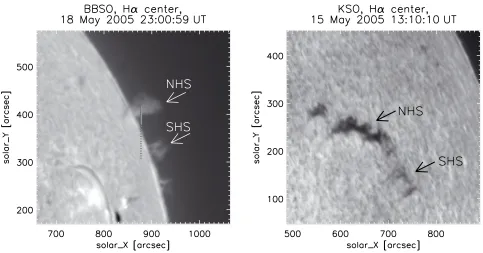
Fig. 1.Left panel: part of the full-disk Hαline-centre filtergram obtained by BBSO/NST on 18 May 2005. Vertical bar marks the position of the SoHO/SUMER slit. Spectra were obtained only from the part of the slit that is marked by the solid line because the SUMER detector was partially damaged.Right panel: prominence seen as a filament in part of the full-disk observations in the Hαline centre made at the Kanzelhöhe Solar Observatory three days earlier. The two clearly visible Hαfeatures marked by arrows and denoted as NHS and SHS are the northern and southern Hαprominence structures.
combined the multi-thread prominence fine-structure models with the 3D prominence magnetic field modelling to analyse a prominence observed on 22 June 2010.
Current reviews of the prominence physics can be found in Labrosse et al. (2010) and Mackay et al. (2010) and also in the review of the prominence fine-structure modelling byGunár (2014).
In Sect.2we describe the observations in detail. Section3 provides details of the prominence fine-structure modelling. In Sect.4 we present our results, Sect.5contains the discussion, and Sect.6provides the conclusions.
2. Observations
A quiescent prominence was observed on the NW limb of the Sun by the SUMER spectrograph onboard the SoHO satellite. The observations were made during the fifteenth MEDOC ob-serving campaign between 18 May 2005 22:01:12 and 19 May 2005 01:37:19 UT with static slit position (sit-and-stare obser-vations). The position of the SoHO/SUMER spectrograph slit is shown in the left panel of Fig.1 on the Hαline-centre filter-gram from National Solar Telescope (NST;Goode et al. 2003) at Big Bear Solar Observatory (BBSO). The co-alignment was achieved by correlating the distributions of BBSO/NST Hαdata and the integrated LyαSoHO/SUMER intensities along the slit. Usable SUMER data were obtained from only 40 pixels on the northern part of the SUMER slit because other part of detector A was damaged. The usable part of the slit, marked by the full line in Fig.1, crosses a large column-like prominence structure oriented radially, which contains cool (T ≤ 10 000 K) plasma where the Hα line is formed. Another similar smaller struc-ture is visible to the south. In Fig.1 we mark these two fea-tures as the northern and southern Hαprominence structures.
Table 1.Properties of the SOHO/SUMER observations.
Spectral Wavelength Slit dimensions Exp. No. window range (width×height) time of obs.
[Å] [arcsec] [s]
Lyα 1175.0–1218.5 0.28 ×119.6 15 18 Lyβ 987.3–1032.8 0.99 ×119.6 98 36 Lyγ, Lyδ 932.0–977.7 0.99 ×119.6 98 36
Ly5 to
900.2–946.0 0.28 ×119.6 98 36 Continuum
Notes.The table includes: spectral window, wavelength range, slit di-mensions, exposure time, and number of observations.
In the right panel of Fig.1 the prominence is seen as a fila-ment in the Hαfiltergram made two days earlier by the Patrol Telescope for Solar Observations located at the Kanzelhöhe Solar Observatory. The two Hα prominence structures are clearly visible as two individual filamentary objects marked by arrows.
Complete hydrogen Lyman series were observed by SUMER in four spectral windows: 1215.6 Å, 1025.0 Å, 972.0 Å, and 940 Å, each with a wavelength range of approximately 45 Å and a cadence of 1–2 min. The basic properties of this set of ob-servations are shown in Table1. The observed spectra were re-duced and calibrated using standard SolarSoft procedures. The spectral lines were identified using the SUMER spectral atlas of Curdt et al.(2001).
[image:2.595.306.560.436.537.2]P. Schwartz et al.: Modelling of prominence fine structure
Fig. 2.Calibrated spectra of the Lyα–Lyδlines. The spectra were cor-rected for vertical shifts. The vertical white bar marks the usable part of the slit.
two spectral lines with different wavelengths to be shifted with respect to each other. Moreover, displacement of the slit im-age on the detector due to non-linearity of the grating focus mechanism causes additional cross-dispersion shifts (Schühle 2003). Vertical shifts of the Lyβand the higher Lyman lines with respect to the Lyαline were estimated by a comparison of the in-tegrated intensity distributions and line profile shapes along the slit. Owing to the low signal-to-noise ratio in the spectra of the Ly5 and higher Lyman lines, only profiles of the Lyα–Lyδlines were used in our analysis. An example of calibrated and cor-rected spectra of the four Lyman lines from one observation of the sit-and-stare observing sequence is shown in Fig.2.
The Lyαline was placed on a so-called bare part of the de-tector A – outside the KBr coating and the attenuator. To protect the detector from further damage caused by high Lyαintensity, a lower detector voltage of 5390 V (standard is 5656 V) was set during the Lyαobservations. As was shown bySchwartz et al. (2012), calibration is only marginally affected (by less than 2%) at such lower voltage. Other Lyman lines were observed with the standard voltage. A similar set of Lyman-line observations with lower voltage for the Lyαline was also used byGunár et al. (2010).
3. Prominence fine-structure modelling
Quiescent solar prominences are not homogeneous, but are com-posed of numerous fine structures, often quasi-vertical threads (see e.g. the review byHeinzel 2007). To analyse the Lyman spectra observations of these structures, we used the 2D promi-nence fine structure model ofHeinzel & Anzer (2001) in the multi-thread configuration including the random LOS velocities of individual threads developed byGunár et al.(2008). In this section we briefly describe the single- and multi-thread models and show the results of the statistical comparison of the synthetic Lyman line profiles with observed data.
3.1. Single-thread model
The 2D prominence fine structure model ofHeinzel & Anzer (2001) approximates prominence quasi-vertical threads by a ver-tically infinite 2D structure embedded in a horizontal dipped magnetic field. The plasma in the thread is in the local magneto-hydrostatic (MHS) equilibrium of Kippenhahn-Schlüter type. The thread is symmetrically irradiated at all four sides by diluted (height-dependent) radiation from the solar surface. The dimen-sion across the magnetic field –ycoordinate – is fixed, but the dimension along the field –xcoordinate – is determined by the MHS equilibrium. The centre of the coordinate system is fixed in the centre of the thread. Instead of the geometricalx-scale, the column massm-scale was used in the direction along the
magnetic field. The total column massM(y) along a magnetic field line at a positionyis defined as (Heinzel & Anzer 2001)
M(y)=
M0 1−yδγ3
for|y| ≤δ
0 for|y|> δ, (1)
whereM0is the column mass at the centre of the thread (aty= 0),δis half of the dimension of the thread across the magnetic field, andγ3is the exponent describing the column mass gradient
across the magnetic field. We assumed hereγ3 = 2. The 2D
temperature structure of the thread inm−yscale is defined as (Heinzel & Anzer 2001)
T(m, y)=Tcen(y)+Ttr−Tcen(y)
1−4 m
M(y)
(2)
×
1− m
M(y) γ1
,
whereTtris the temperature at the thread boundary andγ1is the
exponent describing the temperature gradient along the magnetic field.Tcen(y) is the temperature at the dip centre at a positiony and is defined as (Heinzel & Anzer 2001)
Tcen(y)=
Ttr−(Ttr−T0)1−yδγ2
for|y| ≤δ
Ttr for|y|> δ, (3)
whereT0is the minimum temperature at the thread centre (x=
0, y = 0) and γ2 is the exponent describing the temperature
gradient across the magnetic field. This together with two ad-ditional input parameters of the model – the gas pressurep0 at the thread boundary and the horizontal component of the mag-netic fieldBx(0) in the dip centre – defines the distribution of the
gas pressurep(x, y) in the thread.
Thus, the 2D vertical-thread model of the thread has 11 in-put parameters: the column massM0, the dimension across the
magnetic fieldΔy = 2δ, the temperatures at the boundaryTtr
and at the centreT0, the central horizontal magnetic fieldBx(0),
the boundary gas pressure p0, the exponents γ1, γ2, γ3, the
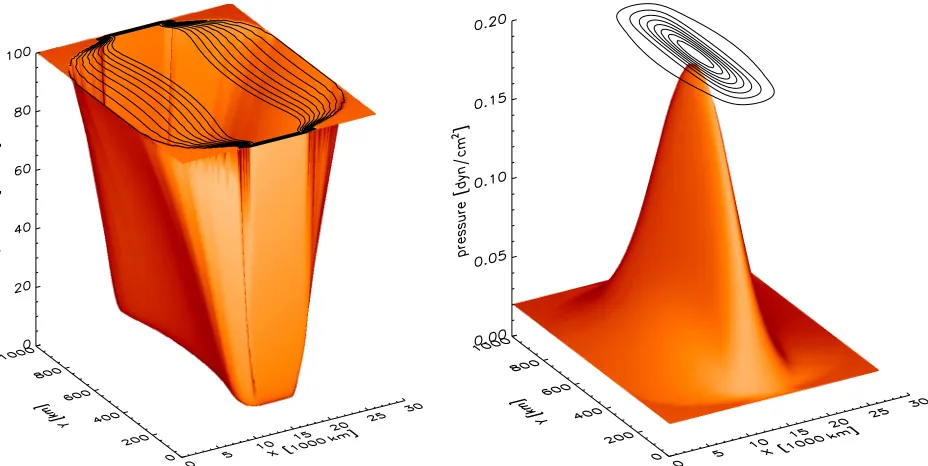
abundance of heliumA(He) with respect to hydrogen (here we used 0.1), and the ratio of the microturbulence and sound ve-locities ε (we adopted ε = 0.5). We assumed the dimension of the threads in the direction across the magnetic field 2δto be 1000 km. Temperatures in the PCTR reach up to the coronal values, but because hydrogen spectral lines are formed at tem-peratures well below 100 000 K, we adopted this value forTtr. Examples of the temperature and gas-pressure distributions in the 2D thread are shown in Fig.3.
We solved the 2D non-LTE radiative transfer by employ-ing the Multilevel Accelerated Lambda Iterations (MALI;Auer & Paletou 1994) in the short characteristics method (Kunasz & Auer 1988). To solve the statistical equilibrium, we used a hy-drogen atom with 12 levels plus continuum. Partial frequency re-distribution (PRD) was assumed for the Lyαand Lyβlines. For the higher Lyman lines the complete frequency redistribution was assumed.
3.2. Multi-thread model
Fig. 3.Example of the temperature and gas-pressure distributions produced by the 2D single-thread model with the best agreement with observed spectra. The temperature step between contours is 10 000 K, that of the gas pressure is 0.02 dyn/cm2.
thread can be seen. In contrast, the optical thickness in peaks is much lower and thus also the radiation from the threads farther away from the observer contributes to the measured intensities. This effect is more pronounced for the higher members of the Lyman line series, but is negligible for the Lyαline because of its large optical thickness even in the near wings. The multi-thread model used in this work (Gunár et al. 2008) was constructed in such a way that the foremost thread (the one closest to the observer) was fixed in the centre of the computational domain. The other threads were shifted to the left or right along the mag-netic field with a maximum displacement equal to the half of thex-dimension of the thread. The distance between the threads was fixed to 1000 Km. The mutual irradiation of threads was not taken into account. As was shown byGunár et al.(2008), assigning various LOS velocities to individual threads of such a multi-thread model can explain the observed asymmetries in the Lyman-line profiles.
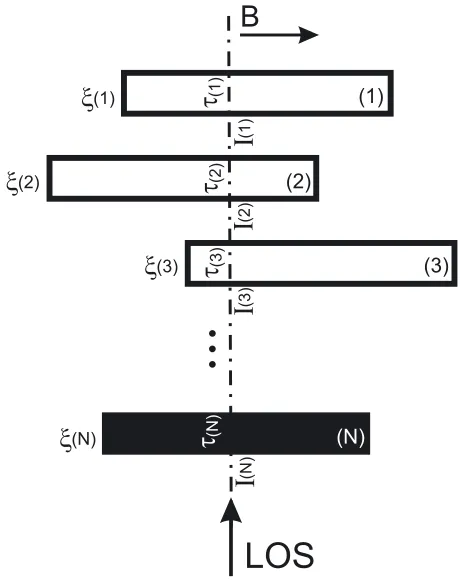
The total intensity Iλtotal along a given LOS emerging from the multi-thread model composed ofN threads with ran-dom LOS velocities (see scheme in Fig.4) was calculated using the following recurrent formula (derived from Eq. (1) ofGunár et al. 2008) withjincreasing from 2 toN:
Iλemj=Iλemj−1×exp−τλj +Iλj, (4) whereIλem(1) = Iλ(1) and Iλtotal = IλemN. The intensity emerging from the jth thread of the multi-thread model is de-noted asIem
λ
j,Iλjis the intensity radiated by the jth thread itself, andτλjis its optical thickness. The latter two quantities are defined in the observer’s frame as
Iλj≡Iλ−Δλj (5)
τj≡τλ−Δλj . (6)
The quantityΔλjis the Doppler shift for the jth thread corre-sponding to its LOS velocityξj:
Δλj=λ0
ξj
c , (7)
whereλ0 is the central wavelength of a given spectral line and cthe speed of light in vacuum. Positive values ofξjrepresent velocities oriented towards the observer. Here we used LOS ve-locities from the interval of ±10 km s−1. Equation (4) can be adapted to obtain the total emerging intensities also along the LOS not perpendicular to the magnetic field. In this case, pa-rameterμ(the cosine of the angle between the actual LOS and the direction perpendicular to the magnetic field) is introduced.
We obtained the distributions of the absorption and emis-sion coefficient for individual threads with the 2D single-thread model described in the previous section. TheIλjintensities for the given value ofμwere calculated by the quadrature form of Mihalas et al.(1978) for the formal solution of radiative transfer. More details can be found inGunár et al.(2008).
3.3. Statistical comparison of observed and synthetic profiles
P. Schwartz et al.: Modelling of prominence fine structure
Fig. 4.Scheme of the prominence multi-thread model composed ofN
threads and LOS perpendicular to the magnetic field. Quantitiesξ(j) represent the LOS velocities of individual threads.
characteristics of the synthetic profiles can be statistically com-pared with large sets of observed profiles. Multiple observations of prominences with a static slit (sit-and-stare mode) are suit-able for such a study. We used three statistical characteristics of the Lyman-line profiles: integrated intensity, Lyman decrement – ratio of the integrated intensity of a given line to the Lyβ inte-grated intensity, and depth of the reversal – ratio of intensity at the central reversal to average intensity of peaks (the so-called centre-to-peak ratio). The centre-to-peak ratio for both the syn-thetic and observed profiles was determined as follows (see also Gunár et al. 2010): first, positions of the two peaks in a profile were found and the ratio was calculated by dividing the mini-mum intensity in wavelength interval between the peaks by the mean intensity of the peaks. To eliminate the influence of the noise on the estimation of the center-to-peak ratio, average inten-sities from three wavelength pixels at the reversal minimum and at each peak were used in the observed data. For profiles without reversal, the centre-to-peak ratios were not estimated, and these profiles were excluded from the statistical analysis of the rever-sal depth, but not from the analysis of the other two parameters. Gunár et al.(2010) used an additional characteristic quantifying the asymmetry of profiles with reversal. We did not use this here because it is sensitive mostly to the values of the LOS velocities, which are not the main interest of this study. The synthetic spec-tra obtained by the multi-thread model were resampled from the virtual slit scale (the actualx-ygrid of the model seen with an an-gleμ) into the SUMER slit scale. One pixel along the SUMER slit is equivalent to one arcsec, which is equal to 726 km on the solar limb at the date of observations. The observed pro-files of the Lyman lines are mainly blended by Balmer lines of He
ii
and by UV lines of Oi
. These blends need to be taken into account when deriving the three statistical characteristics. Approximate contributions of blends to the Lyman-line profilesFig. 5.Example of fitting of a Lyαprofile to estimate the influence of a blend on the three profile characteristics. Observed data are plotted with stars, while the resulting fitted profile (including blends) is plotted as a thick full line. The Voigt function fitting the profile in the wings is plot-ted as a thin solid line and the negative Gaussian in the profile reversal as a dashed line. The blend occurring at approximately 1025.5 Å was fitted with the Gaussian and is plotted in red.
were estimated by fitting the blending lines with Gaussian func-tions, using the data averaged along the slit. The shape of the observed Lyman-line profiles were reproduced with the Voigt function in the wings and with a negative Gaussian in the cen-tral reversal, as is shown in an example of the Lyαprofile in Fig.5. This shows that even non-symmetrical profiles can be fit-ted by this method. The profiles were fitfit-ted with the Levemberg-Marquardt method. The negative Gaussian used for fitting the central reversals has no physical meaning, it was only used to reproduce the shape of the Lyman-line profiles without blends with the highest achievable accuracy. It is important to note that the fitting of the observed profiles was not used to derive the three profile characteristics. It was used only to estimate the in-fluence of blends on the three profile characteristics estimated from the observed profiles. However, only blends located out-side the Lyman-line cores that were sufficiently intense could be removed. For the Lyαline the influence of blends on all pro-file characteristics is negligible. We estimate the contributions of blends to the integrated intensities of higher Lyman lines to be 2.8% for Lyβ, 6.3% for Lyγ, and 7.8% for Lyδ. These con-tributions were subtracted from the integrated intensities of the observed profiles. Blends do not significantly influence the other two statistical characteristics used here.
4. Results
4.1. Multi-thread model with identical threads
To obtain the best possible agreement between synthetic pro-files obtained by the multi-thread model and the observations, we proceeded as follows. Several sets of single-thread models that each produced synthetic Lyαprofiles similar to the observed ones were identified by trial and error. Then we selected from each such set the single-thread model with the leastχ2between
[image:5.595.310.556.75.267.2]Fig. 6.Compared histograms of the integrated intensities of the observed and synthetic Lyαto Lyδline profiles. The solid black line represents the observed data. Three values ofμare represented by corresponding colours and line-styles.
ten identical threads for each of the selected single-thread mod-els. We calculated the synthetic profiles for various LOS an-glesμ. Three statistical characteristics of the synthetic profiles (see Sect.3.3) were then compared with observations. Finally, a unique single-thread model with the best agreement of statistical characteristics of synthetic and observed profiles was identified. The input parameters of this model are the following:
M0 =8.5×10⁻⁵g/cm2, T0=8000 K, p0=0.02 dyn/cm2
γ1=10, γ2=60, Bx(0)=7 G.
The distributions of the temperature and gas pressure of this single-thread model are shown in Fig.3.
The set of observed profiles contains 2160 Lyα profiles and 4320 profiles of each of the higher three Lyman lines. We compared the profile characteristics of such statistically signifi-cant set of observed data with the characteristics of 30 000 syn-thetic profiles of each of the four Lyman lines calculated with the multi-thread model. That means 300 profiles along the vir-tual SUMER slit corresponding to the size of the multi-thread structure in 100 realisations of the multi-thread model.
In Fig.6we show the histograms of the integrated intensity of the Lyα to Lyδ synthetic profiles obtained with the multi-thread model with ten identical multi-threads. For each multi-thread the single-thread model with shown above input parameters was used. The synthetic profiles were calculated for three LOS di-rections – perpendicular to the magnetic field (μ = 1) and at angles 30◦ (μ = 0.866) and 60◦ (μ = 0.5) from the direction perpendicular to the magnetic field. Each angle is represented by a specific colour and line-style. The solid black line rep-resents the observed spectra. Numbers in the upper right cor-ner in each panel of Fig.6 are median values of histograms in corresponding colours. In parenthesis, a percentage value of the median of absolute deviations from the median is given. This provides information on the histogram dispersion. The his-tograms of the integrated intensities of the synthetic Lyαprofiles
only agree well with the observed data in their higher intensity peak (around 30 000 erg/cm2/s/sr). The lower intensity peak at approximately 15 000 erg/cm2/s/sr is absent from the synthetic data. For Lyβ, the histograms of the synthetic integrated inten-sities have only one peak forμequal to 1 and 0.866, while the observed data show two peaks. Only the synthetic data histogram forμ=0.5 has two peaks, and their positions agree with the ob-served data. For Lyγand Lyδ, the situation is similar as for Lyβ, but the agreement between the positions of the two peaks in the histograms of the synthetic data forμ=0.5 and observed data is poorer.
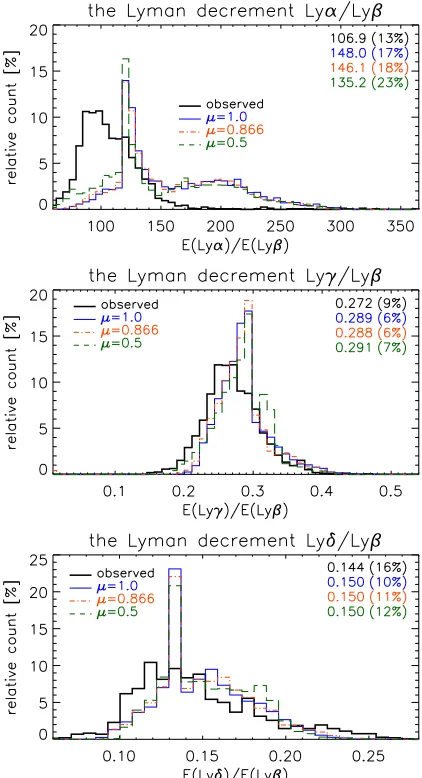
For the integrated intensity ratios of Lyγ/Lyβand Lyδ/Lyβ (Lyman decrement), the synthetic and observed data agree well for all three studied values of μ, as can be seen in Fig. 7. However, they agree less well for the Lyα/Lyβratio. Although a narrow peak in the synthetic data histograms almost coincides with the observed data, to the right of it, a wide bulge appears that is absent from the observed data. This could be explained by the fact that the observed data only represent a small part of the whole prominence, while the synthetic profiles are produced along the whole length of the fine-structure threads.
P. Schwartz et al.: Modelling of prominence fine structure
Fig. 7.Compared histograms of the Lyman decrement of observed and synthetic Lyman-line profiles. The solid black line represents the ob-served data. Three values ofμare represented by corresponding colours and line-styles.
These double-peak distributions suggest threads with various plasma conditions. In the following subsection we assume for the first time multi-thread models with non-identical threads.
4.2. Hotter threads at the edge of the prominence
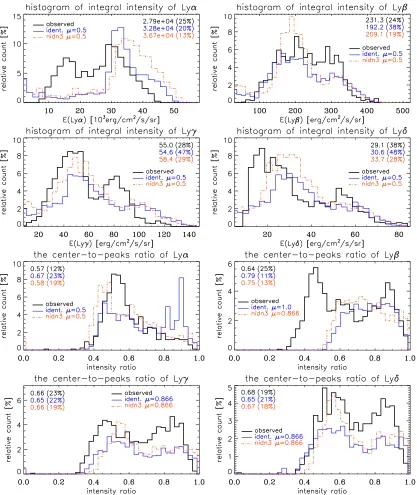
In this subsection we investigate whether hotter threads at the edge of the multi-thread model can improve the agreement be-tween the synthetic and observed data. For the inner threads of this multi-thread model we used the same single-thread model as for identical threads. For the outer threads we assumed higher values of the minimum central temperature T0, while other input parameters were left unchanged. For very high values ofT0 equal to 30 000 K in the foremost and farthest threads and 15 000 K in the second and penultimate threads (the 9th in our case), the histograms of integrated intensities of the synthetic Lyαto Lyδprofiles are much wider (4.8 times wider for Lyα, 6.3 times for Lyβ, 6.2 times for Lyγ, and 7 times for Lyδ) than for the observed data. The example for the Lyαline is shown in the left panel of Fig.9. When lowerT0 values of 15 000 K and 10 000 K were used for the outer threads, the synthetic
histograms of the integrated intensities are still approximately twice as wide as the observed ones – see example for Lyαin the right panel of Fig.9. These results clearly demonstrate that any significant change of the input parameters even in a few threads of the multi-thread model produces large differences.
However, if values of T0 in the outer threads are only slightly higher than in the inner threads, non-negligible changes occur only in a few histograms of the profile characteristics compared with histograms for multi-thread models with iden-tical threads. We compare a model with marginally hotter outer threads (10 000 and 9000 K) with the identical-thread model and with observations in Fig.10. We show only the histograms with a non-negligible differences from the identical-thread model. The histograms for those values ofμare shown here that agree best with observations. The histograms of the integrated intensity of the synthetic Lyαand Lyβ lines agree moderately worse with observations for models with outer threads withT0 of 10 000 and 9000 K than for identical threads. In contrast, using outer threads withT0 of 10 000 and 9000 K improves agreement of
the histograms of the integrated intensity of the synthetic Lyγ and Lyδline-profiles with observations. The histograms of the Lyman decrement are almost the same as those for the models with identical threads and are therefore not shown in Fig.10.
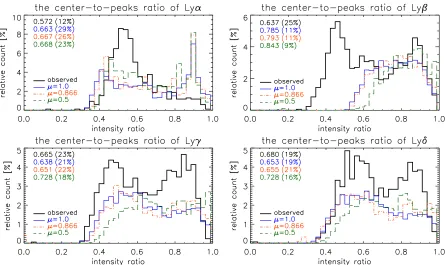
The histograms of the centre-to-peak ratio of the synthetic Lyαline profiles obtained using the models with marginally hot-ter ouhot-ter threads reproduce the observed histogram much bethot-ter than the models with identical threads (see Fig.10). For Lyβ, nei-ther the model with outer threads withT0of 10 000 and 9000 K
nor identical-thread model reproduce the observed histogram. Only much higher values ofT0in the outer threads (such asT0of
30 000 and 15 000 K) would produce histograms of the synthetic Lyβcentre-to-peaks ratio that are comparable with the observa-tions. However, the histograms of integrated intensities are much wider than the observed ones at the same time (see Fig.9).
5. Discussion
The multi-thread model with identical threads is not able to re-produce the histogram of the observed Lyαintegrated intensity with two peaks. The reason for this might be that in reality threads in prominences are probably not identical. To investi-gate this idea, we used for the first time 2D multi-thread models with non-identical threads. We placed two hotter threads on ei-ther sides of the multi-thread model while keeping the total num-ber of threads equal to 10. Assuming central temperaturesT0
Fig. 8.Histograms of ratio of the intensity at the central reversal to mean intensity from peaks for the observed and synthetic profiles of the Lyα to Lyδlines. The solid black line represents the observed data. Three values ofμare represented by corresponding colours and line-styles.
Fig. 9.Compared histograms of the Lyαintegrated intensity of the observed profiles with those calculated using multi-thread models with hotter outer threads.Left panel: multi-thread models withT0values of 30 000 and 15 000 K in the outer threads.Right panel: comparison for somewhat lower temperatures of 15 000 and 10 000 K. The solid black line represents the observed data. Three values ofμare represented with corresponding colours and line-styles.
lead to a double-peaked distributions of the synthetic Lyα inte-grated intensities. For example, usingM0 lower by an order of magnitude, 1×10⁻⁵g cm2, in the outer threads (M
odel
_2 of Berlicki et al. 2011) only shifts the histograms of the integrated intensities and the centre-to-peak ratio to lower values. It can be also argued that the temporal changes of the prominence struc-ture occurring during the observations cannot be the cause of the double-peak distribution of the observed Lyαintegrated intensi-ties. This is because variations of the Lyαintegrated intensities between individual spectra obtained at different times are sig-nificantly smaller (lower than 40%) than the difference between the peaks in the histogram. The lower intensity peak in the his-togram could be caused by the apparent spatial separation of the lower and higher intensity Lyαprofiles within the spectra. The lower-intensity profiles tend to cluster in the southern part of the slit, which is probably located outside of the bright part of [image:8.595.78.518.386.531.2]P. Schwartz et al.: Modelling of prominence fine structure
Fig. 10.Compared histograms of selected Lyman-line profile characteristics for synthetic profiles calculated using the models with identical threads (denoted asident.) and models with outer threads with temperaturesT0of 9000 and 10 000 K (denoted asnidn) with histograms of characteristics of observed profiles (solid black line).
effect of the mutual radiative interaction is strongest mainly for the Lyαand Lyβlines. In contrast,Heinzel(1989) found an op-posite effect for a 1D multi-thread model with 40 threads – the intensity at peaks decreased when mutual interaction was taken into account. This discrepancy between the findings ofHeinzel (1989) in 1D and ofHeinzel et al.(2010) in 2D geometry clearly shows that the question of the effect of the mutual radiative inter-action is still unanswered. We plan to study it in detail in future with 2D multi-thread models.
6. Conclusions
We analysed the quiescent prominence observed on NW limb on May 18, 2005 in detail. Using profile-to-profile comparison
of the observed Lyαprofiles with the synthetic Lyαprofiles ob-tained by the single-thread model, we found a set of input pa-rameters representing a rather dense prominence with the cen-tral total column mass M0 ∼ 10−4g/cm2. This is similar to
perpendicular were used here for the first time. However, the multi-thread model with identical threads is not capable to reli-ably reproduce the two-peaked histograms of the observed Lyα integrated intensities. In addition, while the histograms of the Lyman decrements of Lyγ/Lyβand Lyδ/Lyβagree very well with observations, the Lyα/Lyβhistograms of the synthetic data are considerably wider (due to the double-peak distribution of the Lyαintegrated intensities) than the histograms of the observed data. Histograms of the centre-to-peak ratio for the synthetic Lyα and Lyβlines fit the observed data only partially, while for Lyγ and Lyδthe agreement is satisfactory.Gunár et al.(2010) found for a different prominence also agreement of the centre-to-peak histograms with observations only for Lyγand Lyδ. But the dis-crepancy between their Lyαand Lyβsynthetic and observed data is much more significant.
To investigate the idea that the double-peak histograms of the observed Lyαintegrated intensities might be caused by threads with various plasma parameters, we used here for the first time multi-thread models with non-identical threads. When we used relatively hot threads (T0>10 000 K) at the edges of the multi-thread model, the synthetic spectra histograms of integral inten-sities were significantly different from the observed data his-tograms. This clearly shows that a relatively large variation of parameters of multi-thread model, even in a few of the threads, produces a very large difference in the synthetic spectra. On the other hand, when we used outer threads with slightly higher tem-peratures (T0=10 000 and 9000 K), only some of the statistical parameters were significantly affected, improving the agreement with observations in several cases and deteriorating it in oth-ers. Therefore we argue that the temperature in the interiors of cool prominence fine structures in the studied prominence is at about 8000 K and does not vary significantly among individual structures. This means that the multi-thread model with identical threads is sufficient for a statistical comparison of observed and synthetic data. However, none of the multi-thread models with non-identical threads was able to reproduce the double-peak his-togram of the observed Lyαintegrated intensities.
The results of the multi-thread model with hotter threads at its edges does not suggest that areas with plasma of higher temperatures do not exist in prominences. The visibility of prominences in the transition-region (TR) lines was previously demonstrated byPoland & Tandberg-Hanssen(1983) on UV ob-servations of a prominence obtained on November 20, 1980 by the Ultraviolet Spectrometer and Polarimeter (Woodgate et al. 1980) onboard the Solar Maximum Mission. For filaments, the TR O
v
line emission from PCTR was assumed inSchwartz et al. (2004). However, results presented here show that extended re-gions of prominences filled with plasma at the lower limit of PCTR temperatures (below 30 000 K) would have a significant effect on the Lyman spectra emitted by prominences.Acknowledgements. P.S. acknowledges support from grant P209/12/0906 of
the Grant Agency of the Czech Republic. S.G. acknowledges support from the European Commission via the Marie Curie Actions – Intra-European Fellowships Project No. 328138. The work of P.S. was supported by project RVO: 67985815. P.S. acknowledges support from the Slovak Research and Development Agency under the contract No. APVV-0816-11. The work of P.S. was supported by grant project VEGA 2/0108/12 of the Science Grant Agency. S.G. thanks for support by the Astronomical Institute of the Academy of Sciences of the Czech Republic. We are thankful to P. Heinzel for provid-ing us with his 2D non-LTE code for solvprovid-ing radiative transfer in solar promi-nences. We are also thankful to the anonymous referee for useful comments and suggestions.
References
Anzer, U., & Heinzel, P. 1998,Sol. Phys., 179, 75 Anzer, U., & Heinzel, P. 1999,A&A, 349, 974 Auer, L. H., & Paletou, F. 1994,A&A, 285, 675
Berlicki, A., Gunár, S., Heinzel, P., Schmieder, B., & Schwartz, P. 2011,A&A, 530, A143
Curdt, W., Brekke, P., Feldman, U., et al. 2001,A&A, 375, 591
Goode, P. R., Denker, C. J., Didkovsky, L. I., Kuhn, J. R., & Wang, H. 2003, J. Kor. Astron. Soc., 36, 125
Gouttebroze, P. 2006,A&A, 448, 367
Gouttebroze, P., Heinzel, P., & Vial, J. C. 1993,A&AS, 99, 513 Gunár, S. 2014, inIAU Symp., 300, 59
Gunár, S., Heinzel, P., Schmieder, B., Schwartz, P., & Anzer, U. 2007,A&A, 472, 929
Gunár, S., Heinzel, P., Anzer, U., & Schmieder, B. 2008,A&A, 490, 307 Gunár, S., Schwartz, P., Schmieder, B., Heinzel, P., & Anzer, U. 2010,A&A,
514, A43
Gunár, S., Heinzel, P., & Anzer, U. 2011a,A&A, 528, A47
Gunár, S., Parenti, S., Anzer, U., Heinzel, P., & Vial, J.-C. 2011b,A&A, 535, A122
Gunár, S., Mein, P., Schmieder, B., Heinzel, P., & Mein, N. 2012,A&A, 543, A93
Gunár, S., Schwartz, P., Dudík, J., et al. 2014,A&A, 567, A123 Heasley, J. N., & Mihalas, D. 1976,ApJ, 205, 273
Heinzel, P. 1989,Hvar Observatory Bulletin, 13, 317
Heinzel, P. 2007, in The Physics of Chromospheric Plasmas, eds. P. Heinzel, I. Dorotoviˇc, & R. J. Rutten,ASP Conf. Ser., 368, 27
Heinzel, P., & Anzer, U. 2001,A&A, 375, 1082
Heinzel, P., Anzer, U., & Gunár, S. 2010,Mem. Soc. Astron. It., 81, 654 Kunasz, P., & Auer, L. H. 1988,J. Quant. Spectr. Rad. Transf., 39, 67 Labrosse, N., Heinzel, P., Vial, J., et al. 2010,Space Sci. Rev., 151, 243 Mackay, D. H., Karpen, J. T., Ballester, J. L., Schmieder, B., & Aulanier, G.
2010,Space Sci. Rev., 151, 333
Mihalas, D., Auer, L. H., & Mihalas, B. R. 1978,ApJ, 220, 1001 Patsourakos, S., & Vial, J.-C. 2002,Sol. Phys., 208, 253 Poland, A., & Anzer, U. 1971,Sol. Phys., 19, 401
Poland, A. I., & Tandberg-Hanssen, E. 1983,Sol. Phys., 84, 63
Schühle, U. 2003, SUMER Data Cookbook, Published athttp://www.mps. mpg.de/projects/soho/sumer/text/cookbook.html
Schwartz, P., Heinzel, P., Anzer, U., & Schmieder, B. 2004,A&A, 421, 323 Schwartz, P., Schmieder, B., Heinzel, P., & Kotrˇc, P. 2012,Sol. Phys., 281,
707
Wilhelm, K., Curdt, W., Marsch, E., et al. 1995,Sol. Phys., 162, 189