Executing Bag of Distributed Tasks on Virtually Unlimited Cloud
Resources
Long Thai, Blesson Varghese and Adam Barker
School of Computer Science, University of St Andrews, Fife, UK{ltt2, varghese, adam.barker}@st-andrews.ac.uk
Keywords: Cloud Computing, Bag of Distributed Tasks, Cost vs Performance Trade-off, Decentralised Execution.
Abstract: Bag-of-Distributed-Tasks (BoDT) application is the collection of identical and independent tasks each of which requires a piece of input data located around the world. As a result, Cloud computing offers an effective way to execute BoT application as it not only consists of multiple geographically distributed data centres but also allows a user to pay for what is actually used. In this paper, BoDT on the Cloud using virtually unlim-ited cloud resources is investigated. To this end, a heuristic algorithm is proposed to find an execution plan that takes budget constraints into account. Compared with other approaches, for the same given budget, the proposed algorithm is able to reduce the overall execution time up to 50%.
1
INTRODUCTION
Bag-of-Tasks (BoT) is the collection of identical and independent tasks executed by the same applica-tion in any order. Bag-of-Distributed-Tasks (BoDT) is a subset of BoT in which each task requires data from somewhere around the globe. The location where a task is executed is essential for keeping the execution time of the BoDT low, since data is transferred from a geographically distributed location. It is ideal to as-sign tasks to locations that would be in geographically close proximity to the data.
The centralised approach for executing BoDT, in which data from multiple locations are transferred and executed at a single location, tends to be ineffective since some data resides very far from the selected lo-cation and takes a long time to be downloaded. An-other approach is to group the tasks of the BoDT in such a way that each group can be executed near the location of the data. However, this approach requires an infrastructure which is decentralised and globally distributed. Cloud computing is ideally suited for this since public cloud providers have multiple data centres which are globally distributed. Furthermore, since clouds are available on a pay-as-you-go basis, it is cost effective as a user only pays for Virtual Ma-chines (VMs) that are required.
Cloud computing can facilitate the execution of BoDT, and at the same time introduce the challenge of assigning tasks to VMs by considering the loca-tion for processing each task, the user’s budget
con-straint, as well as the desired performance, i.e. exe-cution time, for executing the task. In an ideal case, it is expected that maximum performance is obtained while minimising the costs.
In our previous paper (Thai et al., 2014b), we ap-proached this problem by assuming limited resources were available. However, as Cloud providers offer virtually unlimited resources, the limit should be de-termined based on the user’s budget constraint. In this paper, we present our approach for executing BoDT on the Cloud with virtually unlimited resources and is only limited by a user specified budget constraint. Compared with other approaches, with the same given budget, our algorithm is able to reduce the overall ex-ecution time up to 50%.
The contributions of this paper are i) a mathemat-ical model of executing a BoDT application on the Cloud with budget constraints, ii) a heuristic algo-rithm which assigns tasks to Cloud resources based on their geographical locations, and iii) an evaluation comparing our approach with centralised and round robin approaches.
2
PROBLEM MODELLING
LetL={l1...lm}be the list of Cloud locations, i.e.
location of Cloud provider’s data centres, andV M= {vm1...} be the list of Cloud VMs. For vm∈V M, lvm∈Ldenotes the location in whichvmis deployed.
LetV Ml⊂V Mbe the list of all VMs deployed at
lo-cationl∈L. The number of items inV Mis not fixed since a user can initiate as many VMs as possible.
LetT ={t1...tn}be the list of tasks, andsizet
de-note the size of a task. The time (in seconds) taken to transfer data from a task’s location to a Cloud lo-cation is denoted astranst,l. Similarly,transt,vm for vm∈V M is the cost of movingttovm(or to a loca-tion on whichvmin running; transt,vm=transt,lvm). We assume that there is only one type of VM is used, hence, the cost of processing one unit of data is iden-tical and is denoted ascomp.
The time taken to execute tasktatvmis:
exect,vm=exect,lvm= (transt,vm+comp)×sizet (1) LetTvm⊂T be the list of tasks executed invm∈ V M. All tasks must be executed and is represented as the following constraint:
[
vm∈V M
Tvm=T (2)
One task should not be executed in more than one location expressed as an additional constraint:
Ti∩Tj=0/ fori,j∈V Mandi6=j (3)
The execution time of all tasks onvm∈V Mis:
execTvm=
∑
t∈Tvm
exect,vm (4)
As it takes some times to create a VM, the over-head associated with the start up of each VM denoted asstart up. The execution time ofvm∈V Mto exe-cute all tasks inTvmis:
execvm=start up+execTvm (5)
It should be noted that Equation 5 can only be ap-plied if there are task(s) assign to a VM, i.e.Tvm6=0/.
Otherwise, it is unnecessary to create a VM, thus its execution time is zero.
Assuming each VM is charged by hour, i.e. 3600 seconds, the number of charged time blocks is:
tbvm=d execvm
3600 e (6)
Equation 6 contains the ceiling function, which means the execution time is rounded up to the near-est hour in order to calculate the number of used time blocks. In other words, a user has to pay for a full hour even if only a fraction of the hour is used.
Let P = {Tvm1...Tvmp} be the execution plan, whose each item is a group of tasks assigned to one
vm∈V M. LetV MPdenote the list of VMs used by
execution planP. Similarly, letLPbe the list of
loca-tions where all VMs of planPare deployed. More-over,Pl denotes the execution plan for locationl∈L,
which meansLPl={l}andV MPl=V Ml.
As all VMs are running in parallel, the execution time of a plan is equal to slowest VM’s:
execP= max vm∈V MP
execvm (7)
The total number of time blocks used is the sum of the time blocks used by each VM, represented as:
tbP=
∑
vm∈V MPtbvm (8)
The budget constraint is the amount of money that a user is willing to pay for executing the BoDT. Even though Cloud providers charge users for using com-pute time on virtual machines and transferring data, only the renting cost is considered as the amount of downloaded is unchanged for any given problem, i.e. regardless the execution plan, the same amount of data is downloaded, thus the data transferring cost.
The budget constraint is mapped onto the number of allowed time blockstbbby dividing the budget to
the cost of one time block (this is possible, because of the assumption that there is only one VM type). Hence, the problem of maximising the performance of executing a BoDT on the Cloud with a given bud-get constraint is to find an execution planPin order to minimiseexecPwhile keepingtbP=tbband
satis-fying constraints in Equations 2 and 3.
3
ALGORITHMS
As stated in the previous section, the optimal plan for executing BoDT on the Cloud with budget con-straint can be found by solving the mathematical model. However, solving the mathematical model can take considerable amount of time since it involves considering multiple possibilities of assigning tasks to different VMs at multiple Cloud locations. In this section, we propose an alternative approach which is a heuristic algorithm for finding an executing plan for a BoDT based on a user’s budget constraint.
3.1
Select Initial Number of VMs at
Each Location
to reduce the number until the total number of VMs across all locations istbb.
In order to determine the initial number of VMs at each location, we make an assumption that it is pos-sible to limit each VM to be executing in one time block, i.e. if a VM finishes its execution in more than one time block, its tasks can be split and scheduled onto two VMs. Then, the total number of time blocks is equal to the total number of VMs across all loca-tions. Thus, the constrainttbb also limits the total
number of VMs, each of which uses no more than one time block. Hence, initially, the number of VMs at each location, i.e.V Ml forl∈L, can be set totbb.
3.2
Find Execution Plan based on
Budget Constraint
LetPnlbe the plan in which tasks are assigned to their
nearest location, i.e. the location in whichexect,l is
minimum. Each item inPnlrepresents the list of tasks
assigned to a location (not a VM).
Algorithm 1Find Execution Plan based on Budget Constraint
1: functionFIND PLAN(tbb,Pnl,V M) 2: P←0/
3: forl∈LPnl do
4: Pl←ASSIGN(Tl,V Ml) 5: iftbPl>tbbthen
6: FAIL
7: end if
8: P←Pl
9: end for
10: P←REDUCE(P,0/,T RU E)
11: iftbP>tbbthen
12: P←REDUCE(P,0/,FALSE)
13: end if
14: iftbP>tbbthen
15: FAIL
16: end if
17: P←BALANCE(P)
18: returnP 19: end function
Algorithm 1 finds a plan with minimum execution time based on the budget constrainttbb. The nearest
planPnland the initial list of virtual machinesV Mare
provided as input. The algorithm uses three functions, namelyASSIGN,REDUCE andBALANCE.
First of all, the algorithm assigns tasks to VMs deployed in their nearest locations (From Line 3 to 9). Line 5 checks if the number of used time block in a location is more than the budget constraint. If that
is the case, then it is impossible to find an execution plan satisfying the given budget constraint.
Secondly, some VMs are removed by moving its tasks to other ones until the budget constraint is sat-isfied (From Line 10 to 13). The reassignment can be performed between VMs in the same location or across multiple locations. If after reducing, the num-ber of VMs is still higher thantbb, it is impossible to
satisfy the budget constraint (Lines 14 and 15). Finally, as the execution times between VMs are different (for example, one VM can take longer to fin-ish than the other ones) it is necessary to balance out the execution times between all VMs so that they can finish at the same time, thus reduce the overall execu-tion time (Line 17).
3.3
Assign Tasks to VMs
Algorithm 2Assign Tasks to VMs
1: functionASSIGN(T0,V M0)
2: T0←T0sorted by−exect,lfort∈T0 3: fort∈T0do
4: V M0←V M0filteredexecvm+exect,vm≤
3600
5: ifV M0=0/then
6: FAIL
7: end if
8: V M0←V M0sorted by(transt,vm,execvm)
forvm∈V M0
9: V M0←arg minvm∈V M0transt,vm 10: vm←V M0[0]
11: Tvm←Tvm∪ {t}
12: end for
13: Pnl← {Tvmforvm∈V M0} 14: returnPnl
15: end function
Algorithm 2 aims to evenly distributed tasks from
T0to the set of receiving VMs.
First of all, tasks are sorted in descending order based on their execution times (Line 2). Then, for each task, all the VMs which can execute it without requiring more than one time block is selected (Line 4). If there is no VM selected, i.e. it will take more than one time block if a task is assigned to any given VMs, the function fails (Lines 5 and 6).
3.4
Reduce the Number of VMs
Algorithm 3Reduce VMs
1: functionREDUCE(P,Ign,is local)
2: vm←arg minvm∈V M Pexecvm
3: ifis local=T RU Ethen
4: V M0←V Mlvm−vm
5: else
6: V M0←V MP−vm
7: end if
8: P0←ASSIGN(Tvm,V M0) 9: iftbP0 <tbPthen
10: P←P0
11: else
12: Ign←Ign∪ {vm}
13: end if
14: iftbP=tbborIgn=V MPthen 15: returnV Mlforl∈L 16: else
17: returnLOCAL REDUCE(Pn,Ign) 18: end if
19: end function
Algorithm 3 is used to reduce the number of VMs by moving all tasks from one VM to others which are either in the same or on different locations. It is a re-cursive process which takes the current planPn, and
the list of VMs which cannot be removed from the planIgn, and the boolean value indicating if the re-ducing process is applied locally or globallyis local. First, a VM with lowest execution time is selected (Line 2). Then the remaining VMs, which can be ei-ther in the same (Line 4) or on different Cloud loca-tion (Line 6), are selected as receiving VMs.
After that, all tasks from selected VM are reas-signed to other VMs (Line 8) by reusing the Algo-rithm 2. Notably, the receiving VMs are not empty but already contain some tasks.
If the reassignment reduces the number of VMs (Line 9), the current plan is updated (Line 10). Other-wise, the selected VM is added into the ignore listIgn
(Line 12). If the total time block satisfies the given constraintorall VMs are ignored (Line 14), the pro-cess stops and returns the current plan (Line 14), oth-erwise it continues (Line 17).
3.5
Balance Tasks Between VMs
After the budget constraint is satisfied, the execution times between VMs can be uneven, i.e. some VMs can have higher execution times than the others. As the execution time of the planexecP is based on the
Algorithm 4Balancing Algorithm
1: functionBALANCE(P)
2: vm←arg minvm∈V MPexecvm
3: Tvm0 ←Tvmsorted by−exect,vm 4: fort∈Tvm0 do
5: V M1←(V Mp−{vm})sorted bytranst,vm 6: vm0←NU LL
7: forvm1∈V M1do
8: ift is never invm1thenANDrtc1+ exect,c1<rtc0
9: vm0←vm1
10: BREAK
11: end if
12: end for
13: ifvm06=NU LLthen
14: BREAK
15: end if
16: end for
17: ifvm06=NU LLthen 18: Tvm0 ←Tvm−t 19: Tvm0 0←Tvm0∪ {t}
20: P←(P− {Tvm,Tvm0})∪ {T 0
vm,Tvm0 0}
21: go to2
22: end if
23: returnP 24: end function
VM with highest execution time, it is necessary to balance out execution time between them.
Algorithm 4 is an iterative process which tries to move tasks from a VM with highest execution time (Line 2) to the nearest VM possible. There are two conditions for selecting a receiving VM: the selected task is never assigned to it and its execution time after receiving the task is not higher than the current exe-cution time of the giving VM (Line 8).
3.6
Dynamic Scheduling To Avoid Idle
VM
Even though Algorithm 1 aims to build the plan in which all VMs finish their execution nearly at the same time, due to the instability of the network and other unaccountable factors, e.g. service failure, it is not unusual for one VM to finish before others. As the cost of a full hour is already paid, it is necessary to utilise the remaining time of the finished VMs in order to reduce not only idle and unpaid time but also the execution time of other VMs.
Let rtvm be the actual running time of a VM.
Let evm and Trvm be the estimated remaining ex-ecution time and remaining tasks of vm ∈ V M.
Algorithm 5Dynamic Reassignment
1: functionREASSIGN(vm)
2: if3600−rtvm<terminate timethen
3: FAIL
4: end if
5: V M1← {V MP− {vm}}sorted by−evm1 for
vm1∈V M1 6: vm0←NU LL 7: forvm1∈V M1do
8: ifevm1≤thr1ANDTrvm1 ≤thr2then
9: vm0←vm1
10: BREAK
11: end if
12: end for
13: ifvm0=NU LLthen
14: FAIL
15: end if
16: Tr0←Trvm sorted bytranst,vmfort∈T 0
r 17: T ←0/
18: el←3600−rtvm−terminate time 19: fort∈Tr0do
20: exec0T ←execT+exect,vm 21: ifexec0T ≥evm0−thr1
2 ORexec
0
T >elthen 22: BREAK
23: end if
24: T←T∪ {t}
25: Tr0←Tr0− {t}
26: end for
27: Trvm←Trvm−T 0
r 28: Tvm←T
29: T IME OU T(vm,el)
30: end function
shut down. Finally,thr1 andthr2 are two threshold
values indicating the required remaining execution time and number of tasks. As unfinished VMs are still running when the reassignment is being performed, those thresholds aim to avoid reassigning tasks al-ready executed by one VM to another. The idea of dynamic rescheduling is to moveTrvm of a VM to an-other finished one while satisfyingthr1 andthr2 in
order to reducing itsevm.
In order to support dynamic scheduling, we add a feature which monitors the execution of VMs, keeps track of the remaining tasks and execution times, and detects a VM which has just finished its execution.
Algorithm 5 is invoked every time a VM that has just finished its execution. First, it check whether there is enough time in a finished VM to execute some tasks (Line 2). This check ensures that the finished VM is able to be terminated before using another time block. Then, the VM which not only has the highest remaining execution time but also satisfiesthr1 and
thr2is selected (Lines 5 to 15).
After that, some of the tasks are moved from the selected VM to the finished one until some conditions are met: i) the execution time of the finishes VM is greater or equal half of the remaining execution time of the giving one, or, ii) the finished VM will take more than one time block to finish its execution if more tasks are added (from Lines 16 to 26).
Notably, Algorithm 5 is invoked only one at a time, i.e. if there are multiple VMs that have com-pleted executing their tasks, only one of them is reas-signed tasks while other VMs wait.
Finally, the timeout feature is added to prevent the finished VM, which is just assigned some more tasks, to use more than one time block. Basically, it takes the VM and the allowed execution time as arguments (Line 29), if the VM is still running when time out, it is automatically terminated and the remaining tasks are moved to another VM with lowest remaining exe-cution time, i.e. the one that is likely to finish first.
4
EXPERIMENTAL EVALUATION
4.1
Set-up
In order to evaluate our proposed approach, we de-veloped a word count application in which each task involved downloading and counting the number of words in a file from a remote server. Those files were located on PlanetLab (PL), a test-bed for distributed computing experiments (Chun et al., 2003). We had 5700 files across 38 PL nodes and the total amount of data for each experiment run was more than 12 gi-gabytes. The VMs were deployed on eight Amazon Web Service (AWS) regions.
Prior to the experiment, we ran the test with fewer tasks in order to collect the computational cost, i.e.
comp, and communicational costs between all AWS regions and PlanetLab Nodes (i.e.trans).
Based on our algorithm, at least four VMs were required to execute all 5700 tasks. We then settbb=
{4,6,8,10,12,14,16,18,20}, i.e. the number of time block (or VMs) that we wanted to use. For each value of tbb, we ran the execution three times to find the
mean and standard deviation.
For comparison, we implemented two simple ap-proaches for executing BoDT on the Cloud:
• Centralised approach: one
cen-tralised location was selected as lc =
arg minl∈L(∑t∈Ttranst,l∗sizet), i.e. the cost
was developed based on the centralised approach introduced in our previous paper (Thai et al., 2014b), however, instead of using only one VM at the selected location, in this paper, the number of VMs was equal to the one used by our proposed approach. In other words, this centralised approach enjoyed the same execution parallelism as the proposed one.
• Round Robin approach: for this approach, all Cloud locations was sorted in ascending order based on their costs of moving all tasks to them. This means the first Cloud location was the one selected by the centralised approach. After that, VMs were added to each location in circular or-der, e.g. the first VM was added to the first Cloud location in the sorted list.
For both approaches, Algorithm 2 was used to evenly distribute tasks to all VMs.
4.2
Dynamic Reassignment
Before going into the main experiment, it is neces-sary to demonstrate the need of using dynamic reas-signment for VMs that finish executing their assigned tasks earlier than others. Figure 1 presents the result of running the same execution plan withtbb=4, i.e.
there were four VMs. Each bar represents the exe-cution time of a VM. Without reassignment, one VM took longer to finish its execution thus increasing the overall execution time. Dynamic reassignment helped to balance out the execution time between VMs so that all VMs could finish at about the same time, which in turn reduced the overall execution time. Dy-namic reassignment is applied for the remaining ex-periments presented in this section.
4.3
Experimental Results
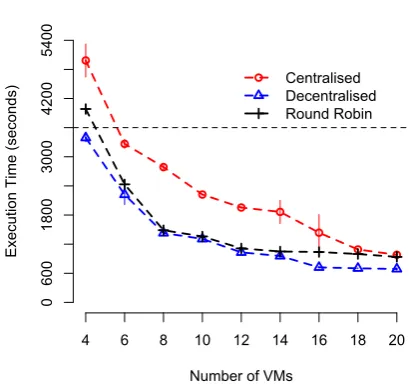
Figure 2 presents the execution times corresponding for each value of the number of VMs for all three ap-proaches. The centralised approach had the highest execution times as even though it selected the loca-tion with lowest transfer cost for all tasks but some tasks were very far from the Cloud location which re-sulted in the high data transfer time. On the other hand, the round robin approach performed better as it deployed VMs at multiple Cloud locations, which means it was possible for tasks to be executed near their data sources. Finally, it is evident that for the same number of VMs (or budget) our approach al-ways had the lowest execution time in comparison with other two.
A reason for the improvement is that our approach not only deployed VMs at multiple locations but also
Without_Reassignment With_Reassignment
Exe
cu
tio
n
T
ime
(se
co
nd
s)
0
1000
2000
3000
4000
ap-southeast-1
ap-southeast-2
[image:6.595.310.516.116.296.2]us-east-1 us-west-2
Figure 1: Compare execution without and with reassign-ment
Number of VMs
Exe
cu
tio
n
T
ime
(se
co
nd
s)
4 6 8 10 12 14 16 18 20
0
600
1800
3000
4200
5400
[image:6.595.309.514.371.564.2]Centralised Decentralised Round Robin
Figure 2: Execution Times
carefully selected those locations so that the major-ity of tasks could be executed near their data sources. The two simple approaches decided the location(s) of VMs based onalltasks, by assuming all tasks were assigned to one Cloud location. On the other hand, our approach took a more fine-grain method by as-signing each task to its nearest location first and then reassigning them to others location until the budget constraint was satisfied.
con-straint, our approach was 30% to 50% faster than the centralised approach. In comparison to the round robin approach, ours was able to reduce the execution times up to 30%.
4 6 8 10 12 14 16 18 20
Number of VMs
N
umb
er
of
T
ime
Bl
ocks
0
5
10
15
20
[image:7.595.75.275.181.364.2]Decentralised Approach Centralised Approach Round Robin Approach
Figure 3: Actual Number of Used Time Blocks, i.e. cost
Figure 3 presents the number of actual time blocks, which can be mapped onto actual cost, con-sumed by three approaches. It shows that our ap-proach was able to satisfy the budget constraint in all cases. Moreover, when there were four VMs, the cen-tralised and round robin approaches were more ex-pensive than the decentralised one. It was because each of their VMs required more than one hour to fin-ish executing all the assigned tasks and the overall ex-ecution time was higher than 3600 seconds, as shown by Figure 2. Which means that the constrainttbb=4
could only be satisfied by the decentralised approach.
4.4
Trade-off Between Cost and
Performance
As presented in Figure 2, the higher the budget con-straint is (i.e. more VMs), the better the performance is. In theory, it is possible to keep adding more VMs in order to achieve better performance. However, the performance gain for each additional VM also de-creases as the total number of VMs inde-creases.
Hence, it is up the user to decide how much im-provement in performance can be afforded. There are some simple criteria to consider such as a defined budget constraint, the desired execution time or defin-ing a threshold in the performance gain (for example, stop adding more VM(s) if the performance gain is
less than 60 seconds).
A user can also make the decision of how many VMs to use based on the trade-off between perfor-mance and cost, as mentioned in (Thai et al., 2014b).
5
RELATED WORK
In the Grid environment in which the resources are shared between multiple organisations, the overall performance of a distributed framework by process-ing data in close proximity to where it resides is im-proved (Ranganathan and Foster, 2002). Similarly, a heuristic algorithm is proposed to improve the perfor-mance of executing independent but file-sharing tasks (Kaya and Aykanat, 2006). An auto-scaling algorithm is proposed to satisfy deadline and budget constraints when each task requires distributed data from multi-ple sources (Venugopal and Buyya, 2005).
However, the application of Grid computing re-search on Cloud computing is limited because: i) the Cloud resources are (virtually) unlimited, hence a user is free to add or remove VMs whenever she wants but ii) the monetary cost factor has to be con-sidered as the resource is not available free-of-charge. Recently, running application on the Cloud has re-ceived attention from many researchers. Statistical learning had been used to schedule the execution of BoT on the Cloud (Oprescu and Kielmann, 2010). The method for scaling resource based on given bud-get constraint and desired application performance was also investigated (Mao et al., 2010). Neverthe-less, those papers do not consider the location of data. Cloud computing is employed for improving the performance of data intensive application, such as Hadoop, whose data is globally located (Ryden et al., 2014). Research that takes geographical distance into account while executing workflows is also re-ported (Luckeneder and Barker, 2013; Thai et al., 2014a). However, recent researches on applying Cloud computing for applications with geographi-cally distributed data only focus on improving the per-formance without considering the monetary cost.
computing by letting a user decides how much re-sources that she wants based on her budget. Fi-nally, the trade-off between performance gain and ad-ditional cost is also presented.
6
CONCLUSION
Due to its decentralised infrastructure and virtu-ally unlimited resources, Cloud computing is suitable to execute BoDT, whose data is globally distributed all over the world. It is challenging to decide how to assign tasks to Cloud VMs based on a user’s budget constraint while minimising the execution time.
The above problem was mathematically modelled in this paper. We also proposed a heuristic approach which assigned BoDT to Cloud VM(s) in order to maximise performance and to satisfy the allowed cost provided by a user.
Furthermore, we implemented a dynamic reas-signment feature to utilise the idle time of a VM that completes execution ahead of others by assigning tasks from other VMs onto it. This feature reduces the overall execution time when a number of VMs take longer to finish their execution due to service failure or network instability.
Our approach was evaluated and able to provide execution plans which satisfied given budget con-straints. Compared to the centralised and round robin approaches, our approach reduced the execution time on average by 27%. Our approach was also able to satisfy the low budget while the others did not.
In the future, we plan to further improve dynamic resource provisioning and tasks scheduling so that they can be performed during execution in order to handle expected events, e.g. network instability or machine failure. Moreover, the different types of Cloud instances, which have varying performance and cost will be taken into account.
ACKNOWLEDGEMENTS
This research is supported by the EPSRC grant ‘Working Together: Constraint Programming and Cloud Computing’ (EP/K015745/1), a Royal Society Industry Fellowship, an Impact Acceleration Account Grant (IAA) and an Amazon Web Services (AWS) Education Research Grant.
REFERENCES
Chun, B., Culler, D., Roscoe, T., Bavier, A., Peterson, L., Wawrzoniak, M., and Bowman, M. (2003). Planet-lab: An overlay testbed for broad-coverage services. SIGCOMM Comput. Commun. Rev., 33(3):3–12. Kaya, K. and Aykanat, C. (2006).
Iterative-improvement-based heuristics for adaptive scheduling of tasks shar-ing files on heterogeneous master-slave environments. Parallel and Distributed Systems, IEEE Transactions on, 17(8):883–896.
Luckeneder, M. and Barker, A. (2013). Location, location, location: Data-intensive distributed computing in the cloud. InIn Proceedings of IEEE CloudCom 2013, pages 647–653.
Mao, M., Li, J., and Humphrey, M. (2010). Cloud auto-scaling with deadline and budget constraints. InGrid Computing (GRID), 2010 11th IEEE/ACM Interna-tional Conference on, pages 41–48.
Oprescu, A. and Kielmann, T. (2010). Bag-of-tasks scheduling under budget constraints. InCloud Com-puting Technology and Science (CloudCom), 2010 IEEE Second International Conference on, pages 351–359.
Ranganathan, K. and Foster, I. (2002). Decoupling compu-tation and data scheduling in distributed data-intensive applications. InProceedings of the 11th IEEE Interna-tional Symposium on High Performance Distributed Computing, HPDC ’02, pages 352–, Washington, DC, USA. IEEE Computer Society.
Ryden, M., Oh, K., Chandra, A., and Weissman, J. B. (2014). Nebula: Distributed edge cloud for data in-tensive computing.
Thai, L., Barker, A., Varghese, B., Akgun, O., and Miguel, I. (2014a). Optimal deployment of geographically dis-tributed workflow engines on the cloud. In6th IEEE International Conference on Cloud Computing Tech-nology and Science (CloudCom 2014).
Thai, L., Varghese, B., and Barker, A. (2014b). Execut-ing bag of distributed tasks on the cloud: Investi-gating the trade-offs between performance and cost. InCloud Computing Technology and Science (Cloud-Com), 2014 IEEE 6th International Conference on, pages 400–407.