A Genetic Algorithm for Face Fitting
David Hunter
1, Bernard P. Tiddeman
2and David I. Perrett
1 1School of Psychology, University of St Andrews, Fife, Scotland, UK2Department of Computing, University of Aberystwyth, Ceredigion, Wales, UK
{dwh5, dp}@st-andrews.ac.uk, [email protected]
Keywords: Genetic Algorithms, Face Fitting, Three Dimensional Morphable Models
Abstract: Accurate estimation of the shape of human faces has many applications from the movie industry to psycholog-ical research. One well known method is to fit a Three Dimensional Morphable Model to a target image. This method is attractive as the faces it constructs are already projected onto an orthogonal basis making further manipulation and analysis easier. To date use of Morphable Models have been limited by the inaccuracy and inconvenience of current face-fitting methods. We present a method based on Genetic Algorithms that avoid the local minima and gradient image errors that current methods suffer from. It has the added advantage of requiring no manual interaction to initialise or guide the fitting process.
1
INTRODUCTION
Accurate analysis of the 3D shape of human faces has been limited by the relative lack of data from three-dimensional scanners. Databases of 2D face im-ages are often far more complete, easier to produce, and have a long history that pre-dates 3D scanners. However accurate shape estimating using landmarks, or other measures, is limited by problems of pose and orientation. Blanz and Vetter proposed a solution in the form of a Morphable Model that captures in a sta-tistical model the space of human face shapes and then attempts to find from this face-space a model that most closely matches the target image (Blanz and Vetter, 1999). The advantage of this algorithm is that shape can be estimated from a far wider variety of poses than with a two-dimensional method such as the commonly used AAM (Cootes et al., 1998). Also, illumination is less of an issue as the illumina-tion of the three-dimensional model can be computed by physical simulation. Widespread adoption of these models has been hampered by the lack of accuracy in the fitting of the model.
Most current methods involve minimizing a cost function based on the L2-norm between a rendered face model with a particular set of parameters and a target image. As the derivatives of this function can be approximated, many previous authors have used gra-dient descent methods. However these methods are prone to local-minima problems. Also the derivatives are approximated and are only valid if the face is
al-ready closely aligned with the target image. These derivatives introduce a new source of error to the fit-ting that is most pronounced when the gradient is shallow, as well as a windowing effect that makes it difficult to detect shape updates that differ signifi-cantly in scale.
We used an alternative minimization approach that avoids many of the problems associated with gradi-ent descgradi-ent, called a Genetic Algorithm. This algo-rithm uses the ‘best’ results from the previous itera-tion to seed a new set of trial parameters. This allows a greater proportion of the parameters’ space to be analysed and so is less likely to become ‘stuck’ in a local-minima and so find a global optimum.
2
Background
case the derivative images would have to recalculated in their entirety. The most promising was a multi-feature fitting strategy that combined, in a Bayesian fashion, a set of different differentiable cost functions designed to extract different aspects of the image; for example, edges and particular illumination artefacts such as specular reflection (Romdhani, 2005). Like previous methods, these functions were differentiable and required a good initial estimate of parameters. Faggian et al. adapted the method for multiple views of the same face, however we will be working with just one view (Faggian et al., 2008).
Xiao et al. used a 2D to 3D method whereby an Active Appearance Model was constructed from a 3DMM. Thus methods developed to fit and track AAMs can be used with 3D models. However the combined model also spans a large set of parameter values that result in invalid 3D shape models (Xiao et al., 2004). These methods all suffer from both the local-minima and windowing problems described above.
Fitting a model by matching it to prominent fea-tures in the target image is an appealing option. The most obvious of these are the boundaries such as those between the face and background and inter-nal boundaries such as the edges of eyes, the mouth etc. Moghaddam et al. used face silhouette taken of the same source from multiple angles to capture a 3DMM. They used an XOR based cost function where a high cost was applied to silhouette edge points that are found in one image but not at the equiv-alent point in the other. Not all the boundaries on the images and models are appropriate for fitting. Hair, for example, provides false edges, and the model it-self can provide false silhouettes as it is defined over the face only and not the full head. The cost func-tion was therefore weighted towards appropriate sil-houettes (Moghaddam et al., 2003).
A number of techniques make use of shape-from-shading, solving a partial differential equation linking the image intensity to the reflectance map based on the assumption that the surface is Lambertian. Patel and Smith estimated the 3D shape by minimising the arc-distance between the surface normal of the Mor-phable Model and the illumination cone. These con-straints applied only to vertex points and as such al-lowed the shape-from-shading model to capture fine-scale surface details. Current Shape from shading for-mulations rely on specific lighting and camera set-ups, for example a distant light source or a light source at the optical centre of the image. This con-straint is not present when the lighting model is calcu-lated by physical simulation (Patel and Smith, 2009).
3
Constructing a Morphable Model
Three dimensional Morphable Models, introduced by Blanz and Vetter, use Principle Components Analysis to describe the space of human faces as a set of or-thogonal basis vectors. Given a set of 3D dimensional face models we find a set of one-to-one correspon-dences between vertices by delineating key points on the models, such as eyes, nose, mouth etc. The ex-emplar is warped into alignment with the target face using the landmarks to drive a 3D thin-plane-spline model. Correspondences between face models and an exemplar face model are found by casting rays out from the vertices of the exemplar models in the di-rection of the surface normal at the vertex, the posi-tion on the target model intersected by the ray is con-sidered to be the corresponding vertex. The meshes are remapped by warping the vertices of the exem-plar mesh to the corresponding vertices of the target mesh, thus creating a new mesh with the vertex count and structure of the exemplar and the shape of the tar-get mesh. Colour is warped similarly using the cor-respondences defined to between the two shapes. We concatenate the resulting vertex positions and colour values as,
s= (x1,y1,z1,x2,y2,z2,· · ·,xn,yn,zn)T, (1)
t= (r1,g1,b1,r2,b2,g2,· · ·,rm,gm,bm)T (2)
Each face is centred by subtracting the mean of all the faces and PCA performed. A reduced set of 40 eigenvectors for each of shape and colour were used to describe the face space. The shapesand colourt of a new face are generated as a linear combination of weighted PCA vectorssj,tjand the averages ˆsand ˆt.
s=sˆ+
k
∑
j=1αjsj, t=ˆt+ k
∑
j=1βjtj (3)
With the probability distribution over the PCA face-space defined as
p(s)≈e−
1 2∑i
α2i
σs,i (4)
whereσs,i is the standard deviation of the ith shape
component. The PDF for colour is defined similarly. The weightsαjandβjform the parameter vectors
4
Genetic Algorithm
4.1
Cost function
In order to extract three dimensional facial features we minimize theL2-norm of the difference between a rendered 3D face model and the target image.
C(p)l=
1
|Ω|x
∑
∈Ω(M
(p)lab−I
lab)2 (5)
whereΩis the subset of all samples in the image cov-ered by the rendcov-ered face image and|Ω|is the num-ber of samples inΩ. The cost function is scaled to
the number of rendered samples to avoid degenerate minimisation.
The calculation is performed in L*a*b* space as this allows an emphasis on the Intensity of the im-age (the L* values are on averim-age larger than the a* and b*) with some colour information included in the model.
We found that fitting to an L2-norm alone was unsatisfactory as the model tended to have difficulty matching the edges of the face. The cost function is unspecified outside the area of the rendered model so the edges of the face are generally undefined by this method. We added an edge fitting metric as defined by (Romdhani, 2005). A Sobel edge detector is used to find edges in the target image. For each position in the target image the distance to the nearest edge point is found. The error metric for the edge detector becomes
C(p)e=
1
ΨM(p)x∈
∑
ΨM(p)
(argmin
x x
|x−ΨI|22) (6)
ΨIandΨM(p)denotes the set of detected edge points
after a Sobel edge detector has been applied to the target image and rendered Morphable Model respec-tively.
The error metrics are combined into a single cost function
C(p) =λC(p)l+µC(p)e (7)
Whereλandµ were chosen to be 1 and 15
respec-tively. These numbers were chosen such that the ratio λ
µ=
median(Cl)
median(Ce). The medians ofCl andCe were
es-timated empirically by rendering a set of Morphable Models with random parameters and estimating the respective error metrics between them and a randomly selected target image.
4.2
Minimisation using a Genetic
Algorithm
The minimization method employs a standard genetic algorithm. There are many books and papers on
this topic, and just as many variations on the basic method. For completeness we will outline the exact method used, much of which is from the book ‘Es-sentials of Meta-heuristics’ (Luke, 2009). The algo-rithm is inspired by Darwinian evolution aims find the global minimum by ‘breeding’ an optimal individual. Each generation, i.e. iteration of the algorithm, a pop-ulation of possible solutions is evaluated and using the cost function (equation (7)). The best solutions are kept and the parameters combined to create a new population for the next iteration of the algorithm. In this manner the algorithm converges to the global op-timum, the parameters of which are the values of p
that minimise equation (7).
The algorithm begins by generating a set of sam-ples from a distribution believed to contain the global minima of an cost function. In theselectionphase a cost function is applied to this set of samples and the m best selected as ‘parents.’ A new set of samples are generated from the parent set by selecting random pairs of parents and combining their parameters, this is known as Cross-Over. In a finalMutationphase the combined pairs are randomly altered to introduce variation into the population. The cost function is ap-plied to these child samples and the mbest become the ‘parents’ of the next generation. The algorithm repeats until no further improvement is made over a pre-defined number of generations.
Algorithm 1Outline of Genetic Algorithm
Let P be a set of randomly generated Morphable Models (with shape, colour and camera positions)
repeat
For eachpi∈Pcompute the cost functionC(pi)
(equation (7))
LetP(l)= subset oflbest samples fromP, fork=1 tomdo{Createmnew samples}
Select pair of samples at random fromP(l), de-notepiandpj,i6=j.
foro=1 tondo{For each parameter inpi}
Choose at random from each of the parents.
qk,o=pi,o|p(i,o)
0.25 chance of Applying mutation toqo
ac-cording to equation (8).
end for end for
Combine bestlsamples with newly created sam-ples and use in next iteration. i.e. Let P=
{P(l),Q}.
untilAlgorithm ceases to converge Take sample with lowest cost as solution.
of 25 with the ’best,‘ i.e. lowest, scores selected as parents for the next generation. These ‘parents’ survive into the next generation and are randomly paired to produce offspring.
Cross-Over In order to create a new ‘child’ subject from two parents it is necessary to select indi-vidual features from one parent or another, in the hope that the ‘child’ will feature the best parame-ters from each parent. As we do not know in ad-vance which features offer the best improvement we select the features at random. Thus, for each parameteriin the parameter vectorp we select, randomly, one of the two parents and copy that parents parameter. In our implementation we did not bias towards either parent and thus each pa-rameter has a 0.5 chance of being selected from each parent.
Mutation The offspring that result from the Selec-tion and Cross-over will differ from their parents and uniqueness is enforced, however only param-eter values randomly generated in the initialisa-tion phase will be explored. In order that the pa-rameter space is adequately explored by the al-gorithm, each parameter has a chance of being mutated, the probability of mutation is known as themutation factor. A trivial implementation of the mutation would be to add a random amount to the parameter determined by the Probability Density Function (see equation (4)) for the pa-rameter. However this adversely affects the con-vergence time of the algorithm as the parameters will frequently be far from the global optimum. To avoid this we used a new method that con-strained the new mutated value to be with-in or close to the area that the population is converging towards. We assume that the two ‘parent’ values, being chosen from the amongst the best current solutions, frame the global minimum and thus we concentrate our search between these two values. This is a trade-off between a search that covers the whole space of possible Morphable Models and the speed of convergence. Define the mutated pa-rametersp0as
p0i=1
2(p
(1)+p(2))−
ρ+r (8)
r∈
U
(−12(p
(1)+p(2)),1
2(p
(1)+p(2))) ρ
wherep(1)andp(2)are the parameters of the two selected parents and ρ is a constant that allows the value of the new parameter p0 to randomly stray beyond the limits described byp(1)andp(2), preventing the algorithm from becoming too con-strained. In our system ρ=1.2.
U
(a,b)is theuniform distribution defined over the rangeatob inclusive.
Elitism The best result from the previous generation is preserved in the new generation. This makes the search similar to a ‘down-hill’ search.
5
Results
3D models of 185 individuals (123 females, 62 males) of student age (17-23 years) were captured us-ing a Cyberware scanner. A Morphable Model was constructed using these heads as outlined in section 3. Further, 43 photographs of female subjects, also stu-dent aged were taken. These photographs were taken under controlled lighting conditions; these conditions were different from the lighting conditions of the 3D capturing system.
Shape estimation of each of the 43 subjects was carried out using both the Genetic-Algorithm method, outlined above, and using a Taylor-Series gradient de-scent method similar to (Blanz and Vetter, 1999). For the Taylor-Series method the faces where initialized by hand, placing a Morphable Model in the average configuration in the location on the face that most closely matched the subjects own face. To overcome the windowing problem we used a multi-scale fitting strategy.
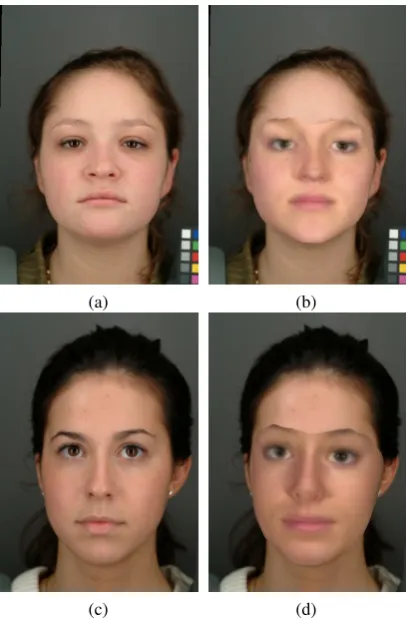
Results of fitting using our GA algorithm are shown in figures 1 and 3.
In order to get some empirical measures we would ideally like to have a three-dimensional face model that exactly matches the photographic image for com-parison. As we have no access to such models we opted for a feature point matching strategy. Each of the 43 photographic images were hand delineated, marking out clear feature points, e.g. corner of eyes, mouth, chin etc. Identical landmarks were found on the Morphable Model, and appropriate shape updates found such that the landmarks were appropriately ad-justed when the Morphable Models parameters were updates. When fitting, either by the Taylor-series method or the Genetic Algorithm, is completed the landmarks are updated to match the Morphable Model and projected onto the two-dimensional image. Each landmark is compared with its corresponding hand-placed landmark to determine the accuracy of the fit-ting in anL2, least squares sense.
χ2=
∑
i
|li−M[sˆi+ k
∑
j=1αjsi,j]|22 (9)
Hereliis the 2D position of theithhand-placed
(a) (b)
[image:5.595.312.516.84.495.2](c) (d)
Figure 1: Example results of the GA face fitting algorithm. The left column shows the original subjects the right col-umn the rendered shape estimation that approximately min-imises the cost functionC. The right most image shows the final result of the algorithm.
andsj,ithe shape update of theithlandmark in thejth
principal shape component. M is a linear transform from 3D to 2D built using the camera parameters.
Table 1 shows the results of fitting to 43 example images using both the Taylor-Series and Genetic Al-gorithm methods. From these results we can see that the GA method offers a clear improvement over the Taylor-Series method, the difference is significant to p=0.005, using a single-tailed paired t-test.
Method Mean Standard Deviation Taylor-Series 44.0 12.9
GA 38.8 4.5
Table 1: Average error from template fitting computed as mean squared difference in pixels between landmark pairs. The images are 378 by 478 pixels. The results are averaged across 43 fitted images.
(a) Original Image (b) GA Fitted Image
(c) Taylor-Series Fitted Im-age
[image:5.595.77.281.92.402.2](d) Model only - Front View (e) Model only - Profile View
Figure 3: Example results from the face fitting algorithms. The top-left image shows the target face image for one of the subjects. The top right image is the result of the Ge-netic Algorithm applied to the target image. The middle row shows the results of fitting using the Taylor-Series al-gorithm for comparison. On the bottom row the models pro-duced by the Genetic Algorithm are shown in both full-face (left) and profile (right) views.
6
Conclusion
[image:5.595.74.266.626.663.2](a) 1stiteration (b) 3rditeration (c) 5thiteration (d) 11thiteration (e) 28thiteration
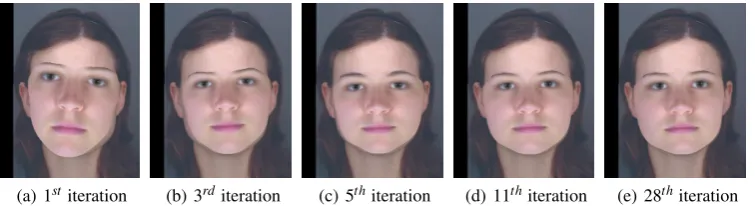
Figure 2: The progress of the Genetic Algorithm in fitting to an example face. Each image shows the best sample from the indicated iteration.
The algorithm described offers a clear improve-ment over the simple Taylor-Series method. The Ge-netic Algorithm is able to reasonably accurately esti-mate the shape of the face without guidance by fea-ture landmarks or other form of initialization. We be-lieve this offers a significant improvement over cur-rent techniques as the method can be applied easily to large data-sets. One drawback of the algorithm that is worth mentioning is the speed. The average time taken for each subject in our set was 18.4 minutes on a 2.4GHz Intel(R) Core(TM)2 CPU. Gradient de-scent methods are significantly faster, taking an aver-age of 4.7 minutes each. Although slower our method is more accurate than the Taylor-Series method. The standard deviation of the errors is significantly larger for the Taylor-Series method as this method produces highly inaccurate fits in a number of cases, whereas the GA method is more consistent.
Rather than implement exactly some of the state-of-the-art techniques we have used a simplified ver-sion that distils the various algorithms down to their essence as iterative gradient descent methods. Some of the methods such as (Romdhani and Vetter, 2003) and (Xiao et al., 2004) which attempt to exchange accuracy for speed are not considered as accuracy is our main aim. At the other end of the spectrum the multi-features fitting strategy of Romdhani’s thesis uses many different error metrics in combination to produce a face model (Romdhani, 2005). We have not attempted use all of these metrics in our compar-ison, however we believe that they are likely to ex-hibit many of the same problems as the Taylor-Series method. This is due to the problems of local-minima and errors in derivative calculation, a problem inher-ent in gradiinher-ent descinher-ent techniques. It is also worth noting that both Romdhani’s algorithm (Romdhani, 2005) and (Blanz and Vetter, 1999) both rely on man-ual placement of landmarks on each face image both initialise and to guide the fitting. In this respect our method provides a clear advantage in that no land-mark placement is required.
REFERENCES
Baker, S. and Matthews, I. (2004). Lucas-kanade 20 years on: A unifying framework. International Journal of Computer Vision, 56(1):221 – 255.
Blanz, V. and Vetter, T. (1999). A morphable model for the synthesis of 3d faces. InSIGGRAPH ’99: Pro-ceedings of the 26th annual conference on Computer graphics and interactive techniques, pages 187–194, New York, NY, USA. ACM Press/Addison-Wesley Publishing Co.
Cootes, T. F., Edwards, G. J., and Taylor, C. J. (1998). Ac-tive appearance models. Lecture Notes in Computer Science, 1407:484–.
Faggian, N., Paplinski, A. P., and Sherrah, J. (2008). 3d morphable model fitting from multiple views. InFG, pages 1–6. IEEE.
Luke, S. (2009). Essentials of
Metaheuris-tics. Lulu. Available for free at
http://cs.gmu.edu/∼sean/book/metaheuristics/. Moghaddam, B., Lee, J., Pfister, H., and Machiraju, R.
(2003). Model-based 3d face capture with shape-from-silhouettes. InIn IEEE International Workshop on Analysis and Modeling of Faces and Gestures, page pages.
Patel, A. and Smith, W. A. P. (2009). Shape-from-shading driven 3d morphable models for illumination insensi-tive face recognition. InBMVC. British Machine Vi-sion Association.
Romdhani, S. (2005). Face Image Analysis using a Multi-ple Feature Fitting Strategy. PhD thesis, University of Basel.
Romdhani, S., Blanz, V., and Vetter, T. (2002). Face iden-tification by fitting a 3d morphable model using linear shape and texture error functions. In Computer Vi-sion – ECCV’02, volume 4, pages 3–19, Copenhagen, Denmark.
Romdhani, S. and Vetter, T. (2003). Efficient, robust and accurate fitting of a 3d morphable model. In9th IEEE International Conference on Computer Vision (ICCV), pages 59–66.