arXiv:1408.0794v1 [astro-ph.EP] 4 Aug 2014
An Enigmatic Pointlike Feature within the HD 169142 Transitional Disk
Beth A. Biller1,2, Jared Males3,∗
, Timothy Rodigas4, Katie Morzinski3,∗
, Laird M. Close3, Attila
Juh´asz5
, Katherine B. Follette3
, Sylvestre Lacour6
, Myriam Benisty7
, Aurora Sicilia-Aguilar8,9
, Philip M. Hinz3
, Alycia Weinberger4
, Thomas Henning2
, J¨org-Uwe Pott2
, Micka¨el Bonnefoy10
, Rainer K¨ohler2
ABSTRACT
We report the detection of a faint pointlike feature possibly related to ongoing planet-formation in the disk of the transition disk star HD 169142. The pointlike feature has a ∆mag(L)∼6.4, at a separation of ∼0.11′′
and PA∼0◦
. Given its lack of an H or KS counterpart despite its relative brightness, this candidate cannot be explained by purely photospheric emission and must be a disk feature heated by an as yet unknown source. Its extremely red colors make it highly unlikely to be a background object, but future multi-wavelength followup is necessary for confirmation and characterization of this feature. 1 2
1
Institute for Astronomy, University of Edinburgh, Blackford Hill, Edinburgh, UK
2
Max-Planck-Institut f¨ur Astronomie, K¨onigstuhl 17, 69117 Heidelberg, Germany
3
Steward Observatory, University of Arizona, 933, N. Cherry Ave, Tucson, AZ, 85719, USA
*
NASA Sagan Fellow
4
Department of Terrestrial Magnetism, Carnegie Institution of Washington, 5241 Broad Branch Road, NW Wash-ington, DC 20015, USA
5
Leiden Observatory, Leiden University, P.O. Box 9513, 2300 RA Leiden, The Netherlands
6
LESIA, CNRS/UMR-8109, Observatoire de Paris, UPMC, Universit´e Paris Diderot, 5 place Jules Janssen, 92195 Meudon, France
7
UJF-Grenoble 1 / CNRS-INSU, Institut de Plan´etologie et d’Astrophysique de Grenoble (IPAG) UMR 5274, Grenoble, F-38041, France
8
Departamento de F´ısica Te´orica, Facultad de Ciencias, Universidad Aut´onoma de Madrid, 28049 Cantoblanco,
Madrid, Spain
9
SUPA, School of Physics and Astronomy, University of St Andrews, North Haugh, St Andrews KY16 9SS, UK
10
Universit´e Grenoble Alpes, IPAG, F-38000 Grenoble, France. CNRS, IPAG, F-38000 Grenoble, France
1
Based on observations made with ESO Telescopes at the La Silla Paranal Observatory under programme ID 091.C-0572.
2
Subject headings:
1. Introduction
Transition disks trace a key step in the formation of planetary systems, intermediate between gas-rich protoplanetary disks and debris disks, where primordial gas is cleared away, leaving only remnant dust. These disks are observationally identified by weak mid-IR emission (at ∼15 µm) relative to the Taurus median spectral energy distribution (Najita et al. 2007, i.e. the median SED of primordial disks in the young (<2 Myr) Taurus star-forming region). While numerous physical processes may be responsible for the depletion of gas and dust in transition disks, cleared gaps in particular may be an indicator of a planet or brown dwarf companion in the midst of formation. Thus, these disk systems have been key targets for direct imaging searches for planets.
Transition disks tend to be found in young star-forming regions >100 pc from Earth. Only recently have imaging techniques been available to probe the inner portions of these disks, where planets are likely to form. In the last few years, there have been a number of notable discoveries of companions in transition disks with cleared gaps. Via the interferometric sparse-aperture mask-ing (henceforth SAM) technique (Lacour et al. 2011), Kraus & Ireland (2012) found LkCa 15b, a candidate protoplanet embedded within the disk of a ∼2 Myr solar analog. Biller et al. (2012) detected a 0.1-0.4 M⊙ companion in the disk around the Herbig Ae/Be star HD 142527. This
bi-nary companion was recently confirmed and shown to be accreting via direct imaging (Close et al. 2014). HD 142527 has a particularly wide gap in its disk (> 10-120 AU, Fukugawa et al. 2006, Rameau et al. 2012, Casassus et al. 2012), which may be explained by a stellar companion on an eccentric orbit. Finally, Quanz et al. (2013a) reported an as yet unconfirmed candidate protoplanet detection in the disk of the Herbig Ae/Be star HD 100546.
The Herbig Ae/Be star HD 169142 possesses a nearly face-on transition disk, and has been studied in detail both spectroscopically (Meeus et al. 2001, van Boekel et al. 2005), and through imaging (Habart et al. 2006, Kuhn et al. 2001, Hales et al. 2006, Grady et al. 2007, Fukugawa et al. 2010, Honda et al. 2012, Mari˜nas et al. 2011). Recently, Quanz et al. (2013b) detected a well-resolved annular gap from 40 - 70 AU via polarized light imaging. Thus, like LkCa 15, HD 142527, and HD 100546, it is an excellent candidate to possess a planetary mass or brown dwarf companion in the midst of formation.
2. Stellar Parameters
Adopted stellar parameters are presented in Table 1. In general, we adopt the stellar param-eters from Table 1 of Quanz et al. 2013b. An accurate age estimate is particularly important for estimating candidate companion properties; HD 169142 has been assigned a fairly wide range of ages. Guimar˜aes et al. 2006 assign a comparatively young age of 1-5 Myr based in HD 169142’s HR diagram position, while Blondel & Djie 2006 claim a similar mass and age asβ Pic for HD 169142. Grady et al. 2007 find a comoving companion 9.3” separated from HD 169142. This object is a 130 mas separation weak-line T Tauri binary, thus they assign an age of 6+6−3 Myr for the entire
system. For our analysis here, we thus adopt an age range of 3-12 Myr. Sylvester et al. 1996 derive a photometric distance of 145 pc to HD 169142, based on an A5 spectral type; Blondell & Djie 2006 update this to 151 pc based on a spectral type of A7V. As derived spectral type will strongly affect the photometric distance, we adopt a distance range of 145±10 pc here to account for any uncertainty in spectral typing.
3. Observations and Data Reduction
3.1. July 2013 VLT NACO Vortex Observations
First epoch observations were conducted using the novel annular groove phase mask (hence-forth AGPM) vector vortex coronagraph (Mawet et al. 2013) with the NACO camera at the VLT (Lenzen et al. 2003; Rousset et al. 2003). The AGPM coronagraph uses an annular groove phase mask to redirect on-axis starlight out of the pupil (Mawet et al. 2005). In this manner, the AGPM coronagraph enables L’ band contrasts of ∆mag>7.5 mag at inner working angles down to 0.09′′
(Mawet et al. 2013). HD 169142 was observed in L’ from 02:47 UT to 04:54 UT on 14 July 2013, covering nearly an hour both before and after transit. The derotator was turned off to enable azimuthal differential imaging (ADI) techniques. Seeing varied from 1-2′′
over the observation. We used a base exposure time of 0.25 s with 120 coadds and obtained a total of 1 hour 15 minutes on-sky exposure time. Sky frames were interspersed after every 20 frames and 0.05 s unsaturated exposures were taken at the beginning of the sequence. Care was taken to keep the primary star centered under the AGPM. Observation details are presented in Table 2.
Data were flat-fielded and bad-pixel corrected using dome flats and darks taken as part of ESO standard calibrations. Numerous dust spots are apparent on the AGPM, thus, slight misalignments between science and sky frames can produce significant cosmetic errors. Thus, we carefully selected the sky frame which minimized cosmetic errors for each science frame. Eleven science frames (out of 126 total science frames) which showed significant cosmetic errors even after sky subtraction were discarded. Each frame was centroided on the raw data using the idl routine mpfit2dpeak.
(PCA) pipelines (following the algorithms of Soummer et al. 2012, Amara & Quanz 2012). All three pipelines yielded similar results – we report here the results using the publically available pipeline of Dimitri Mawet (http://www.sc.eso.org/∼dmawet/DimitriMawet/IDL PCA pipeline.html).
3.2. April 2014 Magellan AO Observations
Followup observations were conducted using the 585 actuator 1000 Hz adaptive secondary AO System (MagAO) at the 6.5m Magellan Clay Telescope (Close et al. 2013). With 378 corrected modes, the MagAO system is one of the highest sampled AO systems on a large telescope (>5 m) and has demonstrated high spatial resolutions (20-30 mas) in the visible (as short as λ =0.6µm, Close et al. 2013). MagAO feeds both a visible (VisAO, 0.5-1µm) and infrared camera (Clio2, 1-5 µm) simultaneously.
We obtained a total of 5 datasets for HD 169142 with MagAO from 8-15 April 2014. Observing details are presented in Table 2. Four of these datasets were obtained with the Clio2 Narrow camera including two H band observations, one KS band observation, and one 3.9 µm 5% filter observation. We also obtained a deep z’ dataset using the VisAO camera. The derotator was turned off to enable angular differential imaging (ADI) techniques. All MagAO data was reduced in the standard manner (flat-field correction, sky-subtraction, bad-pixel correction). The H, KS, and z’ datasets remained unsaturated in the core, thus we align our images using the unsaturated core. We then process our data using the independent PCA-based pipelines of CoIs Rodigas and Males (see e.g. Rodigas et al. 2014 and Males et al. 2014). Both pipelines yielded similar results.
At 3.9 µm, we acquired data for HD 169142 as well as for a PSF star of similar magnitude. We achieved very high Strehl ratios for both stars in dry, photometric conditions. Seeing remained around 0.4-0.6′′
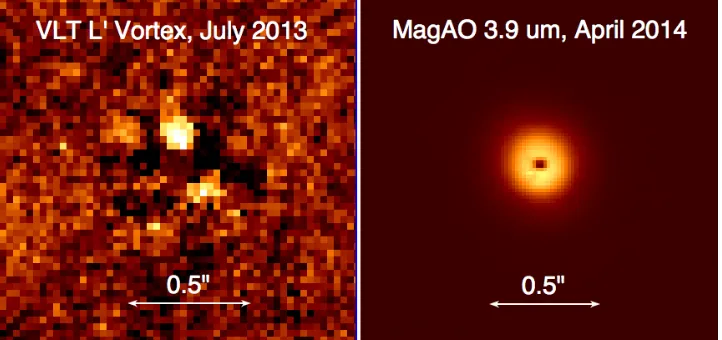
for the entire night. After image registration, we built a PSF from the nearby star images and subtracted the PSF from each of our MagAO/Clio2 images of HD 169142, then rotated to place North up/East left. Our best subtraction is for a PSF scaling of 115%, which removes the Airy rings quite well. Dark pixels in the core are due to saturation/non-linearity.
4. Results
In July 2013, we detected a faint, pointlike feature in our L’ vortex dataset at∼0◦
of the Trapezium cluster.
4.1. July 2013 VLT NACO Vortex Observations
L’ photometry and astrometry was derived for the pointlike feature by inserting scaled PSF images into the raw data and selecting the fluxes and positions that best match the actual feature. Best astrometry and photometry is presented in Table 1. Assuming a point source, our best subtraction yielded ∆mag=6.4±0.2 for this feature, at a separation of 0.11±0.03′′
and PA of 0±14◦
. Given that the inner working angle of the vortex coronagraph is 0.09′′
(Mawet et al. 2013), this pointlike feature is marginally resolved at best.
To estimate the S/N level of our detection, we calculated the mean and standard deviation in a circular aperture with diameter of λ/D centered on the pointlike feature and in the 6 addi-tional resolution elements available at this separation and then calculated S/N from equation 9 of Mawet et al. (2014) (appropriate for speckle-dominated regions):
S/N = x¯1−x¯2 s2
q
1 + n21
(1)
where ¯x1is the mean within the aperture containing the feature, ¯x2is the mean of the remaining
6 resolution elements,s2 is the standard deviation of the remaining 6 resolution elements, and n2
is the number of resolution elements not containing the feature. We find S/N∼6 for the detected feature, thus this detection is unlikely to be a false positive – a result which is further bolstered by the independent detection of the same feature by Reggiani et al. 2014.
Initially assuming purely photospheric emission, we estimate mass using Monte Carlo methods to account for the range of possible ages and uncertainties in photometry for this system. An ensemble of 106 possible ages are drawn from a uniform distribution running from 3-12 Myr. An
ensemble of 106
absolute magnitudes are simulated, assuming Gaussian errors on photometry and distance (0.3 mag error in ∆mag, 10 pc error in distance). We then interpolate with age and single band absolute magnitude to find the best mass for the companion from the DUSTY and COND models of Chabrier et al. (2000) and Baraffe et al. (2002). Mass range histograms are presented in Fig. 2. Adopting a 3-12 Myr age range at a distance of 145 pc and the DUSTY models, this candidate would correspond to a relatively high mass 60-80 MJ up brown dwarf.
4.2. April 2014 Magellan AO Observations
(H band absolute magnitude <7) and have been easily detected given our H and Ks sensitivity. Indeed, our sensitivity is sufficient to detect a∼7-15 MJ upobject at this separation and age range. Such a high-mass companion should open up a very wide gap in the disk, inconsistent with the ring at similar radii observed polarimetrically by Quanz et al. 2013b. The lack of a near-IR counterpart to the L’ detection signifies that we are not observing the photosphere of a substellar object here but may be a potential disk feature its extremely red colors indicate that it is extraordinarily unlikely to be a background.
We performed radiative transfer calculations to investigate whether or not a passively heated disk ’feature’ can reproduce the observed point-like source. We used the best fit disk model param-eters from Maaskant et al. 2013 to describe an axisymmetric disk. Then to simulate a clump we increased the pressure scale height in the disk. The scale height was increased as a 2D Gaussian centered on the observed point source with an FWHM of 7 AU and a peak perturbation of 30%. We used 0.1µm size astronomical silicates for the dust opacity to get an upper limit on the scat-tered light perturbations. Larger grains would scatter preferentially forward, perpendicular to the line of sight, which would decrease the contrast between the clump and the central star. Then we measured the contrast on the calculated L’ images. We find that a “dust clump” at the position of our candidate would have a contrast of∼17 mag (1×10⁻⁷
) between the star and the clump, much fainter than the detected candidate.
This result is not surprising, given the distance of the pointlike feature from the star. Assuming we observe only thermal dust emission from an irradiated clump, if the clump peaks at L’, it would have T∼850 K. Thus, adopting this as the maximum temperature of a potential dust clump, an irradiated clump with this temperature would be at a distance of the order of 0.6 AU (considering temperature and radius of the primary from Quanz et al. 2013b), inconsistent with the >10 AU separation of this detection. Tentatively, we consider this candidate to be a disk feature heated by an as yet unknown mechanism.
We also marginally detected a candidate companion in H and Ks with a separation of∼0.18” and a PA of∼33◦
, but at low significance (S/N=3-5, using the same procedure as for the pointlike L’ feature). These data were taken at two different nods, with very different looking PSFs in the two nods, limiting the precision of our photometry to±0.5 mag. Thus, while this point source was detected in two different bands on 3 nights (with S/N∼5 in the first dataset, but only S/N∼3 in the additional datasets), it requires confirmation at an additional epoch, with a more stable PSF, to verify common proper motion and rule out imaging and reduction artifacts. If real and purely photospheric, this candidate would be a 8-15 MJ upplanet / substellar object (DUSTY and COND models). No corresponding L’ counterpart was found in the July 2013 L’ vortex dataset. If purely photospheric, the L’ counterpart to this object is expected to have an absolute magnitude >8.5 mag (DUSTY or COND models), corresponding to an apparent magnitude of >14.3 mag. This is considerably below our achieved contrast for this dataset at this separation (limiting magnitude of ∼12.7, from insertion and retrieval of PSF images into the raw data). We also do not see a counterpart to this point source in our deep MagAO/VisAO z’ dataset, down to a contrast of 10−4
If real, the very red colors of this object are inconsistent with background stars with spectral types earlier than mid to late M.
5. Discussion
The known geometry of this disk limits the potential masses of companions associated with imaged asymmetries. Quanz et al. 2013b image an inner dust ring peaking at 25 AU and an annular gap from 40-70 AU. The L’ detection lies within the 25 AU dust ring and may be connected to ongoing companion formation in the disk. If associated with a massive object, it may have had some role in clearing out the region inside this ring. Our tentative H/K detection does not lie within the 40-70 AU gap but is coincident with the 25 AU dust ring. This suggests that any substellar/planetary counterpart to this tentative detection cannot be very massive, as a massive object (&0.55 MJ up should completely clear away dust from its immediate environment (Kley & Nelson, 2012). If massive objects are associated with these detections, they would be some of the closest companions imaged to date. Among confirmed directly imaged exoplanets, onlyβPic b, HR 8799d, and HR 8799e have comparably small projected separations (Lagrange et al. 2010, Marois et al. 2008, 2010).
Some disk asymmetries detected via Sparse Aperture Masking (SAM) have been described due to forward scattering off an inclined disk (e.g. Cieza et al. 2013, Olofsson et al. 2013). However, HD 169142 is nearly face on (Quanz et al. 2013b), so forward scattering cannot have produced any observable structure in this case.
Our L’ detection is also not well-described by dust features heated only by the central star; it is simply too far from the star to be heated enough to produce the observed emission. However, bright disk-related features have been observed in other transition disks. For instance, Kraus et al. 2013 detect bright asymmetries via sparse aperture masking in H, K’, and L’ band within the 15-40 AU inner gap in the pre-transitional disk V1247 Orionis. These asymmetries are not well-fit by a companion model; these authors attribute these features to spiral features or accretion streams due to the interaction of the dust disk with the substellar bodies inside the gap responsible for its clearing. Kraus & Ireland 2012 detect a protoplanet candidate (also via sparse aperture masking) around LkCa 15. While their detection is well fit by a single point source at K, the L detection appears extended and not entirely coincident with the K detection. They interpret the K detection as the protoplanet itself and the L detection as circumplanetary material potentially shocked and heated by jets from the protoplanet.
MagAO in Hα and do not detect an Hα counterpart to the L’ disk feature.
The L’ detection may be related to emission line regions inside the HD 169142 disk. Habart et al. 2006 found strong 3.3µm PAH emission (from a C-H stretching feature of neutral PAHs) in the HD 169142 disk out to 0.3” (using high-resolution AO-supported NACO long-slit spectroscopy and along a slit oriented north to south, i.e. intersecting our detection). Maaskant et al. 2014 also find strong PAH emission (however, primarily in ionized features) in the HD 169142 disk, likely stemming from the inner disk gap. A weak blue leak (on order 1%) in the NACO L filter might allow us sensitivity to PAH features in the disk. If our L’ feature is indeed due to PAH emission, future 3.3 µm follow-up observations should easily retrieve this feature.
6. Conclusions
We report the detection of a faint pointlike structure in the HD 169142 transition disk, also independently detected by Reggiani et al. 2014. This structure has ∆mag(L)∼6.4, at a separation of ∼0.11′′
and PA of ∼0◦
. Given its lack of an H or KS counterpart despite its relative brightness, this object cannot be due to the photosphere of a substellar or planetary mass companion and must instead be a disk feature. However, the observed L’ detection is too strong to be described by passive heating from the star and ongoing accretion is ruled out by the MagAO Hα non-detection of Follette et al. in prep. While the location of the L’ pointlike feature right within the disk gap strongly suggests it may be connected to ongoing planet-formation (i.e. whatever process cleared out the gap), the energy source fueling this feature without producing a corresponding near-IR counterpart still remains mysterious. Hopefully, future multi-wavelength followup observations will elucidate the source of this feature – and perhaps in the process refine our understanding of ongoing planet-formation in this disk.
MagAO was constructed with NSF MRI, TSIP, and ATI awards.
REFERENCES
Amara, A., & Quanz, S. P. 2012, MNRAS, 427, 948
Baraffe, I., Chabrier, G., Allard, F., & Hauschildt, P. H. 2002, A&A, 382, 563
Biller, B., Lacour, S., Juh´asz, A., et al. 2012, ApJ, 753, L38
Blondel, P. F. C., & Djie, H. R. E. T. A. 2006, A&A, 456, 1045
Casassus, S., Perez, M., S., Jord´an, A., et al. 2012, ApJ, 754, L31
Cieza, L. A., Lacour, S., Schreiber, M. R., et al. 2013, ApJ, 762, L12
Close, L. M., Males, J. R., Morzinski, K., et al. 2013, ApJ, 774, 94
Close, L. M., Follette, K. B., Males, J. R., et al. 2014, ApJ, 781, L30
Fukagawa, M., Tamura, M., Itoh, Y., et al. 2006, ApJ, 636, L153
Fukagawa, M., Tamura, M., Itoh, Y., et al. 2010, PASJ, 62, 347
Grady, C. A., Schneider, G., Hamaguchi, K., et al. 2007, ApJ, 665, 1391
Guimar˜aes, M. M., Alencar, S. H. P., Corradi, W. J. B., & Vieira, S. L. A. 2006, A&A, 457, 581
Habart, E., Natta, A., Testi, L., & Carbillet, M. 2006, A&A, 449, 1067
Hales, A. S., Gledhill, T. M., Barlow, M. J., & Lowe, K. T. E. 2006, MNRAS, 365, 1348
Høg, E., Fabricius, C., Makarov, V. V., et al. 2000, A&A, 357, 367
Honda, M., Maaskant, K., Okamoto, Y. K., et al. 2012, ApJ, 752, 143
Kley, W., & Nelson, R. P. 2012, ARA&A, 50, 211
Kraus, A. L., & Ireland, M. J. 2012, ApJ, 745, 5
Kraus, S., Ireland, M. J., Sitko, M. L., et al. 2013, ApJ, 768, 80
Kuhn, J. R., Potter, D., & Parise, B. 2001, ApJ, 553, L189
Lacour, S., Tuthill, P., Amico, P., et al. 2011, A&A, 532, A72
Lagrange, A.-M., Bonnefoy, M., Chauvin, G., et al. 2010, Science, 329, 57
Lenzen, R., Hartung, M., Brandner, W., et al. 2003, Proc. SPIE, 4841, 944
Maaskant, K. M., Honda, M., Waters, L. B. F. M., et al. 2013, A&A, 555, A64
Maaskant, K. M., Min, M., Waters, L. B. F. M., & Tielens, A. G. G. M. 2014, A&A, 563, A78
Males, J. R., Close, L. M., Morzinski, K. M., et al. 2014, ApJ, 786, 32
Malfait, K., Bogaert, E., & Waelkens, C. 1998, A&A, 331, 211
Mari˜nas, N., Telesco, C. M., Fisher, R. S., & Packham, C. 2011, ApJ, 737, 57
Marois, C., Macintosh, B., Barman, T., et al. 2008, Science, 322, 1348
Mawet, D., Riaud, P., Absil, O., & Surdej, J. 2005, ApJ, 633, 1191
Mawet, D., Absil, O., Delacroix, C., et al. 2013, A&A, 552, L13
Mawet, D., Milli, J., Wahhaj, Z., et al. 2014, accepted to ApJ, arXiv:1407.2247
Meeus, G., Waters, L. B. F. M., Bouwman, J., et al. 2001, A&A, 365, 476
Najita, J. R., Strom, S. E., & Muzerolle, J. 2007, MNRAS, 378, 369
Olofsson, J., Benisty, M., Le Bouquin, J.-B., et al. 2013, A&A, 552, A4
Rameau, J., Chauvin, G., Lagrange, A.-M., et al. 2012, A&A, 546, A24
Rodigas, T. J., Debes, J. H., Hinz, P. M., et al. 2014, ApJ, 783, 21
Rousset, G., Lacombe, F., Puget, P., et al. 2003, Proc. SPIE, 4839, 140
Quanz, S. P., Amara, A., Meyer, M. R., et al. 2013, ApJ, 766, L1
Quanz, S. P., Avenhaus, H., Buenzli, E., et al. 2013, ApJ, 766, L2
Soummer, R., Pueyo, L., & Larkin, J. 2012, ApJ, 755, L28
Sylvester, R. J., Skinner, C. J., Barlow, M. J., & Mannings, V. 1996, MNRAS, 279, 915
van Boekel, R., Min, M., Waters, L. B. F. M., et al. 2005, A&A, 437, 189
This preprint was prepared with the AAS LA
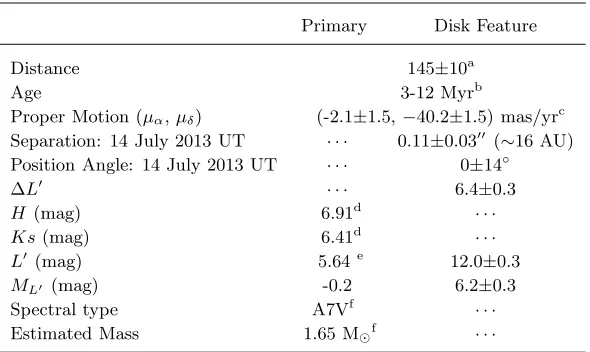
Table 1. Properties of the HD 169142 System
Primary Disk Feature
Distance 145±10a
Age 3-12 Myrb
Proper Motion (µα,µδ) (-2.1±1.5,−40.2±1.5) mas/yr
c
Separation: 14 July 2013 UT · · · 0.11±0.03′′(∼16 AU)
Position Angle: 14 July 2013 UT · · · 0±14◦
∆L′ · · · 6.4±0.3
H (mag) 6.91d · · ·
Ks(mag) 6.41d · · ·
L′ (mag) 5.64 e
12.0±0.3
ML′ (mag) -0.2 6.2±0.3
Spectral type A7Vf · · ·
Estimated Mass 1.65 M⊙
f · · ·
a
Sylvester et al. (1996), but errors derived here.
b
Grady et al. (2007)
c
Høg et al. (2000)
d
From 2MASS
e
Malfait et al. (1998)
f
Blondel & Djie (2006)
Table 2. Observation log
Telescope/Instrument UT Date Band Exposure Time Field Rotation
VLT NACO Vortex 14 July 2013 L’ 75 min 135.2
MagAO CLIO-2 Narrow 9 April 2014 H 46 min 178.5
MagAO CLIO-2 Narrow 10 April 2014 H 30.4 min 172.9
MagAO CLIO-2 Narrow 12 April 2014 KS 70 min 180.1
MagAO CLIO-2 Narrow 15 April 2014 3.9µm 60 min 164.1
[image:11.612.124.487.564.668.2]Fig. 1.— Left: L’ July 2013 NACO Vortex image. We find a pointlike feature in the disk with ∆mag=6.4±0.2, at a separation of 0.11±0.03′′
and PA of 0±14◦
0.6 0.4 0.2 0.0 −0.2 −0.4 −0.6
∆ RA [arcsec] −0.6 −0.4 −0.2 0.0 0.2 0.4 0.6 ∆ Dec [arcsec] −1.0 −0.7 −0.3 0.0 0.3 0.7 1.0 H (4/9)
0.6 0.4 0.2 0.0 −0.2 −0.4 −0.6
∆ RA [arcsec] −0.6 −0.4 −0.2 0.0 0.2 0.4 0.6 ∆ Dec [arcsec] −1.0 −0.7 −0.3 0.0 0.3 0.7 1.0 H (4/10)
0.6 0.4 0.2 0.0 −0.2 −0.4 −0.6
∆ RA [arcsec] −0.6 −0.4 −0.2 0.0 0.2 0.4 0.6 ∆ Dec [arcsec] −1.0 −0.7 −0.3 0.0 0.3 0.7 1.0
KS (4/12)
0.6 0.4 0.2 0.0 −0.2 −0.4 −0.6
∆ RA [arcsec] −0.6 −0.4 −0.2 0.0 0.2 0.4 0.6 ∆ Dec [arcsec] −3.0 −2.0 −1.0 0.0 1.0 2.0 3.0 z’ S/N
[image:13.612.107.481.237.522.2]20 40 60 80 100 0
2•104
4•104
6•104
8•104
20 40 60 80 100
estimated mass (MJup)
0
2•104
4•104
6•104
8•104
[image:14.612.83.348.300.478.2]COND, 145–10 pc COND, 151–10 pc DUSTY, 145–10 pc DUSTY, 151–10 pc