The Enhancement Effect of Lithium Ions on Actuation Performance of Ionic Liquid-based IPMC Soft Actuators
Maryam Safari, Leila Naji, Richard T. Baker, Faramarz Afshar Taromi
PII: S0032-3861(15)30209-3
DOI: 10.1016/j.polymer.2015.09.004 Reference: JPOL 18090
To appear in: Polymer Received Date: 5 June 2015 Revised Date: 29 August 2015 Accepted Date: 3 September 2015
Please cite this article as: Safari M, Naji L, Baker RT, Taromi FA, The Enhancement Effect of Lithium Ions on Actuation Performance of Ionic Liquid-based IPMC Soft Actuators, Polymer (2015), doi: 10.1016/j.polymer.2015.09.004.
M
AN
US
CR
IP
T
AC
CE
PT
ED
Graphical Abstract
(a)
(b)
M
AN
US
CR
IP
T
AC
CE
PT
ED
The Enhancement Effect of Lithium Ions on Actuation Performance of Ionic Liquid-based
IPMC Soft Actuators
Maryam Safari,1 Leila Naji,*1 Richard T. Baker,2 Faramarz Afshar Taromi,3
1
Department of Chemistry, AmirKabir University of Technology, 424 Hafez Avenue, Tehran
P.O Box: 15875-4413, Iran.
2
EaStChem, School of Chemistry, University of St. Andrews, St. Andrews, Fife KY16 9ST,
U.K.,
3
Faculty of Color and Polymer Engineering, AmirKabir University of Technology, 424 Hafez
Avenue, Tehran P.O Box: 15875-4413, Iran.
* Corresponding author to whom all correspondence should be directed. Tel: +98 (21) 64542767;
Fax: +98 (21) 64542762; e-mail: [email protected]
Keywords: Artificial muscle, IPMC actuator, Displacement measurements, Cyclic voltammetery,
M
AN
US
CR
IP
T
AC
CE
PT
ED
Abstract
Soft actuators are of great technological interest and one class of these is made from ionic
polymer-metal composites (IPMCs). It has been established that replacement of water with an
ionic liquid (IL) in IPMCs results in larger actuation response and considerably longer operating
life. However, the rate of displacement of IL-based IPMCs is very low. In the current work,
IPMC actuators were fabricated using Nafion membrane and an imidazolium-based IL. The
effects of incorporating the IL with and without Li+ ions were followed using electromechanical
and electrochemical measurements and were compared with the corresponding behavior of
water-based Li+-exchanged and un-exchanged IPMC actuators. The addition of Li+ ions to the
IL-based system resulted in dramatic increases in the capacitance, ionic conduction, operating
life and in the displacement rate of the actuator. This strategy is of considerable interest for
enabling the use of IPMC-based soft actuators in medicine and robotics.
1. Introduction
Soft actuators are smart materials made from polymers or gels which change shape in response
to an external, usually electrical, stimulus.[1] They are of great interest for application in robotics
[2] – for handling fragile objects and for providing propulsion in autonomous swimming and
crawling robots [3] – and in medicine [4,5] , for example, in replacement valves and artificial
muscles. One class of soft actuators are made from ionic polymer-metal composites (IPMCs).[6]
A typical IPMC consists of an ion-exchange polymer membrane - such as Nafion - with metal
electrodes, chemically plated on opposite faces. The electrodes consist of a dendritic structure of
small, interconnected metal particles, generally platinum or gold, which penetrates into the
polymer membrane. [6] The protons in the Nafion are usually exchanged for cations such as Li+
M
AN
US
CR
IP
T
AC
CE
PT
ED
Then, when an adequate potential is applied across the thickness of the IPMC, it bends
dramatically and reversibly towards its positively charged surface. The magnitude and speed of
the bending deformation may depend on the nature, ionic conductivity and thickness of the ion
exchange polymer, the structure and capacitance of the electrodes, the solvent content of the
polymer, the charge and mobility of the cations, and the specific interactions between the
electrode and the cations.[7,8,9] It has been established that IPMC actuators consisting of Nafion
membrane with cations of larger Van der Waals volume exhibit stronger actuation due to motion
of the larger cation.[10] However, the actuation performance of conventional water-based IPMC
actuators decreases over time due to the electrolysis of the water by the applied voltages and by
the evaporation of water when these devices are operated in air. Replacement of water with other
solvents has been investigated.[10,11,12] Ethylene glycol is polar has a viscosity of about 16
times that of water at room temperature and has a greater molecular mass. The results of a series
of tests with ethylene glycol as the solvent indicated a greater uptake of solvent, greater
resistance to electrolysis at high applied voltages, less stiffness, better actuation performance in
air and later relaxation than with water in both Nafion- and Flemion-based IPMCs. However, the
actuation of an IPMC sample with water as solvent was faster and the sample possessed higher
overall electrical capacitance than with ethylene glycol.[11] Replacement of water with ionic
liquids (ILs) as the solvent has also been investigated.[13,14] ILs are room temperature molten
salts composed, for example, of heterocyclic organic cations and various anions.[15] The
physical and electrochemical properties of ILs depend strongly on the nature and size of their
cation and anion constituents. ILs are easy to handle and possess interesting properties including
high thermal and chemical stability, high ionic conductivity, excellent solubility, negligible
M
AN
US
CR
IP
T
AC
CE
PT
ED
applications where the presence of water as solvent leads to a gradual deactivation of the system
over time through hydrolysis and evaporation processes.[13] Recent studies have shown that ILs
can self-assemble into nanoscale aggregates, both as pristine ILs and in solution, which can
result in multiple conduction phenomena.[17] These phenomena are attributed to the long-range
charge motion or interfacial polarizations arising from the buildup of charge at the domain
boundaries within the material.[17] In Nafion membranes, the mechanism of long-range charge
transfer occurs via ion exchange processes between ionic clusters and the IL aggregates.[17] It
has been established that ILs can solvate and plasticize the Nafion side groups, stimulate the
organization of the fluorocarbon domains of Nafion into a microcrystalline structure reduce the
degree of crystallinity of the membrane and increase its ionic conductivity.[17,18] ILs
comprised of the 1-alkyl-3-methylimidazolium cation and anions including halide, nitrate,
hexafluorophosphate (PF6) and tetrafluoroborate (BF4) are the most investigated ILs in
applications where their ionic conductivity is exploited.[19] These imidazolium-based ILs are
currently being studied as electrolytes for dye-sensitized solar cells,[20] metal plating,[21] Li ion
batteries,[22] and electrochemical capacitors[23] as well as soft actuators.[24]
IPMC actuators incorporating ILs showed an extended operating time over water-based systems.
However, their response times were much longer and the forces generated were decreased
drastically compared to systems using water.[25,26,27,28] This limits the appropriateness of
IL-based IPMC actuators as electromechanical actuators in applications where fast response and
large displacement at low applied voltages is required.[29,30,31] To improve the performance of
water-free IPMC actuators without significant loss in generated force output the preparation of
thick IPMC actuators has been proposed.[32,33] However, it was found that the actuation
M
AN
US
CR
IP
T
AC
CE
PT
ED
further increased. To the best of our knowledge, no studies have reported on methods to
simultaneously increase the tip displacement and decrease response time in IL-based IPMC
actuators. Researchers have shown that the electromechanical performance of IPMC actuators is
influenced by the concentration of ionic liquid, and that the concentration of ionic liquid can be
tuned to achieve maximum actuation performance.[12] IPMCs containing higher concentration
of ionic liquid exhibited more capacitor-like behavior which led to a larger electromechanical
responses.[12] The ionic conductivity and actuation speed of IL-based IPMCs also increases as
the content of ionic liquid and the size of the counterions is increased.[12,13,14] Furthermore,
the actuation speed of IL-based IPMCs is linearly related to the ionic conductivity of Nafion
membrane.[14]
The current work reports the enhancement of the ionic conduction, capacitive characteristics, tip
displacement and response time of an IL-based IPMC actuator by the addition of a small amount
of Li+ ions. IPMC actuators were fabricated using Nafion membrane and an imidazolium-based
IL. The effects of incorporating the IL with and without Li+ ions were followed using
electromechanical measurements, cyclic voltammetery (CV) and electrochemical impedance
spectroscopy (EIS) and were compared with the corresponding behavior of water-based Li+
-exchanged and un--exchanged IPMC actuators. The addition of Li+ ions to the IL-based system
resulted in dramatic increases in the operating life and in the displacement rate of the actuator
over non-IL systems at ambient temperature and humidity. This strategy is therefore of
considerable interest for increasing the applicability of IPMC-based soft actuators in medicine
M
AN
US
CR
IP
T
AC
CE
PT
ED
2. Experimental
2.1. Preparation of IPMC actuators
IPMC actuators were prepared from 0.18 mm thick sheets of Nafion-117 in its protonated form
(DuPont, equivalent weight 1100) using a technique presented by Pak et al.[34] After roughening
the surfaces using abrasive paper to increase the metal-polymer interface area, the membrane
was washed using an established method [35,36] to remove all impurities remaining from the
manufacturing process. The clean Nafion was soaked in a 4.5 M aqueous solution of
tetraamineplatinum (II) chloride ([Pt(NH3)4]Cl2, Alfa Aesar) for 24 h and a few drops of
ammonium hydroxide (Aldrich) solution was added to neutralize the solution. The amount of
[Pt(NH3)4]Cl2 added was calculated to correspond to the number of ion exchange sites available
in the Nafion membrane. After rinsing with DI water to remove the excess platinum salt solution,
the membrane was placed in a small amount of DI water in a crystallization dish under stirring.
An aqueous solution (100 ml) of 5 wt% NaBH4 was added gradually to the membrane. A silvery
layer of Pt was formed on the surfaces of the membrane. This plating procedure was repeated
twice. The membrane was rinsed with DI water and immersed in 1 M HNO3 solution for 12 h to
neutralize the residual ammonium, rinsed again and stored in DI water. Four IPMC sample types
were prepared, each 5×23 mm in size. These were water-based samples with and without Li+ ion
exchange and IL-based IPMCs with and without addition of Li+ ions.
Li+-exchanged water-based samples were prepared by immersing the IPMCs (in protonated
form) in 0.1 M LiBF4 (Sigma Aldrich) solution for 7 d. IL-based samples were prepared by
soaking the IPMCs (in protonated form) in a 50%/50% b.v. mixture (2 ml) of ethanol and
1-ethyl-3-methylimidazolium tetrafluoroborate (EMIMBF4, from Research Institute of the
M
AN
US
CR
IP
T
AC
CE
PT
ED
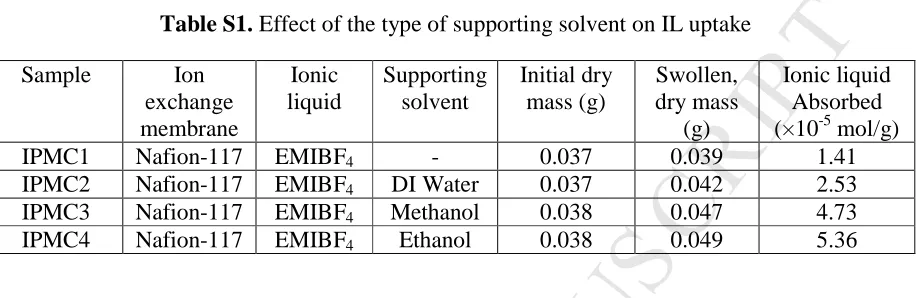
to eliminate ethanol. Ethanol was applied as a supporting solvent to increase the rate of ion
exchange (see Table S1 in supplementary data). Henceforth, the IPMC sample types are named
to indicate the type of cations; H+ (IP-H), Li+ (IP-L) and EMIM+ (IP-E).
Three methods were applied to prepare water free IL-based IPMC actuators incorporated with
Li+ ions. These methods differ in the order and the rate of the penetration of the EMIM and Li+
ions within the polymer and are described as follows; 1) water free EMIM+-exchanged IP-E
samples were immersed in 0.1M LiBF4 solution (2 ml), 2) fully dehydrated H+-exchanged IP-H
samples were immersed in a water free 50%/50% b.v. mixture (2 ml) of ethanol and EMIBF4
containing LiBF4 salt (0.1 M), and 3) fully dehydrated Li+-exchanged IP-L samples were
immersed in a 50%/50% b.v. mixture (2 ml) of ethanol and EMIMBF4. The samples were kept in
above-mentioned solutions at room temperature for 2 h and then dried under vacuum at 70 °C for
4 h to eliminate the solvents. These samples are named as M1, M2 and
IP-E/L-M3 respectively to indicate the number of applied method.
Using method (1), IL-based IPMC actuators containing increasing amount of Li+ ions were
prepared. To this end, water free IP-E samples were immersed in four LiBF4 solutions (2 ml) in
concentration range of 0.05 to 0.5 M for 2 h and again dried under the above-mentioned
conditions. These samples were named as IP-E/L-0.05 to IP-E/L-0.5 to indicate the concentration
of applied LiBF4 solution. The concentration of LiBF4 solution was changed to alter the amount
of Li+ ions absorbed within the IL-based IPMC samples and to find the best concentration in
terms of obtaining IPMCs with the highest capacitive characteristic.[12] Table 1 summarises the
M
AN
US
CR
IP
T
AC
CE
PT
ED
2.2. Physical and Morphological Evaluation of IPMCs
Fully hydrated water-based IP-H and IP-L samples were vacuum dried in an oven at 80°C
overnight and their dry mass, Wdry, measured and subtracted from their wet mass, Wwet and the
percentage of water uptake calculated using Equation 1.
% water uptake = 100× (Wdry-Wwet/Wdry) Equation 1
Scanning electron microscopy (SEM) was employed to study the differences in the morphology
of the platinum electrode layers of IPMCs as a function of cation and solvent type using a
Seron-AIS2300 SEM instrument. Cross-sections of IPMCs were obtained for SEM by freeze-fracturing
in liquid N2. The topology of the sample electrodes was quantified by measuring the number of
folds per unit surface area.
2.3. Electrochemical Evaluation of IPMCs
To compare the ionic conduction and capacitive characteristics of water- and IL-based IPMCs,
electrochemical impedance spectroscopy (EIS) and cyclic voltammetery (CV) were used. Square
elements of 5×5 mm were cut from the IPMCs and placed horizontally in a sample holder
consisting of a pair of platinum contacts embedded within a Plexiglas clamp. These contacts had
the same surface area as the sample. The measurements were performed on a
potentiostat/galvanostat (Autolab) controlled by NOVA software at ambient temperature. The
impedance measurements were performed with an applied a.c. voltage of 10 mV in amplitude
over a frequency range of 100 kHz to 100 mHz. Z-view software was used to analyze the results.
CV scans were performed in the potential range of ±1V at a scan rate of 100 mV s-1. The
capacitance (C) was calculated from the CV results using Eq. 1
M
AN
US
CR
IP
T
AC
CE
PT
ED
where I+ and I- are currents in A at 0 V in the two scanning directions and dV/dt is the potential
scan rate (Vs-1). [37]
2.4. Electromechanical Measurements
Maximum tip displacement, rate of displacement and durability were measured at room
temperature and in ambient air using the arrangement shown in Figure 1. The IPMC actuator was
held at one end in a sample holder consisting of a pair of platinum electrical contacts fixed
within an insulating clamp. The electrical contacts were connected to the two terminals of either
a d.c. power supply or a function generator. All samples were subjected to d.c. voltages from 1 to
8 V. In addition, sinusoidal voltages of 4 and 5 V in amplitude, at frequencies from 0.01 to 1.00
Hz, were applied to the IL-based samples. A digital camera was used to capture video images of
the bending deformation of the sample as the d.c. or a.c. voltages were applied. The maximum
tip displacement was calculated using image analysis software. Displacement rate for each IPMC
actuator was determined by dividing the maximum tip displacement by the time taken to reach it
when they were subjected to a d.c. voltage. Actuator durability was studied by applying 4 V d.c.
every 10 min and measuring the maximum tip displacement as a function of time (over 180 min).
During the time intervals, the IPMC samples were kept still in the sample holder.
3. Results and Discussions
3.1. Morphology of IPMCs
In the cross-sectional SEM image of the freeze-fractured IP-H sample shown in Figure 2(a) two
parallel, bright layers along the surfaces of the Nafion membrane are observed. These layers are
M
AN
US
CR
IP
T
AC
CE
PT
ED
surfaces indicates that the plating process gave a uniform coverage. The high concentration of
platinum at the outer surface is seen as a layer of dense appearance and relatively uniform
thickness along the surface of the membrane.
In Figures 2(b)-(e), top-down SEM images of the platinum electrode in each sample type are
compared. The electrode appears to be highly folded in water-soaked H (Figure 2(b)) and
IP-L (Figure 2(c)) samples compared to the IIP-L-soaked IP-E and IP-E/IP-L-0.1 samples (shown in
Figure 2(d) and 2(e), respectively). This might be attributed to the formation of larger ionic
clusters in the water-soaked samples and a stronger ionic interaction between the small cations of
H+ and Li+ with the fixed sulfonate groups.[14] Nafion is not cross-linked and the ionic clusters
size and the resulting ionic conductivity may vary according to the type of applied solvent and
electrolyte. [38,39] The addition of more polar solvents such as water which interact
preferentially with the ionic clusters (hydrophilic regions), which are minor domain in the Nafion
structure, cause microscopic swelling. However, IL can solvate and plasticize the Nafion side
groups [17,18] and reduce the cross-linking dipolar interactions inside the polar domains and
increase the mobility of the main fluorocarbon backbone chains (hydrophobic regions), which
are major domain, and cause macroscopic swelling. Furthermore, it is expected that smaller ionic
clusters to be formed within the IL-based samples due to weaker electrostatic interactions
between large organic EMIM+ cations with the fixed ion exchange sites.[7] Therefore, the
observed smoother platinum electrode surface in IL-based IP-E actuators (shown in Figure 2(d))
can be attributed to the higher degree of the macroscopic swelling of the polymer and the
formation of smaller ionic clusters within these samples. It must be mentioned that the level of
M
AN
US
CR
IP
T
AC
CE
PT
ED
compared with water-based actuators because the hydrophilic domains are filled with the ILs.
[17]
Comparison of the SEM images of the water-based IPMC samples also shows that the electrode
surface is more folded in L samples compared to H. Determination of water content of
IP-H and IP-L samples revealed that Li+-exchanged IP-L samples had higher water content –
approximately 2.5 times – than the H+-exchanged IP-H samples. Therefore, larger ionic clusters
could be formed within the IP-L samples. The formation of larger ionic clusters within the
water-based actuators, especially in the case of IP-L samples, was confirmed by data obtained from
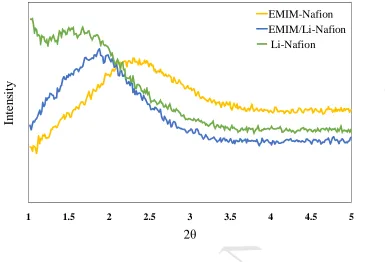
SAXS study of the samples (see Figure S1 in Supplementary Data). The presence of Li+ ions in
the IP-E/L-0.1 sample also led to the formation of folds in the electrode (see Figure 2(e)). This
similarly can be attributed to the formation of larger ionic clusters [40] within this sample
compared to water free IP-E actuators as shown in Figure S1.
3.2. Electrochemical evaluation of IPMCs
Figure 3 shows the voltamograms of the IP-H, IP-L, IP-E samples. All three appear similar in
shape but differ in the magnitude of the current. The symmetric shape of the CV curves can be
assigned to excellent charge distribution in the electrode region of the IPMCs. This indicates that
the platinum plating process has given rise to two equivalent electrodes with similar thicknesses,
as was observed by SEM. In previous work, it was found that the platinum particles penetrate the
polymer to a depth of ~10 µm and provide a porous electrode structure at both surfaces of the
IPMC.[41] The CV curves of the IPMCs are close to rectangular, indicating a capacitive
behavior and a low contact resistance. Generally, the shape of the loop in the CV response of an
M
AN
US
CR
IP
T
AC
CE
PT
ED
oblique angle and narrower loop. [42] Nafion-based IPMC actuators can be considered as
polyelectrolyte-based capacitors [43] since they consist of a pair of conductive platinum
electrodes sandwiching the cation exchange Nafion membrane. Nafion is a perfluorinated
copolymer that can be considered to have a poly(tetrafluoroethylene) backbone from which are
suspended perfluorinated ether side chains terminating in anionic sulfonate groups. In the
samples used in this work, these are paired with counter cations such as H+, Li+ and EMIM+.
Since the sulfonate groups are covalently tethered by the side chains to the perfluorinated
molecular backbone they cannot move away whereas their counter cations can be detached by an
electric field.[44] When a voltage is applied to a water-based IPMC actuator, redistribution of
ions takes place in the Nafion membrane.[35,36] Cations would migrate towards the negatively
charged platinum electrode region and form an electric double layer at the interface, while the
double layer at the other interface is formed from the immobile sulfonate groups located in the
vicinity of the positively charged electrodes. Therefore, regardless to the type of counter cation
within the Nafion membrane it is expected that a thicker double layer is formed near the
negatively charged electrode.
As can be seen in Figure 3, the CV loop of water-based IP-H and IP-L actuators were narrower
than for IL-based IP-E actuators, indicating that capacitance increases in the order:
IP-E>IP-L>IP-H. This indicates that replacing water with IL generally led to a higher current response -
and therefore higher characteristic capacitance. Since Nafion consists of non-polar
tetrafluoroethylene segments and the polar perfluorosulfonic vinyl ether segments four
polarization mechanisms can occur within this polymer; electronic polarization, ionic
polarization, orientational polarization and interfacial polarization. The more easily the various
M
AN
US
CR
IP
T
AC
CE
PT
ED
be. [45] All polarization mechanisms can be described as a number of resistance and complex
capacitance elements connected in series and parallel.[17] The ionic conductivity relates to the
exchange of ions between different domains within the bulk of the Nafion membrane, while the
overall capacitance describes the accumulation of ions at the polymer/platinum electrode region.
A local accumulation of ions is produced in the bulk of the Nafion membrane (interfacial
polarization) due to the presence of hydrophobic and hydrophilic domains with different
permittivity. An interfacial conductivity is associated with charge exchange at the interfaces
between domains with different permittivity. [17] As discussed previously, the incorporation of
large hydrophobic organic cation of EMIM+ and also use of ethanol as the supporting solvent
cause the polymer to swell macroscopically [38,39] to a higher extent compared to water-soaked
samples.[7] Therefore, it is expected that the mentioned polarization mechanisms happen easier
in IL-based IP-E actuators. In Figure 3, it can also be seen that Li+-exchanged water-based IP-L
actuators showed a higher current compared to the H+-exchanged water based IP-H actuators.
This difference can be explained by the presence of larger ionic clusters with higher water
content within the IP-L samples. This leads to a higher microscopic [38,39] swelling in these
samples and facilitate the polarization mechanism.
It has been established that IPMC actuators with more capacitor-like behavior show larger
electromechanical responses.[12] Figure 4 compares the calculated capacitance of IP-E actuators
with that of IP-E/L-M1, IP-E/L-M2 and IP-E/L-M3 actuators (IL-based actuators incorporating
Li+ ions) to evaluate the effect of the sample preparation technique on the capacitance of these
samples. As can be seen, IL-based IPMC actuators incorporating Li+ ions show higher
capacitance than that considered for IP-E actuators with no Li+ addition. Moreover, the
IP-E/L-M
AN
US
CR
IP
T
AC
CE
PT
ED
M1 actuators, while it was still higher compared to IP-E actuators. This indicates that the
microscopic structure of Nafion membrane changes as the order and the rate of the penetration of
the ions within the polymer are altered. It seems under influence of the applied electric field the
transport and migration of ions towards the oppositely charged electrodes occurs easier in the
case of IP-E/L-M1 actuators and thicker double layers are formed. These actuators were first
impregnated with EMIM+ cations, using a mixture of IL and ethanol, and then with Li+ ions.
Since they showed to have the highest capacitive characteristic all IP-E/L actuators (IL-based
actuators incorporated with Li+ ions) used in this work were prepared using the preparation
method described as method (1) in Section 2.2.
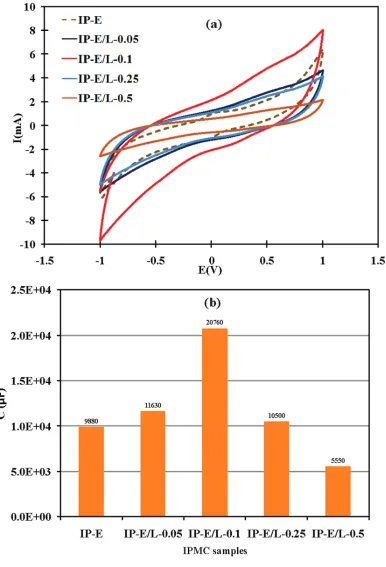
In Figure 5 – part (a) the CV voltamograms of IL-based IP-E samples with no Li+ ion addition is
compared with that of IP-E/L-0.05, IP-E/L-0.1, IP-E/L-0.25 and IP-E/L-0.5 samples with
increasing amounts of Li+ ions. It can be seen that adding Li+ ions into the IL-based IPMCs led
to a higher current response and therefore higher characteristic capacitance in E/L-0.05,
IP-E/L-0.1 and IP-E/L-0.25 actuators compared to that for IP-E actuators, the highest of the three
being for IP-E/L-0.1. However, water- free IP-E/L-0.5 actuators with the highest Li+ ion content
showed a current response lower than IP-E actuators. The variation in the capacitance of the
IL-based actuators as a function of Li+ ion content can be followed more clearly in Figure 5(b). The
calculation of the capacitance from the CV plots revealed that the charge storage capacity of
IP-E/L-0.1 is, about two and four times higher than that of IP-E and IP-E/L-0.5 actuators,
respectively. The capacitance of IL-based IP-E/L-0.1 actuators was also about four and twenty
three times higher than that of the water-based IP-L and IP-H actuators, respectively. This
indicated that there exists an optimum concentration of Li+ ions at which the current response
M
AN
US
CR
IP
T
AC
CE
PT
ED
highest Li+ ion concentration. The observed drop in capacitive characteristic beyond the
optimum concentration of Li+ ions is attributed to accumulation of ions toward the center of the
IPMC actuator. When a small electric field is applied across the thickness of IP-E/L actuators Li+
ions can move easier and faster towards the negatively charged platinum electrode than large
EMIM+ cations. Thus, they can contribute in the formation of a thicker double layer at the
interface of polymer/platinum electrode in these samples and improve the capacitance
characteristic of the sample. This was observed as higher current response and higher
characteristic capacitance in CV response of IP-E/L-0.05 and IP-E/L-0.1 actuators compared to
that considered for IL-based IP-E actuators with no Li+ addition (see Figure 5). However, the
improving effect of Li+ ions on the capacitance of the IL-based IPMC actuators reached a
percolation threshold for IP-E/L-0.1 actuators; the capacitance of IL-based actuators containing
higher amount of Li+ ions decreased. As the concentration of Li+ ions within the IL-based IPMC
actuators is increased the number of the free ions (unbounded ions) within the bulk of the
polymer increases since the excess ions cannot contribute in the formation of the electric double
layer. This can enhance the ionic conductivity of the bulk of the polymer and reduce the
capacitive characteristic of the actuators. These results were confirmed with the data obtained
from EIS studies on the IPMC actuators which will be discussed later. Figure 6 – parts (a) and
(b) illustrates a schematic depiction of the re-distribution of ions under influence of applied
electric field and formation of electric double layer at the interface of polymer/platinum
electrode in an IL-based IP-E actuator containing (a) no Li+ ions, (b) an optima concentration
(0.1 M) and (c) a higher concentration of Li+ ions (>0.1 M), respectively.
The response of an electrochemical system to a small applied a.c. voltage in impedance
M
AN
US
CR
IP
T
AC
CE
PT
ED
against the real part. Nyquist plot appears as a vertical line for ideal capacitors and a point on
x-axis for resistors. Also in these plots a semicircle is fitted as a resistor and capacitor in parallel.
In highly conductive systems, the semicircle in Nyquist plot is not observable; however, for less
conductive systems the semicircle is present in a distorted form. Moreover, the vertical line
indicating electrode capacitance is tilted because the electrode surfaces are not ideally smooth.
Here, the electrochemical system is an IPMC sample sandwiched between two platinum
electrodes, so the alternating current flows through the Nafion membrane. The impedance of the
IPMCs is a function of three variables; the mobility of ions in the Nafion membrane, the
polarization of the Nafion structure and the double-layer capacitance at the platinum
electrodes/polymer. The degree of mobility of ions determines the conductivity of the Nafion
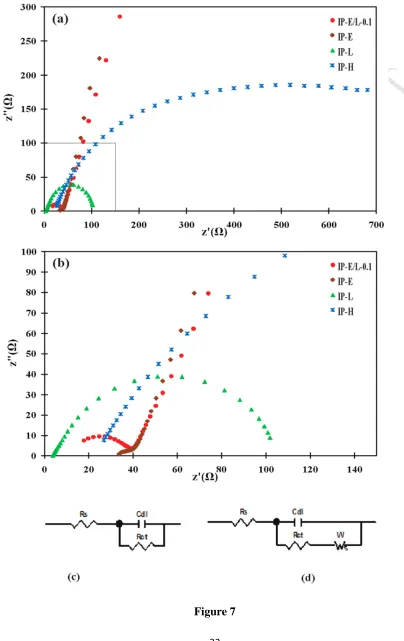
membrane. Small ions migrate faster and provide higher conductivity. Figure 7 –parts (a) and (b)
shows the Nyquist plots obtained by EIS for IP-H, IP-L, IP-E and IP-E/L-0.1 actuators. As can
be seen, both plots shown for the IP-E and IP-E/L-0.1 actuators are nearly linear in the low
frequency region and have a semicircle in the high frequency region. This indicates that at low
frequencies these IL-based actuators behave like capacitors while at high frequencies they
behave like resistors. For IP-E/L-0.1 the semicircle appeared in a higher frequency range
compared to the IP-E actuator. This shift is related to the added Li+ ions causing a decrease in the
ionic resistance of the IL-based IPMC actuator. Contrary to the IL-based IPMCs, for water-based
IP-H and IP-L actuators only large semicircles were observed which extended over a wide
frequency range. Moreover, amongst the four IPMC samples, the largest semicircle region was
observed for the water-based IP-H actuator, indicating the highest impedance (charge transfer
resistance) in this IPMC. Replacing H+ with Li+ caused a significant decrease in the impedance
M
AN
US
CR
IP
T
AC
CE
PT
ED
sample. The high frequency intercepts on the real axis were used to calculate the ionic resistance
of IPMC actuators. The IP-L and IP-E actuators had the highest and lowest ionic conduction,
respectively. The description of ionic conductivity of Nafion-based IPMC actuators is
complicated due to the presence of multiple interfacial polarizations, as discussed earlier. These
polarizations are the result of the presence of several different percolation pathways along the
interfaces between the hydrophobic and hydrophilic domains in the Nafion membrane. [46] The
ionic transport in Nafion membrane is closely related to the size and number of ionic clusters
formed within the swollen Nafion membrane and it is described by Grotthuss (hopping) and
vehicle (diffusion) mechanisms.[47] According to the Grotthuss mechanism, an ion can hop from
a sulfonate site to a nearby acceptor solvent molecule. In contrast, in the vehicle mechanism, an
ion transfers by the diffusion of carrier species in the electrolyte in the form of a solvated ion.
Both of the two mechanisms can occur easier in the case of the water-based IP-L actuators since
they contain larger ionic clusters with higher ionic and water content. This leads to a higher ionic
conduction for this sample compared to water-free IP-E actuators which contain smaller ionic
clusters. (see Figure S1 in Supplementary Data). Adding Li+ ions to an IL-based IPMC led to a
decrease in ionic resistance of this actuator in which the IP-E/L-0.1 actuator appeared to have
ionic conduction of about the average of the values of the IP-L and IP-E actuators. This indicates
that the ionic transport mechanism have been facilitated in the IP-E/L-0.1 samples, probably due
to the formation of larger ionic clusters. EIS data are commonly analyzed by fitting them to an
equivalent electrical circuit model. The Randles model is one of the simplest and most common
models. This model includes a solution resistance, Rs, a double layer capacitor, Cdl and a charge
transfer resistance, Rct. Figure 7 – part (c) and (d) illustrates the obtained equivalent circuit for
M
AN
US
CR
IP
T
AC
CE
PT
ED
additional Warburg element in their equivalent circuit, indicating diffusion processes are
important in these actuators.
3.3. Actuation performance of IPMCs
The tip displacements of the IP-H, IP-L, IP-E and IP-E/L-0.1 actuators in response to d.c.
voltages of 1 to 8 V are shown in Figure 8(a). The four actuators exhibited qualitatively similar
dependences on the amplitude of the applied voltage in that tip displacement increased as a
function of input voltage in a roughly linear relationship. Tip displacements were much larger for
IP-E than IP-H, indicating a significant increase in the actuation response on replacing water
with the IL as the solvent and much larger for IP-L than IP-H, demonstrating the improvement
due to addition of Li ions. Furthermore, water-based IP-L actuators showed smaller tip
displacements than IP-E at the low applied voltages (1 to 4 V). Results show that the IL-based
actuators with the highest capacitive characteristic show larger tip displacement over
water-based actuators. The observed difference in the magnitude of the actuation response can be
attributed to the difference in the Van der Waals volume of the H+, Li+ and EMIM+ as
counterions. [10] The actuation performance of IPMC actuators is solely the result of motion of
ions through the Nafion membrane. As mentioned earlier, upon application of an electric field,
cations and anions are mobilized and migrate toward electrodes of opposite charge. The
accumulation of ions near the electrodes results in an imbalance in volume within the samples
and thus a bending deformation. Since EMIM+ ions have the highest Van der Waals volume,
their accumulation at the cathode results in the largest bending deformation for the IP-E actuator.
Adding Li ions to the IL-based IPMCs also gave rise to a considerable increase in tip
M
AN
US
CR
IP
T
AC
CE
PT
ED
Li+ ions (IP-E/L-0.1) showed the highest tip displacement over the applied voltage range. This
indicates that, in addition to enhancing ionic conduction, addition of Li ions induces a larger
volume imbalance in IP-E/L-0.1 than in IP-E, which in turn causes a larger bending deformation.
Figure 8-parts (b1) to (b4) present the overlaid digital images captured at the starting point and
end point for each IPMC actuator in response to the d.c. voltage of 7 V in amplitude to show the
influence of the preparation variables on their actuation performance.
The measured tip displacements of the actuators IP-E and IP-E/L-0.1 in response to the
sinusoidal voltages of 4 and 5 V in amplitude and over a frequency range of 0.01 to 1 Hz are
shown in Figure 9. It can be seen that these actuators exhibited qualitatively similar
dependencies on the amplitude and frequency of the applied sinusoidal voltages. Over the whole
frequency range, a small increase in the tip displacement of both the actuators occurred when the
amplitude of the sinusoidal input voltage was increased. For both samples at both voltages, there
is a strong, approximately inverse relationship between tip displacement and frequency. At low
frequencies, the polarity of the electrodes changes slowly, and so a greater number of ions have
time to concentrate near the oppositely charged electrodes leading to stronger actuation.[41] The
largest differences between the tip displacement of the IP-E and IP-E/L-0.1 actuators occurred at
low frequencies. The tip displacement of the IP-E/L-0.1 actuator was generally larger (about 5
times larger at 5 V and 0.01 Hz) than for IP-E, indicating again the contribution of the Li+ ions to
increasing the degree of bending deformation.
In Figure 10 the calculated displacement rate (in mms-1) of the IP-H, IP-L, IP-E and IP-E/L-0.1
actuators, in response to a 4 V d.c. input, are presented. IP-L and IP-E are respectively the fastest
and the slowest responding actuators under these conditions. Even though IP-E showed larger tip
M
AN
US
CR
IP
T
AC
CE
PT
ED
times lower than for IP-L and IP-H, respectively. It is reasonable to consider the differences in
size of the mobile H+, Li+ and EMIM+ ions present within these actuators for comparing their
displacement rate. On application of the same voltage, Li+ and H+ ions would diffuse faster
towards the oppositely charged electrode because of their smaller size and more spherical shape
than EMIM+.[41] It was also found that the displacement rate of IP-E/L-0.1 was approximately
twenty six times greater than for the IP-E, although it was still slightly lower than for IP-L. This
means that addition of Li+ ions had the combined positive effect of significantly increasing tip
displacement and greatly decreasing the response time of the IL-based IPMC actuator. This can
be attributed to the faster motion of Li+ ions towards the oppositely charged electrode under the
influence of the applied electric field and its promoting effect on the formation of an electric
double layer being greater in IP-E/L-0.1 than in IP-E.
In Figure 11 the performance over time of the IP-L, IP-E and IP-E/L-0.1 actuators is presented in
terms of the variation in tip displacement on application of 4 V d.c. every 10 min. The tip
displacement of the IP-E actuator, which was the lowest amongst the three, underwent no
significant change over time. This suggests that approximately no evaporation or decomposition
of imbibed IL occurred during the experiment. For IP-L the tip displacement increased to a
maximum value after 10 min. but decayed gradually over time to close to zero after 180 min.
This can be attributed to evaporation of water from the sample and possibly also to loss of water
by electrolysis. Finally, for IP-E/L-0.1, there was a similar increase in tip displacement after 10
min. However, it later reached a stable minimum after approximately 60 min. which was about
100 and 2 times higher than the minima observed for IP-L and IP-E, respectively. Consequently,
it is reasonable to consider the IL-based IPMC containing a small percentage of Li+ ions (IPEL)
M
AN
US
CR
IP
T
AC
CE
PT
ED
4. Conclusions
IL- and water-based IPMC actuators were prepared using commercially available Nafion-117
membrane and were compared using SEM, CV, IS and in electromechanical measurements.
Water-based IPMC actuators were prepared in Li+-exchanged and (un-exchanged) protonated
form. IL-based IPMC actuators were prepared with and without incorporation of a small
percentage of Li+ ions.
SEM analysis showed that platinum electrode structures had good surface coverage and
penetrated into the polymer and that the surface morphology of the platinum regions was
dependent on the type of solvent and the identity of the cation. The IL gave rise to smoother and
denser impregnated regions in pure IL-based actuators. The roughest
platinum-impregnated regions were observed in actuators with Li+-exchanged Nafion. A slight roughness
was introduced into the platinum electrode of IL-based actuators by addition of Li+ ions to their
structure.
In electrochemical tests the electrode capacitance and the frequency response of IPMC actuators
were compared for both set of actuators, using CV and EIS methods. The effect of the solvent
and cation type was examined. A greater contact resistance was observed in the water-based
actuators, especially in the actuator with Nafion in protonated form. The IL-based actuator
incorporating Li+ ions showed the closest behavior to that of an ideal capacitor and appeared to
have the highest charge storage capacity of any actuator. It was found that IL-based actuators
possessed an additional Warburg element in their equivalent circuit.
In electromechanical tests the maximum tip displacement, durability and displacement rate were
recorded for actuators. The effect of amplitude and frequency of the applied voltage on
M
AN
US
CR
IP
T
AC
CE
PT
ED
tip displacements. For all actuators, displacement increased with increasing applied voltage but
decreased with increasing frequency. The small displacement rate of IL-based actuator was
enhanced by twenty six times by adding Li+ ions and it also showed the lowest actuation decay
over time. Water-based Li+-exchanged IPMC actuators had the highest ionic conduction and
showed the highest rate of displacement. However, their tip displacement was considerably
lower than IL-based IPMC actuators incorporated with Li+ ions, which also possessed the highest
electrode capacitance. Results revealed that there was a direct linear relationship between
response time and the ionic conduction process in the IPMC actuators while the magnitude of tip
M
AN
US
CR
IP
T
AC
CE
PT
ED
Table 1. Naming system of IPMC samples
Sample Preparation process Elimination
of solvent Cation type
IP-H IPMC immersed in 1M HNO3 (aqueous) - H+
IP-L Dehydrated IP-H immersed in 0.1M LiBF4 (aqueous) - Li
+
IP-E Dehydrated IP-H immersed in EMIMBF4/Ethanol EMIM
+
IP-E/L-M1 Dehydrated IP-E immersed in 0.1M LiBF4 (aqueous) EMIM+/Li+
IP-E/L-M2 Dehydrated IP-H immersed in 0.1M LiBF4
(EMIMBF4/Ethanol)
EMIM+/Li+
IP-E/L-M3 Dehydrated IP-L immersed in EMEBF4/Ethanol EMIM
+
/Li+
IP-E/L-0.05 Dehydrated IP-E immersed in 0.05 M LiBF4 (aqueous) EMIM
+
/Li+
IP-E/L-0.10 Dehydrated IP-E immersed in 0.1 M LiBF4 (aqueous) EMIM+/Li+
IP-E/L-0.25 Dehydrated IP-E immersed in 0.25 M LiBF4 (aqueous) EMIM +
/Li+ IP-E/L-0.50 Dehydrated IP-E immersed in 0.5 M LiBF4 (aqueous) EMIM
+
/Li+
M
AN
US
CR
IP
T
AC
CE
PT
ED
Figure 1. Schematic diagram and photographic view of experimental set-up for measurement of
tip displacement on IPMC actuators
Figure 2. (a) Cross sectional SEM image of IP-H actuator and longitudinal SEM images of IPMC
samples showing the platinum electrode surface structures in (b) IP-H, (c) IP-L, (d) IP-E and (e)
IP-E/L
Figure 3. Comparison of the CV response of the fabricated water-based IP-H, IP-L actuators with
IL-based IP-E actuator with no Li+ ion addition
Figure 4. Comparison of the calculated capacitance of IL-based IP-E actuators with IL-based
IPMC actuators incorporated with Li+ ions; IP-E/L-M1, IP-E/L-M2 and IP-E/L-M3 prepared
using method (1) to (3), respectively.
Figure 5. (a) Comparison of the CV voltamograms of IL-based IP-E samples with no Li+
addition with that of IL-based samples with increasing amount of Li+ ions. (b) Variation in the
capacitance of the IL-based actuators as a function of Li+ ion content
Figure 6. Schematic depiction of the double layer structure in IL-based IP-E actuators containing
(a) no Li+ ions, (b) an optima concentration (0.1 M) and (c) a higher concentration of Li+ ions
(>0.1 M)
Figure 7. Comparing Nyquist plots of all IPMC actuators (a) in full view and (b) in the selected
region shown in part (a) and obtained equivalent circuit for (c) IP-H and IP-L actuators and (d)
M
AN
US
CR
IP
T
AC
CE
PT
ED
Figure 8. (a) Comparison of the dependence of tip displacement on amplitude of the input d.c.
voltage for fabricated IPMC actuators and (b1), (b2), (b3) and (b4) are the corresponding overlaid
digital images captured at the starting point and end point for IP-H, IP-L, IP-E IP-E/L-0.1
actuators, respectively, in response to the d.c. voltage of 7 V in amplitude.
Figure 9. Comparison of the tip displacement against frequency of applied voltage signal for
IL-based IPMC actuators. Data are presented for actuators subjected to voltages of 4 and 5 V in
amplitude.
Figure 10. Comparison of the calculated displacement rate (in mmS-1) of the IPMC actuators;
IP-H, IP-L, IP-E and IP-E/L-0.1, in response to the same d.c. voltage of 4 V in amplitude
Figure 11. Comparison of the operating life of the IPMC actuators; IP-L, IP-E and IP-E/L-0.1
M
AN
US
CR
IP
T
AC
CE
PT
ED
Figure 1
M
AN
US
CR
IP
T
AC
CE
PT
ED
M
AN
US
CR
IP
T
AC
CE
PT
ED
M
AN
US
CR
IP
T
AC
CE
PT
ED
Figure 4 9880
14272
16619
20760
0.0E+00 5.0E+03 1.0E+04 1.5E+04 2.0E+04 2.5E+04
IP-E IP-E/L-M3 IP-E/L-M2 IP-E/L-M1
C
(
µ
F
M
AN
US
CR
IP
T
AC
CE
[image:32.595.110.496.108.675.2]PT
ED
M
AN
US
CR
IP
T
AC
CE
PT
ED
Figure 6
(a)
(b)
M
AN
US
CR
IP
T
AC
CE
PT
ED
[image:34.595.83.487.110.751.2]
M
AN
US
CR
IP
T
AC
CE
PT
ED
Figure 8 0 5 10 15 20 25 30 350 1 2 3 4 5 6 7 8 9
T ip d is p la c em e n t (m m ) Voltage (V)
IPE
IPE
IPL
IPH
(a)
(b )
1(b )
2(b )
3(b )
4M
AN
US
CR
IP
T
AC
CE
PT
ED
Figure 9 0 2 4 6 8 10 12 14 16 18 200 0.1 0.2 0.3 0.4 0.5 0.6 0.7 0.8 0.9 1
T ip d is p la c em e n t (m m ) Frequency (mHz)
M
AN
US
CR
IP
T
AC
CE
PT
ED
M
AN
US
CR
IP
T
AC
CE
PT
ED
Figure 11 0 2 4 6 8 10 12 14 16 18 20 220 20 40 60 80 100 120 140 160 180
M
AN
US
CR
IP
T
AC
CE
PT
ED
References[1]. Y. Bar-Cohen, .Adv. Mater., 2006, 38, 3.
[2]. S.-W. Yeom, & I.-K. Oh, Smart Mater. Struct. 2009, 18, 085002
[3]. V. Palmre et al. . Smart Mater. Struct. 2013, 22, 014003.
[4]. M. Shahinpoor, K. J. Kim, Smart Mater. Struct., 2005, 14, 197.
[5]. Y. Bar-Cohen, C. Mavroidis, M. Bouzit, B. Dolgin, L. Deborah, 8th Ann. Inter. Symp. on Smart Structures & Materials, Smart Structures & Materials, Proc. SPIE, 2001, Paper No. 4329-47.
[6]. C. Jo, D. Pugal, I.-K. Oh, K. J. Kim, K. Asaka, Prog. Polym. Sci., 2013, 38, 1037.
[7]. Y. Bar-Cohen, “Electroactive Polymer (EAP) Actuators as Artificial Muscles – Reality, Potential & Challenges”, SPIE Press, Bellingham WA, 2001.
[8]. Z. Zhu, L. Chang, K. Takagi, Y. Wang, H. Chen, and D. Li, Applied Physics Letters, 2014, 105, 054103.
[9]. T. Sugino, K. Kiyohara, I. Takeuchi, K. Mukai, K. Asaka, Sensors and Actuators B, 2009, 141, 179.
[10 ]. W. Hong, C. Meis, J. R. Heflin, R. Montazami, Sensors and Actuators B, 2014, 205, 371.
[11]. S. Nemat-Nasser, S. Zamani, Smart Structures & Materials, 2003, 5051, 233.
[12 ]. W. Hong, A. Almomani, R. Montazami, Organic Electronics, 2014, 15, 2982.
[13 ]. M. D. Bennett, D. J. Leo, Sensors and Actuators A, 2004, 115, 79.
[14 ]. M. D. Bennett, D. J. Leo, G. L. Wikes, F. L. Beyer, T. W. Pechar, Polymer, 2006, 47, 6782.
[15]. A. Dharaskar Swapnil , J. Chemical Sciences, 2012, 2, 8, 80.
[16]. S. Sowmiah, V. Srinivasadesikan, M.Tseng and Y. Chu, Molecules, 2009, 14, 3780.
[17 ]. V. D. Noto, M. Piga, G. A. Giffin, S. Lavina, E. S. Smotkin, J. – Y. Sanchez and C. Iojoiu, J. Phys. Chem. C, 2012, 116, 1370.
[18 ]. V. D. Noto, E. Negro, J. – Y. Sanchez and C. Iojoiu, J. Am. Chem. Soc., 2010, 132, 2183.
[19]. G. Raabe and J. Köhler, J. Chem. Phys., 2008, 128, 15, 154509.
[20]. J. D. Decoppet, T. Moehl, S. Salem Babkair, R. A. Alzubaydi, A. A. Ansari, S. Habib, H. W. Schmidt, Sh. M. Zakeeruddin and M. Grätzel, J. Mater. Chem. A, 2014, DOI:10.1039/C4TA01995D.
M
AN
US
CR
IP
T
AC
CE
PT
ED
[22]. Y. Lu, K. Korf, Y. Kambe, Z. TuandProf. L. A. Archer, Angewandte Chemie, 2014, 126, 2, 498.
[23]. L.Wei1, M. Sevilla, A. B. Fuertes, R. Mokaya, and G.Yushin, Advanced Functional Materials, 2012, 22, 4, 827.
[24]. J. Sakthi Swarrup, R. Ganguli, and G. Madras, Advanced Science: Engineering and Medicine, 2014, 6, 7, 741.
[25]. K. Oguro, K. Asaka, and H. Takenaka, US Patent Specification, 1993, 5, 268, 082.
[26]. S. Liu, W. Liu, Y. Liu, J. H. Lin, X. Zhou, M. J. Janik, R. H Colbyb, and Q. Zhanga, PolymInt, 2010, 59, 321.
[27]. J. Wang, Ch. Xu, M. Taya and Y. Kuga, Smart Mater. Struct., 2007, 16, 214.
[28]. N. Terasawaa, I. Takeuchia, H. Matsumotob, Sensors and Actuators B, 2009, 139, 624.
[29]. F. Carpi, E. Smela (Eds.), “Biomedical Applications of Electroactive Polymer Actuators” ,Wiley and Sons, Ltd, Chichester, 2009.
[30]. V. Palmre, E. Lust, A. Jänes, M. Koel, A.L. Peikolainen, J. Torop, U. Johanson, A. Aabloo, J. Mater. Chem., 2011, 21, 2577.
[31]. J. Toropa, T. Suginob, K. Asakab, A. Jänesc, E. Lustc, A. Aablooa, Sensors and Actuators B, 2012, 161, 629.
[32]. B. K. Kim, B. M. Kim, J. W. Ryu, I. H. Oh, S. K. Lee, S. E. Cha, and J. H. Park, Smart Structures and Materials, 2003, 5051, 486.
[33]. L. A. Zook and J. Leddy, Analytical Chemistry, 1996, 68, 21, 3793.
[34]. J. J. Pak, S. E. Cha, H. J. Ahn, S. K. Lee, Proc. of the 32nd Intl. Symp. on Robotics (ISR), 2002, 51, 9, 455.
[35]. L. Naji, J. A. Chudek and R. T. Baker, Soft Matter, 2008, 4, 1879.
[36]. L. Naji, J. A. Chudek and R. T. Baker, J. Phys. Chem. B, 2008, 112, 568.
[37]. J. Torop, V. Palmre, M. Arulepp, T. Sugino, K. Asaka, A. Aabloo, CARBON, 2011, 49, 9, 3113.
[38]. A.M. Affoune, A. Yamad, M. Umed, J. Power Sources, 2005, 148,9.
[39]. A. Elliott, S. Hanna, A.M.S. Elliott, G.E. Cooley, Polymer, 2001, 42, 2251.
[40]. Y. Kawano, Y. Wang, R. A. Palmer, S. R. Aubuchon, Polímeros: Ciência e Tecnologia, 2002, 12, 2, 96.
[41]. L. Naji, J. A. Chudek, E. W. Abel, R. T. Baker, J. Mater. Chem. B, 2013,1, 2502.
M
AN
US
CR
IP
T
AC
CE
PT
ED
[43]. X. Bao, Y. Bar-Cohen, S. S. Lih, Smart Structures & Materials, Proc. of SPIE, 2002, 4695, 220.
[44]. X. Gong, A. Bandis, A. Tao, G. Meresi, Y. Wang, P. T. Inglefield, A. A. Jones, W. Y. Wen, Polymer, 2001, 42, 6485.
[45]. A. Nussbaum, Electronic and Magnetic Behavior of Materials, Prentice-Hall, 1967.
[46 ]. G. A. Giffin, G. M. Haugen, S. J. Hamrock and V. D. Noto, J. Am. Chem. Soc, 2013, 135, 822.
M
AN
US
CR
IP
T
AC
CE
PT
ED
Highlights
• Preparation of Li incorporated IL-swollen IPMC actuators
• Enhancing effect of Li ions on ionic conduction and capacitance of IL-swollen IPMCs
M
AN
US
CR
IP
T
AC
CE
PT
ED
Electronic Supplementary Information (ESI)
Table S1. Effect of the type of supporting solvent on IL uptake
Sample Ion
exchange membrane
Ionic liquid
Supporting solvent
Initial dry mass (g)
Swollen, dry mass
(g)
Ionic liquid Absorbed
(×10-5 mol/g)
IPMC1 Nafion-117 EMIBF4 - 0.037 0.039 1.41
IPMC2 Nafion-117 EMIBF4 DI Water 0.037 0.042 2.53
IPMC3 Nafion-117 EMIBF4 Methanol 0.038 0.047 4.73
IPMC4 Nafion-117 EMIBF4 Ethanol 0.038 0.049 5.36
The difference in mass between the dried EMIM+- exchanged IPMCs and the original dried
IPMC in protonated form was assigned to be the mass of EMIBF4 absorbed. The data presented
in Table S1 show that the amount of absorbed ionic liquid increased strongly in the order IPMC1
< IPMC2 < IPMC3 < IPMC4. This trend implies that ethanol is a more effective supporting
solvent than methanol, which in turn is better than water, because it facilitates the penetration of
more of the large organic cations of the ionic liquid into the membrane. Thus, ethanol was
[image:43.595.70.530.179.328.2]M
AN
US
CR
IP
T
AC
CE
PT
ED
Figure S1. Comparison of SAXS patterns obtained for water-soaked Li+-exchanged and ionic
liquid soaked EMIM+ and EMIM+/Li+ - exchanged Nafion membranes.
In Figure S1, it can be seen that the cluster reflection – the main peak - moved to lower scattering
angles on moving from EMIM+- to EMIM+/Li+ - and to Li+- exchanged Nafion membranes. The
corresponding intercluster spacings were 37.7, 48.1 and 54.4 Å, respectively. These results
clearly indicates that the intercluster spacing increases as the large EMIM+ cation is partly and
then completely replaced by Li+ ions with lower ionic radius, due to the formation of larger ionic
clusters..
1 1.5 2 2.5 3 3.5 4 4.5 5
In
te
n
si
ty
2
θ
EMIM-Nafion EMIM/Li-Nafion
[image:44.595.110.497.110.372.2]