How Effectively does Metamorphic Testing
Alleviate the Oracle Problem?
Huai Liu,
Member, IEEE
, Fei-Ching Kuo,
Member, IEEE
, Dave Towey,
Member, IEEE
, and
Tsong Yueh Chen,
Member, IEEE
Abstract— In software testing, something which can verify the correctness of test case execution results is called an oracle. The oracle problem occurs when either an oracle does not exist, or exists but is too expensive to be used. Metamorphic testing is a testing approach which uses metamorphic relations, properties of the software under test represented in the form of relations among inputs and outputs of multiple executions, to help verify the correctness of a program. This paper presents new empirical evidence to support this approach, which has been used to alle-viate the oracle problem in various applications and to enhance several software analysis and testing techniques. It has been observed that identification of a sufficient number of appropriate metamorphic relations for testing, even by inexperienced testers, was possible with a very small amount of training. Furthermore, the cost-effectiveness of the approach could be enhanced through the use of more diverse metamorphic relations. The empirical studies presented in this paper clearly show that a small number of diverse metamorphic relations, even those identified in an ad hoc manner, had a similar fault-detection capability to a test oracle, and could thus effectively help alleviate the oracle problem.
Index Terms— Software testing, test oracle, oracle problem, metamorphic testing, metamorphic relation.
I. INTRODUCTION
The scale and use of software systems around the world have been growing exponentially, yet at the same time, reports of problems due to software faults have also been growing. Software quality assurance has become one of the most important areas in the software industry as well as in the academic community. Software testing, a major approach in software quality assurance, is widely acknowledged as a critical activity and a main research focus in software engineering [18]. One of the objectives of software testing is to detect as many software faults as possible, and to do so as quickly as possible [33].
Although many effective test case selection strategies have been proposed [11], [14], the majority of these strategies rely on the availability of a test oracle [20], a mechanism which can systematically verify the correctness of a test result for any given test case (input). Only with a test oracle can it be clearly claimed that the output of the program under test passes or fails for any given input. In many situations, however, a test oracle either
This research project is supported by an Australian Research Council Discovery Grant.
H. Liu is with Australia-India Centre for Automation Software En-gineering, RMIT University, Melbourne 3001 VIC, Australia (e-mail: [email protected]).
F.-C. Kuo and T. Y. Chen are with the Faculty of Information and Commu-nication Technologies, Swinburne University of Technology, Hawthorn 3122 VIC, Australia (e-mail: [email protected]; [email protected]).
D. Towey is with the Division of Computer Science, The University of Nottingham Ningbo China, Ningbo 315100 Zhejiang, China (e-mail: [email protected]).
does not exist, or is too expensive to be used. This problem, referred to as theoracle problem, is a fundamental challenge for software testing, because it significantly restricts the applicability and effectiveness of most test case selection strategies.
Metamorphic testing [5] is an approach to alleviating the ora-cle problem. In metamorphic testing, some necessary properties (hereafter referred to asmetamorphic relations) are identified for the software under test, usually from the software specifications. These metamorphic relations provide a new perspective on ver-ifying test results. Traditionally, after a test case is executed, its corresponding test output is verified using a test oracle. Unlike traditional testing, metamorphic testing always involves multiple test case executions, with their corresponding outputs being verified using the metamorphic relations rather than a test oracle.
Metamorphic testing has been applied in various application domains, successfully detecting faults [6], [25], [32], [37], [40], and has also been integrated with other software analysis and testing technologies to extend their applicability to those pro-grams without test oracles [4], [10], [41]. The effectiveness of metamorphic relations has been studied, with attempts made to establish guidelines for the selection of “good” metamorphic relations [7], [29]. Studies [21], [42] have also been conducted comparing metamorphic testing with other techniques, such as assertion checking, for alleviating the oracle problem.
There remain, however, some as yet unanswered, fundamen-tal research questions related to metamorphic testing, such as: whether, and to what extent, metamorphic relations can alleviate the oracle problem; how many metamorphic relations are required to match the fault-detection effectiveness of a test oracle; and what are the key factors that influence the effectiveness of metamorphic testing. This paper presents an investigation of these questions through a series of empirical studies. The rest of the paper is organized as follows: In Section II, the procedure and background information for metamorphic testing are presented. Work related to metamorphic testing is discussed in Section III. In Section IV, the three fundamental research questions in this study are explained. Details of the empirical studies are presented in Section V, the results of which, and the answers to the research questions, are reported in Section VI. In Section VII, potential threats to the validity of this study are discussed. Finally, Section VIII summarizes the paper.
II. METAMORPHICTESTING
The basic steps for implementing metamorphic testing are as follows:
1) Some necessary properties of the software under test are identified (normally extracted from the specifications), and
represented in the form of relations, referred to as metamor-phic relations. Each metamormetamor-phic relation involves multiple test case inputs and their corresponding outputs.
2) Some test cases, referred to as the source test cases, are generated using traditional test case selection strategies. 3) New test cases, called the follow-up test cases, are
con-structed from the source test cases according to the meta-morphic relations.
4) Both source and follow-up test cases are applied to the software under test.
5) The test case outputs are checked against the relevant metamorphic relations to confirm whether the relations are satisfied, or have been violated.
The following example illustrates how metamorphic testing works. Suppose that a program P searches for the shortest path between two nodes in an undirected graph. One metamorphic relation ofP is that if the start and goal nodes are swapped, the length of the shortest path should remain unchanged. Suppose that a source test case(G, a, b) is selected according to some testing strategy, where G is an undirected graph, and a and b are the start and goal nodes, respectively. According to the metamorphic relation, a follow-up test case(G, b, a) can be constructed. After the execution of both test cases, the outputs can be checked against the relation by confirming whether or not |P(G, a, b)|= |P(G, b, a)|is satisfied (where |·|denotes the length of a path). If the relation has been violated, it can be concluded thatP is faulty.
Metamorphic testing is not only simple in concept, but once the metamorphic relations have been identified, it can also be easily automated. Since metamorphic testing first appeared, it has been widely applied in various application domains. Murphy et al. [32] developed a framework for implementing metamorphic testing in machine learning; their framework includes a degree of automation, and can also be applied in other disciplines. Segura et al. [37] applied metamorphic testing to the analysis of feature models. Furthermore, metamorphic testing has detected real-life faults in a number of programs, including a bioinformatics pro-gram [6], two C compilers [40], a wireless metering system [25], and three programs in the popular Siemens suite (schedule,
schedule2, andprint tokens) [35], [41] which have been extensively used and tested in the literature [13]. The detection of these faults proves that metamorphic testing has brought a new perspective to testing, not only for test result verification, but also for test case generation. In other words, metamorphic testing can be viewed as a test case selection method complementary to existing methods.
Metamorphic testing has also been integrated with other soft-ware analysis and testing techniques. Beydeda [4], for example, presented an approach integrating the self-testing COTS compo-nents method with metamorphic testing, which, because metamor-phic testing provided an automatic way for test result verification, significantly enhanced the COTS self-testability. Chen et al. [10] integrated metamorphic testing with symbolic execution, resulting in a method which can help verify program correctness with respect to certain necessary properties. The method also provided some important and useful information to support debugging. Gotlieb and Botella [17] developed an automatic testing frame-work by combining metamorphic testing with constraint logic programming. Xie et al. [41] applied metamorphic testing to fault localization, and proposed a methodology that supports
spectrum-based fault localization without the need for a test oracle. Their investigations included the development of metamorphic slicing, an integration of metamorphic relations with slicing techniques.
III. RELATED WORK
An approach to addressing the oracle problem may involve the construction of oracles from formal specifications. Hierons [20], for example, developed algorithms for two types of conformance relations to test physically distributed systems using the frame-work of finite state machines. However, such an approach requires specifications expressed in a formal notation, which is not always feasible. Compared with this, metamorphic testing is a more generic approach, because it is applicable regardless of how the specifications are written.
The assertion checking technique [36] uses assertions, normally embedded in the source code during the programming phase. These assertions are constraints on specific portions of the source code, which, when the program is executed, help detect software faults that violate the constraints at runtime. With assertion checking, a fault could be revealed with a single execution of the program under test, whereas metamorphic testing always requires multiple executions. The fault-detection capability of assertion checking has been compared with that of metamorphic testing [21], [42]. It has been demonstrated that metamorphic testing consistently detects more faults than assertion checking, but may incur additional overheads. Different from these studies, in the current paper we attempt to directly compare the fault-detection effectiveness of metamorphic testing with that of a test oracle, and thus answer more fundamental research questions, such as, whether or not metamorphic testing really provides an effective mechanism for imitating a test oracle. As will be discussed in Section V-C, random testing with a base program as the oracle is used to simulate the automatic test result verification against an oracle, and thus provides a benchmark for evaluating the effectiveness of metamorphic testing.
Recently, the mutation analysis technique [12] was used to help construct test oracles. Staats et al. [38] proposed a mutation-based method for automatically selecting some variables to construct a test oracle, however, such a method assumed the existence of an oracle — among all well-defined internal state or output variables, it selects some which show high effectiveness in killing mutants. Fraser and Zeller [16] investigated how to generate unit tests and oracles based on a mutation technique, but the oracles defined in their method are effectively a list of assertions. Our study focuses on whether, and to what extent, metamorphic testing effectively alleviates the oracle problem. Thus, rather than comparing metamorphic testing with other techniques, we concentrate on evaluating its effectiveness against the benchmark provided by a simulated and automated oracle — which is actually random testing applied to a base program, as explained in Section V-C.
Some relatively simple ways to detect faults without a complete test oracle also exist. Testers can use as inputs, some “special” values for which the expected outputs are well-known (e.g.,
sin(π/2) must be1). However, the applicability of such special case testing is very limited. Another method is to reveal faults by causing the program under test to crash (have an execution error, such as segmentation fault, infinite loop, divide-by-zero, etc). Although such an approach has successfully revealed faults [15], [30], [31], only certain types of faults can be detected.
In addition to research into the application of metamorphic testing, studies of its core components, metamorphic relations, have also been conducted. Chen et al. [7] investigated how to distinguish metamorphic relations with better fault-detection potential. They suggested that testers should understand not only the application domain, but also the algorithm’s structure, and reported that for “good” metamorphic relations, the execution behavior of the source test case should be very different from that of the follow-up test case. In addition, Mayer and Guder-lei [29] examined several determinant computation programs to identify their metamorphic relations, finding that relations with rich semantic properties had better fault-detection effectiveness.
Although there have already been many studies of various aspects of metamorphic testing, to date, no work has been done to evaluate how effectively metamorphic relations may be able to approach the fault-finding efficiency of a test oracle. This paper attempts to answer the research questions surrounding this issue through a series of empirical studies.
IV. RESEARCH QUESTIONS
This section summarizes the fundamental research questions for metamorphic testing, and how they will be answered through the empirical studies.
• RQ1: How effectively can metamorphic relations detect software faults?
Metamorphic relations, the core components of metamorphic testing, provide a test result verification mechanism which can imitate a test oracle. Their fault-detection effectiveness is the major factor determining to what extent metamorphic testing can alleviate the oracle problem. In the empirical studies presented in this paper, the fault-detection effec-tiveness of metamorphic relations was evaluated from the following perspectives: the performance of each individual metamorphic relation was measured according to the number of faults it revealed; the total number of faults revealed by all
identified metamorphic relations for a subject program was calculated; and finally, the relationship between the number of metamorphic relations used and the overall fault-detection effectiveness was analyzed. Through the investigation of RQ1, not only can we qualitatively assess how effectively metamorphic testing alleviates the oracle problem, but we can also quantitatively evaluate how many metamorphic rela-tions would normally be required to effectively imitate a test oracle, based on which some guidelines could be provided for applying metamorphic testing in practice. As detailed in Section V-C, the effectiveness of metamorphic relations is evaluated against two benchmarks: random testing with and without an oracle. If a set of metamorphic relations can deliver a fault-detection effectiveness much higher than that of random testing without oracle, and similar to that of random testing with an oracle, they could be considered to effectively imitate a test oracle.
• RQ2: How capable are testers of alleviating the oracle problem using metamorphic testing?
Obviously, the applicability and effectiveness of a testing method depend on human factors, such as how easily testers can learn the method, and how effectively they can apply it. Previous studies [21], [42] have shown that it is not difficult for testers to understand the basic concept of meta-morphic testing, and be able to identify some appropriate metamorphic relations. In this study, an in-depth analysis was conducted of how easily metamorphic testing is understood and applied, and also of the extent to which testers could use metamorphic testing to alleviate the oracle problem. This was done as follows: the number of faults detected by the metamorphic relations identified by each individual tester was measured; the overall performance of individual testing teams, each consisting of several testers, was examined; and the relationship between the fault-detection effectiveness and the number of testers involved was investigated.
• RQ3: How can the cost-effectiveness of metamorphic testing be optimized?
The two previous research questions focus on fault-detection effectiveness, which is measured as the number of detected faults. However, high fault-detection effectiveness may not be useful if its cost is too high. A good testing method should have high cost-effectiveness, that is, it should detect as many faults as possible at a relatively low cost. The cost-effectiveness of metamorphic testing depends on the number of metamorphic relations and their fault-detection effectiveness. This study investigated the fundamental factors affecting the cost-effectiveness of metamorphic relations; a better understanding of these factors should make it possible to optimize the cost-effectiveness of metamorphic testing.
V. EXPERIMENT
An empirical analysis was adopted to answer the research ques-tions in Section IV. The design and settings of the experiments are described in this section.
A. Subject programs and mutant generation
knowledge. Because there are many application domains (such as scientific computing, financial calculations, web services, database applications, image processing, clinical systems, etc), it is practically infeasible, if not impossible, to conduct an investi-gation for general domains — it is extremely difficult to recruit a sufficient number of testers with in-depth domain knowledge for the various applications — therefore, our investigation needed to be constrained to just a few domains. In the experiments, all the testers were university students in computer science and/or software engineering without any commercial experience. We selected the algorithmic programs for which the testers had sufficient domain knowledge to identify metamorphic relations. In addition, the subject programs were selected such that they were neither too complex nor too simple: If too complex, the experiment would have required a prohibitively long time, and this study aimed to complete both the training and experimental application, for each individual participant, within a single day. If too simple, the faults could easily have been detected by any testing method, and might thereby undermine the validity of the experiment.
Five Java programs representing different application areas were selected as the subjects of the experiments (see Table I). Understanding their specifications only required some basic knowledge of data structures and search algorithms, which the university students in these studies had already acquired. Mutants for the subject programs were generated automatically using
muJava[27]. Since the focus was on the basic functionality of each program, not the class interfaces, only the “traditional” muta-tion operators (such as arithmetic operator replacement, relamuta-tional operator replacement, etc) were used to generate the mutants, each of which contained a single fault. It should also be noted that, like other specification-based techniques, the effectiveness of metamorphic testing is hindered if mistakes exist in the software’s specifications. Nevertheless, the subject programs’ specifications were well-defined, with little ambiguity, and were examined very carefully before being distributed to the testers. Therefore, the possibility of problems in the specifications, and their potential impact on our study, were minimized.
As will be discussed in Sections V-B and VI-A, the metamorphic relations identified in this study detected real-life faults in the original MultipleKnapsack [26] and
SparseMatrixMultiply [22] programs. These faulty pro-grams were fixed, and the corrected versions were then used as subjects in the study.
B. Metamorphic relation identification
For each subject program, two testing teams were assigned to identify its metamorphic relations. Each team was composed of four to seven members, who were postgraduate or senior undergraduate students in computer science and/or software en-gineering from the same university.
Although some of the students participating in the study had already learned some basic software testing concepts, they had neither the knowledge of metamorphic testing nor the practical experience in testing. Before working on the subject programs, all students were given a three-hour training session covering basic metamorphic testing concepts and some examples of metamorphic relations for applications other than the subject programs. The training session consisted of a minute tutorial and a ninety-minute exercise. In the tutorial, a trainer (a co-author of this paper)
first gave a one-hour presentation on metamorphic testing and metamorphic relations, during which several examples were used to illustrate the metamorphic relation identification. The trainer then hosted a thirty-minute discussion session, during which the students were encouraged to raise any questions and to discuss the related topics. Next, to examine their understanding of the training content, the students were given an exercise involving the calculation of average, standard deviation, and median values for a set of real numbers. They were then asked to work individually to identify as many metamorphic relations as possible within a period of one hour. In the final thirty minutes, the trainer commented on the identified relations, discussing and providing feedback to the students.
After the three-hour training, each student was next assigned up to two subject programs, for each of which they were asked to identify as many metamorphic relations as possible within ninety minutes. Students worked individually and independently during the metamorphic relation identification process: They were not permitted to communicate with each other. At this point, students who had been given the same subject program, and who came from the same university, were considered to form a testing team (even though they had not collaborated on the relations identification). To minimize the learning effects, we allocated the subject programs according to the following criteria: (1) Subject programs were given in different orders — for example, one team was required to first work on the MultipleKnapsack
program, and then, after this, on a different program; at the same time, another team was given a different program, after they finished with which, they then worked onMultipleKnapsack. (2) Each pair of testing teams had at most one common subject program — no two testing teams were allocated exactly the same subject programs. For example, a testing team from University A worked on the SparseMatrixMultiply and FindKNN
programs; while another testing team, from University B, worked onFindKNNand SetCover.
After the identification process, the trainer (different testing teams may be associated with different trainers) checked all identified metamorphic relations, keeping the valid relations, and discarding all others. The checked results were then also confirmed by other trainers/co-authors, to further assure the correctness. Table II summarizes the results of the metamorphic relation identification process. In the table, the totals for meta-morphic and invalid relations refer to distinct relations — for
TABLE I
SUBJECT PROGRAM INFORMATION
Program Line ofcode Number ofmutants Basic functionality
FindKNN 153 698 Finding theknearest neighbors of a sample point [34]
MinimizeDFA 929 1,660 Minimizing a deterministic finite automaton [23]
MultipleKnapsack 808 1,905 Solving the multiple knapsack problem [26]
SparseMatrixMultiply 259 212 Multiplying two sparse matrices [22]
SetCover 211 258 Solving the set coverage problem using a greedy algorithm [3]
very familiar with the specifications) to identify invalid relations, usually in less than a minute, simply by reading them. In other words, the impact of invalid relations was very small. As a reminder, the identification process was conducted in an ad hoc manner: The students were not taught any systematic method to generate the metamorphic relations.
All identified metamorphic relations were first verified against the original programs. Surprisingly, this verification process re-vealed two real-life faults in MultipleKnapsack, and one fault in SparseMatrixMultiply (details are reported in Section VI-A) — in other words, the metamorphic relations, even defined in such an ad hoc way, were very effective at revealing real faults! After fixing these faults, since the corrected versions of these two programs, and the other three original subject programs, satisfied all metamorphic relations, they were referred to as the base programs in the experiments.
C. Random testing with and without a test oracle
The fault-detection effectiveness of metamorphic testing was evaluated against two benchmarks: random testing without a test oracle, referred to as RT in this paper; and random testing with a test oracle, referred to as RTo in this paper. Both of these methods show a high degree of testing automation — test case generation and test result verification are automated — with little human bias, and thus provide simple, but fair, comparison benchmarks for evaluating how effectively metamorphic testing alleviates the oracle problem.
Intuitively speaking, the fault-detection effectiveness of RT should be the lower bound for the effectiveness of metamorphic testing: If the performance of metamorphic testing is similar to that of RT, then metamorphic testing cannot effectively alleviate the oracle problem. In the absence of a test oracle, as was the case with RT, a fault could only be revealed when the program crashed (refer to Section III for the definition of “crash”). Such a “crash only” verification scheme has been widely used in research into random testing without a test oracle [15], [30], [31]. Since, in addition to crashing the program, metamorphic testing uses the violation of metamorphic relations to detect faults, intuitively speaking, it should not perform worse than RT.
On the other hand, RTo provides an upper bound for the fault-detection effectiveness of metamorphic testing: If a number of metamorphic relations can collectively detect a similar number of faults to RTo, then they could be considered to effectively imitate a test oracle. In RTo, the base program served as a test oracle to verify the results of mutants, as has been commonly adopted in other experiments using mutation analysis techniques [12]. In addition to crashing, for certain test cases, some mutants produced different outputs to the base program, in which case these mutants were said to be “killed” by these test cases. Both crashing and killing implied the detection of faults.
In the testing, the following categories of fault-detection were of interest: (i) crashed only mutants that were not killed by any other test cases (hereafter referred to as crashed mutants); (ii) crashed mutants that were also killed by some other test cases (hereafter referred to as crashed and killed mutants); and (iii) non-crashed mutants that were killed by some test cases (hereafter referred to askilled mutants). RT could only identify mutants of category (i) (that is, crashed mutants), while both RTo and metamorphic testing could identify mutants of all three categories (that is, killed or crashed mutants). Note that RTo and metamorphic testing had slightly different meanings of “kill”: RTo killed a mutant when the mutant had an output different from that of the corresponding base program which was used as the test oracle; metamorphic testing killed a mutant when a metamorphic relation was violated by the outputs of some related source and follow-up test cases for that mutant.
Suppose thatncmutants were crashed by RT,nkcmutants were killed or crashed by RTo, andnMT mutants were killed or crashed by metamorphic testing using a set of metamorphic relations. In order to quantitatively evaluate how effectively metamorphic testing imitates a test oracle, we introduce an oracle imitation measure (Moim), defined as follows.
Moim= nnMT−nc
kc−nc . (1)
Note that Equation 1 is applicable whennkc> nc. Theoretically speaking, although extremely unlikely, it is possible for nkc to equal nc, which would imply that all faults can be revealed by crashing alone, and thus neither an automated oracle nor metamorphic relations would improve the fault-detection effec-tiveness. If Moim approaches 0(that is, nMT ≈nc), it means that metamorphic testing could not effectively alleviate the oracle problem. On the other hand, if Moim approaches 1 (that is,
nMT ≈nkc), it implies that metamorphic testing could effectively imitate a test oracle. However, it should be pointed out that, as explained in Section VI, because metamorphic testing and RTo use different test cases in our experiments, metamorphic testing was able to detect more faults than RTo (that is, Moim was greater than1in some cases); in other words, the fault-detection effectiveness of RTo is only considered to be the theoretical upper bound.
D. Test case generation
TABLE II
IDENTIFICATION OF METAMORPHIC RELATIONS
Program Team
Number Number of metamorphic Number of invalid of testers relations identified relations identified in the team Team Total Average per tester Team Total Average per tester
FindKNN
University A 5 10 3.8 0 0
University B 5 11 4.2 2 0.4
total 10 16 4 2 0.2
MinimizeDFA
University B 6 11 2.8 2 0.33
University C 7 10 2.3 2 0.29
total 13 16 2.5 3 0.31
MultipleKnapsack
University D 5 17 6 1 0.2
University A 4 18 5.3 2 0.5
total 9 27 5.7 3 0.33
SparseMatrixMultiply
University D 5 18 4 0 0
University A 5 7 2.8 0 0
total 10 22 3.4 0 0
SetCover
University A 4 11 3.8 1 0.25
University B 5 15 3.8 3 0.6
total 9 18 3.8 3 0.44
and W = {w1, w2,· · ·, wn}, which respectively represent the profits and weights of n items to be selected, and onem-tuple set C = {c1, c2,· · ·, cm}, which represents the capacities of
m knapsacks to hold the selected items. The following proce-dure was implemented to generate the random test cases for
MultipleKnapsack: First, randomly select the values for n andm. Second, randomly select the values ofpiandwi for each of thenitems (i= 1,2,· · ·, n). Third, randomly select the value ofcjfor each of themknapsacks (j= 1,2,· · ·, m). An example of the test cases randomly generated forMultipleKnapsack
is as follows: P = {95,30,93,72,19,14,68,31,56,99}, W = {46,70,91,17,80,39,88,35,24,62}, and C = {113,129,150}, wheren = 10and m= 3. All one thousand random test cases were used in the execution of RT and RTo.
Metamorphic testing involves two types of test cases, the source and the follow-up. In the experiments, some of the one thousand random test cases were selected as the source test cases, based on which follow-up test cases were generated. In order to have a fair comparison with RT and RTo, both of which used one thousand random test cases, the total number of source and follow-up test cases was kept as close as possible to one thousand, without exceeding it, and the number of common test cases for metamorphic testing and RT/RTo was maximized.
We applied the following settings in the experiments: Suppose a metamorphic relation requires ms source test cases and mf follow-up test cases. When only one metamorphic relation was used in testing, the first1+1000m
f/ms
random test cases were used as source test cases. For example, suppose that MRa was used, and it required two source test cases and one follow-up test case. First,1+11000/2= 666random test cases were used as source test cases. Then, 333 follow-up test cases were generated, each of which was constructed from two source test cases according to MRa. Thus, a total of999(666source +333follow-up) test cases were used for testing with MRa.
When the testing of a subject program used multiple meta-morphic relations, MR1, MR2, · · ·, and MRn, each of which required mis source test cases and mif follow-up test cases
(i= 1,2,· · ·, n), the first
1000 1+ni=1mif/mis
random test cases
were used as source test cases. Based on the source test cases,
follow-up test cases were constructed according to each of the relevant metamorphic relations. For example, suppose that two metamorphic relations, MRb and MRc, were used: MRb required one source test case and one follow-up test case; and MRc required one source test case and two follow-up test cases. First,
1000 1+(1+2)
= 250random test cases were selected as source test
cases. Next, each source test case was then used to construct one follow-up test case according to MRb, and two follow-up test cases according to MRc. This resulted in a total of 1,000 test cases (250×(1source +1follow-up for MRb +2follow-up for MRc)).
As shown, this test case generation arrangement ensured that up to a thousand test cases were generated and executed for each run of metamorphic testing on an individual subject program.
VI. EXPERIMENTAL RESULTS
A. Detection of real-life faults
The metamorphic relations identified by the testers were first tested on the original programs, surprisingly revealing real-life faults in the MultipleKnapsack and
SparseMatrixMultiply programs, as detailed in this section.
In the Java code of SparseMatrixMultiply [22], the 194th line was “ic[0] = 1;”, but should have been “ic[1] = 1;”. This fault was revealed by 17 of the 22 identified metamorphic relations. Nine of the ten testers who had been assigned the
SparseMatrixMultiplyprogram identified metamorphic re-lations capable of revealing this fault.
There were two faults found in the Java code of
Previous studies of metamorphic testing have also reported revealing real-life faults, even for well-tested software, includ-ing three programs in the popular Siemens suite (schedule,
schedule2, and print tokens) [35], [41], C compil-ers [40], bioinformatics programs [6], and wireless embedded systems [25]. The detection of these real-life faults implies that in addition to alleviating the oracle problem, metamorphic testing is also an effective test case selection method complementary to existing methods.
As a reminder, the mutation analysis in the following Sec-tions (VI-B to VI-D) was based on the corrected versions of
MultipleKnapsack and SparseMatrixMultiply, and the original versions of the other three programs. In other words, the base programs satisfied all the metamorphic relations before mutation began, and hence were used as test oracles in this analysis.
B. RQ1: Fault-detection effectiveness of metamorphic relations
1) Fault-detection effectiveness of individual metamorphic
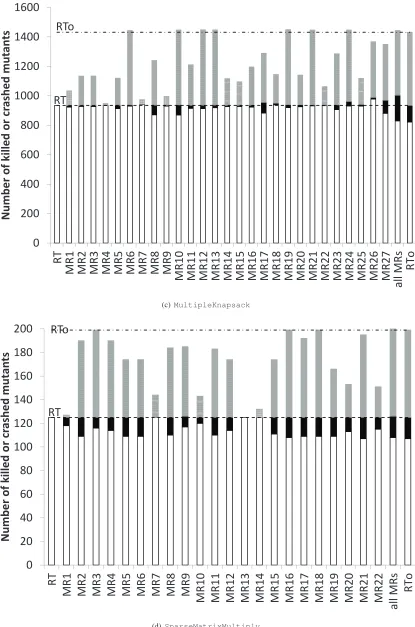
re-lations: Fig. 1 summarizes the fault-detection effectiveness of
individual metamorphic relations compared with RT; with RTo; and with all identified metamorphic relations. In Fig. 1 (also in Fig. 3 and Fig. 4), crashed mutants are displayed as white boxes; crashed and killed mutants are displayed as black boxes on top of white ones; and killed mutants are displayed as grey boxes on top of black ones. As a reminder, since RT referred to random testing without a test oracle, it could only identify crashed mutants, while both RTo and metamorphic testing could kill mutants in addition to crashing.
Because different test cases were used, the numbers of crashed mutants for metamorphic testing were not necessarily equal to those for RT (although they were quite similar): RT used the whole pool of the one thousand randomly generated test cases; while metamorphic testing used part of this random pool as source test cases, and generated new follow-up test cases. As can be observed from Fig. 1, apart from two metamorphic relations (MR13 forSparseMatrixMultiplyand MR10 for
FindKNN), the overwhelming majority of the relations (97 out of 99) both killed and crashed mutants. In other words, it was very likely that metamorphic testing using a single metamorphic relation had a higher fault-detection effectiveness than RT.
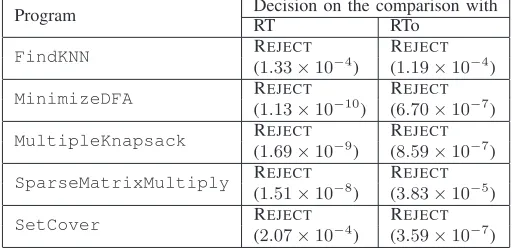
Hypothesis testing was conducted to verify whether this obser-vation was statistically significant. The significance level was set to 0.05, and the null hypotheses (H0) were that each individual metamorphic relation had similar fault-detection effectiveness to RT. When the p-value was smaller than the significance level of
0.05, the null hypothesis was rejected; otherwise, it was accepted. The two-tailed t-tests results are reported in the 2nd column of Table III, in each cell of which, the decision (reject or accept) was given based on the p-value represented by the number in parentheses. It was shown that for each subject program, the null hypothesis was rejected. Based on these t-test results, and the data shown in Fig. 1, it can be concluded that even though the metamorphic relations were identified in an ad hoc way, each one by itself had significantly higher fault-detection effectiveness than RT. In summary, in this instance of the oracle problem, metamorphic relations definitely helped to reveal more faults than RT, which depended entirely on program “crashing” to reveal faults.
The t-tests for the comparison between individual metamor-phic relations and RTo are summarized in the 3rd column of Table III. Obviously, an arbitrary metamorphic relation could not be expected to outperform a test oracle, therefore an investigation was conducted into how well individual metamorphic relations could alleviate the oracle problem. A histogram analysis was used to quantitatively compare the fault-detection capabilities of the individual metamorphic relations and a test oracle. For each subject program, 10 groups of metamorphic relations were defined as follows: Each of the first 9 groups was defined as the group of metamorphic relations that individually has the value of
Moim∈[(i−1)×0.1, i×0.1), where i= 1,2,· · ·,9. The 10th group contains the metamorphic relations that haveMoim≥0.9. Technically speaking, each group (with the exception of Group 10) represents a 10% difference in effectiveness between RT and RTo. The grouping of metamorphic relations is summarized in Table IV, where the number of metamorphic relations in each group for each program is given. For example, the value of “5” in the entry corresponding to Group 7 and the program
MinimizeDFAmeans that there were five metamorphic relations forMinimizeDFA, each of which outperformed RT by 60% to 70% of the difference in effectiveness between RT and RTo.
Based on Table IV, it can be observed that there were 19 metamorphic relations (Group 10,19.19% of all), each of which outperformed RT by at least 90% of the difference in effectiveness between RT and RTo. Since 55.56% ((6+10+8+12+19)/99) of the metamorphic relations are in Groups 6-10, this means that over half of identified metamorphic relations each achieved a fault-detection effectiveness at least half way between that of RT and that of RTo.
2) Fault-detection effectiveness when using all identified
meta-morphic relations: We compared the fault-detection effectiveness
of using all identified metamorphic relations with that of RTo and of RT, as summarized in Table V. It can be observed that the use of all identified metamorphic relations always had much higher fault-detection effectiveness than RT. It can also be observed that when using all identified metamorphic relations, metamorphic testing killed or crashed a similar (or sometimes even larger) number of mutants compared with RTo. For one program (FindKNN), the fault-detection effectiveness when us-ing all identified metamorphic relations was only marginally lower than that of RTo (0.95 < Moim < 1). For another program (SetCover), the use of all identified metamorphic re-lations and RTo had exactly the same fault-detection effectiveness (Moim= 1). For the remaining three programs (MinimizeDFA,
MultipleKnapsack, and SparseMatrixMultiply), the use of all identified metamorphic relations was able to outperform RTo. Note that although RTo had been expected to play the role of an upper bound on performance, it was possible for metamorphic testing in this experiment to detect more faults than RTo because they used different test cases. In summary, the collection of all identified metamorphic relations, even though they were identified in an ad hoc way, can be regarded as an effective imitation for a test oracle.
3) Relationship between fault-detection effectiveness and the number of metamorphic relations used in metamorphic testing:
RT
RTo
0
100
200
300
400
500
600
700
RT
MR1
MR2
MR3
MR4
MR5
MR6
MR7
MR8
MR9
MR10
MR11
MR12
MR13
MR14
MR15
MR16
all
MRs
RTo
Nu
m
b
er
of
killed
or
cr
ashe
d
mut
an
ts
(a)FindKNN
RT
RTo
0
200
400
600
800
1000
1200
1400
1600
RT
MR1
MR2
MR3
MR4
MR5
MR6
MR7
MR8
MR9
MR10
MR11
MR12
MR13
MR14
MR15
MR16
all
MR
s
RT
o
Number
of
kille
d
or
cr
ashed
mut
an
ts
(b)MinimizeDFA
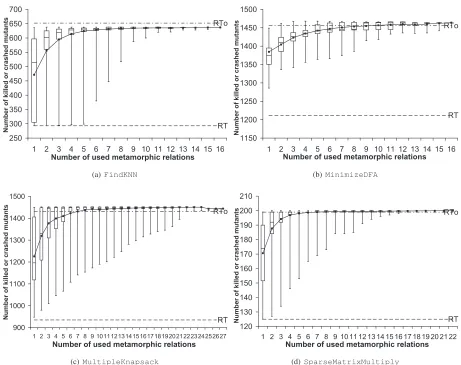
killed or crashed by a given number of metamorphic relations (note that for this given number, there were various possible groups of metamorphic relations). The upper and lower bounds
RT
RTo
0
200
400
600
800
1000
1200
1400
1600
RT
MR
1
MR
2
MR
3
MR
4
MR
5
MR
6
MR
7
MR
8
MR
9
MR
10
MR
11
MR
12
MR
13
MR
14
MR
15
MR
16
MR
17
MR
18
MR
19
MR
20
MR
21
MR
22
MR
23
MR
24
MR
25
MR
26
MR
27
al
l
MRs RT
o
Number
of
killed
or
cr
ash
e
d
mu
ta
n
ts
(c)MultipleKnapsack
RT
RTo
0
20
40
60
80
100
120
140
160
180
200
RT
MR1
MR2
MR3
MR4
MR5
MR6
MR7
MR8
MR9
MR10
MR11
MR12
MR13
MR14
MR15
MR16
MR17
MR18
MR19
MR20
MR21
MR22
all
MRs
RTo
Number
of
killed
or
cr
ashed
mut
an
ts
(d)SparseMatrixMultiply
whiskers denote the maximum and minimum values, respectively, and a square dot denotes the mean number of mutants killed or crashed by a given number of metamorphic relations. For ease of
[image:9.567.87.502.56.683.2]comparison, the fault-detection effectiveness of RTo and RT are given as the horizontal dot lines in Fig. 2.
RT
RTo
0
50
100
150
200
250
RT
MR1
MR2
MR3
MR4
MR5
MR6
MR7
MR8
MR9
MR10
MR11
MR12
MR13
MR14
MR15
MR16
MR17
MR18
all
MRs
RTo
Nu
m
b
er
of
killed
or
cr
ashe
d
mut
an
ts
(e)SetCover
[image:10.567.89.502.58.374.2]crashedmutants crashedandkilledmutants killed mutants
Fig. 1. Relationship between individual metamorphic relations and the number of killed/crashed mutants
TABLE III
T-TESTS FOR COMPARING INDIVIDUAL METAMORPHIC RELATIONS WITHRTANDRTO
Program Decision on the comparison with
RT RTo
FindKNN REJECT REJECT
(1.33×10⁻⁴) (1.19×10⁻⁴)
MinimizeDFA REJECT REJECT
(1.13×10⁻¹⁰) (6.70×10⁻⁷)
MultipleKnapsack REJECT REJECT
(1.69×10⁻⁹) (8.59×10⁻⁷)
SparseMatrixMultiply REJECT REJECT
(1.51×10⁻⁸) (3.83×10⁻⁵)
SetCover R(2EJECT.07×10−4) R(3EJECT.59×10−7)
H0: Each individual metamorphic relation had similar fault-detection effectiveness to RT/RTo.
were used, not only were more mutants killed or crashed, but also the variation between the fault-detection capabilities of various groups of the same number of metamorphic relations decreased. In other words, with an increase in the number of metamorphic relations, the fault-detection effectiveness was not only increased, but also stabilized.
Based on the data in Fig. 2, it is possible to calcu-late the average number (nMR) of metamorphic relations re-quired to outperform RT by at least 90% of the differ-ence in effectiveness between RT and RTo. It was found that for FindKNN, MinimizeDFA, MultipleKnapsack,
SparseMatrixMultiply, and SetCover, nMR was 5
[image:10.567.165.422.440.565.2]TABLE IV
GROUPING OF METAMORPHIC RELATIONS,COMPARING WITHRTANDRTO
Group FindKNN
Total number
Minimize Multiple SparseMatrix Set of metamorphic
DFA Knapsack Multiply Cover relations in
a group
1 5 0 2 3 4 14
2 0 0 2 0 4 6
3 1 0 1 2 2 6
4 1 1 4 2 2 10
5 1 1 4 0 2 8
6 0 4 2 0 0 6
7 0 5 1 4 0 10
8 3 1 2 2 0 8
9 2 3 2 4 1 12
10 3 1 7 5 3 19
Total number
16 16 27 22 18 99
of metamorphic relations for
[image:11.567.86.502.70.279.2]a program
TABLE V
FAULT-DETECTION EFFECTIVENESS FOR ALL METAMORPHIC RELATIONS COMPARED WITHRTO/RT
Program Mmetamorphic relationsoimwhen using all
FindKNN 0.9582
MinimizeDFA 1.0328
MultipleKnapsack 1.0241
SparseMatrixMultiply 1.1757
SetCover 1
extensive experience in testing.
C. RQ2: Capabilities of testers
1) Capability of individual testers: The fault-detection
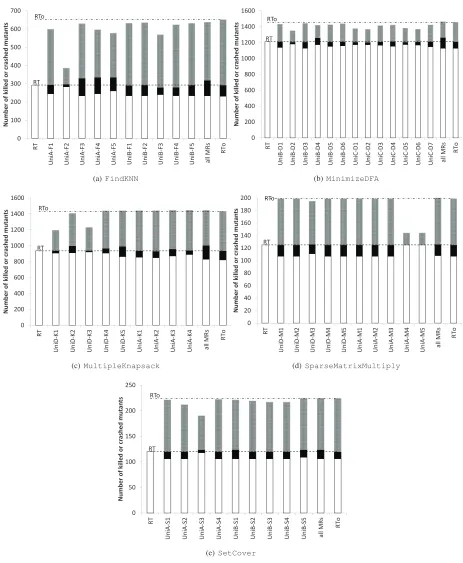
effec-tiveness of metamorphic relations identified by individual testers for each subject program is reported in Fig. 3, which, for ease of comparison, also includes the results for using all metamorphic relations, for RTo, and for RT.
Fig. 3 clearly shows that each tester was able to identify metamorphic relations that were sufficient by themselves to reveal more faults than RT. It can also be observed that the fault-detection effectiveness of the identified metamorphic relations varied from tester to tester. Table VI reports the results of two-tailed t-tests conducted to compare the fault-detection effective-ness of the metamorphic relations identified by each tester with RT and RTo. In the tests, the null hypotheses (H0) were that the group of metamorphic relations identified by an individual tester had similar fault-detection effectiveness to RT/RTo; the significance level was set to0.05.
As can be observed from Table VI and Fig. 3, it is statistically significant that the metamorphic relations identified by a single tester detected more faults than RT. However, we could not obtain a general conclusion whether the metamorphic relations identified by a single tester were as effective as RTo with respect to the num-ber of revealed faults. For two programs (MultipleKnapsack
andSparseMatrixMultiply), there was no statistically sig-nificant difference between the fault-detection effectiveness of RTo and the metamorphic relations identified by a single tester; for the remaining three programs, it was statistically significant
that RTo had higher fault-detection effectiveness than all the metamorphic relations identified by a single tester.
A histogram analysis was again used to quantitatively compare the fault-detection capabilities of the metamorphic relations iden-tified by a single tester and a test oracle (refer to Table IV and related discussion in Section VI-B.1 for details of such a method and the grouping scheme). The grouping of the fault-detection effectiveness of testers is summarized in Table VII, where the number of testers in each group for each subject program is given. For example, the value of “2” in the entry corresponding to Group 9 and the programFindKNNmeans that there were two testers who individually identified a group of metamorphic relations for
[image:11.567.185.404.302.376.2]FindKNNthat outperformed RT by 80% to 90% of the difference in effectiveness between RT and RTo.
Table VII shows that, on average, 58.82% (30/51) of testers identified metamorphic relations that outperformed RT by at least 90% of the difference in effectiveness between RT and RTo (that is, Group 10). 94.12% ((3 + 5 + 2 + 8 + 30)/51, from Groups 6 to 10) of testers were able to identify metamorphic relations that achieved a fault-detection effectiveness half way between that of RT and that of RTo.
RT RTo
250 300 350 400 450 500 550 600 650 700
1 2 3 4 5 6 7 8 9 10 11 12 13 14 15 16
Number of used metamorphic relations
Number of killed or crashed mutants
(a)FindKNN
RT RTo
1150 1200 1250 1300 1350 1400 1450 1500
1 2 3 4 5 6 7 8 9 10 11 12 13 14 15 16
Number of used metamorphic relations
Number of killed or crashed mutants
(b)MinimizeDFA
RT RTo
900 1000 1100 1200 1300 1400 1500
1 2 3 4 5 6 7 8 9 101112131415161718192021222324252627
Number of used metamorphic relations
Number of killed or crashed mutants
(c)MultipleKnapsack
RT RTo
120 130 140 150 160 170 180 190 200 210
1 2 3 4 5 6 7 8 9 10 11 12 13 14 15 16 17 18 19 20 21 22
Number of used metamorphic relations
Number of killed or crashed mutants
(d)SparseMatrixMultiply
RT RTo
100 120 140 160 180 200 220 240
1 2 3 4 5 6 7 8 9 10 11 12 13 14 15 16 17 18
Number of used metamorphic relations
Number of killed or crashed mutants
[image:12.567.63.524.52.417.2](e)SetCover
Fig. 2. Relationship between the number of metamorphic relations used and the number of killed/crashed mutants
metamorphic testing could guarantee that a sufficient number of metamorphic relations were identified to imitate an oracle: A testing team composed of different testers was required, as is discussed in the following.
2) Capability of testing teams: In the experiments, every
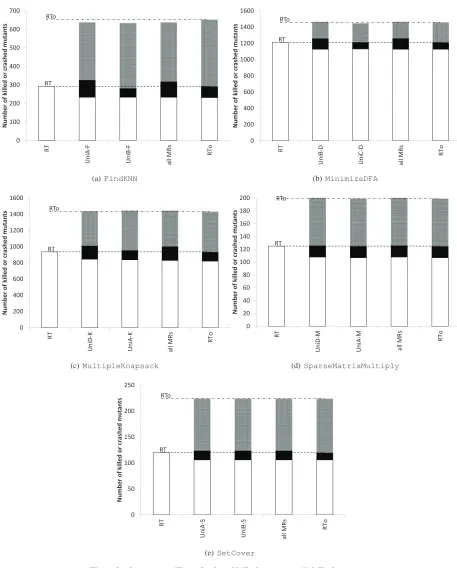
sub-ject program was investigated by two testing teams, each of which consisted of four to seven students from the same university. Fig. 4 reports the fault-detection effectiveness of metamorphic relations with respect to the testing teams, and Table VIII compares this
RT RTo 0 100 200 300 400 500 600 700 RT UniA Ͳ F1 UniA Ͳ F2 UniA Ͳ F3 UniA Ͳ F4 UniA Ͳ F5 UniB Ͳ F1 UniB Ͳ F2 UniB Ͳ F3 UniB Ͳ F4 UniB Ͳ F5 all MRs RTo Number of killed or cr ash e d mu ta n ts (a)FindKNN RT RTo 0 200 400 600 800 1000 1200 1400 1600 RT UniB Ͳ D1 UniB Ͳ D2 UniB Ͳ D3 UniB Ͳ D4 UniB Ͳ D5 UniB Ͳ D6 UniC Ͳ D1 UniC Ͳ D2 UniC Ͳ D3 UniC Ͳ D4 UniC Ͳ D5 UniC Ͳ D6 UniC Ͳ D7 all MR s RT o Number of killed or cr ashed mut ants (b)MinimizeDFA RT RTo 0 200 400 600 800 1000 1200 1400 1600 RT UniD Ͳ K1 UniD Ͳ K2 UniD Ͳ K3 UniD Ͳ K4 UniD Ͳ K5 UniA Ͳ K1 UniA Ͳ K2 UniA Ͳ K3 UniA Ͳ K4 all MR s RT o Number of kille d or cr ashed mut an ts (c)MultipleKnapsack RT RTo 0 20 40 60 80 100 120 140 160 180 200 RT UniD Ͳ M1 UniD Ͳ M2 UniD Ͳ M3 UniD Ͳ M4 UniD Ͳ M5 UniA Ͳ M1 UniA Ͳ M2 UniA Ͳ M3 UniA Ͳ M4 UniA Ͳ M5 all MRs RTo Number of killed or cr ash e d mu ta n ts (d)SparseMatrixMultiply RT RTo 0 50 100 150 200 250 RT UniA Ͳ S1 UniA Ͳ S2 UniA Ͳ S3 UniA Ͳ S4 Un iB Ͳ S1 Un iB Ͳ S2 Un iB Ͳ S3 Un iB Ͳ S4 Un iB Ͳ S5 al l MRs RT o Number of killed or cr ashed mut an ts (e)SetCover
[image:13.567.62.525.48.611.2]crashedmutants crashedandkilledmutants killed mutants
Fig. 3. Relationship between metamorphic relations identified by the same tester and the number of killed/crashed mutants
of inexperienced testers who identified the metamorphic relations in an individual and ad hoc way.
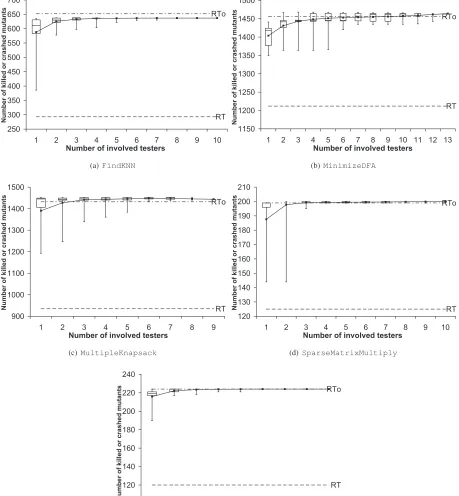
3) Relationship between fault-detection effectiveness and the
number of testers: Fig. 5 reports the fault-detection effectiveness
of metamorphic relations identified by a group of testers. Based on the data in Fig. 5, it is possible to calcu-late the average number of testers (ntr) required to identify
a sufficient number of metamorphic relations to outperform RT by at least 90% of the difference in effectiveness be-tween RT and RTo. It was found that ntr = 2, 3, 1, 2, and 1, forFindKNN,MinimizeDFA,MultipleKnapsack,
TABLE VI
T-TESTS FOR COMPARING THE METAMORPHIC RELATIONS IDENTIFIED BY A SINGLE TESTER WITHRTANDRTO Program Decision on the comparison withRT RTo
FindKNN REJECT REJECT
(5.61×10⁻⁷) (0.0243)
MinimizeDFA REJECT REJECT
(3.86×10⁻¹¹) (5.50×10⁻⁵)
MultipleKnapsack REJECT ACCEPT
(8.87×10⁻⁷) (0.2113)
SparseMatrixMultiply REJECT ACCEPT
(1.50×10⁻⁵) (0.2172)
SetCover REJECT REJECT
(2.97×10⁻⁹) (0.0462)
H0: The group of metamorphic relations identified by the same individual tester had similar fault-detection effectiveness to RT/RTo.
TABLE VII
GROUPING OF TESTERS AS COMPARED WITHRTANDRTO
Group FindKNN Minimize Multiple SparseMatrix Set
Total number
DFA Knapsack Multiply Cover in a groupof testers
1 0 0 0 0 0 0
2 0 0 0 0 0 0
3 1 0 0 2 0 3
4 0 0 0 0 0 0
5 0 0 0 0 0 0
6 0 1 2 0 0 3
7 0 4 0 0 1 5
8 2 0 0 0 0 2
9 2 5 0 0 1 8
10 5 3 7 8 7 30
Total number
10 13 9 10 9 51
of testers for a program
TABLE VIII
FAULT-DETECTION EFFECTIVENESS FOR METAMORPHIC RELATIONS IDENTIFIED BY THE TESTING TEAMS COMPARED WITHRTO/RT
Program Team Moim when using metamorphic relations
identified by a testing team
FindKNN University AUniversity B 00..958295
MinimizeDFA University BUniversity C 10..02879549
MultipleKnapsack University DUniversity A 11..01010262
SparseMatrixMultiply University DUniversity A 11.1757
SetCover University AUniversity B 11
as RTo. In other words, only a small number of testers were sufficient to identify metamorphic relations acting as a test result verification mechanism which was as effective as a test oracle, even though the metamorphic relations were identified in an ad hoc way by inexperienced testers.
D. RQ3: Enhancement of metamorphic testing cost-effectiveness
Further investigations revealed that the groups of metamorphic relations with the smallest number of killed or crashed mutants displayed some degree of “similarity”: These metamorphic rela-tions appeared to be related to the same properties or character-istics of the subject program. These observations motivated the
question of how to enhance the cost-effectiveness of metamorphic testing, and led to the conjecture that relations having more “diver-sity” (less similarity) would be more cost-effective. Intuitively, for the same number of metamorphic relations, more diverse relations could deliver higher fault-detection effectiveness than similar relations; likewise, comparable fault-detection effectiveness could still be achieved using fewer, but more diverse, metamorphic relations. Therefore, diversity in metamorphic relations should enhance the cost-effectiveness of metamorphic testing.
RT RTo 0 100 200 300 400 500 600 700 RT UniA Ͳ F UniB Ͳ F all MRs RT o Nu m b er of killed or cr ashed mut an ts (a)FindKNN RT RTo 0 200 400 600 800 1000 1200 1400 1600 RT Un iB Ͳ D UniC Ͳ D all MR s RT o Number of killed or cr ashed mut an ts (b)MinimizeDFA RT RTo 0 200 400 600 800 1000 1200 1400 1600 RT UniD Ͳ K UniA Ͳ K all MRs RTo Number of killed or cr ashed mut an ts (c)MultipleKnapsack RT RTo 0 20 40 60 80 100 120 140 160 180 200 RT UniD Ͳ M UniA Ͳ M all MRs RTo Nu m b er of killed or cr ashe d mut an ts (d)SparseMatrixMultiply RT RTo 0 50 100 150 200 250 RT UniA Ͳ S UniB Ͳ S all MRs RTo Number of killed or cr ashed mut an ts (e)SetCover
[image:15.567.63.520.48.616.2]crashedmutants crashedandkilledmutants killed mutants
Fig. 4. Relationship between metamorphic relations identified by the same testing team and the number of killed/crashed mutants
experiments based on their own ideas of similarity. As expected, Table IX shows that different assessors had different grouping outcomes, reflecting their different interpretations of similarity.
The effectiveness of an assessor’s grouping was analyzed as follows. Suppose that an assessor had classified all metamorphic relations for the same subject program intoggroups. From these
g groups, m (m = 2,3,· · ·, g) groups were randomly chosen,
and from each of thesemgroups, one and only one metamorphic relation was then randomly selected. Intuitively speaking, such
mselected metamorphic relations exhibit some kind of diversity because they have been selected from different groups of similar metamorphic relations. The fault-detection effectiveness of these
RT RTo
250 300 350 400 450 500 550 600 650 700
1 2 3 4 5 6 7 8 9 10
Number of involved testers
Number of killed or crashed mutants
(a)FindKNN
RT RTo
1150 1200 1250 1300 1350 1400 1450 1500
1 2 3 4 5 6 7 8 9 10 11 12 13
Number of involved testers
Number of killed or crashed mutants
(b)MinimizeDFA
RT RTo
900 1000 1100 1200 1300 1400 1500
1 2 3 4 5 6 7 8 9
Number of involved testers
Number of killed or crashed mutants
(c)MultipleKnapsack
RT RTo
120 130 140 150 160 170 180 190 200 210
1 2 3 4 5 6 7 8 9 10
Number of involved testers
Number of killed or crashed mutants
(d)SparseMatrixMultiply
RT RTo
100 120 140 160 180 200 220 240
1 2 3 4 5 6 7 8 9
Number of involved testers
Number of killed or crashed mutants
[image:16.567.65.524.61.557.2](e)SetCover
Fig. 5. Relationship between the number of testers involved and the number of killed/crashed mutants
reported in Section VI-B.3 and Fig. 2. The comparisons were conducted from two perspectives: the average number of killed or crashed mutants (average effectiveness); and the standard deviation of the number of killed or crashed mutants ( effective-ness reliability). Note that we removed redundant metamorphic relations prior to the random sampling: The random sampling was on a pool of distinct metamorphic relations.
The massive amount of data used to derive the average ef-fectiveness and efef-fectiveness reliability of diverse metamorphic
TABLE IX
GROUPING OF METAMORPHIC RELATIONS ACCORDING TO THE ASSESSOR’S OWN INTUITION OF SIMILARITY
Program
Number of Number of groups classified by metamorphic
Assessor1 Assessor2 Assessor3 Assessor4 relations
FindKNN 16 4 6 10 7
MinimizeDFA 16 4 7 13 9
MultipleKnapsack 27 9 12 17 12
SparseMatrixMultiply 22 6 8 13 10
SetCover 18 7 12 13 8
a similar performance to m randomly sampled metamorphic relations in terms of the average effectiveness (Tables X) and the effectiveness reliability (Tables XI). In each cell of the tables, the number in parentheses represents the p-value, based on which the decision (reject or accept) was made.
Based on the experimental data and the t-test results in Tables X and XI, it can be observed that when considering all programs and all assessors, it was statistically significant that both the average effectiveness and the average effectiveness reliability were enhanced by the use of diverse metamorphic relations. 14 of the 20 different assessor–program scenarios had statistically significant higher fault-detection effectiveness and reliability for
m diverse metamorphic relations than m randomly sampled metamorphic relations. Only in one scenario (Assessor1 for programSparseMatrixMultiply), was there no statistically significant difference for either the average effectiveness or the effectiveness reliability.
With respect to individual subject programs, the t-test results show that the average effectiveness could not be significantly enhanced by more diverse metamorphic relations for two pro-grams (FindKNN and MultipleKnapsack, as shown in the rightmost column of Table X), but more diverse metamorphic relations could result in more statistically reliable fault-detection effectiveness for all five subject programs (as shown in the right-most column of Table XI). Furthermore, although the different as-sessors had different intuitions regarding similarity and diversity, their groupings helped to select diverse metamorphic relations which significantly enhanced both the average effectiveness and the effectiveness reliability (as shown in the bottom rows of Tables X and XI).
VII. THREATS TO VALIDITY
The threats to validity of this study are discussed as follows. The threat to internal validity is mainly related to the implemen-tation of metamorphic testing, and the generation of (pseudo) ran-dom test cases. The programming required was relatively small-scale, and all the source code was carefully reviewed, several times. We are confident that both the metamorphic testing and the random test case generation have been correctly implemented in the experiments.
The major potential threats to external validity relate to the selection of subject programs and the identification of their asso-ciated metamorphic relations. As mentioned in Section V-A, due to the experimental constraints, we selected five subject programs of the algorithmic type, and these programs could neither be too complex, nor require much specific domain knowledge — therefore it might be argued that the findings of this study cannot be generalized to any type of program. Nevertheless, we believe that our results are still very useful for providing guidelines for
the application of metamorphic testing in practice. Metamorphic testing has been successfully used in the testing of different types of programs, such as online ATM [39], telecommuni-cations [8], wireless metering [25], compilers [40], and office applications [21], [42]. In these previous studies, it has been consistently shown that testers with adequate domain knowledge could identify a sufficient number of metamorphic relations. Compared with the subject programs in this study (each of which implemented a single functionality), simpler programs may need even fewer metamorphic relations to effectively alleviate the oracle problem; similarly, more complicated systems, with multiple distinct functionalities, may require more metamorphic relations to effectively imitate a test oracle. Moreover, since each tester identified metamorphic relations in an independent and ad hoc manner, such a process was somewhat subjective. Several invalid metamorphic relations were also generated, and the number of these might vary with application domains. The recruited testers were university students, who had neither prior knowledge of metamorphic testing nor formal experience in software testing. Nevertheless, if these testers could deliver such promising results after a brief training, it is very likely that more professional testers would be able to identify even more diverse and effective metamorphic relations. In our study, four assessors with experience in metamorphic testing were recruited to classify the identified metamorphic relations into similar groups. Although such a grouping process was subjective and dependent on the as-sessors’ individual understanding of similarity, it did significantly improve the effectiveness of metamorphic testing.
The main potential threat to construct validity is in the mea-surements used in this study. Fault-detection effectiveness was evaluated based on the number of killed or crashed mutants, a measurement metric commonly used in experiments using mutation analysis, which has been acknowledged as a popular and fair method for evaluating a testing method’s effectiveness. In addition, we introduced an oracle imitation measure to quan-titatively examine the extent to which metamorphic testing can imitate the fault-detection effectiveness of a test oracle. This measure compares metamorphic testing’s fault-detection with that of random testing with and without an oracle, giving the relative degree to which metamorphic testing approximates the oracle.